Heaven. Z approaches God’s golden throne.
God: “You lived a good life. Ask now of me whatever you may wish to know.”
Z: “Oh great and wise God, why was I forced to learn calculus in this life? It made me suffer so.”
God: “Because calculus is hard, my child.”
Z: “...?”
God: “It is a gift to you and all mankind. Learning calculus has proven you can do hard things.”
Z: “Oh Lord, praise be to you — couldn’t I have learned something hard and useful?”
God: “No. Well, errm, I don’t think so.”
Z: “And Father, couldn’t I have chosen to do something hard of my own volition?
God: “I, uhh, well. That’s enough questioning for now.”
Every generation faces the classic problem of justifying their educational practices. This doesn’t always go well. Previous episodes have given us “you won’t always have a calculator in your pocket”, “cursive helps with spelling”, and “[without corporal punishment], you'll have a 25-year-old living in your basement”. The task has now fallen to us.
Among the most difficult subjects to justify teaching is math. And the final boss of high school math is calculus. Some adults, even some teachers, are convinced that calculus just isn’t useful in real life. So, of course, an alternative justification must be given for teaching it to the kids.
If you’re reading this, you probably know calculus is incredibly valuable for many things (not just for real life). But a defense of calculus isn’t the topic of today’s post. Rather, today’s point of discussion is the latest theodicy for high school math. Alternatively, I could have titled this post “what not to say to your teenager”.
The newest calculus apologist is writer/entrepreneur Nat Eliason. In his blog post, Proof You Can Do Hard Things, he writes:
When a precocious yet nonconformist teenager asks why they need to learn calculus, what should you say? You know they will never use it in adulthood, outside of certain career choices. You could say, “It’ll help you get into college,” but then they’re left wondering why college cares if you know calculus. And once they’re in college, maybe you could say, “To get a good job,” but why would a potential hirer care how you did in multivariate calculus if your job doesn’t require any knowledge of calculus?
But I recently realized there is a very good reason to take Calculus. It’s to prove you can do hard things.
Eliason spends time explaining the value of having proven to yourself that you can do hard things. You’ll be more competent, resilient. You won’t get bothered by the small stuff in life. You’ll be able to try new careers and stay tough through challenging times:
Our self-image is composed of historical evidence of our abilities. The more hard things you push yourself to do, the more competent you will see yourself to be… The proof you can do hard things is one of the most powerful gifts you can give yourself.
Across my social media, people were loving this:
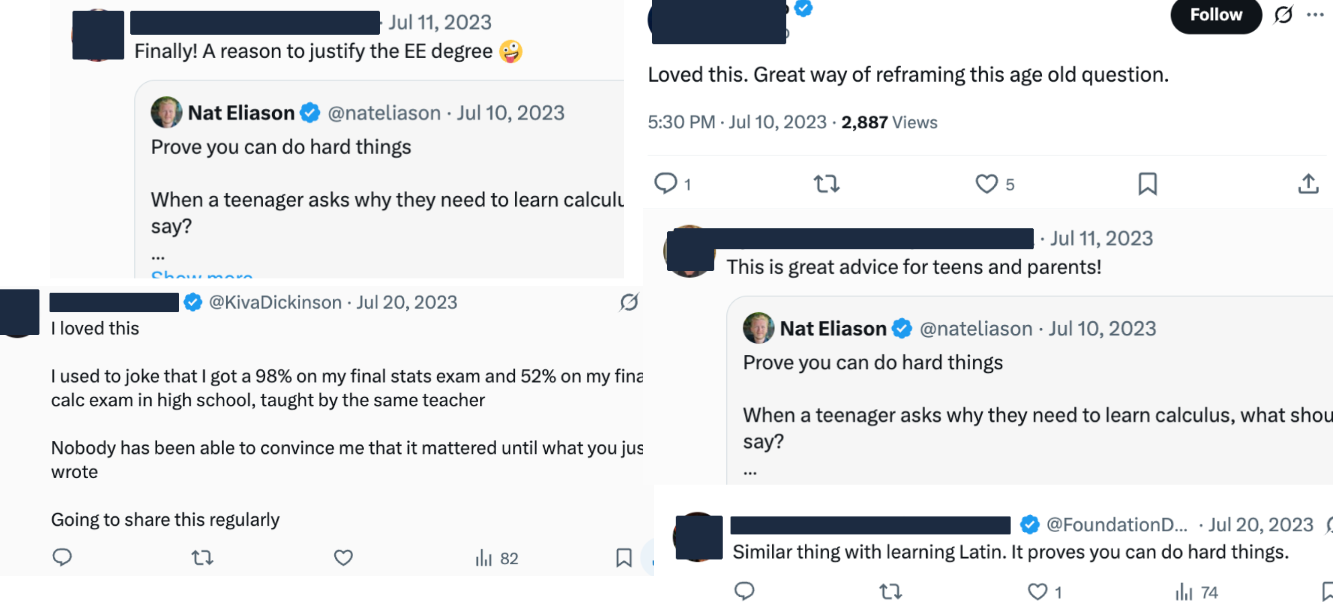
And look, I find it compelling too. There are things I’ve done in my life that I probably would not have attempted, without the belief that I could do hard things. And there are probably difficult things I could be doing right now, if only I had a greater personal history of overcoming hardship.
Eliason is getting at something important; it is genuinely good to have proof you can do hard things. But as I read through the comments online, I found myself thinking but that’s not good justification for pointless activity. In fact, once you pay attention, it approaches non sequitur:
“Dad, why did you make me count the 474,339 blades of grass on the lawn?”
“Son, I’ve given you a gift: proof you can do hard things. You’re welcome.”
By now, we should all know from the internet atheism wars (or the history of philosophy) that this pattern of reasoning just doesn’t work. When posed with the Problem of Evil — how could there be evil in a world created by an all-powerful, all-knowing, and all-loving god? — theists quickly say that some evils are “soul-building”, or evil arises necessarily from God’s gift of free will.
But, the argument goes, if it’s good to have a deeply developed soul, then couldn’t God have just given us deeply developed souls without all the evil and hardship? If the answer to that is, “no, evil and suffering are required for moral soul-development”, then the question just moves back a step: couldn’t God have made it so soul development requires no evil or suffering? If the answer to that is “no”, then it seems like God isn’t so all-powerful after all.
The argument goes similarly for free will. Free will doesn’t logically require the ability to harm other people (just as free will doesn’t logically require the ability to fly). And while we’re at it, what’s with all those hurricanes, earthquakes, tornados, droughts, tsunamis, volcanic eruptions, diseases, viruses, parasites, cancers, genetic disorders… are those evils included with the gift of free will? As internet commenters often put it, these are known as the “God is a complete jerk” theodicies.
The point is that an all-powerful God could have built our soul, or given us free will, without all the other evil stuff. Analogously, we can encourage kids to do hard things without all the pointless painful useless boring stuff.
Learning calculus because it’s hard, unfortunately, is not even a good reason to pick calculus over some other difficult thing, let alone a reason to force kids to take it in high school. “Proof you can do hard things” comes across as bad apologetics. We’ve learned our lesson when it comes to the problem of evil, why haven’t we learned our lesson when it comes to high school math?
Eliason comes close to noticing this in his own essay (emphasis added):
I don’t particularly care what grades my kids get once they start school. But I do care that they consistently prove to themselves they can do hard things. If Calculus is how they want to do it, fine, but there are many, many more options.
Yes! The next step is simply realizing that justifications other than “learn calculus because it’s genuinely valuable” are terrible reasons for forcing students to learn it (or any high school subject). Not only are these theodicies bad justifiers, but they’re totally transparent to teenagers. (A better strategy might be Tyler Cowen’s trick).
Have we already forgotten what it’s like to be a teenager? If my parents or teachers said “You probably won’t use it after high school, but trust me, if you learn calculus, it’ll be proof you can do hard things”, here’s what I think 16-year-old me would hear: “We’ll subject you to hours, days, and weeks of mind-numbing boredom, forcing you to learn something completely useless. We don’t care if you suffer. Do what we command! Us Adults know what’s best for you!”
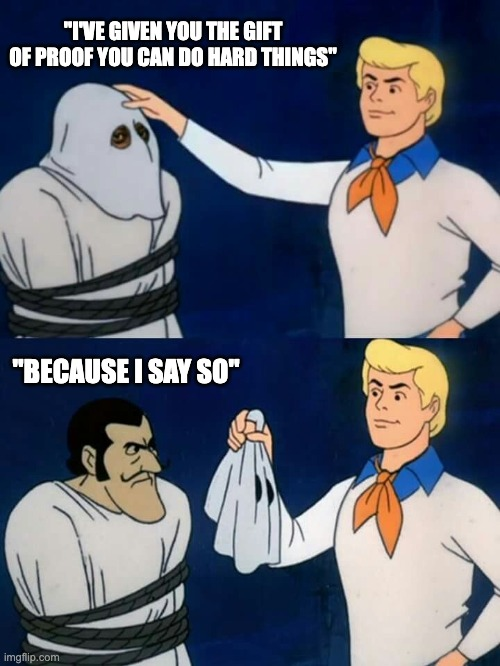
“Why are you making me learn calculus?”
And here’s a sociological observation: a lot of the new atheists (in my experience, angsty /r/atheism types) were former Christians that, having fully grappled with the problem of evil, didn’t just lose their faith in God, but actively turned against it. The sentiment is familiar: even if there was a God, why worship him? He’s a jerk, after all.
If you try pulling some cheap apologetics trick on your kid, there’s a risk they’ll have the same reaction to their parents and teachers as those reactionary atheists had to the Christian God. And kids who see through high school math theodicies grow up and write books titled “The Case Against Education”. You wouldn’t choose a life like that for your child.
Calculus is hard — Eliason is right. But calculus is valuable, too. We should let people choose to do hard things for hard-things-sake of their own accord; not force it on them over 12+ years of compulsory education. If calculus really is genuinely useless, then fine, stop teaching calculus. Teach something else valuable or useful. Maybe that thing will be hard.