A Residence of Twenty-One Years in the Sandwich Islands
1. A New Cause Area
In October 1819, my grandmother’s grandfather’s grandfather, Hiram Bingham I, stood with his wife, Sybil, and his friends outside Park Street Church in Boston and bade farewell to family before venturing into the unknown. They would spend the next five months on a cramped ship sailing to a foreign land of strange people, full of “destitution, degradation, and barbarism.” They did not know if they would ever return to America.
Unlike others who voyaged out to sea, they were not whalers, nor merchants trying to make a quick profit. Instead, their goal was far more ambitious: to uplift an entire nation out of heathenry to civilization. Or as Hiram wrote, to “most effectually and most extensively promote the Redeemer’s cause with the means that are put into our hands”.
I first came across Hiram’s memoir, A Residence of Twenty-One Years in the Sandwich Islands, on my honeymoon to the Hawaiian Islands last summer. I had vague knowledge of a family connection to the area, and decided to do some research into it. As I started reading, I had a growing sense of deja vu as I recognized my own patterns of thinking in Hiram’s words.
Today’s Effective Altruists sincerely want to do the most good possible, and often focus on international development as a means of improving lives. However, there is another group who fits that description equally well: 19th-century missionaries.
Hiram and his colleagues believed that Heaven and Hell were not metaphorical, and that doing the most good meant saving the most souls from eternal torment. And what, they asked themselves, was the most effective means towards accomplishing this goal? Spreading the Gospel to those who had never heard it. All of humanity required salvation, and those who lived in foreign lands mattered just as much as those who lived nearby.
As a missionary destination, the Hawaiian Islands (then known as the Sandwich Islands), had several compelling advantages. First, the islands were very neglected, being recently discovered. While not as important as China, Egypt/Palestine, or India, they still held a sizable population. And unlike those places, there was little competition from other missionaries or pre-existing organized religions, making them much more tractable for conversion. The mission to Hawaii would prove notably cost-effective compared to other missions.[1] Basically all that was needed was a ship, a printing press, and missionaries to teach the Bible.
In other words, if the EA Forum existed in the early 19th century, I could easily imagine a post arguing that bringing the Gospel to the Sandwich Islands is a promising cause area.
So, with the benefit of 200 years of hindsight, what can Effective Altruists and other aspiring do-gooders today learn from the previous wave of people who wanted to save the world?
To find out, I read Hiram’s memoir, A Residence of Twenty-One Years in the Sandwich Islands. Published in 1847, it’s not a particularly engaging book,[2] but as a historical document, it’s a fascinating account of the effort of seven young missionary couples and their Hawaiian friends to do the most good possible by bringing Christianity, literacy, Western civilization, and Puritan social mores to a nation of 130,000 souls.
2. The Twenty-One Year Honeymoon
In many ways, the islands of Hawaii are a paradise on Earth, but to the missionaries who knew them as the Sandwich Islands, they were a savage place. These islanders, after all, had killed Captain Cook just 40 years ago.[3] From 1782 to 1810, the nation was ravaged by war. King Kamehameha I, adopting Western military technology such as gunpowder, forcefully unified the islands into a single kingdom and suppressed potential rivals.
A young boy, Opukaha’ia, was left an orphan by Kamehameha’s warriors, who killed his father, mother, and infant brother. With nothing left for him in Hawaii, he joined the crew of a passing ship, and eventually made his way to New England, where he converted to Christianity and befriended theology students at Yale and Andover. Opukaha’ia described his native Hawaii as a land in need of salvation, and the local ministers decided to send a mission to spread the Gospel and the light of civilization. Opukaha’ia would return to Hawaii with the missionaries and serve as a translator.
Hiram Bingham, a student at Andover Seminary, heard Opukaha’ia’s call to aid the Hawaiians. Born October 30, 1789, Hiram was one of the thirteen children of a Congregational deacon, Calvin Bingham. Although his parents had wanted Hiram to take over the family farm and care for them in old age, Hiram felt his duty to God was greater, and convinced his parents to allow him to study for the ministry. In Hiram’s own words, “Christ undoubtedly requires all his followers to bear their cross, and to forego or forsake whatever comes in competition with rendering him the highest service”. But service to God was not a gloomy undertaking; instead, it was accomplished “with joyful hearts and grateful praise.”
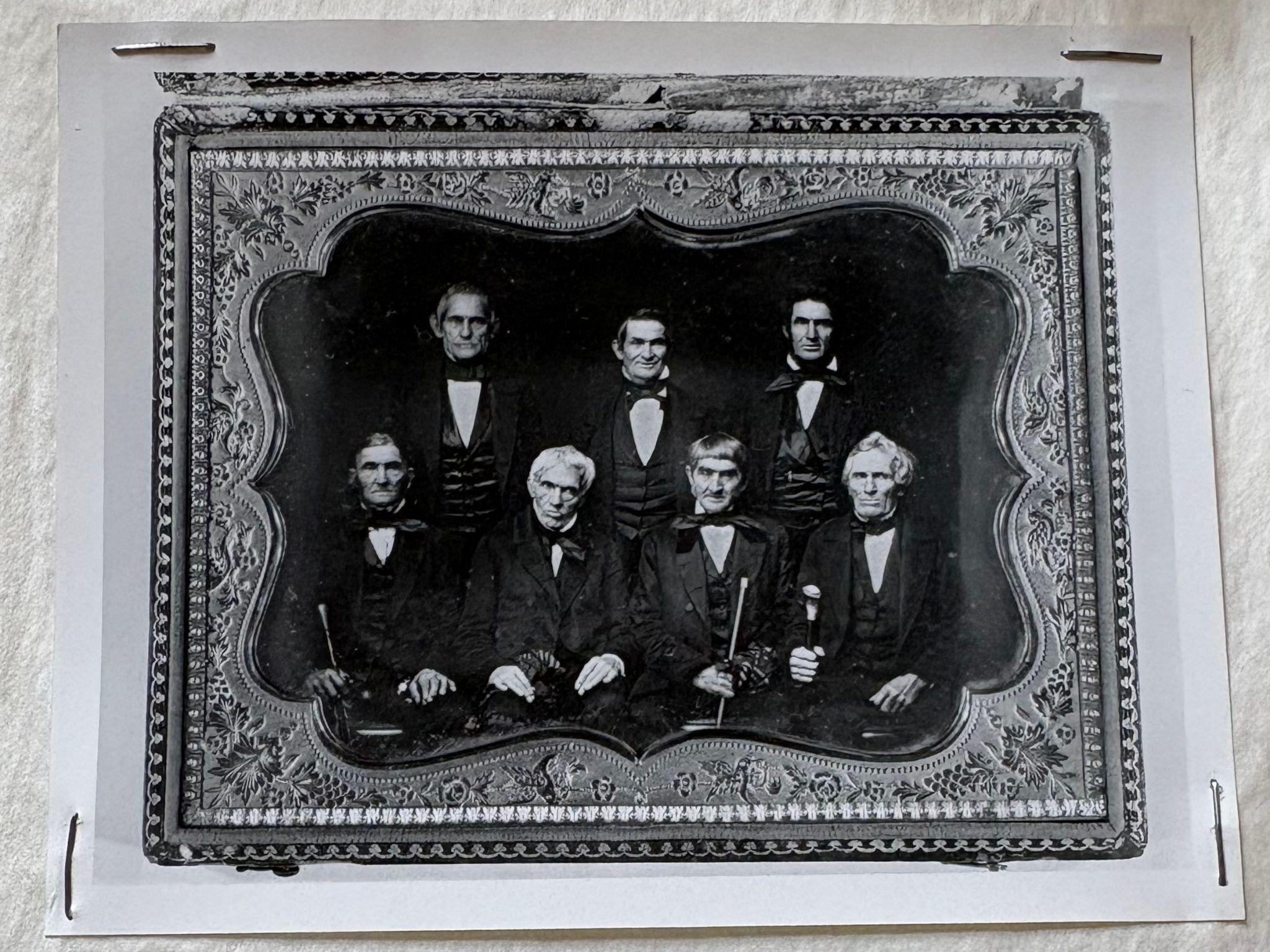
An old family portrait of Hiram and his six brothers taken sometime 1854-1860. Bottom row: Asa, Amos, Calvin, Luther. Top row: Hiram, Stephen, David. Not pictured were his six sisters.
Hiram truly felt the commandment to “love thy neighbor”, and for him, the 130,000 native Hawaiians on the other side of the globe were neighbors just as much as the inhabitants of his hometown in Vermont. Thus, Hiram was eager to become a missionary as soon as he had finished his studies.
Unfortunately, during preparations for the mission, Opukaha’ia fell ill and died.[4] Still, the plan went ahead. As Hiram writes, a good Christian must “extend the influence of the Gospel, because Christ requires it, rather than because of his own engagement. To know, to be qualified, to have opportunity, constitute the special call to do good.” Parents and relatives urged the missionaries not to go, but Hiram saw things differently: somebody had to and no one else would.
There was just one problem: Hiram needed a wife. Sending a young single man to a land of licentious heathens was asking for trouble, and therefore only married couples were allowed to be missionaries. Thus, after being ordained as a Congregational minister, Hiram proposed marriage to Sybil Moseley, a woman he had met at the ordination ceremony just twelve days earlier. Fortunately, she accepted, and later that month, the couple was on a ship bound for Hawaii — not as a two-week honeymoon, but as a mission that would last twenty-one years.
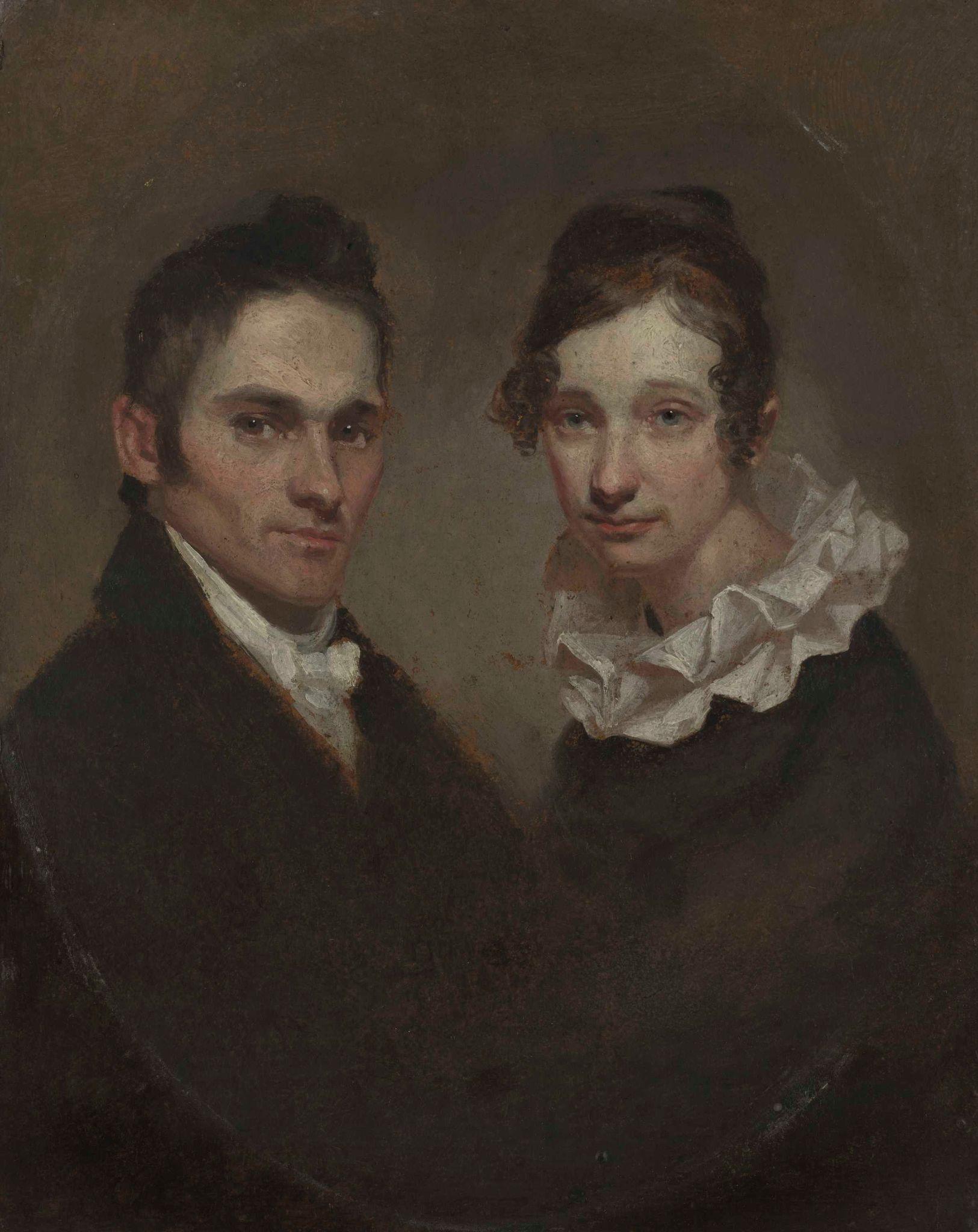
Hiram and Sybil in 1819, as painted by Samuel Morse (yes, that Morse).
3. A Fortuitous Arrival
After a sea voyage of 18,000 miles, during which Hiram and Sybil’s first child was conceived, the missionaries spotted the peak of Mauna Kea on the morning of March 30, 1820. Five months after departure, the sight was exhilarating: the work of spreading Christianity, literacy, and civilization was finally at hand.
There was just one important restriction, put in place by the American missionary board: absolutely no meddling in the politics of the natives.[5]
Upon arriving, the missionaries’ first request was for an audience with King Kamehameha, the fearsome conqueror of the islands. Kamehameha’s authority upheld the kapu (taboo) system,[6] the foundation of the native Hawaiian religion. Converting him to Christianity would be difficult, but crucial for the success of the mission. Kamehameha’s authority was absolute, and anyone who went against it would be exiled or killed. Unless he converted, the mission was doomed to fail.
However, the missionaries were shocked to find Hawaii in a state of political and religious turmoil. Several months before their arrival, Kamehameha had fallen ill and died. His son and heir, Liholiho, was just 21 years old and inexperienced in politics. Queen Ka’ahumanu, who had been Kamehameha’s favorite among his many wives,[7] took control. Officially, she was regent in the king’s name, but in practice she ruled Hawaii.
As a woman, Ka’ahumanu was burdened by the many restrictions of the kapu system. Among other things, many foods (such as coconut) were forbidden to women, and women were not allowed to eat together with men. Soon after becoming regent, Ka’ahumanu allied with Kamehameha’s other widows, including Liholiho’s mother, Queen Keopuolani, to abolish the kapu, which she “felt to be degrading and oppressive” to herself and the other women of Hawaii.
Conveniently, this also removed some of the customary limits on her power as a queen regent, and boosted her popularity. It seemed that all along, nobody had really liked the kapu. Well, almost nobody: there was a brief insurrection of traditionalists, but this was soon crushed. As the kapu system fell, so too did the native Hawaiian religion.
Thus, the missionaries arrived to find their work half done for them. The Hawaiians themselves had discredited and discarded their former religion. But what was to take its place? A missionary’s nightmare of rum and atheism, or “an elevated state of Christian civilization”?
4. Speedrunning Civilization
The intended audience with Kamehameha was impossible, but the missionaries soon met with the Hawaiian royal family, including King Liholiho and Queen Ka’ahumanu. After twelve days of negotiations, during which the missionaries assured the Hawaiians that they were purely benevolent and definitely not looking to meddle in politics or “interfere with the government or trade of the islands”, Ka’ahumanu and Liholiho granted them permission to settle. Half the missionaries, including the expedition co-leader Asa Thurston, would remain on the big island, and the other half (including Hiram) would continue to Honolulu.
From then on, Hiram and his fellow missionaries worked tirelessly to establish “the school, the pulpit, and the press”. The royal family was impressed by their “kindness and demonstration of their ability and readiness to make themselves useful”, and their gifts of a telescope and ornate Bibles.[8] The missionaries were granted a plot of land on which to build a house and a church, and a school was soon added. Although Opukaha’ia had died before the mission departed, the missionaries brought four other native Hawaiians who were able to translate, including Prince George Humehume (the son of Kaumuali’i, chief of Kaua’i), and Hiram quickly learned the language himself.
The native Hawaiians were fascinated by the missionaries’ technology, even for seemingly simple things. Several high-ranking Hawaiian women requested that the missionary wives make American-style dresses for them. In traditional Polynesian culture, obesity is considered a mark of high status, and the missionaries had never seen women that big. Hiram describes one as a “rude giantess”.[9] Some initial attempts at dresses were “too tight” but after alterations, the dresses were well received.
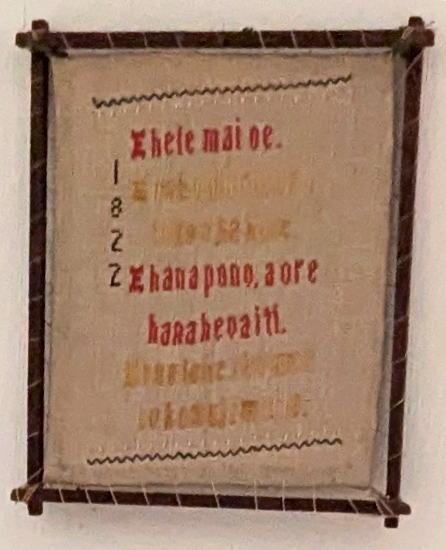
The missionary women taught the native Hawaiians to embroider, and also used this as a means of teaching writing. The textile shown here is preserved at the Hawaiian Mission Houses Historic Site. Although somewhat faded, the text corresponds to the “First Exercise in Reading” from the first Hawaiian spelling book printed by the missionaries.
Besides dress-making and other fabric production, the Hawaiians were intrigued by American-style houses. The missionaries brought pre-cut lumber to build a house, which was much more comfortable than the native grass huts: among other advantages, a chimney let smoke escape instead of filling the entire room. Music, and musical instruments, also delighted the Hawaiians, and Hiram adapted several hymns to the native language.
In addition to improving the physical lives of the Hawaiians, these new technologies were a gateway to what Hiram saw as spiritual improvement. Hiram remarked that initially, native Hawaiians “are not able to appreciate [a missionary's] knowledge of the classics or what is called learning, but they can appreciate the talents of a man who can build a house or make a coat better than they can. By such means a missionary establishes, in their view, his superiority over them. This being done, they will listen to his religious instructions with deference, and feel confidence in him as a teacher.”
But Hiram and his missionaries were not the only Westerners introducing things to the Hawaiians. In 1820, the north Pacific had a large whale population, at a time when the Atlantic whales had declined due to overharvesting. This caused a whaling boom in the region. Many whalers supported the missionaries, but others were a bad influence. They brought rum and spread syphilis and other diseases. Even before Hiram’s visit, some native women were having sex with sailors in exchange for pieces of iron. As Hiram wrote, “That was the dearest bought iron, doubtless, ever bartered for guilty indulgences; and thousands have been the victims of suffering and death, throughout the whole group, as the lamentable consequence of evils thus introduced, and not yet wholly eradicated.”
Alcohol, especially distilled spirits such as rum, were also popular among the Hawaiians. Without any social immunity to alcohol or stigma about drinking, alcoholism was rampant. Foreign merchants repeatedly got the king drunk, then tricked him into making bad trade deals. Most of the sandalwood trees on the islands were cut down to sell the valuable wood. At one point, Hiram intervened when the king was offered a drink: “I gently took the uncorked bottle, and offering it to the earth rather than to his majesty, turned it bottom upwards on the mat.” Although Hiram’s “attempt to thrust aside a deadly weapon” did little to earn the king’s favor, most of the royal women were sympathetic to Hiram’s efforts to keep the king sober.
George Humehume, the Hawaiian prince who had accompanied the missionaries on their journey from Massachusetts back to his native land, also found the temptation of drinking too much to resist. Although Hiram had hoped George would be a key ally due to his high status among Hawaiians, his alcoholism led him to abandon the missionaries. Although Hiram was sad to lose a close friend, he notes that this ended up being a good thing for the mission, because later on, George would become even more disgraceful.
Faced with these difficulties, Hiram almost gave up and moved to Kamchatka in the Russian Far East (what a change of climate!), but heard from the Russians that the native Kamchatkans were all converted already. To Hiram, the Russian Orthodox church was a valid form of Christianity, and “though not in its unobscured glory”, it at least ”engaged in promoting the circulation of the Holy Scriptures”, unlike the “Popes and Jesuits”.
However, the missionaries would soon make an important breakthrough. In December 1821, Queen Ka’ahumanu fell ill with some unnamed disease. The missionaries prayed and cared for her as best they could, and Mrs. Sybil Bingham “sat down by the side of the sick queen, and with unfeigned sympathy for her sufferings and danger, bathed her aching temples, she bound a silken cord around her heart, from which I think she never broke loose while she lived.” Sybil’s compassion won the Queen over to Christianity, and she proved to be an invaluable ally for the missionaries. But King Liholiho, being polygamous, was reluctant to convert, since that would have required him to give up his wives.
Caring for Ka’ahumanu was far from Sybil’s only contribution to the mission. She also ran the school, which “having commenced with ten or a dozen children and adults, now numbered forty regular scholars, attending five or six hours daily”, made garments for the missionaries and any Hawaiians who requested them, led weekly prayer meetings, and managed all aspects of running a respectable household in an unfamiliar climate. Not to mention giving birth to seven children![10]
Meanwhile, Hiram had been hard at work devising a writing system for the Hawaiian language. Others before him had tried, but failed because they didn’t know the language well enough, and wrote things like “Owhyhee” for Hawaii or “Hanaroorah” for Honolulu. If the native Hawaiians remained illiterate, Hiram foresaw a grave danger: Catholicism.
“[they] might indeed have been taught to cross themselves, repeat Pater Nosters and Ave Marias in Latin, to dip the finger in water, gaze on pictures, bow before images, and buy indulgences with great formality and punctuality, and still have been as ignorant of the volume of inspired truth as the Aborigines of California and South America . . . To make the spelling and reading of the language easy to the people, and convenient to all who use it, was a matter of great importance, almost indispensable to our success in raising the nation.”
To standardize the spelling in a way intended to be easy for native speakers, Hiram set a fixed alphabet of twelve letters: “a, e, i, o, u, h, k, l, m, n, p, w”, with an additional set of consonants for foreign words, “b, d, f, g, r, s, t, v, and z”. There were some differences in local dialects: for example, Hiram writes tabu instead of kapu, since k/t and b/p were interchangeable, as well as r/l and v/w. Hiram’s standardized orthography is still in use today.
January 7, 1822 marked a milestone: the first printing press became operational, and began printing books in Hawaiian for the missionary school. The royalty quickly learned the advantage of sending written communication to administer the kingdom, and native Hawaiian newspapers became popular. In a few years, one third of the population attained a basic level of literacy – a higher proportion than many European countries of the time. Most of these were not taught by the missionaries themselves, but by other Hawaiians who showed great enthusiasm for learning (called palapala). Hawaiians wrote poems in their own language “of no inferior order compared with the ancient Greek and Latin odes”. The missionaries would go on to print nearly 150 million pages (over 1000 for each Hawaiian) over the next 23 years.
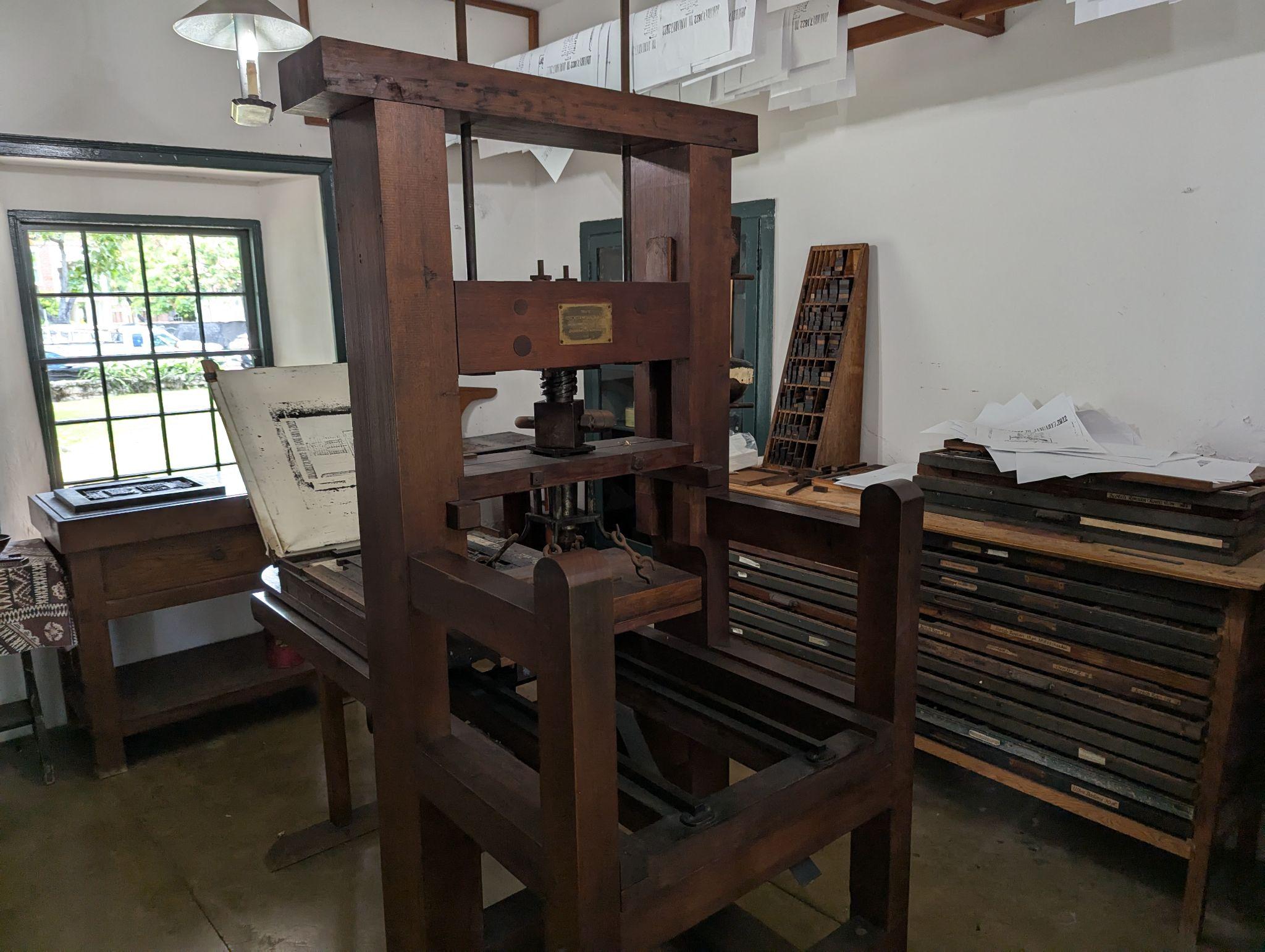
The printing press, as preserved in the Hawaiian Mission Houses Historic Site.
The next year, King Liholiho had become sufficiently curious about Europeans to travel to Europe and see what all the fuss was about. With his favorite wife Kamamalu[11] and his courtiers, including the powerful Chief Boki, governor of O’ahu, he boarded a ship to England to meet King George IV. A few days before their audience, they all fell ill with measles, and Liholiho and Kamamalu both died. Lord George Anson Byron, cousin of the poet Lord George Gordon Byron, was dispatched to bring back the survivors (including Boki) and the royal coffins, reaching Hawaii in 1824. With Liholiho dead, his younger brother Kamehameha III inherited the throne. However, at the time, he was even less experienced in politics than Liholiho, and as a result, Queen Ka’ahumanu’s influence increased to new heights. Only after the queen’s death in 1832 would Kamehameha III truly take power. Like Ka’ahumanu, the new king was also Christian, though less of a reliable ally to Hiram.[12]
Around this time, George Humehume further disgraced himself in the eyes of the missionaries and Hawaiians. In 1824, while Liholiho was absent in England, George’s father, the chief of Kaua’i, died. However, his will excluded George from inheriting the chiefdom. Dissatisfied, George launched a revolt. As Hiram saw it, “to affect superiority over his countrymen, seemed far more to be his object, than to improve and elevate them.” Hiram, sensing trouble, visited George before his rebellion in an attempt to talk him out of it, but “was grieved to observe the incoherency and untrustworthy character of his statements as well as his reckless determination to resist the ruling powers”. Queen Ka’ahumanu and her allies soon put down the revolt. George fled into the mountains, but was captured. In a gesture of mercy, his life was spared, but he was placed under house arrest until his death from influenza a year later at age 28.
Over the next several years, the missionaries continued to make progress. Hiram’s book outlines a long list of accomplishments, summarized year by year: teaching students, conversions and baptisms, establishment of new schools, arrival of more missionaries from America, and translation of new chapters of the bible into Hawaiian. This translation was a daunting task, requiring both effort and creativity: for example, how does one explain the "The Parable of the Sheep and the Goats" in a culture that had seen neither animal? It was finally completed in 1839, shortly before Hiram's departure.
Hiram also had the chance to explore some of the unique environments of Hawaii. A Hawaiian noblewoman, Kapiolani, converted to Christianity and made a journey to the volcano Kilauea to overthrow the worship of the fire goddess Pele. Later, Hiram also visited the crater and walked right up to the lava lake. Standing on a thin crust of rock, he “reached the melted lava with a stick two yards long, and thus did gross violence to Pele's tabu . . . I was, perhaps, too venturesome; but other visitors have been far more so.” Later, one of his geologist friends narrowly escaped incineration.
In 1824, Hiram demonstrated his astronomical knowledge to the natives by predicting a solar eclipse, perhaps foreshadowing the plot of “The Adventures of Tintin: Prisoners of the Sun”.
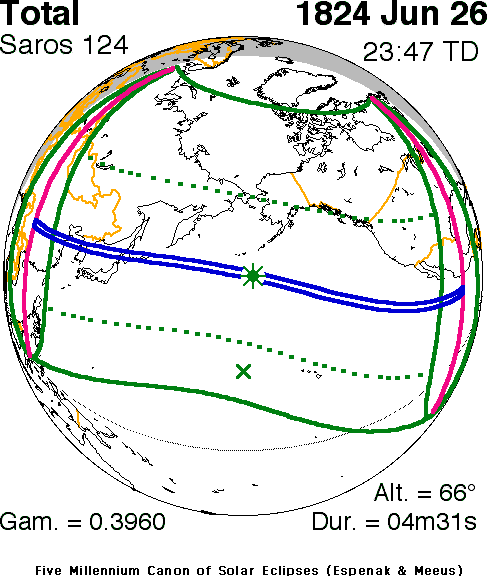
The eclipse path. Viewed from Hawaii, this would have been a partial eclipse (I calculate that 43% of the sun was obscured in Honolulu).
However, instead of claiming supernatural powers, Hiram simply explained that it was the moon passing in front of the sun:
“this phenomenon, which they had been accustomed to regard with superstitious awe and forebodings of evil, I endeavored to explain as the mere passing of the moon between us and the sun, so as to throw a shadow upon us for a time. Some, supposing me to be able perhaps to take the place of their old astrologers, demanded of me the ano, purport of the wonder, or to tell the event indicated by it. But I could not, from that phenomenon, predict either war or peace, famine or plenty, death or prosperity, as their pretending astrologers had been accustomed to do.”
Hiram saw himself as a teacher, not a prophet. In explaining the eclipse as a natural phenomenon, he sought to promote truth over superstition. Civilization itself was his means of evangelism.
5. Things Hiram Didn’t Like:
Hiram wouldn’t have called himself a Puritan, but rather one of “the sons of the Puritans”. Still, he was a Puritan in all but name,[13] and as such, could make “no compromise with the vile pleasures and criminal indulgences of those who love darkness rather than light.” For example:
- Alcohol, especially rum
- Catholicism
- Fornication
- Prostitution
- Hula dancing. It’s too sexy, and Hiram convinced Ka’ahumanu to have it banned.
- Human sacrifices
- Idolatry
- Worship of Catholic saints
- Polygamy
- Royal incest
- Homosexuality[14]
- Infanticide[15]
- Drunkenness
- Idleness
- Gambling
- “Heathen sports.” Except for surfing, which is great, so long as nobody places bets.[16]
- Illiteracy
- “Popery”
- Indulgences
- Covetousness
- “Papists”
- Slavery
- The French
- Sugar cane: people make rum from it
- Tobacco
- Poi: a paste of kalo (taro) root often eaten by Hawaiians, and which “would do well for bookbinder’s work”
- Jesuits
- Swearing
- Lord Byron’s poems: “weapons of rebellion against the Sovereign of the world”
- “Romish Priests”
Oh, and did I mention he didn’t like Catholics?
Political Meddling, Part 1
Hiram really didn’t like Catholics. Even in parts of the book completely unrelated to Catholicism, he goes out of his way to diss the Catholic church. In discussing native Hawaiian idol worship, he compares it to the indulgences sold by Johann Tetzel and denounced by Martin Luther. When discussing the importance of teaching Hawaiians to read so they can understand the Bible, he continually references the fact that Catholics don’t do this. Reading between the lines, Hiram wants to convert the native Hawaiians to save their souls, but thinks the Catholics deserve to burn in hell. I’d say this is a classic example of far-group vs. out-group.
Driven by anti-Catholic bias, Hiram and the other missionaries convinced Queen Ka’ahumanu to ban Catholic missionaries from Hawaii. French priests, in particular, kept trying to sneak into Hawaii despite the ban, and were repeatedly deported. Severe restrictions were placed on Catholic Hawaiians, and those caught with images of saints were jailed for idol worship, even though the idolatry law was written to suppress the native Hawaiian religion, not Catholicism. After the fact, Hiram claimed to never have condoned the jailing of Catholics, and wrote as much in his book, but his role in the matter is clear. His efforts to keep Catholicism out of Hawaii were quite successful — at least initially.
Hiram also allied with the queen-regent Ka’ahumanu and supported her against her political rivals such as Chief Boki, who had tried to push the king towards a policy more tolerant of foreign merchants and Catholic missionaries. Ka’ahumanu, in exchange, helped spread Protestant Christianity, and instituted laws banning practices that Hiram considered immoral, such as cooking food on the Sabbath, or hula dancing. Hiram, in his book, defends himself from accusations that he created a “union of church and state” in Hawaii. But the fact that these accusations were made is telling, and in Hiram’s denial that he had made the Hawaiian government into a church per se, he instead claimed that his goal was for it to be a “religious institution”.
Although Hiram’s political meddling was largely directed against Catholics, he also used his influence to ward off what he saw as unwholesome temptations. When the American ship Dolphin, captained by “Mad Jack” Percival, visited in 1826, its sailors attempted to find local women willing to have sex in exchange for payment, as was typical among Pacific islands. But Ka’ahumanu forbade it, and as a result, the horny seamen started a riot in which Hiram was targeted and nearly killed. Capt. Percival had the sailors responsible for the riot flogged, but is said to have called the missionaries “a set of damned schoolmasters.”
In addition to prostitution, the importation and production of alcohol were also banned, as were many other activities falling under the categories of “Sabbath desecration, intemperance, and licentiousness.” As C.S. Lewis would have put it, Hiram had created “a tyranny sincerely exercised for the good of its victims”.
At first, the Missionary Board overlooked this meddling, since things appeared to be going well. Under Hiram’s guidance, the missionaries and their Hawaiian collaborators had converted most of Hawaii to Protestant Christianity. And with communication between Hawaii and America taking five months each way, it was hard for the Board to know what was really happening.
“The angel of death stands over the land with a drawn sword.”
Meanwhile, Hiram’s flock of native Hawaiians “diminished at a fearful and lamentable rate.” Like so many other places after European contact, Hawaii had been ravaged by disease. Even in 1792, Capt. Vancouver “was painfully struck with the evidences of the great depopulation of the islands which had taken place in half a generation, and with the demonstration of the disastrous consequences of the early intercourse of Cook and his men with the people”. Outbreaks of various diseases, including measles and mumps, caused high mortality among royalty and commoners alike.
In 1833-1836, there was a particularly bad epidemic of consumption (tuberculosis):
“The angel of death stands over the land with a drawn sword. The anger of the Lord has kindled a fire upon the nation which will burn to its entire destruction, unless it be speedily extinguished. With us the present is truly a time of hope and fear. It is also emphatically a time of effort. If the work of destruction is ever arrested here, it must be done soon. According to the present ratio of decrease, it will be but a few years before the pall of death will be spread over the whole land, and these valleys, once full of people, will be solitary. These shores, once teeming with myriads, will either become silent as the house of death, or be peopled with a new race of men.
But we hope better things are in reserve for this people; that these fearful clouds will, ere long, pass away, and the work of destruction cease. But should the consumption determined go through the land in indignation, a remnant will be saved; and we feel more and more that we are to labor for this people as ‘pulling them out of the fire.’”
Against this, the missionaries offered “the only sovereign antidote to this dreadful contagion”. Or in other words, thoughts and prayers. Through his writing, it is clear that Hiram deeply felt the suffering of the Hawaiians, but unfortunately, he could do little to stop it.
Neither were the missionary families completely spared from death. Two of Hiram and Sybil’s seven children died in infancy, including their first son, Levi Parsons Bingham, who in 1823 was interred in the first grave of Kawaiaha‘o cemetery, aged only 16 days. Hiram used the sad occasion as a way to demonstrate a Christian burial.
Political Meddling, Part 2: Hiram’s Comeuppance
For nearly two decades following their arrival in the Sandwich Islands, Hiram and his fellow missionaries worked tirelessly to promote civilization and Protestant Christianity. Building ties with the royal family, they amassed great influence. But of all people, Hiram should have known how “pride goeth before destruction”. It turned out that the Missionary Board’s kapu against political meddling was put in place for good reason, and by violating it, Hiram had brought about his own downfall.
On July 9, 1839, a large ship sailed into Honolulu harbor. It was the French frigate l’Artémise, captained by Cyrille Pierre Théodore Laplace, with 60 guns, nearly 300 men, and orders from the French government to secure the rights of Catholics by any means necessary.
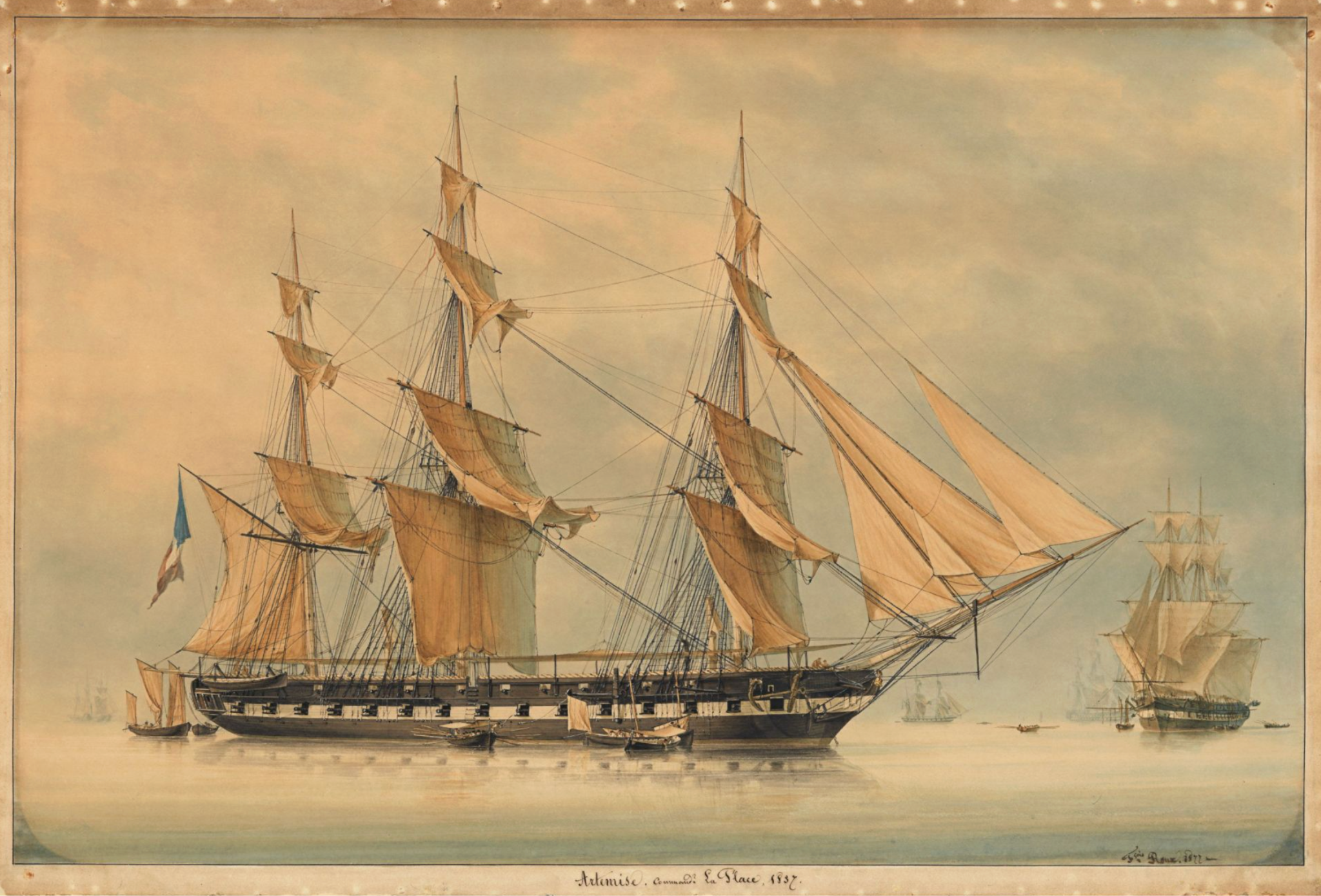
Word had reached France of the persecution of the French priests at the hands of the Hawaiians, and Capt. Laplace was dispatched to set things straight. Upon arriving, he presented a manifesto:
“I shall make the principal chiefs of these islands understand how fatal the conduct which they pursue towards [France] will be to their interests, and perhaps cause disasters to them and to their country, should they be obstinate in their perseverance.
Misled by perfidious counsellors; deceived by the excessive indulgence which the French government has extended towards them for several years, they are, undoubtedly, ignorant how potent it is, and that in the world there is not a power which is capable of preventing it from punishing its enemies; otherwise they would have endeavored to merit its favor, or not to incur its displeasure, as they have done in ill-treating the French … to persecute the Catholic religion, to tarnish it with the name of idolatry, and to expel, under this absurd pretext, the French from this archipelago, was to offer an insult to France and to its sovereign.”
Laplace made several demands:
- Freedom of worship for Catholics, and right of Catholic missionaries to proselytize.
- A grant of land in Honolulu to build a Catholic church.
- Release of all Catholics imprisoned on account of religion.
- A payment of $20,000 (roughly $710,000 in 2026 dollars).
- A treaty of free trade, and a 21-gun salute to the French flag.
But if “the king and principal chiefs of the Sandwich Islands, led on by bad counsellors, refuse to sign the treaty which I present, war will immediately commence”. Clearly, the “bad counsellors” referred to Hiram and his friends.
And in this war, all foreigners would be guaranteed safety, except for Protestant missionaries. In a message to the American consul, Capt. Laplace promised that no Americans would be harmed, except “the individuals who, although born, it is said, in the United States, make a part of the Protestant clergy of the chief of this Archipelago, direct his counsels, influence his conduct, and are the true authors of the insults given by him to France.”
Hiram was outraged, but in the face of French cannon, the Hawaiians had no choice but to give in to Laplace’s ultimatum. The king, not having $20,000 cash on hand, had to borrow it from local merchants at 12.5% interest. After the payment was made, Laplace forced the king to accept additional demands, notably including that any French citizens accused of crimes could only be tried by the French, not in Hawaiian courts, and that all restrictions on the importation of French wine and liquor must be removed. This last term was a personal insult to Hiram, who for so long had worked to keep alcohol out of Hawaii.
Upon learning of the incident, the American Board of Commissioners for Foreign Missions launched an investigation. No longer could they ignore Hiram’s meddling in native politics. Hiram devotes a whole chapter of his book to presenting evidence in an attempt to clear his name: first, that the Catholic priests, unlike the American missionaries, had not secured the permission of the Hawaiian rulers to proselytize, and thus the rulers were justified to deport them; second, that anti-Catholic measures were not anti-French, as some French were Protestants; third, that Laplace’s demands were inconsistent with international law.
In the opinion of the Board, Laplace had indeed made his demands with “no just grounds of complaint.”[17] However, they still felt that Hiram had interfered too much in the Hawaiian government, and was now a political liability. In August 1840, Hiram and Sybil Bingham left Hawaii, reaching New York in February 1841. Officially, Hiram’s departure was to preserve the health of his wife, who had been ill, but another motivation was clear: the Board had finally had enough of Hiram’s political meddling, and no longer supported his leadership of the mission.
Mission Accomplished?
Despite a decisive defeat against Catholicism, Hiram had in fact succeeded at most of the other aims of his mission, including promoting Christianity, literacy, and Western civilization. Shortly before his departure, Hiram witnessed the signing of the Constitution of 1840, a document forming the basis of a constitutional monarchy with Kamehameha III as its head. The king kept most power for himself, but delegated some to an elected council of representatives. For the first time, Hawaii had a written constitution, instead of being governed solely by the custom of the kings.
Upon returning to America, Hiram served as minister to an African-American church in Connecticut. He wrote his book, which in large part was intended to convince the Missionary Board to re-instate him in Hawaii, but the Board declined.
He also visited Washington DC, where he continued to meddle in politics, promoting the cause of Hawaiian independence. John Quincy Adams, who, after serving as President, chaired the House Committee on Foreign Affairs, wrote in a report in 1842:
“By the mild and gentle influence of Christian charity, dispensed by humble missionaries of the Gospel, unarmed with secular power, within the last quarter of a century, the people of this group of islands have been converted from the lowest debasement of idolatry to the blessings of the Christian Gospel, united under one balanced government; rallied to the fold of civilization by a written language and constitution, providing security for the rights of persons, property, and mind, and invested with all the elements of right and power which can entitle them to be acknowledged by their brethren of the human race as a separate and independent community.”
The United States government under President Tyler officially promised to protect the independence of the Kingdom of Hawaii. This promise was soon tested: in 1843, a British naval captain, George Paulet, briefly annexed Hawaii in the name of Queen Victoria, but this was an act exceeding his authority and the captain was recalled after protest from the Hawaiians and Americans.
Hiram spent the rest of his years in Connecticut, serving as minister to an African-American church in New Haven. His son, Hiram Bingham II, continued missionary work in Polynesia, both in Hawaii and the Gilbert Islands. Like his father, he attended Andover Seminary, married immediately after his ordination, and departed with his wife Clara on a ship two weeks later. Their descendants, including the notorious Hiram III,[18] would go on to play important roles in history, but those stories are for another time.
Hiram I died in 1869, glad to have lived to see the end of slavery in America. His obituary, published in 1871, described him as a man devoted to doing good, and unwilling to compromise with sin:
“The history of that first mission to the Islands of the Pacific is but the history of the rise and progress of the Sandwich Islanders from utter barbarism to civilization and Christianity. A marvellous change in fifty years!. . . And with all this work the name of Hiram Bingham is identified. No one was more faithful or efficient than he. He had one ruling purpose which stimulated and sustained him in the darkest hours . . . he was sincere and honest, without pretence, without selfish ends, an enemy to every form and species of wickedness, and fearless in rebuking it; of irreproachable character, loved by the good, and dreaded and hated by the wicked.”
Hawaii after Hiram
When Hiram published his book in 1847, there was reason for optimism about Hawaii. It seemed like the foreign powers of France, Britain, and America had agreed to preserve Hawaii’s independence (or at least, each had determined to not let another power take it over). The native population continued to suffer from disease,[19] but the situation seemed to be mostly stable. The literacy rate was rising, and new technological developments were being introduced. A land reform effort called the Great Mahele was in progress that was intended to redistribute land to native Hawaiians.
However, the next 50 years were not kind to Hawaii. Smallpox, which first arrived in 1853, devastated the native population, which declined below 40,000 by 1896 as a result of this and other diseases. And the political meddling didn’t end when Hiram left. As native Hawaiians died, rich foreigners bought up land and amassed power. The Great Mahele, instead of fulfilling its stated intention of redistributing land to Hawaiians, became easily exploited by American merchants and sugar barons.
In 1887, a group calling itself the “Citizen's Committee of Public Safety”, members of which included Lorrin Thurston (grandson of Hiram’s colleague Asa Thurston), and Sanford Dole (also descended from missionaries, and whose family would go on to start the Dole Pineapple Company), forced King Kalakaua to sign the “Bayonet Constitution”. This heavily restricted the king’s power in favor of the elected parliament, but instituted property requirements to vote that excluded most native Hawaiians, who had formerly enjoyed universal suffrage.
Six years later, Queen Liliʻuokalani attempted to restore the power of the monarchy, but in response the Committee of Safety deposed her in a coup, which led to Hawaii’s annexation by America.[20] In an ironic reversal of Hiram’s journey, the former queen went into exile in Massachusetts.
The overthrow of the monarchy marked a low point in the history of Hawaii, but fortunately, the situation has greatly improved since then. Today, Hawaii is one of the fifty United States, and its residents enjoy a standard of living comparable to other developed countries, with a GDP per capita above the median for US states, and far above other Polynesian islands.[21] The native Hawaiian population has recovered and increased beyond pre-contact levels.[22] Though much cultural heritage has been lost, the state of Hawaii makes an effort to preserve its native language and traditions, instead of suppressing them as heathenry. There are still issues with things like land ownership inequality,[23] homelessness, and environmental degradation, but the Hawaiian Islands have undoubtedly done better than their peers in the Pacific.
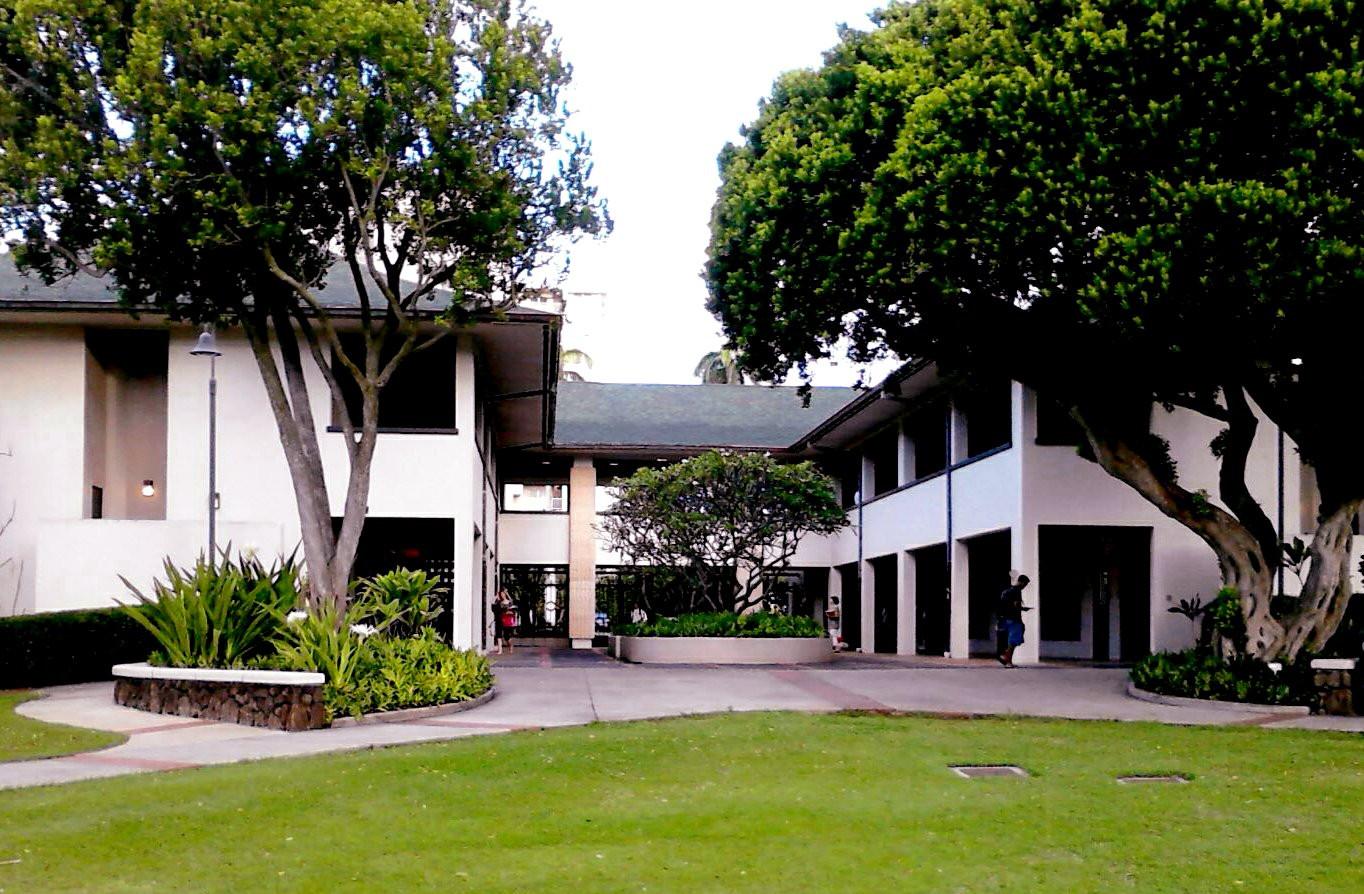
Bingham Hall at Punahou School, which was founded by the missionaries of Hawaii on land granted by Ka’ahumanu to Hiram, and still exists today. President Obama learned math in this building.
What have we learned?
Looking back, it’s easy to judge Hiram. But on his own terms, the mission was largely a success: today, 60% of Hawaiians are Christian, and Protestants outnumber Catholics. Literacy is high, and the Hawaiian language is still written largely according to Hiram’s system. Incest and infanticide are no longer common.
And as I read his story, I was struck by how similar he was to myself today. Not just because he’s my ancestor: our ways of thinking are surprisingly alike. If I were born 200 years earlier, I may well have ended up like Hiram.
Hiram was a man who sincerely believed in doing the most good possible. And he certainly took ideas seriously: the concepts of Heaven and Hell imply that the souls of Hawaiians would spend eternity either in torment or in bliss, depending on whether Hiram was able to convert them to Christianity. Compared to this, everything else was basically irrelevant. Hiram saw himself and the other missionaries as “ambassadors of the King of Heaven, having the most important message to communicate . . . the Gospel of eternal life”. Some of the evils that Hiram preached against – alcoholism, venereal disease, infanticide, domestic abuse, slavery – were real problems, whereas others – ancestor veneration, hula dancing, Catholicism – we would consider today to be no big deal. But to Hiram, they were all barriers to salvation.
And Hiram’s goal to “most effectually and most extensively promote the Redeemer’s cause with the means that are put into our hands” sounds surprisingly similar to Effective Altruism, which asks the question, “How can I do the most good, with the resources available to me?” Even the theme of international aid, or valuing lives in distant countries just as much as close neighbors, is shared. Thus, modern Effective Altruists have a great deal to learn from Hiram. Both his successes and his failures provide valuable lessons:
First, have the confidence that you can make the world a better place. A group of seven young missionary couples, told by their parents and relatives that they were crazy, sailed halfway across the globe and brought writing, education, and Christianity to a nation of 130,000 people.
Second, be an example of the behavior you want to inspire in others. Hiram, his wife Sybil, and his missionary colleagues made special efforts to be role models for the Hawaiians: abstaining from alcohol, observing the Sabbath, and being charitable to neighbors, even when they requested an exceptionally large dress. Their personal conduct inspired the native Hawaiians to collaborate with the mission, which was key to its eventual success. The missionaries alone could not have taught ⅓ of the Hawaiian population to read. Buy-in from the Hawaiians themselves was crucial, and this was only possible because the missionaries were good role models.
The missionaries were also careful to distance themselves from those who didn’t meet their standards. George Humehume, in particular, brought disgrace upon himself through his rebellion, and if the missionaries hadn’t parted ways with him early on, this may have jeopardized the mission. Hiram, quoting another theologian, writes, “A man of only ordinary goodness, who puts himself forward in this work, throws a suspiciousness over the efforts of better men”.
Third, make powerful allies. Targeting the royalty, and in particular Queen Ka’ahumanu, for conversion was key to Hiram’s success. A focused campaign of influence can be much more effective than preaching to the masses, because if you can get leaders on your side, their followers will soon join you. The key is identifying which leaders may be receptive to your message.
Fourth, learn to recognize when your beliefs are mistaken. At one point in the book, Hiram argues with a Catholic and claims that their religion is false because their version of the Ten Commandments is incorrect.[24] He fails, however, to model what the Catholic would think in the situation: that the Protestant version is the incorrect one. Overcoming one’s own bias is a challenging task, but clearer thinking may have prevented Hiram’s greatest failure.
Finally, winning a battle, if it draws in a larger opponent, may lose the war. Even if you have the advantage, sometimes it’s best not to attempt to completely crush your adversary if there’s a chance the conflict may escalate beyond your control. Hiram made this mistake, as did Douglas MacArthur in Korea, and many others throughout history.
In summary: act with courage, exemplify moral character, make friends who can help you, and be sure to critically examine your own beliefs.
And most importantly, don’t piss off the French.
Your message is stored now and emailed to the author after the contest ends. The author can reply to you, but their identity stays hidden unless they choose to respond.
Footnotes
- ↩
The Hawaii mission took only a small fraction of the budget of the American Board of Commissioners for Foreign Missions: approximately 5% according to Hiram. Most of the Board’s funds in its first ten years were spent on “Missions to the East, Bombay, and Ceylon” (50%) and “Missions to the American Aborigines” (25%), although the Board’s funding for the Hawaiian mission increased over time as it became clear the investment was paying off. By the end of 1845, the Board had spent $650,000 in total (equivalent to $28 million in 2026), providing for 1100 person-years of missionary labor. Later in this story, we’ll see an instance where the King of Hawaii had trouble coming up with the cash to make a $20,000 payment: in other words, the Missionary Board was far richer than the Hawaiian government.
- ↩
I was amused to see an obituary for Hiram in 1870 describe his book similarly: “Though diffuse and somewhat cumbrous, it has great historic value, being generally accurate in its statements.”
- ↩
Before his death, Capt. Cook named the islands after his patron, the Earl of Sandwich.
- ↩
This could be the first drink in a morbid drinking game – just make sure the drink is non-alcoholic, because otherwise Hiram would disapprove!
- ↩
The Board was wise. Political meddling had previously backfired for other missionaries, most notably the Jesuits, who ended up getting Christianity banned in Japan.
- ↩
Hiram spells this tabu in his book, and in some dialects of Hawaiian it was pronounced closer to tabu than kapu. For consistency with other sources, I’ll use kapu in this review except when directly quoting Hiram.
- ↩
Favorite does not mean well-treated. Kamehameha often beat his wives for even minor perceived infractions. Hiram, after speaking with Ka’ahumanu and her sister Kalakua (who was also one of Kamehameha’s wives), wrote:
“Kalakua, the late governess of Maui, who gave me much of Kamehameha's domestic history, says of him, "He kanaka pepehi no ia; aole mea e ana ai kona inaina. He was a man of violence, nothing would pacify his wrath." She said she was once beaten by him, with a stone, upon her head, till she bled profusely, when in circumstances demanding his kindest indulgence and care, as a husband. An English resident, who enjoyed his confidence as fully and long as any foreigner, says, he has seen him beat Kaahumanu with a swivel, for the simple offence of speaking of a young man as "handsome.”
- ↩
At the time, the Hawaiians were unable to read, but they liked the decorations on the books.
- ↩
Hiram uses “rude” in its archaic meaning of “unpolished”, not its modern meaning of “offensive”.
- ↩
Hiram and Sybil gave the middle name Ka’ahumanu to one of their daughters, Elizabeth, showing their honor and appreciation for the queen. Several other missionary couples also gave their children Hawaiian names.
- ↩
She also happened to be his half-sister. The native Hawaiians, like the ancient Egyptians, Persians, and Incans, practiced royal incest.
- ↩
Among other things, Kamehameha III reversed Ka’ahumanu’s ban on hula dancing.
- ↩
When introducing the Puritan Spotting checklist, Scott mentions “Hiram Bingham (his son, also named Hiram Bingham, was also a famous traveler)” as an example. Does Hiram the First get any extra credit for starting four generations of Hirams?
In any case, I think his score works out to 28: +1 for being born in New England (Vermont), although probably deserves +2 for spending much of his early life in Massachusetts. +3 for 12 siblings. +3 for father being a deacon. +3 for weird Biblical name and +3 for relatives’ names. +3 for a famous child with the same name. +1 for inventing the Hawaiian writing system. +1 for being anti-Catholic. +3 for founding his own school. +3 for being a social reformer (I think missionary work counts here). +1 for fighting for African-American rights (after returning to the USA), and +3 for prohibiting alcohol.
- ↩
Hiram never mentions gay sex directly, but when a Hawaiian chief called some missionaries “‘Aikane”, or close male friends, Hiram clarifies that this “heathen title” came with “privileges which they did not covet”.
- ↩
“according to the opinion of those who had good opportunity to judge, more than half the children were destroyed during the generation preceding the introduction of Christianity”
- ↩
In fact, Hiram felt unfairly blamed for the decline of surfing among the native Hawaiians.
- ↩
On the other hand, the French government, despite hearing an appeal of missionaries’ claimed grievances, judged that Laplace had acted admirably and awarded him a promotion! Laplace’s side of the story can be read here. However, it should also be noted that around this time, the French pressured Tahiti into becoming a protectorate after a very similar incident involving missionaries, so it’s clear the French had aggressive intentions in Polynesia.
- ↩
Briefly: Hiram III was a Yale archaeology professor and explorer who brought Machu Picchu to the attention of the Western world, and inspired the character of Indiana Jones. He also was elected to the U.S. Senate from Connecticut. As Senator, Hiram III supported restrictions on immigration (especially from Catholic countries of southern and eastern Europe) flew in an autogyro from the Capitol plaza to play golf, and was formally censured for corrupt actions regarding a lobbyist. His son, Hiram IV, was granted a diplomatic position in France largely due to family connections, but ended up defying the visa quotas which his father had supported and thereby saved many Jews from the Holocaust.
- ↩
Hiram estimated there were around 130,000 native Hawaiians when he arrived in 1820, and around 100,000 when he left in 1840.
- ↩
In a case of nominative determinism, the act of annexation was called the Newlands Resolution after its sponsor in the Senate, Francis Newlands.
- ↩
Hiram would be especially proud to see it’s nearly quadruple that of French Polynesia.
- ↩
For example, Larry Ellison owns 98% of the entire island of Lanai, which he bought from the owner of the Dole corporation.
- ↩
The text of the Bible describing the commandments (Exodus 20:1-17) is equivalent, but Catholics consider “Thou shalt have no other gods before Me” and “Thou shalt not make unto thee any graven image” to be one commandment, whereas Protestants (except for Lutherans) split them into two. And Catholics consider “Thou shalt not covet thy neighbour's house, thou shalt not covet thy neighbour's wife” to be two commandments, whereas Protestants consider them to be one.