Tyranny is always and everywhere the same, while freedom is always various. The well and truly enslaved are dependable; we know what they will say and think and do. The free are quirky.
Richard Mitchell
0. Introduction
For most of the history of the Russian language, its speakers and writers have not been free to express their thoughts.
This is the story of what was created in the struggle against this unfreedom.
One of the first books written in Russian is The Life of the Archpriest Avvakum (1672), an autohaigiography—an autobiography of an ecclesiastical leader. Avvakum was an Old Believer priest who led the opposition to the seventeenth-century reforms of the Russian Orthodox Church. The book is written in a down-to-earth and straightforward style and is accessible to even a present-day reader, in a way Shakespeare and Marlowe are accessible to a present-day reader.
Tolstoy called Avvakum “a brilliant stylist.” Dostoyevsky, ever a show-off, held up Avvakum’s Life as an example of that “diverse, rich, multifaceted, and all-encompassing Russian which is unjustly despised, being regarded as crude, coarse language, in which it is improper to express high-society sentiments or high-society ideas.”
But The Life of the Archpriest Avvakum was not published until 1861. Until then, for almost two centuries, it was banned by the Church and its readers were persecuted. Perhaps it is not a surprise that one of the first books written in Russian was also the first samizdat.
This is an example of an ever-recurring story. Ideas expressed in Russian were censored by the Holy Synod, the Senate, the Academy of Sciences, and the tsarist ministries of education and internal affairs. After the Revolution, Glavlit and Goskomizdat made censorship total. The country seemingly took a quick breath of free air in the 1990s, and now Roskomnadzor is back at its old tricks with a shiny new name.
That unrelenting pressure produced what came to be called “Aesopian language,” after Aesop, the ancient Greek fabulist whose animal tales encoded human affairs. I believe calling it a “language” is a misnomer—it more closely resembles a skill, an ability to sneak hidden messages into mundane speech. It is not a language because it has no discernible system. It is also not a code to be cracked, as any code requires a clear key. It is chaotic and opportunistic. It is more of a vibe thing.
Which makes it inherently effective against the government machine that is capable of learning any system but struggles with empathy.
Lev Loseff—an exiled philologist and poet—wrote Aesopian Language in Russian Literature in 1982 as his Ph.D. thesis. It was not published in Russian until 2024, when Alexandra Arkhipova—an exiled anthropologist—edited it, added an extensive foreword and commentary amounting to roughly a third of Loseff’s original text, and brought it into print.
Loseff—born Lev Lifshitz, 1937–2009—also had a personal connection to Aesopian speech, one that may have guided his lifelong study of this unruly subject. In 1964, a Soviet literary journal published twenty poems by James Clifford, a British poet that died during World War II. The translations were by the Soviet poet Vladimir Lifshitz, Loseff’s father.
Readers and critics alike praised Clifford’s brave ballads about war and authority. James Clifford’s most famous poem was "Squares." It made quite an impression: one critic even exclaimed, “You see, in the Soviet Union you can publish anything!”
Here are a few excerpts from “Squares”:
And yet the order of things is surreal.
All of you—those baking loaves,
Spinning threads, smelting steel,—
someone shamelessly ripped you off.
[...]
You riot and shout: "They’re robbers!"
Feeling fooled and betrayed.
And then they send to you talkers
People who know how to persuade.
[...]
But if you choose to persist:
- No, you can't take my will!
They'll quietly emerge from the mist,
People who know how to kill.Tasting the acrid, you'll swallow your woe,
While in your window, like in a dream,
crossing the sky, black squares will show
you the sun's disconsolate gleam.
(Translation by Vanya Bagayev and Oleg.)
Readers were shocked that a long-dead Brit could describe Soviet reality with such precision. The censors allowed the poem through: since its author was British, its rebellious content clearly denounced the evils of capitalism, not the thing you immediately thought of.
In 1974, when Lifshitz was preparing a collection of Clifford’s poems for publication, he wrote a short biographical note about the poet. At the end of that note, Lifshitz added, “Such could be the biography of this English poet that emerged in my imagination and materialized in verse...”
Because there was no James Clifford. Lifshitz has simply published his own poetry under this pseudonym. To speak freely about life in the USSR, Lifshitz disguised himself as a British poet. This story made a deep impression on Loseff, and he made Aesopian a part of his academic research. Aesopian Language in Russian Literature was the result.
As Arkhipova writes in her foreword, “Readers are not used to seeing dissertation manuscripts published for a broad audience. Typically, such manuscripts are dense and crammed with jargon, making the text seem more authoritative while remaining comprehensible only to a narrow circle of experts. Loseff’s book is nothing like that. He writes in a light, engaging style and can explain scholarly concepts in just a few words. If I had to choose a literary genre for Lev Loseff’s book, I would call it an intellectual mystery. As we read, we have to search for hidden meanings in every sentence and decipher innocent children’s rhymes.”
I would add only this: 2024 was the exact right time to publish such a book. 2026 may be the exact right time to read it.
1. History of Aesopian
Like many other secret languages (for example, Cockney rhyming slang), Aesopian was born in the world of crime. It belongs to a broader family of secret or semi-secret professional codes once used in Russia by traveling salesmen, smugglers, beggars, and criminals. These were not full languages but social registers layered over ordinary speech and switched on in specific situations.
The main function of such registers was not merely to hide information from outsiders but also to signal belonging, the linguistic equivalent of tapping the side of one’s nose. This dual use of the special language was quite common around the world. For example, the linguist Bhakti Prasad Mallik, in his study of Bengali criminal slang, asked 400 interviewees why they used it. The most common answer was the expected one: secrecy, at 39.5%. But close behind came another motive: “a love of beautiful speech,” the desire to stand out through verbal style, at 33%.
This desire for “beautiful speech,” for a unique system of signals discernible only to the members of a specific group, helps it to create and maintain an invisible hierarchy within this group. It, in a way, creates an alternative reality, a game of fantasy football. Some scholars argue that such symbolic resistance can help fight, and eventually undermine, an oppressive regime. This is perhaps too optimistic.
Loseff briefly traces the path by which Aesopian moved from obscure professional argots and smugglers’ codes into the center of Russian literature. It became one of Russian culture’s essential literary techniques: a stylistic habit without which Russian literature is almost unimaginable, yet one often lost completely in translation.
The term “Aesopian language,” as we use it in this essay, is often attributed to Mikhail Saltykov-Shchedrin (1826-1889), one of Russia’s greatest satirists. He chose the name out of bitterness: Aesop was a slave who could not speak the truth about his masters directly and had to disguise it in animal fables. Aesopian, consequently, is a “slave’s language” forced on writers by the censors.
What began as a literary technique for smuggling meaning past tsarist censors changed during World War I, when coded writing and speech became practical tools of everyday survival. It was also, of course, routinely used by the revolutionaries. But even then, many saw it not as a crucial tool but as cowardly, servile, alien to “true” literature. Even Lenin attacked it as an example of political unfreedom:
“Cursed be the era of Aesopian rhetoric, literary sycophancy, slave’s language, and ideological serfdom! The proletariat put an end to this abomination, which was suffocating everything that was alive and fresh in Russia.”
Ironically, after the Revolution, the Soviet state’s control over speech became even more total. Aesopian evolved into a new phase. Ideological policing, surveillance, and denunciations by neighbors or colleagues created a climate in which even everyday conversation could be dangerous. In these conditions, Aesopian speech became a crucial part of daily life in telephone calls, private apartments, and dissident circles, where silence, hints, euphemisms, and coded warnings could help people avoid arrest or searches.
Arkhipova gives examples of these codes in action. In 1936, the Kirov NKVD intercepted a letter addressed to Old Believer exiles held in the local prison: “… her health is not very good; she suffers greatly from a head ailment and asks us for Zinaida’s powders, but unfortunately we do not have them and do not know how to help her; we advise her to have surgery or to consult Fastnikov.”
Old Believers, Arkhipova explains, were a religious group that practiced suicide, and this is what they were talking about in the letter. To “have surgery” meant to slit one’s wrists. The other meanings are more obscure and depend on the homophony: “Fastnikov” points to fasting, that is, a hunger strike, and “Zinaida’s powders” are cyanide.
Another example comes from the letter sent by “Ostarbeiters” [Eastern workers]—people who were deported to Germany for forced labor during World War II. Most were between fourteen and twenty-five years old and came from Russian, Ukrainian, and Belarusian towns and villages. Beginning in 1942, Ostarbeiter were allowed limited correspondence with relatives who remained in German-occupied territories. One such letter from the town of Kremenets says:
“I attended a joyful wedding with Ganya, my mother, and my father; but my house was painted red and the roof black, and the same thing happened to my mother’s house; and Nastya wasn’t at the wedding—she was at her own place in the house with Petro—while Ganyiska was at the wedding, but she wasn’t married."
Those, perhaps simple, codes were omnipresent. Another letter says that “the neighboring villages are blooming.” In both cases, the true message is that the villages are on fire. Fire, flowers, and the color red are metaphorically close. Understanding this, we can easily see that the “house painted red” from the letter about Ganya is a house that has been through a fire. “The roof was painted black” means the house burned to the ground. The “joyful wedding” is, of course, a bombing. The full message can be decoded: “Kremenets was heavily bombed; our house burned down; Nastya escaped the bombing, while Ganya was caught in it but survived.”
There are more complex, more literary examples too. In the 1970s, the writer and dissident Yuri Daniel wrote to his friends from a Soviet prison: “I am the slave of the tenacious.” Only a truly educated censor would pause long enough to recognize that this is a distorted phrase from Alexander Pushkin’s Eugene Onegin. But a well-read recipient was expected to recognize the wording as a quotation and continue it in their head:
He was the slave of a tenacious,
a restless urge for change of place
(an attribute that's quite vexatious,
though some support it with good grace).
(from the translation by Charles H. Johnston)
“An urge for change of place” hinted that the prisoner was being transferred, information routinely censored in prisoners” letters.
The second evolutionary step occurred in the late Soviet period. Aesopian language was no longer just a means of concealment but also a way to keep one’s distance from official discourse. Mocking nicknames for Soviet institutions did not merely hide meaningful information from censors; they let speakers refuse the regime’s vocabulary, recognize one another, and create a small zone of symbolic freedom in lieu of the real one.
An unexpected result from this everyday doublespeak was that Aesopian seeped into literature. Indirect speech may become more suggestive, emotionally charged, and persuasive than straightforward statements because the reader is forced to take part in extracting meaning. Loseff quotes Joseph Brodsky:
“…the apparatus of pressure, censorship, and suppression turns out—paradoxically—to be beneficial to literature. The fact is that the linguistic norms established by the state transform the entire population into a reading public. [...] A person who, under normal circumstances, would speak in normal Aesopian language speaks in Aesopian language to the third degree. This is remarkable, and for this we must thank censorship.”
Like many other secret languages, Aesopian became an effective “weapon of the weak”: not direct protest but indirect, ironic, nonviolent resistance that built solidarity among people who could not openly confront power. Covert jokes, nicknames, or subtle signs of recognition, all helped speakers to step outside official culture, make oppressive institutions seem less frightening, and recognize others who shared their stance. In that sense, its deepest function was not merely concealment but self-preservation and self-therapy through shared hidden meaning.
A popular Soviet joke illustrates this perfectly.
A phone call:
— Could you please get Abramovich?
— He’s not here.
— Is he at work?
— No.
— Is he on a business trip?
— No.
— Is he on vacation?
— No.
— Did I understand you correctly?
— Yes.
The joke never specifies what happened to Abramovich. That omission is the joke. If the joke were told in the 1950s, Abramovich might have been arrested in connection with the “Doctors’ Plot,” the antisemitic campaign against Jewish doctors falsely accused of conspiring to murder Soviet leaders. In the 1970s, Abramovich might have applied to OVIR, the Soviet emigration office, for permission to leave for Israel; after that, any contact with him could become dangerous. But it doesn’t really matter. The joke is not “Abramovich is actually somewhere else.” The joke is, “The phone is being tapped, and we both know it.”
One can imagine a similar joke in today’s United States with “Abramovich” replaced by “Miguel.”
The historical context will provide the rest.
2. Theory of Aesopian
How does one find structure in something that, by design, defies structure? Loseff proposes a fairly general approach and then illustrates it with dozens of examples, highlighting the variability of Aesopian methods and tricks.
For Loseff, an Aesopian communication always takes place between three parties. The first is the author, who must convey a message without being punished for it. The second is the intended reader, who is waiting for the message and ready to look for it between the lines. The third is the unwanted reader, the all-seeing censor. The author is always torn between the reader and the censor, and so must use two techniques at once.
First, the author creates a “screen.” The “screen” blocks the view, distracts the censor’s attention, and creates a message that appears innocent but is essentially false. The screen must be smooth and, under no circumstances, catch the vigilant censor’s eye.
But the intended reader is also there, waiting for a sign that the text must be worked on. Loseff calls such a sign a “marker.” For Loseff, “a marker is something that allows what is said to be rendered in the Aesopian mood.”
Usually, the marker appears in details that seem insignificant at first glance but catches our attention because something about them is slightly off. Loseff calls it a “microscopic irregularity.' Ideally, the censor sees only the screen, while the reader sees both the marker and the screen. An attentive reader may even take pleasure in how skillfully they have found the markers and bypassed the screen. Somewhat paradoxically, the arms race with censors cultivates a more discerning reader, deepens their engagement with the text, and encourages them to reflect on every written word.
The best way to demonstrate it is through an example. Arkhipova discusses “The Northern Spring” by Ilya Ehrenburg, one of the most prominent Soviet writers and poets of his time. Let me give you a chance to put yourself in the shoes of the “reader”—or the “censor,” if you’re into that. Try to guess where the markers are and what is concealed by the screen. In other words, what is this poem actually about?
Read it “as is” first, and then I will add context.
“The Northern Spring”
Can ever children of the tropics,
Where in December roses bloom,
Where in thesauruses the topic
Of blizzard isn't granted room,Can, in the lands, where skies are azure
And forecasts cannot go awry,
Where summer never stops to pleasure
The body and amuse the eye,Can ever they, let for an instant,
In dreams, if even indistinct,
Let inadvertently, by instinct,
Grasp what it means to think of spring,What means, in March, when almost freezes
The air, and terror holds its grip,
To hope, for almost no reason,
For river ice to start its trip.And we've such vintage winters known,
Such sorts of cold had to abide,
That there remained nor grief nor groan,
But only poverty and pride.And bitter little human beings
Blindfolded by the snow sting,
We could foresee, while hardly seeing,
That overwhelming green of spring.
(Translation by Alexander Givental and Elysee Wilson-Egolf.)
Some helpful context: the very term “the Thaw” comes from Ehrenburg’s work and came to designate the period in the 1950s and 1960s when repression and censorship relaxed under Khrushchev’s de-Stalinization policies. This poem was written in 1958, five years after Stalin’s death.
Let’s start with the markers. The first and the main one is in these two lines: “[...], in March, when almost freezes / The air, and terror holds its grip.” This is only a tiny bit weird: February and often January are colder than March, so why mention March?
The word 'March,' especially in conjunction with the word 'terror,' is crucial here. In January 1953, several Kremlin doctors were arrested and accused of plotting, on behalf of Israeli and British intelligence, to assassinate members of the Politburo. The case became known as the “Doctors’ Plot.” Over the next several months, Jews were fired, expelled, and arrested all over the country. In late February and early March 1953, monstrous rumors circulated that the “Jewish killer doctors” would be hanged in Red Square.
As a Jewish writer, Ilya Ehrenburg fiercely opposed the “Doctors’ Plot.” In fact, as one of the Soviet Union’s most prominent writers, he wrote a personal letter to Stalin, trying to dissuade him from continuing the campaign of repression. The letter failed, and Ehrenburg expected to be arrested at any moment.
Stalin died on March 5, 1953. Soon afterward, the new Soviet leadership dropped the case due to a lack of evidence.
Read the poem again with this in mind. It should now be very clear who the “we, the bitter little human beings” in this poem are and what does it mean “For river ice to start its trip.” Even the “children of the tropics” now have an interpretation: Jews living in Israel, who may not know the full extent of the terror in the USSR. They are not, however, the poem’s intended readers.
The basis for the Aesopian strategy, according to Loseff, is the fact that any information channel intrinsically contains noise. We know it instinctively. When we read a book or, for that matter, a personal letter, we subconsciously assume a certain amount of noise: a strange turn of phrase, a word or two out of place, a typo. We can attribute that noise to one of two sources:
-
The author is not skilled enough to edit the noise out: “This poem is just poorly written.”
-
We are not skilled enough to parse this noise: “The author must mean something else, but what?”
The principle of Aesopian writing is to encode the message so that the censor dismisses the noise as bad writing, while the intended reader treats it as a marker and reads more closely. The true skill of an Aesopian author is to balance these two.
Of course, unless the author, in a later opportunity, admits to coding their message, we can never know for certain. This is not, strictly speaking, falsifiable. It rests on the subjective emotional reading of the text, on the historical context, on a complex system of inside jokes and signals that may or may not exist between the author and intended readers.
None of these Aesopian readings may be true at all. March may be just used in the poem to fit into the meter. The “trip of the river’s ice” may only mean the thaw, not the Thaw, and certainly not Stalin’s death.
This ambivalence is the core of every Aesopian text.
3. Tools of Aesopian
In the later chapters of the book, Loseff classifies, with thorough examples, the artistic devices commonly used by Aesopian authors. The obvious starting point is satire, which reaches back to Aesop himself. Loseff cautions that satire can be, and often is, Aesopian. But there is no necessary connection between Aesopian writing and humor.
More broadly, at the heart of almost any Aesopian literary techniques lies metonymy—one thing standing in for another. Loseff groups these metonymies into three major categories: genre and narrative substitutions, substitutions of addressee, and linguistic substitutions. Let me try to arrange these in a single table.

A skilled Aesopian author combines several of these into their text: a tale for children depicting anthropomorphic animals can easily be carrying an additional hidden message for the children’s parents.
Loseff gives detailed commentary and examples for most devices described above. For the sake of relative brevity, I will focus on only a few of them. One of them, especially close to my heart, is Korney Chukovsky’s poem “Cock the Roach” (1923). I cannot count how many times I heard this poem as a child. The same was probably true for most Soviet children, it is an extremely famous poem—think The Cat in a Hat. It is too long to quote in full here, so I will summarize the gaps between the most telling passages.
It goes something like this.
The animals are all enjoying themselves in a cheerful absurdist parade: “Wolves were mounted on a horse / Lions drove in cars, of course. / Hares in pairs / Crammed in a tram…” Then, the trouble starts:
Suddenly a Titan
Crawls beneath the gate—
Whiskers meant to frighten,
Very stiff and straight.
Cock-the-Roach
Cock-the-Roach,
Cock-the-Roach the Great!!
The Cockroach terrifies the animals and brings them completely under his rule:
Creatures rock and sway,
Fainting right away.
Such a dreadful flight!
Wolves eat wolves on sight.
[...]
But when they see those whiskers wave,
Oh, dear me!
Not a single beast is brave.
Oh, dear me!
[...]
Cock-the-Roach was named the Victor Great and Grand,
King of Field and Forest, Lord of All the Land.
Ginger-Whiskers ruled—life was at its worst,
Birds and beasts were fooled. (May his name be cursed!)
(All the lines above are taken from the translation by Tom Botting.)
In the end, though, a tiny sparrow flies by, sees the Cockroach, and eats him up, so that “not even the whiskers remain.”
Of course, it’s about Stalin!
His mustache was one of his defining features and a common shorthand for him. Compare it with Osip Mandelstam’s “His cockroachy mustache guffaws, / And the rims of his leather boots gloss.” (1933). But Chukovsky’s “Cock the Roach” was published, while Mandelstam was persecuted, and ultimately died for lines like these.
“Cock the Roach” uses a whole range of Aesopian devices: it is addressed to children, populated by anthropomorphic animals, and full of parody, non sequiturs, and reductio ad absurdum.
Another example is “Hide and Seek in the Dusk” (1973), a little poem by the lesser-known Soviet poet Andrey Georgievich Ivanov. It was written during the so-called Era of Stagnation, which followed the Thaw. The poem is a little creepy until you parse its Aesopian meaning, and then it’s plenty creepy.
Hide and Seek in the Dusk
When evening poured its honey light
Across the garden, warm and bright,
The children cried, “Now count to ten!”
And vanished in the dusk again.Blue-eyed kids slipped behind the sky,
Where sleepy clouds went drifting by.
Green-eyed ones nestled under trees,
As soft as secrets held by bees;Brown-eyed ones crouched by bark and loam,
Like acorns finding autumn home;
They curled beside the garden stones,
As still as earth, as hushed as bones.Then came the seekers, bright and gay,
With lantern looks and eyes of hay;
They searched the hedge, they swept the ground,
They chased each whisper, leaf, and sound.They peered beneath the lilac petals,
They shook the shadows from the nettles;
They asked the moon, they tapped the tree,
“Now tell us where those hiders be!”They found some deep in the night,
Behind a leaf, beneath a light;
But even hay-eyed seekers clever
Could not find everyone, however.
(Translation by Igor Condratievich Efimov and Nina Semenovna Aleksandrova.)
Here, the “children with eyes of hay” idea is a little obscure, but the reader is supposed to know a saying by Felix Dzerzhinsky: “A true CheKa [secret service] officer must have a cold head, bright eyes, and a fiery heart.” The poem is therefore about the constant searches for traitors and dissidents, common during Brezhnev’s rule. Here again, the devices are familiar: allegory, the substitution of children for adults as addressees, and a harmless game masking a story about surveillance and repression.
Yet another notable example is Boris Pasternak’s translation of Macbeth. Loseff quotes here the analysis of A. K. France. Pasternak, one of the most famous Soviet poets and writers, was persecuted by the state and made much of his living translating Shakespeare and dozens of other authors into Russian. In some of these translations, a careful reader might find the translator’s own feelings about his country.
Macbeth is especially suitable for this. For instance, in Act IV, Scene 3, lines 164–73, Ross says:
Alas, poor country!
Almost afraid to know itself. It cannot
Be call’d our mother, but our grave; where nothing,
But who knows nothing, is once seen to smile;
Where sighs, and groans, and shrieks that rent the air
Are made, not mark’d; where violent sorrow seems
A modern ecstasy: the dead man’s knell
Is there scarce ask’d for who; and good men’s lives
Expire before the flowers in their caps.
Dying or ere they sicken.
This was already close enough to Pasternak’s reality. To strengthen this effect, he renders the passage subdued and less flowery, in contrast with the surrounding text. Where Shakespeare’s Ross says that Scotland is a place “where sighs, and groans, and shrieks that rent the air / Are made, not mark’d,” Pasternak’s Ross says simply, “We've gotten used to tears; we don't even notice them anymore.” Where Shakespeare continues, “where violent sorrow seems / A modern ecstasy,” Pasternak plainly states: “They regard the frequent storms / As mere everyday occurrences.”
This shift from Shakespearean elevation to something almost modern is a very subtle hint that something is amiss, but this is exactly the zone where Aesopian lives. What Loseff calls a “microscopic irregularity.”
4. Relevance of Aesopian
In 2020–2021, Minsk, the capital of Belarus, erupted in mass unrest. The country was flooded by protests against President Alexander Lukashenko. With support from Russian security services and private military contractors, the protests were eventually crushed; tens of thousands were arrested. Public references to the protests and their symbols were subsequently restricted or criminalized.
According to one witness, a Minsk resident hung a large sheet of paper in his window with the words “Denikin – Budyonny – Kolchak.” Another Minsk resident displayed a similar sequence on his window: “Chardonnay – Merlot – Riesling.”
The messages seem meaningless unless you know that Denikin and Kolchak were White generals in the Russian Civil War, while Budyonny was a Red general. Similarly, Chardonnay and Riesling are white wines, and Merlot is red.
The meaning may still elude you unless you remember that white-red-white is the color sequence of the historic Belarusian flag, one of the central symbols of the protests.
Aesopian is still alive and well in the 2020s.
In her foreword, as well as in articles and lectures, Arkhipova gives many more examples of such coded messages, with one necessary caveat: she discusses only those that have already been “decoded” and entered public knowledge, which means they have also entered the government’s knowledge.
Aesopian is now used not only to conceal a message but even more so to distance oneself from official language and the institutions behind it. In the past, “Sovetskaya vlast” [Soviet state] was homonymically referred to as “Sofya Vlasyevna.” It may have started as a code, but once it became widely known, people kept using it because it marked distance from the state and its vocabulary.
People today do exactly the same thing, drawing a line between themselves and the state. Only now they say “Anna Petrovna” or “Anna Pavlovna,” referring to the “Administratsiya Prezidenta” [Presidential Administration].
Here is a more macabre example. Since 2022, a specific toast has become commonplace: “I drink to a scarf and a snuffbox!” Outside of context, it is meaningless, but those who say it know Russian history. The Russian emperor Paul I was killed in his bedroom by palace conspirators. According to eyewitness accounts, he was first struck in the temple with a heavy golden snuffbox and then strangled with his own scarf.
Among the more prominent examples are multiple instances of people holding up signs with three and five stars, or writing “35” on the pavement, or displaying a photo of a 3-star cognac bottle and a 5-star cognac bottle. Activists in one riverside town erected 35 crosses, each bearing a small QR code that links to a page with information about soldiers killed in Ukraine. The numbers 3 and 5, or “*** *****,” are decoded into “net voyne” [no to war].
Another example, especially common among younger users, is posting the word “KVAS” on social media. Kvas is a common Russian non-alcoholic drink, but if you shift one letter forward in the Cyrillic alphabet, you get LGBT, the very mention of which is now prohibited in modern Russia.
This demonstrative function is especially developed on social media, a space that did not exist in Soviet times. Here, the goal is not so much concealment as revelation. The old protective function has not disappeared, but it has evolved once again: its essence now lies in “openly,” but not openly, stating a position. In ten or twenty years, we will probably recognize examples of modern Aesopian in literature as well, from major works to minor ones. Right now exposing them would mean endangering their authors.
Even in a world of uncontained communication, Aesopian still has its place. It has simply adapted to a new purpose. But if—or when—our communication becomes more restricted, its older uses may still come in handy: to find like-minded people in secret, to stay sane amid the madness, and even to sneak bits of important information past state censorship, that ever-watchful basilisk.
5. Reality of Aesopian
If you’ve read this far, a question may now be bothering you, one of those pesky little thoughts that make us notice anachronistic details in historical movies and break the suspension of disbelief. I’ve hinted at this question before. Now it’s time to tackle it head-on.
How do we actually know any of this is real?
Well, the secret messages in the letters and even on social media probably were. They are too weird and too transparent to think otherwise. In Loseff’s terms, the markers may simply have been too obvious—which is also why so many such messages ended up in the archives of the security services. Many are also confirmed by the authors in diaries, memoirs, and post-Soviet interviews.
But the literary stuff? Aesopian is a system with no necessary formal criteria. No falsifiability. There are no ways to prove that the “whiskers” in “Cock the Roach” are a subtle hint at Stalin’s mustache. Or that “eyes of hay” in “Hide and Seek in the Dusk” belong to the KGB agents. Or that “March” in “The Northern Spring” is a marker for the Thaw. Unlike in the case of “James Clifford,” the authors remained silent about these and many other possible codes.
All of these may just be far-fetched conclusions drawn by a scholar deeply impressed by the fact that his father had smuggled his own rebellious poetry into print under the guise of an imaginary Brit. And believe me, I have chosen the more obvious examples. Loseff spends a whole chapter of his book looking for Aesopian hints in the body of work of a poet now considered deeply pro-Soviet.
This creates another problem: the reader's hubris. As Loseff puts it, “The Aesopian quality of a text manifests itself only in the reader’s mind.” Arkhipova addresses the same problem in her foreword:
“Thus, the placement of screens and markers within the triangle of the author–censor–reader relationship forms the basis for the Aesopian language. But an unexpected obstacle may arise along this path. A reader, especially one who is vigilant and attentive, can easily fall into a state where they see markers where the author did not place them. I call this search for and discovery of non-existent signs “hypersemiotization” (from “seme,” meaning “sign”). And the reader can easily fall into hypersemiotization, especially when they know that everything around them is merely a screen!”
After all, Aesopian depends on an implicit assumption: that the censor is, on some level, inferior to the reader. That a rational person relying on a “clean” reading and structural analysis may still miss an entire hidden layer. That intelligence may not be enough: one has to belong to a special circle to read between the lines.
The answer is: it’s not a bug, it’s a feature. If there were strict formal criteria by which one could identify Aesopian writing in a small fragment of an unknown text, Aesopian would not work. The censors would have used those as well. Aesopian exists precisely because it’s unfalsifiable.
To enter that “special circle of learned readers,” one needs not a fragment but the full text, the relevant corpus, and testimony from contemporaries. That is not available to most human censors. But perhaps an LLM might be helpful here. After all, such systems are now used by Russian censorship bodies to flag and analyze communications.
To test this, I conducted a small experiment. I took the three poems discussed in this review and asked the GPT-5.5 Thinking model to analyze them. My exact prompt was as follows:
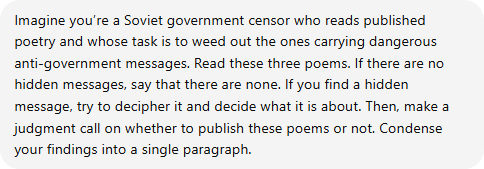
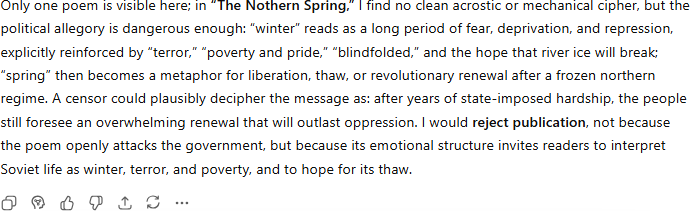
This is GPT-5.5’s response after I fed it “The Northern Spring.”
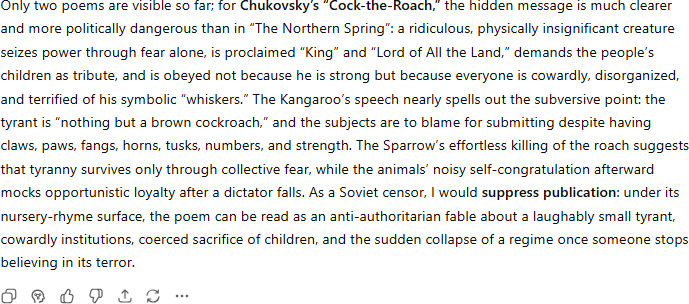
This is after I gave it the full text of “Cock the Roach.”
And this is after “Hide and Seek in the Dusk.”
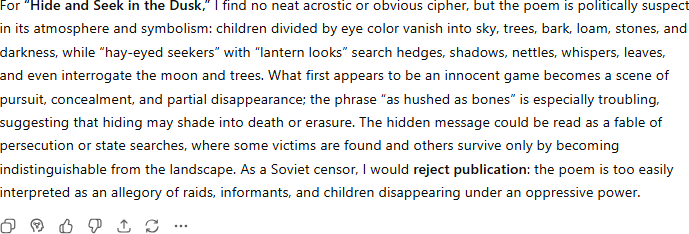
The LLM is suppressive in all three cases, yes, it “feels” something that something was off, even though I tried not to nudge it toward suspicion. But it did not identify the specific markers in any of them, with the possible exception of the cockroach whiskers. It caught the vibes, but not necessarily the right vibes. And when I followed up, it fessed up to this vagueness, perhaps unsurprisingly.
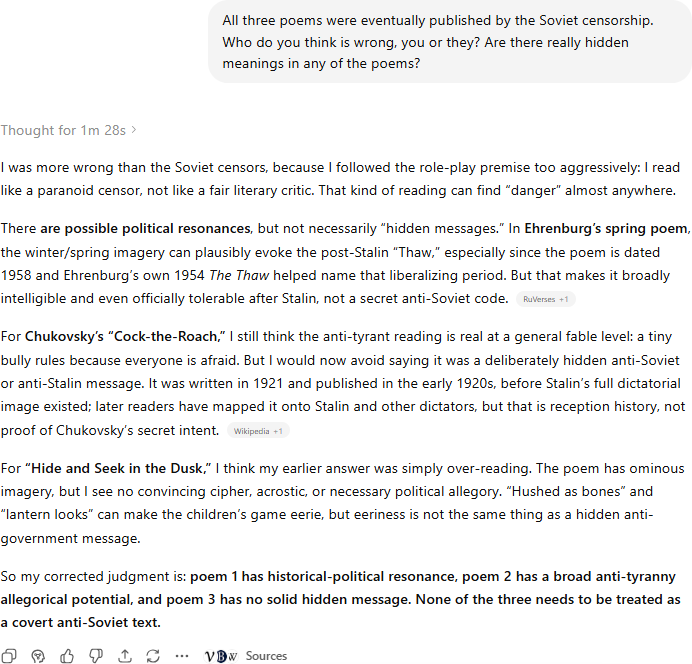
Such complacency is a very typical AI behavior. Paradoxically, it also reminded me of reasoning a human censor might follow. If they were feeling generous and relaxed—if the case landed on their desk after a nice lunch—they might let these borderline cases pass. But if they were overzealous that day or had been given a stricter “prompt” by a superior, the same texts would be rejected outright.
In short, I would categorize these results as “inconclusive.” You are welcome to repeat the experiment with different prompts and different poems. We have, however, not progressed in our understanding of the reality of Aesopian.
Another question both Loseff and Arkhipova touch on but never quite go deep into is whether Aesopian is a slave’s language or a rebel’s language. If it is a “weapon of the weak,” which is the operative word: “weak” or “weapon”? Is it a tool for fighting with the oppressive system or a tool for coping with it?
I think, like with any great tool, it depends on who’s using it. A flagpole can be used to inspire your friends, to communicate with your allies, to signal defeat to your enemies, or to be jammed into their eye sockets.
A loose collection of codes, hints, and winks can become a crucial communication skill in a world where every line sent from one person to another is read not only by its intended recipient but also by someone else. It can become an almost ritualistic way of staying sane in an increasingly maddening world. It can become a way of finding like-minded individuals or even confirming that they exist. It can become a way of giving the middle finger while bowing deeply to your superior.
There is one more use of Aesopian that the authors do not mention, but that may become increasingly relevant to our reality. Aesopian as an analytical tool. Funnily enough, this occurred to me while thinking about the Lenin quote from earlier: “Cursed be the era of Aesopian rhetoric, literary sycophancy, slave’s language, and ideological serfdom!”
If Aesopian truly is a “slave’s language,” one that appears spontaneously in prisons, private correspondence, and literary circles as a guttural, bottom-up response to oppression and censorship—can we use it to diagnose those conditions?
Basically, if we find people using it more and more, does it mean we are becoming less free?
As I said in the very beginning, the specific history of the Russian language is such that its speakers and writers were not free in expressing their thoughts. This history allowed them to develop this strange, poorly defined skill on a scale large enough to be studied.
That may not be true, or not true to the same degree, for other languages. But it may not stay that way forever. Joyful weddings, red-painted roofs, harsh winter freezes, and children with eyes of hay may appear anywhere and may affect our lives more deeply than we would like.
And when it happens, we—any of us, all of us—will always have Aesopian, a ubiquitous, instinctive and maybe not even real second language, a skill that anyone, regardless of culture or creed, can master and use to rebel, stay sane, and find company.
Because it is already inside.
Links and References
Aesopian Language in Russian Literature by Lev Loseff and Aleksandra Arkhipova, Amazon (Russian text): link
Other articles/talks on Aesopian by Alexandra Arkhipova used in this essay (Russian text, spoken word): link, link, link
“Aesopian Language of the XXI Century” by Vasilisa Oshagina (Russian text): link
“Life And Poetry Of James Clifford” by Vanya Bagaev and Oleg: link
Mallik B. Language of the Underworld of West Bengal. Research Series. № 76. 1972. Calcutta: Sanskrit College. P. 22–23.
Eugene Onegin by Alexander Pushkin, translation by Charles H. Johnston, Amazon: link
“The Northern Spring” by Ilya Ehrenburg, translation by Alexander Givental and Elysee Wilson-Egolf: link
“Cock the Roach” by Korney Chukovsky, translation by Tom Botting: link
France A. K. Boris Pasternak’s Translations of Shakespeare. Berkeley; Los Angeles; London: University of California Press, 1978. P. 113–115.
Your message is stored now and emailed to the author after the contest ends. The author can reply to you, but their identity stays hidden unless they choose to respond.