Airships: A Tech‑Tree Branch We Let Wither
I like to imagine the state of technical progress as a tech tree in a video game. The digital age tech tree is cool, with advancements like the internet and now and, built on top of it, AI, but I can’t help thinking about the tech paths we let wither on the branch. Take airships: a century ago they crossed oceans in Art‑Deco salons, then vanished in a flash of hydrogen and bad headlines. Today armed with carbon‑fibre frames, electric drivetrains and a climate mandate we may finally have the points to re‑unlock that branch.
Airships can cut CO₂ by 90 % on regional cargo runs. Here’s how we lost and may regain this tech branch.
As this is a review of airships, I should acknowledge my bias. I think airships are very cool. So much so that I spent a considerable amount of time building one in Minecraft.

This airship has lightning rods to prevent re-creating the Hindenburg disaster.
I The Glory Days
As most technologies began, airships were developed through the military. These airships made their debut during World War I. This was surprising to me at first, wouldn’t they be easy targets for early airplanes? A few shots into their hydrogen cells, and they’d be done for.
Yet militaries found plenty of niche uses: fleet scouting, city bombing, U-boat hunting, shielding cities, and even serving as early warning radar stations. Eventually, every one of these roles would be taken over by faster, tougher fixed-wing aircraft or missiles, but for a time, airships ruled the skies.
There was a man named Hugo Eckener who had a plan to take this technology and repackage it into luxurious cruises of the sky for the well-to-do.
At the time, the Zeppelin company was running out of money, they would need a large win if they wanted to continue existing. Its senior captain, Hugo Eckener, who had started as a journalist writing about zeppelins, knew how powerful a good story could be. He pitched a bold idea: he would captain the Graf Zeppelin, LZ-127, around the globe faster than anyone ever had before. He reached out to newspaper tycoon Randolph Hearst, offering exclusive rights to the story in exchange for funding. Hearst loved it and invested $200,000, half the project budget and about $3.7 million in today's money. In return, he placed four of his own correspondents aboard and insisted the trip start and end in Lakehurst, New Jersey, his hometown. He also required the trip to be branded as a "Hearst stunt."
Eckener pieced together the rest of the budget through grubby little deals like selling souvenir airmail stamped and pre-ordered by collectors for each leg of the journey.
But this was still a huge gamble. A crash or even bad press could void Hearst’s payments, spook insurers, and scare off future financiers. If successful, however, it would show the world that zeppelins were a safe and reliable luxury travel option of the future.

The Dining area of the Graf Zeppelin
The journey was risky. In California’s Mines Field, hot landing surfaces reduced hydrogen lift so much that the airship couldn’t take off. Eckener had to remove six passengers and reduce fuel, food, and spares to shave weight. Even then, it was barely enough. He ran the engines at full emergency power, and the 776-foot hull surged forward. As the stern dipped, it struck the ground and tore fabric on the lower fin. The ship narrowly avoided power lines and climbed to safety. Riggers crawled along the internal catwalk to patch the tear mid-air.
This was just the beginning. The voyage continued in August, peak season for North Atlantic storms. Eckener dodged thunderstorms and squall lines while navigating with 1920s radio, which often failed in lightning. He reverted to sextant navigation whenever sunlight broke through. Hearst’s newspapers ran hourly updates as all this unfolded. Every detour while likely lifesaving, shaved fuel margins and risked their goal of fastest circumnavigation.
Still, Eckener reached Friedrichshafen in 55 hours and 22 minutes, just four hours behind schedule, setting a new nonstop distance record for an airship.
The Graf Zeppelin completed the trip in 21 days and 33,234 kilometers, the fastest circumnavigation at the time. Crowds cheered the crew on arrival. Eckener received National Geographic’s gold medal, and the success helped secure funding for the Hindenburg.
II: The Hindenburg
May 6 1937, Lakehurst Naval Air Station. Hindenburg is minutes from docking after a 3‑day Atlantic hop. Designed for inert helium, she carries flammable hydrogen because the U.S. export ban under the 1925 Helium Act left Germany no alternative. A sudden wind shift forces a sharp turn; mooring ropes slap the wet skin. At 7:25 p.m. by witnesses’ watches, a pale flame near the tail blossoms into an orange roar.
The ship collapses in 34 seconds; yet 62 of 97 aboard survive, plus most ground crew. Later probes agree on the sequence: a gas‑cell tear, hydrogen‑air mix, then a static‑spark ignition, amplified by the doped‑cotton skin’s flammability Smithsonian Magazine. Insurance rates triple overnight; U.S. media re‑run the footage for weeks; passenger bookings evaporate.
After that, the public lost faith in airships. Within two years, the last aluminum-framed giant, Graf Zeppelin II, made its final flight.
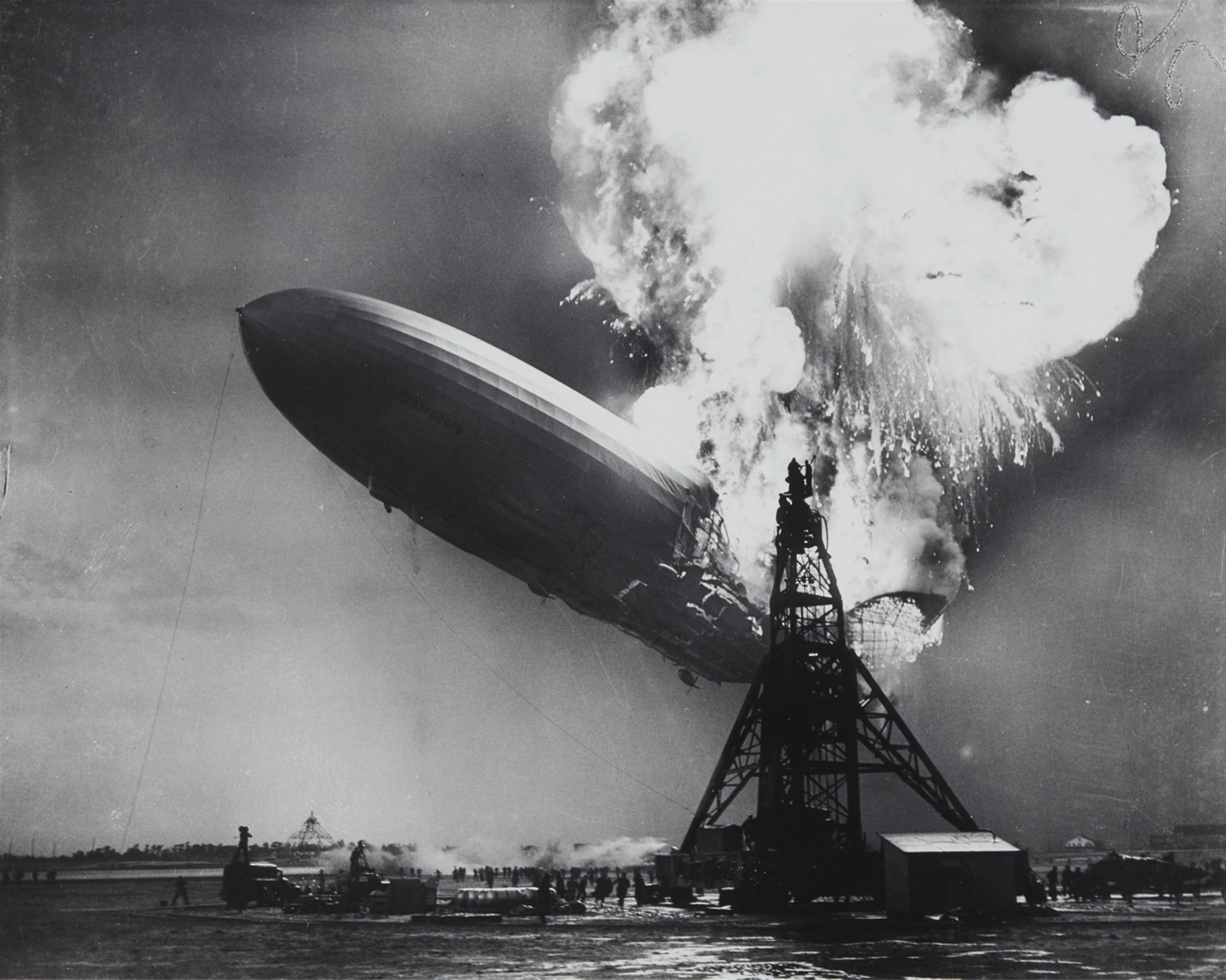
I find it strange. The Titanic also ended in tragedy, yet people didn’t give up on ocean liners. Why were airships treated differently? Maybe it’s because the Titanic sank out at sea, largely away from public view. The Hindenburg exploded in front of a crowd. That visibility may have made all the difference.
III: Where Are We Now
After the Hindenburg, airships became an endangered species. As not much happens for airships in the decades following the Hindenburg here are the highlights:
1940 – late‑1960s U.S. Navy patrol era
• Airships log 1 ½ million accident‑free hours hunting submarines in WWII; the final ZPG‑3W radar picket flights end in 1962 and the program winds down by 1969.
1980 – 2010 Advertising & aerial‑TV era
• Goodyear’s GZ‑20 fleet becomes a floating camera boom, covering hundreds of Super Bowls, Indy 500s and golf majors while the word blimp turns into a global brand asset.
Then came Sergey Brin and Pathfinder 1. In 2013, with Google booming as an advertisement monopoly, Brin, a Google co-founder, quietly funded LTA Research, eventually spending an estimated $250 million to build the 124-meter Pathfinder 1 at NASA’s Moffett Field. The idea began in 2014 when he visited Moffett’s museum and saw the skeleton of the USS Macon, a 1930s airship. The sight sparked the dream of resurrecting efficient, giant dirigibles.
Brin's team worked in secret for nearly a decade. The NDA shield allowed them to develop carbon-fiber structures, advanced avionics, and hydrogen-ready powertrains without competitors or media scrutiny. Early testing was done indoors and later in low-profile outdoor conditions to avoid public panic or "Hindenburg 2.0" headlines.
In September 2023, Pathfinder 1 received its airworthiness certificate. By October 2024, it completed its first untethered outdoor flight. As of today (spring 2025), it's still undergoing cautious, low-altitude test flights.
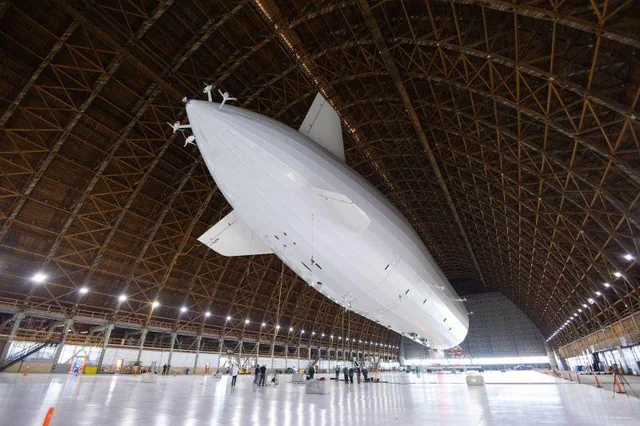
Brin’s nonprofit, Global Support and Development, is already planning to use it for Pacific cyclone relief in 2026, mirroring their yacht-based medical response model. Pathfinder 1 is collecting performance data to certify cargo systems, including slings and pallet roll-on/roll-off designs.
The timing mirrors the “Fourth Turning” rhythm: almost 90 years after the Hindenburg, the span of living memory, and with it the visceral veto against airships. Once living memory fades, technologies can be reassessed on fresh facts especially when new materials and climate pressures rewrite the cost‑benefit sheet. In that sense, the 2013‑onward revival isn’t a fad; it’s the natural moment for a second audition after a catastrophic first act.
IV Quick Definition
So, what are airships?
An airship is a type of lighter-than-air aircraft that can be steered and propelled through the air using engines and rudders. It stays aloft by the buoyancy of a gas, either helium or hydrogen, which is lighter than air. Some, like the Goodyear blimps you might have seen, have no internal structure and rely on internal gas pressure to maintain shape. Semi-rigid airships, on the other hand, include a partial framework, often a keel or truss along the bottom, which reinforces the envelope and allows for heavier loads and larger size. This review focuses on the semi-rigid variety, exploring why they disappeared and how they could make a comeback.
V Design Challenges
As a mechanical engineer, what fascinates me are the design trade-offs modern airships face.
First, there’s the lifting gas. Helium is safe but expensive and in short supply, around $390–550 per thousand cubic feet in 2025. Export helium now rides on three liquefied natural gas hubs: Qatar, Algeria and Russia’s Amur making every plant outage or Strait of Hormuz scare a market shock.
Hydrogen is abundant and can be produced through electrolysis and it provides about 10% more lift than helium, but its explosive nature means developers need to bend over backwards with safety systems. Modern design has every hydrogen cell being double‑walled in Mylar, with an inert nitrogen buffer between skins so that any leak meets nitrogen, not oxygen, before it can mix with the airframe. Spark-proof electrical systems are also needed to reduce risk of igniting the hydrogen. If we can manage the safety problems however, hydrogen is the most scalable path forward for airships. Currently, designers of modern day airships are using helium-based designs as the first step, while hydrogen propulsion is a highly coveted future upgrade.
Buoyancy control is another challenge. If an airship offloads a heavy cargo load, and if nothing is done the ship becomes positively buoyant and tries to shoot sky‑ward. Classic fixes like venting gas or taking on ballast are wasteful or logistically hard. The modern solution is to compress helium into tanks and backfill the envelope with air from the atmosphere. But this requires energy, creates heat, and needs intercoolers.
Ironically what makes hydrogen so appealing as a lifting gas makes it much worse to be able to compress. Hydrogen’s density at 1 bar is half helium’s, so to pack the same volume of gas into a small space you must go to 7 to 10 times the pressure. Some designers sidestep high‑pressure tanks with variable ballonets: onboard blowers pump outside air into flexible internal balloons, trading lift for a small weight penalty in minutes without venting precious gas.
A more experimental idea is steam‑condensation trim, where water ballast is boiled off for ascent and re‑condensed for landing, no gas compression at all.
Regulatory barriers also loom large. Neither the FAA nor EASA has a mature airship certification framework. Each project negotiates special terms, adding complexity and delays. Hybrid Air Vehicles, for example, began UK certification in 2024 and hopes for commercial service by 2028 or 2029, pending hundreds of compliance checks.
VI: What They Could Fix Today
The 1920 Jones Act severely restricts coastal shipping in the United States. It requires that any cargo shipped between U.S. ports must be carried on U.S.-built, -flagged, -owned, and -crewed vessels.
The result? A 2 to 3 times cost increase for American shipping. For territories like Puerto Rico, this translates to higher consumer prices. A study on Puerto Rico found the Jones Act alone adds about 1% to their household costs.Given that the Act is unlikely to be repealed anytime soon, airships might fill the void.
In Canada, Nunavut faces similar challenges. With no road access, everything is flown in, at great cost. A 20 kg box costing $0.10 per kg to ship from Toronto to Winnipeg can cost $3 to $10 per kg to reach Nunavut by plane.
A University of Manitoba study compared a 50-tonne airship with current aircraft and sealift services. The result: airships could reduce logistics costs by 12 to 38% and cut carbon emissions by over 75%. The break-even freight rate is estimated at $2 to $4 per kg, well below scheduled air freight.
Airships can match truck speeds and reach locations without runways or highways, all while using much less energy. Trains are better when available, but at least for Canada building new rail lines seems like something the government doesn’t have the capacity to do anymore.
VII: Carbon Efficiency
Airships require minimal energy to stay aloft and operate at much lower speeds than aircraft, making them incredibly energy efficient. Since power needs scale cubically with speed, airships flying at truck speeds use dramatically less energy.
Compared to bush planes or turboprops, airships can reduce emissions by 90 to 98% for cargo that can’t wait weeks for sealift.
VIII: Conclusion
Airships will not sink container ships or outrun jets. Their sweet spot is the messy middle: routes too thin for rail, too remote for roads, too carbon‑sensitive for constant turboprops. If we marry today’s composites, batteries and hydrogen with yesterday’s buoyancy physics, the next “green freight lane” may float overhead quiet, slow, and surprisingly cost‑effective.
History abandoned airships too quickly. Recently I saw a post showcasing a conceptual design of a new nuclear powered airplane that would be used for sky cruises. The picture looks absurd, a great big behemoth of absolute excess:

The only trouble with this design is that we had already had this type of luxury air cruises back in 1920 with the Graf Zeppelin that circumnavigated the globe! We have forgotten this and are now trying to reinvent it in new silly ways. Maybe that’s why I want them to come back. Floating through the sky in a giant blimp scratches that steampunk itch. It would feel like witnessing a real, imaginative leap forward.