A proof that you should read this book review
The logician Raymond Smullyan once taught me a trick for proving anything. Consider the following two statements:
- Both of these statements are false
- You should read this book review
It is impossible for the first statement to be true without creating a contradiction, so it must be false. But the only consistent way for the first statement to be false is if the second statement is true, otherwise both statements really would be false. Hence, we’ve proven that you should read this book review!
You can substitute any proposition you’d like for the second statement, and you can create proofs for the existence of God, the superiority of reading Narnia in publication order over chronological order, or your own niche political issue.
Smullyan himself explained the counter to that sort of hollow proof: statements by themselves can never prove anything about an external reality. In one of his classic riddles from What Is the Name of This Book?, a suitor is convinced he’s solved a puzzle to let him marry his lady love by assigning statements on caskets with true and false values, allowing him to draw conclusions about which casket he should open in order to win. The suitor ends up shocked when he discovers reality doesn’t match the internally consistent solution to the puzzle. But why would it?
The simple answer Smullyan gives is that isolated statements can’t prove any empirical claim. They could simply represent a paradox, like this pair of statements Smullyan often references:
- The second statement is false
- The first statement is true
There is no consistent way to classify both statements as true or false. Like a single statement of “This sentence is false”, you can’t fit them neatly into the categories of true or false. One common approach is to invent a third label of calling something a paradox, to face the weirdness without flinching. But even inventing that category doesn’t neatly resolve the issue. Consider the following statement:
- This sentence is either false or a paradox
Slapping a label of “paradox” on the statement doesn’t really help: if it’s a paradox, the statement is true, making it not a paradox. But the statement also can’t be true. You may be getting a lot of “paradox” vibes from this “definitely not a paradox” statement, but that also seems to be impossible. Maybe we need a new “meta-paradox” label, but you can easily construct a paradox around that label too.
Or, consider this slightly rephrased example from my favorite of Smullyan’s books, Alice in Puzzle-Land:
- You will never consistently accept that this sentence is true
The answer Smullyan brings the reader to, in a book of logic puzzles intended to be read by children, is a variant of Gödel’s incompleteness theorem. He argues that the statement is true, but unprovable for you, and provable by someone else. If you change the sentence to:
- Alice will never consistently accept that this sentence is true
Alice has no way to consistently integrate the truth of that sentence into her mental framework. But you or I could, resolving it as true. For Alice, it sits in a strange category of true but unprovable for her personally, in a Gödelian result that reveals a reality beyond what her mind can contain.
The best actual proof I could give you for why you should read Alice in Puzzle-Land is that if you find these kinds of logical games entertaining, Smullyan does them better than anyone else. His books introduce concepts and building blocks for solving logic puzzles, gradually escalating in complexity like a well-designed video game, and use these sorts of riddles to touch on deeper themes in logic and mathematics. It’s the children’s riddle book version of Gödel, Escher, Bach that can also be enjoyed for its excellent puzzle design.
The Liar and Truthteller Guards
The 1986 movie Labyrinth contains a variant of one of Smullyan’s riddles:
- There are two guards, one of whom guards a door leading to escape, while the other guards a door leading to death.
- One guard always lies and one guard always tells the truth.
- With a single question to one of the guards, pointing at one of the doors, determine which door to go through.
The solution Labyrinth uses is that you can ask a guard “what would the other guard say is behind your door?”, and be guaranteed to get a false response. The truthful guard would truthfully report a false response, and the lying guard would lie about a truthful response. Either way, you would hear something that’s the exact opposite of the truth, so you can invert it, and be on your way.
Smullyan takes the riddle to another level in his 1985 book, To Mock a Mockingbird. Consider the following:
- There is one guard, guarding two doors which lead to escape or death.
- The guard either always lies or tells the truth.
- With a single question, determine which door to go through
The trick from Labyrinth doesn’t work here; there’s no other guard to ask about. But it’s still possible to resolve a consistent liar and truthteller the same way, with a question of one of the following forms:
- What would you say if I asked if the first door was correct?
- Are you the type who would say that the first door is correct?
Either construction introduces self-reference to cancel out the possibility of lies: truthtellers will respond honestly and give you a true answer, and liars will lie about what they would actually say, inverting their own lies and giving you a truthful answer instead. This sort of construction acts as a skeleton key when questioning consistent liars and truthtellers, always forcing out the truth.
Knowing that those sorts of constructions break down many riddles once you’ve heard them, Smullyan opens Alice in Puzzle-Land with a pair of riddles that constrain the tricks you can use by limiting question size to three words:
- There are two brothers, one of whom is named John. One of the brothers always lies, and one of them always tells the truth, but you don’t know whether John is the liar or truthteller.
- With a single three-word question to an unknown brother, determine if that person is John or his brother.
- Alternatively, with a single three-word question to an unknown brother, determine if John is the liar or the truthteller.
I won’t spoil the solution here (the book contains the answers and logic laid out neatly for each riddle at the back), but the solution is surprisingly elegant and clever. Simple questions like “Is water wet” won’t give you enough information, and the challenges Smullyan poses are often about using language to map a logical space in creative ways.
Why Alice in Puzzle-Land is my favorite Smullyan book
Smullyan wrote a number of excellent books, many of which follow a pattern of kicking off with simple logic puzzles and using their concepts to build into discussion of more complex mathematical ideas. Satan, Cantor, and Infinity builds the reader up to understanding gradations of infinity and Cantor’s Continuum Hypothesis through a series of riddles of how you could meet Satan’s challenges to find an arbitrary number, pair of numbers, or fraction if you had infinite time to work with. The Chess Mysteries of Sherlock Holmes uses the rules of chess as its foundation to deduce things about the prior state of the board, and To Mock a Mockingbird is almost a textbook for lambda calculus told through logic puzzles.
What Is the Name of This Book admittedly contains some dated chestnuts, like the riddle where a boy and his father get into an accident, and the surgeon refuses to operate, stating “I can’t do surgery on this boy, he’s my son.” The reveal that the surgeon was the boy’s mother must have been considered absolutely mind-blowing by 1978 standards, whereas even claiming that as the puzzle’s only valid solution would be a loaded assumption today! But Smullyan’s true forte was his original riddles across math and logic, including a set of riddles in the same book where you have to solve puzzles when you don’t know what the words for “yes” and “no” are.
Alice in Puzzle-Land was a book I devoured multiple times growing up at my local public library, as part of a thorough search through Dewey Decimal 793 for its selection of puzzles and games. It was charming and accessible as a kid with its illustrations accompanying the puzzles that helped keep the characters straight, and the book was my first introduction to a number of concepts from logic. The reason it remains my favorite is also what makes it different from the rest of Smullyan’s books with their mostly dry sets of puzzles: the entire book is wrapped in narrative, a journey that Alice from Alice in Wonderland undertakes to meet the Queen of Hearts, the Mad Hatter, the Red King and more.
Each chapter has Alice encounter a number of oddball characters, engaging in Socratic dialogues or arguments as she puzzles through a series of escalating riddles around a theme. The book starts you off with simple liar/truthteller logic puzzles that slowly ramp up in complexity from riddles you can think through in your head, to a set of 11 statements that need to be resolved for the second chapter’s final puzzle, tricking my childhood self into doing math homework on paper that was actually fun.
The other chapters cover themes Smullyan uses to stack logical concepts in puzzles: characters who are mad and only believe false things, mathematical riddles that require no algebra, or riddles constructed with deliberately missing information and meta-clues about what information would make the riddle solvable, which themselves allow you to solve the riddle. But the category of riddles Smullyan created with the most active legacy are probably his knight, knave, and spy puzzles, which live on in the award-winning indie game Blue Prince.
Liars, Truthtellers, and Normals
My favorite chapters as a kid were the ones based around riddles with the following constraints:
- Knights always tell the truth
- Knaves always lie
- Spies can either lie or tell the truth
Most of Smullyan’s puzzles here would present a setup with one member of each type making statements, leaving it to the reader to figure out who was each type. Reading the puzzles meant you could quickly build up a set of shortcuts to help your deductions: a statement like “I am a knight” was meaningless, since all three types could make that statement, while a statement like “I am a knave” or “I am a spy” immediately ruled out some options for the puzzle, as would statements like “B is a knight”.
Since Smullyan wrote the book in 1982, people have written procedural puzzle generators for this puzzle type, and mapped the solution space in some depth. And this specific puzzle type has seen a revival as a minigame in the video game Blue Prince:
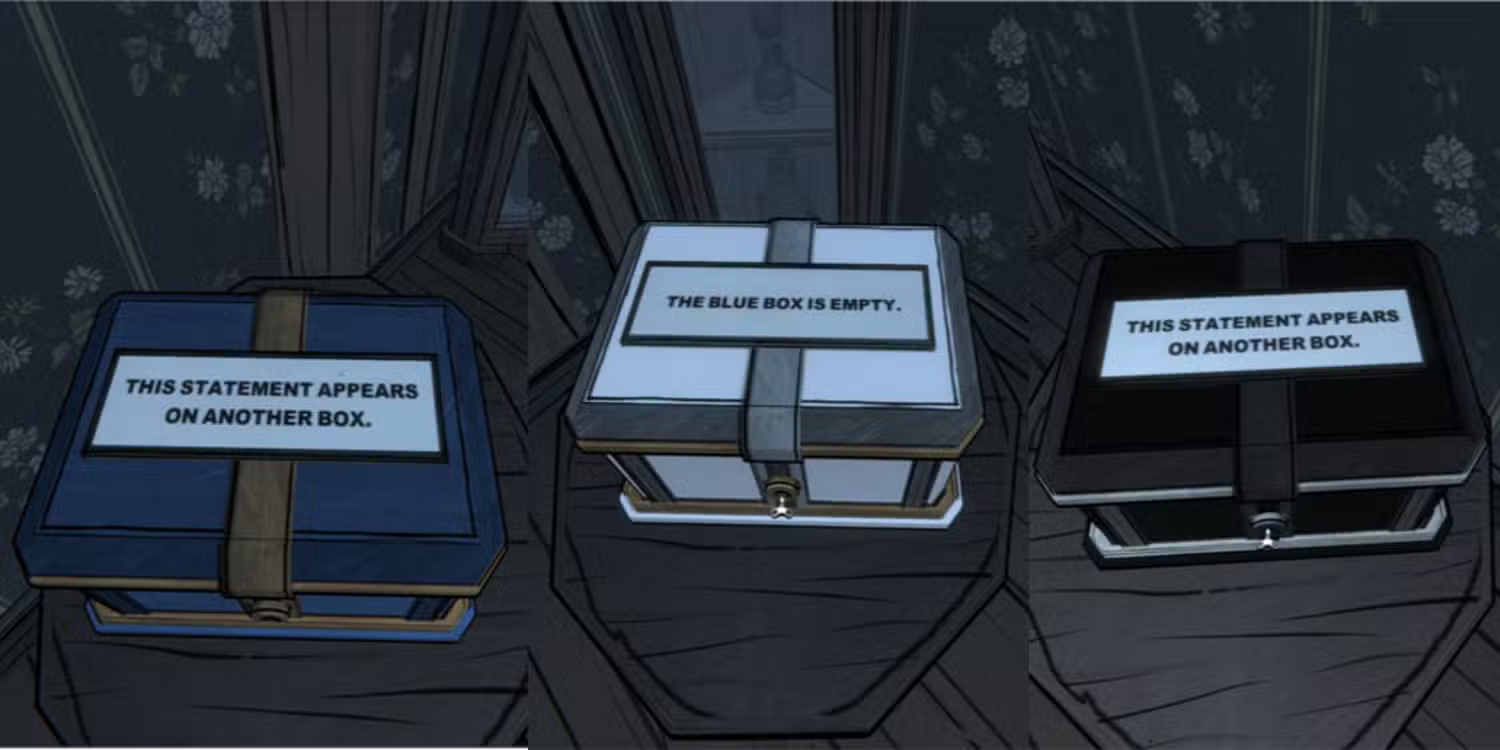
Caption: Blue Box: This statement appears on another box. White Box: The blue box is empty. Black Box: This statement appears on another box.
Blue Prince’s parlor puzzles operate on similar rules to Smullyan’s classic riddle form:
- One box always tells the truth
- One box always lies
- One box can either lie or tell the truth. In a slight tweak from Smullyan’s version, it’s also the only box allowed to say nothing.
Blue Prince differs in that the goal isn’t to resolve the statements as true or false (sometimes, there are multiple consistent assignments), but to find the single box which contains gems. Like Smullyan’s riddles, the game gradually escalates in complexity as you learn the constraints inherent to this puzzle type, and the statements grow increasingly complex, self-referential, and eventually build to each box containing multiple statements to untangle.
While procedural generation of these kinds of puzzles has been possible for years, even before GenAI, I also take some heart in observing that Blue Prince’s puzzle set appears to be hand-crafted, with 110 custom puzzles designed to slowly escalate in complexity, playing on similar tricks to what Smullyan himself used in self-reference.
Some of the later Blue Prince puzzles would be next to impossible without having adapted to the puzzle form first, as would some of Smullyan’s. In a context where being mad means you have only false beliefs and being sane means you have only true beliefs, at one point Smullyan asks the reader what they can conclude if: “The Queen believes that the King believes that the Queen believes that the King believes that the Queen is mad.”
That particular riddle is teased early just to baffle the reader, and Smullyan slowly builds up to it in stages like a logical proof, asking the reader to handle three levels of indirection first, with “The Queen believes that the King believes that the Queen is mad”, then having the reader build on their own logic to reach four levels, and then finally five, to untangle a knot that seemed impossible at first.
There’s also an interesting feature that sets apart Smullyan’s craft in puzzle-making. All of the Blue Prince puzzles contain an implicit simplifier that is never mentioned: the puzzles always have a unique solution allowing you to unambiguously resolve the core question of where to find the gems, which can allow you to short-circuit many puzzles (like the one above) if only one box talks about where the gems are.
Always having a unique solution is necessary for a video game to be satisfying, but I find it interesting that Smullyan specifically dodges this type of trick in his books, where some of his puzzles challenge the reader to think outside the box: sometimes he will pull the rug out from under a reader expecting to find a unique solution, telling them that instead they should have come back and proved that a puzzle had no unique solution, or that its constraints were impossible. This playfulness both discourages blind guessing and reinforces a core theme of Smullyan’s: logic by itself can’t reveal anything about the world, your premises themselves may be invalid.
The Barber Paradox is no Paradox at all
Only one chapter of the book has no explicit puzzles for the reader, instead offering a dialogue with a semantically exacting Humpty Dumpty, that culminates in Alice being baffled by the personally tailored version of Gödel’s Incompleteness Theorem discussed earlier. I know that I spent far too much time as a child re-using Humpty Dumpty’s troll of “Is ‘no’ the correct answer to this question?”, a sin for which I’m already being repaid by the next generation.
Humpty Dumpty also reexamines a pair of classic paradoxes, arguing that the classic “All Cretans are liars” statement made by a Cretan can easily be rescued from paradox by the common sense of the word liar, or even the assumption that at least one Cretan is honest, making the statement a simple falsehood.
The big egg also dissects the classic barber paradox, arguing it’s simply a reason to reject the premises you were given:
- A barber shaves everyone who doesn’t shave themselves
- Does the barber shave themselves or not?
Humpty Dumpty doesn’t get tied up in knots about whether the question can be answered with yes or no, but points out the initial premise has to be false. If you were told a man was six feet tall, and not six feet tall, you’re not really hearing a paradox, but a contradiction. Similarly, the description above is equivalent to being told, “there is a barber who shaves himself and doesn’t shave himself.” The phrasing disguises the inconsistency, but the end result is the same: you’re just being told contradicting things, which differs from classic paradoxes tied to self-reference.
Training the reader to question any premises they encounter is perhaps the deepest lesson of the book; one chapter culminates in a revelation that reframes all the solutions you would have devised up to that point, and the book itself ends on a question about the nature of reality that Smullyan leaves hanging, if not ambiguous.
The Unresolved Riddle
I tried out my copy of Alice in Puzzle-Land with my son when he turned six years old and he loved the Liar and Truthteller puzzles, asking me to re-enact them with stuffed animals for each character as he shouted out solutions. I would recommend it for any precocious child or child at heart, along with the rest of Smullyan’s canon for anyone wanting to explore the world of logic with a sense of whimsy even as it wanders into deep topics. The book sparked much of my own interest in math and logic that eventually led me into Computer Science, through the lens of an imaginative world framed in constant discovery, where the enigmas presented could be baffling but were always resolved with a certain kind of elegance.
Thankfully, the book contains the solutions for nearly every problem it presents, leaving only the last puzzle unresolved. Martin Gardner wrote the following in the book’s introduction:
“At the close of Carroll’s second Alice book, Alice wonders if she has dreamed about the Red King, or if she is only a sort of thing in the Red King’s dream. In his last two chapters, Ray weaves brilliant puzzle themes around the act of dreaming. His book ends with the Red King presenting Alice with a question about dreams that is so confusing and so deep that, as Carroll did, Ray wisely leaves it unanswered.”
Martin Gardner himself was another titan of recreational mathematics, but this particular quote of his eventually came to bother me, after being trained by Alice in Puzzle-Land to always question premises. Smullyan does take the unusual step of leaving his final riddle of the book unanswered, but with his appreciation for elegance and the structure of the riddle itself, I do think he meant for it to have a clear answer.
And, like the solution to many a good logic puzzle, it is one you will appreciate the most if you discover it for yourself.
Your message is stored now and emailed to the author after the contest ends. The author can reply to you, but their identity stays hidden unless they choose to respond.