Armies of Sand: The Past, Present, and Future of Arab Military Effectiveness
I have always loved non-fiction books that take a specific topic that I know little about and in a detailed way break down everything there is to say about that subject. Armies of Sand by Kenneth M. Pollack is one such book and focuses on the military performance of Arab armies since World War 2, more specifically why those performances have had so little success. In an exhaustive way the author goes through wars you’ve probably heard of (the many wars between Israel and its neighbors, Gulf War and Iran/Iraq War) and those you may be less familiar with (Gaddafi invaded Chad at one point and it did not go well). For me these case studies alone were worth the price of admission. For example, if you’ve ever wondered what happened in the Iran/Iraq War, he gives a pretty detailed breakdown. Using these case studies, he tests out different possible explanations for why certain military shortcomings keep happening. Ultimately, he argues that culture is the best-fitting explanation. The book opens with a dramatic retelling of the 1967 Six Day War. Israel was attacked on all sides by its neighbors Egypt, Jordan, and Syria. These countries fielded significantly more men, tanks, armored vehicles, and airplanes.
“The Arab coalition threatening Israel had every material advantage. Altogether, the main Arab combatants-Egypt, Jordan, and Syria-would deploy roughly 275,000 men against Israel with about 1,800 tanks, 2,000 armored personnel carriers (APCs), and 1,700 artillery pieces. For its part, the Israel Defense Forces (IDF) would field about 130,000 troops with roughly 1,000 tanks, 450 APCs, and maybe 500 artillery pieces. In the air, the Israeli Air Force (IAF) had 207 combat aircraft, against 716 Egyptian, Jordanian, Syrian, and Iraqi warplanes.”
Ok, so at the outset it looked like a decisive victory for the Arab coalition should play out.
“For three hours, every 10 minutes, 10 flights of four Israeli aircraft attacked airfields and other installations throughout Egypt. During the course of the morning, the Israelis struck 18 of Egypt’s airbases, cratering runaways, blowing up aircraft, and destroying support facilities. The EAF lost 298 of its 420 combat aircraft and at least 100 of its 350 combat pilots.
As if that weren’t bad enough, Cairo’s air force commanders tried to cover up the disaster. These were all highly political officers, some of them jumped up from low ranks to the highest echelons because they had participated in the Free Officer’s coup of 1952 that brought Gamal ‘Abd al-Nasser to power. They were not about to admit to anyone, even Nasser that the mighty air force they had built had been lost in a single morning. So they lied, telling Nasser that they had won a great victory: They had destroyed three-quarters of the Israeli air force and Egyptian planes were now pounding Israel’s airbases.
When the Syrians heard of the incredible victory the EAF had won, they wanted in on the action. Damascus launched a handful of its own aircraft to join the fray…. Yet there was no particular purpose or strategy to their attacks. In the words of a former IAF officer, “they sent a duo here and a trio there in a disorganized fashion, somewhat hysterically and with no real preparation.” They did no damage to any military targets but provoked IAF to retaliate by striking Syrian airbases as they had the Egyptians.”
The same thing proceeded to happen to the Jordanian and Iraqi air forces. You can guess how things went on land.
“In battle after battle, Egypt’s field commanders demonstrated almost none of the skills needed to prevail in mechanized maneuver warfare. Egyptian soldiers fought hard enough-and their units typically maintained their cohesion-while the Israelis were attempting to breach their fortified lines. But as soon as the Israelis had broken into their positions, let alone after they had broken through, Egyptian tactical formations became helpless. Time and again Egyptian tactical commanders simply failed to react to Israeli penetration or flanking attacks. They would not counterattack, they would not refuse a flank they would not reorient their defenses to meet the new direction of the Israeli assault, they would not even withdraw from a position that had been compromised by Israeli maneuver. As a result, all across the front, once Israeli forces had penetrated an Egyptian defensive line, it was merely a matter of rolling up the rest of the line from the flank.”
Also,
“Egyptian junior officers in Siani contributed to that shock by thoroughly misleading their superiors. At first, Egypt’s frontline commanders refused to admit that they were being defeated and instead sent glowing reports up the chain of command that they were crushing the Israelis.”
On the Jordanian front the results were similarly disastrous.
“Jordanian forces often stoutly defended their fixed positions, and they were generally better marksmen than Cairo’s troops. But like the Egyptians, the Jordanians refused to counterattack, shift their forces, or reorient their defenses to meet Israeli penetrations or flanking attacks.”
Despite defending difficult terrain and impressive fortification efforts the results went about the same for Syria. I’ll spare you the quotes but once again there was a general failure to react or take advantage of opportunities that resulted in disaster.
Problems Identified
An important part of the book is discussing all the ways that the problems of the Six Day War could be applied to most wars in the Middle East involving an Arab nation. He goes through a list of patterns he has identified:
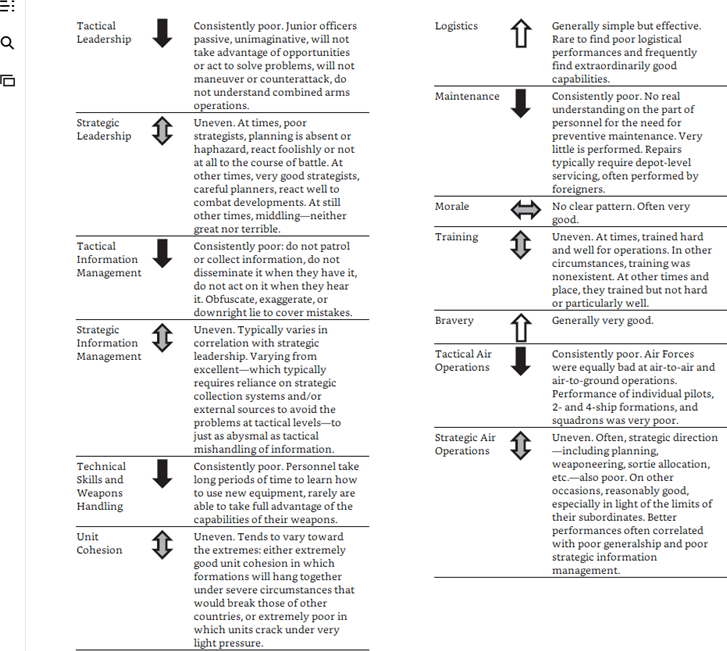
Of the 12, he only finds Bravery and Logistics to be consistently good.
As a way of moving forward with the book, he looks for how well different theories fit in with the above pattern. He looks at four possible reasons: Soviet Military Doctrine, Politicization of the Military, Underdevelopment, and Culture. In a very logical way, he tries to go through each theory, talk out why it might be a good explanation, and tries to test it against real-world examples. He also goes through some non-Arab world examples where the elements of the theory are present to make comparisons.
Theory 1: Soviet Military Doctrine
One possible culprit is the influence of Soviet Doctrine. As this is a book about the 20th century, and the Middle East was one of the many battlefields of the Cold War, it makes sense that this might come up. Egypt, Syria, Iraq, and Jordan all received Soviet advisors, equipment, and training at one point or another.
The book describes Soviet Military Doctrine as involving a focus on the campaign or theater level, with campaign-level commanders having a lot of latitude and lower-level officers having very little. The thinking here is that winning or losing several battles is less important than winning the overall campaign. In Soviet military doctrine, senior leaders at the theater level are generally encouraged to be innovative and aggressive. Junior level officers are trained to restrict their initiative and independence and to choose between a few different variants or ‘battle drills’ that operate as a menu of options for a mission. The book also describes Soviet Doctrine as involving an emphasis on offense, combined arms operations, reconnaissance, and a ‘push’ logistics system that involved regularly sent supplies.
The discouragement of creativity at lower levels and top-heavy decision-making seems to fit part of the story. Well, there’s a problem. If you look at Egypt, for example, they threw out the Soviets and embraced U.S. equipment and training in the 70s. And well after they had made that transition, they participated in the Gulf War. When you look at Egypt’s Gulf War involvement you see the same pattern: extreme caution and an unwillingness to act without an order coming directly from the top.
“When the Egyptians finally did get moving, they advanced at a glacial pace against almost no Iraqi resistance. The Egyptians attacked into the sectors of the Iraqi 20__th and 30__th Infantry Divisions, both of which had been heavily depleted by desertions during the six-week Coalition air campaign. In addition these units had been repeatedly worked over by Coalition strike aircraft, especially A-10 attack planes, which had destroyed most of their supporting armor and artillery. The US deputy theater commander, General Calvin Waller, remarked that “what the Egyptians are facing, two sick prostitutes could handle.” The Egyptians’ mission for the first day was to breach the defensive lines and seize the al-Abraq barracks about 20 miles into Kuwait. However, when the Egyptians reached the flame trenches the Iraqis had dug in front of their defensive lines, the Iraqis lit the trenches and the Egyptians stopped. The Egyptians apparently had not thought through the problem of how to extinguish or cross lit flame trenches, despite having known about them for months beforehand. Rather than improvise a solution on the spot they just sat and waited for the fires to burn out, which took 10 hours. By the end of the first day, the Egyptians had not even crossed the flame trench, let alone breached the main Iraqi defense lines.”
Another issue with this explanation is that there are several examples of countries adopting Soviet Doctrine and being successful. North Korea in the Korean war and Cuba in Angola and Ethiopia are discussed as case studies here, both of which involve the Soviet style of war working effectively. I knew Cuba had been involved in Angola but their role in Ethiopia was news to me. Between 1975 and 1988 Cuba was very active in Africa trying to protect Marxist regimes. Cuba helped defend Angola against Zaire, Angolan resistance movements, and the South African military. Shortly afterward when a Marxist revolution took power in Ethiopia and was invaded by its also-Marxist neighbor Somalia, Cuba rushed in and expelled the Somalis. Angola was again invaded by South Africa and Cuba rushed back by air and sea to repel yet another invasion. Cuban armies showed effective use of combined arms, excelled at maintaining equipment, and showed aggressiveness. Essentially, they showed none of the shortcomings that the author described at the beginning of this book.
This section made me wonder about other military doctrines/schools of thought for other countries as well and what their track records would be. It also made me think it would be interesting to see a more comprehensive table with all the conflicts in the region with and without soviet influence.
Theory 2: Politicized military
I favored this theory the most upon starting this book, but the author does a decent job poking some holes in it. If you are familiar with Bueno De Mesquita’s selectorate theory, you might think that a big part of how a dictatorship stays in power is by providing personal rewards to elites. Generals, party officials, and industry leaders might all be sources of opposition to your rule, and one way of keeping them on your side is by giving them lots of goodies. This can have a nasty side-effect of hurting the dynamism of your economy, but you don’t need the approval of regular people if you have a political and military establishment willing to shoot protestors. Selecting people in the top-tier positions for loyalty may not lead to the best decision-making in a conflict. I think this explanation has some truth in it and that led me to favor this theory at the start.
The author outlines three possible ways that a military/political relationship might produce adverse consequences in a conflict: a) a Praetorian guard kind of situation where the government is the military itself, b) a commissary type of situation where the military has been so infiltrated by loyalist watchdogs that no one can do anything, or c) a palace guard kind of situation where the military exists to suppress dissent as opposed to external threats. Once again, the author summons an impressive array of case studies that both support and undermine the theory.
The case studies are Egypt and its politicized military, Iraq and its politicized military, South Vietnam, and Argentina. Egypt had serious issues with senior commanders being chosen due to their political connections in the 1960s, but this chapter details that there was an effort towards switching to a merit and ability-based system of promotion before the ‘73 War. This newly depoliticized military planned a surprise attack on Israel. The beginning of that campaign went very well for Egypt; they crossed the Suez quickly and achieved surprise. Problems started to multiply as the highly detailed plan to make the crossing was completed and as Israel’s counterattacks increased. Junior officers now had to adapt to a changing battlefield, and they displayed all the same old habits- lack of initiative and lack of adaptability. As you might expect based on what I’ve told you so far, the results were a disaster.
The book details a similar story in Iraq. Saddam went out of his way to hamstring his military in the leadup to the Iran-Iraq war to make a coup against himself impossible.
“By 1980, Saddam appears to have deliberately chosen some of his generals because they were incompetent and so were unlikely to succeed if they ever tried. Like Stalin, Saddam kept large security forces to watch the Iraqi army and block any coup attempt. Like Stalin, Saddam attached political commissars from his Ba’th party throughout the military chain of command. Unlike Stalin, he went so far as to fill the senior ranks of his officer corps with generals who had personal ties (family, tribe) to himself, and to fill key units (such as the Republican Guard) with personnel from his minority Sunni sect. Civil-military relations in Saddam’s Iraq were the epitome of commissarist politicization.”
While the invasion had some initial successes, things bogged down and didn’t work out.
“Not surprisingly, the Iraqi invasion of Iran in 1980 was one of the most pathetic military offensives of the past century. To begin with, Saddam’s incompetent military leaders had no idea how to draw up a military plan. As several professional Iraqi generals who participated in the operation explained, in the end Baghdad just moved 9 of its 12 divisions to the Iranian border and ordered them to drive into Iran and not stop until they reached the Zagros Mountain passes that separated oil-rich Khuzestan Province from the rest of Iran. Iraqi tactical formations were not issued any logistical plans, and then were no march order or routes of advance, no maps, and nothing about air support.”
Saddam began to try to depoliticize his military, allowing people to be promoted more on merit.
“The defeats in Iran apparently convinced him that his straitjacketing of the armed forces had hampered their combat power, and with Iran’s victorious armies beating down the doors of his realm it was time to put military effectiveness ahead of political reliability. Thus, Saddam began to undo the damage, starting in 1982 with the characteristically dramatic gesture of dismissing or executing 200-300 senior officers who had performed poorly in 1980-1982. In their place, rather than appointing still more of his cronies, Saddam began promoting officers who had fought well in the first two years of the war.”
Iraq did see improvements in performance after switching to merit-based promotions. Iraq’s performance was less effective than you might expect however in its subsequent offensives in the late 80s.
“The execution of these operations, however, did not always match the high standards of their planning. As long as the advantages they gained from surprise, chemical warfare, numbers, and overwhelming firepower held, Iraq’s highly practiced field forces performed admirably executing the plans of the General Staff, just like the Egyptians during the Canal crossing in October 1973. Yet any time something happened that was not addressed by the plan, Iraq’s tactical formations reverted to form and stumbled, just as the Egyptians had on October 14, 1973.”
“Whenever it fell to the tactical commanders to take action on their own-particularly when Iraqi forces encountered unexpected Iranian ambushes or counterattacks-they demonstrated that they did not understand combined arms cooperation or maneuver, could not respond or adapt quickly, and were largely incapable of independent initiative or improvisation.”
Despite not reinstating political commissars after the war with Iran, Iraq later went on to lose the Gulf War.
The author argues that South Vietnam in the Vietnam War and Argentina in the Falkland War also had highly politicized militaries, but they did show some successes and appear to have suffered from different problems. South Vietnam’s army showed aggression and performed counterattacks on occasion, but were often hamstrung by bad strategic and political leadership.
“Namely, whenever ARVN corps and divisions had competent leaders, the units under their command fought well- remarkably well in many cases. It is hard to find examples of South Vietnamese generals let down by the poor performance of their subordinates the way that the Egyptian and Syrian high commands were in 1973, the Jordanians in 1967, or the Iraqis time and again.”
In the Falkland Islands, Junior officers and NCOs also showed professionalism, aggressiveness, and an unwillingness to retreat or surrender despite suffering from a politicized military.
Theory 3: Underdevelopment
Another area of discussion in this book is the role of development. Pollack discusses the argument that less developed countries will be less able to put up a fight. Industrialization is associated with improvements in health, sewage systems, literacy, education, all of which might have bearing on the health and war-making ability of a populace. An illiterate or poorly educated populace might be harder to train, and at minimum will have difficulties with receiving written instructions. Industrialization also changes a sense of time in a society, (the author uses an example that in an agricultural society, it may not matter very much if you plant the harvest a few days late but a factory cares a great deal about timing and precision), and involves an increase in reliance on machinery. Likewise modern warfare often involves lots of advanced machinery that requires maintenance and lots of precision. If you’ve never driven a car before or worked with airplanes before you are unlikely to perform well sitting in the cockpit of an F-16.
The author had trouble coming up with economic statistics around GDP per capita in the 1950s, and the earliest he could find was 1960. As you might expect, many countries in the region were poorer than they are today and regardless would have been relatively less well-off compared to say Sweden or the United States. From this argument we should expect Arab militaries to struggle with maintenance, logistics, engineering, and weapons handling.
One of his case studies here is Syria in the 1980s and its performance against Israel in Lebanon. GDP per capita, literacy, and infant mortality were all better in 1980 than they were in 1960. The author suggests we should therefore expect that Syrian military performance would be better in the 1980s than it was in the 1960s. Naturally it wasn’t; the issues discussed throughout the book continued to be a problem. Maintenance, weapons handling, and logistics were all worse in the latter conflict despite improvements in the economy from the 1960s. While this is interesting, I found myself thinking that this case study of Syria is a bad example. Isn’t the more relevant comparison Syria’s economic development compared to whomever it was fighting? If we compared GDP and outcomes for different belligerents for all of the conflicts in the region since 1945, what would we find?
The next case study was of a war I had never heard of: that of a war between Libya and Chad. Gaddafi had an off-and-on conflict with Chad from 1978 to 1987, and if you are going by GDP then the conflict heavily favored Gaddafi. Gaddafi supported dissidents who were trying to overthrow the government of Chad and used this as an opportunity to invade and project his influence. Ultimately France and the United States became involved and provided weapons and air assistance.
“However, the key tactical change that the new weapons made possible was to reintroduce the rapid movement and concentration that were the hallmark of traditional Toubou warfare. The large number of Toyota four-wheel-drive trucks equipped with crew-served weapons restored to the Chadians the strategic mobility and tactical maneuverability they had lost when they had adopted modern infantry weapons, organization, and tactics.”
Armed with technicals, anti-tank, and anti-air weapons to neutralize Libyan air and armored assets, in 1987 Chadian forces were able to retake all of their lost territory. In doing so they showed the opposite of many of the traits listed at the beginning of this book: aggressiveness, and an ability to adapt.
“In contrast, whereas Libyan forces demonstrated their greatest strengths in unit cohesion, set-piece offensives, and static defenses, these were the aspects of military operations in which the Chadians were weakest. The Chadians’ greatest strengths were the flexibility, initiative, creativity, and independence of their tactical commanders and the quickness and maneuverability this brought to their units in battle.”
He also gives the example of China’s role in the Korean War, arguing that by the numbers China was a very poor country circa 1950 and worse-off on various indicators than many Arab countries would have been in 1960. China then went on to save North Korea in the Korean war and bring the conflict to a stalemate.
Once again, while there are very interesting case studies here and even some interesting tables comparing GDP and literacy across countries of interest, I was left thinking this data could use some further analysis on a larger scale. The Expected Utility Generation and Data Management Program (EUGene) and the Correlates of War Project let you download conflict information lots of datapoints like GDP and such going all the way back to the 19th century. It might have been interesting if he’d tried to use data in this way to really test the relationship he is trying to test.
Theory 4: Culture
His last theory up for discussion is culture, and this broad term holds the key to his preferred answer. The idea here is that as technology and the dominant means of war change over time, different cultural traits are going to help different societies make use of those means of war. Consider the Mongols:
“The Mongols did not become great horse archers purposely so that they could conquer Eurasia. The Mongols became great horse archers because those were the skills they needed to survive on the twelfth-century Eurasian steppe. However, once their society developed this skill and Mongol culture began to produce large numbers of skilled horse archers, it gave Mongol warlords such as Genghis Khan a military tool that enabled him to conquer Eurasia. The Mongol army defined the dominant mode of warfare of the time. Although the technology they employed-the horse and composite bow-were readily available to other societies, no one was able to use it to make war as well as the Mongols.”
We can also cite the Spartans, who favored hoplites fighting in a phalanx formation. Spears and shields would have been available to lots of kinds of people, but Greek societies were better at creating the kinds of conditions that supported that kind of warfare.
In the 18th and early 19th centuries when war was fought with muskets, cannons, and horses, the author posits that you really don’t want junior officers showing much creativity. You have the man at the top (say Napoleon or Wellington) who can see the whole battlefield, directing who should go where and do what. A British army operating on those principles would excel at Waterloo under the command of someone like Wellington, but once you introduce machine guns, airplanes, and longer-range artillery in the 20th century suddenly old patterns of warfare don’t work as well (WWI).
Pollack’s definition of culture is: “Culture is both the practice of how things are done in a society and the values that suggest how things should be done by the members of that society.” The author goes through several pages of trying to say that there are all kinds of people in the world and individuals are going to differ regardless of culture. He also goes to some length to say that he isn’t trying to say anything bad about Arab culture generally, just its potential impact on military performance.
He also wants to skip over cultural practices that aren’t likely to have an impact like generosity or courtesy. So, what is he talking about then?
The book argues that Arab culture places a heavy emphasis on conformity, centralized authority, and deference to that authority. This belief system can sometimes encourage being passive until told to do something to avoid the shame from making a mistake. Group loyalty, especially to the family, is highly valued. Part of that group loyalty and deference to authority means it’s very hard to say ‘no’ to a superior and this mindset can lead to lying if asked to do something that can’t be done. Fear of dishonor and shame can lead to compartmentalization of knowledge and concealment of mistakes. Knowledge is often seen as atomized, or as a grouping of details without connections between those details. A tendency of isolating information and knowledge might make it harder for bureaucratic organizations to work as part of a team. Arab society valorizes courage and shows an ambivalence towards manual labor and technical work. He goes on to explain each of these aspects and how they fit in the patterns described at the beginning of the book. This theory would explain the top-down approach to decision making, the avoidance of initiative and creativity, the avoidance of sharing information about failure to avoid shame, and the avoidance of maintenance tasks. In terms of further support for this theory, the author looks at the behavior of civilian organizations in the Arab world and finds many of the same patterns of behavior.
This theory is interesting, seems plausible, and runs counter to my default views that come from my political science training. I was brought up thinking to look for things like political incentives or money to explain the world. If you can’t explain with those things, then at least give me something that can be measured and tested. As I have gotten older, I will admit that it seems clear now that culture exists and is meaningful. That said I am still scratching my head about how to measure it and how it changes over time. For example, when you watch older movies, you’ll notice that dress and social expectations are different than they are today. The world of American culture in the 1950s feels like it took place eons ago. Why has this change happened? Was it technology, education, random events, or social pressure by interest groups? Furthermore, if you were a young military officer in Iraq today and you read this book, how would you even begin to use this information? Go around telling kids to do more critical thinking? I also would feel more confident in accepting this view if the book could lead me to a more generalized take on culture and military performance. For example, if culture is a powerful explainer for military performance among Arab nations, you should be able to do something similar for other culture groupings. This book sadly did not have the space to investigate further. As noted above, I had similar quibbles with the other sections, but this is just a natural result of the scope of the book.
Armies of Sand picks a topic and delves into that topic in an organized and intelligent way. I’m not sure that I walk away from it totally convinced that his explanation is right, but it sparked a lot of interesting questions for me, and I appreciate the lengths he goes to discuss his topic. If you enjoy detailed case studies about semi-obscure conflicts, this book is definitely worth your time.