“As Little as Possible”: Slave Morality in Chinatown and Spec Ops: The Line
I’d heard of the Nietzschean concept of master vs. slave morality on numerous occasions over the years, but without having read any Nietzsche, I’d never quite understood what it entailed. That changed when I read Scott’s post Matt Yglesias Considered As The Nietzschean Superman from last year, in which he offered a succinct definition of the concept. As near as I understand it, it boils down to:
master morality means morally judging people positively on the basis of the good or impressive things they have accomplished; slave morality means avoiding positive moral judgment, and instead judging people on the extent to which they’ve avoided taking harmful actions.
This definition neatly explains the naming convention: to accomplish anything good or impressive, one must possess some degree of power i.e. be a master; but if we’re judging people only on how many bad actions they’ve avoided undertaking, then even an impotent slave who never does anything (good or bad) in his entire life can be considered morally pure.
What really drove the distinction home for me was when Scott quoted an article by Ozy Brennan, who observed that, if you’re a neurotic person whose orienting principles are things like “I don’t want to hurt anyone”, “I don’t want to fail”, “I don’t want to offend anybody” – you are therefore optimising for being a dead person, because a dead person will accomplish all of these goals far better than you could ever hope to, and without expending a modicum of effort. Brennan instead proposes replacing these negative goals (in the sense of “things you want to avoid doing”) with positive ones (in the sense of “things you want to do”), such as “I want to be a good parent to my kids”, “I want to help people”, “I want to get a raise” and so on. It’s strange to think of someone born in a vegetative state who never undertakes actions of any kind before dying without having done anything good or bad being morally superior to an ordinary person who does their best but inevitably makes some mistakes along the way: but taken to its logical conclusion, that’s exactly what slave morality implies.
Once I’d grasped the concept, a bunch of disparate trends in modern politics and culture (from environmentalism and effective altruism, to medicine and social services) snapped into focus, and I now feel like I have a much fuller comprehension of the animating principle undergirding all of them. In particular, I was very taken aback to realise that, even though I fully recognise how toxic and destructive slave morality can be if followed to its logical conclusions, two of my favourite artistic works in two different media can be interpreted as prolonged arguments in favour of slave morality over master morality.[1]
Chinatown
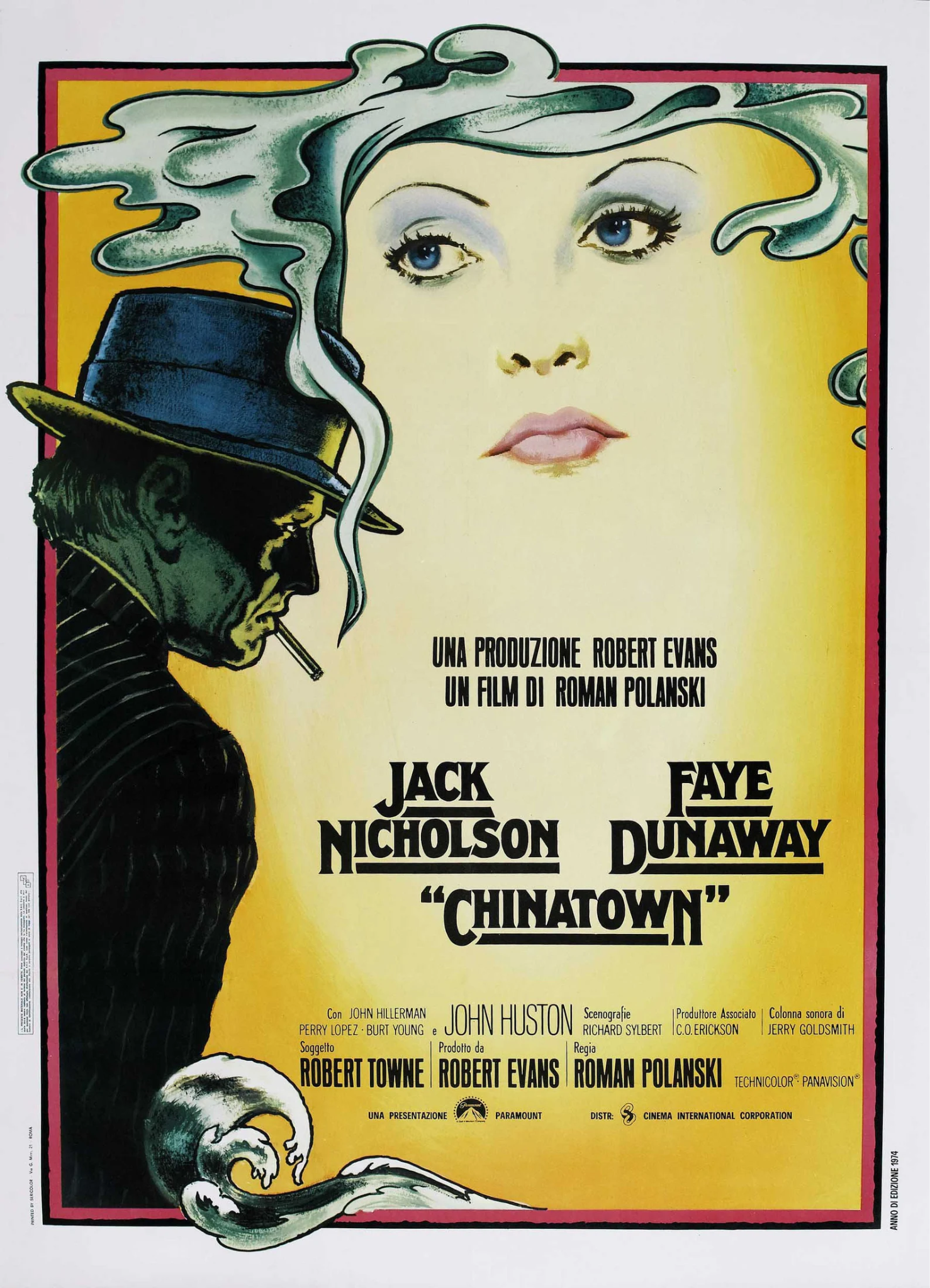
Chinatown is a film which I doubt requires much introduction. Directed by Roman Polanski, written by Robert Towne (for which he won the film’s sole Oscar) and starring Jack Nicholson, John Huston and Faye Dunaway, it’s a film in which every member of the creative team is at the top of their respective games, and perhaps the only “neo-noir” film which can hold a candle to the best works of the genre’s classic era (e.g. The Third Man, The Big Sleep). The film passed its fiftieth anniversary last year, and remains just as twisty, immersive and engaging as it was upon release. Unfortunately, it’s also a film which has become a go-to example of “separating the art from the artist”, for which any praise must be heavily qualified and prefaced by acknowledging that, whatever its artistic merits, the film’s director later committed an unspeakably heinous crime for which he faced minimal repercussions, legal or otherwise.
With that out of the way, a synopsis. In Los Angeles in the 1930s, Jake Gittes is a private detective and former police officer who specialises in matrimonial work (i.e. investigating his clients’ spouses for possible infidelity). A woman named Evelyn hires him to spy on her husband Hollis Mulwray, chief engineer for the city’s water department. While surveilling him, Gittes learns that Mulwray is vetoing a new proposed dam for safety reasons, and was witnessed having a loud public argument with a man named Noah Cross. Gittes surreptitiously takes a photo of Hollis embracing a young woman, and the photo is leaked to the media, embarrassing him. A woman he does not recognise confronts Gittes in his office, and explains that she is the real Evelyn Mulwray: the other woman was a prostitute hired to impersonate her. Shortly thereafter, the police uncover Mulwray’s drowned corpse in a reservoir, and Evelyn hires Gittes to investigate his death.
In the course of his investigation, Gittes is warned off by two thugs from the water department. Gittes learns that Hollis once owned the water supply privately, along with his father-in-law Noah Cross (Evelyn’s father), but Hollis subsequently decided that the water ought to belong to the public, contrary to Cross’s wishes. Gittes meets with Cross, who informs him that the young woman Gittes photographed with Hollis has gone missing, and offers to double the fee Evelyn has offered him if Gittes manages to track the young woman down. Gittes gradually uncovers a plot to buy up huge tracts of land in the Northwest Valley under assumed names, by sabotaging the existing landowners’ farms and forcing them to sell their land for a fraction of its value. He suspects that Hollis was murdered when he uncovered the plot. After escaping some thugs sent to kill them, Gittes and Evelyn return to Evelyn’s house, where they have sex. Evelyn answers the phone in the middle of the night and leaves the house; Gittes discreetly follows her to her butler’s home, where he witnesses her with the young woman he photographed with Hollis, apparently forcing her to take tranquillisers. When Evelyn emerges from the house, Gittes accuses her of holding the woman hostage, which Evelyn denies, insisting that the woman is her own sister, Katherine, and that she is holding her there for her own protection. Gittes subsequently learns that, owing to the presence of saltwater in his lungs, Hollis could not have drowned in the reservoir: he must have been drowned elsewhere, and his corpse moved. Returning to Evelyn’s home, he finds a pair of glasses in the saltwater pond in her garden, and infers that Hollis was drowned in the pond and his body subsequently dumped in the reservoir. He drives to Evelyn’s butler’s home, notifies the police of the address, then accuses her of drowning Hollis in the pond and withholding information from Gittes. Evelyn confesses that Katherine is both her sister and her daughter: her father, Noah Cross, raped her when she was fifteen. She also tells him the glasses he found in the pond are not Hollis’s. Gittes realises that Cross must have drowned Hollis in the pond, and during the struggle his glasses must have fallen in.
Gittes arranges for Evelyn and Katherine to flee to Mexico by car, then escapes from the police and summons Cross to Evelyn’s house. Cross reveals that his plan is to incorporate the Northwest Valley into the city, then irrigate it using water from the reservoirs. Gittes accuses him of murdering Hollis, but Cross retrieves the glasses from him by having one of his thugs hold him at gunpoint. Gittes is forced to drive Cross to his agreed rendezvous point with Evelyn in Chinatown. Unfortunately, the police are waiting and detain Gittes by handcuffing him to a car. Desperate to escape, Evelyn shoots Cross in the arm, hurriedly bundles Katherine into a car and drives away. The police open fire, fatally striking Evelyn in the head. Cross clutches Katherine and leads her away, and the police order a traumatised, practically catatonic Gittes to be released.
Polanski and Towne’s intentions with Chinatown were many and various: for one, subverting the noir genre by using its established tropes to mislead the audience. For example, on a first viewing, the viewer will probably assume (as Gittes does) that Evelyn is a sinister femme fatale like Phyllis Dietrichson in Double Indemnity, when in fact she is likely the most sympathetic and morally upstanding character in the entire film. For his part, Polanski thought that, using the new creative freedom afforded to he and Towne by the repeal of the Hays Code, an unambiguously tragic ending was the only way the film could transcend its fate as a superficial noir pastiche.[2]
But where does the slave morality enter into it? The key to understanding film’s worldview, in my opinion, comes in the scene after Gittes and Evelyn return to Evelyn’s home after escaping from the thugs, and Evelyn asks him the last time he found himself in a comparably dangerous situation:
Jake: In Chinatown.
Evelyn: What were you doing there?
Jake: Working for the district attorney.
Evelyn: Doing what?
Jake: As little as possible.
Evelyn: The district attorney gives his men advice like that?
Jake: They do in Chinatown.
[some time later]
Evelyn: Why does it bother you to talk about it?
Jake: It bothers everybody who works there… for me it was just bad luck.
Evelyn: Why?
Jake: You can’t always tell what’s going on.
Evelyn: Why was it bad luck?
Jake: I was trying to keep someone from being hurt, and I ended up making sure that she was hurt.
The entire exchange, naturally, foreshadows the film’s ending. “As little as possible” are also Gittes’s last words in the film, as he stares at Evelyn’s bullet-riddled corpse and reflects on how, once again, his thoughtless blundering into a situation beyond his understanding has resulted in harm coming to a woman he cared for. Screenwriter Robert Towne based the line on a conversation he’d had with a Hungarian vice cop who had worked in Los Angeles’s Chinatown. Dealing with a confusing mélange of rival gangs speaking in varying dialects, the police officer came to the conclusion that the “police were better off in Chinatown doing nothing, because you could never tell what went on there”, and the police had no way of knowing whether their interventions were helping the victims of crime in the area, or furthering their exploitation. The film’s profound cynicism about the ability of law enforcement to rectify societal ills is made particularly explicit in an earlier draft of the screenplay, which features a line ultimately cut from the film. In the film’s opening scene, Gittes is presenting an unrelated client named Curly with evidence of his wife’s infidelity. A distraught Curly announces that he’d like to murder his wife, but Gittes dissuades him, noting that “you gotta be rich to kill somebody, anybody and get away with it” – and “rich” Curly certainly is not. Towne later admitted that he regretted removing the exchange, arguing that it foreshadowed the entire movie.
The worldview presented by Chinatown is one in which the strong do what they can, and the weak suffer what they must. Any efforts taken by the powerless to remedy or ameliorate this state of affairs is doomed to failure, as they will find their actions ultimately in unwitting furtherance of the nefarious goals of the wealthy and powerful. In such a situation, one’s best bet is simply to do “as little as possible”, hoping that, by so doing, you can at least take solace in the knowledge that you did not exacerbate an already bad situation. It is, in effect, a film about a private investigator, in which the act of investigating causes nothing but destruction and ruin. Lest you think I’m exaggerating, Towne expounded on his intentions for the film in a 1988 interview with NPR:
Chinatown itself, I guess, is a sort of metaphor for the futility of good intentions [emphasis mine]. You simply – individual actions don’t necessarily matter even though we’d like them to, even though we’d all like to be like Rambo and think we could singlehandedly [sic] win a war that we lost. And Chinatown suggests that a good man or a man who is not necessarily good all the time but would like to do something decent has his hands full when he tries to disentangle the Gordian knot that is really the kind of thing that most of us have to disentangle if we’re going to do anything decent.
And most of us – ever since we’ve seen popular entertainments like James Bond, where he’s licensed to kill, have always felt that, yes, we’ve kind of worshiped the job. It’s a dirty job, but somebody’s got to do it. We got to get those – you know, we’ve got to destroy the city in order to save it. We’ve got to win at all costs. And I think that you have to reach a point where you say, do I have to win at all costs? Is it – am I going to be saving more than I’m destroying? [emphasis mine]
Now, I’m sure there is not a man alive who would dispute that “be mindful that your well-intended actions may backfire or carry negative consequences you did not intend” is fundamentally sensible advice. Likewise, the assertion that “the wealthy and powerful sometimes commit heinous crimes with impunity and get away scot-free, while a poor person who did the same thing would feel the strong arm of the law” – everyone, at every point on the political spectrum, would surely agree that this is true at least some of the time (hell, the film’s director is a living example thereof).
But with his talk of the “futility of good intentions”, it is my opinion that Towne carries these observations far beyond their logical extremes and ends up in an ugly, fatalistic (or perhaps quietist) destination. It is one thing to assert that our actions can sometimes inadvertently bring about consequences we didn’t want, and that powerful, evil people may stand to benefit from these consequences: it is quite another to assert that, therefore, one should only do the bare minimum, and that doing any more than that is more or less guaranteed to make a bad situation even worse. This neatly ties in with Ozy Brennan’s explanation of what slave morality really entails: doing “as little as possible” is an activity that corpses notably excel at.
Freddie deBoer describes this attitude as political Calvinism. In the Calvinist branch of the Protestant faith, a certain number of individuals called the “elect” are predestined to go to Heaven after they die, while others are condemned to Hell. Because their respective identities are predetermined at the outset, no decisions anyone makes in his lifetime will have the slightest bearing on his ultimate destination in the afterlife. It doesn’t matter what you do: your fate has already been set. deBoer was writing this in the summer of 2020 in the context of the then-ascendant Ta-Nehisi Coates/Ibram X. Kendi school of antiracism, which routinely makes assertions to the effect that “the United States (and, by extension, the West) is irreparably stained by the sin of white supremacy, and nothing we do will ever make the slightest difference to changing that basic fact”. This certainly sounds like a radical statement, as does Chinatown’s implied message of “we are impotent in the face of the rapacious whims of the wealthy and powerful: the best we can hope for is not to inadvertently aid and abet their dastardly schemes”.
But in reality, both statements are conservative and passive to their core. To be a progressive presupposes that progress is possible. But if progress is impossible, then there’s no good reason to be politically engaged or even to try to make a positive change in your immediate local environment. You can rot in your bed scrolling on Instagram all day long and end up no worse, morally, than someone who devotes every waking minute and every spare cent to trying to help the less fortunate. Sufficiently advanced cynicism, then, is indistinguishable from complacency.
Perhaps Chinatown might benefit from being read backwards, or considered in light of its presumed intended audience. At the time of the film’s production and release, the horrific unintended consequences of ostensibly well-intended intervention was a topic on the minds of every remotely politically engaged American. Maybe Towne intended the film as a much-needed corrective to the then-widespread (I assume) idea that good intentions, in and of themselves, are sufficient to bring about positive change: a wake-up call to busybodies who meddle in other people’s affairs, to the direct detriment of their intended benefactors. But just as there are many pathologically selfish people who might read Atlas Shrugged and come away from it thinking that it vindicates their lifestyle choices, there might equally be many pathologically passive, inert individuals who watch Chinatown and feel reassured that they have made the right choice not to even attempt to help those around them.
But I must confess: Towne’s comment about the “futility of good intentions” inclines me to believe he intended the film’s message as a universal one, rather than contingent. I can’t help but wonder which came first: the realisation that intervention carries unintended consequences, followed by the decision to hence remain passive and disengaged – or vice versa? Perhaps movies like Chinatown are what happens when you wake up in a swanky mansion, but are still acutely, uncomfortably aware of how much suffering there is in the world – but you feel no especial urge to devote any time or effort to attempting to ameliorate this state of affairs, particularly not if doing so would prove disruptive to the lifestyle to which you’ve become accustomed. As always when one finds oneself afflicted with cognitive dissonance, one has a choice to either change one’s mind or change one’s behaviour. But changing one’s behaviour (in this case, becoming more politically engaged, helping the less fortunate, actively trying to improve the world) is difficult and costly: it’s far cheaper to concoct elaborate psychological defense mechanisms with which to rationalise your decision to be politically disengaged and passive. Slave morality steps in to fill the gap: “if you intervened, you would only make a bad situation worse: ergo, your decision to do nothing is the best choice available, and therefore, you are morally superior to those who tried to help”.[3] Or as The Last Psychiatrist[4] might put it: it’s extremely easy to continue practising the same destructive behaviours you always have, while ostentatiously announcing how much doing so makes you hate yourself – far more difficult to actually change your behaviour. I discern some of the same performative woe-is-me bluster in the attitude implicitly endorsed by Towne: “I’d really like to make the world a better place, honestly I would – but I know that if I tried to do so I’d just make matters worse, a fact that pains me to my very core, no joke. But nothing I can do can change this state of affairs one iota – better just put my feet up and watch TV.”
Perhaps what I find so contemptible in this worldview is how nakedly self-serving it is. Much as with Orwell’s observation that “those who ‘abjure’ violence can only do so because others are committing violence on their behalf”, passivity and inertia are only possible in a world in which some people actually do take action. Towne spoke to his vice cop from Hungary, who spoke eloquently about how police ought to only do the bare minimum lest they exacerbate a bad situation, and thought it such a penetrating insight into the human condition that it was worth constructing an entire film around. But if someone had assaulted Towne and he called the police to report the crime, I can’t imagine he’d have been too impressed if the detective handling his case shrugged his shoulders and announced that investigating the crime was pointless: after all, wasn’t there every chance that the act of so doing might carry negative unintended consequences for Towne himself down the line? Passivity and inaction for me, not for thee.
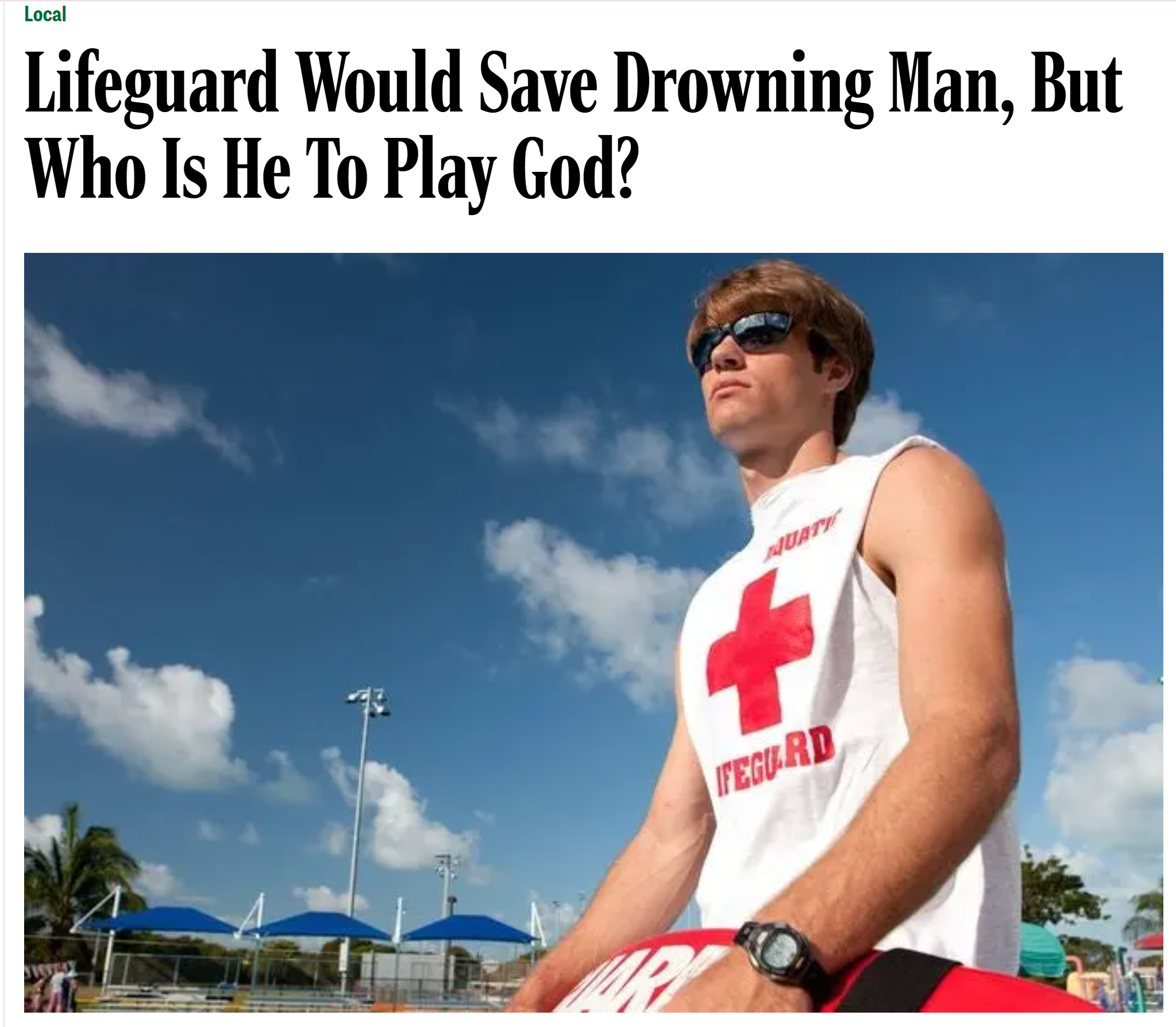
Source__.
Cognitive dissonance of this sort is a major theme of the second work I’ll be analysing, to the point that the term is explicitly defined therein.
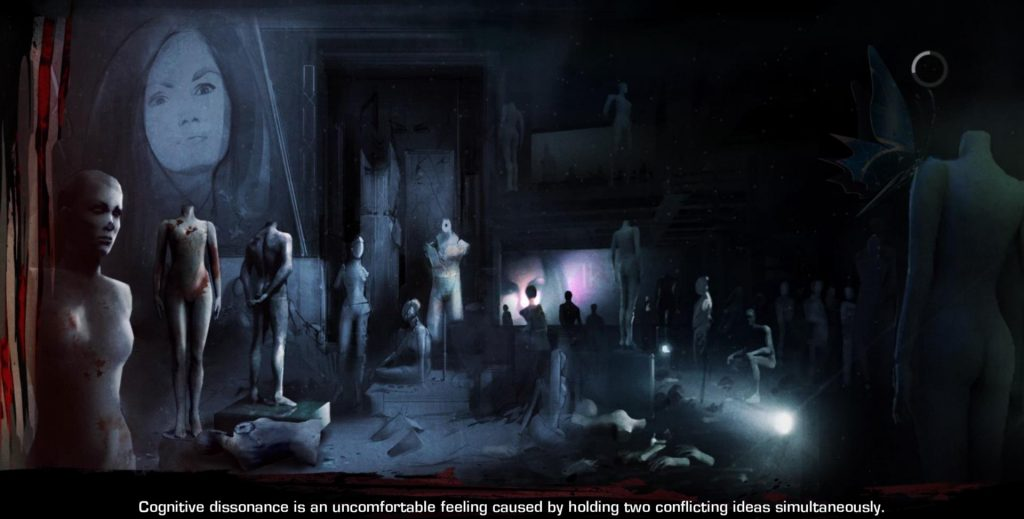
Loading screen from Spec Ops: The Line.
Spec Ops: The Line
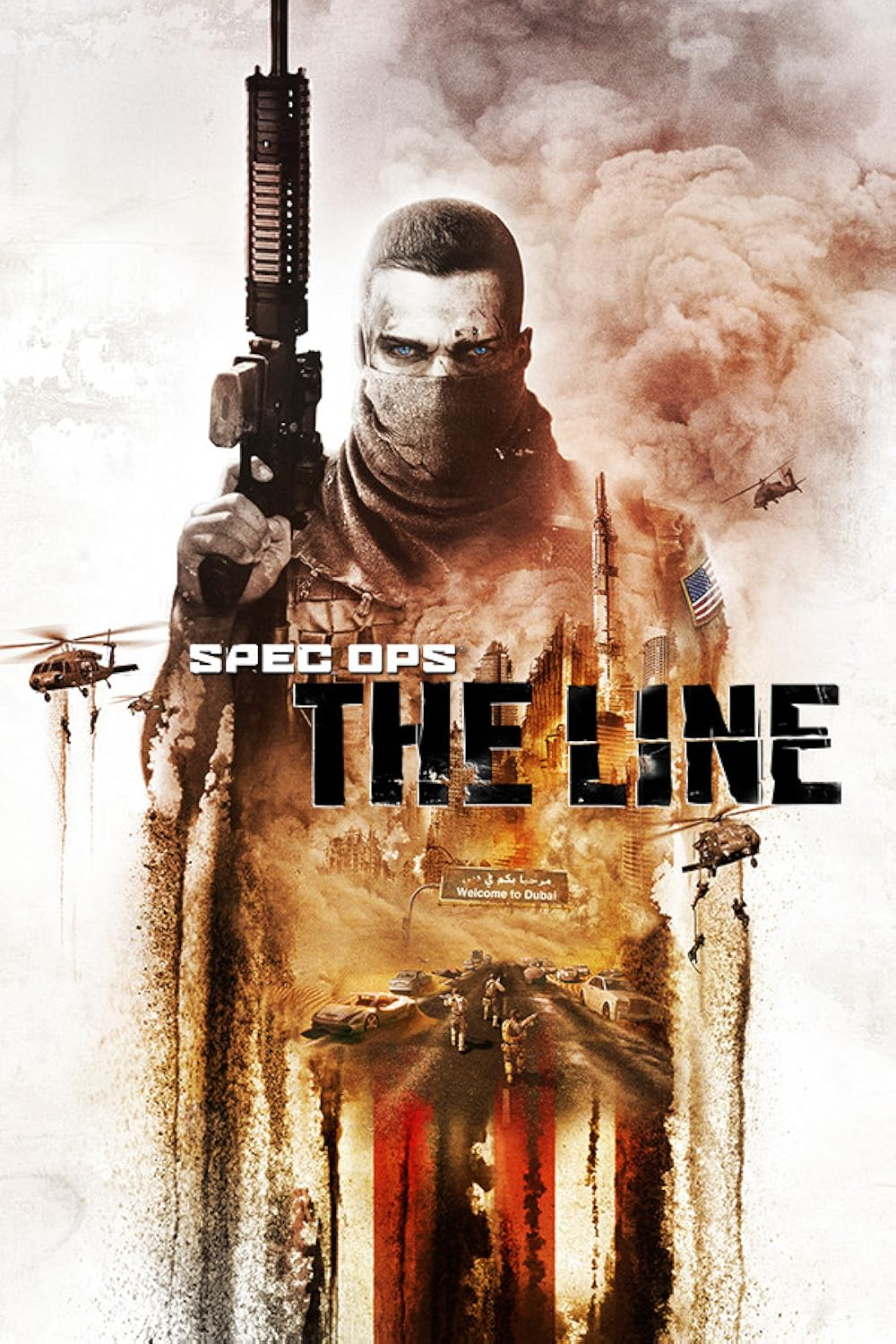
Spec Ops: The Line is a 2012 third-person shooter video game from the German development studio Yager Development, with Cory Davis serving as lead designer and the narrative designed by Walt Williams and Richard Pearsey. The game was marketed as a modern military shooter in the vein of contemporary commercial heavyweights like Call of Duty or Battlefield, in which the player typically controls an American soldier sent to fight in a Middle Eastern conflict. Inherent to the subgenre is an implicitly positive attitude towards American military intervention, in which the complexities and moral ambiguities of real warfare tend to be minimised or overlooked in favour of a binary black-and-white Manichaeism: the player goes in, kills all the bad guys and saves the day.[5]
Spec Ops: The Line’s inciting incident is a massive sandstorm in the UAE which destroys much of Dubai, killing millions. John Konrad [6], an American colonel stationed in Afghanistan, volunteers to lead his battalion (the so-called “Damned 33rd”) into Dubai to assist in rescue and evacuation orders, where they remain even after being ordered to withdraw by top military brass. Struggling to maintain law and order, the increasingly desperate 33rd imposes martial law on the city and commits atrocities as part of its efforts to keep the peace, while Konrad makes plans to lead a caravan of survivors out of the city. Owing to the extreme weather conditions, all communication with the Damned 33rd is lost, until six months later, the American military picks up a distress call, in which Konrad describes the attempted evacuation of the city as a “complete failure”.
The player controls Cpt. Martin Walker, a Delta Force operator who is sent into Dubai (along with two team members, Lt. Adams and Staff Sgt. Lugo) to investigate the distress beacon. Shortly after arriving, the Delta Force squad is ambushed by a group of Emirati insurgents, whom it engages in combat. Venturing further into the city in direct contravention of his orders, Walker learns that the 33rd battalion is seemingly being led by the “Radioman”, an embedded American journalist who barks orders at them via a citywide PA system; while the insurgents, for their part, are taking marching orders from a group of CIA agents, of whose presence Delta was thitherto unaware. Delta are mistaken for CIA agents by soldiers of the 33rd, and are forced to kill them in self-defense. Shortly afterwards, Delta stumbles across an abandoned hotel, in which soldiers of the 33rd are rounding up women and children. Surmising that they intend to massacre the civilians, Delta intervenes to stop the 33rd, but some of the soldiers manage to escape with over forty women and children in tow.
Walker insists to his men that, even if the 33rd has apparently gone rogue, Col. Konrad himself must not be involved. As evidence of Konrad’s honourable character, Walker cites his personal experience of serving under him in Afghanistan, during which time Konrad saved Walker’s life. Believing that the CIA will be able to lead them to Konrad and thereby de-escalate the conflict, Delta battles its way through platoons of 33rd soldiers in pursuit of an agent named Gould. Gould is killed by the 33rd, but Delta learns that his mission involved a building called the Gate. Making their way to the Gate, Delta finds its way impeded by an entire company of 33rd soldiers, far too many to be defeated with small arms fire alone. Despite Lugo’s protestations, Walker decides to deploy a white phosphorus mortar on the company, which inflicts horrific chemical burns on those afflicted by it. After defeating the company, Walker and his men make a gruesome discovery at the rear of the encampment: by using the mortar, they have accidentally killed the forty-seven Emirati women and children the 33rd led from the abandoned hotel, whom the 33rd had rounded up specifically to prevent them from getting caught in the crossfire. Inside the Gate, Walker finds the corpses of Col. Konrad’s command team, whom Konrad had had executed; and a portable radio, through which Konrad speaks with him, taunting him for his naïveté and errors in judgement. Walker infers that it has been Konrad who has been leading the rogue 33rd all along, and that the Radioman is merely his lackey.
Shortly thereafter, Delta rescues a CIA agent named Jeff Riggs from an assault by the 33rd. Riggs explains that his goal is to secure the trucks the 33rd use to distribute water to civilians in Dubai – if the CIA succeeds, they will cripple the 33rd’s control over the city. Walker and his squad assist him and succeed in commandeering the trucks, but almost immediately afterwards, Riggs intentionally crashes and destroys them. Trapped underneath one of the trucks, Riggs explains his reasoning to Walker: were the Arab nations ever to learn of the atrocities Konrad and the 33rd had committed as part of their efforts to maintain law and order in Dubai, they would wage war against the US in retribution. By destroying the trucks, Riggs has condemned the survivors to a slow death by dehydration, thereby preventing the truth about Dubai from getting out.
Suffering from PTSD-induced hallucinations and growing increasingly aggressive, erratic and impulsive, Walker decides that his only hope is to evacuate Dubai of its few remaining survivors, a goal Konrad assures him is an impossibility. To that end, Delta locates the tower from which the Radioman is broadcasting. When the squad confronts an unarmed Radioman, Lugo abruptly shoots him dead, after which Walker broadcasts a message to the whole city through the PA system, in which he vows revenge on the 33rd. Commandeering a helicopter, Walker uses its mounted minigun to destroy the entire upper floor of the tower, including all of its PA equipment. Delta attempts to escape from the 33rd helicopters in pursuit, but their helicopter crashes in the desert and Walker is separated from Adams and Lugo. Walker locates Adams, but arrives too late to save Lugo from a lynch mob of furious Emiratis, whom the player has the option of massacring in retribution.
Walker decides the only goal worth pursuing is to kill Konrad, and leads Adams to the Burj al-Arab, which the 33rd is using as its headquarters. Slaughtering what few 33rd soldiers remain, Walker abandons Adams and ascends to the tower’s penthouse alone, whereupon he makes a horrendous discovery: Konrad had committed suicide days prior to Delta’s arrival in Dubai. Since accidentally killing the civilians outside the Gate, the guilt has driven the already unstable Walker into a dissociative episode, and the Konrad taunting him over the radio was in fact a hallucination. The hallucinatory Konrad (Walker’s own conscience, in effect) condemns Walker for having brought nothing but death and destruction to Dubai in his misguided pursuit of heroism, asserting that all of it could have been avoided had Walker simply followed his orders and not intervened in the conflict at all. Finally, Konrad presents the player with a choice: they can either shoot the hallucinatory Konrad (implicitly pinning the blame for the events of the game on him); or have Walker follow the real Konrad’s example, and shoot himself in the head.
The genesis of the game is an interesting one. Spec Ops was an existing shooter franchise in the late 1990s and early 2000s, which had lain dormant since its last entry in 2002. The publisher, 2K Games, was keen to revitalise the franchise, and hired Yager to develop a reboot, instructing them to modernise the franchise by taking pointers from the modern military shooter genre. Over the course of several years of development, the dev team gradually grew increasingly disgusted and disillusioned with themselves and their target demographic, unable to deny the cynicism inherent to creating a video game in which gunning down endless waves of human beings is presented as sanitised light entertainment. But rather than simply grinning and bearing it, they decided to incorporate these feelings of disgust and self-loathing into the game’s design, presenting a narrative which would deconstruct the modern military genre, and challenge the players to consider why they play games like this in the first place.
Much as in Chinatown, Spec Ops presents a story in which disaster follows the protagonist’s well-meaning but misguided decision to intervene in a situation he does not fully understand: a tragedy about the “futility of good intentions”. (At one point in his closing rant, the hallucinatory Konrad asserts to Walker that “None of this would have happened if you’d just stopped”; he might as well have said: “None of this would have happened if you’d just done as little as possible”.) As such, Spec Ops is just as much a paean to heroic inaction as Chinatown was – even more so, as Walker’s actions result in thousands of deaths, many hundreds of them directly by his own hand. In a game featuring multiple endings (each bleaker than the one preceding it), the developers have explicitly stated that they consider the “happiest” ending the one in which the player elects to put down the controller and stop playing the game without seeing it through to the end. Much as Chinatown is a private investigator film in which investigation leads to tragedy, Spec Ops is a video game in which, to quote WarGames, “the only winning move is not to play”. (Once again, per Ozy, not playing a video game is something that even a corpse can do perfectly well, and it’s no coincidence that two of the game’s four endings depict Walker dying, one of them by his own hand.)
As a self-reflexive (one might even say masturbatory) “game about games” in the vein of Metal Gear Solid 2 or BioShock, Spec Ops: The Line is close to unimpeachable. It is inarguably true that the modern military shooter genre encodes various hidden assumptions into its game mechanics, assumptions which are all the more queasy and disquieting for going unexamined; that games about war habitually gloss over many of the complexities and difficult decisions inherent to real-life conflicts (like war crimes and civilian collateral damage); that even the combatants who survive real-life conflicts are often left horrifically scarred by their experiences, unlike the wisecracking, perpetually unfazed badasses which populate even the video games purporting to be realistic (at least as far as their graphics and physics engines go). These points are forcefully made and well-taken.
It’s when the game moves away from analysing video games themselves and towards making critical arguments about real-world American military intervention that it veers onto much shakier ground.[7] Shortly after playing the game the year after its release, my initial thoughts about it were heavily inspired by Chris “Campster” Franklin’s video essay about it:
As formal systems, computer games often have problems with ambiguity. Most games (not all, but most) have win states… The problem with win states is that they contextualise play in such a way that anything that pushes you towards the win state is good, while anything that pushes you away from this win state is bad. For example, from a ludic perspective, shooting the guys that are blocking your path forward in Call of Duty is an absolute good: it gets them out of the way so that you can safely traverse the map in order to reach the end, which is the level’s win state. Without any other mechanic suggesting something to the contrary, or a narrative recontextualization of those mechanics, the game’s rhetorical position is that shooting these men is an unequivocally good thing… By and large, game stories reflect the black-and-white nature of the gameplay, and assure you that you’re on one side or the other of a binary morality – usually the good side. This sort of reductionist moral philosophy is OK for family-oriented games, like Mario… But it’s extremely dangerous in the context of modern military shooters, because so much of the rest of the setting has a high level of fidelity to real-life.
Pairing these gameplay and narrative aesthetics that reinforce a binary morality with the visual and audio imagery of real-world military actions promotes the idea that these actions are either objectively good or evil. It propagandises the glory of [the United States’s] own military actions, while villainizing those of others. It argues against a more complete and complex understanding of events, where both parties involved may be in some way at fault. It boils complex political situations and historical conflicts down to “which one were the good guys again?” … Western powers being shown as an absolute good crushing the evil Arab or Russian or Asian enemies boils complicated geopolitics down to an oversimplified fairy tale that's disingenuous rah-rah nationalism at best, and destructive to meaningful discourse at worst.
When it comes to moral complexity and ambiguity, the mere presence of characters with sincerely good intentions who take actions which backfire horribly places Spec Ops: The Line head and shoulders above its brethren in the shooter genre, overwhelmingly populated as it is by one-dimensional lantern-jawed heroes and moustache-twirling villains. And yet for all that, it strikes me that many of Franklin’s points about the deficiencies of the modern military shooter genre apply just as much to Spec Ops: The Line, but in the opposite direction. While every action the protagonist in a conventional shooter takes brings him one step closer to saving the day, Spec Ops stacks the deck such that every single action Walker takes makes the situation even worse: at no point in the game does Walker ever do something intended to benefit another person, and actually succeed in improving their lot. As such, the game has effectively supplanted one set of contrivedly black-and-white game mechanics with another: a set of mechanics in which doing “as little as possible” (indeed, not playing at all) is the dominant strategy, always preferable to taking action of any kind. Suffice it to say that I believe such a mechanics set bears little more relationship to real life than the simplistic, sanitised heroism of Call of Duty and its ilk.
And just as Franklin is troubled by video games which pair hyper-realistic imagery reminiscent of real-world political conflicts with game mechanics that admit of no ambiguity between heroes and villains – well, so too am I troubled by Spec Ops’s own handling of the same set of tropes. If Franklin is concerned that gamers might play a Call of Duty game and arrive at the (presumably unintended but entirely foreseeable) conclusion that real-world politics are exactly as uncomplicated as the game implies, and that American military intervention overseas is always a force for good – I worry that someone might play Spec Ops: The Line and arrive at the opposite conclusion: that American military intervention overseas is always a force for bad, that no good will ever come from it, that the world will always be better off if the US doesn’t send troops in. Such a perspective, you’ll note, is nigh-indistinguishable from the isolationism of Donald Trump, or indeed of Charles Lindbergh. It’s not tilting at windmills to note there really were lots of Americans in the 1940s who sincerely thought the United States had no business getting involved in the Second World War: as late as April 1941, a full third of the country were opposed to the idea, and I’m sure there were quite a few who still thought this even after the truth about the Holocaust had become public knowledge.
The question of what role the US should play in maintaining the rules-based international order is a complex and difficult one with no easy answers. Call of Duty and its ilk sidestep these complexities by forcefully asserting “American military intervention good, next question”, presenting sanitised, one-sided narratives in which the American military is heroic at best and temporarily ineffectual at worst. Spec Ops sidesteps these complexities in the opposite direction by highlighting to an almost ghoulish degree all of the horrors that might result from such interventions, ignoring all positive outcomes that have historically resulted from them, and presenting even its legitimately well-meaning characters as misguided, stubborn, narcissistic and self-aggrandising. A monomaniacal fixation on the costs associated with taking action and a hyperbolic discounting of the concomitant benefits is, after all, the essence of slave morality.
At one point in his closing rant, the hallucinatory Konrad scoffs at Walker, “You’re here because you want to be something you’re not: a hero”. If this line is only intended as an observation about video games themselves, fair enough: who would dispute that experiencing a vicarious power fantasy is a major motivating factor in why gamers play shooters? But if this line is intended as a commentary on American military intervention overseas, then the hallucinatory Konrad seems to be suggesting that the very idea of an American soldier performing an act of heroism is just absurd on its face. Far be it from me to suggest that American military intervention abroad has always (or even primarily) been a force for good: the examples of Korea, Vietnam, Iraq, Afghanistan and so on and so forth (and there is a lot of so forth) are well-trodden territory among the anti-interventionist set, examples I have no desire to defend. But hot take incoming: I do, in fact, believe that the American soldiers who helped liberate Europe from the Nazis were heroic. The fact that, in the course of doing so, these soldiers accidentally killed civilians and committed other acts which we would retrospectively (or even contemporaneously) consider violations of the Geneva Conventions does nothing to fundamentally alter this opinion. The counterfactual world in which they did not do so would be poorer than ours.
Williams and Pearsey might defend themselves by arguing that they only intended Spec Ops as a meta-commentary on shooter games, and gamers who interpret it as an argument in favour of American isolationism and non-intervention are reading arguments into it that they never personally intended. But of course, I’m sure the writers of the Call of Duty or Battlefield games would deploy exactly the same argument: that they only ever intended their games as light entertainment, and that they hence bear no responsibility if their audiences interpret them as serious geopolitical commentary, or as accurate portrayals of contemporary real-world conflicts. The whole crux of Spec Ops’s critique of modern military shooters rests on the idea that their creators’ stated authorial intent is irrelevant: that they bear responsibility for all the messages their games convey, explicit or otherwise. You can’t make such a critique, then turn around and demand only to be judged on the basis of the messages you explicitly intended.
The implied thesis of Call of Duty or Battlefield games, “American military intervention overseas is always noble and righteous, and no unnecessary harm will ever come from it”, is simplistic and inaccurate. Spec Ops presents the antithesis, in which American military intervention is always fundamentally wrong-headed, no good will ever come from it, and the best outcome will always come from American soldiers sitting on their hands. Perhaps, like Chinatown, presenting this antithesis served as a necessary corrective to the prevailing trends at the time of writing. But what’s needed now is the third phase, the Hegelian synthesis, the reconstruction, in which we can acknowledge that great harm has resulted from American intervention overseas, while also recognising that there may be rare instances (such as the Holocaust) in which it really is the best option – or at least, the best of a bad bunch.
Knowledge and power
Having read several of the aforementioned The Last Psychiatrist’s blog posts and finding them rife with penetrating, discomfiting insights, I eagerly purchased his book Sadly, Porn, which he published under the pen name (I assume?) Edward Teach. I’m not exaggerating when I say that, in a list of the most impenetrable books I’ve ever read, it would easily make the top ten: occasional glimmers of legible insight and wisdom, buried within mountains of contemptuous stream-of-consciousness ranting about Greek tragedy, children’s books, imaginary porn films and forgettable nineties thrillers. Most of its presumably intended meaning I gleaned from secondary sources, such as these reviews by Scott himself and Rob Henderson. Scott later acknowledged that the book became a lot easier to comprehend when approached from the perspective of master vs. slave morality, rather than the Lacanian perspective he’d adopted on a first pass.
Throughout the book, Teach posits a kind of adversarial relationship between power and knowledge, in which seeking knowledge makes one powerless and vice versa. This was one of many points I didn’t really understand while reading the book, but writing this essay has me groping towards a possible interpretation.
Both Chinatown and Spec Ops: The Line have been interpreted as parables about the dangers of acting with insufficient information. Jake Gittes is sincerely well-intended, but makes several bad decisions on the basis of erroneous assumptions e.g. believing the impostor who claims to be Evelyn Mulwray and agreeing to spy on Hollis on that basis; inferring that Evelyn murdered Hollis and hence providing the police with her location. Likewise Cpt. Walker, who mistakenly assumes that the 33rd are rounding up civilians from the hotel for purposes of massacring rather than protecting them; who carelessly deploys the white phosphorus mortar without properly scouting the field of fire for a civilian presence; and who never stops to really consider why Riggs is so intent on gaining control of the water trucks.
“Don’t act until you have enough information to make an informed decision” sounds sensible on its face. But in reality, it’s a meaningless aphorism, no different to the admonishment to “never assume”: how much information is “enough”? It’s something that can only really be determined in retrospect: you’ll know your decision was an “informed” one only after you’ve made it and it hasn’t hideously backfired because of something you weren’t aware of at the time you made it. We are always acting from a place of ignorance and incomplete information – the difference is only a matter of degree, and perfect, absolute knowledge of a given situation is both a practical and literal impossibility. Ergo, “I didn’t act until I had enough information” is an admonishment for passivity and inaction dressed up in the language of hard-headed commonsense.
This, I think, may have been what Teach was getting at when he talked about the antithetical relationship between knowledge and power: while “don’t act until you have enough information to make an informed decision” might sound sensible on its face, it’s an absolute godsend to those inclined towards inaction. While these people are constitutionally inclined to do “as little as possible”, they will always insist that the reason they have failed to act isn’t that they are globally passive, but simply contingently passive up until the point at which they’ve gathered “enough information” with which to make an informed decision. But because “enough” is underdetermined, you can go on gathering information forever, and still feel like you don’t have “enough”. In the Teachian perspective, as mentioned earlier, ostentatious self-loathing isn’t a starting point towards positive change, but rather a defense against positive change. By the same token, collecting information isn’t something done in order to make informed decisions, but something done as a defense against having to make decisions of any kind.
Looking at the stories of Chinatown and Spec Ops: The Line from a zoomed-out perspective, it’s easy for us to conclude that its protagonists were acting in ignorance, and that in hindsight things would have turned out better had they not gotten involved. But in real life, we are never acting with foreknowledge: we are only ever acting from a place of comparative ignorance. Viewed in this light, our two protagonists actually come off rather better than their creators would have us believe. Gittes’s inference that Evelyn had drowned her husband in a jealous rage (and hence that he should turn her in to the police, lest he be arrested as an accessory after the fact) was erroneous, but a reasonable conclusion given the information available to him at the time – and Evelyn herself bears no small amount of responsibility for actively misleading him. If Gittes had been correct, doing nothing and allowing a murderer to escape scot-free would have been the wrong decision. Likewise, Walker’s conclusion that the 33rd were rounding up civilians from the abandoned hotel in order to massacre them was incorrect, but reasonable given the information known to him at the time: if he’d been right, doing nothing and allowing the 33rd to murder a group of women and children in cold blood would have been the wrong decision. In retrospect, he ought to have thoroughly scouted the 33rd encampment before giving the order to fire the white phosphorus mortar – but given that, only a few minutes earlier, he’d personally witnessed soldiers of the 33rd torturing and executing civilians in hopes of extracting information from Gould, it was hardly unreasonable of him to assume the 33rd did not have the best interests of the Dubai civilians at heart.
Conclusion
Refusing to intervene may feel like passivity, but it is not. Inaction, paradoxically, is a subset of action: the decision not to intervene is not “the lack of a decision”, but a decision in and of itself, on the basis of which the person who made it can be morally judged in just the same way as the person who decided to intervene. In many jurisdictions, a person who declines to intervene to help another person can be held criminally responsible for their inaction.
A world in which refusing to take well-meaning action always resulted in better outcomes than taking well-meaning action would be an easy world to live in. In the short term, it may even be comforting to imagine such a world. But such a world is not our world.
Footnotes
- ↩
I’m sure it goes without saying that I cannot discuss the two works’ themes without discussing their plots in detail, and also that I think both works are well worth experiencing for yourself unspoiled – but for the sake of clarity, spoilers for Chinatown and Spec Ops: The Line below.
- ↩
The specifics of this ending were a major point of contention between him and Towne, to the point that the two were no longer on speaking terms by the time the scene in question was filmed.
- ↩
Perhaps related: several studies have found that low-income households donate a higher proportion of their incomes to charitable causes than do medium- to high-income households (but, as ever, bear in mind the perennial warning).
- ↩
a.k.a. Edward Teach, author of Sadly, Porn, to whom I’ll be returning later.
- ↩
It has been argued that some of these games’ narratives are more complex and morally ambiguous than the strawman Spec Ops: The Line implicitly holds up for criticism. For example, the American campaign in Call of Duty 4 famously comes to an abrupt end with the American forces powerless to prevent a nuclear device from going off in the centre of the game’s fictional Middle Eastern city, followed by the American player character uselessly dragging himself around the blast zone before succumbing to radiation sickness. While I concede this specific point, it cannot really be argued that the game never really questions the fundamental righteousness of Western military intervention in foreign conflicts, and the soldiers in the British campaign do ultimately bring the conflict to a peaceful resolution. I have yet to encounter anyone defending any of the sequels to Call of Duty 4, or any of the Battlefield games in contemporary settings, along these lines: by all accounts, these games are exactly as one-sided, jingoistic and morally uncomplicated as Spec Ops implies.
- ↩
Named in reference to one of the game’s primary inspirations, Joseph Conrad’s Heart of Darkness, and its earlier loose film adaptation Apocalypse Now. Spec Ops’s player character, Martin Walker, is probably so named in reference to the actor who played that film’s protagonist, Martin Sheen.
- ↩
While the game was marketed as a deconstruction of modern military shooters first and foremost, critics were quick to also interpret it as a sustained critique of American military intervention. Chris “Campster” Franklin, for example, draws parallels between Konrad’s doomed mission in Dubai and the American-led invasions of Iraq and Afghanistan in the 2000s.