Bad News: How Woke Media is Undermining Democracy
Tony calls 911 twenty minutes before he dies. He tells the dispatcher that he’s schizophrenic and hasn’t been taking his medication. He says he’s afraid for his life. Then he hangs up the phone and runs into traffic.
A security guard sees him and runs after him. He places him in handcuffs and waits until the police arrive a few minutes later when the body camera footage begins.
“Help me!” Tony calls out.
“Hey, get on the ground,” Officer Dillard says.
“You’re gonna kill me! You’re gonna kill me!”
Another officer grins. “Yeah,” he says.
Dillard kneels on his back.
“Will you let me go, please?” Tony says. Tony begs for his life and says over and over that they’re going to kill him. Dillard continues to kneel on his back until he begins making unintelligible sounds into the grass. Then he stops moving after eleven minutes.
“Tony, you still with us?”
Tony doesn’t respond.
Dillard stays kneeling on his back while other officers peer down at Tony.
“Tony. Tony!”
“He’s out cold.”
“What the fuck? Is he asleep?”
The officers gathered around him start joking.
“It’s time for school. Wake up!” They laugh. Dillard continues to kneel on Tony’s unconscious body.
An officer mocks him in a child’s voice, “I don’t want to go to school! Five more minutes mom!”
“First day you can’t be late. Tony, we bought you new shoes for the first day of school, come on! Made breakfast. Scrambled eggs, your favorite.”
“With waffles!” Another chimes in.
“Waffles!”
“Rooty tooty fruity waffles.”
Dillard kneels on his unresponsive body until the paramedics arrive and they place him on a gurney. His body is limp. His eyes are partially open and glassy. “He ain’t dead is he?” Dillard says.
“No, he just looks it.”
“He didn’t just die down there did he?” Dillard looks back at the grassy spot where he held him down.
“I don’t think he did.”
“Is he breathing?” Dillard puts his hand on Tony’s chest and shakes. Tony stays limp.
The paramedics take Tony away.
Dillard seems worried but the other officers grin into Dillard’s body camera. They slowly walk over to the ambulance still joking and laughing the hardest they have all night.
Tony lies on a gurney in the back of the ambulance. One paramedic is sitting in the back, wearing purple gloves. Another is standing next to Tony. He looks back and says, “He’s not breathing.”
“He’s not breathing?”
“Nope.”
“Oh shit.”
Another officer calls into the ambulance, “I’ve got his mom on the phone and she knows all his stuff.”
A paramedic points at Tony. “He’s dead.”
Tony Timpa
Tony Timpa died on August 10, 2016, two years after protests over Michael Brown, Eric Garner, and Tamir Rice. Given the national discourse in the United States on policing, you would think that Tony Timpa’s death would get significant news coverage. But his death, as a white victim, went largely unreported in the national news. Four years after Tony Timpa’s death, George Floyd was killed in an eerily similar way. An officer knelt on him while he was pleading for his life, continuing to kneel after he went unresponsive. But the reaction was very different. Millions of people protested in the streets. Some turned into riots with 19 dead in the first 14 days. In Seattle, Antifa locked police officers in a building and then set the building on fire to try to burn them alive. President Trump was briefly safeguarded in an underground bunker. Eventually, six blocks of Seattle were conquered by a warlord and ruled as an autonomous fiefdom called CHAZ.
George Floyd’s death was ruled a homicide. The officers were charged and found guilty. Less than a year after he was murdered, his family was paid $27 million by the City of Minneapolis in a wrongful death settlement. Tony Timpa’s death was also ruled a homicide. However, the officers were not even charged, let alone found guilty. As of April of 2023, nearly seven years later, the family has so far received zero dollars in settlement.
As a white victim of police violence, Tony Timpa was not an aberration. White men are overrepresented among victims of police violence, making up 29% of America, but 44% of the victims according to the Washington Post Police Shootings Database. But it’s not only white victims who are ignored. Asian victims are ignored as well: Tommy Le, Christian Hall, and Angelo Quinto.
The difference in media coverage between these two deaths is staggering. The New York Times ran over four and a half thousand articles about George Floyd by April of 2023, but only five mentioning Tony Timpa. But how is it even possible for a white victim to be ignored in a country that the media itself so often portrays as white supremacist? Black Americans make up 13% of the American population, but are overrepresented among victims of police violence, making up roughly one quarter of the deaths. It is not a contradiction to say that A) It’s a problem that Black Americans are overrepresented among the victims of police violence and B) It’s a problem that three quarters of victims are ignored by the media because of the color of their skin. So how did the media become so hyper-fixated on George Floyd’s death and virtually ignore Asian and white deaths?
This racialization of media reporting is what Batya Ungar-Sargon covers in her book, Bad News: How Woke Media is Undermining Democracy. While books criticizing wokeness have proliferated recently, almost all of them come from a conservative perspective. What distinguishes Bad News from the others is Ungar-Sargon’s perspective as a progressive with about the most leftist credentials you can get. She has a PhD in English Literature from Berkeley — one of the most liberal campuses in the country — and her doctoral dissertation makes an Andrea Dworkinesque argument that consensual sex under patriarchy is rape: “The pre-modern alternative story—that traditional, patriarchal society had plenty of coercion which was eradicated under the magical sign of consent—is revealed for the fiction that it is” (Coercive Pleasures, 28). Her criticisms of the media cannot be dismissed as that of a right-wing reactionary. She calls herself a “vulgar Marxist” and her book is very much a Marxist project. It is this leftist perspective — along with her meticulous research, statistically grounded arguments, and very quotable prose — that makes her book worth reading over all the others criticizing wokeness, cancel culture, and identity politics.
Bad News shows how the technologies producing the newspapers influence the business model of journalism, and the business model controls the content of the newspapers, which finally shapes the dominant political narratives of the time. The book argues that our current technology for consuming and producing journalism — social media — has biased the coverage in favor of the wealthy laptop class, which uses racialized woke narratives to consolidate their power. Focusing on America’s historical racism and ignoring America’s contemporary classism allows journalists to cement the power of the upper class while portraying the (liberal) upper class as virtuous and the lower class as evil for not being as woke as they are. This allows them to morally justify their power: “There is a lot of contempt and even disgust for the working-class aesthetic and culture associated with people who haven’t gone to college. And that contempt is all too often clothed as antiracism” (Bad News, 231).
Journalism’s portrayal of America as an irredeemably white-supremacist nation ignores the glaring class inequalities in the country to the extent that this narrative becomes a form of class warfare. Ungar-Sargon repeatedly makes sure to not avoid America’s historical and current racism, but rather argues that it is dwarfed by class issues. By “woke” she means the belief that race is the primary boundary between the have’s and the have not’s, with a particular focus on intersectionality. She pushes back on the idea that race is the dividing line between the privileged and unprivileged in contemporary America:
“As is so often the case with wokeness, the theory’s ballooning popularity coincided with the growing mountain of evidence that it was wrong, at least factually. A study from 2020 published in the Quarterly Journal of Economics found that while black men earn substantially less than white men from a similar economic background, black women earn slightly more than comparably endowed white women. Black women are also more likely to go to college than white men from similar backgrounds…white men often fare worse than women of color, in direct contravention of intersectionality’s predictions; according to the most recent census data, Iranian, Turkish, and Asian American women all outearned white men” (Bad News, 154 - 155).
A New Populism: Penny Press Journalism
Bad News starts with the history of the penny press in America in the nineteenth century and describes how the industry responded to radio and television in the twentieth century, and the impact these technologies had on the stories that journalism covered. The largest part of the book is focused on the response of the industry to social media. A major point of the book is to contrast the populism of nineteenth century penny presses with the elitism of twenty first century social media journalism.
Bad News begins with the biography of Benjamin Day, an early pioneer of the American newspaper penny press. In 1833, newspapers were priced as a luxury good. It was difficult to buy a single paper, and it was only realistic to buy them through an annual subscription, which cost as much as a used car today. These newspapers were read by, and written for, the upper class. They focused on elite interests like politics and business and international affairs. At the time, America was the most literate country in the world, and penny presses for religious material and gallows confessions were already profitable. But Benjamin Day was the first to begin selling newspapers for a penny. In contrast to the newspapers targeting elite audiences, he focused on selling the papers individually on the streets rather than making the business model a subscription service, since his audience likely didn’t have the excess cash to invest in an annual subscription.
We quickly see that the coverage of the newspaper and the business model of the newspaper are inextricably linked. It gave voice to unions and working class concerns and focused on the crime that the lower classes faced. But this drew criticism from the wealthy critics who alleged that the penny presses were sensational in their focus on crime. Ungar-Sargon sees this criticism through a Marxist lens: “The charge of sensationalism would be the first time a class concern—protecting elites from having to reckon with the realities of lower-class life—would be clothed as a journalistic critique” (Bad News, 42). But, penny presses sometimes were sensational. Their business model demanded it. When they shifted to individual sales, rather than an annual subscription, it forced these penny presses to have nineteenth century versions of clickbait.
The Rich Strike Back
However, a new business model came to challenge these papers: the New York Times. The revenue model was focused on advertising rather than subscriptions or individual sales. Rather than trying to outsell the penny presses, the founder, Henry Raymond, just had to convince advertisers that his paper was a conduit into the minds and pocketbooks of the wealthiest consumers in the city.
Once again, we see how the business model shapes the content of the paper. The Times announced that it would be written for “good society” and part of the strategy of attracting wealthy consumers was focusing on national, rather than local stories, as well as a substantial business section. The serious tone of the paper was reinforced by a ban on comics and photographs, leaving a monotonous look that earned the paper the nickname the “Grey Lady.” An early slogan for the paper was “It Does Not Soil the Breakfast Cloth” — not so subtly indicating that the target audience had a tablecloth for breakfast at a time when butlers spent their mornings using a clothing iron on the newspapers so the ink wouldn’t stain the fabric.
Knowing about international affairs is a luxury only afforded to people who have the time to read about international affairs — that is the people who don’t have to worry about their family not having enough to eat at dinner. This luxury knowledge became a signifier of wealth and it was this class signifier that the New York Times really offered its readership, much as anti-racism is a class signifier of wealth today.
Journalists become Influencers and Newspapers become Data Brokers
The technological shift Bad News focuses on the most is the shift to social media. As news shifted to being consumed online rather than in print, newspapers were faced with a challenge: digital ads are much cheaper than print ads, and so bring in much less revenue. To compensate they paywalled their content and began to charge subscriptions. As we saw with the penny presses, switching to a subscription-based model tends to bias content towards wealthier readers.
The switch to a digital model brought other changes as well. Papers shifted from simply selling a paper, to increasing engagement — the time spent on the site. Rather than simply convincing someone on the street to buy a copy of the paper or a subscription to a paper, they were now financially incentivized to make sure that they spent as much time as possible reading the paper after they bought it. Like most of our online consumption, newspapers began organizing their content by recommendation engines to hook the reader into clicking on the next article. The New York Times created a Data Science Group, and then trained a sentiment analysis model to predict the emotional reaction to stories, which then "sells this insight to advertisers, which can choose from eighteen emotions, seven motivations, and one hundred topics they want the reader to be feeling or thinking about when they encounter an ad.” (Bad News 126).
The change has not simply been digital consumption, but to social media consumption, and Bad News once again notes the impact this technological shift has on the content of the newspaper. Prior to social media, journalists and the people selling the paper were siloed from each other. Journalists wrote to impress other journalists and ignored the revenue. But in the age of social media, the journalists themselves became the salespeople. In this new paradigm, the journalists were also the paperboys distributing the stories they wrote. The content becomes even more driven by capitalism. The wall between the journalists and the salespeople breaks down: “the incentives of journalists wanting their stories to go viral and business executives selling subscriptions, and then memberships, were completely aligned” (Bad News, 125).
In the new business model, the news is increasingly customized to appeal to the Twitter hive mind. On social media “journalists cast themselves as the stars of a Manichaean drama, a process very much rewarded by an industry that measures success in terms of buzz, clicks, and attention” (Bad News 105). Twentieth century journalism emphasized objectivity, where the reporter describes different sides of a debate with an attempt at impartiality. In an age of social media, reporters see themselves as activist influencers, who are part of the story. They’ve shifted from writing in the third person to the first person. And in a mode of communication where the audience can easily tweet back, then this encourages para-social relationships. It’s not that there are no longer impartial reporters writing in the third person, it’s that the reporters writing themselves in as characters are building the most aggressive audiences.
This has become complicated for the businesses though. When the newspaper is dependent on the same employees for both generating content and generating revenue, it puts the journalists in charge. These journalists have been selected in a way that only allows wealthy students to succeed: “unless you come from the kind of background that can pay $70,000 for a vanity degree, you need not apply” (Bad News, 70). In the age of social media, journalists have become influencers from wealthy backgrounds:
“Once a blue-collar trade, journalism has become something akin to an impenetrable caste. And what journalists have done with that power, perhaps inadvertently, is to wage a cultural battle that enhances their own economic interests against a less-educated and struggling American working class. Once working-class warriors, the little guys taking on America’s powerful elites, journalists today are an American elite, a caste that has abandoned the working class and the poor as it rose to the status of American elite. And a moral panic around race has allowed them to mask this abandonment under the guise of ‘social justice’” (Bad News, 6).
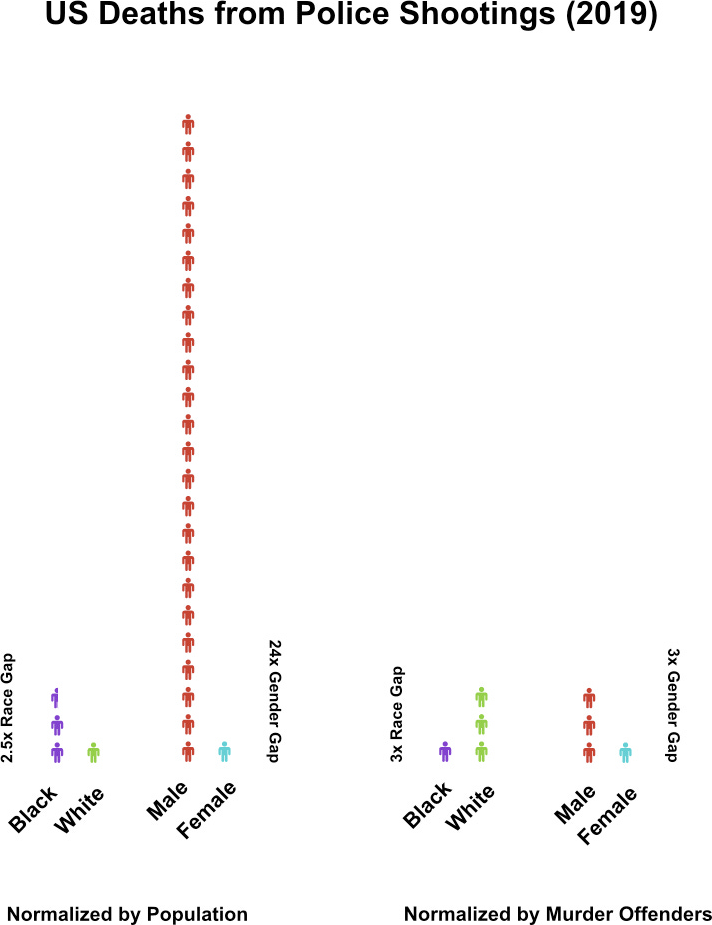
To show just how bizarre the woke narrative on police violence is, let’s look at some of the statistics around the problem. One tenet of the woke narrative is that you should normalize the victims of police violence by population, which leads to the conclusion that Black Americans are two and a half times more likely to be victims than white Americans. Which is true: Black Americans make up 13% of the US population but about one quarter of the victims. A second tenet is that only a profoundly bigoted person would ever suggest that the discrepancy is due to Black Americans perpetrating more crime, because that would be victim blaming. A third tenet is that this discrepancy of 2.5x is a tragic social injustice that needs to be urgently rectified until the populations are equally victimized.
But if a 2.5x gap is an urgent matter of social justice, then what does that say about the fact that men are killed at twenty four times the rate as women? Now you might say, but men commit more crime, putting them at greater risk for lethal interactions with police. But of course, that’s a deeply bigoted statement when applied to the racial discrepancy, but is perfectly woke to explain the 24x gender discrepancy. But it’s true, men commit vastly more violent crime than women, eight times as many homicides. So rather than normalize by population, you might say, let’s normalize by perpetration of homicide. Now remember that a 2.5x discrepancy is an urgent matter of social justice and evidence of a deeply bigoted country. When you normalize by murder offender rate, you find that men are still overrepresented by a 3x rate relative to women. It’s not like anyone is going to care about that gender gap, but more problematically for the woke narrative is that the racial gap flips: white Americans become overrepresented 3x relative to Black Americans.
In an interview with FiveThirtyEight, Danielle Kilgo lamented the lack of media coverage for Black female victims, saying “One of the biggest explanations for this is that we don’t just live in a racist society, we also live in a sexist and patriarchal one.” And yet, the New York Times ran 750 articles mentioning Breonna Taylor by April of 2023, but only five mentioning Tony Timpa.
The theory of intersectionality posits that being Black and female is a double disadvantage in our society. We saw earlier how Ungar-Sargon pushed back on this, saying “the growing mountain of evidence that it [intersectionality] was wrong, at least factually.” The statistics show that when normalized for crime, the intersection of white and male is most at risk to police violence and Black and female is the least at risk. But, you might say, all the normalization we did above is too much, too complicated, instead let’s just see the raw numbers from an intersectional perspective:
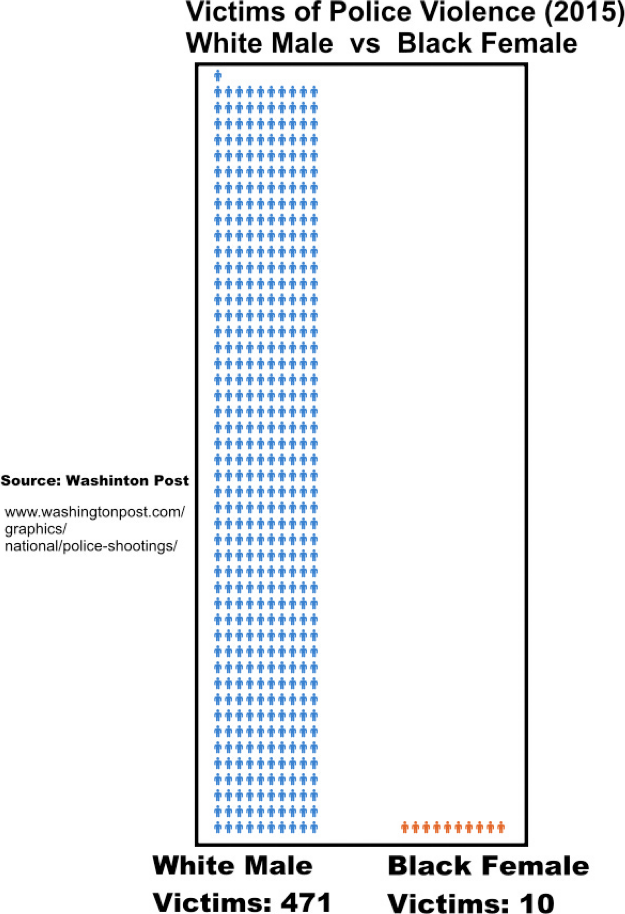
If you find any of this surprising, first you should wonder why the media has reported these things in such a distorted way. And second, reproduce it yourself. The police shootings are available at Washington Post Police Shootings Database and the homicide statistics available at the FBI. Don’t just take my word for it. You can select for any year from 2015 onwards or aggregate them together to find a larger sample.
Martian White Supremacists
On January 7, 2023, Tyre Nichols was pulled out of his car and beaten to death by five police officers. Nichols’ death had a lot in common with George Floyd’s murder. The brutality and cruelty of his death. The way the police ignored his cries for help. But one big difference was the skin color of his killers. The media went into overdrive to assure us that the culprit was the same: white supremacy. A Black chief of police, an all Black unit, and somehow the problem is still white supremacy. Despite the fact that every person involved was of the same race, the media was determined to racialize the narrative.
Elie Mystal, in The Nation, wrote:
“You could drop a Martian in the middle of a local prosecutor’s office and, unless they actively and consciously looked for ways to subvert and sabotage the system, they too would soon start charging Black suspects with stunning haste while using their discretion to aid and appease white wrongdoers.
And if you dropped that same Martian into a patrol car, it wouldn’t take long before they got out of that car and started cracking Black skulls.”
How would you ever disprove such a belief?
Mystal does make a statement that is potentially falsifiable. He says that the police would never kill an innocent white male because “…the cops know that a white male in that situation can call out to anybody from ‘CNN’ to ‘lawyer,’ and somebody might materialize out of thin air to stop them.” This is a provably false statement. Tony Timpa did call out. No one materialized. Only his mother called and he was already dead.
Ungar-Sargon sees these woke beliefs as a luxury good. What the New York Times is selling is not just information, it’s a status symbol that comes at the cheap cost of a subscription. She notes that the wokest headlines and the luxury ads run side by side because what Armani and anti-racism have in common is that they’re both luxury goods for elites who never worry about whether police violence or local crime is actually fixed or not:
“These headlines don’t exist in tension with the Armani ads they appear on top of; they are the content Armani has paid tens of thousands of dollars to embed beneath. The October 2020 edition of the Times’s luxury magazine, T, had a picture of activist Angela Davis on the front cover—and an ad for Cartier on the back cover. Because they are two sides of the same coin.” (166)
So why was the media so silent about Tony Timpa’s death? Because contemporary social media journalism is starkly different from the nineteenth century penny press populist journalism. The combination of the current business model, the technology that it’s consumed on, and the price of a journalism degree means that it’s written by an elitist group far removed from the problem of police violence and writing for a wealthy audience that purchases these ideas as a status symbol. Solving a problem requires you to accurately describe it. The danger of racializing a problem that clearly cuts across racial boundaries is that you don’t actually solve it. Which doesn’t really matter to you personally if you’re wealthy and don’t come into contact with the police. That’s for the peasants to worry about.
Bad News
I once heard a metaphor for why the phrase “All Lives Matter” is offensive and potentially hate speech. Imagine you’re sitting at a table and they pass around the platter of food. Everyone takes their fill. Then it gets to you and it’s empty. You say, “I deserve to eat.” Someone says to you, “Don’t be selfish, we all deserve to eat.”
It’s a useful metaphor to show that if you’re asking for equal treatment, how cruel it is to call that selfish. But let’s plug in some accurate statistics.
Someone passes a plate of food around a large table with dozens of people at it. At the table sit Don Lemon, Van Jones, and Taylor Lorenz. At the end of the table are two poor white men, a Hispanic man, and a Black man. When the plate gets to the first poor white man it’s nearly empty. The rich people say, “You need to take less so that Black man can eat.”
So the poor white man only takes a spoonful and gives the plate to the other three men.
The Black man looks at his plate and then looks around the table at all the people with full plates and says, “I deserve to eat.”
Don Lemon, Van Jones, and Taylor Lorenz all nod. “Yes, he does,” they say. They bang their fists against the table and yell, “He deserves to eat!”
One of the hungry white men says, “We all deserve to eat.”
Don Lemon gasps.
Van Jones turns to the poor white man and says, “You’re only saying that because you’re a racist bigot.”
Taylor Lorenz says, “I know that I only have a full plate because of my white privilege.”
Don Lemon nods vigorously. “Look how aware she is of her white privilege. She’s so virtuous.”
Taylor Lorenz smiles smugly. “What’s important is that we teach him about his white privilege. Then maybe that black man wouldn’t be hungry.”
The four hungry men look down at their empty plates.
Taylor Lorenz belches.