Why do we no longer construct beautiful buildings set in walkable mixed-use neighborhoods? A century ago, we built stately brick buildings on narrow, charming streets, and the surviving examples are expensive enough to suggest that lots of people still like them. But somewhere along the way, we stopped building them, and instead we churn out cookie-cutter suburbs with ticky tacky houses and strip malls and 8-lane highways and endless parking. Even in our cities, we have mostly built ugly concrete hulks, glass and steel skyscrapers, and more recently, endless 5-over-1s. Why don’t we turn the clock back a hundred years and simply build the stuff people like?
Theories abound as to why we do not: perhaps we should blame government regulation, or the rise of the automobile, or higher construction wages. Maybe it is changing popular tastes, or maybe urban planners or architects are at fault, or possibly it is spreadsheet capitalism. The question of where architecture and urbanism went wrong has been addressed here at ACX, and elsewhere on the internet, but here I would approach the question from a different angle.
It turns out that there is a particular type of prominent building in every major North American city that actually turned back the clock a hundred years after a brief sojourn in the concrete, suburban wilderness. Early versions of this building went up in the early 1910s as beautiful architecture set in a walkable urban neighborhood. Then, starting in the early 1960s, those buildings were almost entirely demolished and abandoned, replaced by brutalist cookie-cutter structures placed in vast surface parking lots near highways. But then, in the early 1990s, we completely reversed course! We started building retro-style versions of the original buildings, set again in walkable urban neighborhoods. They were an immediate success, and so we rapidly built more and tore down the 1960s monstrosities. As of today, the 1960s-style buildings and settings are on a path to complete extinction, to be replaced completely by retro-style new buildings or preserved originals, all set in a walkable urban neighborhood, or at least in a simulacrum of one.
This is the story of the American ballpark, as told by Paul Goldberger in Ballpark: Baseball in the American City. He traces the history of the ballpark from the Golden Age of the early 1910s that brought us Wrigley Field and Fenway Park, to the brutalist “concrete donut” era of the 1960s that produced defunct structures like the Astrodome and Shea Stadium, and finally to the current retro era that started in 1992 with Baltimore’s Camden Yards_._ Goldberger was a longtime architecture critic at the New York Times and the New Yorker, and he states that the book was written to explore “the relationship between the ballpark, public space, and the American city”. He does a fantastic job of covering the history of the ballpark from the 19th century and its relationship to the urban fabric in great detail, with a few pages on every ballpark of note, written with an architecture critic’s eye toward what works and what doesn’t.
My goal here is to specifically understand what factors produced complete victory for retro-style ballparks, and whether there are lessons for ordinary buildings: can we imitate what worked in baseball, or is baseball simply the exception that proves the rule? I will mostly skip studies of individual ballparks, and do this in two parts: in the first part, I give a summary of Goldberger’s history of baseball and ballparks, to supply necessary context, and in the second part, I examine the most promising theories for the success of retro ballparks one-by-one.
A Brief History of Baseball and Ballparks
Why should we care about ballparks? Well, professional baseball may have long faded in American sporting cultural relevance, eclipsed by football and even basketball, but as a live experience, it reigns supreme. Total MLB attendance reached 71 million in 2025, more than the other three major North American sports combined. The NFL is defined by scarcity, with only 8 or 9 home dates a year, and relies on television, which is how the sport is best experienced. (Two of the most popular football stadiums, LA’s SoFi and Arlington’s AT&T, feature oversized screens viewable from almost anywhere inside.) The NBA and NHL have lots of regular season games (41 home games each), but basketball and hockey require fans to be physically close to the action to see anything, limiting arena capacity to around 20,000, in contrast to NFL stadiums, which can hold up to 80,000.
Baseball succeeds as a live experience because there is a lot of it, it doesn’t require too much physical proximity to the action, and it is fun even if you don’t care about baseball. There are 81 home games during the regular season, and well-designed stadiums can comfortably seat 40,000 while offering an intimate experience even to those in the nosebleeds. This keeps tickets affordable: the Atlanta Braves report an average realized ticket price of $54, around half of the average price in other major sports. (I will cite the Braves a lot here because they are the only publicly traded team, and so they alone publicly disclose a lot of data.) Yes, there are some $1,000 premium seats behind home plate for the corporate crowd, but there are usually also plenty of $10 seats in the upper deck and bleachers, particularly on weekdays, when demand is lower. You don’t see the latter much in football and basketball, unless the on-field (or on-court) product is truly awful.
For those that do care about baseball, regular season games have high enough stakes to maintain interest – despite the 162 game season, the playoff race is typically ultimately decided by only a couple of games. But live baseball is a compelling experience even when the home team is terrible and the games don’t really matter. Last season, the Colorado Rockies compiled the 8th worst record ever in the 125-year modern era of the sport, but still managed to average nearly 30,000 fans per home game. And that comes down to the gameday experience, which is centered around the amenities provided by a modern, retro-style ballpark.
These days, the experience often starts outside the ballpark, at the trendy bars and restaurants across the street. As you enter, you get some promotional giveaway – maybe it’s a George Costanza bobblehead for Seinfeld night, or a pope hat with the team logo to honor their most famous fan. Inside the ballpark, there are wide concourses with every manner of food and drink imaginable. You have local microbrews and cocktails, you have hot dogs and helmet ice cream, you have tacos and sushi. You can get the appropriate local specialty, whether it is Old Bay in Baltimore or Primanti in Pittsburgh. Every new season comes with new novelty food items – the nacho sombrero, lobster poutine, fries served in a replica ferry. For kids, there is at minimum a play area, although Detroit’s Comerica Park goes a step further with a tiger carousel and a 50-foot ferris wheel with baseball gondolas. During the game, you might have dancing mascots, hot dogs parachuting into the crowd, trivia on the big screen, and sausage races on the field. If you simply want to sip cold beers for two and half hours and enjoy a pleasant game of baseball on a beautiful summer day, you can absolutely do that, but the modern ballpark experience is a fun outing for the baseball-agnostic as well.
You might guess that the ballpark as an all-encompassing amusement park is a purely modern invention, but its roots can in fact be traced back to baseball’s very beginnings. Baseball was the first team sport to gain popularity in America. Modern baseball is descended from the New York City version of children’s bat and ball games that came over from Europe, which won out over rival versions played in Boston and Philadelphia. Baseball was being played as early as the 1820s in New York, but the earliest officially recorded baseball games were played by amateur New York clubs in the 1840s across the river at Hoboken’s Elysian Fields, a sort of proto-amusement park with fields and rides and taverns.
The first baseball contest staged in front of paying fans was an 1858 three-game series between all-star teams representing New York and Brooklyn (then an independent city). The three-game series attracted 4,000 fans per game, paying 10 cents per ticket (at a time when the typical daily wage was about $1). The success of this series inspired Brooklyn businessman William Cammeyer to build Union Grounds in Williamsburg in 1862, the first enclosed baseball field. It had a clubhouse, stands that seated over 1,000, and featured a live band, drinking, and gambling. (Gambling was always lurking in early baseball, until the Black Sox scandal of 1919, and it too has made a return, unfortunately.) Fans paid 10 cents (after 1867, 25 cents) to watch the New York and Brooklyn teams that shared the ground. The success of Union Grounds inspired the opening of the larger Capitoline Grounds in nearby Bed-Stuy two years later.
As baseball gained popularity across the country, traveling teams made up of top players sprang up to make money. The most successful of these was the Cincinnati Red Stockings, which criss-crossed the country by train, attracting 200,000 paying fans en route to 130 straight wins in 1869 and 1870. The Red Stockings finally fell to the Brooklyn Atlantics in an extra-inning showdown at the aforementioned Capitoline Grounds, played in front of a crowd of over 10,000 in June 1870, each of whom paid 50 cents to get in. (At the time, a typical daily wage was $1, so 50 cents was a lot of money; compare that to the $54 cost of a ticket in Atlanta today, in a city where the typical daily wage is $270.)
Despite their initial success, the Cincinnati Red Stockings disbanded, re-forming as the Boston Red Stockings in 1871 as a founding member of the National Association (NA), the first professional league.[1] The NA soon fell apart, with some team owners defecting to help form the National League (NL) in 1876. The NL had the idea that baseball would be better if they excluded the drunks and gamblers and instead went after a more well-heeled crowd, charging 50 cents per ticket while banning alcohol and refusing to play on Sundays (the only day off for the working class).
Sensing an opening, a competing league, the American Association (AA), formed in 1881. The AA went for the audience the NL excluded, by charging 25 cents (still a lot of money, but manageable for the working class), playing on Sundays, and serving alcohol (which would earn it the nickname of “The Beer and Whiskey Circuit”).
The AA was personified by Chris Von der Ahe, a St. Louis saloonkeeper and entrepreneur who noticed that baseball fans drank a lot of his beer and decided that he should get into the baseball business, which he did by becoming a founding member of the AA with the St. Louis Browns. Von der Ahe was a flamboyant promoter who constantly experimented with ways to get fans into his ballpark and so that he could sell them beer. He had a beer garden in play in right field, and turned the area around the ballpark into a “Coney Island of the West”, complete with a “shoot-the-chute” water ride in center field, and later a race track and sideshows as well. In 1892, the AA failed due to mismanagement, but many of its teams (including the Browns) were absorbed into the NL, which adopted the AA’s superior approach to alcohol and Sunday baseball. In 1898, Von der Ahe was forced to sell the Browns, which became the St. Louis Cardinals,[2] but his promotional approach to baseball would be revived frequently by future teams.
As cities grew, so did baseball. The late 19th century urban environment was dirty and crowded, which left demand for green spaces that people could escape to. Goldberger explains that parks and cemeteries satisfied some of this demand, but the ballpark was a green space that people could enjoy while cheering. As he puts it, “[Frederick Law] Olmstead’s vision [of parks], however democratic it may have been, was genteel. The public space created around baseball was democratic and exuberant. If the cemetery and park were reflective, the baseball park was participatory.”
At the time, ballparks had to be squeezed into some distant part of the urban grid, where land was cheap enough to support a ballpark, but which was still reachable by streetcar, the only form of longer-distance transportation then available to most people. Even then, space was tight enough that ballparks would end up asymmetrically shaped, in order to fit whatever parcel of land had been assembled. The field might be sloped or bumpy, and neighboring rowhouses might have a view of the field from their rooftops.
The ballparks of the late 19th century were inexpensive, wooden structures, which were functional but had an alarming tendency to burn down every few years, sometimes taking the neighborhood with it. As the sport grew in the early 1900s, team owners decided to invest in fireproof ballparks made of steel and concrete and brick, which would be larger, more durable, and more comfortable for players and fans.
This generation of ballparks turned out to be the Golden Age of ballpark construction: between 1909 and 1915, 13 of the 16 major league teams built or rebuilt a new steel and concrete ballpark,[3] and the resulting “jewel-box” structures were a huge success and beloved by generations of fans. Although only two are still in use today (Boston’s Fenway Park and Chicago’s Wrigley Field), modern retro ballparks seek to emulate the best features of Golden Age ballparks while also offering the amenities fans demand today.
Observers today attribute the timelessness of Golden Age ballparks to the constraints of the early 1910s, which were similar to the constraints faced by the prior generation of wooden ballparks in the late 1800s. Golden Age ballparks were less intimate than the smaller wooden parks that came before, but were much cozier and quirkier than the concrete donuts that would follow in the 1960s, and so are praised for their intimacy. They also continued to be tucked into walkable urban neighborhoods: as Goldberger puts it, “baseball parks were a part of the urban fabric because, up until the middle of the twentieth century, everything was a part of the urban fabric”.
It is also worth noting that ballparks rarely had to accommodate big crowds in those days. League-wide average attendance in 1915 was 5,215, compared with around 30,000 in most years since the early 1990s. Ballparks didn’t have lights for night games, cities were much smaller, car use was not widespread, and many mid-sized cities had two teams, a result of the competing American League (AL) entering those markets when it was formed in 1901. For example, St. Louis had two teams in a metro area of about 900,000 in 1910, and now it has one team in a metro area of 2.8 million, a sixfold increase in population per team.
Golden Age ballparks were built quickly and relatively inexpensively, and were subsequently upgraded and remodeled over time. Fenway Park was originally built in 1912 in less than five months for $600,000 ($20 million in today’s dollars) on a $120,000 plot of land, and seated only 24,000 at the time (vs. 37,000 today). It had to be thoroughly renovated in 1934 (at which point it was painted in its famous green), it didn’t get an upper deck and lights until 1946-47, and it got a $270 million renovation in the early 2000s. Other ballparks of the era would go through similar renovations and expansions throughout their life.
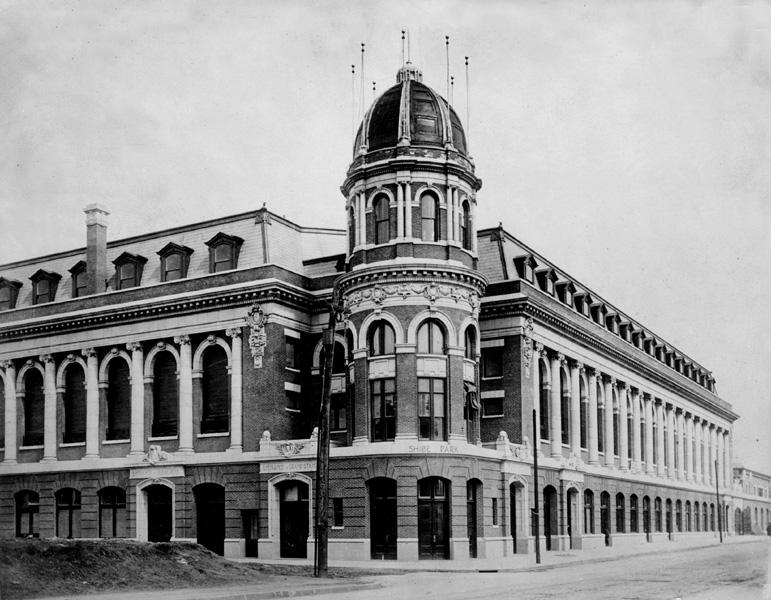
Many Golden Age ballparks are also known for their beautiful facades, which give the effect that they might contain an ordinary (but aesthetically attractive) building, until you go inside and are hit with the expansive view of an enormous green ballfield. Some of the facades could be quite ornate, like the French Renaissance design of Philadelphia’s Shibe Park, the first of the Golden Age ballparks:

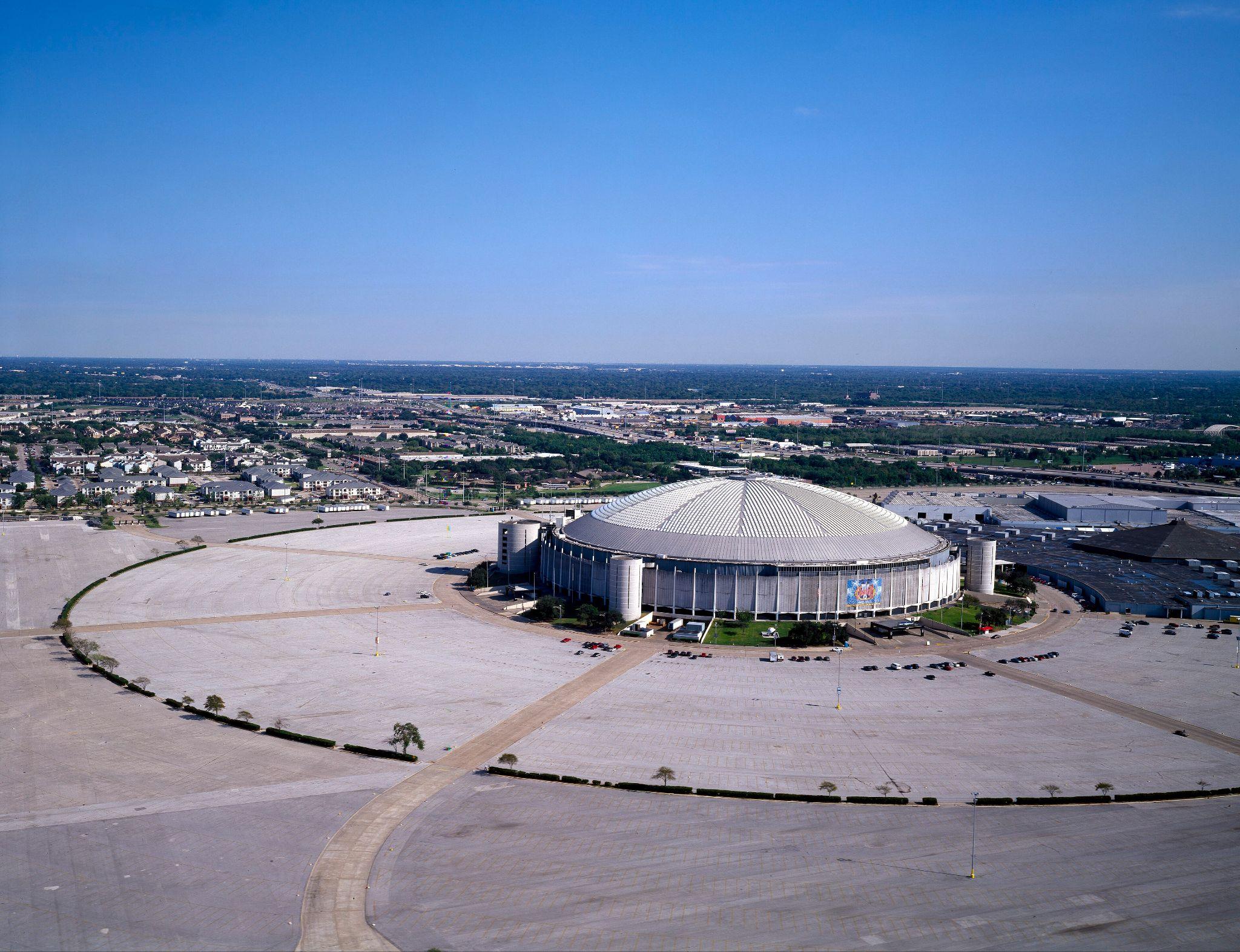
These ballparks enjoyed popularity initially, but by the 1960s, the country was flocking to the suburbs and leaving the city behind. The ballparks of the 1910s were feeling dirty and cramped and lacked parking and clear views. Furthermore, football was rapidly growing in popularity. The response to these trends was the multi-purpose concrete donut, a massive, circular gray stadium plopped down amid a sea of parking off of a freeway exit somewhere, which could be used for both baseball and football. Here is Houston’s Astrodome, built in 1965:

Baseball had previously been constrained by train travel, which limited the placement of teams to no further south and west than St. Louis. Now, with the airplane, teams could move anywhere, and they did, leaving their 1910s ballparks behind. The Giants and Dodgers moved to California, the Boston Braves moved to Milwaukee and then Atlanta, and the Philadelphia Athletics moved to Kansas City and then Oakland. Some teams swapped their aging Golden Age ballparks for concrete donuts in the same city: the St. Louis Cardinals, Cincinnati Reds, Pittsburgh Pirates, and Philadelphia Phillies all went this route. Finally, this was a period of expansion for baseball, which went from 16 teams in 1960 to 28 teams in 1993; expansion teams (like the Houston Astros) all got concrete donuts.
By 1991, there were only four stadiums left from the 1910s and 1920s: Detroit’s Tiger Stadium, old Yankee Stadium, and Fenway and Wrigley. Other than those ballparks and LA’s Dodger Stadium, a more traditional baseball-only park built in 1962, the entire MLB played in concrete donuts.
When we think of concrete donuts today, we think of all of the drawbacks. They were ugly, drab, and the fans were stuck far from the field. The game was played on astroturf, the views were closed off, there was nothing to do outside the stadium, and the amenities inside the stadium were lacking. Why did concrete donuts become so dominant so quickly, if they are seen today as a terrible mistake?
For one, they did genuinely offer an improvement in amenities over the previous generation of ballparks, even though the quality of those amenities was thoroughly eclipsed by modern retro parks. As Goldberger puts it:
All of the ballparks of the first generation, whatever their other virtues, were cramped, with mean public facilities, awkward circulation spaces, and almost no amenities for either fans or players. The concrete stadiums of the second generation were only slightly better, and generally offered only marginal improvements in amenities in exchange for the total abdication of any charm, leaving neither fans nor players any better off.
Goldberger cites two other forces that led to so many concrete donuts. One is that concrete donuts were all publicly funded, and the idea of a circular multipurpose stadium appealed to the bureaucrats that had to approve them. Two sports for the price of one! The second is that modernist architects at the time simply preferred simple geometric shapes, and so that helped determine what we got.
The explosion of concrete donuts coincided with major attendance growth across the sport, with average turnout per game growing from 13,212 in 1961 to 27,002 in 1991. It’s easy to look back now and say that most of that probably came from population growth and increased disposable incomes, but at the time, it felt to most like concrete donuts were the best path forward, so teams kept building them.
The retro era kicked off with the opening of Oriole Park at Camden Yards in Baltimore in 1992. Larry Lucchino, the CEO of the Baltimore Orioles, observed in the late 1980s that the five teams who were still playing in baseball-only parks were doing particularly well. The causality is questionable here: the Yankees and Dodgers were (and are) the two biggest teams, and the Red Sox, Tigers and Cubs were above average to good in that era. Nevertheless, he was generally skeptical of concrete donuts and used this fact to argue for a downtown retro ballpark. He was abetted by new Orioles owner Eli Jacobs, who was an architecture and urbanism enthusiast, and a Baltimore government that had just lost their football team to Indianapolis and was willing to meet the demands of their baseball team to keep them from leaving too.
Camden Yards was a retro-style ballpark, with brick and wrought iron and the warehouse in right field, but it was larger and outfitted with modern amenities – clean bathrooms and wide concourses and concessions and gift shops. Camden was a massive success as soon as it opened, with fans flocking to games in droves and critics singing its praises. Goldberger quotes the New York Times as saying at the time that Camden was “a design that enriches baseball, the city and region, all at once, and makes every sprawling concrete dome sitting in a sea of parked cars look bloated, fat and tired…Baltimore is not the first city to understand the virtues of urban design, but it is the first one to prove that they need not be incompatible with the pleasures of professional sports.”
The Cleveland Indians soon followed with a retro downtown stadium of their own, Jacobs Field, in 1994. Cleveland’s ticket revenue jumped 140% between their last season at the old Cleveland Municipal Stadium (aka “The Mistake by the Lake”) in 1993 and the first full season at Jacobs Field in 1996 (the intervening years were shortened by the players’ strike), evenly split between increased attendance and higher ticket prices, although it should be noted that the team also got much better over that time, and the old stadium was really bad. As an aside, average realized ticket prices in Cleveland went from $22 in 1993 to $31 in 1996 (in 2026 dollars), quite a bit below the $54 mark that the Atlanta Braves achieve today.
Inspired by the success of Camden Yards and Jacobs Field, other teams rapidly followed with their own retro parks, most of which were attached to their city’s urban fabric, with hip bars and restaurants outside the stadium. In 1995, the Colorado Rockies opened Coors Field in LoDo, a historic urban neighborhood in Denver, and in 1999, the Seattle Mariners opened Safeco Field (now T-Mobile Park) in SoDo, adjacent to a similarly historic urban neighborhood (Pioneer Square) in Seattle. In 2000, the Astros moved into Enron Field (now Daikin Park) in downtown Houston, the Giants started play at Pacific Bell Park (now Oracle Park) in the SoMa neighborhood of San Francisco, and the Tigers opened Comerica Park in downtown Detroit. Also during that decade, the expansion Arizona Diamondbacks began play in Bank One Ballpark (now Chase Field), an air-conditioned retractable roof ballpark in downtown Phoenix, and the Texas Rangers moved into the Ballpark in Arlington, an unfortunately not air-conditioned outdoor ballpark that they had to abandon for Globe Life Field in 2020.
New retro ballparks kept opening across the league through the 2000s and 2010s. As of today, almost all of the MLB’s 30 teams have a retro ballpark, and the last few concrete donuts are on the verge of disappearing: Tampa Bay and Kansas City have announced plans for new ballparks, the Chicago White Sox are reportedly looking at one as well, and Toronto recently remodeled their stadium with plans to build a new one in the next decade.
Today, in 2026, the multipurpose concrete donut era seems like a blip: few of those stadiums were used for more than 30 years, whereas the oldest retro ballparks are already over 30 years old and there is no sign that any of them will be replaced anytime soon. Indeed, the main trend right now in all of sports (not just baseball) is not replacing stadiums, it is the development of larger mixed-use real estate projects that use the existing stadium as an anchor, which in some sense is kind of a throwback to the 19th century efforts of Chris Von der Ahe to build a larger amusement park and beer garden around his ballpark.
Theory: Team owners build beautiful ballparks in walkable neighborhoods because baseball fans care more about architectural beauty and walkability, while residential and commercial users don’t care about those things very much at all.
I think of this as the Disneyland theory: Of course Disneyland is beautiful and walkable, it’s in the business of selling tickets to a beautiful and walkable experience! Ballparks are themselves a kind of theme park, in that sense, insofar as their users care a lot about beauty and walkability. We should really be wondering why team owners went temporarily insane and built a bunch of concrete donuts on top of isolated parking lots.
We already saw that the Cleveland Indians had a 140% jump in revenue when they opened Jacobs Field, but that had the confounding factor of the team going from terrible to amazing. The Atlanta Braves saw a 76% jump in ticket revenue when they opened Truist Park in 2017, and a $124 million jump in overall annual revenue, all at a time when the team sucked. That is a pretty good initial annual payback on a $722 million investment (only half of which was actually paid for by the team – the rest came from local taxpayers) and revenue has grown another 70% in the eight years since. Retro ballparks are just a reflection of the revealed preferences of baseball fans, who are ones (along with taxpayers) that really pay for them.
Another point in favor of this theory is the fact that baseball teams now sometimes develop hotels, condos and office buildings by their ballparks, and for the most part, they build ordinary modern glass and steel structures, not replicas of the Tribune Tower. In fairness, they do build some more retro-feeling structures as well, especially for restaurants and retail, but I think it’s reasonable to say that apartments and office buildings can’t extract the same direct premium from their users for architectural beauty that ballparks do.
Theory: Commercial developers build utilitarian but ugly apartments and offices not because their users don’t value beauty, but because they capture only a fraction of that value, with the rest going to their neighbors. Similarly, commercial developers find it hard to coordinate with their neighbors to provide uniform design and public goods like pedestrianized streets and plazas. Baseball teams don’t have this spillover problem because ballparks are giant buildings that dominate the neighborhood, and increasingly, they are likely to own the neighborhood as well.
Anecdotally, it’s harder for office and apartment developers to capture the benefit of a beautiful building, because tenants spend most of their time on the inside and care more about comfort and utility. They might pay a premium if all of the buildings in a neighborhood are beautiful and uniform (e.g. the West Village), but it doesn’t make sense for an individual developer to independently spend a lot of money on external flourishes – the value will be captured by their neighbors. In theory, cities could overcome this by banning ugly buildings, and they try, but in practice, these regulations seem to make buildings more expensive and uglier.
This problem extends to walkability, which requires a very competent local government or good coordination among neighbors to invest in the features that make a neighborhood attractive. Samuel Hughes recently wrote about the merits of unified ownership, an essay showing that large urban landowners in England have historically invested in public goods like attractive building design and garden squares because they owned enough of the neighborhood to capture the value they created, while fragmented ownership led to underinvestment.
The modern approach to ballpark development presents an interesting test of this idea, because sports teams in North America have recently realized that they should be using their ballparks as anchors for large mixed-use developments – after all, a lively pedestrian experience with trendy bars and restaurants is one more reason to come to the game. Those bars and restaurants become more sustainable if they can serve residents and office workers during weekdays and the offseason, and residents and office workers like living and working where there are restaurants and bars and ballgames.
By building mixed-use developments around their stadiums, teams can capture more of the economic value that comes from the ballpark and enhance their own ticket sales. The Atlanta Braves are considered an exemplar of this trend, having built their new stadium next to a freeway in the middle of nowhere and surrounded it with a thriving development known as The Battery, an agglomeration of office buildings, restaurants, condos and hotels.
The Battery is…fine. It’s clean and orderly, with a lawn and a fountain and two or three blocks of mostly pedestrianized streets leading to brick buildings with upscale dining and shopping. Tucked behind the dining and shopping are several parking garages, some office buildings, and a pair of hotels. On the night I visited, the Braves put on an outdoor concert before the game, which gave the scene more life. The most remarkable thing about The Battery is that the Braves’ stake in it is now worth $1.25 billion.
Incidentally, Goldberger is critical of the mixed-use development trend, stating that “[Truist] is a mallpark as much as it is a ballpark”, and that The Battery “might better be called urbanoid than urban”. He argues:
…Real urban places are untidy mixes of different uses and different buildings and different kinds of people…they can be boisterous, even chaotic, and part of the urban idea is that a moderate amount of disorder is a fair trade-off for the virtue of having a truly public place.
…
The Battery offers a privately owned, sanitized version of urbanism that you drive to and park your car in (or have it parked by a valet) before you stroll past the shops and restaurants and into the ballpark. It is a bubble, and like all such bubbles, it has a superficial appeal, but it is disingenuous to claim that it represents something truly urban: it is just too clean and neat for that.
Goldberger is totally right about The Battery – it is sterile and bland. And so is Gallagher Way outside of Wrigley, and Texas Live! In Arlington, and every other ballpark-centered development that has ever been or will ever be built. They build these kinds of outdoor malls because people like them, and orderly gathering places are in short supply.
In theory, boisterous and chaotic is great, but in practice, large gatherings in public places are soft targets for bad actors. At my hometown ballpark, for years there have been “preachers” that scream hate speech into electronic megaphones at 120+ dB at fans trapped waiting in line to go through the turnstiles. Since this is on public property, there are no laws against this, although the team is currently lobbying to get it banned, and likely some day they will. But once they do, another form of harassment will no doubt spring up to take its place. One can see why teams prefer to turn the whole area into private property and pre-empt the problem before it starts, and make some money in the bargain.
For those of us that grew up in a different era, new developments like the Battery are jarring because we associate the gameday experience with parking lots and cheap dive bars and street vendors hawking hot dogs and pirated t-shirts. Still, maybe urban authenticity shouldn’t be expected near a ballpark. Real urban neighborhoods also have lots of bank branches and national fast food chains and it seems fine that baseball teams mostly exclude these in favor of what is essentially an outdoor mall filled with local boutiques and upscale dining and bars. The result might be a little bland, but it’s a place you can take a family and have a good time.
Also, I do wonder if Hughes is right, and the chaos and ugliness that characterizes what we in America think of as a “real” urban place is just an artifact of fragmented land ownership and weak governance here, and this is why these stadium-anchored mixed-use developments have been so successful so far – they have scarcity on their side.
If the problem really is externalities and fragmented land ownership, then we would expect other instances of consolidated land ownership to have more beautiful and coherent architecture and better walkability and public spaces. The two examples that come to mind for me outside of sports are college campuses and master planned communities like Irvine, CA. I didn’t have time to research it too much, but a first pass seems to indicate that colleges are more likely to build retro buildings, and Irvine is often considered to have good architecture and public spaces, which lends more credence to this particular theory.
The economics of baseball ensure that any successful innovation will be rapidly copied across the league.
It might seem counterintuitive that retro-style ballparks wiped out concrete donuts so comprehensively and quickly, even though a) spinning up a construction project as large as a baseball stadium is difficult and expensive and b) the concrete donuts in use were relatively new and could have been kept in service with some maintenance.
I alluded above to the return on investment to a new retro-style park; we know that the Braves put up around $350 million for an additional $124 million or so of annual revenue, of which let’s say about half falls to the bottom line.[4] That would be a return of something like 20% per year, on an investment mostly funded with non-recourse debt with an interest rate of less than 4%. This actually overstates the cost to the Braves, because the alternative would have been a large investment in the existing stadium to keep it up. Of course every team was going to trip over themselves to build their own retro-style park as soon as possible, doubly so if they can extort their local government to cover part of the cost, as is usually the case. Once an investment is shown to hit a certain return threshold, it becomes inevitable everywhere.
The same logic applies to mixed-use developments. The Braves were not the first to build one, but their success has forced teams to think about how they might build their own; after all, a billion dollars is a billion dollars. Every new stadium or arena proposal published today seems to come with an adjoining development, and Mark Cuban cited the trend as his reason for selling a majority stake in the (basketball) Dallas Mavericks to casino developers, a group that would be better suited to develop a new entertainment district in Dallas (potentially with a casino attached).
Note that this explains why the retro trend spread so quickly and decisively, but doesn’t explain at all why the retro trend started. There’s another theory about that…
The retro trend only happened because a few people willed the first retro stadium into existence and everything followed from there
The most interesting thing about the retro trend is how abrupt the shift was. Baseball teams were building new concrete donuts right up until Camden Yards opened in 1992. Toronto’s SkyDome (now called the Rogers Centre) opened in 1989, Tampa Bay’s Suncoast Dome (now called Tropicana Field) opened in 1990,[5] and Chicago’s Comiskey Park (now called Rate Field) opened in 1991.
The first retro baseball stadium built at any level was Pilot Field (now called Sahlen Field) in downtown Buffalo, opened in 1988. It opened with the local AAA team (the highest level of the minor leagues) as a tenant, but was built to eventually attract a major league team. Ironically, the original intention was to build a larger domed concrete donut, but state funding fell through, so they settled for a smaller, cheaper retro park that could be expanded once they got a big league franchise. (They never did, although the Toronto Blue Jays ended up playing a number of games there due to Covid in 2020 and 2021.)
The Baltimore Orioles took the leap of building the first major league urban retro park because they happened to be owned and run by executives who were deeply interested in architecture and urban design and Jane Jacobs, and they firmly believed that an urban retro ballpark would work. (The protagonists were owner Eli Jacobs, who bought the team in 1988, chief executive Larry Lucchino, and Janet Marie Smith, who they brought in to manage the project.) Even though the government appointed an architect that had mostly built multi-purpose concrete donuts (this was a publicly funded project), the Orioles used their veto authority to insist that the architect build a retro park after architect initially presented them with a concrete donut, and they were very involved in the architectural details that made the park so successful.
Goldberger contrasts the Orioles’ process with the Chicago White Sox’s development process for their new stadium, which happened concurrently. The White Sox hired the same architect and some suspect they got the concrete donut that the Orioles rejected. But White Sox management earnestly believed that fans wanted a concrete donut, ignoring a proposal from a local architect that would have brought a park that was even more retro than Camden Yards. White Sox owner Jerry Reinsdorf was later quoted as saying: “I thought people wanted unobstructed views and wide aisles. I guessed wrong. People wanted a more homey feeling.”
It’s tempting to look back at history and conclude that larger forces were at play that would have eventually brought us urban retro ballparks, but it was very much not clear at the time that retro parks could be successful, and perhaps it would have been years or decades before anyone even tried if the Orioles hadn’t built one. Concrete donuts weren’t unsuccessful, and were seen as a safe pick. We got retro parks at the time we did and in the style we did because of the determination of three people who insisted on building one.
Governments let sports teams build whatever they want (and in fact subsidize it!), but they make it illegal to build walkable neighborhoods and retro-style buildings
America has a curious system where major sports leagues are exempt from antitrust laws, and so the leagues make sure that the market for franchises is a little undersupplied.[6] This way, teams can extort their cities for public funding for a new stadium by credibly threatening to move to a different city. (On occasion, they have to follow through, as the Oakland A’s did in moving to Las Vegas.) Politicians usually cave, because sports teams are very popular locally, and the cost is minimal in the scheme of things – $1 billion sounds like a lot, but in a metro area of 5 million, it’s $200 per person spread over twenty or thirty years.[7]
Perhaps it was once the case that municipal officials demanded some measure of control in return for publicly funded stadiums. Again, Goldberger states that multipurpose concrete donuts appealed to a “bureaucratic sensibility” – monumental, uniform, two sports for the price of one. And there are certainly examples where municipal officials determined the placement and design of concrete donuts, like Cleveland Municipal Stadium being stuck away from downtown, and Robert Moses insisting that Shea Stadium be built in Flushing. But as we saw, by the time the Orioles built Camden Yards, the owners were mostly calling the shots, and that turned out to be a good thing.
These days, the only owners beholden to their cities are the ones that are in such a good situation that they can’t credibly threaten to move – the Chicago Cubs and Los Angeles Dodgers have had to pay for stadium upgrades out of their own pockets, and the Dodgers have failed to make any progress in getting approval for anything that would let them redevelop their giant parking lot.
People often lament that attractive older buildings and neighborhoods would be illegal to build today, because of well-meaning but stifling regulation that has piled up over time. As a result, we have movements advocating for single-stair reform and elevator reform and zoning reform and so on, to make it possible once again to build what we used to.
Sports teams mostly build what they want without having to lobby for regulatory exemption, and in fact the balance of power is so far in their favor, they usually have municipalities falling over themselves to give them money and clear the way with eminent domain. To be clear, it is bad that teams are allowed to extort cities in this way, but it is part of the reason that retro-style stadiums and adjoining mixed-use developments have been built so quickly.
Baseball stadiums have always followed larger architectural trends, and retro stadiums were just a reflection of the larger 1980s postmodernist architectural trend
This is something Goldberger proposes, which I will quote at length here:
[Pilot Field in Buffalo] looked like a kind of modest, low budget riff on a traditional ballpark, which is pretty much what it was, and it provided the first hint that ballparks might be influenced by a larger trend that had been going on in architecture for some years, the rise of what came to be known as postmodernism. Frustrated by the limits of conventional modern architecture, which seemed to be trapped between austerity on the one hand and harsh heaviness on the other, and aware that neither glass boxes nor concrete bunkers were generally very popular with the public, architects were increasingly seeking ways to make buildings richer, warmer, and more complex. If people perceived contemporary buildings as feeling like blunt instruments, well then, architects would show that they were listening, and were ready to give them an alternative.
More often than not, their route to that alternative would involve turning back toward the past, the very thing that modern architecture had made a fetish of rejecting. Architects began actively looking at traditional buildings and trying to find ways to integrate historical elements into new buildings. Some architects mimicked older buildings directly while others tried to evolve more abstract, up-to-date versions of traditional elements; either way, the result was a tide of architecture in the 1980s that looked different from the buildings of the previous several decades.
It was inevitable that this trend would somehow reach the realm of baseball. Ballparks are rarely on the cutting edge of architecture, but…where other architecture went, ballpark architecture would soon enough follow.
There is undoubtedly truth to the broader trend he describes here – there was backlash to modern architecture everywhere, which resulted in fewer brutalist buildings and some new postmodern ones. However, there is a vast difference in magnitude between what we see in baseball and what we see elsewhere. Sure, there are some postmodern buildings scattered here and there in our downtowns, but baseball has razed pretty much all of its concrete donuts and replaced them with retro ballparks, and that’s something we should try to understand.
Baseball stadiums are a reflection of our changing attitudes toward cities and urbanism
This is a core thesis of Goldberger’s book, and it seems to be a contributing factor at every level. Ballparks now usually get built in urban neighborhoods because fans want it and owners want it. This was not so much the case in the 1960s and 1970s, but eventually attitudes changed enough so that one owner was willing to try it, and fans liked it and more got built. I’m not sure that changing attitudes would have made much of a difference if Camden Yards had failed, but changing attitudes made it more likely that someone would try.
Retro ballparks succeeded because baseball fans are suckers for nostalgia
This is the most intuitive explanation, so it has to be addressed. Baseball does trade heavily on its history, so it is natural to think that retro stadiums swept baseball because baseball fans are stuck in the past. After all, the live baseball experience includes the 7th inning stretch, where fans stand up and sing a vaudeville song from 1908, and the many teams employ a live organist.
I don’t think this really holds up, though. The 1910s are too distant for anyone today to yearn for, and even dedicated baseball fans would struggle to name more than a couple of players from the deadball era. Most people that go to baseball games are casual fans, and while they get a kick out of going to an actual historic park like Wrigley or Fenway, they couldn’t tell you much about how Citi Field is actually built with features that recall Ebbets Field. Also, remember that concrete donuts did better than the Golden Age stadiums they replaced, so baseball fans aren’t averse to going to games at a modern park.
Retro ballparks have succeeded because they offer an enjoyable experience, and that is downstream of desirable amenities and aesthetics that are delivered by copying certain techniques from the distant past: a ballpark design that brings fans close to the field, a lively scene outside the park instead of endless parking, brick and steel and iron instead of drab concrete. But it is not because they copied ballparks that few fans nationally have visited (in the case of Fenway and Wrigley) or ballparks that nobody was alive to remember.
Golden Age baseball stadiums weren’t as great as people remember, and modern baseball stadiums aren’t actually that retro
This is an important one to keep in mind. There is a simplistic narrative where all we have to do is copy and paste what worked in the past, and once we legalize that and someone has the courage to build it, all will be solved.
This is not exactly what happened in baseball. As Goldberger points out, the automobile released the ballpark from a lot of constraints – no longer did it need to be outdoors, or fit in a tight parcel of land, or be near a streetcar stop – and so architects went a little nuts designing gigantic suburban concrete donuts to take advantage of that newfound freedom.
In the retro era, architects picked and chose some throwback features that worked, like intimate, urban settings, and asymmetrical dimensions. Sometimes they tried some throwback features that didn’t work, like Tal’s Hill in Houston, a slope and flagpole in center field that was still in play, that was removed in 2016. And they added lots of modern amenities, like wide concourses and food and entertainment options, luxury boxes and club seating, retractable roofs (where appropriate), and of course, tons of parking nearby. Even historic ballparks like Fenway, Wrigley, and Dodger Stadium have been heavily renovated to keep up with these modern demands.
New ballparks are a solution to a multidimensional problem, where owners and architects get one shot to figure out what combination of amenities and location and design will make fans and stakeholders happy. It should not be a surprise that their first stab at the solution in the automobile era was ok but fell short of optimal. They tried things that were newly possible that were intuitive – it feels like you should make the stadium bigger if you can, and make the field uniform and predictable and capable of hosting multiple sports – but some of those intuitive approaches turn out not to work in practice. Similarly, it makes sense that the next approach would incorporate a lot of the features that worked well in the past but were not compatible with this last approach.
To me, this is the likely lesson of the history of ballparks: retro can work if you can isolate the parts that worked in the past, and blend them with the modern amenities people demand today. We cannot and do not want to return to the past, but we can learn from the past in our effort to build the future.
Your message is stored now and emailed to the author after the contest ends. The author can reply to you, but their identity stays hidden unless they choose to respond.
Footnotes
- ↩
The Boston Red Stockings eventually became the Boston Braves of the NL before moving to Atlanta, but inspired the name of the current Boston team; the Cincinnati Red Stockings would soon be reborn in the AA and then the NL and are today known as the Cincinnati Reds.
- ↩
New teams in a city would often take on the name of beloved old franchises, which makes sense from a commercial standpoint, but is confusing when reading about baseball history. A different, unrelated St. Louis Browns team (formerly the Milwaukee Brewers, another name that was later reused) played in the AL for a half century before moving to Baltimore and becoming the Baltimore Orioles, which was the name of a team that was contracted out of the NL in 1899. The Chicago Cubs were originally called the Chicago White Stockings, the Mets were named after the New York Metropolitans of the AA, and there were three separate teams called the Washington Senators (one was also contracted out of the NL in 1899 and the last two became the Minnesota Twins and Texas Rangers).
- ↩
The Philadelphia Phillies had rebuilt Baker Bowl in steel and concrete in 1895, Yankee Stadium didn’t open until 1923 (they played at the Giants’ Polo Grounds until then), and the St. Louis Cardinals stayed in their wooden park until they became tenants of the St. Louis Browns’ Sportsman’s Park in 1920.
- ↩
This is a rough guess; some of the additional revenue is food and beverage and merchandising, which has unit costs, and the MLB currently has a system where 48% of local baseball revenue (including ticket sales and TV money) goes toward revenue sharing.
- ↩
The Suncoast Dome was actually built on spec to lure a new team, but attempts to move the Chicago White Sox and Seattle Mariners and San Francisco Giants to Tampa Bay in the early 90s failed when all of those teams got new stadiums. Tampa was eventually granted an expansion team, the Devil Rays (now just the Rays), which started play in 1998.
- ↩
The most undersupplied cities are Los Angeles and New York, which double or triple the size of the next tier of cities, but have one and two teams respectively (the Angels are actually in Anaheim). It would be great to have a team in Brooklyn again, and a team in West L.A., which would make baseball much more accessible to people who live in those regions. Unfortunately, the owners would never go for that, so maybe this is something that Congress can take up.
- ↩
There is a less common version of this extortion racket where teams take incentives to move to different municipalities within the same region, like when the Atlanta Braves moved to Cobb County. This makes less sense because the municipality in question is usually small – Cobb County is only 800,000 people – and so the subsidy becomes much more expensive (but still manageable) on a per capita basis. I’m not sure if this happens because of the egos of local government officials or something else, but it happens.