Chinese parenting clashes with the West, neither leaves unscathed
Manowar
Gone are the days, when freedom shone,
Now blood and steel meet bone,
In the light of the battle's wake,
The sands of time will shake.
Lyrics excerpt from Battle Hymn by Manowar
Tiger mother is the part of the title that makes the most sense to me at first blush, but this is somewhat circular. The term was popularized by Amy Chua’s book, which was published in 2011 and quite controversial in its time — partly due to the exceedingly strict parenting she describes in the book, but primarily I assume due the shade it throws on the Western model. Mothers will supposedly fight to their death to defend their children, and they will defend their own parenting with similar ferocity.
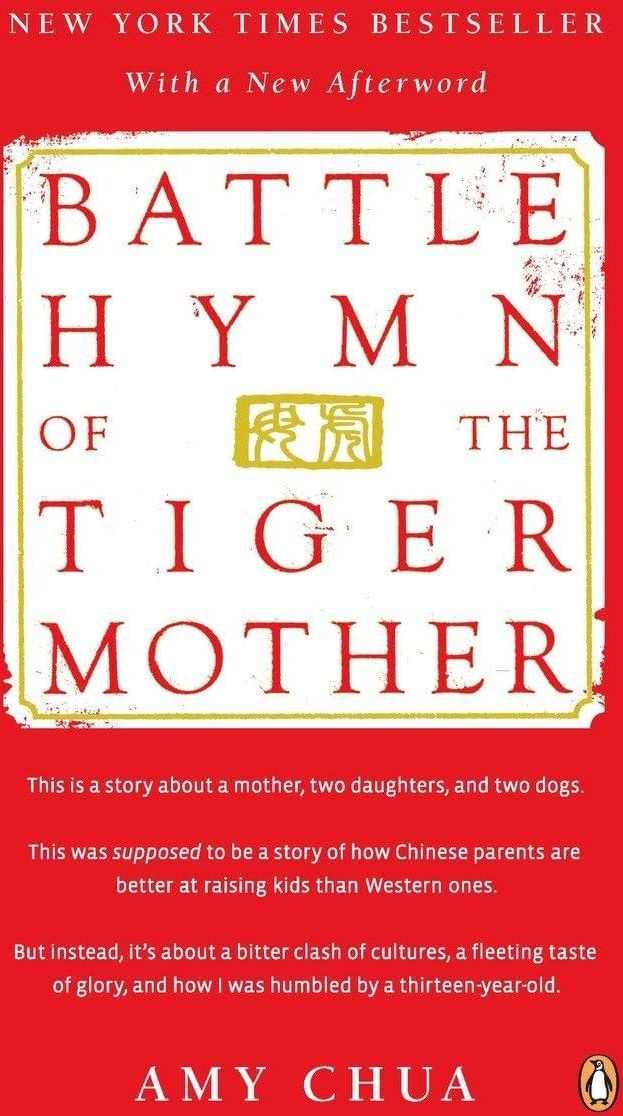
Chua’s book is one part memoir, recounting her role in the achievements of her two daughters in both academics and classical music, and one part explanation of the differences between the Western and Chinese perspectives on parenting. I do not think it would be unfair to accuse it of sometimes trying to have it both ways, arguing that the strict Chinese model of parenting builds on a different set of values such that they cannot really be compared, but that if you did do a fair comparison then the Chinese way would definitely come out on top.
Battle Hymn is the part of the title that is more puzzling — my primary association is to the song by Manowar, the «world’s loudest» heavy metal band with aesthetics ripped straight out of Conan the Barbarian, celebrating muscles, leather and swordfighting. No one would accuse Manowar of exceptional poetry — some with less manners than me might even question their musicality! — but with a debut album called Battle Hymn, perhaps we can take them as an authority on that concept.
War is obviously a grisly affair, horrible as it is unfolding in the present and also in the trauma, injuries and deaths it leaves behind. A battle hymn is in some sense an attempt to come to terms with the sacrifices a warrior must make, balancing all the visceral negatives with nebulous ideas about honor, brotherhood and a greater good. Yes, you might die, but you will also live on as a hero. The sands of time will shake.
In this interpretation, battle hymn fits nicely in the title of the book, perfectly summarizing Chua’s understanding of her role as a mother. She must prepare her children for a life in the adult world, so that they will be able to realize their ambitions and honor the family name, regardless of what it costs in terms of comfort. Implicitly, she accuses Western parents of being tunnel visioned on feeling loved by their children and getting to see them happy and carefree, so that they can congratulate themselves on being perfect parents. She argues that conflict avoidance and coddling only pushes the problems ahead, leaving it to the children themselves to deal with them without either the support of their parents or the discipline that Chinese parenting instils.
In this review, I will not summarize the content of the book because I could never do it justice anyway, but I will scatter around some excerpts while trying to pull in related ideas and perspectives. If you are at all interested in parenting, the duality of child, or the stranger than fiction cultural differences between West and East, you should read it — it is very short, pleasant to read and full of stories that like a blue or gold dress sort of morph between amusing and shocking. You might come away with a strong conviction that Chinese parenting is literal child abuse or that the sort of watered down positive parenting that is gaining popularity in the West basically amounts to taking children’s potential and pouring it down the drain.
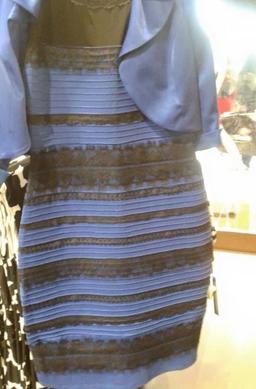
The black-and-blue (sic) dress that sparked a short-lived internet controversy.
Either way, Chua’s perspective as an outsider immersed in the American mainstream culture is fascinating, not only for taking us beyond surface-level understanding most of us have of Chinese parenting, but also for how her background enables her to notice and criticize things that we just take for granted, like how a fish does not notice the water it swims in.
Haruki Murakami
A lot of people wonder how Chinese parents raise such stereotypically successful kids. They wonder what these parents do to produce so many math whizzes and music prodigies, what it’s like inside the family, and whether they could do it too. Well, I can tell them, because I’ve done it. Here are some things my daughters, Sophia and Louisa, were never allowed to do:
- attend a sleepover
- have a playdate
- be in a school play
- complain about not being in a school play
- watch TV or play computer games
- choose their own extracurricular activities
- get any grade less than an A
- not be the #1 student in every subject except gym and drama
- play any instrument other than the piano or violin
- not play the piano or violin.
Battle Hymn of the Tiger Mother (p 3-4). Kindle Edition.
I must say that the more I read gifted writers, the more I learn to fear them. Two standout examples for me are Murakami (Norwegian Wood) and Knausgård (My Struggle). In some sense, you can always trust a bad writer, because to them writing feels like pulling teeth. They do not enjoy it, so they only write if they feel like they have something important to say, and their work will only ever pass through all the filters if their content has genuine merit. Great writers, on the other hand, have an unnerving tendency to write beautifully page up and page down about absolutely nothing. This is ultimately the same effect as why you should pick the least charismatic doctor — he must have been just that good to get the job.
Tiger Mother is written in a prosaic style, with short descriptive sentences and the occasional sprinkle of dry wit as seen in the above excerpt. This is quite effective — it gives center stage to the events themselves and allow us to get a more matter of fact understanding of them. It also leaves space for the reader to think about the content rather than just be dazzled by all the beautiful language, and Tiger Mother is very much a book where you want to try to keep three threads in your head at once: one for the underlying data, one for Chua’s interpretations and one for your own opinions.
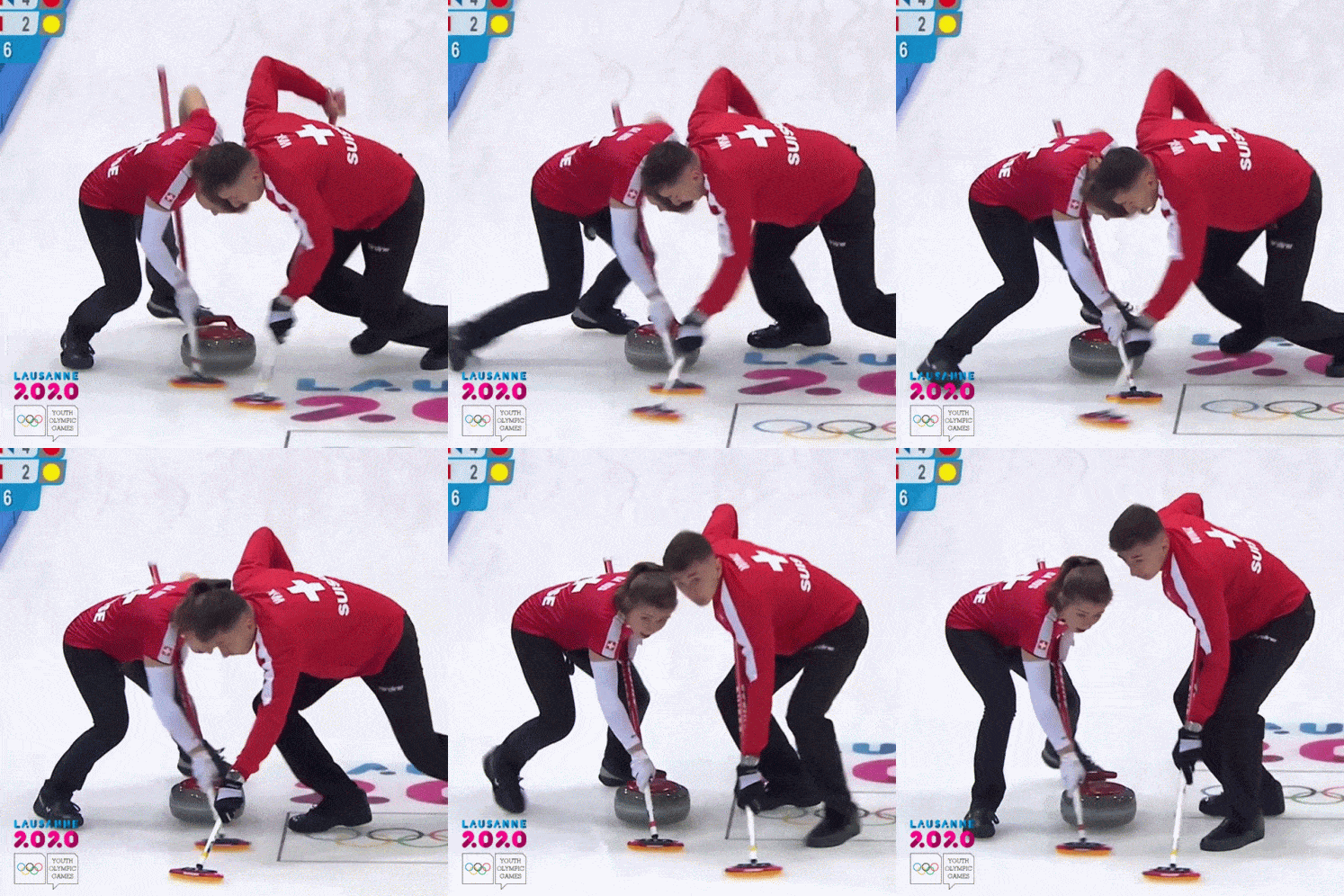
Helicopter parenting is a quite evocative term, describing parents who are overly protective of their children and do not trust them to do anything by themselves. Countries with winter sports traditions also have the term curling parenting, likening the behavior of parents to that of the sweepers in curling doing everything in their power to give the stone the smoothest possible ride to its destination.
As a book that is ultimately about the effects of different parenting styles, which is in some sense a scientific question that could be studied by crunching mountains of numerical data, it might be tempting to brush away Tiger Mother as meaningless anecdotal evidence. We can not possibly determine whether the outcomes — such as Chua’s children playing in Carnegie Hall and getting Harvard scholarships — are due to parenting, heritability or just randomness.
I definitely have some sympathy with this, and I feel like Chua does not wrestle enough with how she is raising children with two professors as parents, a highly gifted mathematician as their maternal grandfather and prestigious PhDs sprinkled all over the family tree. Ironically, the closest she flies to the sun on this admittedly controversial topic is when she discusses the talents and inclinations of the family’s Samoyed dogs, where her toolbox of sticks and carrots ultimately comes up short:
In return, I accused him of being selfish and thinking only of himself. “All you think about is writing your own books and your own future,” I attacked. “What dreams do you have for Sophia, or for Lulu? Do you ever even think about that? What are your dreams for Coco?” [Coco is a dog.]
Battle Hymn of the Tiger Mother (p 83). Kindle Edition.
However, I find it a bit petulant to refuse to engage with anecdotal evidence at all. Obviously, the memoirs of one Chinese-American disciplinarian lacks statistical power to prove hypotheses, but it also makes room for a wealth of contextual information that would disappear the moment we tried to compel it into an Excel spreadsheet. Furthermore, I find Tiger Mother to have significant value as a sort of proof-by-construction. Sufficiently extreme data, assuming that it is reliable, can teach us something even if N = 1 — how many atomic bombs do you need to see blow up before you get curious about fission?
Unfortunately, for the case of Tiger Mother, while I feel very confident that I should learn something from it, I am not quite as sure about how much, let alone what.
Lady Tremaine
A key feature of the Suzuki approach is that a parent is expected to attend every music lesson and then to supervise practice sessions at home. What this meant was that every moment Sophia was at the piano, I was there with her, and I was being educated too. I had taken piano lessons as a child, but my parents didn’t have the money to hire anyone good, so I ended up studying with a neighbor, who sometimes hosted Tupperware parties during my lesson. With Sophia’s teacher, I started learning all kinds of things about music theory and music history that I’d never known before.
With me at her side, Sophia practiced at least ninety minutes every day, including weekends. On lesson days, we practiced twice as long. I made Sophia memorize everything, even if it wasn’t required, and I never paid her a penny. That’s how we blasted through those Suzuki books. Other parents aimed for one book a year. We started off with the “Twinkle, Twinkle” variations (Book One); three months later Sophia was playing Schumann (Book Two); six months after that, she was playing a sonatina by Clementi (Book Three). And I still felt we were going too slow.
Battle Hymn of the Tiger Mother (p 27-28). Kindle Edition.
While she is of Chinese heritage, Amy Chua is born in the US to parents who immigrated from the Philippines. By the Chinese zodiac, she is a water tiger, and throughout the book she draws on the characteristics traditionally assigned to tigers to describe her own temperament. She is married to a Jewish man, and they are both Professors of Law at Yale University as well as successful writers. Somehow, despite her ancestors having left China roughly a century ago, her two daughters both speak Chinese and she has tried to convince them that they are Chinese, with mixed results.
While it is relatively easy to understand the absurdly high standards that the tiger mother demands from her cubs — and tempting to think of them as both unrealistic and insane — it is difficult to wrap your head around just how extreme commitments the tiger herself makes to this project. The easy way of conceptualizing tiger parenting is to just imagine whatever normal kind of household you are familiar with and to turn the expectations dial up to 11 while everything else stays the same.
This would be completely wrong — along with the over-the-top expectations comes similarly unprecedented amounts of support, even if some of this support comes in the form of stressful schedules and savage scolding. This is another reason that there is no substitute for reading the book and getting a full picture, because it is our nature to fill in the missing pieces with what we are familiar with, which just does not work when you are effectively in a foreign country.

The stepmother from Disney’s Cinderella; someone you would not be flattered to by compared with.
It is perhaps also tempting to picture the tiger mother as a sadist who enjoys controlling and chastising her children. A readily available comparison is the stepmother from a fairy tale, who is mean to children because she would rather they be dead because she is not too fond of them. As Chua explains her point of view, nothing could be further from the truth. It is not for her own enjoyment that the home is in intermittent states of cold and hot war, and she would have loved to be permissive and forgiving, if only so she could give herself some time off. But rest is weakness entering the body; the first crack in the house of discipline brings the whole structure crashing down; it’s the child He loves that He disciplines.
If you find that this smells a bit like a convenient excuse, I would like nothing more than for you to decide for yourself. For what it’s worth, my impression is that she really comes from a position of tough love. Among other things, I would refer her excesses to prepare Ecuadoran dishes, artifacts and interviews for her younger daughter’s Passport Around the World-project, as well as her thorough documentation of her daughters’ childhoods. Chua is strict with her children to the point of being a living caricature, but that is still not even half as hard as she pushes herself to keep the wheels spinning. She cares too much about her children’s future to compromise it for nothing more than to get to feel loved by them — that would be selfish.
But in the name of bothsidesism, I suppose it is fair to point out aspects of Chua’s personality that I find somewhat tacky. She has a preference for extravagant celebrations, where it seems like the massive expenses are not as much an unfortunate side-effect as they are the main point. To some degree, this can be justified as just a proportional response to the extraordinary investments and achievements of her daughters. I take more issue with how she seems to blithely assume that whichever teacher or instructor is the most expensive or famous must necessarily be the best.
For the reception afterward [Carnegie Hall concert], I’d rented out the Fontainebleau Room at the St. Regis New York, where we also took two rooms for two nights. In addition to sushi, crab cakes, dumplings, quesadillas, a raw oyster bar, and iced silver bowls of jumbo shrimp, I ordered a beef tenderloin station, a Peking duck station, and a pasta station (for the kids). At the last minute I had them throw in Gruyère profiteroles, Sicilian rice balls with wild mushrooms, and a giant dessert station.
Battle Hymn of the Tiger Mother (p 27-28). Kindle Edition.
Jordan Peterson
Wait, who invited that guy? And where’s the excerpt? Well, sure. One thing at a time please!
I was soaking some stale focaccia in the small dish of olive oil the server had given us. At Jed’s urging, Lulu handed me her “surprise,” which turned out to be a card. More accurately, it was a piece of paper folded crookedly in half, with a big happy face on the front. Inside, “Happy Birthday, Mommy! Love, Lulu” was scrawled in crayon above another happy face. The card couldn’t have taken Lulu more than twenty seconds to make.
I know just what Jed would have done. He would have said, “Oh, how nice — thank you, honey,” and planted a stiff kiss on Lulu’s forehead. Then he probably would have said that he wasn’t very hungry, and was only going to have a bowl of soup, or on second thought just bread and water, but the rest of us could order as much as we goddamn liked.
I gave the card back to Lulu. “I don’t want this,” I said. “I want a better one — one that you’ve put some thought and effort into. I have a special box, where I keep all my cards from you and Sophia, and this one can’t go in there.”
“What?” said Lulu in disbelief. I saw beads of sweat start to form on Jed’s forehead
I grabbed the card again and flipped it over. I pulled out a pen from my purse and scrawled “Happy Birthday Lulu Whoopee!” I added a big sour face. “What if I gave you this for your birthday, Lulu — would you like that? But I would never do that, Lulu. No — I get you magicians and giant slides that cost me hundreds of dollars. I get you huge ice cream cakes shaped like penguins, and I spend half my salary on stupid sticker and eraser party favors that everyone just throws away. I work so hard to give you good birthdays! I deserve better than this. So I reject this.” I threw the card back.
Battle Hymn of the Tiger Mother (p 103). Kindle Edition.
Were we to accept Chua’s separate-but-equal presentation of Western and Chinese parenting, we could conceptualize them as the end points of a line, one emphasizing happiness and the other success. We could imagine that like the volume slider in an app, a parent could choose which one is more important and exactly how to trade this amount of well-being off against that amount of achievement. If this is the world we actually live in, it sounds like an incredibly unpleasant choice to make.
However, Chua also frequently veers into all animals are equal, but tigers are more equal than others-territory, and whether you ultimately end up accepting or rejecting it, it is worth at least entertaining this line of thought. After all, tigers are majestic.
It would be easy if the way to get happy and self-confident children was just to give them total freedom and lavish them with praise, but humans are sort of complicated. Take the example of games — they sink or swim depending on whether we find them fun, but incredibly popular games such as Mario, Pokemon and League of Legends tend towards the difficult, unforgiving and even unfair end of the spectrum. Admittedly, there are also games that believe that failure states are are bad design, such as Animal Crossing I suppose, but they seem to be the exception rather than the rule.
Chua ascribes the success of Chinese parenting to a virtuous circle:
- Parent sets ambitious and meaningful goals, while providing the support, guidance and — uhm — motivation to make them achievable
- Child puts in the often unreasonable amounts of practice and work necessary to succeed, learning and developing new skills in the process
- Success reinforces the child’s trust in its own abilities, the rewards that come from hard work and effectiveness of its parent’s harsh rules
- Recognition of success gives the child feelings of satisfaction and pride, and if not eagerness at least a willingness to keep working towards new lofty goals, closing the loop back to (1)
While Chua does not provide a full take-down of the pitfalls of Western parenting, I feel like it can be found implicitly in her praise of the Chinese model as well as the breadcrumbs of explicit criticism scattered around in different parts of the book. Disconnecting praise from achievement gives children a broken model of how the world works outside of the reach of a coddling mother’s unconditional love. Like a bird with broken wings, the child that does understand the importance of step two above does not fare well outside of the nest.
The fact is that Chinese parents can do things that would seem unimaginable — even legally actionable — to Westerners. Chinese mothers can say to their daughters, “Hey fatty — lose some weight.” By contrast, Western parents have to tiptoe around the issue, talking in terms of “health” and never ever mentioning the f-word, and their kids still end up in therapy for eating disorders and negative self-image.
Battle Hymn of the Tiger Mother (p 51). Kindle Edition.
In 12 Rules for Life, Jordan Peterson’s fifth rule is Do not let your children do anything that makes you dislike them. Just the wording itself is beautifully provocative, and the accompanying chapter follows suit. While Peterson’s analysis is rooted in something that vaguely resembles conservatism and that draws heavily on sometimes far-fetched interpretations of Biblical stories, his criticisms of Western parenting converges on many of the same idea as Chua’s. It should always pique your curiosity when completely different traditions converge on similar answers.
The intended reading of Do not let your children (...) mirrors Chua’s point that children need a work ethic that is compatible with the outside world if they are to succeed in it and be happy. Peterson criticizes overly forgiving parents who put up with terrible behavior from their children, in an attempt to maintain harmony or as an expression of self-sacrificing love. The urge is understandable — parents are predisposed to liking their own children — but this also means that by the time children annoy even their parents, their peers see them as positively feral and shun them. Well, who needs friends, anyway?
The smothering niceness of a coddling mother risks stunting their social development. Indeed, one of the boogeymen of Peterson’s archetypical landscape is the mother who is so reluctant to let go of the intimate mother-and-child relationship with her young son, that she tries to infantilize him and make him so dependent on her so that he can never leave her. If this sounds criminally insane, bear in mind that this way of making its members socially incompatible with the outside world is Customer Retention 101 for cults, with dietary restrictions being only the tip of the iceberg.
While Chua emphasizes professional success, Peterson is much more focused on socialization and relationships. And while Chua sparked controversy with her extremely demanding parenting style, Peterson played with fire by speaking in favor of using physical dominance to discipline children. The reactions are somewhat understandable — the stereotype of a bad parent involves strong alcohol, hair-trigger temper, abusive language and belts. The over-correction to this failure mode is to never get physical with a child, ever, or even to go full positive parenting and strike out the word no from the dictionary.
Peterson argues that physical restraint, absent temper or violence, is an effective language that children speak fluently. He recounts one episode of babysitting a neighbor’s son who was impossible to reason with, and managing to get the child to sleep through the night with a combination of wrestling, playfulness and patience. Peterson emphasizes that there is no need for brutality, because adults have a second key advantage to complement their sheer size:
A patient adult can defeat a two-year-old, hard as that is to believe. (...) This is partly because time lasts forever, when you’re two. Half an hour for me was a week for my son. I assured myself of victory. [This except is from a different context in the same chapter.]
Twelve Rules for Life (p 127). Allen Lane Edition.
The most interesting part of Peterson’s wrestling story is not that he managed to overpower and exhaust a much smaller child, but his claim that the child, even as it fights to win actually wants to lose. One might have imagined that in the morning, the child would remember the episode and be resentful, perhaps tattle to his parents. In Peterson’s interpretation, the kid instead gained a newfound respect for him, not from fear, but for having restored the world to its rightful order, where grown-ups decide and children obey.
I might be blurring the lines between Peterson’s writing and my own imagination, but I will go out on a limb and claim that perhaps children are curious by nature and driven to explore, like a robot vacuum that is introduced to a new home. But the child’s exploration is not limited to its physical surroundings — it also feels compelled to explore the social environment with its rules and codes for behavior.
Just like a Roomba expects to find walls that limits it and uses these walls to find its way around the apartment, so a child also expects to find furniture too low to crawl under or too high too climb — indeed, these discoveries help them make sense of the world, just like with the walls and the Roomba. And similarly, a child expects there to be rules they are not allowed to break and adults who will tell them no and actually follow through on it. If parents fail to set limits for children, it does not give them comfort. Rather, it confuses them and drives them towards ever more reckless and inappropriate behavior. They become the human equivalent of a robot vacuum helplessly spinning in circles and failing to position itself.
So that amounts to a lot of squid ink and very little clarity. Where does this all leave us? Well, if you wanted simple answers you should have stuck with algebra or structural engineering. But if we insist on arriving on something looking like a conclusion, I think we can at least say that the overly simplistic model, where strict parenting causes self-esteem issues and burn-out and coddling parenting leads to happiness and confidence, must be wrong.
But this is something like an anti-conclusion: we are trying to cross out one hypothesis in a forest of millions. And even if we manage to point out weaknesses or flaws in the Western model, I would be hesitant to leap right into Chua’s arms. What happens to her virtuous circle when some load bearing component fails — when the mother gets too ambitious or the child fails to meet the expectations? I have some doubts about how well tiger parenting translates to children with less talent or diligence, though I suppose part of point is adapting both the standards and the methods to the children.
South Korea is famous for its gruelling admissions tests as well as its unpleasantly high suicide rates. Japan and China however, which shares much of the same Confucian cultural influence do not particularly stand out, and as far as I can tell from some very quick web searches it is primarily the elderly, not eighteen year olds, who inflate the Korean numbers. Japan has brought us the word karoshi, a term for overwork-related death or suicide, and whlie these phenomena all allow us to look up numbers in tables, I am dubious of how well we are actually able to interpret them.
So let us retreat to the safety of anecdotes. Battle Hymn of the Tiger Mother does not just offer us various stories about Amy Chua and her two daughters. It can also serve as an anecdotal longitudinal study. Despite critics predicting that the girls would soon enough buckle under stress and become estranged from their family, both have written mostly favorably about their childhood and pushed back against criticism painting their mother as abusive. It feels a bit unseemly to do too deep a dive into their personal lives, so I will contend myself to say that from bird’s eye point of view they seem like the sort of successful and well-adjusted people that many would envy.
There are more than enough interviews, articles and essays to be found out there, but I will highlight a 2023 interview with Chua and Louisa in the Daily Mail, which is perhaps the most recent. It is a bit boring and predictable in parts, and the headline seems quite misleading, but it’s still an interesting read that some insight into how things have worked out for the family:
‘And I thought: “Oh my God, if I had really died in the hospital, there were all these things I should have said to my daughters that I hadn’t. Things like: I’m so proud of you and I hope you realise that even though I tend to err on the side of criticism and finding fault, you are so much more talented and brilliant than I ever was. You exceeded my wildest expectations.” ’
(...)
‘I still believe achieving excellence can bring a lot of benefits, and I’m glad I instilled a sense of grit in my kids. But the things I regret more are the harsh things I said to them and losing my temper.’
(...)
Her family now appears closer than ever. She and husband Jed celebrate their 35th anniversary this year, while her daughters continue to prove that perhaps being tiger-mummed really does work.
Sophia, 30, who through her mother’s exhortations played piano at Carnegie Hall aged 14, graduated from Yale Law School and now works as a military lawyer in Washington where she lives with her husband, fellow lawyer Tim Mitchell.
And 27-year-old Lulu graduated with distinction from Harvard and spent a year at an elite New York law firm before embarking on the first of two judicial clerkships in Miami.
(...)
‘That makes me think that there’s a trade-off. I would say that the one upside of my kids not having quite as much fun as everybody else when they were little means that they have a lot of opportunities now. They’re confident, self-sufficient, earn their own keep and pay their own rent.’
Interview with Amy Chua and Louisa Chua-Rubenfeld by Lina Das, Daily Mail, 1 October 2023
Bertrand Russel
One of my greatest fears is family decline. There’s an old Chinese saying that “prosperity can never last for three generations.” I’ll bet that if someone with empirical skills conducted a longitudinal survey about intergenerational performance, they’d find a remarkably common pattern among Chinese immigrants fortunate enough to have come to the United States as graduate students or skilled workers over the last fifty years. The pattern would go something like this:
- The immigrant generation (like my parents) is the hardest-working. Many will have started off in the United States almost penniless, but they will work nonstop (...). Everything they do and earn will go toward their children’s education and future.
- The next generation (mine), the first to be born in America, will typically be high-achieving. They will usually play the piano and/or violin. They will attend an Ivy League or Top Ten university. They will tend to be professionals (...). Whether male or female, they will not be as strict with their children as their parents were with them.
- The next generation (...) is the one I spend nights lying awake worrying about. Because of the hard work of their parents and grandparents, this generation will be born into the great comforts of the upper middle class.(...) Finally and most problematically, they will feel that they have individual rights guaranteed by the U.S. Constitution and therefore be much more likely to disobey their parents and ignore career advice. In short, all factors point to this generation being headed straight for decline.
Well, not on my watch. From the moment Sophia was born and I looked into her cute and knowing face, I was determined not to let it happen to her, not to raise a soft, entitled child — not to let my family fall.
Battle Hymn of the Tiger Mother (p 20-22). Kindle Edition.
My brother borrowed me his copy of Logicomix, a graphic novel about Bertrand Russel’s life and ideas. I did not find it fantastic — in part, I suppose, because I have a stronger background in mathematics than the intended audience, making some of its explanations feel a bit tedious, and in part because the book lacks a proper heroic arc. In fairness, it’s the fault of the source material, not the book.
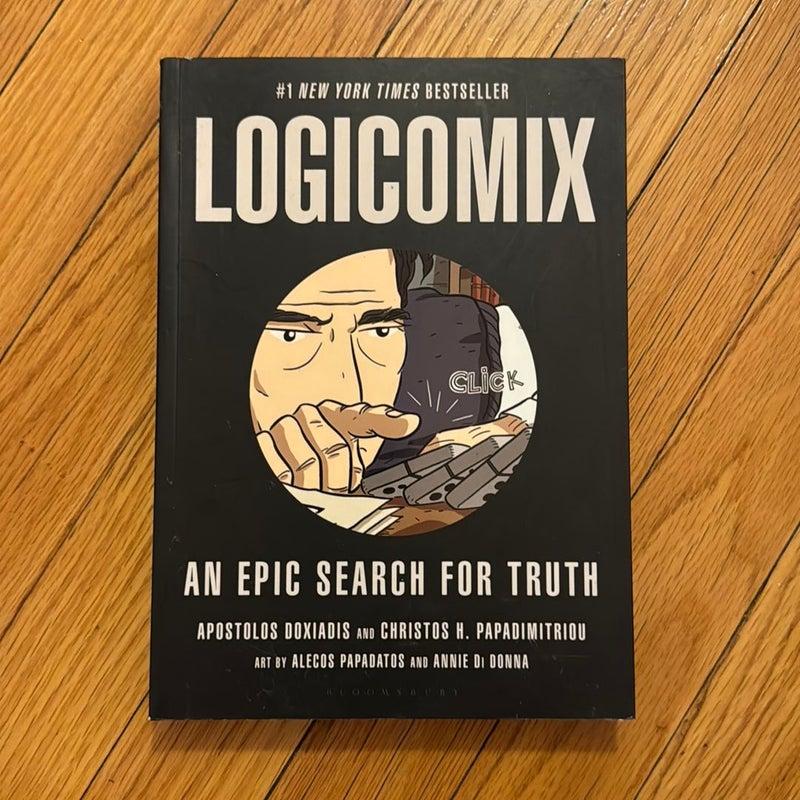
Russel is most famous for his ultimately futile quest to rebuild the entirety of mathematics in a strict, logical formulation, proving every theorem from the smallest possible set of assumptions or axioms. This project eventually ran afoul the paradox of the the barber who cuts the hair of everybody who does not cut it themselves, which with some bells and whistles can be expanded into Gödel’s incompleteness theorem. It’s an unfortunate way to end not just a story, but also the life project of a brilliant man.
Russel can deflect from the failure of his mathematical project by pointing to his life as a public intellectual and his Nobel Prize in Literature. Personally, I find the prize somewhat dubious, but then again, he can keep company with Bob Dylan, and at least it’s not the Peace Prize. The award points to his varied and significant writings in which he champions humanitarian ideals and freedom of thought, which I suspect means that the prize was not only because of his literary merits but also for espousing ideas that flattered the committee’s sensibilities.
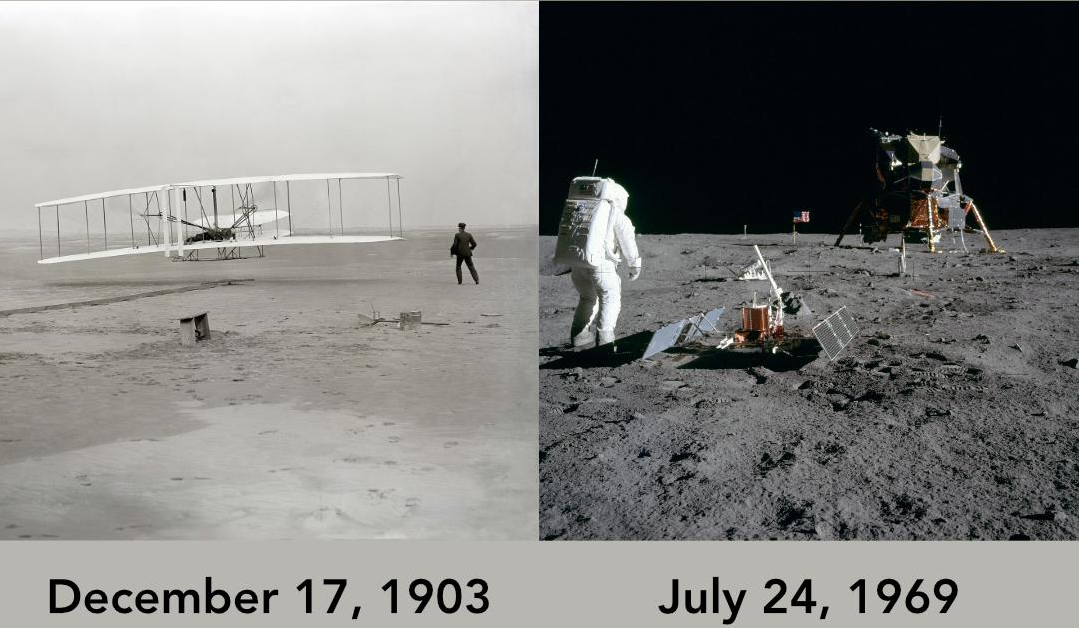
A picture with some serious they promised us flying cars and all we got was 140 characters-energy.
While a fascinating man in his own right, Russel is not directly relevant to Tiger Mother. I bring him up because because he was born into the British aristocracy, a culture with somewhat similar ideas about honoring the family name as Chua gets from her Chinese background. Russel had a private tutor, and while the primary role of a teacher in the modern West is to be the responsible adult that prevents children from sticking peas too far up their noses, Russel’s tutor was an actual scholar by the name of Douglas Spalding. Again, as with Chua and her tiger cubs, we can not distinguish innate talent from good education, but it is useful to remember that we inherit a civilization built by people who idolized lions, not kittycats.

The coat of arms of England. It is not entirely clear to me if the artist had even seen a lion or why they are drawn with their tongues sticking out.
The other reason I have for brining Bertrand Russel into this is that he is the originator of some of my all-time favorite quotes. This first one is quite famous, though it is usually massaged a bit to make it more pithy:
The fundamental cause of the trouble is that in the modern world the stupid are cocksure while the intelligent are full of doubt.
Mortals and Others, Bertrand Russel
But this second one is in my opinion better, not to mention much more pertinent. Just like you cannot appreciate a painting by having different parts of it described to you in words, there is no substitute for reading the book. If there was, it would definitely not be to just read this review. Battle Hymn of the Tiger Mother is full of stories that come together as a whole that is greater than its part, and you would be better off getting it straight from the horse tiger’s mouth.
A stupid man's report of what a clever man says is never accurate, because he unconsciously translates what he hears into something that he can understand.
A History of Western Philosophy, Bertrand Russel