Warning: Spoilers abound.
The Plot
There is a popular riddle that goes:
A father and his son are involved in a horrific car crash and the older man dies at the scene. When the child arrives at the hospital and is rushed into the operating theater, the surgeon pulls away and says, “I can’t operate on this boy, he’s my son.” How can this be?
The answer is that the surgeon is the child’s mother. People miss this simple answer because they are used to most surgeons being men.
Broken Harbor by Tana French is a book-length version of this riddle. The police are called to a grisly scene out in the suburbs. Two young children lie dead in their beds, suffocated by their pillows. Their father and mother lie bloody in the kitchen downstairs, each stabbed multiple times. The mother is barely clinging to life, everyone else is dead. Whodunit?
I’ve given away the answer, of course. It’s the mom. The amazing thing is, French also gives away the answer in the first chapter when the lead detective tells his partner, “The fact that [the mother] survived puts her front and center.” The detective proceeds to merrily ignore this fact and pursue every other unlikely lead for the rest of the book, right up until the end.
The book works precisely because both the detectives and the readers find the idea of the mother being the murderer so improbable. There is no need for a large cast of suspects or a trail of red herrings. The real answer is so cruel that, no matter what Sherlock Holmes taught us, even after eliminating the impossible, we can’t look straight at the improbable truth.
The real villain in this book is the idea that, no matter how blamelessly you live, something “clawed and simian” might randomly hook onto you and follow you back home. Patrick and Jennifer Spain lived a picture-perfect life. Individually, they were both popular and kind. Together, they were high-school sweethearts still in love after many years. They did all the right things: created a lovely home, had two sweet children, treated each other well. Yet, they were destroyed by a barbaric monster that rose out of the ocean: the 2008 recession.
Patrick loses his job as a recruiter in the recession. At a loss of what to do with himself at home, he turns his attention to getting rid of a pest in the attic. He thinks the pest is a mink, but it is really more of a Moby Dick. The mink ignores his baited traps, avoids the cameras he sets up all over the house, growls in the ceiling to taunt him, moves its nest every time he cuts a hole in the walls to find it. Never mind. Patrick doesn’t give up; he is more determined than ever to keep his family safe from the dangerous predator.
There is no mink.
Patrick is losing it, and all Jennifer can do is watch. Her son, who is young enough to be suggestible, also starts hearing the mink. For many months, Jennifer acts with “a frail, doomed gallantry,” “braced at the door with all her pathetic weapons, fighting her heart out while the water seeped past her.” As their bank account races to zero, she takes care of the children, cooks fancy dinners, puts on a good act in front of their neighbors, makes their home lovelier than ever in the hopes that Patrick will come back to her. The opposite happens. Her older child, her daughter, also starts believing in the mink. Jennifer snaps, and comes to the conclusion that she has to get her family out of there.
A Note on Spoilers
At this point, after having thoroughly spoiled the story for you, let me beg for forgiveness. Spoiling a mystery book is a most uncouth act, but in this case, it is slightly less bad than it seems because:
- I have avoided talking about at least one major plot point that will still surprise you.
- The book is fun to read even if you know the ending. I re-read it in preparation for writing this review, and even though I remembered almost everything, I still walked around with my nose in the book the entire weekend.
- This is not the best of French’s books. The most widely acclaimed is The Faithful Place, while my personal favorite is The Trespasser. If this book sounds good to you, there are several excellent books you can still dig into.
Gone Girl, come back
Gone Girl (2012) was the biggest thing to happen to suspense books in the last decade. Gone Girl was so big that it was released as a David Fincher (director of Fight Club) and Ben Affleck (actor in Dunkin Donuts commercial) blockbuster movie a mere two years after publication. Gone Girl was so big that its author hasn’t written another novel since. Gone Girl was so big that it is now a cruise theme. Gone Girl was so big that there is now a whole genre of books that sound like it:
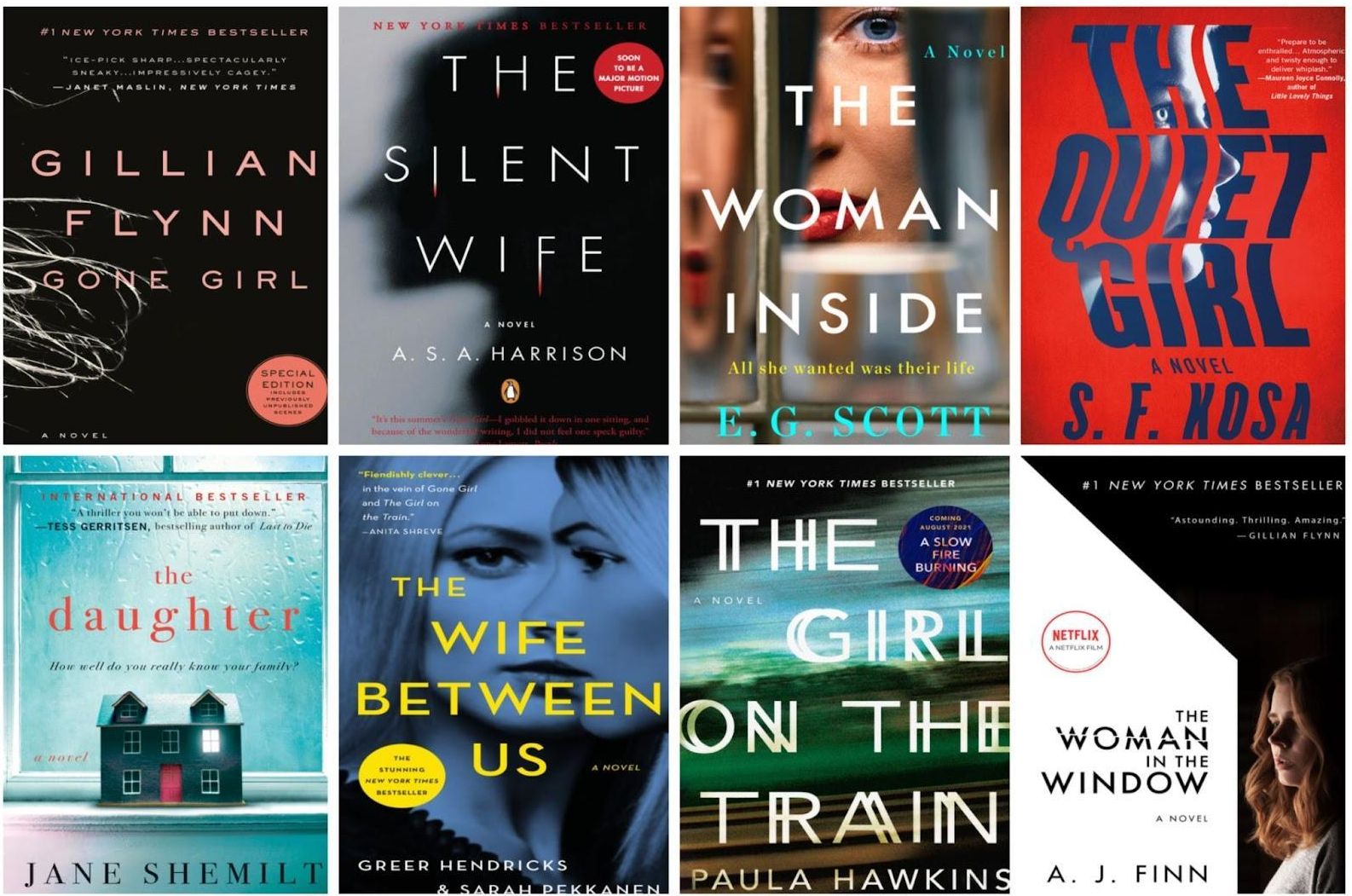
The original is in the top-left. I’m ashamed to admit I’ve read all of these.
Everyone wants the next Gone Girl. More than a decade after it was published, nothing has even come close. The entire genre is a wasteland of wasted women and wayward plot twists. But what if I told you that the next, new and improved, Gone Girl, has been with us all along? It was published a scarce month after the original, and captured the same lightning in a bottle. It was Broken Harbor.
Both books feature married couples who are incredibly compatible and in love with each other. Both couples, in the wake of the 2008 recession, find themselves living financially precarious lives in ugly suburbs. Both couples end up destroying each other because of (1) the all-too-common bad behavior of one half and (2) the over-the-top cinematic villainy of the other half.
Broken Harbor is better because it is operating on a higher level of difficulty. Unlike Gone Girl’s couple, the Spains have kids and the two tots are an integral part of the story. The readers see their autopsy, the supporting characters mourn the loss of their unique relationships with each child, and Jennifer Spain’s motive stems from her kids’ experiences. Broken Harbor pulls off the difficult trick of creating an interesting plot with both kids and parents involved. This is impressive because usually kids and parents mutually make each other's lives less interesting and more stable. There is a reason protagonists in fantasy stories are orphans; otherwise their parents would care too much to let them travel hundreds of miles with a donkey and an old man. (More precisely, writers are too lazy to come up with a good reason for their parents to say yes to this batshit idea.) There is a reason protagonists in adult contemporary fiction can always conveniently drop their child off with a babysitter or grandma or ex-wife before the end of the chapter; no one is driving anywhere exciting with an occupied car seat in the back.
Broken Harbor is also better because it picks the better justification for its villain. Gone Girl’s villain has the justification of, roughly, “feminism” and “men are jerks.” The iconic cool girl monologue (very mild spoilers) provides a taste. This justification has the advantage that it is relatable, but is otherwise inferior in every way to Broken Harbor’s villain’s justification: “entropy wins and that sucks.”
Broken Harbor is littered with characters who try to impose some semblance of order upon their lives, and are defeated by life’s random vagaries. There is a group of tight-knit high school friends who hang out with each other every day and love each other to pieces, and then they grow up and apart and find it awkward to ever hang out again. There is a character who suffers a major personal blow, and so goes to enough therapy that he is able to live a good life, excelling at his job and navigating an amicable divorce, until the past that he thought he had resolved rises up again to hurt him. And of course, our central couple, who even after having been with each other for all their adult lives would “kiss when they passed in the kitchen,” are torn to shreds by the emotional and financial stress of joblessness. Side characters are not immune either: one of them, on the same day that all her immediate family is throwing up because of a stomach flu, finds out that she needs to provide urgent care to an extended family member suffering her own health crisis.
Over and over again, good people’s orderly lives fall apart due to sheer bad luck, and the wild mood builds and builds until the reader understands how Jennifer came to feel cornered. There was nowhere she could hide her children where chance wouldn’t chase them down and chew them up. There was no safe harbor from the endless deluge of bad news we call life. All her harbors were broken; death was the only escape.
The Bigger Short
Pop quiz time: where are these cafes located?

Answers, clockwise from top-left:
- Chai Café, Harare, Zimbabwe
- Two or More Cafe, Karachi, Pakistan
- Rose Café, Barquisimeto, Venezuela
- The Thirty-Six, Medan, Indonesia
But if you answered that they are located in America, you are not wrong. They are not physically in America, but they are American in every other way that counts. You could walk into any of these cafes and have the barista draw you adorable latte art. You could walk up to any of the customers and ask them what they thought of the latest season of Game of Thrones. I didn’t even try that hard to find these examples! It took me fifteen minutes on Google Maps to find all four pictures.
Americans are myopic. (Not you, dear reader; I’m talking about the rest of them.) Apart from occasionally comparing American social safety nets to European ones, they don’t care about the world and assume the rest of the world is returning the favor. Unfortunately, the rest of the world can’t afford that luxury. As I learned in my high school history class, “when America sneezes, the world catches a cold.” For better or for worse, the world is being dragged along by America. They stream Hollywood movies, they learn to make cold brews, they copy WeWork decor, they eat KFC, they stare at smartphones instead of talking to friends, they wear hoodies, and worst of all, they suffer for American financial crises.
Broken Harbor takes place in an Irish suburb that has been devastated by the 2008 recession. A developer bought a huge plot of land in Broken Harbor and renamed the area Brianstown. All the twisting, dead-end suburban roads have names like Ocean View Rise, Ocean View Drive, and Ocean View Grove (with nary an ocean in view). The half-completed McMansion development is mostly empty, and the few families that remain stuck there have an unemployment rate of 50% and a desperation rate of 100%. The overall effect is something like the Florida scene from The Big Short (2015), but across the ocean.
The characters are Irish, but the mood is pure American (or universal?). For example, here are the Spains talking about their decision to buy their home: “How else are we supposed to get on the property ladder? How else are we supposed to buy a decent-sized house with a garden for the kids? It’s a brilliant investment, in a few years it’ll be worth enough that we can sell it and buy somewhere in Dublin, but for now...” and “Man, do you know how fast property prices are rising? We haven’t even moved in yet, and the gaff’s already worth more than we’re paying. Any time we decide to sell, we’ll come out with a profit.”
And then, the inevitable pop: “Only innocents think broke is made of how much you earn and how much you owe. Ask any economist: broke is made of how you feel. The credit crunch didn’t happen because people woke up any poorer than they’d been the day before; it happened because people woke up scared.” A neighbor compares the development’s half-built ruins to the other B-city America destroyed: Baghdad.
Apart from the murder detectives, who are in a counter-cyclical profession, almost every single household we meet in the book is under financial stress caused by the recession. It is incredibly heartbreaking to watch these people fall apart because of mortgage rate decisions made by America. It’s not fair. They are paying for mistakes made by an uncaring giant across the ocean, and all they can do is batten down the hatches and wait for the storm to pass.
Life of the Author
My toxic trait is that, once I fall in love with a book, I immediately begin armchair analyzing its author to try to figure out which of their real world experiences led to which plot points. In French’s case, I have built a castle of assumptions upon two items from her sparse Wikipedia page: her old profession as an actor and her immigration to Ireland.
French’s writing is most exquisite when she talks about acting, and we are lucky that she chose to write about detectives, a group of people who find more opportunities to act than most. Her detectives (the good ones anyway) don’t go into interviews guns ablaze. Instead, they walk in as actors onto an improv stage. They calibrate their own performance to elicit the desired responses, they carefully watch for their interviewees tics, they maintain control of the pace and rhythm of the scene to keep their interviewee off-balance. Throughout, they are assessing and adjusting their own masks.
For example, here is the lead detective praising his partner’s interview skills: “I had been right to send him in. He was relaxed as a sunbather and doing a beautiful job. [...] Every detective [...] has knacks, little things that he does better than anyone else around: we all know who to call if we want a witness reassured by the expert, or a quick bit of intimidation done right. Richie had one of the rarest knacks of all. He could make a witness believe, against all the evidence, that they were just two people talking.”
French is also excellent at capturing how much humans long to drop their masks, even the thin transparent ones we don to maintain blasé politeness with coworkers. Her detectives, thrown together as they are into late night stakeouts and ugly crime scenes, long to turn their partners into close friends. They are held back by the natural human inclination to put up walls for security, and the push-and-pull struggle leads to some of her most evocative passages: “I thought of the other partners on the squad, the ones going strong after longer than most marriages: the deft balance with which they moved around each other; the trust as solid and practical as a coat or a mug, something never talked about because it was always in use.”
French’s other hallmark is that all her books are set in Ireland. French herself is an American who moved to Ireland for college, when she writes about her adopted homeland, she displays the best traits of immigrant writing: a deep love for her chosen country and an outsider’s observant eye.
French is obsessed with Ireland. Not only the easy-to-understand Dublin bars that American tourists visit, but the backwoods and the bogs, the cramped places the working class live in and the unglamorous campgrounds they vacation in. Not only Ireland’s current incarnation, but the knotted past that has been bulldozed and paved over. Here she is, talking about Broken Harbor (I have not marked all omitted bits, there are several):
I used to know Broken Harbor like the back of my hand, when I was a skinny little guy with home-cut hair and mended jeans. Kids nowadays grew up on sun holidays during the boom, two weeks in Costa del Sol is their bare minimum. But I’m forty-two and our generation had low expectations. A few days by the Irish Sea in a rented caravan put you ahead of the pack.
Broken Harbor was nowhere, back then. A dozen scattered houses full of families named Whelan or Lynch who’d been there since evolution began, a shop called Lynch’s and a pub called Whelan’s, and a handful of caravan spaces, just a fast barefoot run over slipping sand dunes and between tufts of marram grass to the cream-colored sweep of beach. We got two weeks there every June, in a rusty four-bunker that my dad booked a year in advance.
The three of us were up and out at daybreak with a slice of bread and sugar in each hand. We had all-day games of pirates with the kids from the other caravans, went freckly and peeling from salt and windburn and the odd hour of sunshine. We’d come back to find my mum sitting on my dad’s lap, leaning her head into the curve of his neck and smiling dreamily out at the water. I waited all year to see them look like that.
Conclusion
I am writing this in spring 2023, before the blooms are out. Smart people tell me I’d do well to prepare for another recession. I was too young to fully absorb the last one. My dad did lose his job then, but he found another one after a bit, and worked hard to keep our home unchanged in the meantime. I barely noticed or cared because I was a teenager.
This time is different. My parents are retired now. This time, I’d be the one in danger of losing my job with kids to feed at home.
It doesn’t even have to be a recession. It could be the next pandemic, the next war, the next earthquake, whatever. The older I grow, the more I realize that everything I value about my life is built on soft shifting sands of luck. This book resonates with that melancholy fear in my soul, that even though I have done everything right and played by the rules, it could all come to naught.