Why do smart people invest time and money in bad ideas? Sterling Delano’s Brook Farm: The Dark Side of Utopia answers this question with a fascinating case study from the 1840s that is surprisingly relevant to today.
Brook Farm (1841-1847) was a secular utopian commune founded near Boston by a group of Transcendentalists, a loosely aligned progressive movement. While many utopian communities failed in the 1840s, the story of Brook Farm is notable for the involvement of several famous figures including Nathaniel Hawthorne, Margaret Fuller, Ralph Waldo Emerson, Henry Thoreau, Edgar Allen Poe, and Horace Greeley.
Less well-known today but prominent in the 19th century were Brook Farm’s founder, George Ripley, and his second-in-command, Charles Dana. Ripley, 38, was a disaffected Unitarian minister who had hosted the first meeting of the Transcendental Club and wanted to see Transcendentalist ideals put into action. Dana, 21, had recently left Harvard after three years without graduating. He was penniless but possessed an abundance of energy and idealism. Neither man had any farming or business experience, yet after the bankruptcy of Brook Farm both would have highly successful careers. Ripley achieved financial success writing book reviews for the widely read New York Tribune newspaper. Charles Dana worked as the managing editor for the New York Tribune and then became the owner and editor of the equally influential New York Sun newspaper. He became friends with Karl Marx (who served as a London based correspondent for the New York Tribune) and served as Assistant Secretary of War for President Lincoln during the Civil War. After Brook Farm, Ripley and Dana also published the sixteen-volume New American Cyclopedia that brought them both significant wealth. With their obvious abilities, how did these two intelligent men fail to manage a simple communal farm?
There is more to the story of Brook Farm than a group of naïve writers and dreamers rediscovering that farming is hard work. Sterling Delano was an English Professor who wrote BFDSU for both a specific academic audience and a general audience, and he succeeded at both goals. He made an appropriate decision to tell the story through the words of the Brook Farmers as much as possible with a thorough and well-documented engaging narrative that offers a firsthand perspective of life in a socialist experiment and mostly avoids inserting his own opinions until the end.
George Ripley’s admirable ideals and ambitious goals for social reform attracted a steady stream of residents and visitors eager to see Brook Farm succeed. Many of Ripley’s goals for Brook Farm were decades ahead of their time (e.g. limited workweek hours with medical benefits, equal work opportunities with equal pay for women, equal access to education). While Ripley had a clear-eyed view of several problems in society and courageous faith that he could build a thriving community to demonstrate reform, he lacked the leadership experience and business acumen to make a successful plan that could generate sufficient income to pay for his vision. In an attempt to save Brook Farm from debt after a few years of operation, he made an ill-fated decision to embrace Fourierism, a utopian socialist movement that had a brief moment of popularity among over thirty experimental communities that attempted to implement it.
The 1840s were a decade brimming with ideas for reform that produced several short-lived utopian communities. Ralph Waldo Emerson wrote in 1840 that “we are all a little wild here with numberless projects of social reform. Not a reading man but has the draft of a new community project in his waistcoat pocket.” Almost every experimental community failed, however Brook Farm did endure longer than most. Starting a community or any new enterprise and driving it to success requires certain leadership qualities and decisions. Part 1 of this review presents the story of Brook Farm and the mistakes that caused its collapse. Part 2 contrasts George Ripley with another social reformer in the same era who led an experimental community that faced much harsher challenges than Brook Farm and achieved far greater success.
Part 1. His knowledge of the actual was not so large as his faith in the possible ideal
I. George Ripley
Brook Farm got off to a rocky start―literally. The 192 acre property in West Roxbury that George Ripley purchased had previously been used as a dairy farm due to the unsuitability of its rocky and sandy soil for agriculture. Ripley acquired the rocky territory anyway for its aesthetic appeal bordering the Charles River and for its proximity to his close friend and fellow Transcendentalist Theodore Parker. The purchase was the start of growing debts that would force Ripley five years later to auction off several hundred books from his personal library, after which he told a friend, “I can now understand how a man would feel if he could attend his own funeral.”
The chain of events that led to George Ripley’s decision to become a farmer started several years earlier when he hosted the first meeting of the Transcendental Club at his house in 1836. By then Ripley had served as a Unitarian minister in Boston for ten years after graduating from the progressive Harvard Divinity School. He was inspired by religious and social activism, and his desire for reform was shared by a group of Boston-area Unitarian ministers who started the Transcendental movement.[1]
The devastating Financial Panic of 1837 caused many reformers to further question existing social institutions and hardened their resolve for activism. In an 1837 sermon Ripley said, “the great danger of our country… is the inordinate pursuit, the extravagant worship of wealth,” and his congregation needed to “learn from what we are now going through, to cherish a deeper sense of our dependence upon one another.” Ripley’s passion for religious and social progress (and his habit of questioning religious orthodoxy) clashed with his congregations’ desire for their minister to simply remind them to follow the traditional teachings that they had heard their whole lives. Ripley complained to a fellow Transcendentalist that his congregation “would rather be exhorted than enlightened.”
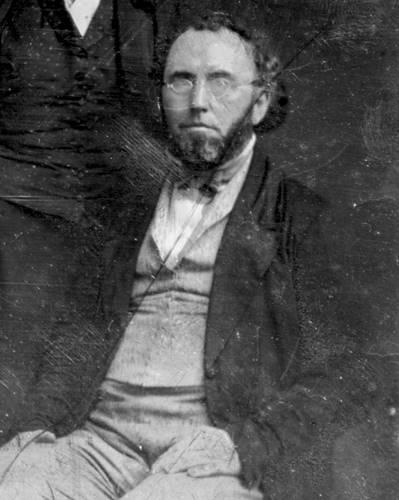
George Ripley, 1850s. One Brook Farmer said of fellow utopian Bronson Alcott, “[his] knowledge of the actual is not so large as his faith in the possible ideal,” a point that BFDSU author Sterling Delano agreed also applied to George Ripley. (image source: Wikipedia commons)
In 1840, George Ripley and his wife Sophia spent a relaxing vacation during July and August at Charles Ellis’s scenic 170 acre dairy farm in West Roxbury, eight miles southwest of Boston. George spent his vacation reading, not working, and enjoying scenic walks through the mature pine forest and open pastures on the property. He may have read Albert Brisbane’s Social Destiny of Man; or Association and Reorganization of Industry (1840), which was the first American publication to describe in detail the theories of French socialist Charles Fourier, and which would shape the second half of Brook Farm’s existence. Theodore Parker, Ripley’s close friend who lived nearby, did read the book that summer and wrote in his journal that it “contains many excellent things. It points out the enormous miseries of our present society, & proposes to remedy them by bringing men together in phalanxes of 300 or 400 families to live combined with all the advantages of action.”
In August 1840, Theodore Parker and George Ripley attended a convention for “Come-Outers,” religious reformers who had “come out” of their established churches. The convention inspired the formation of four separate utopian communities in Massachusetts by attendees. At the next and final meeting of the Transcendental Club in September, Ripley announced his decision to quit his position as a minister and leave the formal Church to start an agricultural community at the Ellis dairy farm with no formal religion or religious requirements. Several members of the club thought this was too radical and believed the existing Church could still be reformed instead of deserted. The already loosely aligned club fractured and stopped meeting. Some members, like Ralph Waldo Emerson, believed social change should happen at the level of the individual and pursued secular individualism, while others joined Ripley and his attempt to reform the institutions of society through socialism.
On October 1, 1840 Ripley submitted a 7,300 word resignation letter to his church congregation that declared his last day as their minister would be April 1, 1841. His letter denounced “the formality and coldness which are breathed from the atmosphere of our churches.” Ripley stated that after some efforts at reform, “Liberal churches began to fear liberality,” while ministers “who defended the progress as well as freedom of thought were openly denounced as infidels… The plainest expositions of Christian truth… were accused of heresy.” He stated, “The purpose of Christianity is to redeem society as well as the individual from all sin,” and continued that he could not “witness the glaring inequalities of condition, the hollow pretension of pride, the scornful apathy with which many urge the prostration of man, the burning zeal with which they run the race of selfish competition, with no thought for the elevation of their brethren, without the sad conviction that the spirit of Christ has well-nigh disappeared from our churches.”
Even before securing funding, Ripley was firmly committed in October to his plan to buy the Ellis dairy farm (plus an adjoining 22 acres) and start farming on May 1, 1841. He prepared for his new life by talking to local farmers and reading journals (Farmer’s Magazine, New England Farmer) which offered formulas for estimating costs, crop rotations and yields, and calculating manure production for optimal spread and fertilization. Ever the optimist, Ripley also visited Emerson to try to recruit him to join his proposed “colony” for Transcendentalists to live and work together in harmony in the “‘city of God’ which we shall try to build.” Emerson was noncommittal so Ripley followed up with a letter on November 9 clearly stating his intentions:
Our objects as you know, are to insure a more natural union between intellectual and manual labor than now exists; to combine the thinker and the worker, as far as possible, in the same individual; to guarantee the highest mental freedom, by providing all with labor, adapted to their tastes and talents, and securing to them the fruits of their industry; to do away the necessity of menial services, by opening the benefits of education and the profits of labor to all; and thus to prepare a society of liberal, intelligent, and cultivated persons, whose relations with each other would permit a more simple and wholesome life, than can be led amidst the pressure of our competitive institutions.
Ripley hoped Emerson would live in the colony, but also would have been happy to claim him as a prominent investor to assist his fundraising efforts. Ripley was now seeking to raise $30,000 via subscription in a joint-stock company whose investors would be guaranteed a fixed interest annually, with their investments secured by the real estate. Emerson was undecided for five weeks before declining Ripley’s request and remained in Concord to continue his comfortable life delivering paid lectures. Emerson praised the new colony as “noble & humane” but concluded “I think that all I shall solidly do, I must do alone.”[2]
Ripley gave his farewell address to his congregation on March 28, 1841. He said he was “a peace man, a temperance man, an abolitionist, a transcendentalist, a friend of radical reform in our social institutions,” adding “we part in peace. An honest difference of opinion need alienate no kind feelings.” Ripley saw the obvious call for social reform in the Biblical teaching “Inasmuch as ye have not done it unto one of the least of these, ye have not done it unto me” and was now going to lead by example rather than preaching.
II. Nathaniel Hawthorne
The Brook Farm Institute for Agriculture and Education (taking its new name from Palmer Brook running by the farm) started small with thirteen associates in April 1841. The only resident with farming experience was William Allen, who had managed Theodore Parker’s nearby small farm. Initially, Brook Farm had a large barn and a two-story farmhouse with attached quarters converted for sleeping rooms that the new residents named the “Hive.”
George Ripley was thrilled to start his new career by cleaning the stables, plowing, and planting. His wife Sophia wrote to a friend that he did “a harder day’s work each day than the last; and feels better than ever before… George is happy as a prince & works as hard as any day laborer with constantly increasing strength and no suffering.” George Ripley’s father was a successful merchant who had sent his son to a private academy and chosen Harvard College for him (when his son had been leaning toward Yale) and then Harvard Divinity School. Farming would have been quite different from the privileged life and career track that he had been on.
George Ripley wasn’t the only one energized by the novelty of doing manual labor. Nathaniel Hawthorne, 36, did a speedrun of the utopian experience at Brook Farm during the six months he lived there. Hawthorne joined Brook Farm in April believing it was a sound investment and that he would have plenty of time to write each day when the farming chores were finished. He especially loved his living situation in the Hive. George Ripley had one of the largest personal libraries in New England and his books were stacked along the wall outside Hawthorne’s bedroom door, while nearby was a couch under a staircase where he could read and observe his fellow Brook Farmers. One evening Hawthorne enjoyed a particularly memorable pillow fight with two young single women, Ellen Slade and Ora Gannett, who found him sitting alone and delighted in opportunities to draw the taciturn writer out of his shell. “As fast as we could throw them at him he returned them with effect, hitting us every time, while we could hit only the broom. We laughed and his eyes shone and twinkled like stars,” recalled Ora Gannett, 16.
Hawthorne was engaged and his fiancé planned to join him in a home at Brook Farm immediately after hearing about Ora Gannett after they were married. He joked in a letter to his fiancé about milking a “transcendental heifer” and claimed he felt “the original Adam reviving within me.” He boasted about chopping hay with such “righteous vehemence” that he broke the tool so Ripley gave him a “four-pronged instrument… which he gave me to understand was called a pitch-fork” and together they “commenced a gallant attack upon a heap of manure.” Hawthorne wrote to his sister on May 3, “the whole fraternity eat together; and such a delectable way of life has never been seen on earth, since the days of the early Christians.”
Hawthorne’s initial joy from shoveling manure and waxing poetic about hard labor did not last. Ripley had encouraged the workers by calling the mounds of manure the “gold mine” that needed to be continuously spread on the fields. By early June in a letter to his fiancé Hawthorne complained, “that abominable gold mine! Of all the hateful places, that is the worst. It is my opinion, dearest, that a man’s soul may be buried and perish under a dung heap or in a furrow of the field, just as well as under a pile of money.” Hawthorne had hoped to have plenty of time to write fiction but was instead facing the daily reality of exhaustion from hours of hard work. He also feared that Brook Farm had failed to raise enough funding to be successful, putting its future and his $1,000 investment in jeopardy. Questioning Ripley in July, Hawthorne noted Ripley’s “zeal will not permit him to doubt of eventual success.” Ripley had been encouraged by the recent addition to Brook Farm of Charles Dana, 21, his wife’s cousin who had dropped out of Harvard after 3 years, and who quickly rose to Ripley’s second-in-command. Eventually Hawthorne negotiated an agreement starting September 1 so that he was no longer required to do any manual labor and could spend his time writing. Someone else would have to shovel the manure.
Hawthorne still wanted to be married and resolved not to stay at Brook Farm that winter. Trying to retain Hawthorne, Ripley appointed him chairman of “Direction of Finance” and made him one of Brook Farm’s four trustees (with himself, Charles Dana and William Allen). The Ellis Farm purchase was closed on October 11 for $10,500 (financed with dual $6,000 and $5,000 mortgages from several of Ripley’s friends), that included an adjoining 22 acre lot for a total of 192 acres. The additional lot had a barn and farmhouse that the Brook Farmers named the “Nest” and was already being used for classrooms for the community’s growing school.
For Brook Farm’s funding, Ripley had pledges from investors to buy shares totaling $12,000, but only about half purchased their shares in cash. Cash investors included George Ripley ($1,500), Sophia Ripley ($1000), and Nathaniel Hawthorne ($1,000). Charles Dana and William Allen both pledged $1,500 to buy their shares, an amount that neither ever paid.
Life at Brook Farm followed a routine. Morning chores started at 4:45 feeding and milking the cows. After breakfast the men shoveled and transported manure, hoed crops, and cut hay, which they continued after lunch. After dinner the community enjoyed reading, talking in the Hive, and the occasional dramatic tableaux. In addition to being highly educated, George’s wife Sophia Ripley took on domestic work (scrubbing floors, washing clothes) with other women and also taught classes in history and foreign languages for the community’s school. She remained cheerful while working long days and was determined to make the community succeed. She wrote to Margaret Fuller at the end of September “I must tell you how well we are satisfied (I trust without fanaticism) with the success of our experiment. We have all learned a great deal—more perhaps than in any six months of our life.”
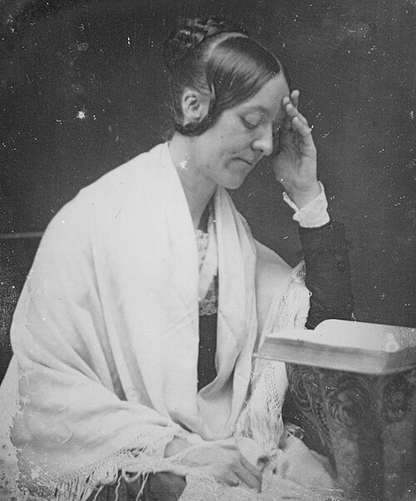
Margaret Fuller in 1846. She chose not to join Brook Farm but visited often and was a close friend of George and Sophia Ripley. When George Ripley first told the Transcendental Club his plan to buy a farm, she wrote to another member that she hoped that Ripley might have “a faithful friend in the beginning, the rather that his own mind, though that of a captain is not that of a conqueror.” (image source: Wikipedia Commons)
Hawthorne left Brook Farm at the end of October 1841 and moved to Concord. He was one of several ex-Brook Farmers to do so, where they enjoyed a collegial intellectual environment (and didn’t have to shovel manure). He did get enough material from his time at Brook Farm for his 1852 novel The Blithedale Romance. In the preface Hawthorne admitted there are obvious similarities between Brook Farm and the fictional Blithedale Farm, but denied that any characters were based on real people. Readers did see similarities between Hawthorne and the narrator Miles Coverdale, a taciturn writer who joins the fictional utopian community. Later in the novel the character Zenobia, a feminist who shares several characteristics with Margaret Fuller, observes that “intellectual activity is incompatible with any large amount of bodily exercise.”
Despite the departure of several original associates, new arrivals had pushed Brook Farm’s population over twenty and prompted Ripley to start construction of more housing. He chose a rocky outcropping on the highest hill on the farm for a new building that he named the “Eyrie.” More construction required more fundraising since the only reliable source of income was the school. In December, Ripley wrote to Emerson asking for funding and was “so sure of your sympathy in the ideas which our little company are trying to illustrate, that I do not hesitate to bespeak your attention to our prospects.” Ripley hyped Brook Farm claiming a “ten per cent net gain on the value of the estate” and “our personal resources are sufficient… for the immediate improvements we contemplate” but “without larger means than are now at our command, we must labor to great disadvantage, and perhaps retard and seriously injure our enterprise.” This time Emerson didn’t respond. Ripley was undaunted, saying “so many powers are at work with us and for us, that I cannot doubt that we are destined to succeed.”
III. Expansion
Brook Farm continued to grow and attract visitors. One year had over four thousand names registered in the reception room of the Hive, though many may have only visited for the day. Those who stayed were charged 25 cents for lunch, 12 cents for dinner and 25 cents for lodging per night (tuition and board for the school was $4 per week). One Brook Farmer described the hodgepodge of visitors as “some of the oddest of the odd; those who rode every conceivable hobby; some of all religions; bond and free; transcendental and occidental; antislavery and proslavery; come-outers; communists, fruitists and flutists; dreamers and schemers of all sorts.” Margaret Fuller never joined Brook Farm but lived nearby and stopped by often. Other visitors included Horace Greely, owner and editor of the New York Tribune, Emerson, Bronson Alcott and Henry Thoreau.
George Ripley was welcoming of those interested in joining Brook Farm as associates, students, or boarders. By May 1842 the total population was around fifty, then sixty in June and seventy in July. One weakness of BFDSU is difficulty following Brook Farm’s population and financial status each year. While specific expenses and mortgages are mentioned, an overall profit and loss statement for each year would be useful, as well as a breakdown of the population each year by associates, students, and boarders. Perhaps these records are no longer available. There also is no indication that Brook Farm charged associates for membership or for visitors to attend its popular parties.
Many were students and boarders who didn’t always pay their bills. Seeing the challenge of growing crops at Brook Farm, Ripley stated “every community should have its leading purpose, some one main object to which it directs its energies. We are a company of teachers. The branch of industry which we pursue as our primary object, and chief means of support, is teaching.” The growing school was preceded by private boarding academies in New England; however classes at Brook Farm were not restricted to the wealthy: anyone could attend regardless of class, race, gender, or age. At a time when college graduates were rare, Brook Farm had several teachers who had graduated from Harvard and offered evening classes for adults (George Ripley taught classes on moral philosophy and maths, Charles Dana taught Greek and German). Brook Farm also had one of the first day nurseries in the U.S.
One reason for the growing population of students was the opportunity for young women to pursue education, which attracted young men. Emerson sympathized with Ripley’s task “to meet the expectation & admiration of all this eager crowd of men & women seeking they know not what who flock to them.” BFDSU author Delano counters that the young women and men knew “they sought freedom from restrictive and repressive domestic and intellectual expectations, as well as opportunities for personal growth and development.” Ripley had created an early version of what modern co-educational college campuses offer students, which was rare outside of Brook Farm in the early 1840s. Years later, students and residents recalled fun parties (picnics, socials, dances, masquerade balls), glee club singing (Mozart and Haydn), and boat rides on the Charles River. Perhaps if federal student loans had been available Ripley could have charged much higher tuition to capitalize on the appealing academic campus, talented teachers, and lively social life at Brook Farm.
IV. Charles Fourier
Brook Farm continued to accept new associates and students in 1842, and constructed two more two-story residences, the “Cottage” and the “Pilgrim House.” The buildings added $6,300 debt to the existing $11,000 in mortgages. The additional debt spurred Hawthorne to visit and try to claw back the remainder of his $1,000 investment (he had received $500 previously). Ripley and Dana gave him a $524 promissory note payable in 30 days for his stock certificate. This satisfied Hawthorne, who resigned as an associate on October 17 but said he would take “the warmest interest in your progress, and shall heartily rejoice at your success—of which I can see no reasonable doubt.”
To address the financial strain at Brook Farm, George Ripley started looking farther away for funding. Horace Greeley, the owner of the popular New York Tribune, had a keen interest in social reform and especially the plans of French social scientist Charles Fourier for the “Association and Reorganization of Industry.” Greeley had been in contact with Brook Farm as a location for his wife to recover from a visual impairment and was sending Brook Farm free copies of the Tribune, which was publishing a new column by Albert Brisbane promoting Charles Fourier’s proposals. Albert Brisbane was from a wealthy American family and studied in European universities for six years, including in Berlin as a student of Hegel. He was moved by the devastating poverty he saw and became a devoted apostle of Charles Fourier after studying under him. He published Social Destiny of Man; or Association and Reorganization of Industry in 1840 to promote Fourier’s theories.
George Ripley wrote to Greeley in August that “The greatest difficulty we find is, what you would expect, the want of money… This limits us in every way” and complimented the “immense practical wisdom embodied in Fourier’s plan.” Greeley declined to invest unless Brook Farm embraced Fourierism (also known as Associationism).
George Ripley was likely aware of Fourier’s theories for “Association and Reorganization of Industry” when he founded Brook Farm, which met several of the requirements for Fourier’s ideal community. Fourier’s plan for a successful “Association” required 2000 people living and working on a 6000 acre commune, which Brisbane saw as unfeasible and instead promoted 400 people on 1500 acres as “the smallest number with which Association can succeed.” Fourier proposed an Association should also be near a large city for selling its products and be organized as a joint-stock company. “We condemn Community of Property entirely, we consider it as the most false of principles and as the grave of individual liberty,” wrote Brisbane in one Tribune column. However, one requirement that Brook Farm lacked to be a “Phalanx,” Fourier’s term for an ideal community, was a single immense residential building called a “Phalanstery” where all members of an Association could live together.
In December 1842, Greeley wrote to Ripley urging him to diversify the sources for Brook Farm’s revenue into industrial production instead of depending so heavily upon the school. To encourage Fourierism at Brook Farm, Greeley had recommended Louis Ryckman, a shoemaker from New York and Vice President of the New York Fourier Society, who joined Brook Farm in November.
In February 1843, Brook Farm responded to financial difficulties with retrenchment (e.g. no new purchases on credit, cancelling milk delivery, forgoing certain foods including meat for those unwilling to pay extra for it). In April, Brook Farm took out another $1,000 loan (at 5% interest) from Thoedore Parker and now owed more than $18,000 in loans and mortgages. Brook Farm wasn’t the only utopian community facing austerity, although one community had adopted it as a founding principle. Bronson Alcott (with his wife and four daughters) started “Fruitlands” in May. The community of fewer than 20 members embraced asceticism as a virtue and lasted less than six months. Alcott believed reform must happen at the individual level by “spiritual regeneration through physical purification” and that “outward abstinence is a sign of inward fullness.” Members of Fruitlands started each day with a cold-water shower and adhered to a strict vegetarian diet with no coffee, tea, or alcohol. Members were also prohibited from wearing clothes made from cotton, wool, or leather (whose production required exploiting animals and slaves), and chose to till their 11 acres of farmland by hand. Life at Brook Farm looked plush in comparison and one visiting member from Fruitlands sneered that the Brook Farmers were “playing away their youth and day-time in a miserably joyous frivolous manner.”
Hard working Brook Farmers grumbled anyway under retrenchment without much to show for it (in September 1843 they made the ultimate sacrifice when they gave up coffee). Ripley wrote to a member with three young children “I cannot look without daily admiration on the patient toil & perpetual sacrifice, which you in common with other associates, so faithfully endure in our common cause.” Yet he admitted due to the community’s limited finances “our daily life is not the expression of our aspiration, and only a hopeful life in the future can cheer us amidst present embarrassments.” He added, “I believe there is sufficient power & love in the spirit of man to carry it through,” and giving up would be “little better than death.”
Power & love in the spirit of man were not enough to stop several of the most productive associates from leaving, which caused George Ripley to look more seriously at other sources for funding. In August 1843 he attended a convention for Fourierism, returning with Albert Brisbane, who was more determined than ever to spread his message from New York into New England, which he believed was ready for radical social reform. After his first visit to Brook Farm, Brisbane wrote in his Tribune column, “Mr. Ripley is admirably adapted to the position which he holds; for he combines, beside the advantages of a polished education, great activity, practical talent and high benevolence.” To further promote Fourierism, Brisbane wanted Brook Farm to expand its industrial production and asked readers who were blacksmiths, carpenters, machinists and shoemakers to join. Ripley was pleased with the interest and still believed Brook Farm could succeed, writing, “a small sum of money would place us at ease in pecuniary matters & enable us to improve our outward life.”
Henry David Thoreau visited Brook Farm in December 1843. He had previously been invited to join Brook Farm during Ripley’s first recruitment push in early 1841, writing in his journal on March 3: “As for these communities, I think I had rather keep bachelor’s hall in hell than go to board in heaven.” But two years later when he was between projects and casting about for a new direction he decided to visit Brook Farm to witness the benefits of communal life. The visit confirmed his belief in taking a solo approach to experimental living, which he did a year and a half later in 1845 at Walden Pond. The attention to his finances in Walden may have been prompted by the difficulties he heard about at failed experimental communities. Thoreau’s skepticism of communal living found a receptive audience among several disillusioned residents at Brook Farm. George Bradford wrote to Emerson following the visit, “We were quite indebted to Henry for his brave defense of his thought which gained him much favor in the eyes of some of the friends here who are of the like faith.”
At the end of 1843, Ripley and several Brook Farmers attended the Boston “Convention of Friends of Social Reform in New England,” that was partially devoted to Fourierism. Ripley and his colleagues felt renewed hope after the meeting and decided to reorganize Brook Farm with the hope that leading Fourierists would support the community as the “Model Phalanx” for the country and save it from its debts. Ripley hyped Brook Farm and its advantages, including its close proximity to Boston, natural beauty, experience from three years of operation, and claimed that the property was worth nearly $30,000. His efforts to promote Brook Farm and Fourierism were recognized in January 1844 when he was elected the first president of the newly established New England Fourier Society. Privately, Ripley and Dana continued to ask their friends for additional financial support.
V. A New Direction
Brook Farm was formally reorganized in January 1844 as the Brook Farm Association of Industry and Education. The new Constitution written by Ripley, Dana, and Ryckman organized all labor into Departments, Series, and Groups. They wrote “[Fourier’s] law of Groups and Series, is, as we are convinced, the law of human nature.” The Department of Industry contained Agricultural, Mechanical, Domestic, and Educational Series. In the Agricultural Series there was a Plowing Group, Planting Group, Weeding Group, Hoeing Group, Milking Group, etc.
Tracking of all hours of labor required complex record-keeping in each Series account book. Ripley had turned to Associationism out of financial necessity, but the movement did align with his Transcendentalist beliefs about the dignity of labor. Fourier believed that organizing workers according to their “passional attractions” would unleash human potential instead of being crushed doing tedious labor in prevailing industrial schemes. Charles Dana never thought much of Albert Brisbane but called Fourier the “profoundest thinker of these modern times.”[3]
Inspired by the change to Associationism, Brook Farm had community meetings to approve building a new workshop for industry and a three-story Phalanstery to house all members. They also discussed raising $3,200 to liquidate all outstanding debts. In the first six months of 1844, 87 applicants were admitted to Brook Farm and 58 were formally elected members (after completing a two month probationary period). During the summer, 25 out of 100 applicants were rejected by Brook Farm, which was trying to become semi-selective for those with useful skills or were semi-skilled.
The transition of Brook Farm from agriculture and Transcendentalism to industry and Associationism was a major turning point that created a rift between the newcomers and the “first dispensation” of residents. Many of the original associates left and moved to Concord, including Ora Gannett, one of the earliest and most gregarious residents. One source estimated 28 ex-Brook Farmers and those connected to the community married each other.
In April, George Ripley, Charles Dana, and Louis Ryckman went to New York City for the “General Convention of the Friends of Association in the United States,” where Ripley was appointed president of the convention. Ripley made a resolution to distinguish Associationists from Fourier’s controversial beliefs. “We do not call ourselves Fourierist,” he stated “because there are parts [of Fourier’s theories] which we individually reject,” referring to Fourier’s views that natural instincts for love and sex should be unconstrained by monogamy. Dana spoke about Brook Farm’s accomplishments during its first three years: “In the first place we have abolished Domestic Servitude. In the second place, we have secured thorough education for all. And in the third place, we have established justice to the laborer, and ennobled Industry… This is not a dream which we propose, but something which has actually been done.” He did not mention that these admirable accomplishments required deficit spending since Brook Farm never was a profitable business. The convention was a success for Brook Farm and Ripley was able to raise $3200 in investments from the New York Associationists, including Horace Greeley.
One May 1, Brook Farm was officially incorporated as the Brook Farm Phalanx. George and Sophia Ripley purchased ten more shares of stock, bringing their total cash investment to $3447.50. That summer the Phalanx spent $1000 on a new steam engine to support its new industries, which were operating at a loss or barely broke even. The three main products were whale-oil lamps, shoes, and “sashes, blinds, and doors,” the latter being the most costly and illustrated the problems Brook Farm had trying to industrialize with insufficient capital. Making quality products required buying lumber in sufficient quantities and storing it until properly dried to prevent warping and shrinkage after construction. Brook Farm’s lack of dried inventory and the resulting inferior products dissatisfied the carpenters and their customers. The “sashes, blinds, and doors,” generated $870 in revenue and cost $1200 for the 1845 fiscal year. Another increasing problem was lack of accountability for Brook Farmers who didn’t pay their bills and associates who left with unpaid debts (one mother with three sons left without paying $141 for board and education). To fund its growing deficit, the Brook Farm Phalanx took out a five-year $2,500 loan from one of its neighbors.
In the face of these challenges, Brook Farm did start one enterprise that was successful and profitable. Albert Brisbane had been publishing his monthly newsletter The Phalanx to promote Associationism. When he left for France for a year in 1844, the editors offered to transfer it to Brook Farm, which had four printers in its “Printers Group.” The Harbinger (1845-1849) replaced The Phalanx as the unofficial paper of Associationism in the U.S. George Ripley, Charles Dana, and John Dwight contributed reviews of poetry, literature, and music in addition to promoting Associationism. One month after the launch in June, 1845 Ripley reported “we have now a circulation of over one thousand, and new names coming in every day.” For the second half of 1845 the paper’s revenue was $1,000 and costs were $255. The Harbinger could have been used to promote Brook Farm; however when one reader wrote asking for details about life at Brook Farm Ripley replied “we are more anxious to discuss principles, than to exhibit results.”[4]
Two of Edgar Allen Poe’s works published in 1845 were reviewed. Charles Dana reviewed Tales in July and John Dwight reviewed The Raven and Other Poems in December. Regarding Poe’s sense of taste, Dana wrote the tales were “clumsily contrived, unnatural, and every way in bad taste,” adding “a peculiar order of genius is apparent” but the tales “are like the vagaries of an opium eater.” Dwight wrote Poe’s poems “have a great deal of power, a great deal of beauty (of thought frequently, and always of rhythm and diction), originality and dramatic effect.” He did praise The Raven as portraying the “true grief of a lover” and having the “power of strange, sad melody, which there is no resisting. So there is in all his poems.” Poe responded to Dwight’s review one week later in the Broadway Journal: “The Harbinger edited by ‘The Brook Farm Phalanx,’ is, beyond a doubt, the most reputable organ of the Crazyites. We sincerely respect it—odd as this assertion may appear. It is conducted by an assemblage of well-read persons who mean no harm- and who, perhaps, can do less. Their objects are honorable and so forth—all that anybody can understand of them.” He lightheartedly added that he hoped in the future that “’The Snook-Farm Phalanx’ will never have any opinion of us at all.”
VI. Disaster
Two events caused the end of Brook Farm. In November 1845, two members contracted smallpox when visiting a relative in Boston and unknowingly exposed the entire community, many of whom were unvaccinated. About 1/3 of the 90 residents showed symptoms and were quarantined. The outbreak devastated the school, which lost revenue from parents who withheld their students or enrolled them elsewhere. With the steady revenue from the school gone, the few remaining animals (oxen) were sold for $100. The only way Brook Farm was able to celebrate Thanksgiving dinner was with charity donations (turkeys, etc.) from their neighbors.
In December 1845, Nathaniel Hawthorne filed a lawsuit still trying to recover the money from his $524 promissory note. Ripley was desperate and wrote to the New York Associationists asking for $15,000 to pay off part of Brook Farm’s debts. Brisbane wrote back to say “you might as well undertake to raise dead men” and that the New York Associationists had decided to support the North American Phalanx in Red Bank, New Jersey instead.
On March 3, 1846 the Brook Farmers saw their dreams go up in flames. The three-story Phalanstery for 150 residents on a terrace below the Eyrie was almost complete when it caught fire at 9 PM. The Eyrie was saved but the Phalanstery, which was uninsured, burned to the ground. Ripley later wrote the cause was “from a defect in the construction of the chimney” in the basement that was being used by carpenters during the day. Following the fire, all of the New York Associationists, including Greeley, relinquished their shares in Brook Farm. Albert Brisbane had never invested any money in Brook Farm, but he did run up a bill of $75 that he never paid for room and board during the months he visited the community.
After the fire, the Brook Farmers discussed ways to delay the community’s inevitable bankruptcy. One plan was to continue the successful enterprises (the school and The Harbinger) and re-emphasize farming. Going forward the group also agreed that wages would now “take note of results rather than of hours” (i.e. wages would no longer be the same for all types of work). The population steadily declined in 1846 from over 100 to less than 30 in August.
Ripley wrote in The Harbinger that spreading the Associationist movement across the country was his primary goal and minimized the importance of Brook Farm. He spent most of the summer of 1846 away giving lectures about Associationism, which struggled with the perception that it sought to abolish marriage with its theory of “passional attraction.” Dana left in September to work for the Boston Daily Chronotype, then in January moved to New York City to join the New York Tribune’s staff. On November 5, George Ripley finally faced the reality of Brook Farm’s failure and auctioned several hundred books in his personal library to pay some of the debts.
As Brook Farm was dissipating in 1846, the Boston Union of Associates (BUA) was formed with 96 members including over 30 Brook Farmers. The entire Associationist movement remained loosely aligned and Ripley complained, “The Affiliated Unions out of the cities are not to be relied on. The whole movement is becoming more and more ambiguous.” The Brook Farm Phalanx was formally dissolved in October, 1847 and the BUA ended in 1851 with the realization that true Associationism was not possible.
VII. Aftermath
Brook Farm sold at a public auction in April 1849 for $19,150 to the city of West Roxbury which moved the town’s almshouse to the property. The outstanding debts included four mortgages ($14,500) and a $2,096 execution. Out of 32 creditors, 10 made no claim, and 9 claims were not allowed. For the 13 remaining creditors, 9 were paid $1,031.11. Hawthorne received only $70.85 from the $585.90 judgment he was awarded from his lawsuit against Brook Farm. Another creditor, Ichabod Morton, received $641.81 out of the $4654.84 he loaned to Brook Farm in 1841. Ripley paid the remaining four creditors at a later date.
George Ripley joined the staff of Horace Greeley’s New York Tribune in 1847 and lived in New York City writing the Tribune’s book review column until his death in 1880. In 1863 Charles Dana and Ripley collaborated to produce the sixteen-volume New American Cyclopaedia: A Popular Dictionary for the General Knowledge which allowed Ripley to finally pay off his debt from Brook Farm.
George Ripley’s wife Sophia converted to Catholicism when she moved to New York City and died of breast cancer in 1861. Her funeral was held at the Purchase Street Church in Boston where her husband had been the minister, and had been converted to a Catholic Church. A few years later, George Ripley married a wealthy German woman 30 years younger than himself and they enjoyed several extensive vacations together in Europe.
Horace Greeley sent Charles Dana to France, Germany, and Austria in 1848 to cover social unrest for the New York Tribune. Greeley fired Dana as the Tribune’s managing editor in 1863 over differences about the Civil War and Dana was subsequently appointed Assistant Secretary of War in 1864. Dana later purchased the New York Sun in 1868 and was the owner and editor until his death in 1897. Horace Greeley became a proponent of the United States’ westward expansion and popularized the phrase “Go West, young man, go West and grow up with the country.” He unsuccessfully ran for President of the United States in 1872, losing in a landslide to incumbent President Ulysses S. Grant.
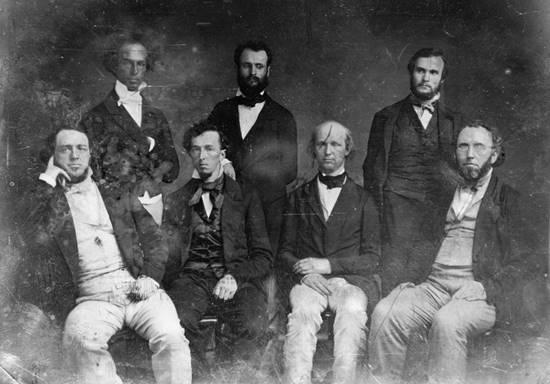
New York Tribune editorial staff circa 1850s. George Ripley is seated on the far right. Horace Greeley is sitting next to him. Charles Dana is standing in the center. This daguerreotype was taken after Henry Jarvis Raymond had left the Tribune to found The New York Times in 1851 with George Jones. The New York Tribune was the largest daily paper in New York City in the 1850s. (image source: Wikipedia Commons)
Ripley and Dana never wrote about Brook Farm after its collapse, declining, as BFDSU author Sterling Delano notes, “to revisit the mount of ashes amid which lay the high ideals and faith in man’s perfectibility that genuinely animated each man.” Delano continues:
As difficult as it is―even painful―to point the finger at a man of such fine and rare spirit as George Ripley, it has to be said finally that upon his shoulders must rest the burden of responsibility for Brook Farm’s chronic internal difficulties, and thus its ultimate collapse. Ripley always had the very best intentions, and he was the most unselfish of men, but he was nearly as ill prepared for the Brook Farm venture as Amos Bronson Alcott had been for his disastrous and short-lived “Fruitlands” experiment in 1843. It is also ironic that a man who had such a breadth of understanding in religious, literary, and social matters consistently failed to exercise good practical judgment, patience, and foresight when it came to the community’s internal operations and development.
Delano also partially blames Horace Greeley for urging Ripley to focus less on Brook Farm’s school, which had exceptional teachers and provided steady income, and instead expand into industries where Brook Farm had no competitive advantage and lacked the necessary capital to be successful. Ultimately, George Ripley was too naïve and too nice to be an effective leader of an experimental community. He ran Brook Farm more like a charity than a business with shareholders and creditors who were justifiably displeased to lose money.
Leading any experimental community to success has always been difficult. However, it was possible for an experimental community in the 1840s to succeed with the right kind of leader and resilient, skilled members. There was such a leader and social reformer who was born in New England, but he didn’t stay there. His goal was to build not just a “city of God” but an entire kingdom. And being too nice was not one of his flaws.
Part 2. The cowards never started and the weak died along the way
I. Early Years
Brigham Young was born on June 1, 1801 in Whitingham, Vermont. [Book reviewer’s disclaimer: neither I, nor John Turner (the author of the Brigham Young biography, Pioneer Prophet, used here as the reference for Young’s life) are Mormon. This book review is intended to be neutral toward the Mormon religion and instead compare the leadership decisions of George Ripley and Brigham Young. While George Ripley was still struggling with the debt from his failure to manage a 192-acre farm near Boston, Brigham Young had turned almost 1/6 of the western continental United States into a theocracy that he ruled in open defiance of the U.S. government and its laws. It is worth examining how Young accomplished his remarkable rise from poverty to power. The challenges he overcame and key decisions he made as a leader offer a sharp contrast to George Ripley’s opportunities and mistakes. Young also experimented with socialism, but only after the Mormons were well-established in Utah.]
Brigham Young was born on a rocky fifty-acre farm, the ninth of eleven children. Farming in Vermont was difficult and in 1804 his family left its unprofitable farm to join the “York Fever” exodus of New Englanders migrating to cheaper and more fertile land, eventually settling in Smyrna, New York. Their life in New York was no easier. Brigham would say later, “In my youthful days instead of going to school, I had to chop logs, to sow and plant, to plow in the midst of roots barefooted, and if I had on a pair of pants that would cover me I did pretty well.”
Young grew up in a strict Methodist home that always observed the Sabbath and prohibited swearing, drinking, dancing, and music. The family moved further west in 1813 to Genoa, New York and in 1815 his mother died from tuberculosis. During those difficult years Brigham often had to take care of his younger brother when his father was away clearing land and harvesting crops to earn extra money. Sometimes Brigham joined his father in addition to his household chores making bread, milking cows, and making butter. His self-reliance was useful when his father remarried a widow and told Brigham it was time for him to move out at age 16, which was not unusual.
Brigham moved back east to Auburn, New York where he was an apprentice to a furniture maker and worked as a “carpenter, joiner, painter, and glazier.” In 1824 he married Miriam Works and they had a daughter. Moving around for work, Young settled in Mendon, New York in 1828 where several of his relatives were now living. His wife had a second daughter in 1830 and then caught tuberculosis, leaving Brigham to care for her and their daughters in addition to working to support his family. Turner writes of Young:
“Thus far, there was nothing in Brigham Young’s life that foreshadowed any sort of success, let alone greatness… At best, he would earn enough money from his handiwork to pay off his debts and acquire a small amount of property. Nearly thirty years old with no prospect of obtaining capital, Young would probably never have organized any sort of larger, more profitable economic enterprise. Uneducated and transient, he appeared even less likely to achieve any prominence in civic or political life.” [Book reviewer’s note- Young’s early life struggles for survival did reveal one character trait predictive of success: resilience. ]
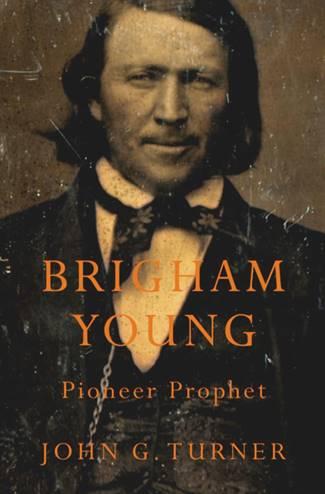
Brigham Young: a leader and a craftsman who built stone temples solidly on the ground (image source: Pioneer Prophet). The uncropped image can be seen here.
II. A New Direction
Young’s older brother Phineas was the first in the family to read the Book of Mormon in 1830 after he was given a copy by Samuel Smith (Joseph Smith’s brother) in Mendon. Phineas was impressed and gave it to his father and Brigham, who did not immediately convert. “I was not baptized on hearing the first sermon, nor the second, nor during the first year of my acquaintance with this work…. I reasoned on revelation,” Young said later explaining his process of testing the new doctrines and observing those who converted. On April 9, 1832 Brigham Young was baptized as a Mormon, a few days after his father and brothers Phineas and Joseph.
Brigham Young was a reliable member of the new church who excelled at fulfilling his assigned responsibilities and soon became an Elder. A Mormon neighbor cared for Young’s family when he was away as a missionary in nearby towns, and in 1832 his wife Miriam died of tuberculosis while Young was gone. A few weeks later, Young traveled to Kirtland, Ohio to meet Joseph Smith for the first time and was convinced that Smith was a prophet. Young also made two missionary trips to Ontario, Canada in 1832 and 1833, before moving with his daughters to Kirtland, Ohio where Smith was gathering members to build a sacred city.
Young was immediately useful in building the city with his practical skills as a craftsman and thrived in the growing community. In addition to promising benefits to come in the life after death, the Mormon faith also inspired its down-to-earth converts with a sacred purpose to their work on earth. Young said, “When I saw Joseph Smith he took heaven… and brought it down to earth; and he took earth [and] brought it up.” Members now called their movement the “Church of Latter Day Saints” and themselves “Saints.” Young remarried in 1834 to Mary Ann Angell, who had a son later that year.
In May 1834, Joseph Smith led an expedition of about 200 armed Mormon men on a march from Ohio to Missouri to help Mormon refugees who had been forced to abandon their homes and expelled from Jackson County by non-Mormons. The refugees had asked Smith for help and the Missouri Governor suggested he would provide militia protection to refugees seeking to recover their property. Brigham Young unhesitatingly volunteered to join the battalion of soldiers known as Zion’s Camp.
Zion’s Camp reached Missouri but stopped short of Jackson County when the Missouri Governor changed his mind about helping the refugees. A militia of about 200 anti-Mormons waiting to attack Zion’s Camp further deterred the Mormon expedition, which then experienced a cholera epidemic that killed fourteen. Smith wisely disbanded Zion’s Camp and its members returned to Ohio.
While the expedition failed to achieve its objective, Young later said that Zion’s Camp, “gave us an experience that Kirtland could not buy. I watched everything that Joseph did and the spirit he did it in.” Instead of seeing failure, Young’s faith was strengthened by what Smith called “a trial of their faith.” Young also proved his steadfast loyalty to Joseph Smith and never failed to defend his reputation. Young’s status in the church rose in September 1834 when Smith named him to a seat on the Kirtland High Council, and continued in February 1835 when Young was appointed as a member of the Quorum of the Twelve Apostles, the leading Mormon missionary group. Young gained approval from Smith for his loyalty in addition to his impactful preaching and spiritual passion.
The struggles of the early Mormon Church continued when the nationwide Financial Panic of 1837 brought disaster to an unchartered bank initiated by Joseph Smith. The “Kirtland Safety Society Anti-Banking Company” (organized as a joint-stock company after the Mormons were denied a bank charter) continued printing soon-to-be-worthless “anti-bank” notes until June, 1837 and finally failed in November. The financial crisis raised questions about Smith’s leadership by many Mormons, including briefly Brigham Young. “It was not concerning religious matters, it was not about his revelations—but it was in relation to his financiering,” said Young later after his involvement helping Smith try to save the “anti-bank” by purchasing properties with the “anti-bank” notes. But Young stayed loyal, deciding that “if I was to harbor a thought in my heart that Joseph could be wrong about anything, I would begin to lose confidence in him… until at last I would have the same lack of confidence in his being the mouthpiece of the Almighty.” The “anti-bank” failure and ensuing dissension within the church led several leaders and many members to reject Smith’s leadership and reorganize by calling themselves the Church of Christ. On December 22, Brigham Young permanently fled his angry creditors (one claimant demanded $2500) and the dissidents in Kirtland by moving to Missouri. Three weeks later Joseph Smith made the same decision. Turner writes:
Brigham Young’s confidence in Smith, though, did not depend on the vicissitudes of the church’s fortunes or whether or not Smith made accurate predictions of future events. He had accepted Smith as God’s prophet in 1832, and the recent missteps did not change that reality. “He was called of God, God directed him, and if He has a mind to leave him to himself and let him commit an error, that was no business of mine.” … “Much of Joseph’s policy in temporal things,” [Young] preached in 1860, “was different from my ideas of the way to manage them.” Young concluded that Smith practiced far too much forbearance toward his wayward Saints. When Young assumed leadership of the church in the mid-1840s, he did not repeat that perceived error.
III. On The Move
The Mormons did not find peace in Missouri. Non-Mormons were again alarmed by the possibility of losing their economic and political dominance to the highly aligned Mormons if they became the majority in the northwestern counties where they were settling. Hostility and depredations by vigilantes escalated into the 1838 Mormon War. At the October 25, 1838 Battle of Crooked River an armed group of Mormons (Brigham Young was not present) defeated a local Missouri militia unit, though the Mormons suffered three fatalities while the militia suffered one. After receiving news of the battle, the Missouri Governor issued Executive Order 44 stating, “The Mormons must be treated as enemies, and must be exterminated or driven from the State if necessary for the public peace.” On October 30, a large mob of over 200 vigilantes attacked a settlement of Mormons at Hawn’s Mill, killing seventeen civilians including several children. Justifying the killing of a ten-year old boy found hiding after the initial attack, the murderer said, “Nits will become lice, and if he had lived he would have become a Mormon.”
The next day, hundreds of state militia surrounded the main Mormon settlement at the town of Far West. The Mormons surrendered and agreed to leave the state during the winter while Joseph Smith was arrested with five other leaders on charges of treason (Young evaded arrest by disguising himself).[5] The six were sent to jail in Liberty, Missouri to await trial. Smith remained imprisoned until April 1839 when he escaped with his companions during transfer to another jail. He rejoined the thousands of Mormons who had relocated to Illinois where the Governor had offered them refuge and were now living on swampy, malarial, low-lying lands along the Mississippi River.
After moving his family to Illinois, Brigham Young again left to serve as a missionary. He sailed to England in 1840 with the other Apostles and observed an economic depression more severe than the one in America after the Financial Panic of 1837. “I for get how menny bagers [beggars] I saw,” he wrote to his wife and added, “when I look at the diffrents betwene poore People here and in America I rejoice that you and the children are there.” During Young’s year in England, the Apostles won many converts with their appealing message of a better life in America building the Mormon vision of Zion. Being the oldest, Young served as the leader of the Quorum of the Twelve Apostles and began organizing emigration to America for willing converts (almost 800 emigrated during his year in England and nearly 5,000 did so by 1846). Young’s role as a successful leader in England positioned him well to lead these emigrants in America, and the Apostles were able to finance their work with funding from wealthy converts. Under Young’s leadership, the Mormon membership in England tripled to almost 6,000 (two Apostles had won converts on a previous missionary trip from 1837-1838). Young’s successful leadership and talent for organization increased trust between Joseph Smith and the Quorum, which he gave more leadership responsibility managing the growing church after their return to Illinois.
When Young returned in 1841 to his family in Illinois, the nearby town had grown to several thousand and been renamed “Nauvoo.” The Mormons made Nauvoo their new “cornerstone of Zion” and began construction of a temple as British emigrants continued to arrive. It was in Nauvoo that Joseph Smith established the controversial practice of plural marriages (i.e. polygamy), which was central to his vision of creating an everlasting chain of humanity “sealed” together through temple ceremonies. Initially, most Mormons were reluctant to accept the new principle of plural marriages but over time agreed to it in obedience to Joseph Smith. Brigham Young officiated at two of Smith’s plural marriages before Smith told him to “go and get another wife,” which he did by marrying Lucy Ann Decker, 20. Over his lifetime, Young married at least 56 times and had 57 children with 16 of his wives.
The practice of polygamy and growing numbers of Mormons in Nauvoo again created tensions with non-Mormons, and anti-Mormonism became a unifying force among Whigs and Democrats in Illinois. In response, Joseph Smith launched his campaign for President of the United States in 1844 to spread his theocratic vision (he expected “the entire overthrow of this nation in a few years”). In May 1844, Smith sent Brigham Young with 350 Elders on a missionary trip to campaign for him in the Northeast. On July 1, Young gave a campaign speech for Smith in Boston’s Melodeon Theater that was interrupted by brawling in the audience and ended early. Back in Nauvoo, Joseph Smith was arrested in June for having a newspaper press destroyed after excommunicated dissidents used it to publish a paper “to explore the various principles of Joseph Smith, and those who practice the same abominations and whoredoms.” Smith was being held in the jail in Carthage when vigilantes broke in and fatally shot him and his brother Hyrum on June 27. Young was still campaigning near Boston and did not receive word of Smith’s death until July 7. The five men accused of murdering Joseph and Hyrum Smith were later acquitted by a non-Mormon jury in Carthage.
IV. Leadership
Brigham Young returned to Nauvoo in August and delivered a powerful speech that persuaded the Mormons to vote nearly unanimously for the Quorum (led by Young) to lead the church. Young’s main goals as the new leader were to hold the church together under Joseph Smith’s teachings and to finish construction of the temple in Nauvoo. Neither task was easy in the face of growing anti-Mormonism and dissidents leaving the church. Young also had no intention of becoming a martyr. He was elected to succeed Joseph Smith as “Lieutenant General” of the Nauvoo Legion, a state-authorized militia, and proceeded to increase arming and drilling his men. When the Illinois legislature repealed Nauvoo’s charter in 1845, the Mormons no longer had legal protection under their own courts, police, and militia. Faced with growing vigilantism, mob violence, and a delegation from the Illinois Governor pressuring them to go away, Young agreed that the Mormons would leave the state the next spring. The temple was completed in December 1845 and Young was able to perform important ceremonies for the Mormons, which reinforced their loyalty to the church under his leadership. Young also maintained morale during the challenging winter by allowing recreational diversions. Under Joseph Smith’s influence, Brigham Young had moderated from his strict Methodist upbringing and stated that “the wicked have no right to dance, that dancing and music belonged to the Saints.”
The Mormon pioneers left Illinois in 1846 and headed west toward the Oregon Trail and their goal of the sparsely populated Great Basin. Viewing their hardships in a constructive light, the Mormons saw themselves like the ancient Hebrews leaving Egypt for the Promised Land (Young himself said, “I feel all the time like Moses”). Young hoped a vanguard of 300 pioneers could reach the Great Basin in 1846, but springtime mud in Iowa slowed the advance party, which did not reach the Missouri River until mid-June. Long accustomed to hardship, Brigham Young took to life as a pioneer like a duck to water and thrived on overcoming challenges. One pioneer observed Young in early April “driving his team in the rain and mud to his knees as happy as a king.” The pioneer life was a welcome reprieve after years of dealing with anti-Mormon violence and attacks in Illinois. Young reluctantly but wisely accepted that the pioneers could not make it across the mountains to reach the Great Basin before snowfall and decided the group of approximately 3,500 Mormons would spend the winter along the Missouri River at Winter Quarters north of present day Omaha. In spring the Mormons would reach the Oregon Trail at present day Kearney, Nebraska, where a monument to the Oregon Trail pioneers bears the quote in the heading for Part 2 of this review. The Mormon Trail paralleled the Oregon Trail on the opposite side of the Platte River to avoid conflicts.
Young kept order at Winter Quarters and staved off dissension by reminding the pioneers that dissent had led to Joseph Smith’s murder. He warned, “You must stop your back bitings speaking evil of the Twelve, speaking evil of me… or you will be damned,” adding “Brother Joseph being a very merciful man bore with these things until it took his life but I will not do it.” He encouraged dissenters to return to Missouri and threatened, with his typical bluster, “if they go with us and continue their wickedness, their heads shall be severed from their tabernacles [bodies].”
In April 1847, an advance party led by Young with 143 men and 5 women departed Winter Quarters. During June they separately met mountain men Moses Harris and Jim Bridger who offered conflicting advice. Harris recommended settling in the Bear River’s Cache Valley north of the Great Salt Lake while Bridger recommended traveling south to Fort Bridger and settling south of the Great Salt Lake. A short time later, Young’s party encountered Sam Brannan, a Mormon entrepreneur who had sailed to San Francisco and recommended that the Mormons continue beyond the wasteland of the Great Basin to California. Young made a key decision to follow Bridger’s recommendations instead of those from Harris or Brannan. He also remembered a report by John Fremont who had tested the soil around the rim of the Great Basin and wrote that it was “excellent in its ingredients” and could support growing crops. In August 1845 he had written he was looking to settle “in the neighborhood of Lake Tampanagos [Utah Lake].”
In July, Young and several of his men became seriously ill (possibly from Colorado Tick Fever) but slowly recovered, trailing three days behind the first of the party that reached the Salt Lake Valley on July 21, 1847. “We gazed with wonder and admiration upon the vast rich fertile valley,” described one of the pioneers. Some wanted to explore further, but Young declared, “this is the place,” which the pioneers affirmed and proceeded digging irrigation ditches and planting crops. Still recovering from illness, Young chose the location for the new temple while the other pioneers began laying out blocks for their new Zion to be named “Great Salt Lake City.” Their new settlement was located north of the main settlements of Ute tribes near Utah Lake and south of the Shoshone tribes. In August, Young left the new settlement to return to Winter Quarters where he was unanimously elected as the Church’s second President in December. He would hold the Presidency until his death in 1877.
In 1848, Young led a much larger party of emigrants to the Great Basin. Over the coming years thousands of emigrants made the journey until nearly 20,000 Mormons were living in Great Salt Lake City by the end of 1852. The first Mormon pioneers were quickly tested by the hard winter of 1848-49. Young, however, saw adversity as a benefit and later said, “I want hard times so that every person that does not wish to stay, for the sake of his religion, will leave.” The Great Basin, he concluded, was “a good place to make Saints.”
V. Expansion
Brigham Young sought to establish Mormon colonies in key locations throughout their newly claimed territory before non-Mormons could settle the land. He also directed colonizers to the perimeter of the territory establishing the city of San Bernardino in present day California. Though Young envisioned an autonomous theocratic kingdom (with its own alphabet), Great Salt Lake City soon prospered as a “mercantile crossroads” for those in need of fresh supplies on their way to the California gold rush.
All of present day Utah was within the border of Mexico when the Mormons first arrived in 1847, and became part of the United States through the Mexican Cession in 1848. In 1849 the church leadership petitioned the U.S. Congress to create a State named “Deseret” (a word for honeybee in the Book of Mormon) to avoid the appointment of officials by the U.S. government if Deseret was merely a territory. The petition was rejected and Utah Territory (named after the Ute tribe of Native Americans) was created with a much smaller area than the Mormons had proposed. Brigham Young was appointed the territory’s governor and maintained his theocratic rule even with the presence of the mostly powerless federal officials appointed to Utah. In 1852, Young publicly acknowledged and defended the Mormon practice of polygamy by comparing it to slavery, which was considered a territorial issue determined by popular sovereignty instead of federal law. The publication of their practice of polygamy turned public opinion in America strongly against the Mormons, who had been viewed somewhat sympathetically after their expulsion from Illinois.
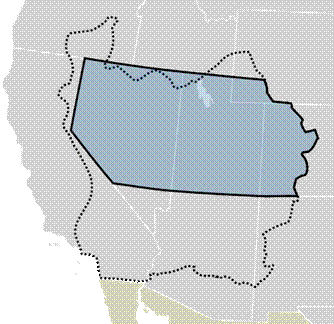
The proposed State of Deseret (dotted line) and subsequent Utah Territory (blue area). (image source: Wikipedia Commons)
While many Mormon emigrants prospered in Utah, some of Young’s leadership decisions had tragic consequences. The church had created the Perpetual Emigrating Fund (PEF) to pay the expenses of emigrants who could not afford their journey, but the fund was losing money as a result of emigrants who failed to repay their debt to the PEF. Young sought a way to reduce the PEF expenses without reducing the number of impoverished emigrants that the PEF could bring to Utah. His solution was for emigrants receiving PEF assistance to pull handcarts instead of using wagons pulled by teams of oxen. Young believed the emigrants could pull handcarts “20, 25 and even 30 [miles] with all ease, and no danger of giving out.” When a fellow Apostle suggested the handcarts be accompanied by additional ox teams with wagons to carry extra provisions and the weak, Young countered that “it is all right not to provide wagons for infirm persons to accompany the hand carts for it would encourage infirmity…There would soon be but few able to walk.” Those pulling the handcarts would have their dedication to their religion sorely tested.
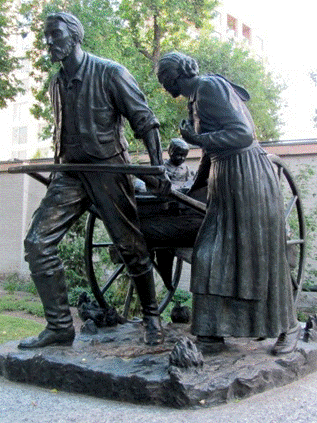
The Oregon Trail on Hard Mode: pulling a handcart. The image is the Handcart Pioneer Monument on Temple Square in Salt Lake City. (image source: Wikipedia Commons)
In 1856, over 1,800 English emigrants were the first to use handcarts for the 1,300 mile journey from Iowa. Young was pleased when the first three handcart companies of 815 emigrants left Iowa City in June and arrived at Salt Lake City in late September with fewer than 30 deaths, a typical death rate. However, two additional handcart companies had departed later and called for rescue in October facing danger from starvation and the onset of winter. Young sent a rescue operation that brought the companies to Salt Lake City on November 9 and November 30. The companies had suffered over 200 deaths and many of the survivors required amputations from frostbite. Young blamed others for “rush[ing] men, women and children on to the prairie in the autumn months.” Five more handcart companies would complete the journey before Young discontinued the handcart plan in 1860, calling it a “hard task.”
VI. Don’t You Have Bigger Fish to Fry?
The Utah War began in May, 1857 when U.S. President Buchanan ordered 2,500 U.S. Army troops to install a replacement for Brigham Young as the territory’s governor. Buchanan was pressured into his decision following a flurry of reports from federal officials who had served in Utah and were fed up with Young’s continued defiance of the U.S. government and its laws. Federal Justice W. W. Drummond wrote in a letter published in the New York Herald, “it is impossible for us to enforce the laws in this Territory…Every man here holds his life at the will of Brigham Young,” who he said “murdered, robbed, castrated, and imprisoned” non-Mormons who questioned church authority.
Brigham Young’s initial response to the approaching U.S. Army was essentially: “molon labe.” Young called up the territory’s Nauvoo Legion with thousands of militia men and later declared martial law. He sent members of the Legion to harass and raid the U.S. troops’ supply trains, and correctly predicted that they would be stopped by winter in southwest Wyoming after departing from Kansas in mid-July. Young hoped that delaying the U.S. troops’ approach would allow enough time for a bigger crisis to distract the U.S. government’s attention away from Utah.
Young’s war-mongering rhetoric to defend Utah from military invasion increased hostile feelings toward non-Mormons, and likely contributed to the gruesome Mountain Meadows Massacre of 120 non-Mormon emigrants headed to California in 1857. On September 11, members of the Nauvoo Legion in southern Utah tricked an emigrant party that they had besieged (while previously disguised as Native Americans) to surrender their weapons under the assurance of a protection from the Mormons. Once the adult emigrants were disarmed, they were slaughtered, and only 17 of the children all under age 7 were spared. There was no evidence that Young had ordered the attack, but his dreadful rhetoric beforehand and failure to hold the perpetrators accountable further damaged Mormons in the eyes of the general public as the facts of the massacre became public. Twenty years later only a single perpetrator of the Mountain Meadows Massacre was convicted and later executed.
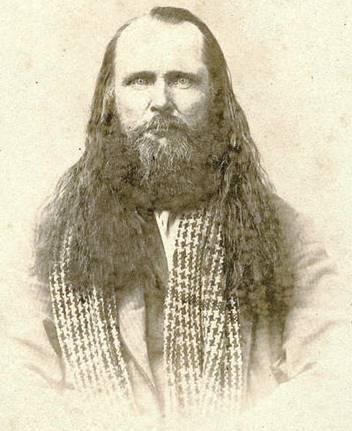
Orrin Porter Rockwell. Also known as “The Destroying Angel,” he was one of the men who may have done wet work for Brigham Young (Rockwell was not involved in the Mountain Meadows Massacre but he was part of the Aiken massacre). He once said, “I never killed anyone who didn’t need killing,” a line later used by the actor John Wayne. Joseph Smith promised him divine protection if he never cut his hair. He died of natural causes in his sixties. (image source: Wikipedia Commons)
Over the winter, President Buchanan considered Utah to be a low priority and was looking for a peaceful resolution to the slow moving and costly military operation. In December, he had a meeting with Thomas Kane, a non-Mormon who sympathized with the Mormons and had previously advocated for them in D.C. Buchanan gave Kane mild support to diffuse the conflict and subdue the Mormon resistance. Kane arrived in Salt Lake City in February, 1858 and his plan for diplomacy was to present Young as a peacemaker who had decided to restrain the more hawkish Mormons from attacking the U.S. Army. To convince the Mormon leaders, Kane exaggerated his meeting with Buchanan who he claimed offered an apology and the possibility of a presidential pardon. As a gesture of goodwill, Kane had Young send provisions to Army’s winter encampment (who were justifiably skeptical after Young had sent them a load of salt the previous fall with a note suggesting it was poisoned). Young also changed his rhetoric and announced he would not fight the Army. Instead, the Mormons abandoned Salt Lake City and moved south to Provo in April leaving the incoming Governor Alfred Cumming and military with nothing to govern.
Cumming met with Young in April and agreed to govern in cooperation with Young’s influence, and said he would prevent the approaching army from destroying Mormon properties. In June, a peace commission from President Buchanan arrived in Salt Lake City and offered “a free and full pardon to all who will submit themselves to the authority of the federal government.” Young accepted the pardon saying “If a man comes from the moon and says he will pardon me for kicking him in the moon yesterday, I don’t care about it; I’ll accept of his pardon.” On June 26, the army peacefully passed through empty Salt Lake City and garrisoned at Camp Floyd built forty miles outside the city. Both sides declared victory without any killed or wounded and Young returned to his Beehive House mansion in Salt Lake City on July 1. Despite the presence of a new governor and future governors (who the Mormons often clashed with), Young largely maintained his de facto theocratic control over the Utah Territory and the Mormons continued to practice polygamy.
VII. Later Years
Brigham Young’s prominence in Utah drew national attention from the media, which was fascinated by the ambitious and boastful real estate developer from New York with a provocative lifestyle. In 1859, Horace Greely traveled across the United States to promote the transcontinental railroad and write articles for the New York Tribune. He interviewed Young for two hours and wrote, “In appearance he is a portly, frank, good-natured, rather thick-set man of fifty-five, seeming to enjoy life, and be in no particular hurry to get to heaven.” Well into his fifties Young looked much younger than his age with a full head of dark hair and youthful stamina, and boasted to Greeley that he was worth $250,000. Young knew how to use simple and humorous language to influence Greeley, who advocated for a hands-off policy toward Utah during his 1872 campaign for President of the United States.[6]
In 1861, Young welcomed the American Civil War as an all-consuming distraction for the U.S. government, which he hoped would leave him alone. He viewed the war as divine punishment for the country for its treatment of the Mormons and for killing Joseph Smith, and hoped the North and South would succeed in destroying each other. He received part of his wish when his former adversary, General Albert Johnston (who led the 2,500 U.S. troops in the Utah War), joined the confederate army to fight against the U.S. government and died during the Battle of Shiloh.
Young continued to outmaneuver local government officials as his wealth and influence over businesses grew. He was able to use his influence on Pacific Telegraph and Western Union Telegraph to persuade President Lincoln to replace a Utah Governor and three justices who wanted to enforce anti-polygamy laws. In 1862, Congress passed the Morrill Anti-Bigamy Act, which Young flouted by marrying Amelia Folsom, 24, in 1863. Prosecuting polygamy in Utah was impossible because under Utah law juries were impaneled by marshals appointed by the Mormon controlled legislature. In 1872, Young simply bought the U.S. Congress to stop a proposed bill that would have given control of the jury selection process in territories to federally appointed officials (specifically he was able to buy enough votes on the House Judicial Committee, which in those days cost $3,000).
In 1865, Young met with the leading Ute chiefs to negotiate their acceptance of the U.S. government’s offer of 60 years of annuities as payment for relocating their tribe from central Utah to a reservation in northeastern Utah. Young told the chiefs they weren’t going to get a better deal and that the government and the Mormons were going to take their land whether they accepted the deal or not. According to Young’s account of his star role in the negotiations, “A few words of explanation and counsel from myself removed all their feelings of aversion and they consented immediately to sign the treaty.” Despite the treaty, deadly attacks between the Mormons and Utes continued (instead of Young’s goal that it was “cheaper to feed than fight”). The end result of the Mormon conquest and colonization of Utah devastated the Native population.
Brigham Young loved to make deals and especially deals where he could use his position as President (and Trustee-in-Trust of the Church) to enrich himself and his family. His later years saw the continued economic development of Utah as a key crossroads in the west. As the transcontinental railroad approached completion in Utah, Young secured a contract worth over $2 million to grade 150 miles of the Union Pacific line approaching from the east of the Great Salt Lake, both as a way to limit the number of outside workers coming to Utah and gain much needed cash. Other church leaders with Young’s consent secured a $4 million contract to grade part of the Central Pacific line. As a way to undercut non-Mormon merchants, Young initiated the Zion’s Cooperative Mercantile Institution (ZCMI) in 1868, a joint-stock company owned by Mormon merchants (and the Church as majority shareholder) to collectively purchase eastern goods to then sell at lower prices exclusively to church members.[7]
Brigham Young never got tired of winning. In 1868, he married Mary Van Cott, 23, who had his 57th child in 1870. With his complicated personal life, it was inevitable that Young would see the inside of a courtroom. In 1873, Ann Eliza Webb sued Young for divorce in federal court. Young had married her a few months after Mary, when she was also 23. Alleging neglect, Ann “sought $1,000 in monthly alimony, $20,000 in legal fees, and $200,000 from his future estate.” Young responded that since they were not legally married he owed her nothing. Pending the divorce suit’s decision, the judge ordered Young to pay $500 in monthly alimony. Young refused to pay the alimony and was sentenced to a night in jail for contempt. Soon after Young’s release, U.S. President Grant removed the federal judge. Young said of the alimony, “I will spend the remainder of my days in prison before I will pay them one cent.” After a few short-tenured federal chief justices in Utah, the case went to trial in 1877. The new chief justice agreed with Young that the marriage was illegal and dismissed Ann’s suit. She later married another wealthy man (and divorced him).
One of Young’s last attempted reforms was the United Order, in which he envisioned Mormons forming voluntary cooperative communities that would pool their resources and labor under common management and distribute the proceeds equitably. Young had been skeptical of capitalism after seeing extreme poverty in England and wanted the United Order communities “to live as one family as did the [Book of Mormon] Nephites while they were faithful.” Most Mormons, especially the wealthy, were dubious about consecrating their property to the Order and refrained, but United Order communities did achieve some success in rural areas. In 1875, about 25 poor families with few resources founded a United Order settlement called Orderville in southern Utah. Orderville’s self-sustaining community almost quintupled its population over five years and had “a communism of goods, labor, religion, and recreation such as the world has seen only in a few places and for very short times,” according to author Wallace Stegner. After his initial enthusiasm for the United Order, Brigham Young admitted he didn’t want to consecrate his own property to the Order because he didn’t trust anyone else to manage his enterprises as well as he could. He still promoted the United Order for other Mormons but the movement waned from lack of interest. Orderville’s United Order collapsed in 1885 after its surrounding communities prospered amid a mining boom in the 1880s. Orderville’s residents envied the imported goods of their neighbors and the community’s rustic self-sufficiency went out of fashion.
One of Young’s last public acts was the dedication of the St. George Temple in 1877. He died in his home surrounded by his family after a short illness at age 76, a very wealthy man. Today, the Church of Jesus Christ of Latter-day Saints has over 17 million members around the world and an estimated net worth close to $300 billion.
Conclusion
The Mormons had fortunate timing when they left Illinois in 1846 with the opportunity to inexpensively gain control of vast territory and resources in the Great Basin. They also had the benefit of a significant military force to defend their new territorial claims. The Mormon pioneers who survived their migration to Utah and survived Brigham Young were a rare breed. Their hard work and sacrifice built prosperous communities that allowed Young to wield great power as the President and Trustee-in-Trust of the Church.
Brigham Young learned self-preservation skills at an early age and honed his exceptional situational awareness over a lifetime of persecution. He thrived on overcoming challenges and successfully organized the Mormons’ rapid colonization of the Utah Territory. When faced with his most important decisions, he had the practical sense to recognize correct advice and could change his mind. Young understood that big fish eat little fish and under his leadership the Church of Jesus Christ of Latter-day Saints grew into an imposing power.
George Ripley learned the hard way that people are not interchangeable cogs. Selectivity matters and a hodgepodge of individuals who lack sufficient skills and capital is not the recipe for a successful enterprise. It’s a lesson that new generations continue to learn.[8] Ripley grew up and was educated without the benefit of practical experience gained by doing physical work. When he entered the world of business at age 38, he had a rough introduction to the vicissitudes of reality.
George Ripley and Brigham Young eventually found places where their talents could flourish: Ripley writing book reviews in New York City and Young ruling a theocracy far away from the capitol of the U.S. government. Both men achieved success by leaving their first careers and joining movements for social change. Young persevered for 15 years as a Mormon before his arrival in Utah. Ripley’s willingness to start over culminated in a fulfilling writing career. For all of their faults, George Ripley and his fellow Brook Farmers were not among the forgotten cowards who never started.
Your message is stored now and emailed to the author after the contest ends. The author can reply to you, but their identity stays hidden unless they choose to respond.
Footnotes
- ↩
Ripley wrote in 1840 that Transcendentalists, “believe in an order of truths which transcends the sphere of the external sense. Their leading idea is the supremacy of mind over matter. Hence they maintain that the truth of religion does not depend on tradition, nor historical facts, but has an unerring witness in the soul…the ultimate appeal on all moral questions is not to a jury of scholars, a hierarchy of divines, or the prescriptions of a creed, but to the common sense of the human race.” When his remarks were condemned by Unitarian church elders Ripley responded, “You are a disciple of the school which was founded by Locke…For that philosophy I have no respect. I believe it to be superficial, irreligious and false in its primary elements.” The Transcendentalists also did not believe that the authority of Christianity required literal acceptance of Biblical miracles.
- ↩
After Ripley’s invitation to join Brook Farm, Emerson wrote in his journal, “to join this body would be to traverse all my long trumpeted theory… that one man is a counterpoise to a city, ―that a man is stronger than a city, that his solitude is more prevalent and beneficent than the concert of crowds.” He added, “It is only as a man detaches himself from all support & stands alone, that I see him to be strong and prevail. He is weaker by every recruit to his banner. Is not a man better than a town?”
- ↩
Briefly, Fourier believed that each person had twelve active “passions” that would tend toward universal unity and harmony in society if allowed to fully develop instead of being suppressed by the present organization of society. The best way to develop all passions was by organizing individuals into Groups (of two or more individuals) and Series (of at least five Groups) so that industry would be “attractive” and creative instead of repulsive and wasteful. Men and women could join any group according to their “passional attractions” though women at Brook Farm clustered in certain groups within the Domestic, Mechanical (“fancy work” manufacturing clothing and painting lampshades), and Educational Series. From May 1844-April 1845 nine of the top ten workers at Brook Farm were women, including Ripley’s sister Marianne with 3057 hours. The man with the most hours, Peter Baldwin, had 2813 hours almost entirely in the Domestic Series doing most of the baking. George Ripley had 2502 hours divided between Educational, Agricultural, and Administrative work.
- ↩
Ripley wrote in his “Introductory Notice” of the first issue of the The Harbinger in 1845: “We address ourselves to … those who cherish a living faith in the advancement of humanity, whose inner life consists not in doubting, questioning, and denying, but in believing; who, resolute to cast off conventional errors and prejudices, are hungering and thirsting for positive truth; and who, with reliance on the fulfillment of the prophetic voice in the heart of man, and on the Universal Providence of God, look forward to an order of society founded on the divine principles of justice and love, to a future age of happiness, harmony, and the great glory to be realized on earth.”
- ↩
Brigham Young also evaded arrest on charges of counterfeiting in Nauvoo in 1845 by disguising himself while law enforcement incorrectly arrested another man intentionally disguised and speaking like Young. Later Young enjoyed recounting the story of the “Bogus Brigham.”
- ↩
Young had risen to power without the social polish of formal education and often used crude rhetoric to make his points. Young once claimed, “in regard to merchandizing I know better than all other men unless they think as I do.” To explain how he gained such prowess he said, “I dream about it and understand it by vision and by all the principles.” Turner writes:
Many visitors commented on the public use of profane language by Young and other church leaders. “They curse or condemn with man’s curses whenever they pleased,” wrote U.S. Army surveyor John Gunnison in 1852, “and such rough language sounds gratingly in refined ears, when it becomes usual conversation.” At the same time, Young surprised some skeptical outsiders with his wit, intelligence, and fervor. Young sometimes said that he only swore from the pulpit, but he also employed profanity during private councils. “Shit on the church debts,” he pronounced during a heated discussion on the church’s liabilities in Winter Quarters. “I say what I please because I know how to say it,” he reasoned after one 1849 outburst. At other points, he knowingly employed crude phrases for effect. “I frequently say “cut their infernal throats,” he offered. “I don’t mean any such thing.”)
- ↩
Young said, “God heaps property upon me, and I am in duty bound to take care of it.” In 1860 he told a Tabernacle audience, “I am not to be called in question as to what I do with my funds.” Privately he explained, “[M]y private affairs are not amalgamated with the public,” and, “Brigham Young and the Trustee-in-Trust are two persons in business…kept as strictly separate as in the business of any two firms in the world.”
- ↩
The following are excerpts from an interview in the article “Why We Left The Farm” in the Whole Earth Review:
Matthew: I think another problem the Farm had was our youthful arrogance, multiplied by the power of the psychedelics that we took, multiplied by the power of having that many people all doing things in unison. Because we had the temerity to think of ourselves as a microcosm of the entire planet, we believed we should allow anyone with a belly button to come in and live on the Farm. But if I were going to do a Farm, I would be selective. I would only let a certain few people in. I would restrict the number of Looney Tunes to about zero. People I was comfortable with sharing my mind intimately, I'd let in. People who wanted to come in and share my mind intimately that I wasn't comfortable with, I would run from, rather than let them come live with me. And I think that was a central problem that we had, that the gate in a way had low standards for what it would accept. In a spirit of compassion, the Farm in its youthful arrogance tried to do too much by trying to take on too broad a spectrum of people.
Kevin (interviewer): You think then that some other generation might decide to try a vision like the Farm again?John: Yes. Sooner or later, it's bound to happen.
Kevin: What kind of advice would you give them?
John: Loosen up. Don't follow leaders. Don't take on more than you can handle financially. Get enough money together before you start.
Kevin: It sounds like starting a business.
Matthew: It is. Or starting a marriage. It's often not a good idea to start off in poverty.
Kathryn: We were faced more with the hard-core reality of how you have to live. You have to raise your kids, you have to feed them, you have to clothe them. It got to the point where just day-to-day living was so difficult that trying to have a good time, or at least not to have a horrible time, and still get the laundry done today, was starting to loom larger than any spiritual ideal.
Matthew: You can't be hungry and help somebody else. You have to be together and smart and well fed and know everything in your home is taken care of before you help others.Kathryn: Well, that's what we always said, and then we never did it.
Walter: But I think we all agree that the friendships and camaraderie from the Farm were some of the most valuable things we have. The Farm created a lot of deep and lasting friendships that we'll all treasure for years - there was a very strong bond among those of us who spent all those years trying to make it succeed. A lot of people worked very hard, and I hope their efforts will be respected.