At the turn of the millennium, there was an explosion of interest in World War 2. This was thanks to works like Steven Spielberg’s 1998 classic Saving Private Ryan and HBO’s 2001 television show Band of Brothers.
This had an impact on video gaming as well. 1999 saw the release of Medal of Honor, the studio behind it being co-founded by Spielberg himself. Others include 2005’s Brothers in Arms: The Road to Hill 30 and 2003’s Call of Duty.
By 2006, however, people were getting exhausted. It had been eight years since Spielberg’s masterpiece and the Western Front has been trodden to death. There was no interest in returning to Normandy, the French Bocage, Paris, etc. This isn’t to say that there were no other fronts depicted, but they were rare.
Accordingly, Call of Duty’s creators, studio Infinity Ward, approached publisher Activision with a new idea in 2006. If people were tired of a 50-year-old war, why not depict something modern? They weren’t the first to do this, several military FPS (first-person shooter) games had put the player in scenarios not out of place in recent history.
Infinity Ward, however, was asking for something different. They wanted to depict modern warfare…as seen on contemporary news media. The Iraq War was ongoing and there was plenty of footage to motivate the mind. Activision agreed, and so the studio got busy with creating a game based on the imagery shown in nightly reporting.
The result was 2007’s Call of Duty 4: Modern Warfare (CoD 4), a game that forever changed the franchise, the gaming sphere, and popular culture as a whole. Much of that stems from the game’s multiplayer innovations and iterations. My focus will not be on that, instead focusing on the game’s story and gameplay.
Just Another Day At the Office
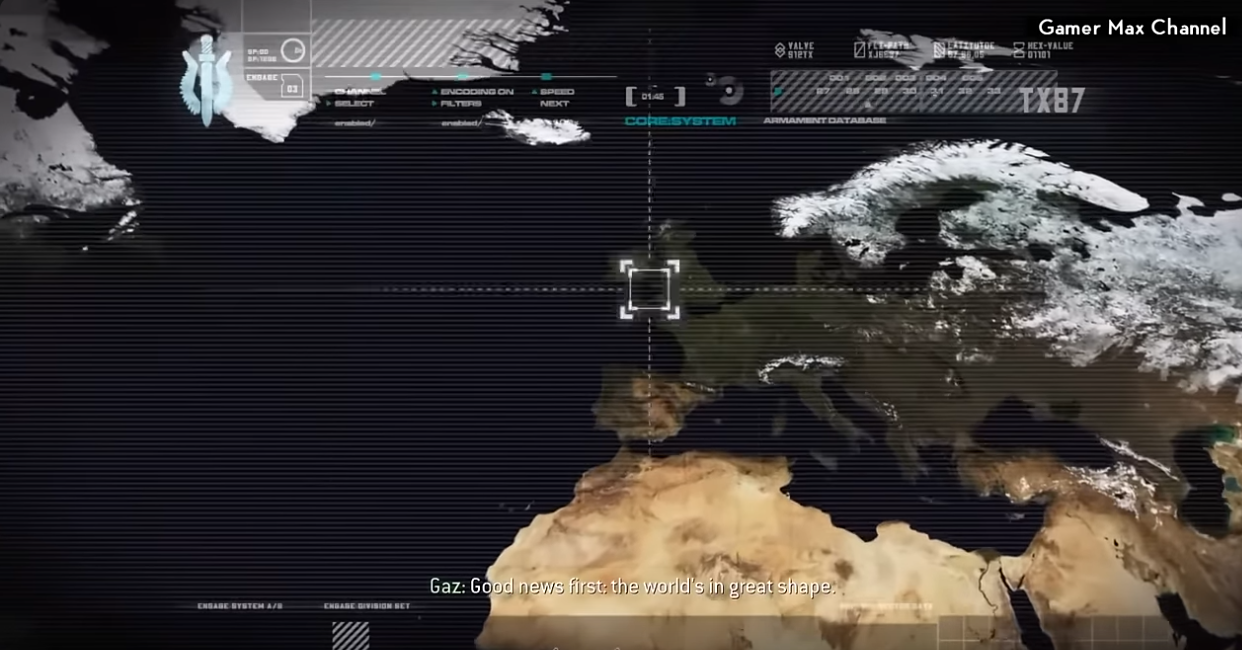
Gaz: “Good news first, the world's in great shape. We've got a civil war in Russia, government loyalists against ultranationalist rebels, and 15,000 nukes at stake.”
Price: “Just another day at the office.”
CoD 4’s campaign begins with a British SAS team, led by one Captain Price, doing a status report. Right from the beginning, the game sets the mood perfectly. The background music as you get brought up to speed is tense and foreboding, reinforcing the idea that the world is on the brink of destruction, and one wrong move could see a lot of people dead. The visuals, meanwhile, consist of zooming into various parts of a globe, mirroring the kinds of images you see from satellites. In-universe videos are played as if taken from TV broadcasts.
In any case, the player takes the role of a new SAS operative joining Price’s team. After a short tutorial, the game starts its story proper by having Price’s team take off for the Bering Strait. Here, we find out that the British are helping the Russian government deal with the ultranationalists. Price and his team kill off any resistance before finding their desired package, only to have to flee when some ultranationalist-aligned MiG-29 fighter jets roar onto the scene and hit the ship with missiles. The team escapes with only the cargo manifest.
The next few missions are similar in nature - move in the dark, use silenced weapons, and kill rebellious Russians. Only rarely do you have straight firefights with the enemy. Instead, you kill them quietly or snipe them from a distance. Nor are you the primary fighting force. Reflecting your role as special ops, you back up the loyalist Russian forces in the area.
Once more, the music greatly enhances the experience. A mission might start with a foreboding feeling that makes it clear you’re about to get into something, then it’s just sounds of shooting, explosions, and screaming. Action sequences and timed events play to accentuate the urgent and chaotic nature of the moment, but there are many moments that you’ll be left alone with your thoughts.
The SAS go on to rescue an informant in the ultranationalist forces and make to flee for Germany, but their helicopter gets shot down. They manage to make their way to a new extraction point. In the climax of this part of the story, the player gets to control an AC-130 gunship to help the SAS escape.
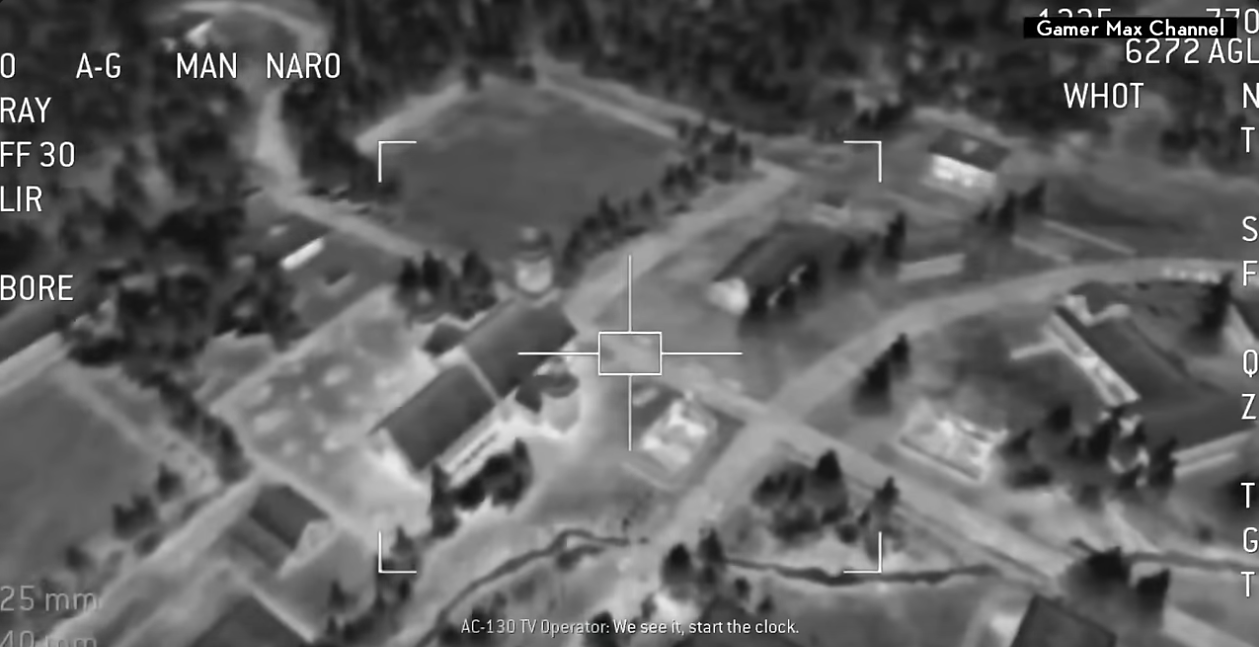
This is where the game goes from great to amazing. There’s no music, just the diegetic sounds of the wind blowing past the frame, the propellers keeping the craft aloft, and the recoil from the powerful guns you have at your disposal.
It’s also where the discomfort begins for me and many others. Don’t misunderstand me, I’ve never been bothered by the fact that the military doesn’t fight fair against its enemies. But bereft of heroic or light-hearted music, I can’t wholly suppress the thought that I’m a god of death circling the battlefield, hurling divine wrath on those who can’t hope to fight back. Each pull of the trigger ends lives, and even if they’re the enemies, a sense of unease settles into some recess of my mind.
Shock And Awe
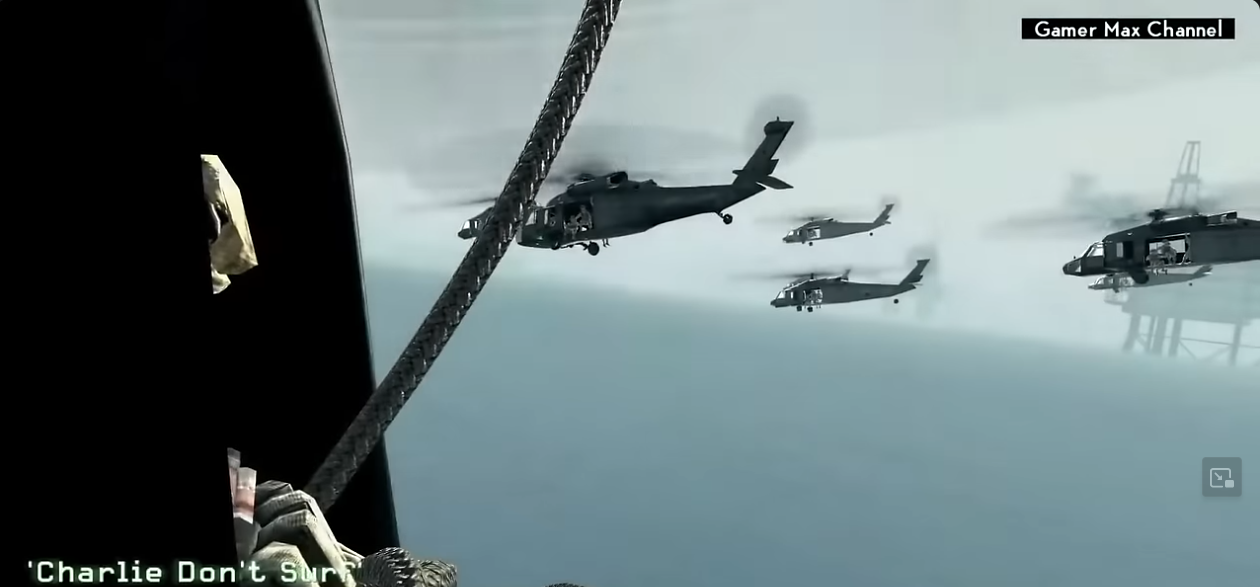
The game switches to an American perspective at this point. Here, the player character is one Sergeant Paul Jackson, a US Marine. His experience is one of power and superiority. The visuals show a large US fleet off the shore, and many helicopters ready to drop Marines and bombs on the enemy. The music doesn’t reassure you, though, retaining the leitmotif of death never being too far away. All this technology, all these soldiers, and your speakers will remind you that it only takes a stray bullet or unfortunate grenade to end your life.
Let’s rewind for a moment, though. Why is the US invading an unnamed country (cough Iraq)? That’s simple. Khaled Al-Asad is a Middle Eastern warlord who, at the start of the game, was seen victorious in the aftermath of his coup against the unnamed nation’s government. The audience sees part of this through a long introduction to the game that ends with that country’s president being executed on live TV.
The player is supposed to conclude that the US decided it was not a good idea for this to go unpunished, hence the need to invade. But this is never stated, and because the player has to arrive at that answer themselves, they might be more susceptible to not following up on the implicit argument that it actually is necessary to invade. In a brilliant analog to real life, you, the person sent off to war, don’t get an adequate justification for a full-scale invasion. The powers that be have decided that this warlord must be deposed, and thus you must turn a city into a battlefield. Mind you, this is probably not the game being calculating, just skipping past the justifications.
The Marines have exactly one goal - find and capture Al-Asad. Once they land in Al-Asad’s capital, they quickly spread out and work their way through a TV station where it’s believed the man is broadcasting to the residents. This turns out to be a dead end, as it's just a pre-recorded broadcast. Jackson and his team are subsequently assigned to help an immobilized tank and its crew until the vehicle can be rescued from a bog. They fight through intense waves as the night passes in this burning warzone of a city, utilizing night vision goggles that give you that iconic green vision.
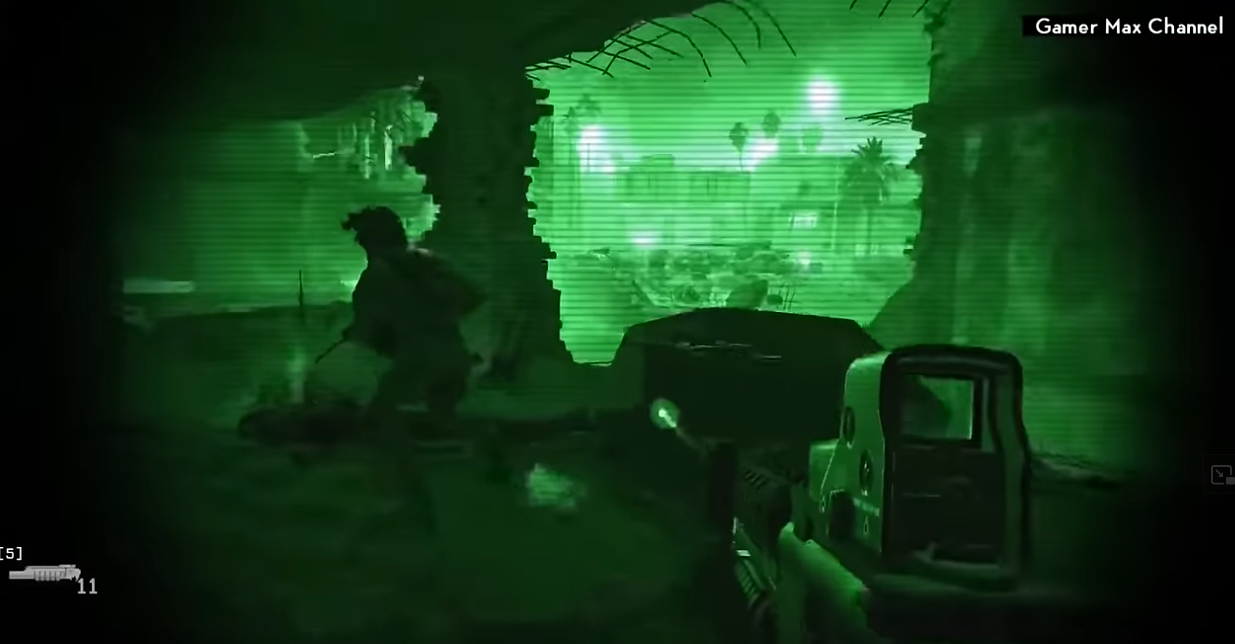
They save the tank’s crew, and all is good by the next morning. After more fighting, they are picked up by helicopters taking them to the next fight. Al-Asad’s been located again. What’s more, there is now a suspicion that he has a nuclear warhead.
A perceptive player will notice the strong contrast between the visuals and music. On-screen, you see countless US fighter jets, helicopters, and tanks destroying the defenses between them and Al-Asad’s palace. The speed of their operations is dizzying, already running at lightning pace before the suspicion of a nuke being present. The music, however, takes a far more tense and foreboding tone at the start. You gain no confidence from hearing this auditory equivalent to seeing a person gasp and watch intensely to see what happens next.
Anyway, the marines continue to fight through more waves of soldiers, but they don’t get very far before they need to get picked up again. Higher command had NEST (Nuclear Emergency Support Team) teams sent in when they got word of this warhead and one of those teams has reported seeing a possible nuclear device. For safety, everyone’s being pulled away to the east.
Unfortunately, a friendly Cobra helicopter goes down due to an enemy missile, but the pilot survives. Higher command warns that if they try to rescue, they won’t be far enough away to be safe, but the US doesn’t leave anyone behind, so the Marines land and manage to get the wounded pilot to safety.
Everything’s good, the game auto-saves, so we can sit back, take a breath, and-
“All U.S. forces, be advised, we have a confirmed nuclear threat in the city. NEST teams are on site and attempting to disarm. I repeat, we have a confirmed nu-”
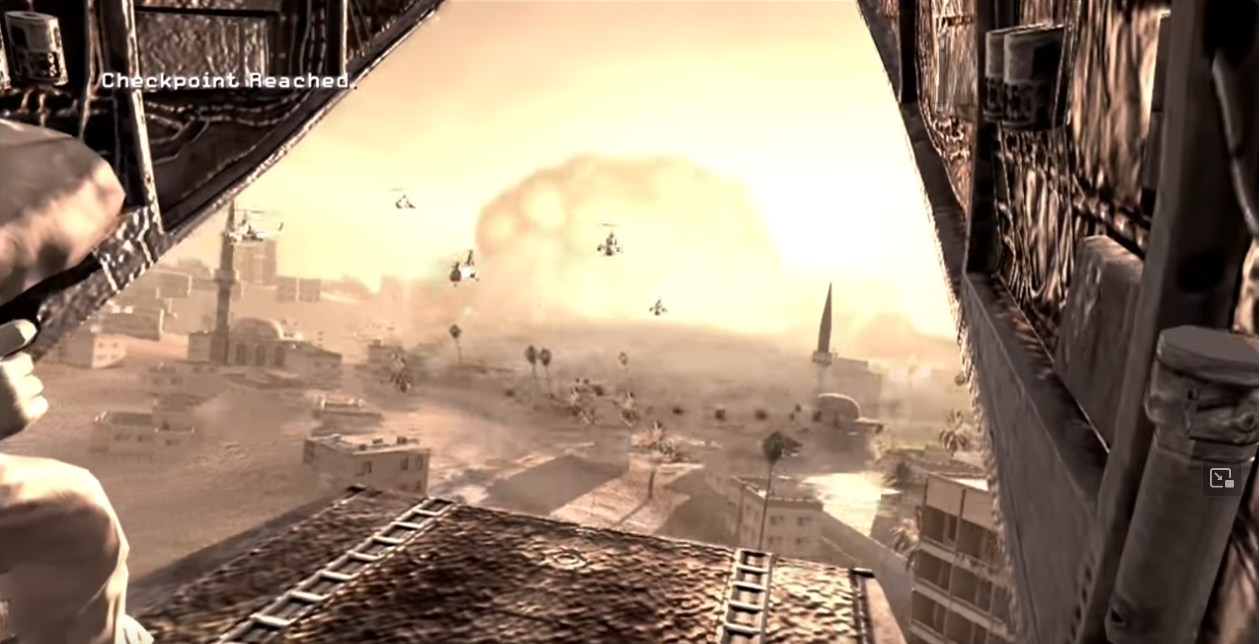
The shock wave sends Jackson’s helicopter tumbling to the ground. He survives, and crawls out before landing hard on the ground. As he weakly stumbles forward, we hear his gasps of breath, the radio messages fading in and out. The wind roaring past him can practically be felt. Around him, the city is devastated, but that’s of secondary importance to the titanic atomic mushroom turning the environment into a poisoned hellhole.
As his strength gives out, he collapses, swelling the ranks of the dead waiting to be carried away by Death.
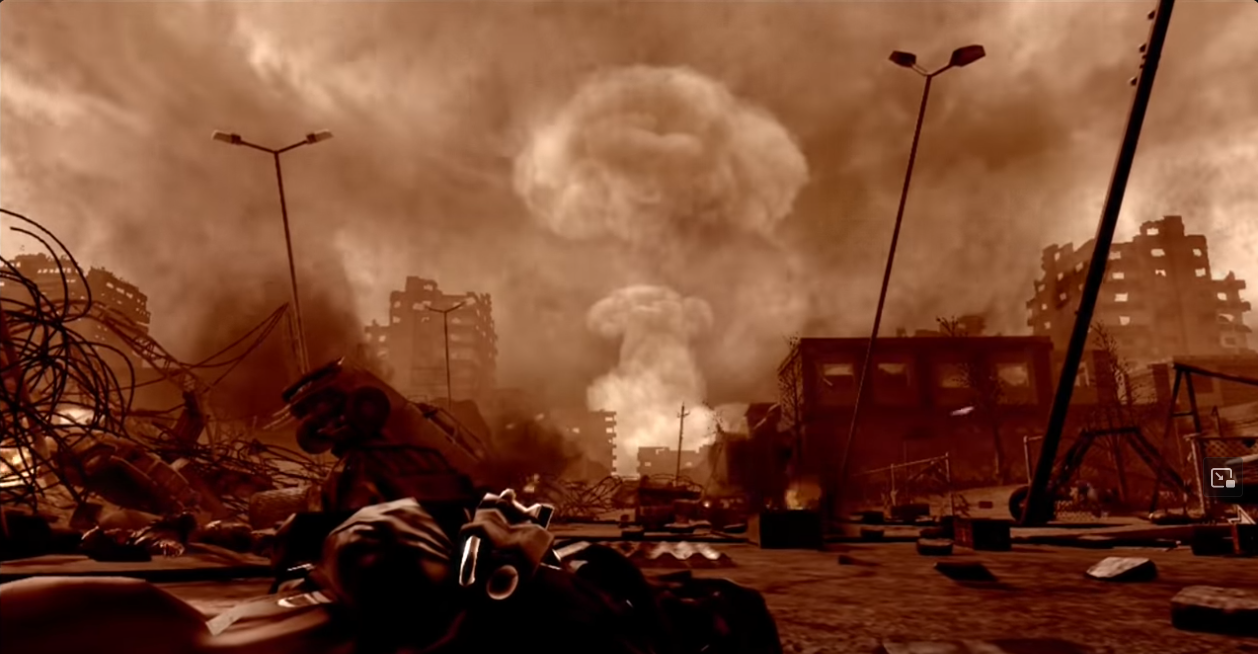
This. Was. Not. Normal. Games where you spent hours as a character and then just die wasn’t the standard in 2007. But this game isn’t normal, and it understands that war is unfair. Sometimes, it’s unfair because you get to blow your enemies away from the sky as they run in terror, other times you can do nothing but collapse and die, one more count in the statistics.
All In
We return to the SAS now, who are told by Nikolai that Al-Asad would never commit suicide and that that there’s a safehouse he used that should be checked out. The Russian loyalists do so and confirm that he’s present.
This raises a major issue with the story. If Nikolai knew that this safehouse existed, why on Earth didn’t he reveal it beforehand??? Surely the US would have appreciated a call suggesting they stop advancing or fall back while another team cleared this potential location. The only way this works is if he assumed America wouldn’t stop their invasion, but there’s no reason to think that some force couldn’t be dispatched to search the area in the many hours before the nuke went off.
In any case, Price and the SAS infiltrate the village, kill the ultranationalists protecting Al-Asad, and find the man in a barn. After an interrogation (read: beating), Al-Asad gives up who gave him the bomb. Before he tells the audience, his phone rings. Price answers it. Then, a moment later, he executes Al-Asad. Gaz asks him who was on the phone, and the captain reveals the big bad of the game - one Imran Zakhaev, leader of the Four Horsemen.
Price isn’t unfamiliar with this man. He once attempted to assassinate the man in the outskirts of Pripyat, Ukraine, 15 years prior to the story of this game as Zakhaev was the leader of one of the many groups trying to get nuclear material after the Chernobyl disaster. He failed, only managing to take off the man’s arm.
Their target made clear, the SAS now have to escape. They spend the night at the barn and prepare for the inevitable ultranationalist attack. The following morning, they skate by the skin of their teeth and manage to evade the much larger force until they are rescued by the Americans, made up of some marines that survived the nuclear blast. Following missions are a joint SAS-USMC job. I’ll refer to this combined group as “Price and his team”.
Anyway, the target is clear. To find Zakhaev, Price and his team go after another of the Horsemen, the man’s son. They ambush his convoy and chase him through abandoned, dilapidated buildings. Once they have him, however, he shoots himself in the head.
This is the point where the experience and story diverge in the quality, the latter taking a significant nosedive. There’s been no build-up to Zakhaev being the main villain, no references to him that make the player invested in this. We can’t be stunned at the depths of his evil because there was no reference for said depths before he was introduced at this point. The Four Horsemen that the game’s marketing hyped up had less impact than a wet paper towel - the game made no attempt to show their collective evil or how they worked together.
But this is also where some of the best gameplay can be found. The player gets to play through Price’s flashback of how he knows Zakhaev in the mission “All Ghillied Up” (a reference to the ghillie camouflage suit), an intensely fun and engaging sneaking and sniping level. After failing to snipe Zakhaev, you go through an explosive retreat that pushes the player’s skill to the limit as they hold out desperately for rescue. In fact, the line, “50,000 people used to live here. Now, it’s a ghost town,” is from this part of the game. It’s become iconic in the gaming community to the point of being a meme.
Nonetheless, we’re in the final act. Zakhaev has managed to take over a Russian nuclear launch site while the SAS was busy going after his son. He threatens the US and Britain with destruction if they don’t withdraw their forces from Russia. Price and his team are sent in to take over the facility. When the missiles are launched, their work takes on critical urgency. For several minutes, you’ll hear the tense music clearly between shooting exchanges, urging you forward to stop the impending disaster.
The SAS ultimately succeed and detonate the missiles mid-flight, but it’s not over yet. Fleeing from the ultranationalists still present, the SAS gun their jeeps out of the facility and escape to the nearby highway. Right as they start crossing a large bridge, however, a helicopter appears and shoots out its supports, sending their hopes plummeting away as well.
The final battle of the game has you hold off on the broken end of the bridge for several minutes until the whole area is struck by explosives. They knock the player’s character down, and several NPCs that have been with you die as you can do nothing but watch.
Zakhaev shows up at this point, compelled to end your existence personally. He executes one soldier, but right as he would do the same to you, the Russian loyalists show up. As the Russians tear into each other, Price slides a pistol to you in slow motion. With careful aim, you kill Zakhaev and a few goons nearby, then collapse in pain. You’re ultimately evacuated by helicopter, ensuring you live.
As the game ends, you hear that multiple nations are criticizing Russia after it claims to have conducted “nuclear tests”. Meanwhile, the search for that cargo ship from the start of the game is called off due to no leads.
The Story Is Bad…And It Doesn’t Matter
Anyone who has played this game would greatly struggle to defend its story. The lack of justifications for invading a country can be handwaved, the point was to replicate contemporary reality, so the US having soldiers in the Middle East was an axiom. But there is much less defense for not having Nikolai at least try to let people know about Al-Asad’s safehouse. The biggest issue is Zakhaev and the Four Horsemen. They only show up a few missions before the end, meaning the player has no investment in seeing them brought down. Nor are they fleshed out, leaving them as hollow villains that have only basic tropes to keep them from imploding.
There are real-life reasons for this. Halfway through development, Infinity Ward scrapped all but three levels, made a second batch, and then hired writer Jesse Stern to piece together a narrative. It shows in where the narrative is fleshed out, that being before and after each mission via cutscenes (in-game movies). Zakhaev, for example, only gets his ideology fleshed out in one such moment, monologuing about how post-USSR Russia’s leaders sold it out to the West and how he wants to reclaim the nation’s honor.
But even from the beginning, this was not an inconceivable thing. Infinity Ward pitched to Activision a game that replicated the videos and imagery seen on nightly news at the time. They never mentioned Price, the SAS, Russia, the Middle East, etc. The only thing they promised was modern war.
In other words, CoD 4 isn’t about the story. It’s about the experience.
Your immersion doesn’t come from the details of the plot, but rather by what the game has you do. As an SAS soldier, you take over a cargo ship, snipe enemies, rescue a spy, infiltrate a village, and mount daring raids to disrupt an enemy’s crucial plan. As a US Marine, you invade a city, kill its defenders, and wrest control away in a matter of days with your overwhelming might.
Seen this way, the lack of good villains or coherent story become irrelevant. The point is to simulate a fast-paced adventure that is indistinguishable from the real-life media present at the time. In that regard, the game succeeds phenomenally.
Pro-War or Anti-War?
There is a debate in the gaming space over whether Call of Duty is pro- or anti-war. The reason for this, in my view, is that while many games have copied CoD 4’s narrative-based story and gameplay, they have not understood why it makes the choices it does, or if they do, then they actively choose to focus on a different message, or have no message at all.
But this debate would have made absolutely no sense in 2007. The franchise’s four games were all about grounded combat that had you doing reasonable objectives without making you into a hero. Of course, you did heroic things, but you didn’t fundamentally dictate any part of the course of war. You were one cog in the machine, whether that machine was the Western Allies fighting Nazi Germany in humanity’s largest conflict, or a special forces operative doing your small part to help defeat the Russian ultranationalists or Al-Asad’s mercenaries.
In other words, the core message was decidedly anti-war, even if the games didn’t explicitly tell you that. War is hell and thus never glorified. Violence was feared, respected, hated, etc., but always taken seriously. Firing giant guns at enemy soldiers from the safety of an AC-130 wasn’t a shooting gallery for earning points, it was a moment of getting the job done that still raised discomfort with the practice. Dying to a nuke wasn’t just a dramatic plot twist, it was getting slapped in the face with the fact that war isn’t fair and you can’t expect to die in a way that makes for children’s stories. To a lesser extent, it’s also a powerful message about the need to ensure this technology is kept safe, lest it destroy us all one day.
And then there’s the ending. The world is not better off in the end. A city in the Middle East has been nuked, with 10s of thousands of US soldiers, enemy combatants, and civilians wiped out in the blink of an eye. Nor is Russia a stable nation. Zakhaev may be dead, but his soldiers are organized and can fight on. There is no happily ever after here.
One last thing to note - you’ll die at some point while playing. Maybe you got careless or just didn’t see something or someone. Maybe the AI was cheating and saw you when you were clearly in cover. Some sections are notably frustrating and you’ll die many times in quick succession. You’re going to get frustrated and feel like throwing your controller away or smashing your keyboard.
Each time, you’ll get a different quote on the screen. Some take the edge off with humor, such as, "Cluster bombing from B-52s are very, very, accurate. The bombs are guaranteed to always hit the ground." But the most common quote you’re going to get is something that should make you pause and reflect, like "Older men declare war. But it is the youth that must fight and die." The point is obvious - make the player realize that they can and should question the use of violence and war when it is so awful.
But these are not the only appeals. Here’s an anecdote I got from YouTube’s comments about what made them think, paraphrased for your convenience.
> I got the quote "Cost of a single Javelin Missile: $80,000", and I was struck as a child by the number. I had been shooting those things like they were candy! How much good could have been done if that money had been spent on anything else?
These cost quotes are rare, as are the ones about communism, the Cold War, and one from Yassar Arafat of all people. But all of them invite the player to reflect on the underlying ideas of technology, militarism, ideologies, and war.
The Beginning Of The End
CoD 4 was an immensely successful title, owing part of that to the experience and themes of the story. The year after, we got Call of Duty: World at War. Unlike previous WW2 entries, this was a fresh take that focused on the Eastern Front and the Pacific. It kept the same themes and exciting gameplay. These games were adding to the franchise’s place in the collective consciousness.
Then it all went to hell.
Call of Duty: Modern Warfare 2, the 2009 sequel to CoD 4, fundamentally altered the franchise’s messaging and it really hasn’t recovered. The restraint, subtlety, and deeper themes were abandoned in favor of action sequences, bigger explosions, and the most absurd alternate history ever told. I could spend hours talking about how awful this game’s story and experience is, but the easiest way to see what I mean is to compare the chaotic fighting and tension found in CoD 4’s trailer to the endless explosions set to a fucking Eminem rap in the sequel’s trailer.
To spite me, the sequel would go on to be the biggest entertainment launch in history up to that point. It cemented the franchise’s place in the cultural consciousness. This was the point at which people bought the games because others were buying the games. You had to keep up with the cultural conversation, as it were, though the quality helped. It would be followed by other games with addicting gameplay and passable to excellent story-telling. For those of us interested in the narrative, there is nothing afterwards like what came out during this time period.
The series eventually became more and more distant from “boots on the ground” combat, but returned to that with 2017’s Call of Duty: WW2 and even released a reboot of CoD 4 in 2019 called Call of Duty: Modern Warfare, but it just wasn’t the same. The execution of themes and narrative has just fundamentally been lost. They could create visually impressive setpieces with insane action, but any meaning or depth was largely absent.
Still, I’m grateful for the small mercy shown in 2016. A remastered version of CoD 4 was released, and I encourage you to play that version instead if you are interested. It improves the visuals and audio while making small enhancements that improve the messaging and themes.
Conclusion
CoD 4 is a time capsule. For me and so many others, it defined an important part of the late 2000s. In the process, it forever altered the gaming and cultural landscape. Many games would go on to do what it did with their own refinement, while Call of Duty became a thing everyone had some awareness of. Its successors lost much of its restraint and ideas, but they were never able to capture its uniqueness, that magical moment that led to its lighting-in-a-bottle nature and why the game holds up, both in our memories and in actual substance, despite so many years passing. People still look back fondly despite the technological and gameplay advancements of future games.
That, I think, is a worthwhile legacy.
Further Resources:
Call of Duty 4: Modern Warfare... 12 Years Later - This video is the most comprehensive review you’ll find on the subject
MODERN WARFARE: How Call of Duty 4 Changed a Genre Forever - This video covers some more of the finer details regarding the game’s development
Does Call of Duty Believe in Anything? - This video explains how poorly constructed the themes of Call of Duty: Modern Warfare (the 2019 reboot) are, though it is far more politically minded and might turn you off if you don’t like left-wing commentary. Still worth a watch, though.