A Mann, a bad plan, a Boeing 727 - Equatorial Guinea
Simon Mann - old Etonian, son of one captain of the English cricket team and grandson of another - describes the plan for his botched 2004 coup attempt against the government of Equatorial Guinea as a “heap of shit”. In fact, throughout Cry Havoc, Mann's tale of his botched coup and subsequent terms of imprisonment in Zimbabwe then Equatorial Guinea (“EG”) itself, he seems so embarrassed about the quality of the plan that he never presents it in one place, instead dribbling it out over a few chapters. This is probably so you can't put it all together and appreciate just how bad it is, as I have just done below:
-
70 unarmed mercenaries, Mann among them, fly out of South Africa on a second-hand Boeing 727 to Zimbabwe.
-
They land at Harare airport to refuel and pick up the weapons they bought from a member of Zimbabwe Defense Intelligence.
-
Then they fly on to Malabo, the captial of EG, where some insiders in the palace of President Obiang will arrest the President as Mann’s gang touch down; they have some black soldiers on their plane so they don't look too foreign.
-
Other guys on the team fly in Severo Moto, an exiled politician, from the Canary Islands, assuming the previous steps have gone well, and he can be interim President until elections are held.
-
If things go wrong, someone is on standby with a helicopter and/or boat to rescue them. Specifically, it is Mark Thatcher, the same one that went missing during the Dakar Rally, and whose mum has to call up the Algerian government to get them to go find him.
-
Alternatively, they can try fleeing to the nearby Sao Tome and Principe, where they have some friends, albeit unsavoury ones who will likely try to get them to carry out a coup there.
-
The Spanish government will recognise the new government, and the rest of the world will follow suit, various intelligence agencies having given this operation a nod of approval.
-
Malaria will then be eradicated and EG will hopefully get turned into Dubai. (That last part isn’t an addition of mine - the analogy is purely Mann’s.)
The plan falls apart when they land in Zimbabwe and go to collect their weapons. It turns out that Captain Brodie, the Zimbabwe Defense Intelligence man selling them weapons, and "a veteran of [the Zimbabwean Air Force's] rape and pillage of the DRC for diamonds", is not a trustworthy fellow. They are arrested on the tarmac at Harare and bundled off to prison. (The likeliest explanation is that the South African government did not want the coup to go ahead, and so tipped off the Zimbabweans to stop it.)
The plan has many failure points. There is the weapons pickup in Zimbabwe. There is another probable refuelling stop in the DRC, where it is not unknown for aircraft to be arbitrarily detained, as happened to another of Mann's aircraft earlier. They do not know who their guys on the inside in Malabo actually are, and do not know if they will succeed, or if they will arrive in Malabo as 70 men against an entire country. The men have been waiting so long to be deployed that rumours of the coup have leaked to a dozen or so intelligence agencies, which means EG might well know they are coming: the EG military might arrest them as soon as they touch down, or blow their 727 out of the sky. And you don't just have to take power, you have to keep it - only six months earlier a coup in Sao Tome and Principe had succeeded, and then fallen apart mere days later after the United States and Nigeria threatened to come in; there were rumous that Nigeria had hundreds of marines ready to invade EG if there was any coup. The plan was not a good plan.
How on earth did we get here? Really, there is a lot to be asked. If there was already going to be a palace coup and they would simply turn up at the end, why were they needed? If external help was needed, and Spain was already on board, why would the insiders not use the Spanish to protect the new president, rather than a bunch of mercenaries? Was this actually the plan, or was the real plan a lot more brutal than Mann is telling us?
Cry Havoc is a confusing book which is bad at answering these questions. (If you are curious I would highly recommend Adam Roberts' far superior book, The Wonga Coup.) However, what Mann's book offers is an answer to a completely different, but still interesting question: how do these plotters think of themselves and their actions, and what makes them go ahead with a plan that has such clear problems?
The rest of this review goes through a number of theories that are plausible but not fully explanatory, before getting to what I think are Mann's true motivations.
Theory 1: He ran out of good plans before the deadline
Mann is very eager to impress on the reader that this plan was their Plan E, and they had a lot of better plans that they could not go ahead with. Better, however, does not imply good:
- Plan A involves buying a second hand cargo ship, filling it up with Liberians and artillery, sending the Liberians to shore in Malabo in RHIBs, and then… something happens? I'm not sure exactly what. That plan falls apart when the American navy turns up in the area for unrelated reasons, and Mann thinks it is ill-advised to be carrying a cargo of Liberian mercenaries about under their noses. So that is cancelled.
- Plan B plays on the greed of President Obiang, who can't resist a gift. Mann's mercenary buddy, Niek du Toit, has already been on the ground in EG on some fake business pretext, and has met with Obiang personally a few times. He will say "my friend Mister President, come to the airport, I have a special gift of four Toyota Land Cruisers for you!" Mister President goes to the airport, and out of the plane come 70 Afrikaner mercenaries. "Beware Afrikaners bearing gifts" writes Mann. But the Land Cruiser dosh doesn't arrive in time, so that plan is called off. (Mann is largely reliant for money on a shadowy organiser he calls “The Boss” - probably Ely Calil - who keeps changing his mind on whether the plan should stop or go ahead, and making promises that the money will be coming soon.)
- Plan C is similar to plan A, but just involves the Afrikaners and no Liberians. They will go ashore in Malabo via helicopter and boat, and then something will happen. But that is called off: the money, again, doesn't arrive in time, and the Afrikaners don't like small boats.
- Plan D looks very similar to Plan E, where armed men turn up in Malabo via a weapons pickup stop Zimbabwe. The exact difference isn't really discussed, this one just happens to be Plan D and the actual plan is Plan E. However, this one is scuppered after their plane goes missing. The problem was that when the flight crew landed to refuel at Douala in Cameroon, they broke the nose wheel, were delayed finding a new one, then when they were flying over the DRC air traffic control forced them to land and demanded they pay a bribe they didn't have the money for.
This is combined with the looming deadline of a Spanish election, which means there might soon be an administration that doesn't want this coup to go ahead. And given Spanish recognition is quite important in their plans, they need to act quickly.
But this theory fails for a few reasons. First, the other plans are still quite bad. For example, Plan B might seem clever (you get the untrusting Obiang out of his palace and nab him at the airport) until you realise Obiang would be surrounded with his bodyguards, who are packing a lot of firepower and would probably light up a few dozen of Mann's gang. Second, even if Plans A-D were excellent, that doesn't demand that he must go ahead with Plan E, which is bad. They could simply… not do a coup. Sure, that is worse than successfully pulling off a coup, but it is much better than getting caught in the act of trying to pull off a coup. If a restaurant has run out of all other dishes and the only available menu item is raw sewage, you don't order the sewage. Even if the other, now-unavailable menu items would have been excellent, and even if the restaurant is going to close soon, you don't order the sewage.
Still, I think that this theory has some explanatory power if it is construed a little differently. Specifically, Mann signed up to the mission when success seemed quite plausible, he then got very invested in the operation, and when success stopped being plausible he was still so invested that he went ahead anyway. With contracts all signed, Mann's own money being burnt up by the day, and his soldiers grumbling impatiently about having the coup date being pushed back and back again, it is hard to turn around and say the deal is off, the sunk costs are all lost. It is telling that, in talks at both the Cambridge and Oxford Unions, he described his hope, as the mercenaries set off for Zimbabwe, that there would be some mechanical issue with the 727 that would force them to cancel the operation. He wanted the mission to be cancelled, but couldn't bring himself to be the one blamed for calling it off.
Theory 2: He thought it was easy
This requires some context.
In 1993, Mann has left the British military, where he served in the Scots Guard and the SAS, and is now working in the City of London for a friend, Tony Buckingham, whose oil and gas company has just a single operation in Soyo, Angola. Rather, it had a single operation. UNITA, an Angolan revolutionary movement and all-round bunch of bad eggs, kicked off a civil war, and seized their plant, among other things. Mann is brought into Buckingham's office and apologetically told that he no longer has a job.
Mann, however, has other plans. Through his mother's side of the family, he knows a bunch of South Africans who know how to fight. Sixty or so of them are popped into a shell company called Executive Outcomes (“EO”). They don't have weapons, they want money, and they want to kick some UNITA ass. The Angolan government has weapons and a bit of money, and wants to see some UNITA ass kicked. It's a match made in heaven: EO signs a contract with the Angolan government, is armed and paid, and they are ready to go take the fight to the enemy. To avoid anti-mercenary laws, the EO fighters enrol in the Angolan military which makes them technically not mercenaries. Mann, so recently having left Britain's SAS, is now an Angolan Brigadier-General. Off they go to take back their oil and gas operation.
Throughout this episode, and most of the others, it becomes apparent how little is required to succeed: (here including miscellaneous details that I think are interesting)
- The beachhead in Soyo is secured by just 60 EO mercenaries against 3000 UNITA soldiers. They do get reinforced, but their reinforcements are literal child soldiers (!), who arrive in a boat whose anchor falls off and gets the boat stuck way off from the shore as it takes on water. With luck, they manage to unload the boat without too much damage done.
- In Soyo, Mann credits their victory to superior logistics. The front lines have to be resupplied continually, because being surrounded by enemies burns a lot of ammunition, plus I assume it is also hungry work. So, for the whole time three light aircraft are rotating in and out with everything they could need. His opponents relied on supplies being carried, on foot, from 600 miles away. (The other reason these aircraft are needed is because dying for your country is all well and good, but the soldiers are all just there for money, and dying for a paycheck is much less romantic. This means that the mercenaries won’t fight unless they know that, if they are wounded, they will be evacuated to a world-class hospital.)
- Reconnaissance flights are done by flying a civilian aircraft around in broad daylight. Everyone they could see could see them, their only protection being that rifle bullets cannot reach a plane flying at their altitude. But if the rebels bought a single medium-altitude anti-aircraft missile they could easily blow the thing out of the sky. Hence a lot of EO thought was devoted to calculating the odds that the rebels had bought a missile.
- One way they weakened their opponents was sending up, at night, an aircraft with some unguided 250kg bombs and no lights. The pilot would fly about with night-vision goggles on and drop the bombs on whatever looked interesting.
- A long-winded subplot sees Mann roaming around Moscow trying to buy some large bombs from Russians, with the aim of using them to terrify UNITA so completely that they must give up. He succeeds in procuring some 500kg ODABs, which are a clever kind of bomb called a "fuel-air bomb". (Explosives need an oxider, and generally they contain a chemical oxidiser. Fuel-air bombs have no oxidiser, and instead, disperse their fuel before detonating, using atmospheric oxygen as the oxidiser. They don't need to carry their own oxidiser with them, and so rather than being part-fuel/part-oxidiser, they are 100% fuel. This means that they carry a lot more booms per kilogram, to use a technical term, than the average bomb.) The Angolan government drops one, which has the desired effect, and the war is soon over. Well, that's how Mann tells the story. The bombs are reasonably impressive but really aren't that big. I guess they are the biggest thing in that part of the world.
- In Sierra Leone, a common tactic is flying a light aircraft over RUF camps at night, reporting the coordinates of their very visible campfires, and having Saffa mortar teams on the ground blow them to bits.
It really seems that with a few well-trained men and some basic technology - which is far more advanced than their enemies' - you can get up to anything you want. "You can just do things", Mann might write if he were on Substack and not dead. This is far from groundbreaking if you have read your history, and know of episodes like the various Spanish conquests of the Americas, the Opium Wars, and both East India Companies. Still, I at least found it surprising, first, that it can still be done, and second, that Mann and his gang aren't using particularly sophisticated kit: unguided bombs and civilian aircraft seem good enough for the job.
Their operations are astonishingly cheap. The 727 they plan to fly to Equatorial Guinea costs only $300,000 (although they may have got it cheap from the US Deep State), and the weapons they pick up for the EG coup are only a quarter million dollars. The plan for dumping a bunch of Liberians in Malabo requires only £800,000 for a second hand cargo ship and then $500,000 for the Liberians. Estimates of the cost of the whole coup operation run from 3 to 20 million, likely on the lower side, but a lot of their expenses come from their many failed plans and delays, along with a lawsuit by Obiang that costs Mann £3m in legal fees. This is not pocket money, but it is tiny when compared to the sticker price of any modern military kit: $3m for a Tomahawk missile, $10m for an Abrams tank, and $100m for an F-35. Note too that these prices omit the ability to launch the missile, ammunition for the tank, and infrastructure required for running the plane (plus another $20m if you want an engine, I don’t know why you can buy an F-35 without an engine). It is alarming to think your average Jane Streeter could fully finance a few coups in their lifetime and still live very comfortably.
Beyond being cheap, you don't seem to require much luck either. As mentioned above, in Soyo, the anchor falls off the landing craft, but things still go alright in the end. When their flight crew takes planes around Africa, they always seem to be getting arrested. And it seems that Mann's men turn up to every fight hungover. Maybe anyone who had gone through all this and come out on top would think themselves bulletproof. And at that point, why even make plans? Who cares if everyone in your coup attempt has been gossiping and it seems every intelligence agency knows what you're up to? If you are invincible, you do not need the advantage of surprise.
But this is clearly not the full story. Mann is aware of risks in general - Plans A through D were never rendered impossible, rather, the risks involved with them became sufficiently high that they were called off. For instance, they could have put all the Liberians on a ship and run the risk of annoying the Yanks, or they could have done Plan B without the Land Cruisers and simply told Obiang there were Land Cruisers on their plane. Also, Mann has backup plans for Plan E going wrong, like the evacuation plan with Mark Thatcher. If he thought he could get away with anything, there would be no reason for that. Still, this has some explanatory power, in that for edge cases, I assume a history of shonky plans working out well would make him more likely to go ahead with a plan that looks shonky.
Theory 3: It was the right thing to do
Yes, Mann is a mercenary, and mercenaries are not generally known to be particularly ethical folks. Maybe the image that comes to mind is of the nasty white guys in Blood Diamond, which are actually based on EO, although, in fairness, they were actually fighting against the RUF, not for them.
However, he claims to be a force for good. His moral reasoning is pretty simplistic - on five separate occasions he analogises Obiang to a playground bully who needs to have his nose punched. He also has a talent for asserting his altruistic motives in a very suspicious way:
Thank God there is a point to this Op. A point beyond mere money, I mean. EG is a rank tyranny and ongoing. Sure, we’ll make money – loads – but EG is a mountain that needs climbing. The people of EG are under the cosh. EG has too much oil. It’s like the fatal gift of beauty. An ancient Greek curse.
Still, in his career as a mercenary, Mann claims he has only ever fought for the good guys against bad guys - in Angola defending an elected government against the sore losers of an election, in Sierra Leone again defending democracy against brutal rebels, in Papua New Guinea if they had got to fighting it would have been for a democratic government, and in Equatorial Guinea trying to bring back democracy. A sample size of 4 is a little small, but the real problem with this argument is that anyone, no matter how much they cared about ethics or not, would do the exact same. This is because if you fight for some real bad hombres (e.g., deposing the ANC and reinstating Apartheid) you get all your assets frozen, and as a mercenary the assets are the entire point. Fighting for the wrong side is financial suicide, so fighting for the right side isn't proof of a good heart. And even if, as he claims, he turned down money, offered by a backer of UNITA to get him to leave Angola, that could just be because winning in Angola, plus the extra business that winning brings, is more lucrative than the immediate payout.
It might also seem suspicious that he only ever does operations in countries with big mineral deposits: EO is founded to protect oil and gas operations in Angola, they enter Sierra Leone because they want a diamond mining concession (they already have one in Angola, and apparently to do an IPO you need to have concessions in multiple states), Papua New Guinea is full of copper, and EG has oil. However, in Mann's defence, if he can't pay for his troops and aircraft then he can't do any mercenarying, and mineral-rich countries are better able to pay. (Nevertheless, for a long time Sierra Leone fails to pay EO, but they keep fighting. An act of generosity? Mann frames it as one, but it is also a respectable business decision, because if you leave you get nothing, but if you stay on you get a decent chance of getting paid.) So I don't think this point is particularly incriminating.
Still, even if we do not have strong evidence of bad intentions, a lot of the book reeks of bad vibes. In fact, alarm bells start ringing before the text even begins, with a map in the front of the book labelling the DRC as "Zaire". He jokes are generally in bad taste, such as one about Zimbabwe standing for "Zero Intelligence Mainly Because All the Bloody Whites Emigrated". And you wonder why he decided to fill the officer ranks of his ethical army from three specific sources:
- the Civil Cooperation Bureau, which, by his own admission, "carried out [the Apartheid South African government's] dirtiest covert and clandestine work",
- the Koevoet, a white Namibian counter-insurgency unit whose behaviours Wikipedia describes as "controversial", and
- the Rhodesian Fire Force, which needs no introduction.
(There are black Africans working for him, just not in the officer class.) Maybe these are the most effective men for the job, and I suppose the master's tools can dismantle another master's house.
But suppose he is highly motivated by the plight of the little guy. Why, then, when he is told by one of his soldiers in Soyo that their Angolan ally, Colonel Pepe, is executing his own child soldiers (he suspects they are giving themselves wounds so they can get taken away from the fighting), does Mann seem completely undisturbed, not just by this truly evil act, but by his own soldier's amusement reporting the story? Also, if he found the government of Equatorial Guinea so reprehensible, why did he cooperate with them and tell them as much as he could to help with their weeding out domestic opponents? This last point feels somewhat unfair of me, because, as a keyboard warrior, it is easy for me to say "simply resist torture and die, coward". However, I do think I have a leg to stand on when I criticise him for, as he describes in a talk at the Cambridge Union, returning to Equatorial Guinea multiple times to hang out with Obiang. Mann now describes as a "friend" the same man he blames, rightly, for torturing political opponents and the extreme suffering that poverty brings to his people. It does not seem that ethics is a high priority for Mann.
Maybe he has some ethical convictions. But I don't think that they are strong enough to make him put his life at risk, especially if the beneficiaries of this risk were black Africans that he has never met.
Theory 4: Wonga
Let's address the elephant in the room. Take a look at EG's exports in 2004:
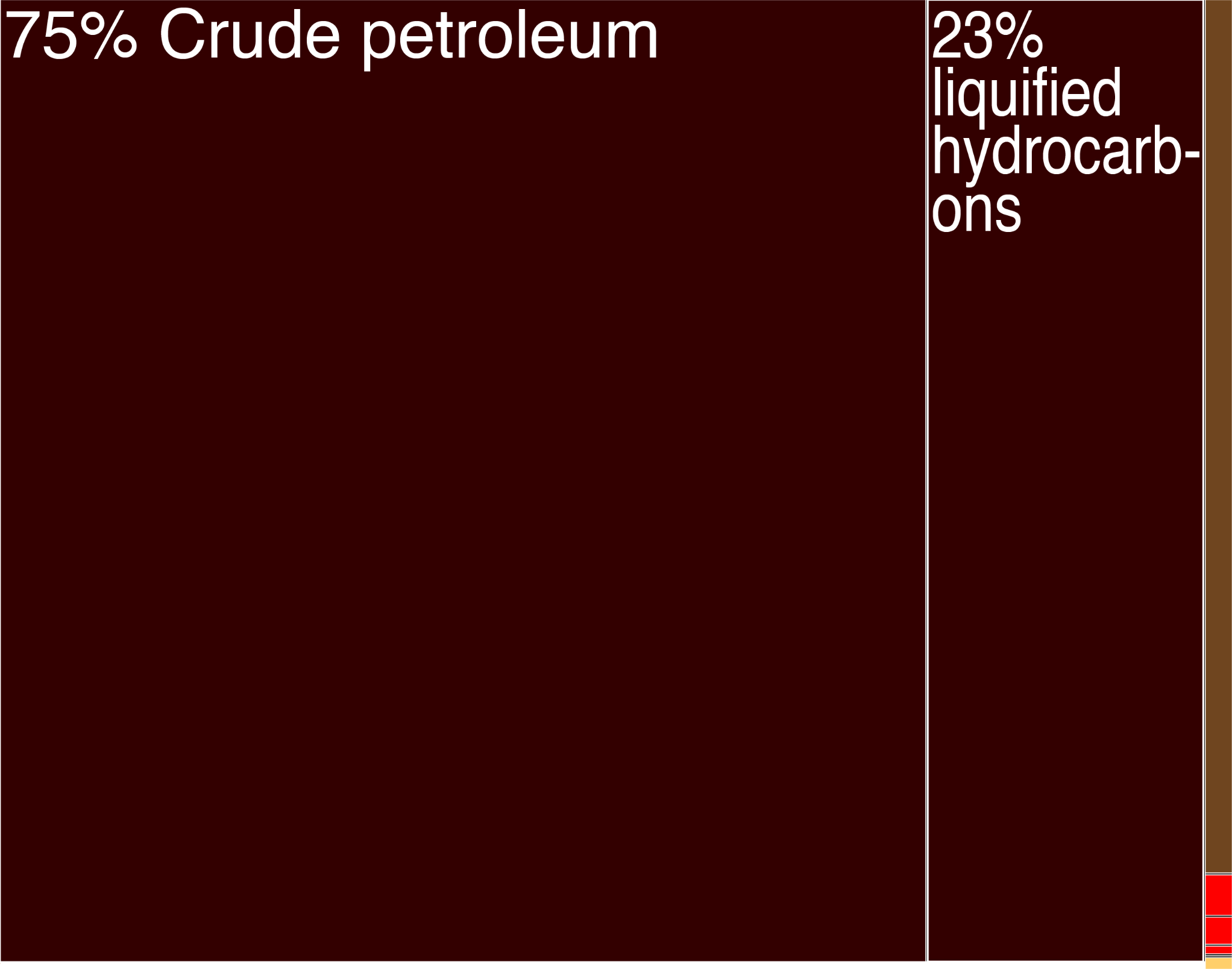
From Wikipedia

It appears to have lots of oil. So, if you pulled off a coup there, perhaps there could be a bit of money involved. As the man who put the new President in power, you could assume a lot of power, especially if he is constantly surrounded by bodyguards that you command. In fact, you probably have more power than the President in that position, since you aren’t constantly surrounded by gun-toting men on his payroll. You basically get to run a country, a country so oil rich that if you go into the rainforest you see it literally seeping out of some rocks. So there is a bit of wonga to be made. (The EG coup attempt is generally referred to as the "Wonga Coup", as a result of a letter from Mann from prison, saying that his getting out may "[come] down to a large splodge of wonga", "wonga" being some obscure British slang for "money".) Mann insists that money isn't the primary motivation, even if it is a factor:
Fucking hell. Why am I doing this? For the money? Sure. Right now, all the money in the world isn’t enough. I’ve got loads of bloody money anyway. I’m a multi-millionaire in sterling, for fuck’s sake.
Of course, it is his autobiography, and he probably does not want to type the words "I am solely motivated by money and like it to the extent that I will kill people for it," even if those are true words. It is quite imaginable that Mann would take some big risks if the prize was, in effect, an entire country.
But that doesn't explain the whole story. Assume Mann had overriding reason to go ahead with the plan. Further, assume that the Zimbabwe weapons pickup cannot be skipped or altered, and it is known that this is a risky part of the plan. What was Mann doing on the plane? He could just… not be on the 727. Then if the plan goes terribly then, ah well, sucks to be one of those goons on the plane.
Did Zimbabwe only trust Mann, such that they would refuse to hand over the weapons to anyone else? They are selling weapons to someone who doesn't have the appropriate documents, and clearly are happy to compromise on procedure for money. Just give them some extra money and have an underling pick it up. Or he could have negotiated the deal alongside an underling so they trust that underling enough that he can skip the pickup.
Did he need to be there up close, to monitor the plans all unfolding? No - there is operational precedent for him sitting things out. In Soyo he was never on the beach firing a gun, but he was in a boat off the coast for much of the operation coordinating the various moving parts. Let other people do the dirty work! He had plenty of trusted lieutenants whom he had spent years fighting alongside. The plan already involved him trusting people who were out of his reach to do the right thing. The plan can run just as well if he is not on that plane.
Did he need to be by Moto's side as he came to power? I don't think so - if it is your guys standing next to him that will achieve the exact same thing. But even if that is wrong, the 727 isn't the only plane going in to EG. Instead Mann could simply fly in with Moto from the Canary Islands, at far less risk to himself.
Money obviously plays a part in this coup. Money as the payoff can explain why someone would take a risk. But if the risk is almost entirely independent of the payoff, as it is here, then money does not explain it. Mann could have avoided being on the 727 and had the same prospect of gaining a huge share of EG's oil wealth. So why was part of the plan putting himself in the firing line, when he didn't have to be?
Theory 5: Mark Thatcher Syndrome
Strangely omitted from the DSM 5, this is the condition of desperately wanting adventure and the sense of being one of the boys, wanting to have a ripping yarn that can impress everyone at your next cocktail party. Comorbidities: having extremely high achieving parents and a completely undistinguished youth. Consider Mann's portrait of Mark Thatcher, already having been described telling of "his love of boys' own adventure" while getting him to commit to their escape and evasion ("E&E") plan:
But the E&E plan is also a warning to Thatcher. This isn’t a game. I’m telling him: if you want to step back, then now’s the time to do so.
It’s a chance for him to say: ‘Stop! I’m an investor … but that’s all I am.’
I need Thatcher to decide. Thatcher has the money, and the political connections – in Zimbabwe, South Africa and the UK – to help me, if collared. I need Thatcher to look me in the eye. Tell me what he’ll do if it all goes tits up for my team and me.
Will he do all he can for us? Or will he deny us?
The E&E plan is the test.
Thatcher picks up his pencil. He dutifully notes down all of the information as I have in my notebook. He promises he’ll help his great friend Simon Mann any way he can, if things go awry. We even shake hands on it. If nothing else, Mark loves to play the officer and gentleman. ‘My word is my bond…’, etc.
Big time.
Loves to play the officer and the gentleman, eh? That couldn't be said about, say, someone who compares his striding about on the deck of a boat off the coast of Soyo to Horatio Hornblower and Jack Aubrey in the exact same sentence? Or someone who incongruously mentions that, while waiting for the next step in his coup plot to come together, he distracts himself by reading Jane Austen, and when arrested, reads the complete works of Shakespeare? And what about someone who, on his way into battle, prays to Athene and Ares, and on his return from prison compares himself to Odysseus returning to his Penelope?
An officer and a gentleman is a true patriot, which Mann certainly is. In Moscow, when he walks past the British Embassy, he claims without much evidence, that the building "had so infuriated the old comrades with its elegance, its pride of place". In a passage quoted above, he’s not just a multi-millionaire, he’s a multi-millionaire in sterling. He frequently quotes himself quoting Shakespeare, one such instance being the titualar line from Julius Caesar ("dog of war" nowadays being slang for "mercenary"). While at Sandhurst, he dips off to go foxhunting. He even thinks the British won Jutland! Zimbabwean prison is no match for his stiff upper lip; he compares it to an English boarding school and the British military, perhaps an easy analogy to draw when he has a butler in prison (the poor man hopes that once Mann gets out he will use his influence to help him).
And what better way to portray yourself as a hero than to write a book about your various exploits? In this particular book, every aspect of his existence is stylised to the point of complete unreadability. Consider the start of Chapter 2. I quote it at length because if I only quote a sentence or two his writing might seem somewhat amusing, and a paragraph or two merely bizarre. But only when you face a full page of Mann's prose do you get close to the experience of reading this entire book, which I can only imagine to be what it feels like to be electrocuted, over and over again:
OK. So just how does this whole fucking shambles kick off anyway? Sometime in late 2002, I’m introduced to Wayne Adams, a spivvy property something-or-other. A wannabe adventurer. He’s short, heavy, fat. Tod slipper shoes, his ankles buckle. Greasy, pitch-black hair, too long. Greasy skin. Rich car. Rich clothes. Centre of the Universe.
Early 2003, he asks me (Africa Hand) to visit Gabon: he had become big mates with the President of that country – the late and unlamented Bongo. The President, it turns out, had taken a shine to Wayne when they had met on holiday.
My seven-day trip to Libreville is as much a waste of time as I had feared. A pain in the arse. The city is a dump, a slum, despite years of oil boom. The palace of Monsieur Le President Bongo, on the other hand, is a thing of beauty.
When I meet Bongo, I feel like laughing and not because of his name or because he is such a short arse (even in high Cuban heels). What is revoltingly hilarious is that nothing matters to Bongo except the flat dollar-a-barrel tariff deals that he has with Big Oil.
The Barrel Boyz.
Deals like this are what an oil company calls a Sweetheart Deal – but only behind their slammed closed doors. They aren’t so ‘sweetheart’ to the Joe Bloggses of Gabon. Bongo’s dollar-a-barrel Sweetheart Deal costs his country ten dollars a barrel, if a cent. The stupid fucker Bongo may not even know that. He wouldn’t care anyway.
Bongonomics.
By the end, the outcome of this business trip farce looks to be the waste of time that I had feared from the start.
As a side-note, beyond Mann’s pretensions at literature, it is worth noting just how strangely “literary” this coup attempt is:
- One code-name for the operation was "the Patrick O'Brian Appreciation Society Spring Outing".
- The novelist Jeffrey Archer almost certainly helped fund it. At least, payments came to Mann's account from a "J. H. Archer", and Mann’s dealings in Russia are helped with a letter from a friend in the House of Lords.
- James Brabazon, a filmmaker and author famous for covering the Liberian civil war, was invited to participate, and only missed it because his grandfather had died and he turned his phone off.
- A coup organiser, Greg Wales, after the fact wrote a (thankfully) unpublished manuscript, Coups and Robbers, about a coup attempt led by a sex addict on an oil-rich West African country.
- The coup itself follows strangely closely the plot of The Dogs of War, a novel so beloved by mercenaries that they are known to bring copies to coups, and which Mann's title is a nod to. It is about a coup in a West African island nation, almost certainly modelled off a coup attempt the author himself had some part in.
Back to this book - our straight-shooting hero is surrounded by zany caricatures. His partner in crime, Tony Buckingham, elsewhere described as a "two-stroke Cohiba engine" (OK, that one's pretty good) is introduced as:
Tony. Shorter and rounder than me. Always laughing. Always suntanned. Noisy. Perma-rich. Lots of cars. Clouds of Cohiba cigar smoke. Toad of Toad Hall, meet JR Ewing.
The Russians are as one would expect from a cheap thriller: the men are vodka-soaked and cryptic, and the one woman we encounter is "lithe in her furs". Black Africans are portrayed as one might worry; President Doe of Sierra Leone "trusted only two blacks: Black Magic and Black Label". And among all this, everyone bar Obiang and Mugabe seems to fall over themselves to pay Mann compliments. The general that finally gets him the ODABs does so because he sees Simon as sincere and wanting peace, and when one is detonated, the UN writes specifically to commend just how ethically it was used. Prisoners in Zimbabwe love him, nicknaming him "Shumba", which is Shona for "lion" ("the lion is king", Mann reminds us), and in case that wasn't explicit enough they pull him aside to tell him he is the best guy of all time:
‘No, Simon – I mean it – we’re serious – you are one of us – the armed robbers … we watch you – how you stand back to let an old poor man walk through a door before you … or in the queue at food time… You have respect for us, you see…’
Once you look for this protagonist mindset you see it everywhere. In an interview with "Bronze Age Pervert" (an effete and hyper-online Romanian fascist with no evident talent for interviewing) he describes a conversation with Tony Buckingham before they got into the mercenary business:
I remember a conversation with Tony Buckingham, my partner and who was one of the founders of Executive Outcomes with me. And I remember before it all happened, before it kicked off, we were sitting having a drink in London. Tony said "God, you know Simon, it's so boring. You know, […] I wish it was the Elizabethan age, and we could […] have a ship and just sort of sail off around the world and, you know, have adventures, and capture Spanish treasure ships… and stuff."
And I looked at him, I said, "No, no, Tony, you don't understand. The adventure is always out there."
(When recruiting a pilot to fly Moto from the Canary Islands, Mann analogises the mission to a galleon full of Spanish gold that one of Francis Drake’s ships might stumble upon.) He uses that term, "adventure", nine times in the book to describe his mercenary exploits. Executive Outcomes was shut down by the South African government because, in his words in a now-deleted interview with London Real, they were "having too much fun", a "lads on tour" vibe which is certainly not helped by the troops' first meal on the 727 being Nando's. Mann does not conceal how he came to have Mark Thatcher Syndrome either: he writes of his whole childhood living in the shadow of his father and grandfather, thinking of the things they had done and the battles they had fought in. (He never mentions his other grandfather, who was a director at De Beers and a chairman of a railway company.) His insecurity was never about money. It was about their having done great things while he had not.
Mark Thatcher Syndrome is the missing factor for all the above explanations. First, cancelling the mission is not ideal, but it is perfectly acceptable in a business operation to cancel a plan that won't work out. What is not acceptable is returning to the fancy suburbs of Jo'burg with his tail between his legs, after he has spent garden parties raising funds for a coup. Pulling out of the plan isn't just writing down some expense, it is giving up on his identity as an adventurer who is willing to take on any challenge.
Second, we also need not believe that he was unaware of the risks. But the adventurer is someone who thinks that they can take on the risks. Besides, although risks should obviously be mitigated, to some extent they are the point. With no risks, there is no adventure. Mann’s identity is that of someone who faces risks and wins, and so he is willing to take far larger risks than he should.
Third, ethics may have been a consideration, but only indirectly and in a peculiar way: the adventurer needs a dragon to slay. That is his exact choice of words when he decides to quit the British military and try some other line of work:
I was proving nothing. Not to myself at least. I was a soldier, but I wanted something more. I wanted to find a cause. I wanted to slay a worthy dragon.
(This would explain why he is happily friends with Obiang afterwards - he is no longer in his role as dragon-slayer and so it is fine to befriend the dragon.) King Solomon's Mines is an exciting tale of adventure if Allan Quartermaine is off to find grand treasure and save the lives of some maidens along the way. But if he had overcome the exact same dangers and challenges on a mission to capture slaves which he then sold elsewhere at a healthy profit, well, it's not exactly the same story.
And fourth, the money is required because the adventurer needs a worthy prize. The £20,000 wager is what makes the victory in Around the World in Eighty Days so exciting - it is no fun if Phileas Fogg walks through the doors of the Reform Club and gets a few respectful nods. He has to get some moolah!
It is convenient that Mann suffers from Mark Thatcher Syndrome. Other motivations can be hidden. For instance, if he was purely in it for the money, then he could write about how he had strong moral concerns, or if he was just pushed into it by those more powerful than him he could say he was just in it for the money. But Mark Thatcher Syndrome is a condition that in its most extreme form produces its own diagnosis, but making the sufferer write a book in which they tell on themself, by portraying themself as a gentleman hero.
What are we to learn from this? Most lessons seem obvious and ungeneralisable. If you are going to knock off El Presidente, don't book a layover in Harare? People shouldn't need to be told that. Mark Thatcher Syndrome appears to be something highly specific which only two people suffer from, namely Simon Mann and Mark Thatcher. But over the time I spent reading Cry Havoc and writing this review, I came to see it everywhere. Or at least, something we might call “Generalised Mark Thatcher Syndrome”, which is less about the specifics of adventure novels Mann and Thatcher read, and extends to genres that aren’t just adventure. I will not commit myself to the rest of this paragraph, as it might just be the ramblings that result from having spent too much time in close proximity to Mann’s prose, ramblings which I will quickly disown once sanity returns to me. But it really does seem that the Syndrome is everywhere. The most serious form is the strain that makes one desperately want to be a character in some grand tale, or, worse yet, fills them with the conviction that they already are. They are rare in everyday society, but perhaps visible in cops who wear body armour with the Punisher skull on it, or couples whose vows include being “the Jim to her Pam”. They are much more common among aggressive risk-takers, such as the self-styled great men founder-visionaries of Silicon Valley or the carnivore capitalists who enjoy watching The Wolf of Wall Street far too much. And I think the ranks of truly world-changing figures are thick with them - what else do you think made Alexander the Great sleep with a copy of the Iliad under his pillow? Beware the sufferer of the Syndrome - he answers not to reason, and thinks he is in a tale of which he is the protagonist.
The end of the story
This is a book, terribly written, incoherently organised, and truly unreadable, about a man who desperately wanted to be a hero. It is a cautionary tale about a man with a particularly acute case of a perhaps not-so-rare condition, which renders him unable to call off an excessively risky operation, and unable even to pursue his own narrow self-interest by allowing others to take the fall. The Syndrome compelled him to prove himself, and show that he was a cut above the average rich man of Jo'burg. He is the Mann of action, and, as the SAS tells us, who dares wins. Unfortunately, in Zimbabwe there is no such thing as plot armour, and his grand fiction runs headlong into blunt reality.
Your message is stored now and emailed to the author after the contest ends. The author can reply to you, but their identity stays hidden unless they choose to respond.