You may have noticed that in many countries around the world, young people have very different moral values than old people. The young and the old have of course butted heads since antiquity and earlier — the Greek philosophers complained about degenerate youth. But never before has technological and economic change been so rapid that each generation’s life experience is so different from that of the generation before it. What does this imply for the moral values that our life experiences shape?
Ronald Inglehart, who died in 2021, spent his career studying the changes in people’s values over time, from generation to generation. One of the most-cited political scientists ever, he summarized the findings of his career’s worth of studies in his pithy 2018 book Cultural Evolution. The book’s thesis, in a nutshell:
“People’s values and behaviors are shaped by the degree to which survival is secure.”
Most people’s survival was not secure for most of human history. Surrounded by persistent disease, hunger, and war, ensuring one’s own and one’s children’s survival was the driving force of most people’s lives. But as economies have ballooned in the decades since World War II and incomes have risen, living conditions have changed drastically — and are still changing drastically — for many people. Rising incomes let people afford nutritious food, healthcare, safer housing, transportation, education, even longer lives. As agrarian economies become manufacturing economies, and ever more people become physically and financially secure, an increasing share of the global population grows up with no reason to doubt its continued survival. Once this condition is met, people consistently turn their attention to other goals, and their moral values change in consistent ways.
Inglehart called this Evolutionary Modernization Theory. To test it, he and his collaborators established the World Values Survey. For the past forty-five years, it has conducted hundreds of thousands of interviews with representative sample populations in “more than 100 countries containing over 90 percent of the world’s population.” The researchers used this quasi-longitudinal data to track how the values in each country have been changing over the decades. Here’s their most recent snapshot of the world’s moral values, from 2017-2022, which you’ve probably seen before floating around on the internet:
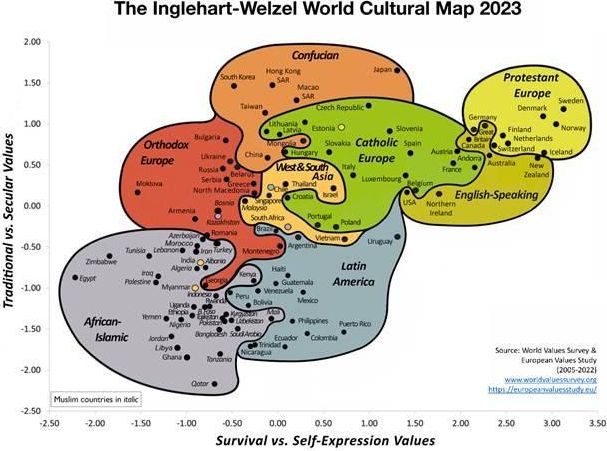
High-income countries tend to hold Secular and Self-expression values, while low-income countries tend to hold Traditional and Survival values. The Traditional → Secular axis is defined about how you expect it to be defined, but Survival values and Self-expression values, which are more central to Inglehart and colleagues’ findings, aren’t as immediately clear. Let’s define these. (Feel free to skip the next two paragraphs if you don’t care about definitions.)
Per Inglehart, Survival values emphasize fighting crime, maintaining order, stopping prices from rising, traditional gender roles, teaching children the value of hard work, willingness to fight for one’s country, solidarity with the in-group and intolerance to out-groups. Societies with these values tend to have authoritarian politics and high levels of xenophobia.
Self-expression values[1], as defined by Inglehart, emphasize freedom of speech, egalitarian social norms, tolerance of diversity and outgroups, openness to new ideas, environmental protection, teaching children the values of imagination and tolerance, giving people more of a say at work and in government, and more relaxed cultural norms, especially sexual norms. Societies with these values tend to be democracies, with populations more critical of their leaders, and laws based on individual freedom.
On the Survival → Self-expression axis, Inglehart and colleagues claim that differences between global cultures can be traced mostly to one causal factor: the extent to which people grew up feeling that their survival was threatened or secure. In their various studies, they measured “existential security” in a given society using proxy variables like GDP, high life expectancy, and low infant mortality. The interview data they collected let them successfully predict how various societies’ moral values would evolve in the future.
But before we get to that, Inglehart wants us to know why some competing theories for why societies’ values change are wrong. He contrasts his theory with two competing ideas: values change because elites use their communications networks to diffuse their values throughout society, and values change because of increasing education.
Both of these are wrong for the same reason: we don’t see big value shifts happening in low-income countries. Elites’ global communications touch poor countries, too, and have no effect on values. And as Inglehart writes,
“Though in high-income countries, the more educated and secure strata are likeliest to hold the new norms, education itself is not driving these changes: these norms are not linked with education in low-income countries.”
Another school of thought says that of course societies are evolving differently, because cultures are different, duh. Inglehart acknowledges that each society’s distinct cultural heritage is foundational to its moral values, and societies obviously differ from each other because of their unique histories. The pace and form of each country’s transition are culturally determined. But he adds that
“Urbanization, industrialization, rising educational levels, occupational specialization and bureaucratization… do not make all societies alike, but they do tend to make societies that have experienced them differ from societies that have not experienced them, in consistent ways.”
Modernization does not equal Westernization. Many non-Western societies follow distinct cultural, philosophical, and political trajectories even as Self-expression values shift in strikingly predictable ways. The view that groups of people simply hold different moral values and that these values are innate naively assumes that cultures are static. Inglehart’s work studies one important pattern of how cultures change, and that work predicts trajectories, not destinations.
Intergenerational Value Change
Here’s where the book really gets going. Because our personalities and values solidify by our mid-twenties, the years before that age have an outsized impact on each person’s conception of the world — and our physical and economic safety within it. These years matter the most for moral value formation. (Genes partially determine our values, too, but they interact heavily with the environment we grow up in.)
The theory predicts that as economic and physical security increase across a society, this will shape the values of each successive generation during its formative years. Survival values will decline from one generation to the next, and Self-expression values will increase.
In almost every country in which data was collected that has experienced sustained economic growth and physical security, this is exactly what we see. In these countries, younger generations hold Self-expression values to a higher degree than older generations.
Societies are of course composed of individuals, and changes that make people feel secure during their formative years don’t touch the entire population at once, so the value changes are heterogenous, with many people retaining Survival values well into their society’s transition. And in practice, most people hold some Survival and Self-expression values simultaneously. Inglehart’s country-level analyses are about relative emphasis, not exclusive categories. But as older generations die and younger generations replace them, each society’s values do gradually change.
Inglehart stresses this point. The idea that generational differences can be explained by young people’s values simply growing more conservative as they age may be popular, but it doesn’t hold up to the data. Each generational cohort largely keeps its Survival/Self-expression orientation throughout its lifespan, and in fact usually bends slightly in the Self-expression direction over time due to simple value diffusion, which does have a small effect.
Another common objection is that generational replacement can’t be the way that social values change, because social change sometimes happens very fast — too fast for generation replacement to be the mechanism behind it. Inglehart reinterprets these fast changes as tipping points being reached. Once the slow churn of generational value replacement reaches a critical mass, Self-expression values become the new norms, and the conformism and social pressure that once fought against them start working on their behalf, which can cause apparently rapid shifts in a society’s values. Inglehart uses the example of gay marriage in the United States, where the slow process of generational value change culminated in a threshold being crossed seemingly overnight, with sudden, widespread acceptance of gay marriage.
There’s also a role for period effects: economic booms, recessions, pandemics, anything that can change how people feel about their own existential security. These tend to affect all living generations at once, and push their values in one direction or the other. But the generational difference remains, with older generations orienting more toward Survival values and younger generations aligning more with Self-expression values even during periods when everyone’s values are affected at once. These cohort effects typically far outweigh any period effects. Events that impact all society are usually transient, and their effects on values reverse as soon as existential security returns to its prior level. Cohort effects tend to be permanent.
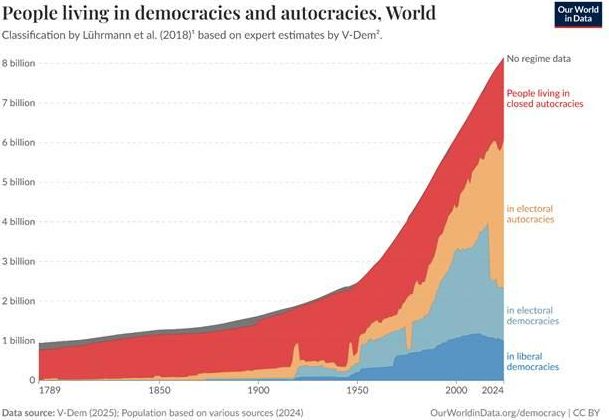
(The period effect of COVID on democracy is clearly visible in 2020. More on democracy below.)
All of this is only true of countries that have been experiencing sustained economic growth. Low-income countries, which haven’t yet begun the transition, don’t demonstrate much of a values difference between the old and the young. Interestingly, this also holds at the opposite end of the spectrum. The data implies that countries can “complete” the values transition, with relatively few differences between the values of the old and the young in some rich countries such as the Scandinavian nations, for example. It is only countries with growing levels of existential security that are experiencing this values transition, but — and this is Inglehart’s most critical insight — it takes fifty years.
“This happens only after a lag of several decades between the time when secure conditions emerge, and the time when new norms become predominant. For example, Western economic miracles, welfare states and the Long Peace all emerged fairly soon after 1945. But the political consequences of these events only began to manifest themselves twenty years later, when the first postwar birth cohort became politically relevant as young adults: the Student Protest Era erupted in 1968, when those born from 1945 to 1955 were in their teens and early twenties. Student protest in advanced industrial societies continued throughout the 1970s but was still a minority phenomenon that evoked strong negative reactions. But by the 1980s, the older members of the postwar birth cohorts were in their thirties and forties, occupying influential positions in society. By the 1990s… norms that were considered deviant in the 1960s became politically correct.”
In every society that undergoes the values transition, we see the same fifty-year (plus or minus a few years) time lag. A generation of kids grows up feeling somewhat safer than the generation before it, and that security encodes itself into the values they form as young adults. But they need to age into positions of influence before the change in vibes manifests as changes in policy. This means current economic and health conditions do not predict a society’s moral and political values. Instead, the conditions from forty to fifty years ago predict a society’s moral and political values today. In one study, existential security in 1960 was a stronger predictor than in any other year of society-wide Self-expression values in 2009.
The Democratic Transition
All of this has a profound effect on democracy, and the relationship is causal. Economic development leads to rising Self-expression values. Then, after assistance or hindrance from each country’s individual culture, these values strongly increase the likelihood of a country transitioning to democracy.
It isn’t only value changes, but also skill changes that bring this about. Industrial economies and especially knowledge economies require educated workers who can think for themselves, speak well, and organize. Command-obedience hierarchies are replaced by work relationships based in mutuality, in which employees are expected to take initiative, with less direct supervision. Employees taste newfound freedom of choice and expression on the job, and they question why they don’t have wider political freedoms. With new values, and new skills, they now have the desire and the means to challenge their governments.
This happens even in the absence of democratic institutions. If an authoritarian state develops its economy and maintains peace long enough that its citizens feel economically and physically safe, Self-expression values will inevitably become widespread, and democracy is likely to follow. In one of Inglehart’s linear regressions,
“the extent to which Self-expression values are present in a society explains over 80 percent[2] of the cross-national variance in the extent to which liberal democracy is actually practiced.”
(“But China!” you object. Hold that thought.)
When a state tries to repress its critics, it often finds itself repressing the knowledge workers who contribute the most to its economy. To repress them is to hamper the state’s own economic development and prosperity. Inglehart repeatedly criticizes the folly of Western democracies isolating rival states with sanctions and embargoes. These may temporarily harm an adversarial government, but they ultimately backfire by slowing economic growth and thus keeping its population in Survival mode longer. Helping adversaries’ economies grow and maintaining peace would be a more effective long-term strategy, because it would let Self-expression values evolve in the rival state, undermining its authoritarianism from within. (Whether this is advisable in the case of a rival country’s active military aggression, such as Russia in Ukraine, is debatable.)
Nevertheless, authoritarian states with effective surveillance, military, and police machinery often manage to keep populations who desire democracy in check. But at an increasingly high cost. When democracy finally comes, it often arrives as more of a whimper than a revolution.
“… With intergenerational replacement, the elite itself may become less authoritarian and repressive, as its younger cohorts emerge from a society that places increasing value on self-expression. Social change is not deterministic, but modernization brings a growing probability that democratic institutions will emerge.”
The transition can happen quickly when institutions that had been keeping rising social demand for democracy at bay suddenly become permissive, just like the “overnight” acceptance of gay marriage in the US that was built on decades of slow change. At the end of the Cold War, East Germany, Czechoslovakia, and Poland had been economically prosperous compared with other Warsaw Pact countries, and Self-expression values were widespread among their peoples. The instant they realized the Soviet military could no longer stop them from democratizing, they did so.
Democracy lasted for them. Why didn’t it last for Russia? A likely answer, or at least its root cause, is apparent in Inglehart’s data, too.
Case Studies, Past and Future
His theory isn’t unidirectional. If survival becomes newly precarious, especially for children and teenagers, a society can revert from Self-expression values back to Survival values. (This creates a dark incentive for authoritarians: keep your people poor and unsafe, and your regime can continue. If your country becomes prosperous, your regime only has about fifty years left.)
The USSR never had as strong of an economy as the United States, but it did experience steady growth from the 1940s until just before its collapse. In spite of the Cold War, this growth fueled increased existential security among the Soviet public. A cross-sectional survey in 1990 showed the same generational value differences in the USSR as seen in other countries.
But when the Soviet Union collapsed, survival became precarious again. Living standards plummeted.
“Per capita income fell to about 40 percent of its former level, social welfare institutions broke down, crime was rampant…”
Not only the economy and political system collapsed, but so did an entire belief system that had formed a pillar of people’s sense of meaning and security. The period effect was severe. Every Russian generation that lived through its country’s collapse saw a sharp decline in Self-expression values. East Germany, Czechoslovakia, and Poland did not experience the same level of economic decline.
Even though Putin oversaw the stabilizing of Russia’s economy (until recently), the scars of the 1990s remain embedded in the moral values of a Russian generation who grew up feeling its survival was threatened. Russia today features a smaller difference in values between generations compared with other developed economies. After Communism vanished, nationalism and religion swept in to fill the ideological gap.
The book explores many other countries that are interesting through the lens of Inglehart’s theory and data, including Latin American nations that have more Self-expression values than expected based on their economic histories, and a United States with fewer Self-expression values than its economic history predicts. Cultural factors are likely at work in both cases.
Middle Eastern nations currently base their morals heavily in Survival values. Inglehart notes that
“In recent Egyptian surveys, 99 percent of the population said that homosexuality is ‘never’ justifiable — which means that even the gays were condemning it.”
He says the US’s state-building exercises in Iraq and Afghanistan failed in large part because they didn’t invest enough effort in establishing economic security for the people who lived there, and they actually made physical security worse. Democratic governance can’t take root anywhere — only in countries where Self-expression values are already high enough to support it. To forcibly democratize a country that has high Survival values (if one considers that an ethical thing to do) would require a massive economy-building investment lasting at least fifty years, until the children born at the point when survival is secure grow up and gain enough experience to run the country. The US’s unrealistic assumptions going into its imposed Middle Eastern projects not only doomed them to failure; they may have set Iraq and Afghanistan up for decades more of Survival value preponderance.
“In recent surveys, the Iraqi public manifested the highest level of xenophobia of any society for which data are available.”
Iran, conversely, is an outlier, with higher Self-expression values than much of the Middle East and a large demand for democracy from its citizens.
Saudi Arabia is an interesting case — not actually mentioned in the book — that will put Inglehart’s theory to the test. Existential security for its population was likely achieved in the late 1970s, yet that security has largely come from oil wealth the state has spent on subsidies, public employment, and services. Because its labor market is so strongly managed with policies that favor Saudi citizens’ employment, that labor market’s competitiveness is partially inhibited, and many Saudis may have skipped the phase of accumulating skills and social capital that Inglehart calls “cognitive mobilization,” which is a major mediating factor on the road from a childhood where survival is assured to moral value change as an adult.
Are value changes more dependent on raw wealth, or is cognitive mobilization necessary? Is the psychological experience of existential security generated by oil rents different from the security generated by participation in an industrial or knowledge economy? Given the high, sustained per capita incomes in many petrostates, they maintain surprisingly low levels of Self-expression values. There is debate that petrostates may offer exceptions to Inglehart’s theory — massive migrant worker populations that outnumber a country’s citizens also complicate the theory — but there are also early signs that changes are underway.
Is it possible to predict when a country will democratize? Conventional wisdom cautions humility, likely learned from the tremendous Western optimism for China’s liberalization when Deng Xiaoping’s reforms opened China’s economy in the 1980s. This optimism was later considered naïve when China did not open up politically.
But fifty years have not yet passed since then. Inglehart notes that
“Only a few decades ago, most people [in China and India] lived just above the starvation level. In the memory of living people, at least 30 million Chinese starved to death after the failure of the Great Leap Forward.”
Economic development brings cognitive mobilization and value changes, in China just as anywhere else. Once economic choices become free, demand for freedom in political choices eventually follows. Despite some Asian leaders’ claims that Asian societies have unique values that render democracy unnecessary, surveys reveal China and Vietnam are outliers like Iran, with a higher demand for democracy than their governments supply.[3] If the United States is worried about future geopolitical confrontation with China, Inglehart advises it to ensure China’s economy is as prosperous as possible, so that the values of its future leaders will change before any major conflict.
China’s economy likely didn’t provide enough economic security to start the fifty-year timer until the mid-nineties, though. In fact, more than any decade in living memory, the 1990s saw political stabilization and rapid economic growth in many countries, including authoritarian countries. So if Inglehart’s fifty-years rule is correct, we may see a renewed wave of democratization in the 2040s, including in China (barring a new calamity that seriously harms its economy — the economic headwinds facing it lately are probably too small to count).
Values and Happiness
The book has an interesting digression into whether Self-expression values are objectively better than Survival values. Inglehart seems sympathetic to Self-expression values, but he also cautions that Survival values are rational in environments where survival isn’t guaranteed. In forager, pastoralist, or agrarian cultures, if another group wants to take your land, survival really is “a zero-sum struggle between Us and Them,” and xenophobia is rational. In a chaotic world that could deal your death at any moment, a tough, decisive bully who promises order actually could make a good leader. When a high mortality rate threatens your group’s continued existence, “stigmatizing any sexual behavior not linked with reproduction” actually will help.
“One distinctive set of norms concerning gender equality, divorce, abortion and homosexuality supports a pro-fertility strategy that was essential to the survival of pre-industrial societies but eventually became superfluous.”
So Self-expression values may not be universally better than Survival values — just adapted to a different environment.
Or are they better? Inglehart and colleagues collected happiness data from many of the countries in the World Values Survey, and they found that on average, people living in countries with widespread Self-expression values are much happier than people living in countries with widespread Survival values.
On one hand, this seems obvious: If your survival isn’t being threatened, you’re happier. But it also seems to contradict hedonic adaptation theory, which says that a person’s subjective well-being will soon reset to a genetically determined baseline, no matter what good or bad things happen to them. Modern researchers no longer hold that happiness set points never change, but the general tendency of happiness to regress to each person’s mean is well-supported by evidence.
How can this finding be reconciled with Inglehart’s data? He thinks that although a genetic happiness setpoint is important at the individual level, it does not meaningfully exist at the societal level. At the group level, environment determines happiness to a much stronger degree than genetics.
Here the objection often returns that the differences between countries are just differences between cultures: Some cultures are predisposed to happiness, some to sadness. Existential security and moral values have nothing to do with it. But this claim would need to explain why poor countries are much less happy than rich countries, even after adjusting for wealth as a confounding variable.
In addition to contradicting hedonic adaptation theory, Inglehart’s happiness data also contradicts the finding that religious people tend to be happier than non-religious people. Again the solution is the same: What’s true at the individual level isn’t necessarily true at the societal level.
“Although within most countries religious people are happier than less-religious people, the people of modernized but secular countries are happier than the people of less-modernized but highly religious countries.”
So Survival values do appear less conducive to happiness than Self-expression values in a world where survival is guaranteed. When the environment changes, the values that aided survival in the old environment are no longer adaptive, and can cause harm. People switching from Survival values to Self-expression values tend to find them freeing. This is especially true of those whose freedom is most restricted by Survival-based societies’ often intrusive rules, like women and LGBT+ people. They, especially, get a huge happiness boost from switching value systems.
“The desires for freedom and autonomy are universal aspirations. They may be subordinated to the needs for subsistence and order when survival is precarious, but they take increasingly high priority as survival becomes secure.”
The Authoritarian Reflex
All of this means that a global transition to Self-expression values is inevitable as long as global economies keep growing, right?
Not so fast. Inglehart’s rosy picture of democratic inevitability seems to be shattered by the empirical reality of democratic backsliding in many countries. He spends the most interesting chapter of the book trying to diagnose this problem’s root causes, and troubleshoot them.
Earlier I wrote that cohort effects (the childhood conditions for a single generation) tend to outweigh period effects (big events that impact every living generation) in the theory. But Inglehart proposes that an unusually giant period effect is currently increasing support for populist authoritarian parties in high-income countries, in spite of younger generations continuing to replace their more xenophobic and authoritarian elders.
He’s careful to note that his theory depends on people’s subjective feeling of their existential security. If a country — say, the United States — was rich, with relatively high life expectancy and low infant mortality, and yet its people nevertheless felt that their survival was threatened, the theory would start to work in reverse, and values would start to drift back into Survival mode. He calls this the Authoritarian Reflex, when people in otherwise wealthy countries
“close ranks behind strong leaders, with strong in-group solidarity, rigid conformity to group norms and rejection of outsiders.”
Many wealthy countries have strong social safety nets to boot, so why would so many of their citizens feel their economic and physical survival is threatened? Inglehart explores two theories: cultural backlash, and economic inequality.
“Cultural backlash” is the political reaction of people who feel that progressive social and cultural changes — around race, gender, religion, and national identity — threaten their status, values, and way of life. There’s substantial evidence that cultural backlash motivates support for authoritarian populism, especially surrounding the perception of immigration as a threat. And this makes evolutionary sense: Inglehart points out that natural selection would of course bestow feelings of stranger danger on us if they helped us survive.
But he claims that cultural backlash is only the proximate cause of the global rise of authoritarian populism. It’s changes in a wealthy country’s Gini coefficient that may be the ultimate cause of changes in its level of authoritarian populism (even though reducing economic inequality is never a big priority for voters in any opinion poll). When income doesn’t keep up with housing, education, and healthcare costs and people are priced out of those markets, they feel economically and physically insecure. Only later in the causal chain does that survival threat change their values — which are what show up as “cultural backlash” on opinion polls.
As industry/manufacturing economies become service/knowledge economies, worker bargaining power bifurcates, with the knowledge sector gaining leverage and the service sector losing leverage. Bargaining power is increasingly allocated according to education level. Then, if large portions of the population never feel the security that fosters Self-expression values, the political balance can remain authoritarian despite average material gains.
There is voluminous empirical evidence that economic inequality is one of the strongest predictors of democratic erosion in high-income countries. But why should it have such a large effect on people’s values? “Low-income” in a high-income country is still high-income relative to the rest of the world. It’s true that even in wealthy countries, the lives of people at the lowest income levels can be exceptionally hard. But this is a small slice of the population that votes much less than other slices, so its values shouldn’t sway elections.
Once good economic conditions have already led to a rise in Self-expression values among the broader population, why do those values recede when economic conditions are still generally good? Inglehart points to this chart, the “elephant curve,” depicting the global population’s relative gain in real per capita income from 1988 through 2008, stratified by income percentile:
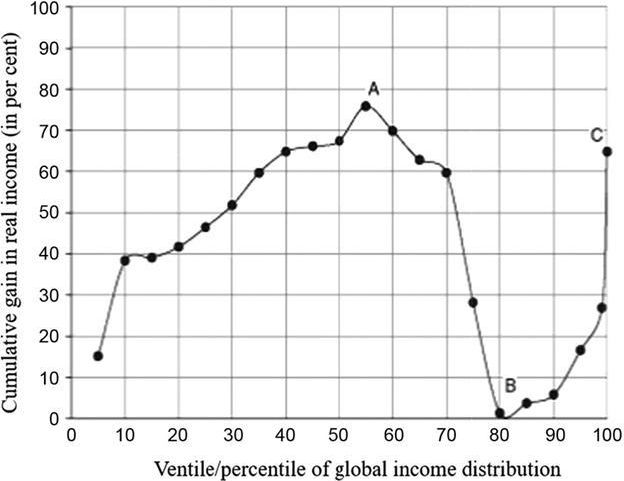
Over this twenty-year period, the real income of the global poor and middle-class increased a great deal compared with their former incomes, as did the income of the world’s very wealthiest people. People living in China, India, and several Southeast Asian countries could tell stories of upward mobility. But at the 80%-90% marks, corresponding roughly to the bottom half of earners in high-income countries, real income stagnated.
As countries transition from manufacturing economies to knowledge economies, it seems that a substantial portion of their populations hit an economic wall. They feel this, subjectively, as a survival threat. Combined with a media ecosystem that amplifies threats out of proportion, the result is predictable.
“Under conditions of insecurity, people have a powerful need to see authority as both strong and benevolent – even in the face of evidence to the contrary. Individuals under stress yearn for rigid, predictable rules. They want to be sure of what is going to happen because survival is precarious and their margin for error is slender.”
This also helps explain why high-income countries are more vulnerable to the Authoritarian Reflex than low- and middle-income countries — low-income countries have Survival values as their baseline, so there’s nothing to “reflex” back to — and it helps explain why rural populations are more prone to it than urban populations, and even why men support authoritarian populists at a higher rate than women. In these cases, the real income of one group has been rising, while the other’s has been stagnating or falling, resulting in different feelings about one’s existential security, and thus different moral values.
At some point during this discussion, Inglehart lapses from evidence-based conclusions to educated guesses, but his speculation does make testable predictions that future work could study, and the speculation itself is interesting.
For instance, he suggests that Self-expression values may, to an extent, be their “own gravedigger.” In high-income countries before 1968, working-class people voted for left-wing parties and wealthier, more educated voters voted for right-wing parties — the opposite of what we see now. But around 1968, the first generation of voters who’d in large part grown up under physically and economically safe conditions gained political influence. True to their Self-expression values, they made cultural issues more central to the platforms of both left- and right-wing parties than economic issues. This chart shows which issue type was predominant in the party manifestos of thirteen Western democracies between 1950 and 2010:
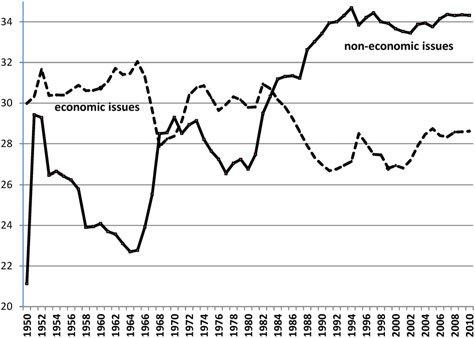
Values-based political polarization replaced class-based political polarization. But economic security is one of the most important long-term determinants of people’s values. By deemphasizing economic security for a large fraction of their countries’ populations, political parties have been allowing Self-expression values to decline and Survival values to increase, especially among low-income voters. This tends to benefit the political Right, which is more focused on defending traditional cultural values. Right-wing policies tend to increase economic inequality, and a positive feedback loop of declining Self-expression values forms.
To cap off the bleak final chapters, Inglehart worries that AI will induce an even more winner-takes-all economy, and will increase the percentage of real income gains that go to the top economic stratum, worsening the problem.
Moreover, much of the World Values Survey data was collected before the advent of digital mass surveillance, algorithmic content control, social media manipulation, AI-enabled disinformation campaigns, and other tools in the “digital authoritarianism” toolkit that help autocrats neutralize dissent at relatively low cost. Whether these will change people’s values and behavior enough to sabotage Inglehart’s theory is unknown.
Reasons for Optimism
Despite all this doom and gloom, Inglehart remained hopeful. Even after the 1990s-era optimism about democracy’s global future gave way to the democratic backsliding of the 2010s, he held to his theory. If conditions of economic and physical safety are met and sustained in any given society, Self-expression values will spread, and the society will be increasingly likely to democratize about fifty years later. Inglehart does not believe democracy will continue to withdraw, because the benefits of a modernized economy attract all states, and as economies modernize, Self-expression values increase.
The economic inequality that makes people in wealthy countries feel as if their survival is threatened is not an iron law of economics or psychology; it’s a political issue subject to reversal. Inglehart believes that if it is reversed, democracy in wealthy countries will become stable once again. Many of the competing explanations for why democratic backsliding is happening — institutional erosion, increased geopolitical conflict, even to some extent economic inequality itself — are actually downstream of values changes, and therefore sensitive and responsive to them over time. “Survival is assured → Values change → Democracy is likely to thrive” is a robust causal pathway. And because the Authoritarian Reflex is a period effect more than it is a cohort effect, it’s less locked in to generations’ values, and so will likely recede quickly if its causes are removed.
So in any country, rich or poor, Inglehart’s solution to the authoritarian resurgence is to make people’s well-being more secure and less precarious. This is what will safeguard democracy in the long run — much more so than any policing of misinformation, public shaming of authoritarian populists, unfocused protests, symbolic summits, or dead-on-arrival democratic reform bills. Resources and social capital should be spent on interventions that are actually effective, and preferably ones that impact the root causes of democratic backsliding.
Left-wing political parties in particular would benefit from deemphasizing “emotionally hot cultural issues that enable conservative politicians to win the support of low-income voters” and reemphasizing economic issues. This may not pay off in any given election cycle, but will move society toward Self-expression values in the long run. Retreating from the fight for those emotionally hot cultural issues may paradoxically accelerate the very cultural shifts left-wing parties are hoping for. Also, catastrophizers who like to paint modernity as crisis after crisis in order to motivate political action may want to think twice about how wise it is to make people, especially young people, feel unsafe.
Inglehart also points out:
“The long-term trend toward democracy has always moved in surges and declines. At the start of the twentieth century only a handful of democracies existed, and even they were not full democracies by today’s standards. There was a large increase in the number of democracies immediately after World War I, another surge following World War II, and a third surge at the end of the Cold War. Each of these surges was followed by a decline, such as the spread of fascism in the 1930s – and each period of decline stimulated widespread belief that the spread of democracy had ended, and that the wave of the future was fascism (or communism; or bureaucratic authoritarianism). But the number of democracies never fell back to its original base line, and in the long run, each decline was followed by a renewed spread of democracy.”
Open Questions
The next wave of the World Values Survey will be finished later this year, so we’ll soon have new data to help us analyze what trajectories we’re on. Meanwhile, the interactions between Inglehart’s theory and several other fields are ripe for exploration. Some questions/ideas that occurred to this reviewer while reading Cultural Evolution (in no particular order):
Children’s and teenagers’ subjective feelings of existential security clearly declined during the COVID pandemic. Have they recovered since the end of that very large period effect? Or did the COVID threat in 2020 permanently embed itself as a cohort effect, and that generation will forever display slightly more survival-based values than would otherwise be expected?
More broadly, can any period effect become a cohort effect if it persists long enough and has a great enough effect on any given generation? And to what extent is this true of the current Authoritarian Reflex, especially among Gen Z?
This touches on a major downstream consequence of any large-scale existential catastrophe. Nuclear war or a high-fatality pandemic wouldn’t just decimate our lives, our societies, and our economies; they’d also disrupt the transition from Survival values to Self-expression values among the survivors for generations.
How will Inglehart’s theory interface with human life extension, and the longer lifespans we’ll likely live in the future? It seems to lend credence to the argument that life extension will cause society’s values to calcify. The longer the oldest generation lives and retains positions of influence, the longer a society’s moral norms will take to change (for good or for ill) — unless the global birth rate were to increase dramatically, which is unlikely.
Lastly, why did this trait — human Self-expression values increasing when survival becomes assured — evolve? It appears to be universal to all human beings, consistent across cultures. Groups radically change their values over the course of generations in response to security cues from our environment. Researchers have proposed that the presence or absence of pathogens in the local ecology where a culture originated determines the values of that culture, but this doesn't explain how Self-expression values evolved. An environment with relatively few pathogens seems necessary for that evolution, but hardly sufficient. It’s strange that evolution conserved a trait that moves us away from Survival values given that evolution occurred in a survival paradigm.
Or did it always occur in a survival paradigm? Evolution is ultimately a survival contest among genes, not necessarily among the individuals who carry them. Presumably, in our deep history, there were periods when hunter-gatherer bands experienced food security and environmental stability for periods well over fifty years at a time – long enough for the cultural transition from Survival to Self-expression values to occur. What was the selection effect that conserved Self-expression values once they developed? Did Self-expression values lead to longer life spans? Did they make one a more attractive sexual partner during boom times, especially compared with rivals who refused to budge from maladaptive Survival values? Did they confer direct benefits on one’s children, encouraging them to think freely and explore, thus gifting them all the social benefits that come with Self-expression-associated personality traits?
If the answer to any of these questions is “yes,” then what a profound example of life transcending Darwinian competition. Could our desires for freedom and egalitarianism have emerged indirectly from the survival engine that forged us? Maybe it’s Survival values rather than Self-expression values that dig their own graves.
Your message is stored now and emailed to the author after the contest ends. The author can reply to you, but their identity stays hidden unless they choose to respond.
Footnotes
- ↩
Inglehart and his collaborators’ research used several different axes of values which were often similar to or subsets of each other. To streamline communication, this essay simplifies their concepts of Postmaterial values, Individual-choice values, Autonomy values, Emancipative values, Quality-of-life values, and Self-expression values into the single term “Self-expression values.”
- ↩
“80% seems really high for a regression,” you also object, and you may be right. Inglehart aggregated his survey data and ran many of his regressions on a small sample of countries, instead of a large sample of individual people. There’s been an active debate about his methods. To oversimplify it, “His methods were moderately flawed but his research is still foundational,” is close to the current consensus.
- ↩
It’s notoriously difficult to survey people in authoritarian countries about their opinions on democracy. When asked at face value, some of them say they support democracy, but when you dig deeper, the thing they call “democracy” tends to sound a lot like subservience to the great leader and his state. Inglehart and collaborators did reckon with this difficulty in the World Values Survey starting in 2010. Their earlier surveys made no adjustments for it.