Bringing Hell to Earth would be a lot of work, one would think. I mean, that’s a lot of brimstone to have delivered, but even if you solve that, what are you going to do for fire? Hell really revolves around fire. Remember though, you don’t really need a lot of fuel at the start of things. No, if you want the world to burn, mostly you just need Tinder.
Let’s talk about dating apps[1].
There’s no real need to go into a long history of dating apps here like I might if I were reviewing something else, partly because the basic idea pre-dates the Internet anyway. Match.com debuted in 1995, only a few years into the existence of the public Internet, and what preceded it was just an analog version of the same idea: people making profiles of themselves and exchanging them with other users in the hopes of finding a match. This makes sense, of course, because love and sex are among the most baseline human desires, and it’s not hard to see how advances in digital connection could improve the ability to find them. It didn’t take a spark of genius to say “let’s put dating profiles online instead of mailing out packets.”
For a long time, online dating remained just a digital version of that analog system. Even into the late 2000s, the majority of dating sites still involved making a large, detailed profile and then browsing freely through many other profiles, sending a message, and hoping for the best. There was no barrier of needing to match first, and because you could see each person’s profile whenever you wanted, you weren’t under a huge time constraint to read it quickly in order to see the next one. I personally thought this system was at least marginally better than what’s replaced it, but it doesn’t really matter; I think thylacines were pretty cool too, and the old dating site style is no less extinct than they are. Regardless, it certainly wasn’t without many of the same issues, and it wasn’t well positioned to compete with what came after.
What’s important is what has changed. The modern dating app as we know it really started with the advent of the matching mechanic: seeing one profile at a time, having to decide whether to like or reject said profile, and having to both like the other before messaging is even possible. That’s the unifying, ubiquitous feature that defines them still. Tinder introduced this in 2012, and it has completely taken over the space since. All of the major apps work this way, regardless of how they dress it up.
We’re deep in the age of the dating app now, with the old-style dating sites fully gone – the few late survivors having been bought out and turned into apps – and a higher percentage of people than ever using them. So do they work? Are they worth using? The title of this review doesn’t leave a lot of doubt about my conclusion, but let’s see what the data says[2].
The Individual Apps
If this were a different product, this would be where I’d go through and review the major players and their different pros and cons, but there’s not any real point in doing so here because there aren’t actually that many major players. The Match Group essentially owns the entire heterosexual-dating-app industry. This sounds like an exaggeration, but here’s a list of major apps they own:
- Tinder
- Hinge
- Plenty of Fish
- Match.com
- OKCupid
- Most if not all of the “XPeopleMeet” apps
There are a few other competitors, Bumble being the largest (they also own Badoo, which is fairly popular outside of the US), but even the ones not owned by Match tend to be strikingly similar in design. They all use the swipe-based matching system (some have you press a like or dislike button instead of literally swiping, but the result is identical). They almost all focus on short profiles with very brief prompts. And they all lock the basic functionality of the app behind paywalls.
Their brand-specialized differences don’t offer a lot of bright spots either. OKCupid’s matching algorithm, once the defining feature of the site, is now largely indistinguishable from what every other app is doing, and its entire approach struggles without the ability to browse profiles freely, rather than having to swipe constantly. Bumble’s purported reason for existence, that women would message first, met the unfortunate reality that women largely don’t seem to actually do so given the option, and that feature has been effectively reworked – women can still message first, but they can also just allow men to message them first. Hinge’s identifying feature, that they are “the app designed to be deleted”, doesn’t actually qualify as a feature at all (though I will give them credit for the slogan, because deleting it in disgust does technically match the app’s design goal).
Some have features that are unequivocally detrimental to the experience. Hinge is a good example of this. Hinge allows messages to be sent as part of the act of liking a profile; you pick a picture or prompt from the profile to like, and then can comment on it. In theory, this might seem like it would make people more engaged in the process and give potential matches more to judge them on. But all this really does is massively increase the effort required on every profile that you like, as you now need to think of a message to send each person. Does this cut down on mindless swiping? Probably a little bit, but it also creates a larger burden for the user without actually improving their chances, since so many other people are also sending messages.
Bumble likewise has a 24 hour time window after a match, during which either the woman must send a message (or the man must send one if they’ve selected that option), or the match goes away. Perhaps this is intended to create a sense of urgency and make users more likely to actually start the conversation, but it also makes it very easy for the few matches you do have to disappear before you can even do anything about them. There’s an option to voluntarily extend it, giving your match another 24 hours to message you, but predictably, the ability to do this more than once per day is gated behind the paywall.
If it feels like I’m not giving a fair shake to each app’s unique idea, I really can’t stress enough how much those gimmicks are a surface-level illusion. The apps function almost identically across the board. They’re just putting different labels on the same bottle of terrible wine to make people feel more like they’re getting something tailored to them. But open up and drink it, and the swill is all the same.
The massively increased quantity of apps doesn’t help the situation either. Instead, it just fractures the population, splitting everyone up onto a bunch of different apps that are all interchangeable, while limiting the amount of people any user is likely to see. For the really small, specialty apps, this is especially terrible, as anyone living outside of a big city will run out of potential matches very quickly. Even if one of those smaller apps had an innovation that was genuinely good, the small size of their user base would make its value negligible.
The Monetization
So obviously dating apps aren’t free. How are they getting your money? There’s a few ways that basically all of them use now (to a degree this may be because Match Group owns them all, but even the non-Match Group ones use them too).
The first and most ubiquitous is the subscription plan. Let’s look at the Hinge plans, as an example:
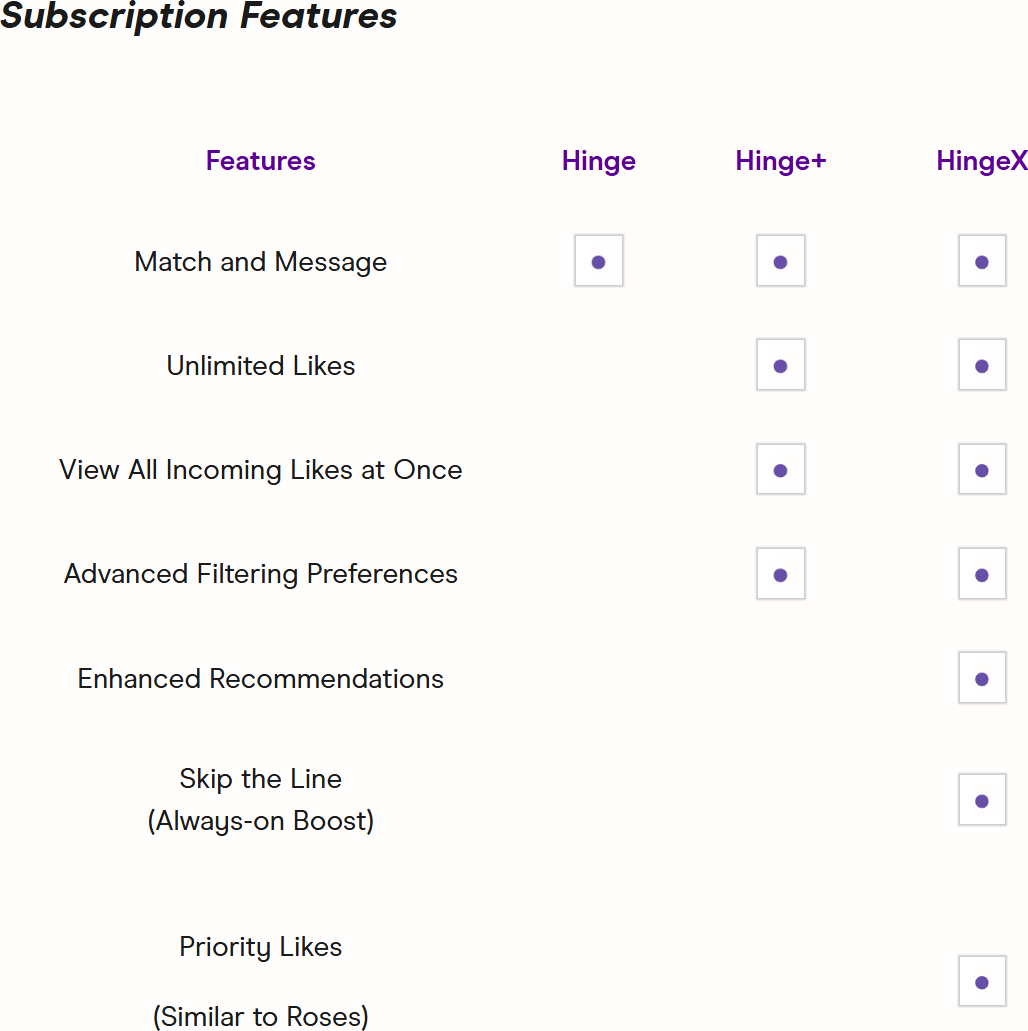
HingeX is $50 monthly, and the breakdown for Tinder features and cost for the highest tier is similar[3]. If you just want unlimited likes via Hinge+, pretty much the bare minimum you need as a male user to even be able to use the app, that runs around 30 dollars monthly.
Obviously there are microtransactions on top of that. Each of them sells some form of “superlike”[4], a like that puts you at the front of the person’s queue of likes, in theory making you more visible to them. These run usually around 3-5 dollars each, depending on how many you buy[5]. This probably has a marginal effect, taking your chances from less than 1% to… well, probably still less than 1%. The apps themselves make a lot of claims about how effective superlikes are at increasing your odds, but they don’t make any of their data public, so it’s hard not to believe that they’re being entirely truthful.
Most apps also have a “boost” system of some kind, something that puts you in a high-priority queue of sorts, where your profile is more likely to be seen by other users. These run about $10 an hour on most apps. This is of extremely dubious value. Women mostly aren’t swiping very often because they’re inundated with likes already, so as a man, you’re not actually being seen by way more people – and even if you were, it takes a couple of seconds to see your pictures, decide they’re not interested, and keep swiping. And for women, being seen isn’t really the issue, it’s filtering the likes you get already.
Almost all of them now also gate the ability to filter the profiles you see behind a paywall. If you don’t want kids, or don’t want to date someone that doesn’t hold your religious beliefs, or don’t want someone who smokes, you’re usually left with no option but to pay up, because the act of manually checking for those things each time adds a ton of extra time to the process, and swiping hundreds of times is necessary to give yourself an actual shot at matching.
All of that is pretty bad at a baseline, but for some apps, it actually gets worse. For example, Hinge has a feature called Standouts. In their words:
“Standouts is a feed of profiles catching the most attention on Hinge—tailored to your preferences and recent activity.”
Which is to say, Standouts are the most popular people in your area who are getting the most attention. You get shown 10-15 of these a day, and many of them will never show up during your normal swiping. In theory, this is an extra pool of people you get to message…except that the only way to do so is via a Rose (their version of a superlike), which cost 4 dollars each. So you’re spending $4 to send a message to the people who are, by the definition of the feature, already receiving tons of other messages.
Somehow, this actually gets worse, because Hinge will show you profiles that are inactive for a period up to 2 years, but haven’t been deleted yet. Which means, your odds of receiving a reply aren’t just very low, they are indistinguishable from zero. At least you only paid $4 for the privilege of sending a message into the void, I suppose.
Look, of course dating apps are going to profit somehow. It costs money to run servers and, at least in theory, these apps provide a meaningful service. They’re allowed to make money. But even casinos and gacha games aren’t as directly manipulative, deceitful, and exploitative as the monetization schemes of these apps. You’d probably lose less money downloading a literal scam app than downloading one of these and trying to actually use it as intended.
The Dating App Experience
So how does this actually play out? Well, the experience is radically different for men and women, so it really has to be broken out more specifically. But before I do that, let’s look at some quick numbers.
Men make up approximately 56% of dating app users vs women’s 39%, with the numbers more skewed for some than others. Tinder’s ratio is 75-25, but the situation is even more bleak than that sounds. One person attempted to hash out the inequality through their own experiment:
“It was determined that the bottom 80% of men (in terms of attractiveness) are competing for the bottom 22% of women and the top 78% of women are competing for the top 20% of men. The Gini coefficient for the Tinder economy based on “like” percentages was calculated to be 0.58. This means that the Tinder economy has more inequality than 95.1% of all the world’s national economies. In addition, it was determined that a man of average attractiveness would be “liked” by approximately 0.87% (1 in 115) of women on Tinder.”
Now, is Tinder particularly bad? Of course. But things look similarly grim elsewhere also. Per a study done by the OKCupid blog – from back in a time when dating sites were willing to actually talk about their data – women rate 80% of men as “below average” in terms of attractiveness. Men by and large also tend to have the unfortunate habit of liking everyone, which beyond being extremely inefficient, actually makes their own situation worse; when women have 150 likes in their inbox, the chance that any single one of them actually gets a match with them goes dramatically down. But this is a classic tragedy of the commons situation, because any guy who isn’t swiping right on everyone is massively hurting their chances; remember, 1 in 115 women will like him, so if he’s not swiping right on at least 115, he can’t even be surprised he hasn’t matched with someone.
So here’s how it actually feels at the ground level.
The Male Experience
You spend a bunch of time setting up a profile and selecting pictures – most of that effort doesn’t actually matter, of course, because your profile will be viewed by very few women, many of whom will be sorting through a mass of likes and don’t have much time to give you. Your first picture probably accounts for >50% of your likelihood of getting a match. Still, you try to get the best pictures you have, get your friends to take some good ones, and spend a lot of time agonizing over what to say to each prompt.
You then start swiping and– oops, you ran out of swipes. Well, if you’re going to be on a dating app, you should take it seriously, right? So you pay up $50 for a month of premium, get unlimited swipes, and get to see your likes. Then you swipe right on a ton of profiles, probably almost all of them that you see – even if you’re selective and don’t swipe on everyone by default, the apps show you the most attractive people first, so you’re more likely to swipe right on them anyway – and then at some point, you stop and go about your normal day.
If it’s your first time doing this, you probably expect to come back later, have some matches, send some messages, and really get this thing rolling. That’s not actually going to happen; if you’re lucky you might have a single match, because remember, the match rate for men is less than 1%. Good news, that match wants to move the conversation to Whatsapp! Bad news, that’s the oldest scam technique in the book. Alright, so you report the scam, then go back to swiping. I’d love to tell you that eventually this pays off, but the evidence just doesn’t support it. If you’re paying for a bunch of “superlikes” and a premium-tier subscription plan, you go to the top of the list of each girl, at least, right? Well, at least into the same pile as every other guy who is also doing that. But more than a third of men are, and the most attractive girls are also collecting all the “free” superlikes that are given out to users every week.
This is also the point where the apps like Hinge start making “Best Match” recommendations to you, supposedly based on your preferences and your swiping history. Strangely enough, all of the recommendations seem suspiciously like the women who are least likely to get matches, as though the app is trying to get you to swipe on them to keep them from quitting, and to make you more likely to have a match, even if it’s with someone you won’t actually be interested in. The more of these you see, the more this supposed algorithm seems suspiciously bad to you, because it also keeps showing you people who have characteristics you’ve specifically filtered out, like having kids, or being frequent users of hard drugs.
You try to hang in there, but as time drags on, you’ve swiped on so many profiles that it’s starting to show you ones outside of your filters, and now you’ve gotta be extra careful to not swipe right on someone who uses hard drugs or has a dozen kids. It wouldn’t make any difference if you did swipe right on them, of course, because you haven’t matched with anyone else anyway, and it’s not likely an accidental swipe will be the first. By the end of the month, you’re rarely even bothering to check the daily recommendation it makes for you.
You bring your profile to your friends and ask for advice, you move pictures around, you change prompts, you agonize over word choice, trying to find something witty and engaging, but also trying to not have your whole profile be fake. You want it to still reflect you, because you do actually want someone to like you, but unfortunately, this strategy, for all its moral value and basic humanity, is woefully sub-optimal at getting matches. Eventually, you quit the app in disgust and vow never again to be so foolish, until your friends bully you into trying again six months later.
The Female Experience
You spend a bunch of time selecting pictures and filling out a– wait, how are there likes coming in already? You haven’t even finished your profile yet! By the time you’ve actually got everything set up, you’ve got 10+ guys already lining up. Well, forget about swiping, just pay the subscription fee to see the likes and sort through those. By the time you’re done buying it, the list is even longer. But still, this is exciting! You match with one or two and… oh, great, that guy sent a dick pic. Well, there’s always going to be some bad apples, so you delete it and move on. Next match and… Hm, his opening line is a question you answered in the first part of your profile. That’s not great either. The third just says “hey bb u still up?” You decide to just go to sleep and sort through this tomorrow.
You come back and you’ve got 100 likes in your inbox. How are you even remotely going to sort through all of that? You’ve got a job, things on your schedule, when are you supposed to have time for this? But you also know how brutal the situation is for men, and you want to give them their fair shake, so at first, you try really hard to read each guy’s profile. You think that maybe the ones who superliked you will be better matches, but most of them have nothing in common with you. The process starts to really drag, and soon you find yourself swiping left on guys after the first picture, and the more you do that, the easier it is to keep doing. But hey, wow, there’s some really attractive men out there that are interested in you! That feels good. You match with a half dozen or so of those, excited about the potential.
A week later, you still haven’t heard anything. This stings, and it also makes no sense. They liked you first! Why would they do that if they weren’t really interested? They’re super attractive, girls must be falling all over them, they didn’t need to like you if they didn’t actually like you. You expand your pool a little bit and now you’ve gotten a few messages, but… it’s strange how all these guys that had clever or interesting profiles can barely form sentences once you actually start talking to them. And even when they can carry on a conversation, it’s pretty unsettling how quickly they snap into asking for pictures of your tits.
You start to put less effort in, sorting through likes when you’re on the toilet. You still haven’t even once actually gone to the queue and swiped the traditional way, but why would you? You’re having trouble keeping up even with the guys that liked you first, why spend a bunch of time swiping on guys who might not even like you?
Eventually, a conversation goes somewhere. He’s handsome, he’s funny, he’s sweet, and he seems genuinely interested in you. In fact, you can’t seem to find anything wrong with him at all, and you’re so excited to have met someone with actual potential that you don’t notice that anyone who seems too good to be true, well, is. You go on a couple of dates, it seems to go really well, and he invites you back to his place after the second. That’s a little fast for you, so you politely tell him you’ve gotta be up super early for a meeting, but you can’t wait for the next time you can see him. There’s not a next time, of course, you never hear from him again, and somehow that hurts more than if no one had liked you at all. You write the next Cat Person story for the New Yorker and try to move on.
That’s the lucky scenario, of course, because just as often, you keep going on dates with him, only to learn later he’s been seeing four other women the whole time. Or you discover that all the things that made you think he was really sweet, or really insightful, or really wholesome were actually just popular prompts he found on other sites, or even ChatGPT.
You start growing really resentful of this situation, and you’re not alone. Only 18% of women think dating apps have been a net good for society, and 79% say they have no interest in using them in the future. Despite the inherent advantages women have in terms of number of options and amount of interest, women are more likely than men to rate their experiences negatively. 56% of women under 50 on the apps have been sent a sexually explicit image or message that they didn’t want or ask for. 43% have continued to receive messages from someone they had already rejected. Even the initial ego boost of receiving so many likes is quickly replaced; while 54% of women feel overwhelmed by the amount of messages they receive, 40% still feel insecure about not having received enough.
You’re resilient enough to keep trying, but you’re so soured on the experience, and so suspicious of each new guy you look at that you become even more selective. You start to read into every detail, hoping to be able to spot the signs of a liar or a cheater ahead of time. You can’t really, because there just isn’t enough information, but you reject more and more characteristics in the hope that you’ll find the universal tell. If he says he values open and honest communication, that’s proof he’s just telling you what you want to hear. If his smile is a little off, it means he’s faking it, and probably everything about him is fake. This doesn’t really work the way you’d hoped, but you’d rather reject a bunch of possibly-decent guys than get ghosted again. If you’re really lucky, you just never go on another date of the app, but if you’re not, you cycle through a few more terrible matches, growing more bitter about it the whole time. Eventually, you quit the app in disgust and vow never again to be so foolish, until your friends bully you into trying again six months later.
Counter-Arguments and Conundrums
The most common counter that gets made is that people do actually meet and have long-term relationships, therefore dating apps don’t work. This is a pretty weak argument, though, because it treats it as though the dating apps were the only way that could have happened. Maybe that’s true for some percentage of the population, but it would be hard to argue that it’s a high percentage, and around 30% of adults have used a dating app. Begging for food is preferable to starvation, but I think we can all agree that if 30% of the population was left with that as their only option, it’d represent a catastrophic social situation. Any system that 30% of the population are using is going to have some successful examples just by sheer numbers. But despite 30% of adults having been on dating apps, only 10% are in relationships that resulted from them. .333 is a very good batting average, but it’s a pretty poor success rate for anything else.
More interesting is a conundrum in the data that I can’t entirely resolve. From the Pew study above, we know that 64% of men felt insecure about the number of messages they read, and from other data, we know that the bottom ~70% of men struggle to get any matches at all. Yet, in that same Pew study, 57% of men said that their time on dating apps was a somewhat or highly positive experience. I struggle to square these pieces of data, because even if your expectations are extremely low when going onto the dating app, surely getting zero matches can’t exceed those expectations, because what would be lower than that? Getting the police called on you? Embarrassment seems like the most likely explanation; saying that you had a negative experience feels a bit like admitting that you failed, so men may mentally reframe it in their survey response. Still, this is something I wish I could get a clearer understanding of.
Perverse Incentives
Look, let’s face it: dating apps are terrible. They’re not good at what they say they do, and they’re also not good at anything else that they could be incidentally doing. Perhaps the more interesting question is could they be good or are the problems with them too inherent to what they are? After all, a lot of different types of people have created dating apps, most of which claimed to genuinely want to make it a good experience for users – some of whom even meant it, at least initially. But none of that has emerged in the actual results. Instead, the machinery of online dating churns out new apps every month, none of which are meaningfully more effective than the ones that came before, and most of which are entirely indistinguishable from what’s already available. Is the elusive solution still out there, or is this all an exercise in futility?
At this point, I think the most likely outcome is that dating apps are fundamentally flawed in a way that can’t be fixed, and the reason ultimately is that the incentives of all sides are too inherently perverse.
First and foremost, dating apps emphasize the most shallow and immediate sense of who people are. On a dating app, you are six pictures and the answers to three blurbs. Can you condense your true self down to that? If the answer is no, then the optimal strategy is to just lie, presenting whatever highly curated image is most popular with the opposite sex. Many people don’t bother filling out much of their profile at all[6], just focusing their attention on their pictures, and the instant, easy nature of swiping only incentivizes this more. There’s simply no space to be a distinct, complete human being on a dating app, and instead, people spend a lot of their time making quick judgments about what they see, including significant, often entirely baseless inferences from the data present in the pictures: “That picture has him next to a computer, so he’s probably not outdoorsy enough”, or “she’s standing next to a guy her age in that pic, so she probably sleeps around a lot.”
That these conclusions are drawn so quickly and with so little information isn’t a bug of the format, it’s basically the core design loop. Dating apps are a gamification of relationships, and the best way to keep players engaged is to keep them cycling through profiles as quickly as possible. That they miss out on real connections in the process is irrelevant; the players don’t know what they’re missing, they have no way of seeing the possible futures where things could have worked out, and they continue to play, hoping they’ll win on the next pull of the slot machine.
And when the only path to victory is to present the most curated, idealized version of yourself, the people who win the most are those who care the least about lying. When you favor the script, you favor the actor. If you are honest and open, and you desire to be seen as you actually are, things are not going to go well for you, because while you’re showing your real self, everyone else continues to present the curated image. Instead of standing out by being real, you simply end up being viewed as someone who isn’t even competent at playing the game.
In many ways, dating apps just amplify the worst instincts of their users. Men become more shallow, lewd, and aggressive. From inside the app, the women on the other side of the screen stop being people at all, you can try sending a dick pic or a rude opener, and if your strategy doesn’t work, you just close the message and move on. The miserable lopsidedness of gender on dating apps also harbors resentment as men increasingly feel like they’re basically begging for women to even notice them. When they eventually leave the apps, still alone and unfulfilled, they do so also with shattered egos and ruined self-image, convinced that women just fundamentally can’t be interested in them, making it even less likely that they pursue love through other channels – what would be the point, after all, if they’re so unattractive that they can’t get even 5 likes on an app?
On the other side, women’s selectiveness quickly turns to snappy and extremely harsh judgment. Again, women rate 80% of men as below average, indicating a level of selectiveness that’s just not compatible with reality. Every detail of a man’s pictures and every word choice he makes in his profile become proof of his inadequacy, an excuse to move on, until women start to become downright proud of all the people they reject. Eventually, the only men who pass the smell test are the ones whose profiles are perfect, who said every right thing, had wonderful pictures, and who passed every secret test of allegiance to the right politics and beliefs. Of course, anyone who is that perfect has the test key for your Scantron, they know exactly what you’re weak to, and soon enough those women are being ghosted, left heartbroken, and growing even more resentful of men.
Worst of all, this creates a feedback loop that’s impossible for any individual to break out of. Men are required to have such a broad strategy (e.g. liking every profile) because women are so selective that their odds are very low, and the only way to increase them is to maximize the number of people they could match with. But on the other side, the more women men swipe on, the more matches women get, which drives women to be more selective. If a man chooses to not take the broad strategy of liking every profile, he torpedoes his own chances of a match because every other guy will keep doing it. Likewise, if a woman chooses to stop being highly selective, she’ll have to deal with the dilemma of matching with every single guy on the site.
I don’t say any of this to blame men or women categorically. It’s just that the interaction of our base, biological natures and this carefully designed system leads to our worst instincts ruling our decisions. The more we interact with quick, curated, incredibly superficial versions of people, the more warped our perception of normal becomes, the less willing we are to tolerate deviation from the ideal, and the harder it is to be accepted for our flaws in turn.
Is there a theoretical dating app that solves all of these, that brings out people’s best instincts instead? I’ll concede that it’s hypothetically possible, but it wouldn’t resemble in any form or fashion the options we currently have available. I’m not convinced it could function as an app at all. So the next time somebody offers you some new app that’s supposed to be way better, but is only 5% different from what already exists, you can feel confident in rejecting it outright. “I’ve found a creative new way of dropping an anvil on your foot” isn’t actually a very compelling pitch.
The Disease
Dating apps are so bad, so malicious, and designed so clearly to squeeze the human soul and collect all the valuable goo that seeps out, that it feels like it would be dishonest to not just call them evil. The desire for love and sex and companionship is so fundamental to the human experience, and the deliberate exploitation and destruction of that is so damaging to individuals and society as a whole that anything short of “evil” just doesn’t feel like it covers it. It is an engine that burns humans as fuel and generates misery. A dramatic reading, perhaps, but I think the evidence speaks for itself.
But, as much as the dating apps are making things much, much worse, it still feels like they’re a symptom rather than the underlying disease[7], which is that we’ve eliminated all of the traditional methods for people to find love. The way relationships are best fostered is by getting to know each other in a friendly context first, so that you know the other person reasonably well before having to make the decision about whether you have romantic interest in them. That way, you’re not just dealing with superficial first impressions, but a deeper understanding of who they actually are.
But the old ways of doing so are gone. Relationships with coworkers of any kind are discouraged, despite those being the people we spend the most time with and also are preselected to have things in common with. Men are less willing than ever to approach a stranger for a date, and women are less likely to want them to. And, most importantly, the close network of friends and family has mostly evaporated, so there’s no one to introduce anyone in a safe setting the way there once was. It seems the sad truth is that dating apps didn’t really force out these other options, so much as they just stepped into the gap the old ways left behind. A void was formed, and the misery engine was wheeled in to fill it.
The old ways had really important protections also, forged over thousands of years of trial-and-error. Your close family friend-turned-romantic-interest couldn’t ghost you, at least not easily, because there would be ramifications throughout his entire social network. If they were actually seeing a bunch of other people around town, everyone would know. Trying to go broad and ask out every girl you met went very poorly, because everyone knew you were doing it, and therefore that you didn’t have a strong interest in any of them. And being overly selective was both unnecessary and carried a cost; rejecting people on a shallow basis would damage you in the eyes of that person’s friends, who were probably also your friends.
I don’t know how we get back to a world where connections can happen organically, if it’s even possible, or if we’ll just have to figure out new solutions. That’s unfortunately outside the scope of this review. I think we shouldn’t rule out tribunals for the Match Group board of directors, but I won’t pretend that’s a complete solution[8].
What I can say with absolute confidence is that you should not be on dating apps. No one should be on dating apps. It’s time for the experiment to end. The machine has consumed enough. We do not need to put anyone else into the brazen bull and pretend that their screams are music.
Footnotes
- ↩
This will be focused on the heterosexual dating app experience, since that makes up the statistical majority of dating app usage. Of course, many of these issues overlap with LGBT dating apps like Grindr and Her, though they have their own unique problems as well.
- ↩
Something I feel I should call out up front is that I’ve really tried to find as much concrete data as possible for all of these topics, but so much of it is old, some more than 15 years at this point, and what is more recent is almost always third-party survey-based studies. All the data that would be really useful and informative, the company’s internal numbers for things like match rate, swipe frequency, user gender balance, etc. are all closely guarded secrets (they weren’t always! OKCupid, for example, used to publish a lot of its own internal data before Match Group bought it). Some of these I can somewhat understand for security reasons. But, judging by the approximate results of third-party research, most of this data seems to be clearly locked away because it would be very unflattering to the app’s efficacy, or would be very discouraging to users, or very often both. Perhaps better data would contradict my conclusions, but until they provide it, I just have to reason with what I have.
- ↩
The prices don’t seem to be present on any of the official sites when viewing the list of features, presumably because they want you to have already decided you want it before you see how much it is.
- ↩
They all call it something different, a SuperLike on Tinder, a SuperSwipe on Bumble, a Rose on Hinge, but I haven’t found any difference in function.
- ↩
They have yet to call them “barrel o’ superlikes [BEST VALUE!]”, but the similarities to mobile game microtransactions is notable.
- ↩
I have searched exhaustively trying to find real data about how much of their profile people fill out and how it correlates with their results, but I’ve come up with nothing. However, my own anecdotal evidence and the anecdotal evidence of everyone I’ve talked to suggests that clearly the majority of people are not filling out their entire profile.
- ↩
Of course, it’s often the symptoms that do the most damage.
- ↩
It certainly wouldn’t make things any worse though, so let’s at least consider it.