Book Review: Der Untergang des Abendlandes by Oswald Spengler
“Before I draw nearer to that stone to which you point," said Scrooge, "answer me one question. Are these the shadows of the things that Will be, or are they shadows of things that May be, only?”
A Christmas Carol by Charles Dickens
Their view; it is cosmic. Not a man here, a child there, but an abstraction [...] (T)he abstract is real, the actual is invisible to them.
The Man in the High Castle by Philip K. Dick
0. Prelude
In a time of growing political polarization, it’s comforting to know that left and right, rich and poor, men and women can all agree on one thing: doom is at hand. The harbinger of said doom can be anything from climate change to right-wing populism to the second coming of Christ, but either way it’s over, bro. To quote that late great head of state Denethor, steward of Gondor — the West has failed.
Paradoxically and ironically, the fear of imminent Western implosion has a surprisingly long history. The post-pandemic gloom recently inspired me to revisit the father of secular doomerism, den Doomer with a capital D – the German historian and polymath Oswald Spengler (1880-1936), and more specifically his foremost work Der Untergang des Abendlandes (eng. The Decline of the West). Untergang des Abendlandes was published in two volumes in 1918 and 1922 respectively, and is a unique genre-defying mega-rant that’s part philosophical treatise, part popular history and part doomer-manifesto. It’s famous enough that you might be familiar with Spengler’s biggest intellectual novelty; departing from the then-predominant paradigm, which in essence amounted to a eurocentric and linear view of history as a forward-moving Western-driven progression from Antiquity to Modernity, Der Untergang des Abendlandes instead posits that history is better understood as a cycle of different civilizations rising and falling intermittently, admitting no exception for the West [1].
Discontent and malaise following WW1 provided fertile soil for Spengler’s thinking, with his magnum opus anguishing European cultural life during the 20’s and 30’s. Later, however, the allied victory in WW2 and the resultant economic upswing of the 50’s rekindled hope throughout the West, whereupon Spenglerism quickly and quietly fell out of popular consciousness. Yet it never truly disappeared, and many doomers of today are unwittingly reiterating talking-points straight from Spengler. Even the classic meme “Strong men create good times, good times create weak men, weak men create AI-bubbles et cetera” owes more to Spengler than to most of our modern thinkers. Having read Untergang des Abendlandes, I myself confess to being disquieted by the Spenglerist prophecy; and to me that’s a clear sign of a book still worth talking about.
Two short caveats. First off, I haven’t actually read Untergang des Abendlandes thoroughly, having instead skipped or skimmed significant sections. This might sound flippant given this is a book review, but I have a good reason – which is that large parts of Untergang des Abendlandes are boring and dumb. An acquaintance of mine once remarked that Spengler had exactly one interesting idea, the idea of civilizational cyclicality, which he then spent 800+ pages milking for way more than it was worth. This is especially true of the first volume which, amongst other excruciating tangents, contains some truly mind-numbing explications on the metaphysical meaning of different numerical systems. At the same time this is also what makes the book especially suited for a review! There’s ample room to take a concentrated look at Spengler’s exciting civilizational eschatology while ignoring his relentless padding.
Secondly, I read Untergang des Abendlandes in the original German despite German being my third language. I’m proficient, yet I deem Untergang des Abendlandes
a tough read even for a native speaker. Spengler is no Schopenhauer, whose German prose shines clear and bright like a well-lit room, but writes rather in a suggestive, poetic and at times semi-Nietzschean style (Spengler indeed cites Nietzsche, next after Goethe, as an inspiration). English in turn is my second language, making this review the end result of a tortured linguistic process wherein the original content has been digested through three different languages in my brain before finally being delivered to you. Take it for what it is: an essay trying to summarize and engage with the most interesting parts of Spengler’s thinking rather than a precise scholarly overview.
I. Der Untergang des Abendlandes
Before getting into the nitty-gritty of Spengler’s late-civilization-eschatology, a brief outline of his general paradigm is necessary. In short, Spengler proposes a grand theory wherein civilizations are born, age and die in semi-predictable 800- to 1,000-year cycles. Every “stage” of civilizational life is characterized by recurring trends, and identifying these trends in the past enables us to glimpse our own future. The groundwork of Spenglerist thought consists of the most anti-materialist views of history I’ve ever seen, with Spengler brazenly alleging that real history is the history of Geist, i.e., our conception of ourselves, our society, our ideals and our situation, and that material conditions, beyond just being uninteresting in a Spenglerist view of history, are mostly a reflection of the civilizational Weltanschauung molding reality around it through meeple-like workers. Spengler’s own summary is colourful and worth quoting (with the added benefit of an early quote also giving you an idea of his umami-rich writing style):
“Instead of this desolate picture of a linear world history, which one can only hold upright by closing one’s eyes to the majority of facts, I see a drama composed of numerous mighty cultures, sprouting with primordial force from the womb of a motherly landscape to which they are all bound during their entire existence; each of them imprinting their own form, their own ideas, their own passions, their own living, willing and feeling onto the material and onto mankind, and each of them dying their own death.” [2]
Spenglerist philosophy is thus both sophisticated and crude. It’s sophisticated in that it throws a broad, innovative and unorthodox net which nevertheless seems to capture meaningful historical motifs. It’s also strikingly crude in that Spengler constantly uses terms in non-standard ways to make his theory tenable [3]. According to Spengler, civilizations are actually not a bunch of people with the same culture existing in the same place over time. It’s instead a sort of historical happening (“Ereignis”) which, from an explosion of intellectual tension, rapidly produces new ideas, empires and modes of thinking. Chinese culture and Arabic culture have clearly existed for more than a thousand years each, but Spengler’s definition deftly excludes the latter parts of their existence.
If this sounds like gerrymandering the entirety of human history to exclude every single piece of data that contradicts you, that’s because it is. Still, the true measure of a model’s worth is not how straightforward its definitions are, but rather how useful predictions it can generate. If we accept Spengler’s home-brewed vocabulary, does his model produce something useful?
One way to misunderstand Spengler and make his model instantly fail is to demand it produce pinpoint-accurate predictions. This it cannot do, but Spengler never claims that it can either. The most succinct heuristic metaphor (which Spengler himself uses repeatedly) is biological aging. We all know that we will grow old, decay and eventually die, but accurately forecasting the individual process is impossible. That doesn’t mean you can’t make useful and accurate predictions about aging! Spengler knows not the hour nor the day of Western demise, but merely claims it is going to happen at the end of our civilization's 800- to 1,000-year life cycle, the same way that you must eventually die at the end of your 80- to 100-year life cycle. He also doesn’t claim to know the exact cause of death, only that a strongly contributing factor will be one or more of the recurring maladies afflicting every old civilization.
Spengler’s model thus admits a high degree of uncertainty. His grand cyclical model does not produce 100% accurate predictions. It instead takes a birds-eye overview of how aging affects a civilization, and makes semi-empirical claims as to how the process unfolds. To help the reader along, Untergang des Abendlandes even comes with a helpful Table of Doom:
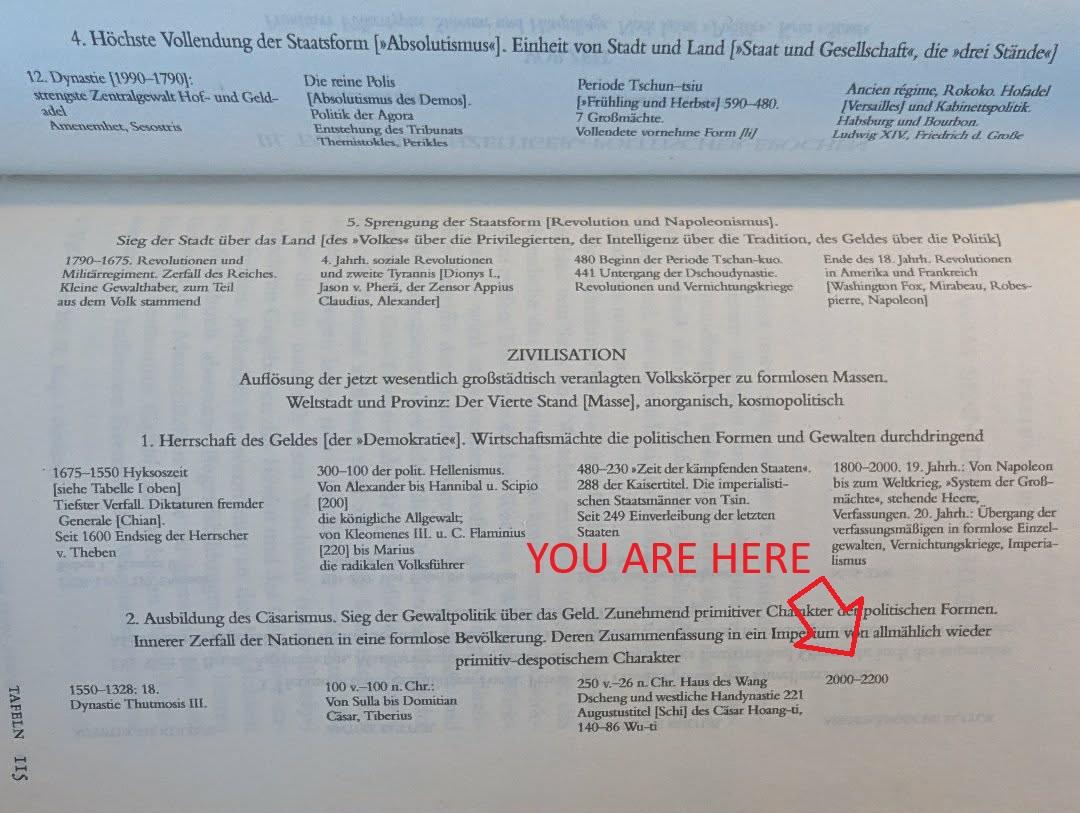
Consulting the table, you can see that you’re currently experiencing the death throes of Western civilization taking place from around 2,000 to 2,200. If you’re like me that makes you eager to know: what does Spengler think will happen? What’s his model of decline? This is the best part of Untergang des Abendlandes, and it remains a treat to read even to this day.
II. Decline
The Rise of The World Cities
I come from a small Swedish town nestled in the marshes of northeastern Scania (that’s the southernmost tip of Sweden for those who aren’t big on European geography). It was originally founded as Christianstad in 1614 by the Danish king Christian IV, who fancied himself an Alexander-the-great-city-builder-type. It was later renamed to Kristianstad after the legendary March Across the Belts won Sweden both Scania and the First Karl Gustav War in 1658 [4]. This annexation was soon contested by Denmark in the Second Karl Gustav War, which was followed by the Bremen War, which was followed by the Scanian War, which was followed by...
Anyway, what does my dinky hometown in an off-beat part of Scandinavia have to do with Spenglerism? The answer is that, during the last two hundred years or so, it’s been devastatingly sidelined by a nearby metropolis in a way strikingly consistent with Spenglerist theory. At the beginning of the 19th century, Kristianstad had a population of about 3,000 people, which was not much less than other nearby urban centres. Kristianstad housed the Court of Appeal over Scania and Blekinge, an infantry regiment and was also the seat of its own regional municipality. It was by no means the most important town in the country or even the region, but still a respectable center in its own right.
Today this has changed. Kristianstad has no higher court, no regional municipality and no serious presence from the military. Instead it has been pulled completely and helplessly into the orbit of nearby cities like Malmö and Copenhagen, which are now home to almost every institution of regional importance. And still Malmö seems quaint, almost provincial, compared to Stockholm! And Stockholm is nothing but a trifle compared to Berlin or Milan or Paris, and these cities in turn pale compared to Beijing or New York. If you come from a small town or rural area you can likely tell a similar story mutatis mutandis. If you can’t, well, then it’s pretty likely you’re from one of these big cities engulfing the world!
Spengler’s theory posits that the fate of Kristianstad, and the fate of your perhaps not-so-different home town, is neither an isolated incident nor a simple matter of urbanization taking its due course. It’s instead the latest instance of a pattern that’s been repeating since history began. Rome becoming the center of a continent, the Caliph's Baghdad housing the epitome of Arab power, New York City dominating an entire seaboard – this is the same phenomenon repeated in different eras and locations. In the final stage of civilizational life, die Weltstädte, the World Cities, rise to dominance. The entirety of Scandinavia is nothing but a province in relation to Berlin, London and New York. The hegemony of the World Cities is a potent portent of decay and a crossing into civilizational elderhood.
Why? To paraphrase Spengler, world history is city history, and the World Cities are one of the main culprits of civilizational decay. Characteristic of all World Cities is their insatiable hunger for new inhabitants and the complete inability of their already existing inhabitants to satisfy this desire. Citizens of World Cities are chronically childless. The World Cities are thus reliant on fresh blood constantly flowing in from everywhere else. For example, The State of New York (whose statistics I’m here using as a proxy for New York City) has had a fertility rate below replacement level since at least the 90’s, yet New York City has seen a population growth of around 1.5 million inhabitants between 1990 and 2020.
New York in fact shows all three signs of the World City: a constant hunger for growth, a tendency towards infertility and last but not least a penchant for robbing nearby urban centres and rural outskirts of their own gravity. In every country the process is different – remember, everyone ages differently! – but the direction is clear. The World Cities pull the rest of human society into their orbit, and soon everything exists only in relation to them. Spengler’s dark portrayal of the World City and the “spiritual nomads” drifting through them is full of delicious German Geist, and worth quoting extensively.
“Yet no misery, no force, not even clear insight into the insanity of this design lessens the attraction of these demonic constructs. The wheel of fate rolls towards the end: the birth of the city comes with death in tow. Beginning and end, farmerhouses and houseblocks, are like soul and intelligence, like blood and stone. Yet ‘time’ is nothing but a word for the fact of irreversibility. Here there exists only a forwards, and no backwards. The farmer once gave birth to the market, the country-town, and nourished it with the best blood he could muster. Now these World Cities suck the land dry, insatiable, ceaselessly demanding and devouring new people, until they at last tire in the midst of a barely populated desert, and subsequently die.
A man who has once been spellbound by the sinful splendor of this last historical wonder can never wrest himself free again. Native people can unroot themselves from the land and wander afar. The spiritual nomad cannot. The homesick longing for the great cities is stronger than perhaps any other. To them, home is any one of these megacities, but foreign is the next village over. They would rather die in the gutter of the World City than return to the land. And even the revulsion before this splendor, the growing exhaustion with these lights of a thousand colors, the taedium vitae, that begins to take hold of many, does not bring liberation. They will carry the city with them into the mountains and to the banks of the sea. They have lost the land inside themselves, and they can never again find it outside. [5]
Truth and fact
The rise of the World Cities is intimately entwined with another important step towards destruction. Here we must face Spengler’s most intricate, esoteric and maybe-bogus concept: the distinction between truths (“Wahrheiten”) and facts (“Tatsachen”). It’s highly difficult to describe clearly or succinctly in the abstract, which means that concrete examples are necessary.
Let’s take two hopefully well-known quantities: Scott Alexander and Donald Trump. Which one of these makes the better statesman? I for one am certain that Scott Alexander has a much better grasp of political and cultural theory than Donald Trump. However, I am also entirely certain Scott would be unable to drum up even a tenth of Trump’s authority and popularity if he was somehow instantly catapulted to the presidency. Scott might know many truths, but Trump has a firmer grasp of fact than perhaps any other person in the U.S.
Truths and facts are the difference between knowing a lot about what’s been written about politics, and being able to make it in politics. Truths and facts are the difference between a sports nerd who has studied sports theory and a sports player who knows how to win. Truths and facts are the difference between a manosphere-adherent who has studied every aspect of attracting women and a Chad with true game.
Spengler is, in a nutshell, exceedingly negative to intellectuals, and derides their alleged knowledge as almost entirely fake – facts don’t care about your truths. Untergang des Abendlandes indeed never tires of tirades against the impotency of theorists and thinkers in world affairs. In a strange paradox Spengler thus espouses both the most anti-materialist and the most anti-intellectual view of history ever proposed. Thinking and understanding and truth, growls Spengler, will get you absolutely nowhere. The Great Men of History concern themselves solely with facts: with popular sentiment, with vibes, with the country as a going concern, with the levers controlling power.
Truth and abstraction are in fact worse than useless, and act as a dangerous poison to late-stage civilization. World Cities cut their inhabitants off from facts, enabling them to exist in a fantasy-world of total abstraction. This is crucial, because the distinction between truth and fact has a vital socioeconomic dimension. Money is to truth as goods are to fact. That is to say, money represents the abstract capability of acquiring concrete goods. This however obscures the reality that goods must always be produced before they can be consumed. As the reign of truth waxes the power of money grows, and eventually the ability to even conceive of economy in terms of goods becomes hazy. Vast amounts of purchasing power can then, and only then, begin to softly yet swiftly recirculate from productive citizens to moochers. Or, to lend a stanza from Rudyard Kipling’s famous Gods of the Copybook Headings:
In the Carboniferous Epoch we were promised abundance for all,
By robbing selected Peter to pay for collective Paul;
But, though we had plenty of money, there was nothing our money could buy,
And the Gods of the Copybook Headings said: "If you don't work you die."
Last but not least, Spengler posits that the growing abstraction of society induces another important and primarily migration-related component of decay: the disintegration of unified peoples (“Völker”) into formless populations (“Bevölkerungen”). Instead of a Roman Rome filled with Romans, we have a cosmopolitan World City in Italy bereft of Roman virtue. Instead of an Arab Caliphate we get a Mamluk-ish hodge-podge of different tribes without asabiyyah. Instead of European nation states, we get multicultural societies without shared destiny and history. This results in further upheaval, but also undermines attempts at correcting course when problems become apparent. Long before Rome fell to the barbarians, barbarians made up most of Rome. This segways nicely into our next topic…
The Coming of the Caesars
The power of the World Cities, the increasing abstractness of society and the demographic disintegration into formless populations combine to dissolve political structure. Spengler describes this as politics losing track of the beat and falling into the wrong rhythm. The old systems become weak, ineffectual and disreputable. This rootlessness and ineptitude gives birth to Caesarism (“Cäsarismus”), which is not just a Spenglerian synonym for autocracy. Caesars distinguish themselves in that they seize power from established elites by exploiting the lack of cohesion, effectiveness and faith in the previous political system. They thereby differ significantly from, e.g., absolute kings in monarchies, whose power and legitimacy is inherited from the old established order rather than being a mere plunder from it. The tell-tale sign of a Caesar is that he amasses vast personal power by subverting the normal legal order while leaving the outer dressings of previous structures relatively intact.
For example, after the rise of the actual Julius Caesar, Rome’s entire political system became the constitutional equivalent of a Potemkin village. The Senate still existed and even at times claimed to have similar powers as before, yet in reality most if not all power had been surrendered to the Emperor and whatever potentates he deemed fit to rule alongside him. Something similar happened in the Weimar Republic – the Nazis never formally abolished the Weimar constitution but Hitler still seized absolute power. There’s other examples which you can probably think of for yourself, and the gist remains the same.
The influence from Nietzsche can be felt most clearly here. Spengler agrees that the old idols are dead, and that the political institutions, cultural beliefs and general ideas have lost their sway not due to any material factors but due to this loss of faith and structure. However, unlike Nietzsche, Spengler doesn’t hope that this Twilight of the Idols will lead to a reevaluation of all values followed by a new dawn. On the contrary! The civilization drew power from the idols, not the other way around. With the Old Gods dead it's only a matter of time before nihilism, in the Nietzschean sense of the term, wins out. All will eventually render unto Caesar, as politics turn increasingly primitive and violence becomes an ever-closer resort.
Eine entsetzliche Entvölkerung
If the aforementioned weaknesses are not enough to bring down the house, civilization sooner or later enters the most destructive phase of decline. It is suddenly faced with eine entsetzliche Entvölkerung, a horrendous depopulation [6]. It’s entirely clear that something akin to this is happening right now (Spengler claims that it has actually happened before in late Rome, but I’m too ignorant of demographic history to vouch for that). Birth rates are declining all over the West and the Westernized world, which fits neatly with Spengler’s model of decline. This is thus Untergang des Abendlandes most illboding and perilous prediction, and it is worth taking very seriously.
Spengler again insists this late-stage decline has no adequate material explanation, and is instead a consequence of abstraction, nihilism and intellectual rootlessness seeping into general consciousness. Even asking “why should I have children?” shows that the perfidious seed of abstraction has found root in your mind! Now you are become abstraction, destroyer of worlds. Do you think the farmers of yesteryear asked why they should have children? They had as many children as they could because that’s what you do. Animals do not ask why they should rear offspring, and neither do Amazonian tribes (whose lives are materially vastly inferior to the lives of any civilized man, by the way). It is only in the Realm of the World Cities that life and children are suddenly a tricky problem allegedly solvable through abstract deliberations, and where modern people (and mainly, suggests Spengler, modern women) demand reasons to have children; and reasons are in short supply. In keeping with the evocative biological metaphors, civilization thereby comes down with a case of sudden wide-spread cellular senescence, and the outcome is always fatal.
In passing it’s worth noting that an attractive but flawed retort to Spenglerism is that nations such as China have existed for several thousand years, and that many other countries who have ostensibly “declined and fallen” seem to be doing fine. This is indeed true, but again, remember Spengler’s definition of history! Spengler is well aware that, after the decline of a civilization, many of the ethnic groups who dominated said civilization continue to exist while practicing their own customs. The barbarians who conquered Rome did not perform an ethnic cleansing, nor did the Mongols wipe out all Arabs after the sack of Baghdad. However, Spengler’s answer is that these remnant groups typically exist only as utterly downcast and historically unimportant “Fellah-types” (from an Arabic word for the populational remnants of the original Ancient Egyptian civilization.)
The Fellah is, somewhat simplified, an object but never a subject. History is something that happens to him rather than something which he creates. Characteristic of this “fellah-type” is that it either eventually disappears as an entity or manages to remain distinct but never again has any agency. Either way all Geist is long gone, and the best a Fellah can hope for is to be treated kindly by whatever new civilization rises from the ashes to conquer him. The prospect of being a remnant of a fallen civilization is certainly better than being wiped out, but it is also clearly worse than being a part of a civilization during the peak of its lifespan.
Spenglerism as the forerunner of Spenglerism
Within Untergang des Abendlandes, there’s an inkling of deeper meaning, a suggestion of insight never explicitly revealed. In various passages Spengler appears to imply that his own magnum opus is in fact a catalyst of the decay it is purportedly merely describing. The traditional Western conception of history which Spengler is subverting, the idea of a linear progression centered on Europe, might actually not be a falsehood as much as a load-bearing pillar of Western mentality which has become frail with age and vulnerable to demolition. If this is true it has momentous implications – for by wrecking the old paradigm Spengler isn’t only establishing a new theory, but instead taking active steps to make that theory reality.
Am I reading too much into this? I admit we are talking about some far-fetched Inception-level stuff here, but once you see Untergang des Abendlandes through this lens it is hard to leave the viewpoint behind. What does it all mean? Did Spengler predict that his work would be influential enough to undermine Euro-Centrism as a general concept, yet slyly hid his prediction as to not out himself should he fail? Does the creation of Untergang des Abendlandes strengthen Spengler’s case that we are indeed on an unchangeable trajectory towards doom? Or is it the other way around? Does this insight hint that Spenglerism is nothing more than Spengler’s attempt to rationalize his own contribution to Western moral and intellectual decay, by insisting that said decay was unavoidable?
These are questions I haven’t seen asked and which stand without clear answers, but dishearteningly every choice of path seems unpleasant. It is especially concerning that the paradigm of Western-driven universal progress – which was indeed at times arrogant, egocentric and xenophobic, but also hopeful, self-confident and inspiring – really does appear to have crumbled into a more relativistic worldview. We are increasingly living in a reality wherein the West is just one pole in a decidedly multipolar world. I chose my opening quotes with care, and I end this section by repeating one of them. Are these the shadows of the things that Will be, or are they shadows of things that May be, only?
III. Fall
Above is a simplified-but-workable summary of Spengler’s model in all its grandeur, ambition and absurdity. Before moving on to a final critique it’s worth putting everything together into one quick cohesive analysis. What follows is a rough sketch of how a dedicated Spenglerian might predict the coming years.
The World Cities of the West continue to grow in size, influence and power. They increasingly redirect the nation’s resources to the benefit of themselves and their arteriosclerotic political structures, all the while despoiling the quality of their own population by sucking in every whole-hearted youngster they can find from rural communities and towns. Their thirst for new inhabitants is unquenchable, their dominance is unquestioned and their power unrivalled.
As more and more people become big-city-dwellers, larger and larger segments of the population degenerate into improductive and infertile abstract “thinkers” unable to grasp concrete issues and contributing little of value. Everything is thoughts and abstraction. If something breaks, just throw money at it so that it fixes itself! Seemingly infinite amounts of goods can be bought with money so it must stand to reason that money produces goods. This mode of thinking leads to a steady redistribution of wealth which allows the non-working and non-productive segments of the population to insidiously increase their numbers and demands even more. Meanwhile the population of the West slowly but surely disintegrates from cohesive Völker into formless Bevölkerungen.
The process described above throws the civilization’s political system out of its rhythm. The façade remains intact but the load-bearing pillars are switched out. Political power is concentrated in the hands of Caesar-like figures whose personal faults, virtues and ambitions decide the fate of millions. Good emperors may slow down the decline, but overall this turn to Caesarism changes the nature of politics into primitive power-contests often ending in violence.
Coinciding with the loss of civilizational rhythm, the birth rates fall disastrously. Sticking with the age-metaphor, the West comes down with a debilitating case of brittle bone-disease. Just like osteoporosis in an elderly patient the danger isn’t immediately apparent. Sooner or later, however, a crisis comes along. A younger civilization and a younger people would handle it just fine, but the aging West cannot – the impact splinters a bone, something important fractures, and even if the wound eventually heals the previous level of functioning can never return. Frailty increases. The next blow comes sooner, hitting harder. Something new is torn apart. This can go on for a while but eventually the swift final conquest and sundering of the entire civilization, from whatever roaming barbarians happen to be around, brings the whole enterprise to an ignominious end.
Does this sound familiar?
IV. I bid you stand, Men of the West
Spenglerism is an absurd position whose every conclusion hinges on accepting a very, for want of a better word, particular worldview. Nevertheless, the most convincing argument against Spenglerism isn’t even that, but instead that many of Spengler’s predictions – some of which now appear hauntingly prophetic – is mere extrapolation of trends Spengler witnessed in his own lifetime (i.e. the falling birth rates of the early 20th century, the rapidly increasing urbanization, the turn towards fascist strongmen, et cetera). Yet many of these trends were later reversed during the 50’s and 60’s! Fertility suddenly climbed, Caesars fell and the West regained its rhythm. This remarkable turnaround is enough to convince me that Spengler’s claim of inevitability truly is untenable. And while Spengler might only have deemed great civilizations worthwhile objects of historical interest, that obviously isn’t the sole available perspective, or even an especially good one. History can also be the story of the lives of ordinary folk; and it is no bad thing to celebrate a simple life.
At the same time Spengler is occasionally eerily on mark. If we attack his theory by pouncing on the post-WW2 era golden age which doesn’t fit his model, it seems necessary to concede that yes, okay, some events, thought patterns and trends today seem to match pretty well with Spenglerism. There’s no doubt in my mind that Spengler for all his faults was one of the last pre-WW2 German महात्मा, a Mahatma, ein Grossgeist, en storsjäl, a Great Soul, and it would be highly unwise to dismiss his vision as being entirely without merit or truth. Despite rejecting his defeatist outlook, broader premise and exaggerated anti-materialist/anti-intetellectual sentiment, I think there are important tidbits worth taking away.
Firstly, Der Untergang des Abendlandes has an unexpected aesthetic value. Spengler’s visions often read like the backdrop to a novel by Phillip K. Dick – ominous and vague, with the true scope and meaning of events always stuck in the corner of your eye, implying a hidden reality which only the wise can see. I wouldn’t be surprised if Spengler has inspired some of the biggest sci-fi writers out there; you could write novels based on his portrait of the end-stage West alone.
Secondly, the esoteric Spenglerian distinction between truths and facts has a kernel of truth however inaccurate it may prove in a final analysis. Spengler is obviously taking things way, way, way too far, but his perspective offers a nutritious slice of humble pie for cerebral types. I feel smarter having read Spengler, because he’s convinced me that I probably am not as smart or useful to society as I thought I was. That’s important! When has another book convinced you of anything even remotely as important as that? Has it even happened?
Thirdly, while he has hardly proved inevitability, Spengler does appear to have discovered trends which appear whenever a civilization is in disarray or experiencing a sharp downturn. Perhaps this can in turn be used as pertinent non-deterministic indicators of civilizational standing. Reasonably high birth rates, concrete thinking, no Caesars, the World Cities not being all-dominating; these might all be good signs for flourishing! Spengler’s model is precious in that it shows us that metrics which at first glance appear peripheral might actually be central, which in turn grants us a way to glean deeper understanding of how things are really going.
Last but not least a concluding remark on Spengler’s pessimistic outlook is in order. A common thread among doomers and Spenglerists of every age is their unrepentant lack of faith_._ The idea of an inevitable impending doom rooted in human folly presupposes a humanity bereft of any meaningful good will, virtue or true insight. Spengler might actually provide the most striking version of this concept: he’s figured out exactly why and how our civilization will die, but since we’ll all be navel-gazing big-city-dwellers ignorantly striving towards decline, no one – himself included – has the power to stop it.
This runs contrary to my lived experience. Bad actors are indeed sometimes allowed to run amok. Things do fall apart with no one fixing them. Thinking can from time to time devolve into useless childish make-believe. Yet none of this is the rule. It’s not even terribly frequent. There’s almost always good men trying to stop the rotten apples from spoiling the bunch, who have gained true insight into our problems and are actively working to remedy the situation, and whose ideas provide value and genuinly energize action.
You’ve probably heard the tired saying “all that is necessary for the triumph of evil is that good men do nothing.” It has indeed become lackluster. However, if you shuffle the words around it gains novelty, freshness and truth. All that is necessary to stop the triumph of evil is for good men to do something. Well, good men are doing something. They do something every day almost everywhere in the West; and it is by their efforts and their ärekärhet [7] – a Swedish compound noun lacking good English equivalent, which might be tentatively carried over as holding dear of unassuming righteous action – that I yet walk with hope of deliverance.
Besides that, regardless of whatever prophetic truth might or might not lie in Untergang des Abendlandes, good actions remain good actions even if they’re performed in an era of decline where they never bear fruit. This is the deciding rebuttal to Spenglerism as a philosophical system, if not as an eschatology. Even if Spengler’s theory is accepted at face value that doesn’t mean that we should stop trying! Spengler’s anti-intellectualism thus rings most true when aimed at his own supreme intellectual accomplishment. Once again, we see a harebrained Denker producing a great big ol’ Gedanken – while men of action safely ignore him and go on working with what’s in front of them.
Spengler’s not around to give his two cents, but I like to think he’d appreciate the irony.
Your message is stored now and emailed to the author after the contest ends. The author can reply to you, but their identity stays hidden unless they choose to respond.
Footnotes
- ↩
It should be noted that the idea of history being cyclical has far deeper roots than Spengler, and is an ancient feature of, e.g., Hindu cosmology.
- ↩
The translation is courtesy of me, and I leave the original German here in this footnote for those who can read it. Note that translating this sort of high-brow Nietzsche-wannabe-German to English is a particularly difficult task where significant subjective elements in the translation are inescapable. German grammar allows long run-on sentences to remain comprehensible and readable in a way that isn’t possible in English, where they need to be broken up to retain any semblance of flow.
“Ich sehe statt jenes öden Bildes einer linienförmigen Weltgeschichte, das man nur aufrecht erhält, wenn man vor der überwiegenden Menge der Tatsachen das Auge schließt, das Schauspiel einer Vielzahl mächtiger Kulturen, die mit urweltlicher Kraft aus dem Schosse einer mütterlichen Landschaft, an die jede von ihnen im ganzen Verlauf ihres Daseins streng gebunden ist, aufblühen, von denen jede ihren Stoff, dem Menschentum, ihre eigne Form aufprägt, von denen jede ihre eigene Idee, ihre eigenen Leidenschaften, ihr eigenes Leben, wollen, fühlen, ihren eigenen Tod hat.”
- ↩
In strict Spenglerist terminology, there’s a distinction between “Kultur” and “Zivilisation” where the former refers to a culture in early stages of life while the latter refers to a culture that has reached elderhood. This dichotomy is unnecessary, shaky and non-standard even in German, and it becomes even more peculiar in English. I have therefore chosen to excise it
- ↩
Actually, the town was renamed to Kristianstad quite a bit later solely due to a Swedish spelling reform. Since the Swedish conquest is the sine qua non of the later renaming however, I will pretend my description is fair.
- ↩
Once again, I leave the original German here for those who can read it, since I am innately skeptical towards all translations.
“Aber kein Elend, kein Zwang, selbst nicht die klare Einsicht in den Wahnsinn dieser Entwicklung setzt die Anziehungskraft dieser dämonischen Gebilde herab. Das Rad des Schicksals rollt dem Ende zu; die Geburt der Stadt zieht ihren Tod nach sich. Anfang und Ende, Bauernhaus und Häuserblock verhalten sich wie Seele und Intelligenz, wie Blut und Stein. Aber >Zeit< ist nicht umsonst ein Wort für die Tatsache der Nichtumkehrbarkeit. Es gibt hier nur ein Vorwärts, kein Zurück. Das Bauerntum gebar einst den Markt, die Landstadt und nährte sie mit seinem besten Blute. Nun saugt die Risenstadt das Land aus, unersättlich, immer neue Ströme von Menschen fordernd und verschlingend, bis sie inmitten einer kaum noch bevölkerten Wüste ermattet und stirbt.
Wer einmal der ganzen sündhaften Schönheit dieses letzten Wunders der Geschichte verfallen ist, der befreit sich nicht wieder. Ursprüngliche Völker können sich vom Boden lösen und in die Ferne wandern. Der geistige Nomade kann es nicht mehr. Das Heimweh nach der großen Stadt ist stärker vielleicht als jedes andere. Heimat ist für ihn jede dieser Städte, Fremde ist schon das nächste Dorf. Man stirbt lieber auf dem Straßenpflaster, als das man auf das Land zurückkehrt. Und selbst der Ekel vor dieser Herrlichkeit, das Müdesein vor diesem Leuchten in tausend Farben, das taedium vitae, das zuletzt manche ergreift, befreit sie nicht. Sie haben die Stadt mit sich in ihre Berge und an das Meer. Sie haben das Land in sich verloren und finden es draußen nicht wieder.”
- ↩
Depopulation is an adequate and legible translation of Entvölkerung, but does not quite capture the strength of the German noun. This is one of those cases where English has moved away from its Germanic roots and adapted a more latin-romance-esque vocabulary, with an accompanying loss of the savory frankness which Germanic words offer (compare “brotherly” and “fraternal”). Bevölkerungsrückgang is a more neutral word for declining population, but Spengler isn’t being neutral here. In Swedish I would have written avfolkning which is much closer to the mark.
- ↩
Ära is a Swedish word that can mean something akin to the English glory, but which can also have deeper connotations related to love of virtue, honour and righteous action for their own sake rather than for their incidental tendency to inspire remembrance in others. Ärekärhet is in turn a linguistically typical but rarely-used Swedish compound noun of with kär = holding dear, and -het = -ness. German, being a closer language, allows the more meaning-retaining and natural translation Ehrliebe. A much more commonly used compound noun with a somewhat similar meaning is ärelystnad, but lystnad = strong desire, longing, yearning, is disharmonious with the conception of ära I wish to invoke here.