Dictator Book Club: Yoweri Museveni’s Sowing The Mustard Seed
When you land in Entebbe[1], the first face you see is Yoweri Museveni’s. He’s everywhere, smiling down on you, beatific under his wide-brimmed almost-cowboy hat. His yellow campaign placards are plastered on every surface, thirty or forty in a row sometimes. After seven days in the country and about 800 miles on the road, I’d estimate that ~20% of the country’s total billboard stock is dedicated to the same poster, which seems like overkill. The slogan is “Yoweri Museveni: Protecting the Gains.” It’s not entirely clear what “the gains” are. (“His own gains!” Our driver snorted). One of my fellow travellers stole a poster to hang up in their home gym, thinking of a different kind of gainz, I suppose.
It’s a fundamentally conservative message, which it would have to be, for a president who has been in power for forty years. Elect me again if you want… more of the same!
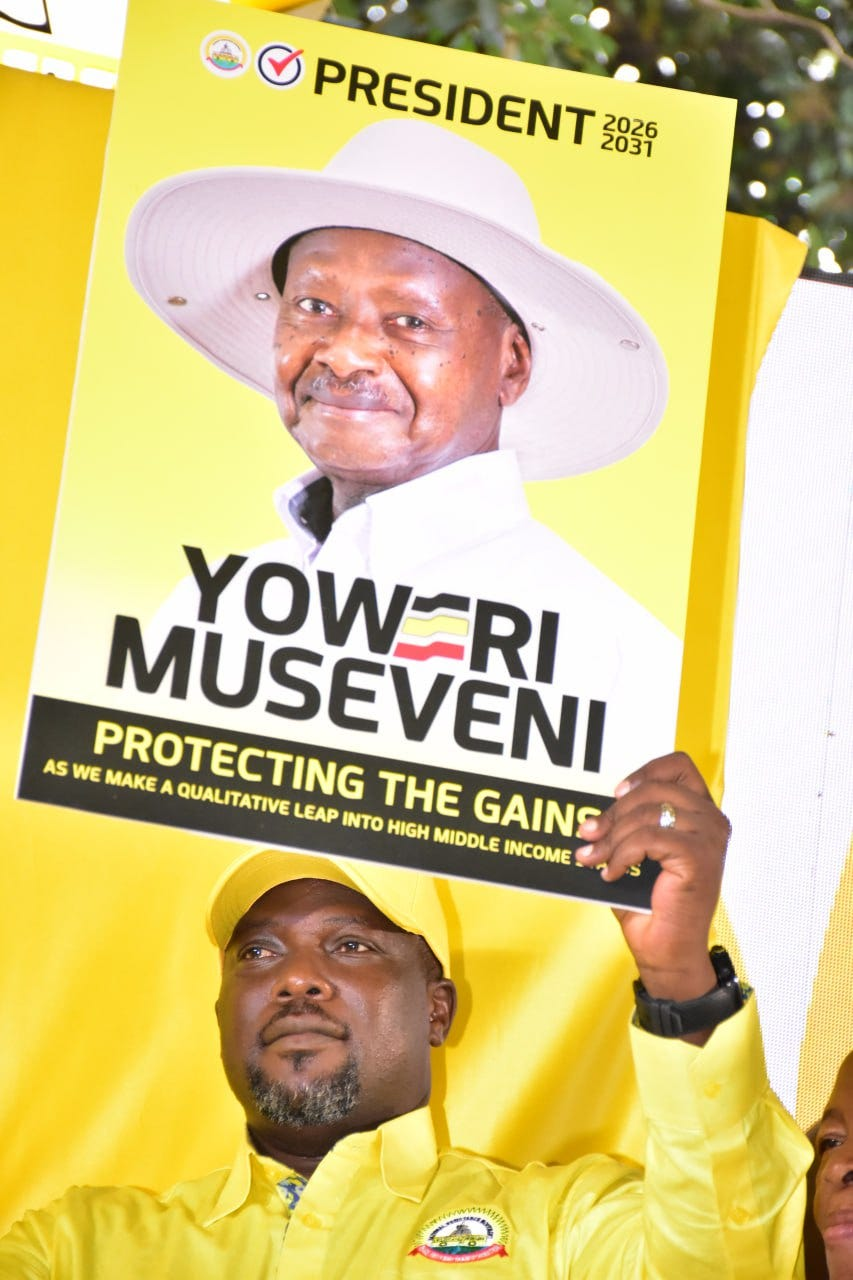
The subtitle is “As we make a qualitative leap into high middle income status” A qualitative leap! Seems like kind of a low bar. It’s not exactly a SMART goal. I mean, qualitatively I look like Brad Pitt. Qualitatively, I make a million bucks a year. Qualitatively, my wife reports I’m great in bed.
In any case, he’s running for re-election in 2026, and it’s looking pretty good. The rule in Ugandan democracy seems to be that every office is fair game except the presidency. As one Ugandan told me: “No need to do any predictions [laughter]! We know what will happen there.” He canceled term limits in 2005, and Parliament removed the age limit[2] in 2017, so it’s clear sailing, constitutionally speaking.
Last year his son floated the possibility of running, but he quickly withdrew after paternal and public enthusiasm failed to materialize. It appears that Museveni simply doesn’t trust anyone else with the job. He consistently wins by reasonable margins: 69%, 59%, 61%, etc., but even this is viewed very cynically: “Oh he is very smart. He knows this isn’t North Korea, he can’t report 98%, no one would believe him!” one of my friends said[3].
His main rival, a musician[4] named Bobi Wine, who sports a jaunty Panther beret, doesn’t seem to inspire much passion, despite knocking out an impressive 43 push-ups at a recent press conference. What’s interesting is that all the Ugandans I was eating lunch with knew this number. They also knew that Museveni can only do 20 (Not bad for a man of his age!). I guess I’m aware of the bench press performance of another Ugandan politician, so maybe it’s less notable than I initially thought.
Most citizens simply don’t remember anyone else. After all, only 13% of Ugandans were even alive before he took power. It’s a generational erasure of counter-factuals. I read The Last King of Scotland on the trip and I had a lot of follow-up questions about Amin, but they were mostly met with confused laughter. Amin is pretty salient in the West, largely because of the book/movie, but for the current generation, the war with the Lord’s Resistance Army in the nineties[5] completely eclipses all the awful things Amin did. That war’s fresher, and in some ways worse, so Amin’s atrocities feel irrelevant[6].
Maybe because they’ve never known anyone else, Museveni seems more like a force of nature than a politician, and they imbue him with preternatural, omnipresent powers, while somehow also thinking he’s kind of a dork. One person’s take was “The youth keep saying that the first person he should arrest is the person who picks his clothes!” His security apparatus doesn’t seem particularly scary. For instance, Facebook has been blocked since the 2021 election. But the Ugandan police apparently still post on their official Facebook page. People openly poke fun at them: “People say ‘What are you doing here? You’re not supposed to be here!’ They forget, I guess!” one friend joked/
In general, when you ask about the government, the Ugandans respond with cynicism, but also with a sense of mystery. For example, we saw some beautiful, brand new, army green Toyota Highlanders screaming through Kampala (no license plates), right as we were passing a gleaming new military hospital. Our driver sucked his teeth and started complaining about how all government money goes to the military. But then we passed the road to the Officer’s Military Academy in Jinja, and it was in dreadful shape. When I asked why they hadn’t paved the road to their own military academy, he said “Maybe there is a reason! The president is very smart! He has a reason for everything!”
We drove on another particularly egregious road that was purportedly kept permanently potholed due to its proximity to an old opposition leader’s home. “You see! He will not let Besigye drive home without some bumps!” Which is funny, because I heard a remarkably similar story from an elderly woman in Chicago about the road in front of her house that was allegedly neglected due to the local alderman’s beef with Rahm Emmanuel.
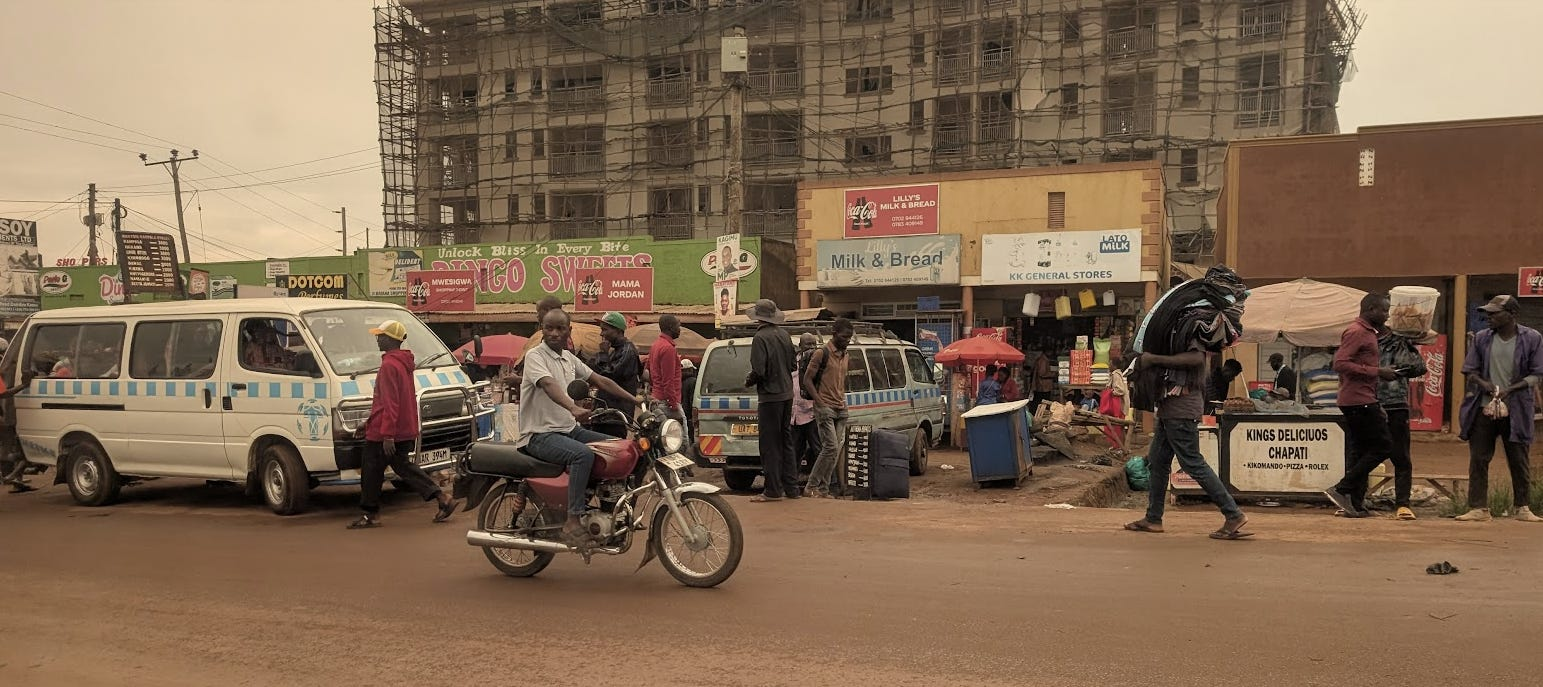
Some other government positions are elected, but the first family holds the reins of all real power in the country. When someone floated the possibility of my getting Ugandan citizenship, they said the request would have to go the first family for approval:
“We need to get you citizenship! You know so much about Uganda already. You are full of surprises. Maybe we can find a family member close to the president and ask if you can get citizenship. You’re so patriotic. You ask us why we’re not patriotic and we say there’s nothing here, so what are we patriotic of? [peals of laughter]”[7]
That sense of hopelessness paired with baseline cheer is everywhere. Like the woman next to me on the flight out: “Oh that man is not a good man. He wants to rule until he dies. He is a warmonger. He sends all of his children to Germany for medical care. Spends all of his money on weapons. Says he is a Christian while misquoting the Bible!” But then she ended with: “I have met him many times.” And… she was in business class on her way to Istanbul, so something must be working out for her.
I wanted to get to the bottom of how Uganda ended up 40 years deep into a single regime, and Chris Blattman said Sowing the Mustard Seed is a good read, so I started asking around for where I could find a copy. It’s not exactly Mao’s Little Red Book. No one knew where I could get my hands on one. But finally, on the last day of the trip, I found a fancy bookstore in Kampala, and forked over 85,000 Ugandan Shillings[8] for a slightly used-looking copy of Sowing the Mustard Seed, Second Edition. My ever-conspiratorial (but probably correct) Ugandan friends pointed out that the really good stuff must have been cut out between editions. They also said that the father of one of our colleagues was mentioned in the book, and that he had actually died fighting with Museveni. When I asked this colleague, she seemed surprisingly nonchalant about it. All she said was “someone’s blood needed to be spilt.”
Before we get to the book review, some random history I found interesting
Uganda is in East Africa, inland from Kenya, hugging the Northern and Western shores of Lake Victoria, which is the largest lake in Africa[9] and the source of the Nile. The name Uganda comes from “Buganda,” which was one of the three or four pre-colonial kingdoms that covered the rough area of modern Uganda. These kingdoms still persist today, actually, and provided some complications to the creation of a modern state whenever one of the kings got ideas. Before whitey showed up, it was a semi-stable feudal society where local chiefs laddered up to the king. The common people were mostly engaged in subsistence farming and avoiding their leaders, who spent their time raiding each other, sacrificing their relatives and trading women around. The one historical novel I read (Kintu, by Jennifer Nansubuga Makumbi) that covered this period didn’t make it sound exactly Edenic.
At some point, missionaries showed up, and caused a real shake-up in Bugandan society, culminating in a minor civil war with Protestants on one side and Catholics on the other. Things really came to a head in 1885 when the Bugandan King Mwanga II’s favorite catamites started raising Christian objections to their typical duties, and the king had the incoming (and first) Anglican Bishop of East Africa, James Hannington, speared to death. One of our local Ugandan guides was named after him!
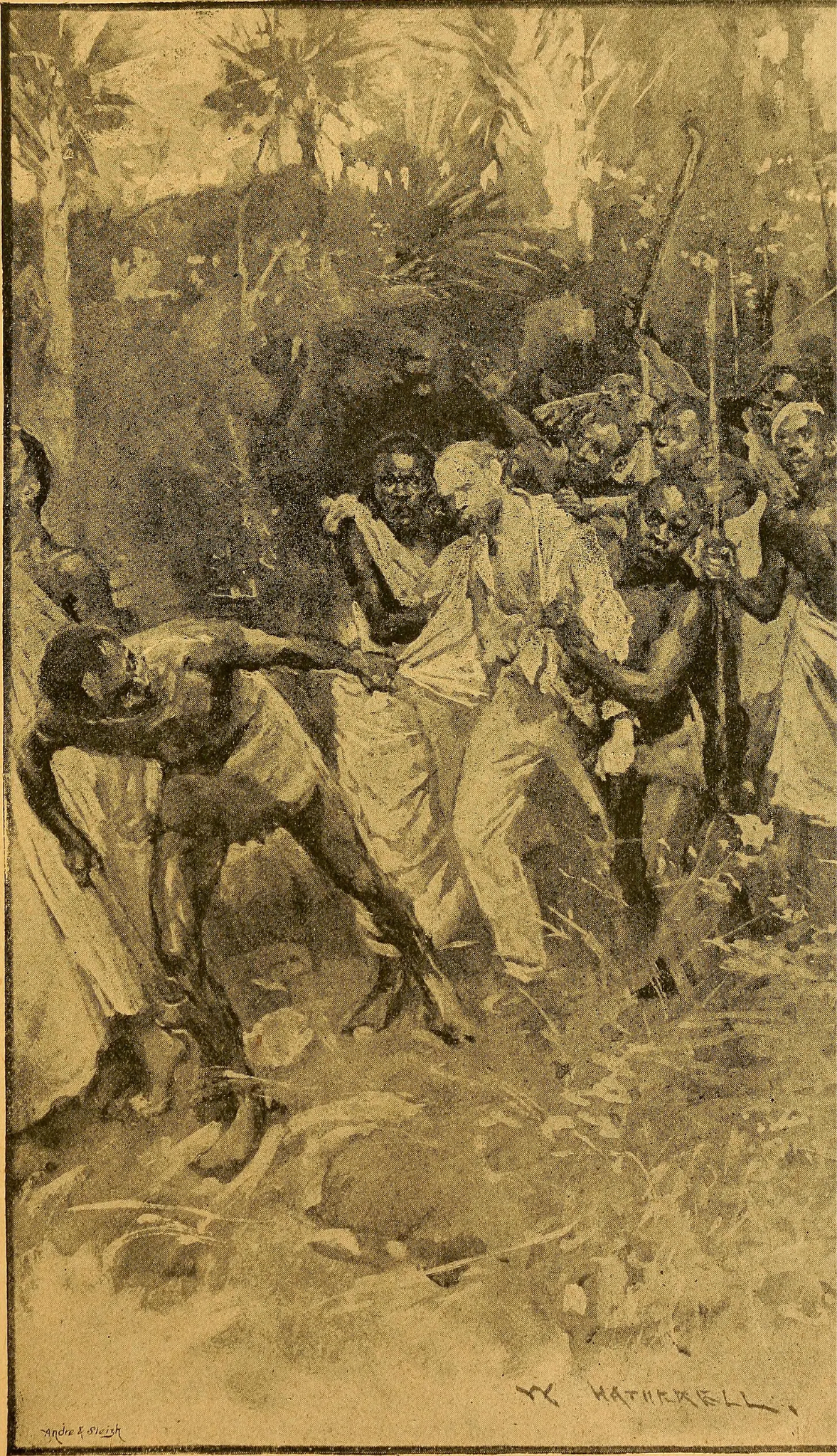
Bishop Hannington, having a bad time
Bishop Hannington’s death provided the proximate cause for Britain’s entry into Uganda, and they formally took over in 1894. They set about trying to modernize and extract resources. One of their major projects was the Uganda Railway, which eventually stretched from Mombasa to Lake Victoria. They imported thousands of Indians as indentured servants to lay track through some truly tricky terrain.
The railway was designed from the beginning to be a jobs-destroying technology, but not in the way you think. One of the last places in the world where there was a still-operating industrial-grade slave trade was the caravan route between Uganda and the coast, and the railway was designed to make that route unprofitable, and thus end the slave trade. By all accounts this seems to have worked, which surprised me. There are perhaps some AI lessons to learn here.
Of course the Sikhs and Gujaratis building it didn’t have a particularly great time. They got malaria, they got blown up, they got buried in landslides, and most cinematically, they encountered a pair of legendary man-eating big cats called The Tsavo Lions (which, by the way, would be a great name for a football club). As Lord Salisbury described it to the House of Lords, the lions were a terrible nuisance because they had “conceived a most unfortunate taste for our workmen.” They killed something like a hundred workers, and construction ground to a halt. So finally the commander of the whole operation, who was a keen big game hunter in his own right said “Fine. I’ll do it myself,” and took them out. It apparently took nine .450 rounds to fell the bigger one, who was nine feet long. The pair of them served as floor rugs for 25 years, but can now be seen in the Field Museum in Chicago.
The big game hunter, Patterson, is one of these Forrest Gump imperial Brits, who killed tigers in India, fought in the Boer war, smuggled German arms into Northern Ireland to bolster the Ulster cause, led the Jewish Legion at Gallipoli (which later formed the basis for the IDF), tried to raise an army of Jews to stop the Holocaust, and was Yonatan Netanyahu’s godfather (Yonatan is apparently after “John” Patterson). This is the same Yonatan who would later die in the Entebbe raid (see FN1 for details), so it all came full circle in East Africa in the end. Patterson and his wife died in La Jolla, but he was eventually re-interred in Israel, at his request.
Anyway, Parliament hated the Uganda Railway. It was ruinously expensive, and they soon dubbed it “The Lunatic Line.” But our boy Winston[10] loved it. He saw in it the whole character of the British Soul:
“The British art of ‘muddling through’ is here seen in one of its finest expositions. Through everything—through the forests, through the ravines, through troops of marauding lions, through famine, through war, through five years of excoriating Parliamentary debate, muddled and marched the railway.“
It’s now in general disrepair, and operates only in sections. The Chinese built a new standard gauge line between Mombasa and Nairobi using a lot of the same pathing. No word on how many of their workers were eaten by lions.
The point of all this is that some of the Indians who built the original line stuck around, which gave rise to a quasi-caste system where the Whites used the Indians as a kind of intermediate merchant class and they both kept the Black Africans down. This status quo persisted until the second world war.
In 1962 they had a relatively uneventful independence transition to a guy called Obote, who nobody really can muster much feeling about, and who later got overthrown by his army commander Idi Amin, who seemed mostly to take power as a way of not getting prosecuted for smuggling gold and doing extrajudicial killings. Once he got in power he continued smuggling gold and doing extrajudicial killings. He also lived in a totally outrageous fashion, with weekly planes from the UK stuffed with his favorite luxury goods, open letters to the Queen of England, appalling torture and ethnic cleansing campaigns, open polygamy and credible accounts of cannibalism.
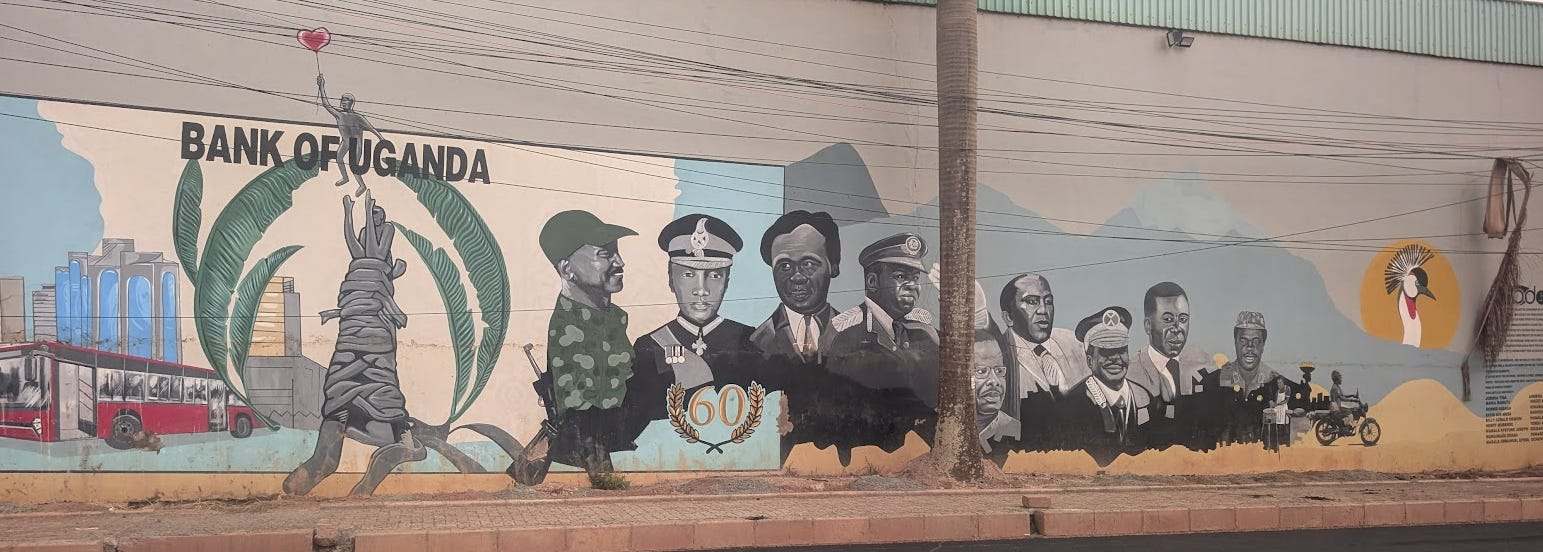
Amin nationalized white and Indian-owned businesses, and this campaign eventually escalated to the point of ordering all Indians out of the country. Many of them were multiple generations deep at this point, and they all make a miserable relocation to points around the globe, many to Leicester, Nottingham, and other third-class English cities[11].
Eventually Amin makes the crucial mistake of invading Tanzania, which has a proper army, and in the counter-attack he and his Libyan mercenaries (he was a pal of Gaddafi’s) get kicked out by the Tanzanian President Julius Nyerere (who another local I met was named after). Amin lived out the rest of his life in exile in Saudi.
OK, so after Amin, Obote has another brief turn in the seat. The man who is the main focus of this review, Yoweri Museveni, has been fighting Amin the whole time. But he’s not happy with Obote either, so he simply shifts targets.
Before we get into his story, a few notes about the man’s prose
This is not a well-written book. But it is a page-turner. Museveni starts by explaining why he wanted a second edition in the first place. Not to redact war crimes from the previous edition. No, no, no! It’s because he hates the Oxford comma! He spends at least a page on how he would never have approved the ghost writer if he knew he would use the Oxford comma. Which, fine, listen: I can understand a man who has strong feelings about punctuation. But then he immediately begins perpetrating egregious crimes against the comma, like:
- “I, certainly, saw a dead body, on the road, as I was heading back to Kampala.”
- “They, immediately, jumped into a number of cars, fully armed with SMGs and drove up to the roadblock at Kireka.”
I could go on! But I’ll spare you. The man is also a serial acronym abuser. Here’s just one example sentence that took me a few attempts to parse:
“The UPC quickly organized the return of Obote on the 27th of May, 1980 and the dismantling of the UNLF so as to resurrect the sectarian parties of UPC, DP and even KY in the guise of CP. The NCC had passed a resolution maintaining the UNLF, which was the correct step at that time.”
He complains that the first edition wasn’t African enough, so he stuffs this one full of folksy Runyankole sayings. He’ll stop for long digressions on how best to translate them, interspersed with snide comments like “You can see how incomparably the Runyankore is superior to the English language,” or “African languages have no comparison with the deficient, incompetent European languages.”
Incompetent, by the way, is his favorite and most devastating insult. Idi Amin isn’t a cannibalistic, genocidal monster. He’s incompetent, because his troops don’t know how to operate a mortar or dig a trench. And that’s worse![12]
European powers? Incompetent. Other African dictators? Incompetent:
“This is the misfortune of Africa—wrong actors from within and wrong actors from without. The confluence of these bad actors is the curse of Africa. The internal wrong actors always look for external backers, sponsors, ‘godfathers’—call it what you want. The external wrong actors are only too ready to come in and back those incompetent leaders.”
In a way, it’s a gamer mindset. Get good! Skill issue! Dictator diff! And like gamers, he’s also surprisingly earthy: he talks about eating too many mangoes and getting constipated after a battle. He talks about his hygiene (“Unbrushed teeth have a most unpleasant feeling for me”). Of his great love for corned beef cooked with onions. Or how attractive another revolutionary’s “mulatto wife” is. In fact he notes probably seven or eight particularly beautiful women that he ran across in his campaigns.
He also has a great mind for cars. He remembers the exact make and model he commandeered to get around a particular roadblock. But his mind for numbers, and particularly for keeping track of matériel, is what’s truly amazing. He remembers every single rifle they stole from the government, busted out of a barracks, lifted from the Tanzanians, or received in an airdrop from Gaddafi. Logistics win wars, I guess.

Now, he’s no Winston Churchill (“The war was won with skills, sweat, blood, food, sewing machine [sic] and so on.”), but he does have a way with words. They were met with “an avalanche of gunfire,” “Uganda is beautiful minus war and turbulence,” and so on. And he’s funny! At one point he tells a truly terrible story and then drily says “I am awaiting the opinion of the reader.”
The narrative is frequently punctuated with random asides. He’ll be in the middle of some wild guerrilla story and then be like “By the way, my sister had polio” or “I remember buying a very sweet pineapple at Lwamata.” He’ll share deep thoughts like “I have never understood how the system of dry-cleaning works. Does it remove the dirt and how?[13] Coming back to the plot to kill me...”
I eventually started to wonder: who is this man’s editor? So, I flipped to the front to check: “Edited by Janet Museveni.” Ah… well, there you go. Find you someone who will let you write what you want!
Biographical sketch
The book starts with the claim that he can remember being four months old (“The beginning of the lies!” One companion remarked). In his memory, he was left on a blanket in the elephant grass, staring up at the sky and waiting for his mother to return.
He was born to a semi-nomadic family that cared for a large herd of cattle from a portable compound that they would pick up and move every few years/months, depending on conditions. As a child he would walk 5 km back and forth to the herd to help tend them every day. The years were marked by various plagues that struck the cows, staved off by intermittent visits from the regional health authorities and their vaccines.
His father was well enough off to send him to be educated at an English school. This is what he had to say about it: “Anyone who says women could run society better than men has never attended a girls’ school where boys are a minority!”[14] He was straddling worlds, learning maths, science and poetry, while his father was taking a second wife (who the first one hated because she was a pagan) and herding cattle. They lived the same pastoralist lifestyle as generations of ancestors. But then his half-sister is born, and they name her Toyota.
There’s a gap in the narrative before we meet him again as a student activist. He goes to college, and becomes completely captured by left-wing and Pan-African thought. He gets a lecturer canceled (some things never change) for promoting non-violent resistance. Yoweri hijacks a bunch of buses to barricade the school for Rag Day[15]. And he records his disappointment with insufficiently indoctrinated fellow “cadres.”
This ideological purity appears to persist to the modern day, in some form. He speaks disapprovingly of Amin killing civilians, but says his real issue was a failure to embrace Pan-Africanism. He scolds Julius Nyerere for stepping down in favor of a peaceful transition of power, saying it set back East-African unity initiatives. And he passionately hates “careerists,” which seems to be his term for anyone who cares more about getting a job and settling down than about perpetrating violent resistance.
At some point he joins the international circuit of young, globe-trotting left-wing revolutionaries. In North Korea he scolds Eldridge Cleaver (the third-most famous Latter-day Saint to run for president) for hitting on a local. He meets Gaddafi, who asks him to help assassinate someone (Museveni politely declines). He visits Deng Xiaoping and Fidel Castro. He even assists Che Guevera with some logistics in the Congo.
Finally, he decides to put his money where his mouth is, and starts looking for ways to violently resist. He hijacks a military truck and drives it out of the country (carefully, because he can’t figure out how to put it in reverse). He trains in a camp in Mozambique and starts building up a force of rebels. They seem to be a general-purpose anti-incumbent force. First anti-Obote, then anti-Amin and eventually anti-Obote again.
At some point in here, he marries Janet and they start having kids. But he’s very explicit with her, them and the reader, that the family is secondary. This is what he writes about returning to the fight the day after his daughter was born:
“This captures my core belief - the country comes before the family. I have a very poor opinion of people who put their families above country. Without a country, families cannot thrive.”
Even so, they’re a constant source of worry for him. He’s always trying to find an untapped phone to call them, or an excuse to visit them in Kenya. Eventually they’re able to relocate to Gothenberg, Sweden. They make ends meet with a combination of Swedish welfare money, CIA slush fund, and the occasional cash infusion from Libya.
He establishes a base inside Uganda, and starts ambushing convoys and storming barracks. He makes it all sound very disciplined and heroic, but you can read through the lines and see real brutality in places. At one point they murder someone for throwing a pumpkin at them. They blow up a whole truck of Tanzanians (who were nominally their allies), and every night they cast a magic spell on Obote.
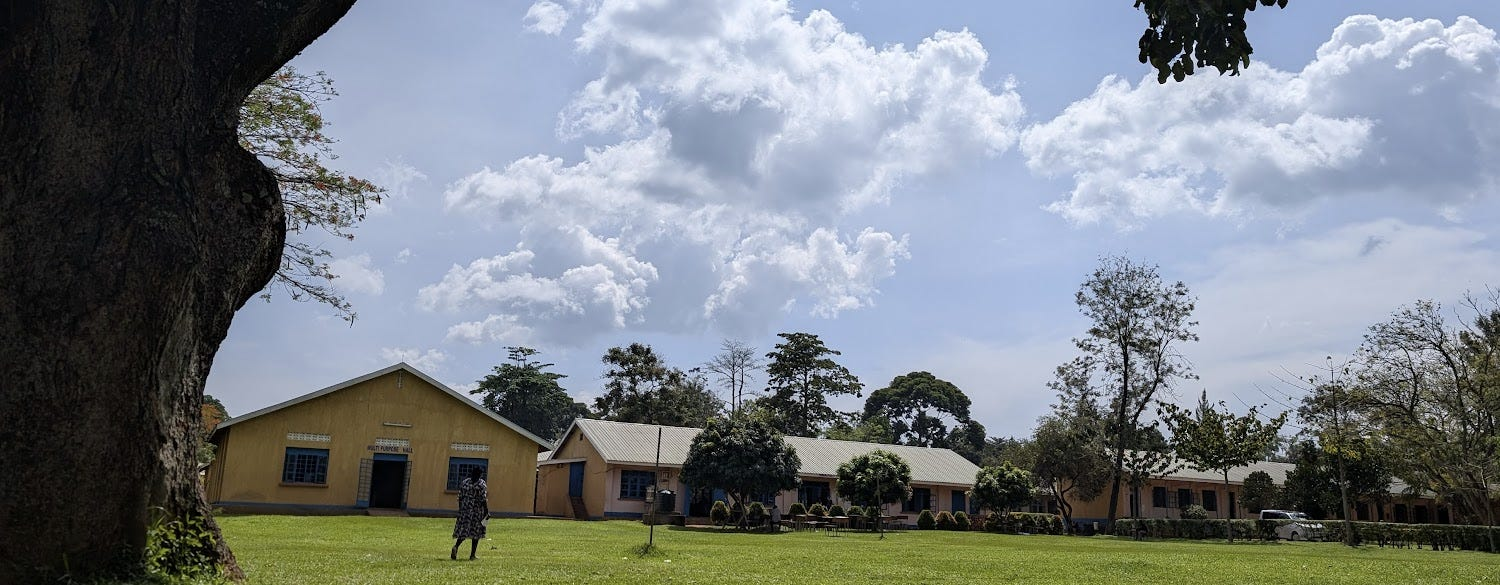
This era of the book (the noble guerrilla leader fighting against all odds) takes up about 75% of the runtime, even though it represents only a few years of his life. It’s telling how much this serves as a founding myth for him personally.
Eventually, he liberates Kampala. He’s careful to not repeat the mistakes of his predecessors. He tamps down sectarian violence, maintains the discipline of the army, avoids any major massacres, and preserves important economic assets. He even makes the dubious claim that he had a totally rape- and pillage-free conquest:
“Kampala was so quiet that night. Unlike 1979, there was no looting whatsoever; neither by civilians nor by soldiers. Uganda had never seen such a disciplined army. It was a marvel. As a consequence, the soldiers were ‘over-appreciated’ and, as a consequence, many of them, unfortunately, got HIV and AIDS and many, eventually, died. There was no raping—not even a single one was reported.”
He craftily sends some high level POWs back to the enemy unhurt, with the express intention of showing that the NRA “did not kill people.” This is an important piece of game theoretic information, which starts a cascade of major defections.
To help consolidate the country, Museveni makes a credible effort to end the old colonial North vs. South distinction by promoting a blanket amnesty on past atrocities, while simultaneously threatening to shoot people on sight if they engage in any new tribal violence:
“Mistake-makers must be separated from the people. The people cannot be blamed for the mistakes of leaders simply because they come from certain parts of the country. Mistake-makers are individuals, responsible for their mistakes. Moreover, even within the mistake-makers, we must make a distinction between the misleaders and the misled. While we should be harsh with the misleaders, we should be lenient with the misled.”
Eventually this culminates in total victory. After complaining profusely about how the election of 1980 was a sham, he decides not to hold one himself after taking power. At least not yet: “The conditions for election were not propitious,” he says, vaguely.
This is how he sums up his victory:
“It is this NRM/NRA that had scored a great victory unparalleled on the African continent of winning a revolutionary war without a rear base and, for a long time, no external aid… Only Cuba and possibly China (if Stalin was not assisting them) had done something comparable.”
Recall that he had met Deng Xiaoping, and Kim Il Sung and Fidel Castro. You have to imagine that watching them gave him a bit of a playbook on how you hang on to power after a leftist insurrection.
OK, so he’s in charge. What does he do? At first he rolls out a pretty good four-part plan for normalization:
- Maintain army discipline to create calm and reassure everyone
- Let the Shilling float to establish fiscal stability
- Start building out paved roads and the electrical grid
- Get proper tax collection organized so his government wouldn’t have to be totally kleptocratic to make ends meet
I mean… is this the most reasonable plan ever instituted by a first-generation leftist dictator? It’s not perfect, but he clearly has some common sense. For example, he recognizes that nationalizing companies is counterproductive:
“Our leaders thought they were putting the economy in the hands of the people. Why couldn’t the people start their own companies instead of grabbing other people’s companies? No clear answer!”
But he’s not above a little centralized planning either. He tries to establish a dairy industry by building a network of milk coolers (once a cowherd always a cowherd, I guess), and he kickstarts the fishing industry by building some canneries.
He then gives the whole World Bank/IMF thing the old college try. He adheres to their rules on keeping military spending below 2% of GDP but immediately regrets it when a succession of rebel groups sprout like mushrooms around the borders. You get the sense that the military is the only truly effective organization in the country, and so he starts counting on it for everything.
The first of these rebel groups was relatively harmless, led by a witch doctor who told her soldiers that if they remained chaste and rubbed shea butter on their skin, they would achieve immediate moisturization for all skin types without clogging pores be bullet-proof. This was an unsuccessful strategy, and she was eventually driven from the country. At this point we see that Museveni isn’t exactly Putin: he lets her live out the rest of her days in a refugee camp across the border, and can’t even be bothered to send assassins when she keeps writing him hate mail for the rest of her life.
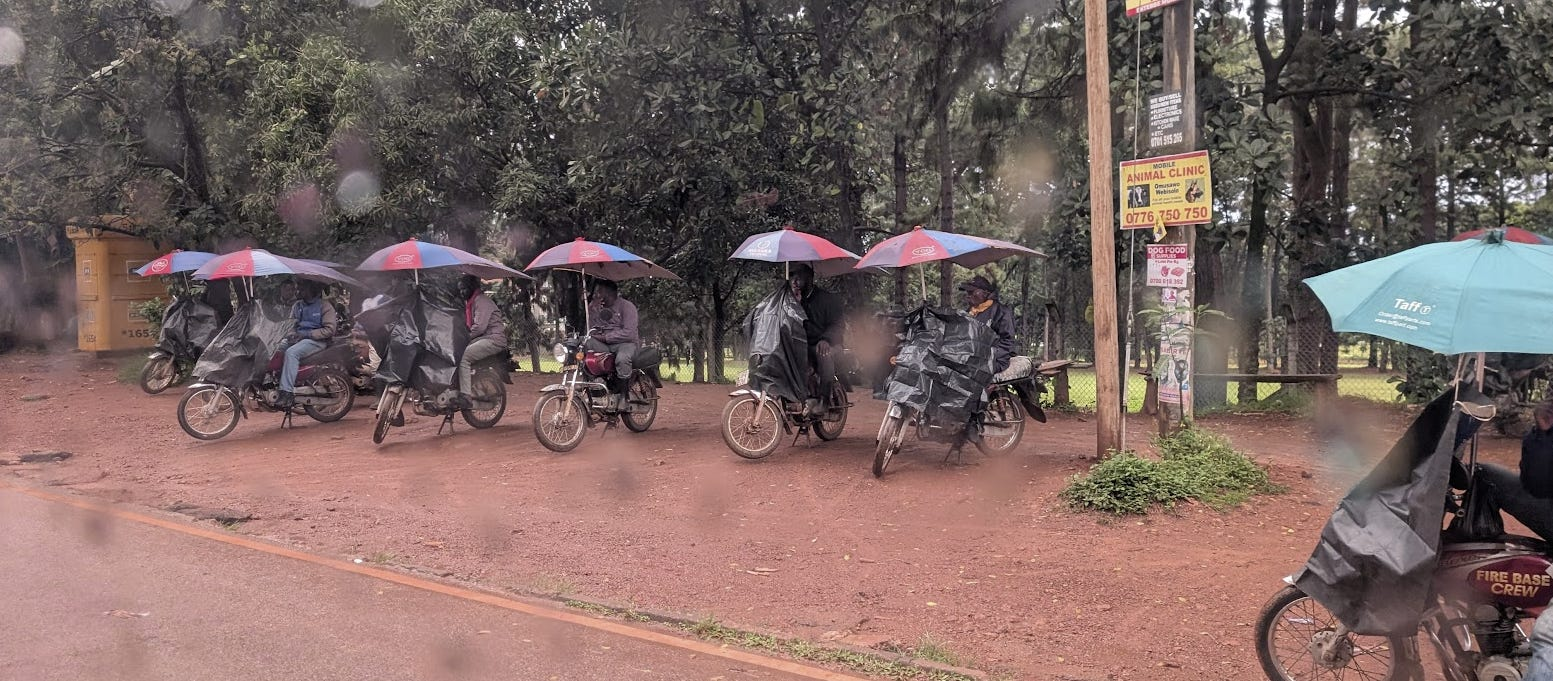
But pretty soon he has to deal with Kony (funded by the Sudanese), and he clearly struggles. He looks for help from the outside, but has a bad experience with the UN (“The UN has engaged in ‘terrorism conservation’ in the heart of Africa”) and particularly blames Western governments for being unwilling to sell him arms: “Western governments always put too many strings on the weapons, so we went to the USSR.” After the collapse of the USSR, he has to scrounge a bit, piecing together a few tanks from the North Koreans, some artillery from India and small arms from Israel. Finally, after the ANC takeover in ‘94, South Africa becomes a reliable source of matériel, but even so, the war drags on until 2006.
Things have been pretty low-key ever since. He styles himself mostly as a farmer these days, instead of a warrior. He closes the book by claiming he’s taken very little pay over the years and that his day job is still cattle keeping. After all, “leadership, in the African context today, is about the mission and national salvation and not about improving the CVs of individuals or about ‘Vaawo nange ntureko’ — (’let me also take my turn on the seat’).”
So how do we grade Yoweri Museveni?
He rates himself very highly, and isn’t afraid to name and attack his detractors head on. He gives himself particularly high marks for avoiding five out of the seven “types of crime and corruption” his predecessors engaged in. This is not a joke. Here’s the list:
- Extra-judicial killings
- Raping women and defiling young girls
- Extortion of money at roadblocks by soldiers and looting
- Poaching of animals at the national parks and encroachment on the forest reserves[16]
- Embezzlement of public funds, bribe taking and abuse of office
- Obstruction of projects of public interest
- Nepotism
“Of these seven types of crime and corruption, only two are surviving. These are N0.5 and N0.6—i.e. embezzlement of public funds, taking of bribes and abuse of office and blocking of projects of public interest such as investments.”
Is five out of seven supposed to be a good score? 71%? His primary source of legitimacy is stability and the lack of political violence:
“It is no accident that Uganda is today enjoying peace—from corner to corner—for the first time in 500 years. Before colonialism, there were the tribal wars. During colonialism, Karamoja was never pacified. After colonialism, the situation became worse with terrorists, cattle rustlers, extra-judicial killings and other ills. It is only now that the whole of Uganda is at peace… Even security alone is a big contribution. What do the youth in Somalia say about security? Life is unbearable without security.”
It’s a strong point, but it does make you wonder what kind of credibility hit he took during the eight-year war with the LRA. And sure, there’s the whole democracy thing, but he has some responses to that too, don’t worry:
“Democracy. This is a principle that does not need too much elaboration. However, the democracy of populism is not profitable. We should go for the democracy of enlightening people so that they develop and get out of poverty.”
Later he lists the outstanding issues facing Uganda in the form of “10 Bottlenecks.” The first nine are straightforward state capacity or economic issues, but he wraps up with:
“The tenth bottleneck used to be democracy. However, that bottleneck was addressed long ago, even when we were still in the bush.”

He also tries to get ahead of criticism of removing term limits. After pointing out that a comparison to the US is inappropriate for a variety of social, historical and practical reasons (and anyway, the US only instituted term limits in 1947!). He spells out the real issue:
“Africa does not need people who run countries. Africa needs people who create countries, create nations, create institutions and create a culture of modernity. While the West needs managers of systems, Africa needs the creators of systems and the builders of countries, states and nations.
In the case of the underdeveloped countries of Africa, like Uganda, the results we are talking about are not simple management results of producing targeted levels of soap or soda. They are life-and-death struggles for the future survival of our people, having survived the darkness of colonialism.”
But the problem is, on any specific and tackle-able issues, he takes surprisingly little responsibility, and in fact, seems to have a fairly low opinion of his own efficacy. Here is a long rant about how government schools shouldn’t impose school fees:
“I still have a problem with the structures in the country—the schools, the parents associations and so on. Under different guises, they creep back the practice of school charges. My stand is that, a parent should pay nothing in terms of money. He should only provide entaanda (packed lunch) for each of the children, buy exercise books and buy uniform for the child. The rest should be done by the government…
Why do I take this stand? This is because of the original problem (to be compared with the original sin). The original problem was that the poor parents could not afford to pay those school charges. That logic can only be collapsed if all the parents have become able. If they have not, it is a crime to re-introduce school charges. If the money is not enough, then let us look for more money but not change the original logic, unless the original problem has disappeared.”
OK, but Yoweri, my brother… you’re dictator for life! Just outlaw them! And your wife is the Minister of Education! Certainly you could enforce this rule if you wanted to? What’s the point of being a despot if you don’t get anything done? What a lack of imagination.
And this, in the end, is what disturbs me the most about Yoweri Museveni. He’s been in power for 40 years. What does he have to show for it? By his own admission, he hasn’t put a stop to 29% of corruption. He claims to be a military genius that brought durable peace to Uganda, but it takes him eight years to put the lid on a devastating civil war. And on development, he’s resigned to protecting “qualitative” gains, whatever that means. It’s the ultimate indictment of rule by a single, uninspired leader.
Incompetent!
Your message is stored now and emailed to the author after the contest ends. The author can reply to you, but their identity stays hidden unless they choose to respond.
Footnotes
- ↩
A city that has a difficult-to-place whiff of violence for people of a certain age, due to the 1976 PLO hijacking and subsequent raid by Israeli commandos in which Benjamin Netanyahu’s brother was killed. Bibi actually came to Uganda a few years ago. “He forgave us—all of us!” One local mentioned. “Wow, did you feel better?” I asked. She laughed. “No! I feel the same!” She was mostly offended that he never left the airport, just in and out.
Israel has a surprisingly intertwined history with Uganda. It was originally pitched as a Jewish homeland to the Zionists by the British Colonial Secretary in 1903 (they declined). But Israeli aid workers and engineers have been a fixture ever since (there was one on my flight). An Israeli is the main love interest in the novel The Last King of Scotland, and as we’ll see later, there’s a reason Netanyahu felt a connection to Uganda, besides his brother’s death.
Anyway, the British chose Entebbe as their seat (Entebbe means “seat” in Luganda), and it is now known primarily for having an airport, though the State House, the official home of the subject of this book review, is still there.
- ↩
Museveni is 81. In what I was to find out was a fairly typical conspiratorial moment, our local contacts swore that his age was a great state secret, and that he was constantly changing it to magically stay in his 70s.
But his birthday is listed in the opening chapters of Sowing the Mustard Seed. He spends a whole page explaining why the day itself is a bit of an estimate, because people didn’t really keep track of things like that where he was from. But it fits his overall aura to have a mysterious origin, so most Ugandans seem to run with it.
- ↩
Interestingly, President Hassan in neighboring Tanzania recently declared a 98% victory. It’s actually an interesting game theoretic move. She’s obviously not stupid enough to think it’s believable, or convincing. But publishing 98% is a powerful signal. You’re telling your citizens how much power you think you have, which “truth” you expect them to adhere to, and anyone who’s paying attention then knows how to act.
- ↩
Sub-Saharan Africa has a rich history of musician-politicians playing resistance leader: see Jad Abumrad’s latest project on Fela Kuti.
- ↩
I heard some wild first-hand stories about this war. The adage is that every family in Uganda was affected in some way. One of our friends (let’s call him John) spent his whole childhood sleeping every night in the bush so he wouldn’t be kidnapped and pressed into service as a child soldier. His dad would carefully disperse the six kids across a few kilometer stretch, so that if one of them was taken perhaps the others would be safe (diversification at its finest). Then he would spend all night on a circuit, checking in on them in their dugouts or tree-top perches.
One night, they bumped into a group of people they knew from their village who were dressed up in LRA gear, on their way to perpetrate a false flag attack. John and his siblings performatively covered their eyes to show they hadn’t “seen” anything, and their neighbors let them live.
Another time, a Ugandan government agent fell into a half-dug latrine in his village and couldn’t get out. Knowing he was unlikely to receive a warm welcome, he stayed quiet until he was about to expire with thirst. When the villagers heard his accent they filled in the latrine—with the exhausted soldier still inside.
- ↩
They also have more prosaic and contemporary concerns. Several people told me how much they worried about TikTok melting the next generation’s brains. Some things are global.
- ↩
This reads like a humble brag, but the Ugandans are very easy to please. Doing the bare minimum of research is way above the median mzungu they’re used to dealing with. Anyway, I don’t buy the point about their not being patriotic. The doctor that was hired to tag along with us asked me in full seriousness one evening: “Setting aside economics, which society would you prefer to live in, Uganda, or your home country?” And she seemed genuinely surprised that I would prefer to live in the States.
- ↩
~$24
- ↩
roughly the size of Ireland or West Virginia, depending on how cultured you are.
- ↩
By the way, Churchill visited Uganda in 1907 (allegedly sent on a round-the-world colonial inspection tour by his fellow MP to get rid of him), and he coined the term “Pearl of Africa,” which the Ugandans exercise great brand discipline on.
- ↩
We Are All Bird of Uganda by Hafsa Zayyan spins a multi-generation story of Ugandan Indians assimilating (or not) in Uganda, then England and then Uganda again, and is a decent read, in a kind of Gen Z, debut novel fashion.
Obote and Museveni eventually invite the Indians back, and some return and are successful again, but the Ugandans I talked to about this topic have mixed feelings. One of our companions, who came off as a quite compassionate Catholic, told me that it was “on net good for the country that they were asked to leave.”
All of this led to me walking into a fancy resort on the Nile, and seeing a remarkable photograph: Museveni cutting the ribbon, a turbanned Sikh by his side (the owner), and in the background, a banquet hall named after James Hannington.
- ↩
Here’s how he describes them at one point: “They simply did not have the discipline and patience to undertake that painstaking work every time you moved along the roads. They continued to zoom around in single vehicles, at high speed, cowboy style.” Other soldiers are similarly excoriated for being too lazy to properly defend themselves. I think this makes it easier to kill them, psychologically. It also explains his massive spending on the army to this day—he realizes how easy it is to exploit an unprofessional or lackadaisical force.
- ↩
OK, Jerry Seinfeld.
- ↩
He speaks approvingly of several female soldiers in his army later, though.
- ↩
A student tradition of British origin where students dress in rags as part of a charitable appeal on behalf of the poor.
- ↩
Though we drove through one forest reserve that his lackeys had chopped down illegally, so maybe it’s actually four out of seven…