By A.H.
Disco Elysium is the best video game I’ve ever read. Reviewing it as part of the “Everything-Except-Book Review Contest” feels a bit like cheating, as Disco Elysium is more choose-your-own-adventure book than any video game you might have seen. The game’s script is over a million words long[1]. You spend most of your time conversing with other characters, the narrator, the city's soul, street signs, and fragments of your psyche. It’s one of my favorite pieces of media and is among the most high-brow entries that video games have to offer.
The Story
Disco Elysium describes itself as a Role-playing game (RPG)[2], but you will find no swords, no magic spells, and no fantastic stories of the chosen one saving the world[3]. Instead, you wake up in a trashed hotel room, so fucked up from the night before that you cannot remember your name. After fumbling around trying to dress yourself, you find out from conversations with other people in the hotel that you’re a detective sent there to investigate a murder. But instead of investigating, you’ve spent the past three days annihilating your liver with any substance you can get your hands on and generally terrorizing everyone around you, all while the murder victim’s body has been swinging from a tree behind the hotel.
Giving the main character amnesia is a semi-common storytelling trick in video games. It provides your character, presumably a capable adult, with plausible deniability for having to ask everyone simple questions about how the world works. That way, the game can let you ask other people in the world inane questions like, “What is money called here?” and, “Who lives in that gigantic castle over there at the center of our continent? And why is it decorated with skulls and the blood of the local innocents? Is the person who lives there a not-nice fellow?” all without inviting the disconcerting thought that your adult character living in this world probably should have figured these things out by now. After establishing why you’re so ignorant about the world, most games quickly move on, and everyone is cool answering your banal inquiries without ever mentioning the absurdity. Disco Elysium has a unique take on this trope: characters in this world assume that you are a mentally unhinged cop, and you are given every opportunity to play into that assumption.
As you try to leave your hotel room, the manager, Garte, confronts you about your massive bar tab and asks that you pay him 130 real, “real” being the name of the currency in this world. You, having amnesia, have no clue what he’s talking about. You don’t know about the existence of any bar tab, and you also have no idea what currency is. So you demand that he explain the concepts of currency and capitalism and threaten to arrest him if you don’t like his answers.
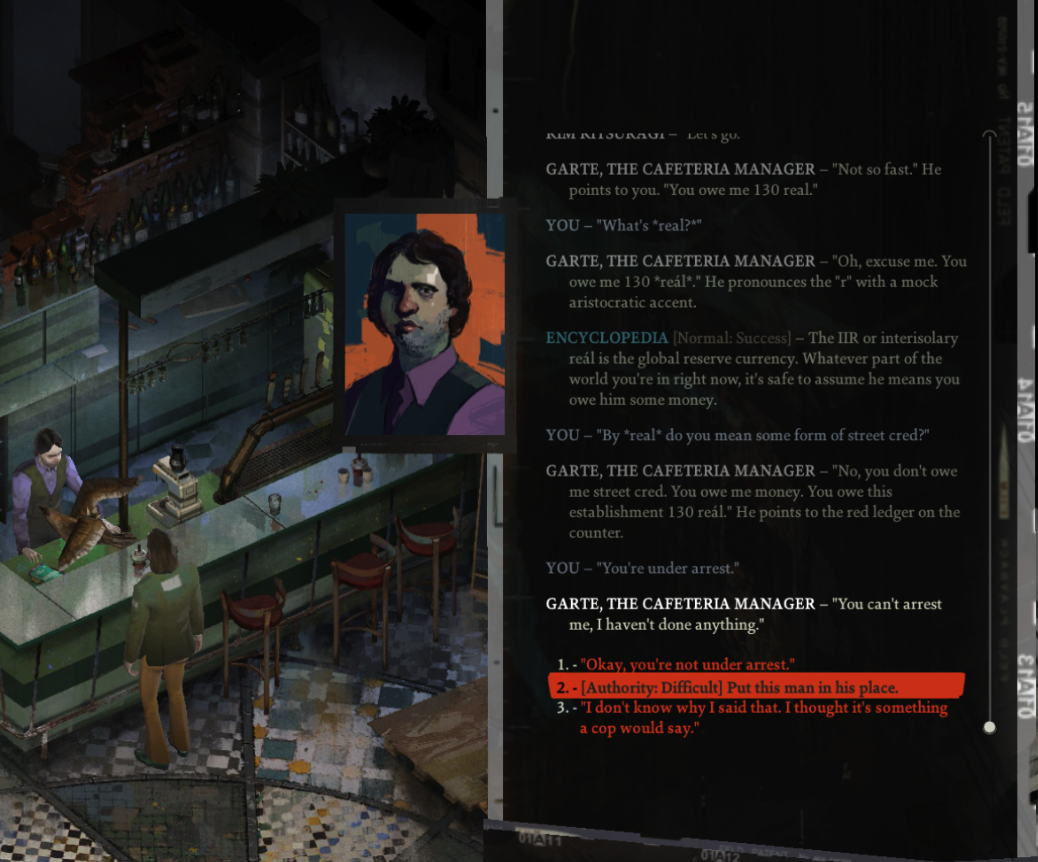
You can approach these situations more reasonably, but I generally recommend you don’t. These little moments of absurdity keep the game funny and lighthearted, even within its depressing setting. Your character is a colossal fuck-up, and you are constantly unearthing the sins of your past. You do so in the city of Revachol; Its streets are pocked with bomb craters, and most of its buildings are dilapidated and full of bullet holes. You walk by old statues and monuments that speak to the powerful place the city once was, now rusting away. After an occupying force put down a violent communist revolution, the city fell into disrepair and economic depression. The only place that is making money is the docks, and the workers have recently decided to go on strike. Tensions in the city are high, and you suspect the murder is somehow wrapped up in the budding political turmoil.
Disco Elysium is highly political. Characters often profess their political views and try to convert you to their ideals. There’s a game mechanic where you can subscribe to the world’s different political ideologies, becoming a communist, moralist (the game’s term for vaguely liberal-leaning centrism), ultraliberal (hyper-capitalist libertarianism), or a fascist. None of these factions is treated with any reverence. You can tell that the writers are more fans of communism (they do self-identify as communists after-all) than fascism, but past that, there is plenty of poignant criticism to go around.
Recognizing that it’s been taking you some time to make progress on the murder, the police force has decided to send you some backup in the form of Lieutenant Kim Kitsuargi. Kim is a serious, rational detective who intends to do his job well. But you outrank him, so you get to call the shots. And if, instead of working on the investigation, you want to go find some teenagers to start a nightclub and do drugs with[4], he’s along for the ride! He may grumble about it, and how you conduct yourself around him can heavily affect the trajectory of the game[5], but there’s not much he’ll actively prevent you from doing.
The Gameplay
If you’re unfamiliar with video games and find learning how to use a controller or buying some dedicated gaming hardware daunting, don’t worry. Disco Elysium is straightforward to play and should run fine on any old laptop or console you’ve got kicking around[6]. There’s no fast-paced movement or shooting, just walking around and reading.
As you talk to people (or the occasional street sign), a window on the right hand of your screen opens to show the current dialogue. It also allows you to choose what your character will say or do next from a list of options.
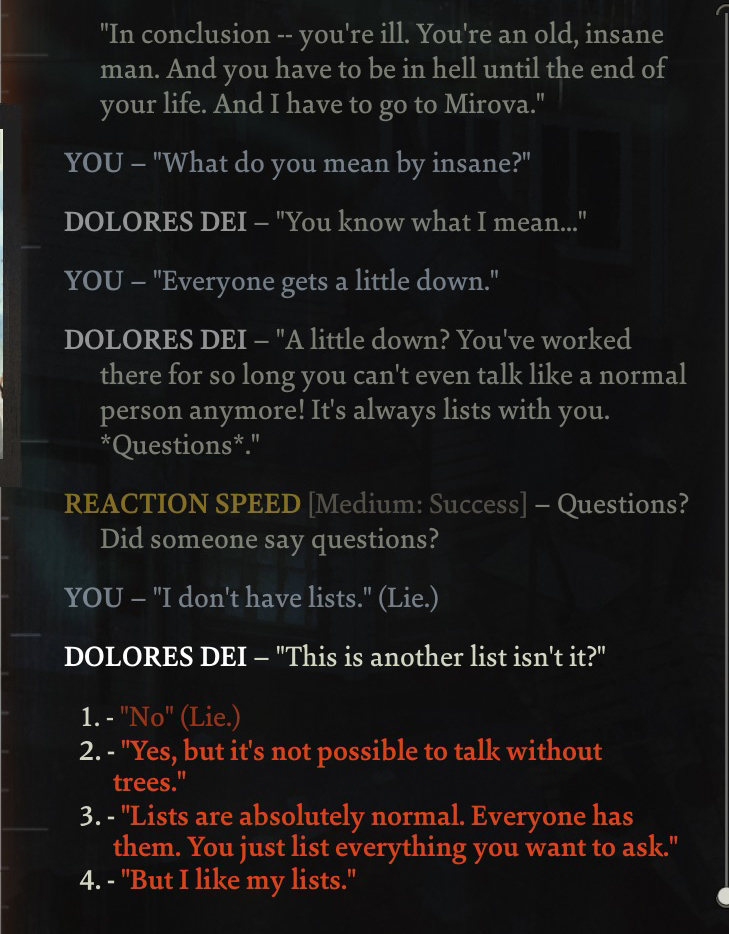
This dialogue system was intentionally designed to mimic a Twitter feed, which the game's creators saw as their primary competition. They disposed of the idiom, “Nobody reads anymore,” and instead recognized that people read social media all the time, so they should cater to that style. This works out fantastically; the writing is snappy, brilliant, and smooth.
Most RPGs give your character a set of skills, and how good you are at those skills determines what your character can do in the game. This is an old-school, nearly ubiquitous system. Some typical examples include:
- Strength: Swing heavy things at your enemies
- Intelligence: Outthink your enemies
- Dexterity: Dance around your enemies
Disco Elysium uses this system, but with refreshing creativity. Here’s a sampling of my favorite skills:
- Encyclopedia: Makes you a know-it-all, turning your mind into a database of facts. It enables you to draw on these facts innately, offering a wealth of background knowledge to all things related and unrelated to your case.
- Inland Empire: The unfiltered wellspring of imagination, emotion, and foreboding. It enables you to grope your way through invisible dimensions of reality, gaining insight into that which sight can’t see.
- Electrochemistry: The animal within you, the beast longing to be unleashed to indulge and enjoy. It enables you to take drugs with fewer negative side-effects.
Each one of these skills acts as its own independent character. They’re constantly chattering in your ear with what they think about the situation, and, another fun twist, they aren’t all reliable. Most games go with the assumption that putting more points into a skill always leads to benefits: having a lot of points in strength means you’re very strong and can pick up whatever you want, and this is always a good thing. But in Disco Elysium, if you put a lot of points into Encyclopedia, it will give you plenty of useful information, but far more useless information. While trying to focus on an essential part of the case, it could tell you about a clue, or it could notice that the bird outside belongs to an interesting subspecies, and then convince you that the witness you’re talking to would really like to hear about this fun fact. Or Electrochemistry will convince you that you absolutely need to lick spilled beer off of a dirty counter because it will give you super-powers.
If you want to punch out a bad guy or convince a witness to talk to you, the game will roll dice to determine the outcome, and use your prowess in a related skill to help bias the dice towards better rolls. This is also pretty standard in RPGs, but in most other ones I’ve played, failing the dice roll is always a bummer. You fail to do something you wanted, which usually locks you out of other interesting bits of the story. But not in Disco Elysium. Sometimes failing a check is much more fun or interesting than passing it.
The little moments of ludonarrative harmony[7] I mention above stand out in a game that explores many themes, but I’d argue none more intensely than the power of choice and the consequences of your actions. Sometimes failure is a misnomer for opportunity, which is a nice perspective to have when playing a character who is constantly re-discovering his old screw-ups. He’s haunted by his distant past of a failed relationship, and his not-so-distant past of taking as many drugs as possible and terrorizing the city. Part of the game is solving the murder, but the real mystery is finding the redeeming points (oh, and also the name) of a man who has hit rock bottom.
I think the typical mold of an ACX review suggests I should start exploring each theme and story-beat of the game and connect it to other high-brow literature or philosophy. I think this would be doing a disservice to you. This medium, and especially this game, is something best experienced yourself rather than told about. Much of what gives the game its charm is its ability to surprise you with its humor, creativity, and crushing sadness. The act of discovery, of finding those little golden nuggets of dialogue and situations that felt they were specifically crafted for you, is part of what makes the experience so enjoyable. So, if any of the themes I’ve mentioned have struck an interest, I urge you to play it.
The Making and Un-Making Of
The game was released in 2019 to massive critical acclaim. At The Game Awards[8] and the BAFTAs , Disco Elysium beat out some industry titans to win best narrative awards. It was not made by any large video game company, but by an Estonian artist collective called ZA/UM, whose “offices” were an abandoned art gallery. The artists were led by Robert Kurvitz, an Estonian author and rock singer.
Kurvitz is an avid Dungeons and Dragons player and built an elaborate world for his friends to play in. He decided to write a novel about the world, and published “Sacred and Terrible Air” in 2013 after working on it for five years. It sold maybe 1,000 copies, and he fell into a deep, alcohol-fueled depression. The support of his friends and the idea of adapting the world into a video game roused him, and he called upon his artist friends and a few shady Estonian investors to help build what would become Disco Elysium[9]. This worked out great for everyone until the assumedly niche title turned out to be a massive, money-making success.
In 2022, 3 years after the game was released, Kurvitz and two other senior writers were fired from ZA/UM. Kurvitz claims he, suspecting the investors and executives were doing something shady with the finances, asked for some documents, which led to his firing. The CEO and investors claim there’s nothing shady going on, Kurvitz and the others are just nightmares to work with, and they had to be fired to preserve company morale. Now everyone is suing each other, all while the company tries to release a mobile version of the game and work on a sequel. If you go onto r/DiscoElysium or other social media, you’ll see fans have clearly taken the side of Kurvitz and encourage each other to pirate the game and boycott anything else ZA/UM makes. Quite a lot of vitriol has been hurled at the planned mobile version, and any other updates that have been made since Kurvitz was fired.
This controversy almost fully subsumes the online discourse around the game now. People Make Games produced a 2.5 hour long documentary that gets deep into the weeds of it all[10]. The TL;DW is that there are a lot of murky, complex business dealings going on behind the scenes, all of which sound rather suspicious, but might not technically be illegal. Also, Kurvitz sounds like a nightmare to work with, and probably deserved to be fired.
No one comes out looking particularly good in this saga, and I can’t help but opine on how it mirrors the political discourse in the game. Self-proclaimed communists (Kurvitz) strike up some shaky alliance with the capitalists (ZA/UM executives) that works out fine until the stakes get raised and giant piles of money enter the picture. Then everything gets cloudy. I think this line from the game points to who will come out on top, though:
“Capital has the ability to subsume all critiques into itself. Even those who would *critique* capital end up *reinforcing* it instead…”
Footnotes
- ↩
For context, the notoriously long novel, Infinite Jest, clocks in at a little under 500k words[a]. It takes most people about 24 hours to finish the game, up to 50 hours depending on how you like to play.
- ↩
Popular examples include Dungeons and Dragons, Skyrim, and The Witcher
- ↩
Well, it’s certainly not the main focus anyway... No spoilers!
- ↩
I highly recommend you take this opportunity when it’s presented to you. In the game, or otherwise.
- ↩
Kim is a fan favorite, so most players try to stay on his good side. Playthroughs where you deliberately upset him are regarded as personally painful to experience.
- ↩
It’s available on computer, Xbox, PlayStation, and the Switch. It’s usually $40, but it will often go on sale for $10. As I started writing this review, the company behind the game announced they were also making a mobile version. I’m not sure what this will look like, but I doubt this will be a good rendition for reasons explained later in this review.
- ↩
A term among snooty video game types that means the way you play the game matches with the story of the game. Its antonym is ludonarrative dissonance, best represented by a game’s narrative that tells you the fate of the world rests on your shoulders and time is of the essence, but then you suffer no consquences if you just fuck off and do a fishing minigame for 3 hours.
- ↩
“The Oscars”, but for video games. Calling it that will seem controversial to the sort of people who really care about video game awards, but I generally ignore those sorts of people.
- ↩
The original title was “No Truce with the Furies”, inspired by the R.S. Thomas poem, Reflections.
- ↩
Noclip is planning to release its own documentary about the game soon. It will try to focus on the actual nuts and bolts of how the game was created, but I’m sure it will also shed more light on the controversy.
[a] Including footnotes