Don't Make No Waves, Don't Back No Losers: An Insiders' Analysis of the Daley Machine
Aka “So You Want to Be a Machine Politician”
Egads! You’ve Been Non-Consensually Time-Traveled!
It’s your favorite part of the week: the arrival of Astral Codex Ten’s latest installment. You’re just settling in to read Scott’s newest, when BAM—the air around you changes pressure wildly, the room begins to vibrate and spin, and your vision fills with colors and fractals that weren’t there a moment ago. That’s when it hits you: you’ve been launched into a cosmic vortex, traveling through space and time. You knew you shouldn’t have popped that fifth Zyn!
When the chaos subsides, you’re no longer in front of your computer in 2024—you’re in a crowded pub in 1965 Chicago, planted on a dirty barstool. And you’re no longer an effete, over-educated ACX reader—somehow, you’ve transformed into a young, working-class Irish immigrant. (Or, if you already were a young, working-class Irish immigrant, then nothing has changed except that now I feel bad for having stereotyped all ACX readers.)
Where just a moment ago you were a complacent member of the laptop class, the new you is full of ambition and grit, eager to rise beyond the station you’ve been born into (well, time-traveled into). But how? You won’t be satisfied with a job in construction or manufacturing, but you don’t have the education to become a doctor or lawyer, the connections to become a financier, or the capital to start a business.
You evaluate the assets you do have. There’s your personality: you’re a natural people person, warm and gregarious, the kind of guy who knows everyone in the neighborhood. There’s your drive: you’re willing to work your ass off, with no task too menial if it might be a stepping-stone to greater things. And lastly, there’s your, um… moral flexibility—or perhaps it’d be better described as a shade of realpolitik. You’d never embrace outright villainy, but you’re willing to keep your head down and look the other way on occasion if you need to.
There’s one career that’s an obvious fit, a path where you can not only make some money, but possibly even gain power, prestige, and respect. Buckle up, kiddo: it’s time for you to enter the exciting field of local politics.
And local politics means the machine. Everyone knows what the machine is, but it’s such a part of life that you don’t even think of it as “the machine”—it’s just the way politics in Chicago always has been and always will be.
The machine is the confederation of organizations and politicians that dominates Chicago. At the top sits the only mayor you’ve ever known, sixth-termer Richard J. Daley. Pretty much no one gets elected to office, passes a law, or even fixes a pothole without the machine’s say-so. Once, every big city had a machine, but by now government reforms, legal investigations, and cultural shifts have brought the rest down: Philadelphia’s bosses have been tamed, Boston’s Curley Machine couldn’t survive its namesake’s imprisonment on bribery charges, and future airport icon Fiorella LaGuardia dismantled New York’s Tammany Hall.
Only Chicago’s remains. It’s not only alive and well, but more powerful than it’s ever been. And it just might be your ticket to riches—or at the very least, to a better life than the one your parents had.
Luckily, you have a guide with you. Although the Zyn-powered time travel vortex consumed your Oura ring, crypto wallet, and vintage “FTX Summer Intern” t-shirt, one accessory made it through with you: Milton Rakove’s 1975 book Don’t Make No Waves, Don’t Back No Losers, an insider’s account of the Chicago machine’s inner workings.
Even better, Don’t Make No Waves isn’t some boring work of egghead political science. It’s a firsthand ethnography: to write the book, Rakove went inside the machine, volunteering for the local party and even running (unsuccessfully) for office himself. “One stint on the campaign trail,” he writes, “provided more insights than would a half-dozen models of a campaign structure.”[1]
And so, with Rakove as your non-antisemitic Svengali, you begin your journey.
Becoming a Candidate
There are two things you need to become a candidate for office. And because this is the world of machine politics, they aren’t things like policy positions or a campaign organization. Here, there are only a handful of “voters” you need to convince: the dozen or so men who dominate the Cook County Central Democratic Committee, the machine’s main organization. If those guys decide to slate you for office, you’re pretty much guaranteed to win: they’ll clear out the competition and put their powerful get-out-the-vote operation behind you. If they decline to slate you, you don’t stand a chance.
Now, if you were already rich, you could buy your way into a lesser office with a generous donation to the party coffers. But, like most aspiring candidates, you’re not. Not only have you become a working-class immigrant, but that cosmic vortex ate most of your wallet—all that remains is your now-useless Costco membership card.
Since you can’t Mike Bloomberg your way into office, you need two things: the right ethnicity, and a track record of proven loyalty.
The “right” ethnicity is any one with voting power in Chicago, so it’s a good thing this vortex made you Irish. Being Polish, German, Italian, Jewish, or even Black could work too, but the Irish are the largest ethnic group in the city, and thus the dominant force in its politics[2]. Like everyone else, you’re familiar with the old saying about Chicago: “The Jews own it, the Irish run it, and the Blacks live in it.”
With your ethnic credential secured, it’s time to prove your loyalty to the party. And there’s no question about which party. Vaudeville comic Will Rogers once joked, “I am not a member of any organized political party—I am a Democrat,” but Will Rogers never lived in Chicago. Chicago is a one-party town, and the machine is the Democratic machine.
Actually, it’s not just Chicago—the vast majority of big-city machines were Democratic. Why the Republicans never managed to develop their own machines could be an entire essay in itself, but the biggest factor was the way the machine used patronage jobs to maintain its influence. This worked well with the (on average) poorer Democrats, but not so well for the (on average) richer Republicans. For a middle- or upper-middle-class Republican voter, a patronage job might well have been a step down!
You’ll think more about the Republicans later. For now, it’s time to prove your loyalty by volunteering for the Democrats. And that means volunteering for your local committeeman.
Itty-Bitty City Committees
Chicago is divided into fifty neighborhood districts called wards, and each ward has a local representative called a committeeman[3]. This is technically an elected position, but like most local offices, in practice it’s entirely controlled by the party: becoming a candidate requires collecting so many signatures that it’s essentially impossible for anyone to gather them without a bunch of machine volunteers like you helping out.
You’ve never volunteered for anything before—typical ACX reader that you were, you took the efficient route and just donated a portion of your salary to effective altruism-related causes. On your first day, your ward committeeman explains how things work.
Your ward’s entire performance will be judged on a single day: election day. Your committeeman’s job—and therefore your job—is to deliver as many votes as possible in the ward for the machine’s candidates.
Your ward’s performance is all that matters. If the party gets crushed overall but does great in your ward, you and your committeeman had a great night. If the party cruises to victory but underperforms in your ward, you’re in trouble. And your committeeman sure as hell better have predicted the ward’s vote totals accurately. If he predicts the party will get 60% of the vote in the ward and it actually gets 80%, he won’t be rewarded for over-performance—he’ll be punished, because he’s just demonstrated that he doesn’t have a clear grip on what’s going on.
Your first trick for getting out the vote is handing out jobs. Chicago in this era has roughly 30,000—yes, 30,000—patronage jobs: low-level government roles that can be filled whoever the ward captain selects. That’s roughly one patronage job for every 100 residents, which means it’s pretty easy for your committeeman to hand out enough jobs that almost everyone in the ward has a cousin, friend, or neighbor who’s benefitted from the party’s largesse.
But it doesn’t stop there: on top of the official government jobs, there are several thousand faux-patronage jobs in the private sector. These jobs aren’t technically under the party’s control, but a friendly word from a party official is usually all it takes to get someone hired. After all, the guys running these businesses either got a favor from the party already or else will want one in the future.
For the most part, these are pretty good jobs: they pay well, they provide good benefits, and they don’t require much education, or even much work. The really good ones don’t even require showing up at all! Sure, the patronage system sometimes results in incompetent people being appointed to these positions, but as long as the incompetent remain a minority, the system keeps working. As one anonymous employer said of his ward’s committeeman: “He’s reasonable—if he sends you five guys to work, only two of them are illiterate.”
Of course, you can’t explicitly force people to vote for the Democratic ticket in exchange for their patronage job, but you don’t have to. The average voter in your ward isn’t particularly interested in ideology or political theory; they’ll be naturally inclined to vote for the party that’s putting them to work. Besides, they know that if you’re voted out, their employment prospects—or their cousin’s or friend’s or whatever—are likely to suffer as well.
You even get a patronage job for yourself, which somewhat eases the pain of your volunteer position being unpaid. Your committeeman probably has one too, the kind that enables him to spend most of his working hours on party work instead. If he’s extra-ambitious, he might even own a business on the side, ideally one that he can use his position to funnel government contracts to.
In your past life as a 2020’s internet nerd, this system would have struck you as horribly corrupt, but now, you and your committeeman genuinely don’t see it that way. You’re using your office to help the members of your district, which is exactly what politicians are supposed to do. Granted, you’re helping them in a scattered, ad-hoc way, but that’s just the way things go. The defining attitude of a typical machine politician is one of practicality and small-c conservatism, common to recent immigrants: the system is the way it is, and you just try to work it as best you can.
Besides, you have more ways to help your ward’s citizens than just handing out patronage jobs. In fact, outside of the weeks leading up to Election Day, helping your constituents is pretty much all you do. Once again, you do this in the most small-scale, personalized way imaginable: committeemen and their teams spend their days literally going door-to-door, doing favors and handling complaints one at a time. They get streetlights repaired and trash cans replaced, arrange free legal services, and even give talking-tos to young miscreants. A good committeeman is basically a one-man impromptu welfare state.
The best ones go above and beyond to a degree that’s hard to fathom of today’s government services. Don’t Make No Waves gives the example of a committeeman who accompanied a new immigrant on seven separate trips to various government officesl in service of helping her get citizenship. Another spent multiple days sifting through trash at the dump to find a wad of cash one of his constituents accidentally discarded, a level of service that guy who threw out 8,000 bitcoins could only dream of.
As Election Day approaches, your get-out-the-vote operation shifts into full gear—and it puts those automated texts from Nancy Pelosi to shame. Here’s how one committeeman, Arthur Varchmin, delivered a dominant Democratic performance in his ward:
Varchmin started working on his voters a year ago. He informed them all, verbally and by letter, that the city budget was being reduced by the mayor and that next year their property taxes would be lower.
Meantime, Varchmin went to the city map department, obtained the legal description of every parcel of property in his precinct, some 208 in all. Then he went to the county assessor's office and got the tax bill for each. Only four of the 208 were increased. He then reminded his voters that what he had told them a year ago about their taxes was true.
"Some tried to argue with me, but I produced the figures right on the spot.”
City Council: Where the Ambitious Go to Do Nothing
When you fantasized about time travel as a kid, you always thought you’d hang out with Socrates in ancient Greece, or maybe give the old kill Hitler thing a try. At the very least, you thought you’d at least get to meet your past self and tell them not to post that one YouTube video where they’re smoking salvia.
Now it’s actually happened, and somehow all you want to do is secure a spot on Chicago’s City Council[4]. You’re ready: you’ve proven yourself as a loyal party volunteer, and maybe you’ve even spent some time as a ward committeeman yourself. The party agrees to slate you, and you win with barely any campaigning.
A councilman’s job is so easy that it makes being an Account Strategist at Google look like being an Alaskan crab fisherman. Unless you’re one of the mayor’s top two or three lackeys, you can pretty much get away with doing absolutely nothing. Here’s how the Chicago Tribune described a typical council meeting in 1965:
Alderman Thomas Keane arrived 11 minutes late for a meeting Tuesday morning of the council committee on traffic and public safety, of which he is chairman. The committee had a sizeable agenda, 286 items in all to consider.
Ald. Keane took up the first item and, without calling for a vote, he declared the motion passed. He followed the same procedure on six more proposals. Then he put 107 items into one bundle for passage, and 172 more into another for rejection, without a voice other than his own having been heard.
Having disposed of this mountain of details in exactly ten minutes, Ald. Keane walked out. The rest of the aldermen sat around looking stupid.
If you don’t have to do any work or get any legislative influence, why do you even want to be on the city council? Most likely, you want to make some money—you could own a business and use your government connections to help it grow, or you could just trade favors the old-fashioned way. Or maybe you just want to feel like a big shot. As a councilman, you get to walk at the front of all the big parades, and everyone in your neighborhood knows who you are and sucks up to you. The position comes with essentially no formal legislative power, but it comes with a lot of informal social power.
It also comes with de facto immunity from all but the most serious crimes. Case in point: longtime alderman Paddy Breuler once shot two cops in a bar fight—because, he claimed, they called him “a fat Dutch pig”—and suffered no consequences. (In his defense, he wasn’t even that fat.) Violence involving aldermen is common, as they often got themselves mixed up in various shady situations. That’s why in 1967, a newspaper reporter wrote: “This was a good year for the City Council. Only 4% of aldermen were shot.”
One thing you almost certainly don’t want to do is use your seat as a springboard to state or national office. Almost without exception, machine politicians are incredibly parochial. To some degree, this is just a necessary trade-off: the do-nothing jobs and low-level corruption that flies in Chicago would be politically radioactive at the state or national level. But it’s also the rational move given your desires. If you care less about power, and more about money and social climbing within your community, then sticking to local politics is better. It provides more money-making opportunities and more of the direct connection with your constituents that you, as a social gadfly, thrive on[5]. One party politician explained why he didn’t care about higher office like so: “How many jobs does a U.S. Senator have to give out anyway?”
Another reason you’re probably not interested in higher office has to do with your likely attitude. This is a stereotype, of course, and it doesn’t apply to everyone, but the truth is that you and most of your kind are just a parochial, local-minded guy. You’ll probably die in the same neighborhood you were born in, surrounded by fellow immigrants who share your background and ethnicity. It would never occur to you to move somewhere else. It might not even occur to you to take a vacation outside the state. You identify first with your neighborhood, then with Chicago, and only lastly with the United States as a whole.
And then, of course, there’s this: if you run for higher office, you might lose. As a councilman, as long as you don’t cross the machine, you can probably die in office (unless you get shot in a bar fight).
Though the council is ostensibly nonpartisan, the machine uses its power over the Board of Elections to make sure that only its candidates have a shot. It schedules city council elections on off years to insulate aldermen from national trends, protecting them in the event Republicans have a state- or country-wide sweep. It also schedules them to coincide with the Democratic mayoral primary, but not the Republican one, which depresses turnout for Republicans. And to top it all off, it makes sure they fall during the coldest time of the year. Thus, only two groups of people bother going to the polls: the true believers and those brought there by the machine’s extensive get-out-the-vote operation.
As a result, out of 68 aldermen, only a handful are Republicans or independent-minded Democrats. The vast majority are loyal rubber-stampers like you.
King Richard
The man you and your fellow aldermen are rubber-stamping for is Chicago’s longest-serving mayor, six-termer Richard J. Daley[6]. Daley didn’t create the machine, but he consolidated it and, in many ways, came to define it. Like you, he started as a ward committeeman and worked his way up through the system, becoming both mayor and, simultaneously, the head of the official party organization.
Daley is the platonic ideal of a machine politician. He’s obsessed with his work and with Chicago—as a fellow lawmaker said, “Daley loves this city like you love your wife and kids. He considers Chicago his city and he doesn’t want anyone else to screw it up.” His entire “personal life,” to the extent he can be said to have one, is based around Chicago politics: he has no friends, only constituents, and he sees them not as a faceless body politic but as individual people he can relate to one by one. He attends every parade, luncheon, or ribbon-cutting ceremony he can possibly get invited to, and he fucking loves it[7].
Daley is pretty honest, at least by the standards of Chicago politicians—three of his four immediate predecessors had major corruption scandals. Sure, he engages in his fair share machine patronage: over 100 of his relatives have government jobs, and he gets a highway named for an old buddy with no notable political or civic accomplishments. But he doesn’t steal from the city or conspicuously enrich himself. In fact, throughout his whole mayoralty he lives in the same blue-collar area he grew up in.
The Daley governance strategy is hard-nosed and cynical, yet undeniably brilliant. The key is to focus on low-controversy material issues, like building infrastructure, and to avoid addressing, or even mentioning, anything related to ideology or political philosophy. If a controversial issue becomes so salient that silence is untenable—as would happen with civil rights—you slow-walk it by punting it to a committee and hoping the public has a short memory. If all goes well, by the time the committee issues its recommendation, the issue will be out of the headlines and everyone will have moved on.
You’ll never be LBJ or FDR if you govern like this—hell, you won’t even be George H. W. Bush. But if you play your cards right, you can stay in office forever, and that suits Daley just fine. Like most machine politicians, his number-one goal is self-preservation.
(Don’t) Rage Against the Machine
Given that it’s the sixties, it occurs to you that maybe you should try the counterculture. You consider taking up yoga, dropping acid, or buying a VW Bus, but then you remember that as a Chicago politician, the most radical thing you could do would be to become a Republican.
Remember the Republicans? So far, we’ve given this as much space in this review as they occupy in local politics: basically none. In general, there are only one or two on the city council, and not for long. But past the city limits, the GOP has a lot of power. Over the past few decades, they’ve regularly controlled the state senate, governor’s office, and presidency. It doesn’t take a psychedelic revelation to think maybe they should try using some of that power to take a crack at the machine.
But they’ve never really tried. This is the most counterintuitive fact about the machine: it relies on the tacit cooperation of state and national Republicans to maintain its power.
If you can look past the party labels, the status quo actually isn’t too bad for the Republicans. For one thing, although the machine is Democratic, it’s hardly liberal. It rarely pushes left-wing policies, and it’s quite friendly to corporate interests. As the Chicago Tribune once wrote, “With Mayor Dick Daley, who needs a Republican?”
On the rare occasion when an ambitious Republican politician in the city does gain some traction, the machine’s non-ideological nature means it can usually co-opt them by convincing them to switch parties. They won’t even have to change that many of their policy positions.
Outside of the city limits, the machine isn’t even all that partisan. It only cares about Democratic victories in offices that are essential for its own self-perpetuation: it keeps an iron grip on the state attorney’s office, which could cause them legal trouble, but it doesn’t really care if the governor or president is a Republican[8]. To stay on good terms with national Republicans, the machine even has an official policy of supporting every president, regardless of party, on all issues not important to their local interests. Daley, for example, supported the Vietnam War to the very end, and was vocally against the New York Times publishing the Pentagon Papers.
Most importantly, though, Republican officeholders feared the unpredictable nature of political change. Once a reform wave gets going, who knows where it’ll end up? One day you’re Louis XVI, calling for a new constitution to solidify your power; the next day, a mob storms the Bastille and your head gets separated from your body. A predictable electorate benefits the insiders in both parties, and any change that pushes machine Democrats out of office might end up with Republican incumbents getting thrown out too. Even if such a change would benefit the Republican party in the long run, it’s not in the interests of any individual Republican officeholder[9].
Not With a Bang
By now, a decade has passed since that cosmic vortex sent you tumbling back through time and space. It’s 1975—the year of Don’t Make No Waves’ publication. You’ve become a wealthy and successful Chicago politician, secure in your position, your old life in the year 2024 but a distant memory. The words “Astral Codex Ten” no longer have any meaning to you, and the idea of putting ketchup on a hot dog has become inconceivable.
You can’t imagine Chicago without the machine, and neither can Don’t Make No Waves author Milton Rakove, who confidently predicts that the machine isn’t going anywhere. Yet only a year later, Daley will die, setting off a chain of events that will end in the machine’s disappearance. Within a decade, it’ll be greatly diminished; another decade later, it’ll be gone entirely.
As in a Greek tragedy, the machine has unknowingly sowed the seeds of its own decline. As the immigrants it worked so hard to help get richer, they—and especially their children—will move up the political version of Maslow’s hierarchy. No longer focused entirely on securing their place in America, they’ll begin to develop stronger ideological beliefs, which means they’ll be less inclined to vote based on handouts alone. Soon, they’ll begin to crave not only material success but respectability, which the machine can’t provide.
Meanwhile, Chicago’s growing Black population will begin to want more than just the occasional Black machine representative, and the increasing salience of civil rights will make the Daley strategy of ignoring controversial issues impossible. In reaction, much of the city’s white population started moving to the suburbs, where they were outside the machine’s grasp entirely.
All this will happen as the national Democratic and Republican parties get deeper into the long process of polarization kickstarted by LBJ’s passage of the Civil Rights Act. When ticket-splitting is common, the machine can get people to vote for its candidates locally, even if they vote Republican for governor or president. But as people begin to vote more consistently on party lines, the machine will find itself less able to remain immune from national trends.
Besides, the machine’s leaders, always parochial, are getting old, and they’ll be distracted by infighting after Daley’s death. Perhaps a vibrant, forward-thinking machine could see these trends coming and adapt. But even if they could stave off their decline temporarily, a more educated populace and greater media scrutiny will make the death of the machine inevitable.
Or at least, that’s what most historians say.
It’s hard to imagine a machine like Chicago’s existing today. But if you squint, a version of the machine dominates the politics of the 2020s: the one-man machine named Donald Trump. Sure, he’s not a master organizational tactician like Mayor Daley. But a lot of the other similarities are there: he uses politics for his personal enrichment, prizes loyalty above all else, and his ideology—to the extent he even has one—is driven primarily by the need for political survival. He even hands out “patronage” jobs to his family members!
Trump’s Twitter account is today’s version of a classic machine politician’s forging of individual connections with their voters: both eschew traditional media in favor of more personal bonds. In the modern era of social media and anti-establishment sentiment, the machine could never be a faceless organization. It’d have to be a celebrity-driven cult of personality. And it’d look a lot like Donald Trump.
So Did You Like the Book or What?
Just as the machine can’t last forever, neither can the time travel gimmick I’ve been using to frame this review, which I will now leave behind to share some thoughts on the book itself.
I became interested in this book because “the machine” is one of those terms I’ve heard repeatedly over the years without ever really understanding what it meant, beyond a vague association with cigar-chomping guys in pinstripe suits. I was curious to learn more, and I suspected, accurately, that machine politics might involve some entertaining stories.
I appreciated the fact that Don’t Make No Waves is a firsthand account, but its insider nature left me with a lot of unanswered questions. It’d make a great handbook for my imaginary time traveler, but as someone who moves through time the normal way, I wanted more than I got. For example, the book is conspicuously silent on how the machine got started in the first place, which I imagine is a pretty interesting story. It also doesn’t engage at all with other cities’ machines—how were they similar to, or different from, Chicago’s, and why did they die long before its did? In a way, Don’t Make No Waves is as parochial as the politicians it describes.
Also like its subjects, Don’t Make No Waves is surprisingly uninterested in actual governance. I appreciated that the author didn’t waste time moralizing about the machine’s ethics, but I wanted to know more about how well the machine actually ran the city. The author repeatedly asserts that Chicago is no worse-governed than any other big American city in the 1970’s (admittedly, incredibly faint praise), but never provides any evidence.
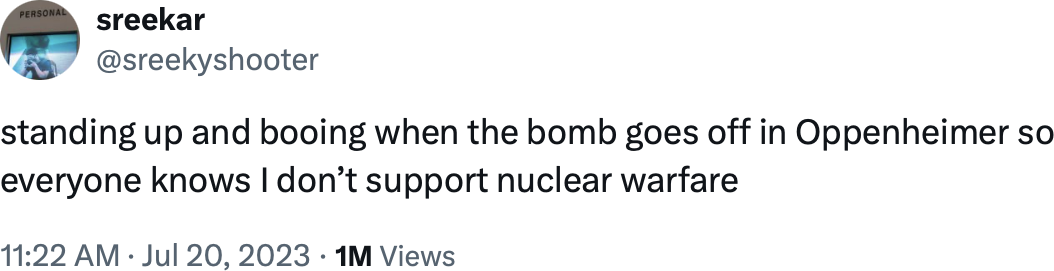
I wanted a tiny bit more of this attitude in the book
Without a sense of the machine’s effectiveness at actually governing the city, it’s impossible to judge how much its corruption mattered. I came away from the book grateful that government jobs (mostly) no longer go to some random politician’s cousin, but I also came away with a different emotion: envy. I was left longing for a Democratic party that’s as organized and competent as the one described in the book, instead of the one we have now, best illustrated by this Simpsons meme:
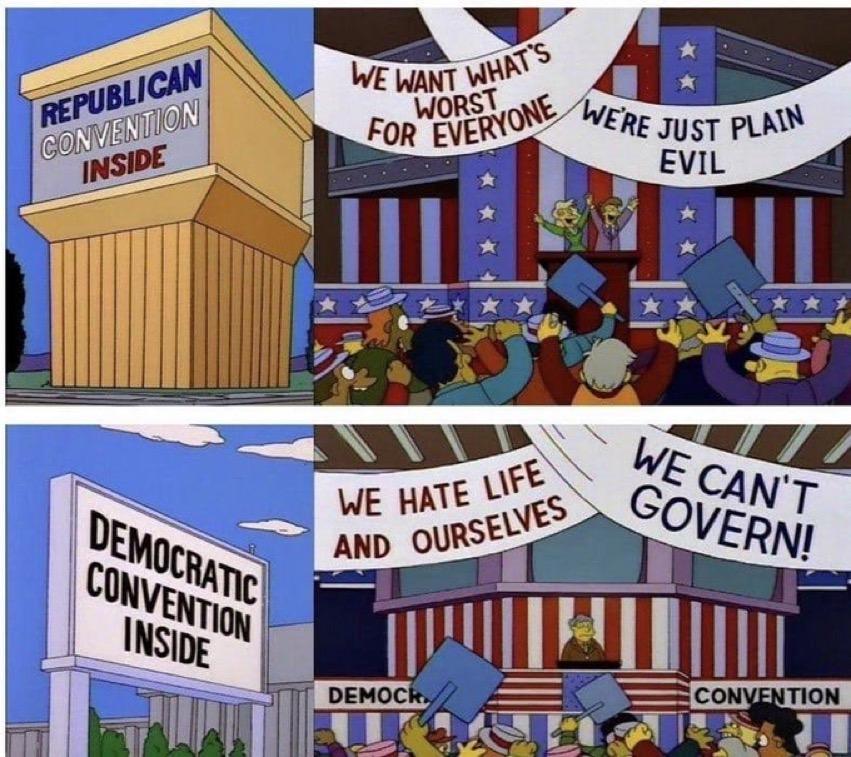
Because ultimately, that’s what I wanted to know: were the trade-offs of machine politics in any way worth the results? Could we possibly bring back some of its positive elements without all the downsides? If a little more corruption and graft is what it takes to get there, that’s a trade I might be willing to make.
I still don’t feel like I have the answer to that question, but I’m grateful to have learned more about what politics was like during other times in this country’s history. Such knowledge is always interesting, but it’s especially relevant today, when every election involves talk of American democracy itself being on the ballot. When I remind myself that “American democracy” has had many different meanings throughout this country’s short history, my nightmares are soothed. I may still have unanswered questions about the machine, but at least I’m sleeping better.
Footnotes
- ↩
This also means the book is much less well-sourced than the typical work of political science. Although the author interviewed many machine politicians, every single one of them declined to be named.
- ↩
Two other factors contribute to the disproportionate Irish representation in Chicago and other cities. First, many of the first wave of immigrants ran local gathering places like bars and taverns, which gave them a head start forming local connections. Secondly, as non-continental Europeans, the Irish were mostly immune from the factional rivalries and prejudices that many other immigrants brought over from the continent.
- ↩
And they are all men. The term won’t be officially changed to the more gender-neutral “committeeperson” until… wait for it… 2018.
- ↩
I’ve oversimplified things for this review. In reality, the path wasn’t always so linear: you might want to hold an administrative office like treasurer or county assessor, which were actually the seats of significant power.
- ↩
This is decidedly no longer true today, when national politicians can use the internet and social media to connect directly with their constituents, and can easily get rich once leaving office with a cushy think-tank job or a spot as a TV commentator.
- ↩
His record will later be beaten by his son, Richard M. Daley, who also served six terms (from 1989–2011), but who’ll slightly outlast his father by not dying in office before his last term is up.
- ↩
He’s also incredibly uncharismatic and a notoriously poor speaker. Way before George W. Bush, Daley was a master of malapropisms, like the time he addressed a meeting of the League of Women Voters as “ladies and gentlemen.”
- ↩
In forty years, machine Democrats only lost control of the state attorney’s office twice, and once was when they renominated someone who had already been indicted for hiding evidence.
- ↩
The one powerful Republican who did try to break the machine was the notoriously vengeful Richard Nixon, who was convinced that Chicago Democrats had stolen Illinois, and thus the presidency, in the 1960 election he lost to JFK. His Justice Department managed to get some machine politicians on corruption charges, but it wasn’t enough to shake the overall system, since most of the ways the machine maintained power weren’t technically illegal.