Drunk: How We Sipped, Danced, and Stumbled Our Way to Civilization
Apéritif
I like wine and ale, so I probably wanted Drunk to be a different book than it was as a result before I started reading. I wanted this book to say that actually recent about-faces in guidance on alcohol use were all wrong, pop-science articles from several years ago calling moderate drinking good for you were right, and that more recent complete arguments against any drinking at all were overzealous safetyism. This is despite being aware of the dangers of confirmation bias. It is not the book that I was expecting it to be either in this bad write-the-bottom-line first way, nor in a good determine-what’s-true way, but rather a different book with a different focus.
This book is definitely for alcohol and other intoxicants, albeit with cautions and exceptions. And Slingerland does describe himself as a "philosophical hedonist" against "general queasiness about risk". But the discussion in Drunk takes more of a society-wide, species-wide view. Whether the infamous J-shaped curve for risk for Coronary Heart Disease and Diabetes, with its lowest point at about 1 to 2 drinks per day[1], is “real” is not deeply explored[2]. The question of whether light drinking might be individually healthy is dismissed as irrelevant:
Since pleasure per se is rarely accepted as publicly defensible rationale, defenders of alcohol use, for instance, have generally focused on its supposed health benefits. Wine lowers cholesterol! It’s good for your heart!
The scientific literature on the health benefits of alcohol consumption is, in fact, mixed and confusing...
And:
All things considered—liver damage, calories, and all—a spot of social drinking is good for you, and this has nothing to do with any French paradox or narrow health benefit.
Instead, Slingerland makes a case that the psychological effects of drinking have cultural and social benefits. With a lot of squinting, this can be thought of as pulling the rope sideways: whether alcohol is beneficial or harmful to any particular individual doesn’t matter as long as group benefits outweigh any reasonable measure of the sum of individual harm. While there are stories of drugs and alcohol improving individuals lives, that is not the focus. And although it's acknowledged that drinking can be fun, that's not the point either.
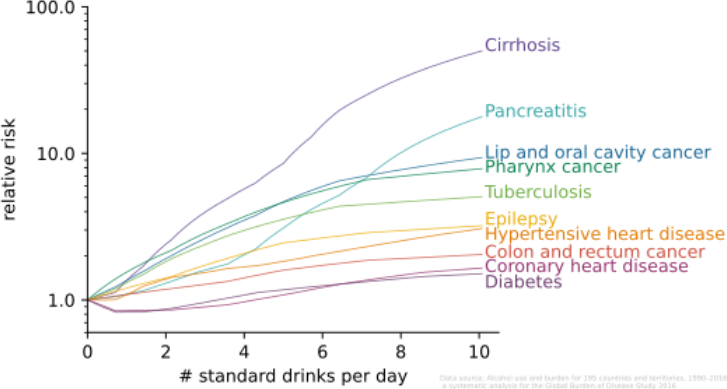
Dynomite, CC-BY SA__, https://en.wikipedia.org/wiki/File:Health_risks_of_alcohol_consumption.svg . I was tempted to zoom in on the portion < 2 drinks a day to better show the dip for coronary heart disease and diabetes, but the overall chart shows that the confusion on individual health effects that Slingerland mentions is really only plausible for light/moderate drinking.

What this book says could easily have been tweaked into an argument that alcohol is different from most other psychoactive substances and ought to be regarded as special and accepted to a greater degree. There are some hints of this in Drunk. But at first glance, it seems like alcohol, cannabis, ecstasy, peyote, LSD, kava, and opium all get mishmashed together in this work, as
…people have been getting intoxicated—drunk, stoned, or lit up with psychedelics—for a really long time, all over the world.
So it initially feels slightly unclear about whether the discussion is about these supposed benefits of alcohol or human tendencies to seek out psychoactive substances and put them into cultural practices instead. Slingerland sort-of addresses the topic by indicating that he does not consider stimulants like caffeine and nicotine to be intoxicants, as they improve rather than decrease physical and cognitive performance[3].
The source of this intellectual jumbling together of disparate-looking drugs seems to be which intoxicants are used by some culture in a social practice. Using this definition allowed me to find that Slingerland does actually give the use of ecstasy "in modern rave culture, where the powerful boost in serotonin created by MDMA intoxication is combined with driving, repetitive beats and group synchrony" as an example of what he's talking about; I initially hadn't remembered it being in the book but found it after doing another search. This can't be quite right though, as Slingerland mostly considers caffeine only to contrast it with alcohol, and people meeting for coffee is unremarkable. Maybe it's intoxicating drugs that are used in a ritual? An endnote to the introduction indicates that drugs can either be normalizing (caffeine) or intoxicating, categories which are themselves from Stephan Braun's Buzzed: The Science and Lore of Alcohol and Caffeine. Regardless of how they are defined, Drunk is an argument for intoxicants in general and not just ethanol.
Alcohol in particular is not usually thought of as socially-beneficial. While individual health concerns are emphasized in modern arguments against drinking, the supposed social costs of the drug are also reasons typically given to avoid its use and availability, and such arguments have been made for a very long time. Could it have not only been unfairly maligned as one of the most socially harmful drugs, but have such estimates completely gotten the direction of the ultimate effect on larger groups wrong?
| U.S. Prohibition era poster, from https://prohibition.osu.edu/gallery/posters | Modern CDC infographic, from https://www.cdc.gov/alcohol/onlinemedia/infographics/cost-excessive-alcohol-use.html |
Main Course
Drunk starts by highlighting that it is actually strange that drinking alcohol is not only a thing that people can do, but enjoy doing. Alcohol has many obvious negative effects at first glance to indicate it's just bad for the imbibing individual. Besides that, historically it was very expensive, requiring a reservation of grain or similar produce that could have been used directly for food instead:
It should puzzle us more than it does that one of the greatest foci of human ingenuity and concentrated effort over the past millennia has been the problem of how to get drunk.
Organized into five chapters, "Why Do We Get Drunk?", "Leaving the Door Open for Dionysus", "Intoxication, Ecstasy, and the Origins of Civilization", "Intoxication in the Modern World", and "The Dark Side of Dionysus", the middle three chapters of the book and the ideas presented in them actually comes across as slightly jumbled. The first chapter makes sense as an introduction of why alcohol use is at all mysterious in the first place and reviewing shortfalls of common explanations, and the last chapter makes sense as an intoxicants are good, but… end, but the overall argument is spread across these middle chapters with – just a bit – of pop-sci-book fluff.
Putting the important points of Drunk together: Rather than an evolutionary mistake, human beings are naturally inclined to intoxication, metaphorically Homo imbibens, a term attributed to Patrick McGovern, rather than Homo sapiens. Early hominids sought out over-ripened fruit that had low but notable quantities of alcohol, the "Drunken Monkey" hypothesis, and also inherited capabilities to detoxify and consume plant toxins. In early humans this drive for alcohol, and maybe other intoxicants as well, caused agriculture to start in a "Beer Before Bread" history. As human civilization arose and society developed, parallel biological and cultural evolution ensured that the use of the available intoxicants would be interwoven with other practices and infused in society. We see this today, in the use of intoxicants for social bonding and helping with out-of-the-box thinking (humans are "required to be creative, cultural, and communal"). The social use of alcohol is not incidental, but is a subtle culturally-transmitted technology that allows humans to cooperate in situations where defection would otherwise be the norm, and intoxication allows us to more easily suss out motives and thoughts.
ACX readers, especially those also familiar with the LessWrong sequences, are likely to enjoy the discussion of alcohol in a both a biological and cultural evolutionary context, perhaps with some mental translation to selection and mild eye-rolling at the personification of evolution in the introduction, described as being kept up at night by the possibility of humans drinking Jäger shots. The book gets better quickly: Slingerland later explains natural selection doesn't work that way and evolution could get stuck with less than perfect overall designs – in principle, such as sticking with a brain that's rewarded by intoxication when that is nonetheless harmful to survival and reproductive success.
In trying to gauge how accepted or controversial this is, I had to read over Donald Brown's lists of human universals several times before realizing that although "intoxication" is not listed, "mood- or consciousness-altering techniques and/or substances" is. "Feasting" is also considered a universal and there are several descriptions in Drunk of alcohol and drug use accompanying feasts and festivals. A book by Ronald Siegel, arguing that intoxication is a universal drive, was notable enough to get a blurb in Time magazine in 1989 – the 2005 3rd edition of this book, Intoxicated, changed the subtitle from "Life in Pursuit of Artificial Paradise" to "The Universal Drive for Mind-Altering Substances" and is in the bibliography for Drunk.
I am slightly disquieted to find some overlapping arguments from SIRC, which has been accused of having ties to the alcohol industry and is an advocacy think-tank regardless. Nonetheless, this is not a counterargument but still weak evidence in favor of the contents of Drunk. (Think tanks very rarely lie?)
Somewhat similar game theory ideas about alcohol use appear in a 2009 paper by Jan Heufer. I haven't looked at this very closely at all, but there's a note in the abstract that "If coordination on an exclusive technology is efficient, social norms or laws can raise efficiency by legalizing only one drug" which sounds like another possible reason for the ubiquity of alcohol over other intoxicants besides the ones given by Slingerland.
Returning back to Drunk itself, two theories for human use of alcohol are mentioned. The "hangover theory" supposes low levels of alcohol were normal in the past – itself either leaning on the "Drunken Monkey hypothesis" or various ideas about fermented beverages being antimicrobial or improved nutritionally over the unfermented grain – and that modern behavior around alcohol is simply a misalignment caused by greater availability in the modern world. In dismissing this idea, Slingerland explicitly leans on Heinreich's ideas on cultural evolution (Ch 1, footnote 46), and reasons that to improve nutrition by fermentation, there would really be selection for porridge rather than alcohol, and dirty water would be more likely to result in water-boiling rituals. I did not actually know porridge can be made by fermenting oats prior to reading this.
While the term "evolutionary hangover" is regularly applied in other contexts, this collision in terminology makes for very confusing reading in this book. I had to constantly remind myself that the hangover theory has little to do with an alcoholic hangover. A joke in the intro about how if it were true, then evolution should reach for some aspirin, does not help.
In contrast, "hijack" theories suppose alcohol is evolutionarily novel. Think "chemical wireheading" although of course that phrase is not used in the book. In this view, alcohol consumption continues because humans haven't had a long enough evolutionary time frame for there to have been strong selection against drinking alcohol. This explanation is rejected in Drunk, among other reasons, by noting that an unpleasant reaction to alcohol, caused by a mismatch of ADH and ALDH, leading to a build-up of Acetaldehyde on ingesting alcohol, has been around for about 10000 years, and could easily affect nearly everyone at this point. In reality, this "is most common in East Asians" and even then to a limited extent. Drunk also considers cultural evolution again: it's very easy to imagine a world where prohibition offered societies a decisive advantage that alcohol-free cultures came to utterly dominate the world even in just the last century, but that didn't happen.
The argument that if reduced efficiency for ALDH were adaptive then it'd be everywhere has been flipped around elsewhere as "Evolution May Make it Harder for Humans to Hold Their Liquor". I don't know if there's a good explanation contra Slingerland for why it hasn't already, but the amount of time this would have taken is not overlooked in Drunk, but instead Slingerland presents examples of similar mutations spreading widely (for example, lactose tolerance in some European populations)[4].
Having established a mystery as neither perspective can explain why drinking alcohol is so popular, Slingerland begins to examine human nature, considering game theory, evolution, and the structure of the brain. Chapter 2, "Leaving the Door Open for Dionysus", explains that humans are a strange social species, acting in some cases almost more like hive insects in terms of cooperation, even though related to much more aggressive and individualistic chimpanzees. Humans are "most helpless of altricial mammals" with a long childhood, and reliant on cultural transmission of ideas for success. Henrich's famous example of manioc processing in South America making it non-toxic gets a retelling here as well.
Considering the behavior of children, Slingerland notes that they can have better lateral thinking than adults. Going into the biological reason for this, there is a description of changes in the brain as children age, with the Prefrontal Cortex (PFC) maturing last in the early 20s. The development of the PFC in adulthood increases self control and abstract thought, but suppresses creativity.
Going into riddles, the Remote Association Test (RAT), and the Unusual Uses Test (UUT) the concept and benefits of lateral thinking are introduced. This leads to a discussion of an experiment actually done with both children and adults (Gopnik, Alison, et al.) where children had dramatically superior performance in determining when "blicketness" was a property of a pair of objects rather than a single object, an insight that decreased with age: 84% of 4-year olds correctly determined how to activate the blicket detector with a pair of objects compared to 53% of 6 and 7-year olds and slightly fewer adults.
These ideas are connected by explaining that humans have less-developed PFCs across their very-extended childhood because of a reliance on social learning. This allows children to observe and learn better in order to pick up the culture that they're in and the techniques which that culture has developed. Yet, this is a tradeoff as the greater ability to observe and learn and greater creativity come at a cost of focus and control. Such social learning is relatively rare across species but humans have it to an extreme.
Drunk introduces some very basic game theory (if you have ever read anything at all about the prisoner's dilemma, you already know the game theory that's introduced here) and, noting again that humans don't have the sort of circumstances that make cooperation easy for bees and ants, must deal with "tension between our need to cooperate on a large scale and our individual, primate-driven selfishness". Emotional commitment can allow people to mutually make choices that considered only individually would be detrimental for everyone, however, the PFC "is the enemy" in such cases, guiding toward calculated rather than emotional decisions that cause all players to have worse results.
Putting this together, Slingerland goes over the benefits that would be possible if only there were a way to partially shut down the PFC temporarily and in a controlled manner: regaining a sort-of childlike creative state, with credible increased emotion over reasoning. While noting that there are other ways to obtain altered states of consciousness, even in a social setting, the easiest way to do this is just with alcohol. The low-tech nature of this solution is yet another plus, compared to transcranial magnetic stimulation (TMS), which is "typically not welcome at parties."[5] There are several examples of how the behavior of those who are intoxicated resembles that of those with PFC damage. Metaphorically,
Dionysus appeals to the more ancient, primitive regions of our brains, those dedicated to sex, emotions, movement, touch. Apollo finds his natural home in the prefrontal cortex. The PFC is what makes adult humans typically function more like grim wolves than playful Labradors. Under its guidance, we become very efficient at specialized tasks and are able to pursue them relentlessly, brushing aside boredom and distractions and fatigue.
So reducing PFC activity increases creativity and trust, and alcohol reduces PFC activity; all else equal, therefore alcohol increases creativity. Everything else staying equal does not seem like a safe assumption from a drug that's flat-out described in detail as having an extremely wide variety of other effects in different parts of the brain. However, Drunk returns later to confirm this suspicion in the next chapter as Slingerland highlights a study that intoxication actually does improve performance on the Remote Associations Test. Similarly, the UUT is mentioned again later in Drunk in the context of microdosing hallucinogens.
The importance of this increase in creativity and social openness is considered in the context of drinks at academic conferences, office parties, after-hours drinking by Japanese salarymen and Swedish bureaucrats, the dispersion of ideas in the 1800s, changes in innovation as a result of U.S. prohibition, and the Ballmer Curve (the XCKD comic is included in the book).
Delving into just one of these examples, Slingerland cites a 2017 manuscript of economist Michael Andrews' working paper "Bar Talk: Informal Social Interactions, Alcohol Prohibition, and Invention" for a comparison of innovation, using patents at a proxy, of wet and dry counties in U.S. prohibition as additional support of the importance of intoxication in helping social connections. However, in the more recent copies of this paper available online, Andrews mostly attributes the decline in patents to the closing of saloons itself, breaking up social networks formed around them, rather than alcohol per se, as patent rates went back up several years later.
I was puzzled reading the SSRN version of this paper: unless there's something special about alcohol, why didn't all the saloons in the U.S. didn't just turn into coffeehouses in 1919 and otherwise continue business as usual? The version of the working paper on Andrew's personal site has an answer to this question which the 2019 SSRN version does not (difference in bold):
Taken together, these tests suggest that changes in the consumption of alcohol had at best modest effects on the patenting rate, while the large negative effects from shuttering saloons remains. This is consistent with the conclusion of qualitative researchers such as Oldenburg (1989, p. 169), who calls alcohol consumption “the junior partner in the talking/drinking synergism.” Thus, while far from conclusive, these results imply that invention is one instance in which we cannot “blame it on the alcohol” (Foxx, 2008).
The Oldenburg book referenced is the origin of the phrase "Third Place", by the way (the other quote is the Jamie Foxx song).
Focusing again on Drunk itself, "Beer before Bread" theories about the rise of agriculture are introduced at the beginning of chapter three, "Intoxication, Ecstasy, and the Origins of Civilization". As someone who's home-brewed wine[6], I had heard before that fermenting alcoholic beverages has been practiced by many cultures across thousands of years, and it's nice to see a summary and review of the evidence of the age of these practices in Drunk. Using this idea that early agriculture had the production of alcohol as its goal with easier access to food as a nice side-effect rather than the other way, Slingerland then notes that civilization requires agriculture, and therefore would not exist without alcohol.
It's interesting that alcoholic beverages existed even around 10000 years ago, but I'm not sure what the practical implication would be if actually food were the primary goal of early agriculture and alcohol were the side effect. Maybe it's just because prior theories of food-first agriculture are plausible that I'm not convinced by the counterfactual. Rather than a no-civilization world if early humans didn't care about alcohol, are we sure civilization wouldn't just be delayed a few hundred years? At worst a few thousand years? Ideas can be implemented badly behind their time, but it's not that hard to suppose someone would have eventually figured out to put plants in the ground and tend to them for food if alcohol had no appeal to early humans.
A section on ecstasy – the mental state, mostly not MDMA despite the quote about rave culture appearing in this portion – is fascinating but very compressed and could easily form the basis for a book itself. It's normal for writing about ecstatic states to be difficult as they're almost fundamentally ineffable, but I find it difficult to write about the writing in this part of Drunk which itself is mostly about writing about ecstasy. Nonetheless, Slingerland emphasizes that the word and state are basically misunderstood by almost everyone:
True ecstasy is terrifying to the individual because it shatters the boundaries of the self. This is frightening and disorienting for an ape, but simply business as usual for a honeybee or ant. The ecstasy that comes with chemical intoxication causes not merely physical and mental pleasure, but effects a transformation that is crucial for achieving group cohesion...
This is, it's noted, directly in the etymology: "from the Greek ek-stasis, or literally 'standing outside oneself'". A wide array of ecstatic rituals featuring dancing and music are described, with Slingerland suggesting that the literature actually downplays the extent to which intoxicants are acknowledged as a part of this collective effervescence, including an original analysis of HRAF data by his research assistant, Emily Pitek, showing a 71% overlap in cultures with "ecstatic religious practices" and various other tags indicating the use of intoxicants. As a side note, Slingerland especially notes work by Robin Dunbar in acknowledging the role of alcohol in such rituals (as in "Dunbar's Number" although that's not brought up by Slingerland), and recommends "Functional benefits of (modest) alcohol consumption" by Dunbar and several others.
The theme of ecstasy is brought up again later as it's noted that lists of the attributes of ecstatic religious practices look a lot like a description of Burning Man, and Larry Harvey, one of the co-founders, actually described the intention of the festival to be ecstatic, effervescent, and collective. And of course, there are drugs. More generally, Slingerland highlights a survey of (not-Burning-Man) festival attendees as finding festivals more transformative with the use of drugs within 24 hours (but not actually with alcohol itself – an endnote speculates that this might be confounding as those abstaining from drugs might also be less involved in the festival).
Drunk also describes the stresses and anxieties that the contradiction of being an individual living in a civilization can cause: considering that the agricultural civilization most of humanity has been living in for the last several thousand years is far different than the lifestyle we're adapted for, there's again discussion of how alcohol makes it possible for "fiercely independent hunter-gatherers to shrug off those aspects of their chimpanzee nature that present a barrier to living like a social insect." Slingerland reviews some studies in rats and in humans to show that alcohol really does have a stress reducing effect, in case of doubt.
| Stable Diffusion, "Chimpanzee head on a bumblebee body flying through the air, professional realistic illustration on plain background", from sketch. |
|---|
A recurring theme throughout Drunk is that these substances have their cultural function specifically because of their effects. It's wryly noted that all of these cultural practices centered around alcohol could have developed to use non-alcoholic alternatives but didn't specifically because those alternatives don't have any substantial mind-altering effects. The recent existence of "sober bars" is brought up, but it's argued that these only work in a sense, and participants experience placebo-bar benefits, because of the existence of and cultural expectations around alcohol-serving bars. I can't help but wonder again why U.S. saloons in 1919 couldn't start serving mocktails and skate by for a decade or so on previous expectations, but I guess that wouldn't have worked somehow since it wasn't actually done.
At several points throughout Drunk, a handful of examples of alcohol being used for social control are mentioned, and a particularly succinct overview of these examples follows this section in another, "Political Power and Social Solidarity". Including in brief: probably the booze-filled construction of Göbekli Tepe[7] (an endnote acknowledges this is speculative), "the Erlitou and Shang cultures in the Yellow River Valley of China", Incan focus on chicha (corn beer), and even continuing into modern examples of festivals and fraternities.
Hallucinogens are also mentioned, and a particular section on "Modern Shamans and Microdosing" in the "Modern World" chapter is dedicated specifically to considering their potential role. Slingerland recounts similar experiences both from his own life when he "dabbled in psychedelics as a young adult" and from early psychologist William James tripping on nitrous oxide: both of them thought they had discovered deep universal insights but actually had written down nonsense when reviewed again later[8]. The problem with hallucinogens, it's explained, is that they cause too much a disconnect to reality to be put into everyday life or common rituals. However, they're also powerful agents for reducing PFC control of the other areas of the brain, allowing increased "entropy" which usually just results in trippy effects but "the thoroughly shaken brain sometimes finds itself resettling into a useful different configuration" which really does lead to deep insight. As can be guessed from the section title, Microdosing is introduced as a possibility to overcome this limitation.
If this sounds a lot like how these drugs can be thought of as increasing the learning rate in an updating process as previously discussed on ACX's predecessor Slate Star Codex, it should: Slingerland cites exactly the same article by Carhart-Harris and Friston that was reviewed on SSC in 2019, "REBUS and the Anarchic Brain".
My initial impression of the final chapter of Drunk, "The Dark Side of Dionysis", was that it was an unfortunate counter to the rest of the book necessary for it to be published; a CYA against those would might otherwise claim that Slingerland was being reckless in his promotion of intoxication and especially of alcohol. I'm still not fully convinced it would have been published without this portion of the book, but it is nonetheless as thoughtful and well-researched as the rest prior to this point.
Acknowledging that a significant portion of the population might be susceptible to alcoholism, Slingerland asks how this could be if intoxication were historically common as previously supposed. Considering the possibility of a "modified hangover theory", two very recent changes are suggested as being within a recent-enough time that they would not have an evolutionary impact – distillation and social changes that made solitary drinking more accessible.
The ABV levels of different alcoholic beverages are given, with traditional beers and wines at 2-4% although modern equivalents are stronger, and naturally fermented beverages topping out at 16%, and a process of repeatedly freezing and removing the ice from these – fractional freezing – can push levels up to about 20%. However, distilled liquors are typically around 40 to 60% ABV. Beyond just being a greater amount of alcohol concentrated into a single drink, Slingerland noting that a "couple bottles of vodka contain a dose of ethanol equivalent to an entire cartload of pre-modern beer", this is also problematic as ingesting liquors causes a more rapid rise in BAC, directly from "pleasant social buzz" levels of about 0.08 to far higher levels with "slurred speech and wild disorientation." On this basis, Slingerland actually favors raising the legal drinking age for liquors while simultaneously suggesting that a lower age makes sense for wine and beer.
For the decrease in social drinking and the rise of the potential for solitary drinking, while there are examples of formal banquets and symposiums given as a brake on drinking due to timing rules and conventions, "even quite informal" social drinking is given as an example of risk-reduction compared to drinking alone.
To mitigate these dangers, Slingerland gives actionable advice in suggesting to adopt a "Southern" European approach to drinking rather than a "Northern" approach. Oversimplifying even from the description in Drunk, this means preferring social drinking of naturally-fermented beverages, usually with a meal and neither excessively fast nor to excess, as opposed to doing shots of distilled liquor, binge-drinking, and drinking alone. The high level of consumption in "Southern" countries is contrasted with nonetheless low levels of alcoholism.
"The Dark Side of Dionysus" also includes an overview of alcohol-attributable fractions of global deaths and disability-adjusted life years based on WHO data[9]; only for ischemic stroke and diabetes is the current real-world direct effect of alcohol beneficial. Alcohol also increases risky behavior, and in reviewing statistics and literature on sex and alcohol, it's noted that it can lead to poor choices and abuse.
Finally, there is an overview of how alcohol can be damaging even when working as intended to bring groups closer together. This necessarily involves creating outsiders. Men have generally drunk more than women across societies, and Slingerland surveys several of the ways this could create inequality. Additionally, people may not drink for a wide variety of reasons not intended as a rebuff to the drinking group: health concerns, religion, family obligations, etc.
Digestif
Something that bothers me is that if alcohol is really an old friend of humanity, wouldn't we expect the observed health effects to be substantially more beneficial, at least in the < 2 drinks per day range? The negative effects aren't ignored in Drunk, but the implication in this line of thinking seems to be missing. There is, at least, a piece of the puzzle missing for why outside chemicals were ever needed for groups of humans to come together in the first place. If the goal were for humans to be more hive-minded, couldn't we just... do that? Why is a chemical hack necessary? Humans have lots of differences from other primates, naively that could have been another one. I'm guessing, although not sure, that this is why "Beer Before Bread" is emphasized so much – in such a timeline, humans have a reduced need to develop innate cooperation.
I'd like to know more the extent to which it's supposed that intoxication is literally instinctual – Siegel is quoted that "intoxication is the fourth drive" – and the extent the use of alcohol and other drugs as social lubricant and/or glue is a useful technique that has been independently adapted by multiple cultures, with earlier alcohol consumption setting the stage to allow such cultural innovation to occur.
As a description of historical societies, the role of alcohol and intoxicants in maintaining cultural control is fascinating. As a way to actually run a modern society, I don't think Slingerland calls out how easily this could be abused in the wrong hands. To be clear, there is no advocacy in Drunk for such "alcohol makes right" antiegalitarianism either, and decentralized exclusion of nondrinkers is specifically called out as unfair in the “Dark Side” chapter. However, thinking over the possibilities here: Office parties with a few drinks? Maybe. Going on a hallucinogenic retreat with coworkers to become one with the universe and our employer? No. And while Huxley also has interesting things to say on the topic of intoxicants – Drunk has a few passages quoted from The Doors of Perception – please let's not accidentally make a soma-based brave new world.
Drunk highlights many social rituals that involve people getting absolutely out of their minds… well... drunk. But in determining how much social drinking is actually optimal, a tipsiness with a BAC of 0.08 tops is suggested for most cases. This isn't fully a contradiction – it's explored that occasional heavy drinking sessions might be useful to bringing a group together while habitual binge-drinking is just an unalloyed bad. But I think this is a bit underdeveloped: should this be a once in a lifetime event for an inner circle of close compatriots? A yearly festival of a subculture? A monthly bonding ritual? The details are sketchy.
The wide variety of different intoxicants mentioned makes it difficult to know what to do or recommend if you accept that some sort of intoxicant would make a group more effective but are worried about potential negative physical effects of alcohol in particular. Various nootropics, psychoactive substances, and hallucinogens have had some discussion in the ratsphere, but this has mostly revolved around individual effects rather than effects on social groups. Legality and/or availability can be a concern in some cases, obviously.
It seems unlikely to me that a new nootropic marketed as making you temporarily less intelligent but your group more socially cohesive and effective would ever get off the ground. Alcohol may be an unfortunate Schelling point as the cultural infrastructure around it already exists. You can invite someone for a drink, but you can't invite them to have your PFCs mutually knocked off-line by TMS (and the fact that it took so many more words to describe the TMS-thing is itself a sign of the lacking social infrastructure).
Do I recommend Drunk? While written in a very logical, prefrontal cortex appealing style[10], if there were ever a book that deserved to be judged on an impressionistic basis after a glass of Pinot Grigio, this is it. So, how do I feel about Drunk? I guess it convinced me to evaluate it on its own terms, slightly buzzed, but I just do not believe the overall social argument on an outside view basis: grand stories of human nature are often wrong, and there are obvious reasons to think this one is more appealing but less tied to reality. There seem to me to be way too many teetotalers and subcultures that eschew such substances in the world[11]. If this worldview were correct, Slingerland wouldn't need to point it out – it would be wildly obvious rather than a subtle point to be teased out of mountains of research across several disparate fields[12]. On yet the other hand, maybe WTF happened in 1971 was not the end of Bretton Woods but Nixon declaring the War on Drugs leading to a delegitimization and reduced availability of what turned out to effectively be empathogens[13]. This itself is wildly irresponsible speculation which I also don't quite believe, but it's a creative idea and I really did have a glass of wine before making the connection, and I can believe the part about alcohol increasing creativity.
So, reviewing the question again the next day, sober, as Drunk mentions done for important decisions in ancient Persia[14] and in Germanic tribes as observed by Tacitus: Do I recommend the book Drunk? Yes strongly, but with reservations. The book is interesting and likely to have insights even if the overarching ideas might be wrong. And I don't have any solid reason to think that the overall argument is wrong, beyond the absurdity heuristic and some mild controversy surrounding some of its supporting evidence (the drunken monkey hypothesis is not that solid, beer before bread might or might not be how things went for early agriculture, etc). The view of intoxicants as a culturally-evolved technology, put together for reasons beyond immediate human intuition and understanding, is thought-provoking: anyone trying to lead a group should ponder what will fill this role if not necessarily literal intoxicants, everyone should be on guard for both intoxicants and substitutes being potentially used to cement individuals to groups.
Many of the concepts discussed are likely to be familiar to ACX readers or dovetail nicely with topics either here or on other rationalist blogs[15]. Slingerland's background in Sinology does come across in a large number of references to Chinese history and poetry throughout, which I personally found slightly distracting, but could be good or bad depending on your own interests. It does seem that there's a pro-alcohol, pro-intoxicant spin on the literature summarized, which is at least sometimes explained and addressed in the end-notes.
The topic is important in a "big if true" way: if humans are evolved to use intoxicants for social cohesion, then maybe drug and alcohol use should be encouraged, while attempts to discourage intoxication based on a cost-benefit analysis that ignores this factor will be counterproductive. Kevin Munger observed that the bartenders at the October 2022 Effective Altruism Global conference had very little to do, although it's not clear to me if this is from genuine abstention or the use of alternatives.
Accepting there "are many ways humans can achieve a hive mind, but liquor is certainly the quickest" – why would I, as a contrarian individualist, want this? Some tricks only work if you don't know how they operate. Can two people or a small group agree to have drinks, ostensibly for fun? Sounds easy. Can two people agree to shut off their critical thinking so as to be mutually intellectually defenseless? Sounds difficult, a thing that would require a high level of existing trust, even if the actual effect and actions are the same. Indeed, if the summary of the effects of alcohol in Drunk were too common knowledge, the very act of suggesting a drink could be very suspicious depending on the context. The modern world also contains social dangers in the form of advertising, impersonal institutions – (AI, governmental, and corporate), propaganda, and remote and even automated scams that did not exist in the human ancestral environment, any of which would be better dealt with fully aware. A "chemical handshake" only works with a mind that is capable of being affected by chemicals.
Ultimately however, Drunk: How We Sipped, Danced, and Stumbled Our Way to Civilization acts like an intellectual figure-ground inversion in its view of humanity and society, focusing on a plausible nearly-universal aspect of human life that is nonetheless often overlooked and taken for granted, and does so thoughtfully. Cheers.
Footnotes
- ↩
By coincidence Asterisk published an updated version of Dynomight’s 2021 post on how an experiment that would have mostly settled this important question was killed as I was writiAnother Roundng this review and the Asterisk issue got a link at ACX. If the chart above looks familiar, while looking for a different source for a good chart of this relative risk curve, I found that Dynomight had also uploaded their chart to Wikipedia and it was attached to “Alcohol and Health” there, so it’s here too.
While searching for any more recent developments, I found a 2022 crossover study of a 0.5% ABV water solution, essentially similar to the strength of a traditional fermented soda, which did report a decrease in "AST, ALT, and LDH levels" (Oshima S, Shiiya S, Kato Y). There are multiple reasons, starting with but not just the small sample size noted as a limitation within that paper, to be cautious about that result.
- ↩
While searching for current Effective Altruism thinking about alcohol, I found a post on the EA Forum by Omizoid that collects and summarizes a lot of studies. Disclaimers: I am not an EA, I haven't looked very closely at this, and also I like the TLDR conclusion and just said earlier in the review I have confirmation bias.
- ↩
Mostly. There is some very mild inconsistency as a later passage describes older varieties of tobacco as "more powerful and intoxicating" than modern varieties. An endnote includes that it was usually smoked along with hallucinogens, but that really shouldn't change whether nicotine itself is considered an intoxicant.
- ↩
Later, when Slingerland is discussing the historic novelty of distilled liquors, he explicitly suggests that this may indeed cause alcohol flush reaction to spread in the future.
- ↩
I wasn't able to determine from a very quick search if anyone has ever claimed a similar effect with tDCS, which would only be slightly weirder at a house party than a VR headset.
- ↩
Two for one book recommendation although I am not writing a second review to justify this: Terry A. Garey's The Joy of Home Wine Making is a good intro.
- ↩
Also coincidentally, if Göbekli Tepe sounds familiar it was mentioned in The Dawn of Everything__.
- ↩
Slingerland tells this story more poignantly, another reason to read the book.
- ↩
Drunk contains a table rather than a graph, but see Figure 4.5 in the WHO document for the same numbers.
- ↩
Which is acknowledged as "ironic", p 214
- ↩
Religions and cultures that eschew intoxicants are acknowledged in Drunk but supposed as contrasting to a wider culture of intoxicant usage.
- ↩
I'm reminded of Daniel Lakens' "Impossibly Hungry Judges" (not about alcohol nor Drunk):
If hunger had an effect on our mental resources of this magnitude, our society would fall into minor chaos every day at 11:45. Or at the very least, our society would have organized itself around this incredibly strong effect of mental depletion. Just like manufacturers take size differences between men and women into account when producing items such as golf clubs or watches, we would stop teaching in the time before lunch, doctors would not schedule surgery, and driving before lunch would be illegal. If a psychological effect is this big, we don’t need to discover it and publish it in a scientific journal - you would already know it exists. Sort of how the ‘after lunch dip’ is a strong and replicable finding that you can feel yourself (and that, as it happens, is directly in conflict with the finding that judges perform better immediately after lunch – surprisingly, the authors don’t discuss the after lunch dip).
- ↩
Wikipedia currently includes a sentence that "Enactogen" is preferred over "Empathogen", but this is unsourced, none of the reasons given for doing so make very much sense, it's actually possible to guess what an "Empathogen" from the term without thinking deeply about the etymology, and people outside academia actually use the term "empathogen" even if very rarely.
- ↩
Further attributed to Iain Gately's Drink: A Cultural History of Alcohol
- ↩
I haven’t read it, but Slingerland’s previous book was recommended in the comments of "The 3 Books Technique for Learning a New Skill" on LW, where AlpineAlps recommended Trying Not to Try: The Art and Science of Spontaneity for the skill of "Experiencing Flow".