Ejaculate Responsibly: A Whole New Way to Think About Abortion
After reading this book and taking extensive notes, I noticed there actually is no exclamation point in the title. But there should be, so I’m going to pretend there is.
Ejaculate Responsibly! argues that men should take responsibility for their fertility. We currently assume that abortion is a woman’s choice. Some people think abortion is wrong—some people think irresponsible child-bearing is wrong—in either case, the woman bears the moral responsibility. And the pain, angst, and cost of either pregnancy or abortion.
Meanwhile, a man who ejaculates irresponsibly can walk away, with consequences limited to, maybe, a child support bill to pay. We assume that male ejaculation is a given, something that will never change, so both pro-choicers and pro-lifers focus on changing women’s behavior and the law.
Isn’t this unfair? asks Gabrielle Stanley Blair. She argues that, given the biological realities of male fertility, men should take primary responsibility for birth control. The book exhorts men to change their behavior, but also dips into thought experiments on the theme of “what would men do if they really cared about preventing abortion?”
Let’s take a moment to appreciate this spiffy cover.
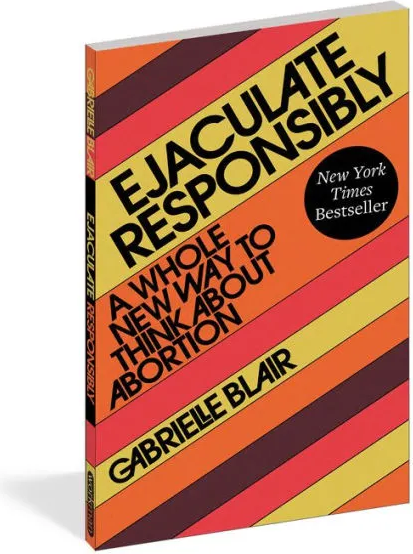
Ejaculate Responsibly! is a beautifully short book (126 pages). Its main arguments are presented verbatim but reordered below.
-
Men are 50 times more fertile than women.
- Most times when a woman has sex, she cannot be impregnated because her egg is not fertile. Every time a man has sex, he can potentially impregnate someone, because he is always fertile.
-
Women’s fertility is unpredictable.
- [In a] 2020 study of 32,595 women...even among women who wanted to be impregnated, and were trying hard to track their fertility, using the fourteen-day ovulation guidance was not accurate...Even if cycle length can be predicted, the day of ovulation can be very variable, meaning that you cannot accurately predict the fertile phase using cycle length alone.
-
Ovulation is involuntary, ejaculation is not.
- We treat ejaculation as something that happens at random, that is unintentional, that is impossible to anticipate or predict. And we treat ovulation like it can be pinpointed well in advance and easily predicted. Somehow, we've confused the two.
-
Birth control for women is hard to access and hard to use.
- The list of side effects for the Pill/Patch/Ring/Shot is long and serious, including depression, fatigue, headache, insomnia, mood swings, nausea, breast pain, vomiting, weight gain, acne, bloating, blood clots, heart attack, high blood pressure, liver cancer, and stroke.
-
Birth control for men is easy to access and easy to use.
- The stereotype of men trying to avoid using condoms is basically a given in our culture...But what if our cultural myths around condoms are wrong?
- [T]he expectation ought to be that a man uses a condom every time he has sex. And if a man is deeply condom-averse, it should be an absolute given that he would get a vasectomy.
-
Vasectomies are less risky than tubal ligations.
- Successful reversal rates are known to hover around 75 percent for vasectomies reversed within three years, with less success as the time between vasectomy and reversal attempt increases, but, happily, things are improving.
- Of course, if reversal success is a worry, men can always bank their sperm before the vasectomy.
-
We expect women to do the work of pregnancy prevention.
- Why would a woman ever need to ask a man to wear a condom? Why wouldn't it be the default that men should provide their own condom and put it on without a request?
-
Men cause all unwanted pregnancies.
-
The realities and burdens of parenting are unfathomable.
- People don't want to hear that pregnancy and childbirth can be so awful, because if we were honest about how difficult it is, and how it will permanently change your body, perhaps fewer women would be willing to endure it.
- [The author has six children.]
-
There are zero consequences for men who ejaculate irresponsibly.
- Men can and do walk out on pregnancies. Women cannot.
- [O]nly 43.5 percent of parents report receiving the full amount of child support due.
-
Men can easily prevent abortions but choose not to.
- [M]en could easily prevent elective abortion, which is virtually all abortion, simply by ejaculating responsibly.
As a committed feminist (whoops, just lost my audience, huh), ahem, as a committed feminist, I wanted to like this book. It’s the unicorn combination of left-wing ideology, egalitarianism, and personal responsibility! And, like most women, I’ve been annoyed many times with men who come up with bullshit reasons for not wearing a condom.
Then I looked up the footnotes and they lost me. Partly because the notes are in PDF form, which makes it really unnecessarily hard to open links, but what do you care, you have a book reviewer to copy and paste links for you.
Start with the discussion of women’s birth control. We are told that hormonal birth control causes a long list of bad things, including heart attack, liver cancer, and stroke. Or, if you go with a copper IUD, you can expect “significant daily bleeding for months or more than a year” and the IUD insertion is described by “a surprising number of people…as the worst pain they've experienced in their life.”
I don’t want to denigrate these claims, because some women do indeed suffer from the side effects of birth control, and that’s valid, and maybe we should give more pain medication during IUD insertions. But these are not typical experiences! The vast majority of women who use hormonal birth control do not get liver cancer, and the vast majority of women who use IUDs don’t bleed for a year afterwards.
My IUD insertion involved less than a minute of mild pain and I had no unusual bleeding. How much weight should you give that? Very little! But the positive anecdotes deserve as much weight as the horror stories.
(Part of this, by the way, is the FDA’s fault—yes, friends, it’s all about the FDA. Unlike the IUD horror stories, the author’s claim about side effects of hormonal birth control mostly checks out, but, as with most lists of side effects that American patients are given, she makes no attempt to distinguish between common risks and incredibly rare ones.)
A person who wanted to tell an honest story about birth control would focus on typical experiences, not just the horror stories. This was the first clue that the author is operating from a conflict mindset and presenting facts tendentiously.
Ejaculate Responsibly!’s most unusual claim is that male birth control is not just on the horizon, but already perfectly good, in the form of condoms and vasectomies, which every man should use. There’s some fudging of the data with regard to vasectomy reversibility. Compare this quote from Ejaculate Responsibly!:
Stanford Medical Center reports that, depending on the type of technique used, their vasectomy reversal success rate is 95 percent and makes clear that the length of time between the vasectomy and the reversal doesn't affect that success.
—with what Stanford Medical Center actually says, in the source referenced by Blair’s own footnote:
While the age of the vasectomy is a factor, there is no time cutoff where a vasectomy reversal will not work…The effectiveness of a vasectomy reversal is up to 90-95 percent. Vasovasotomy procedures (90-95 percent) generally have higher success rates than vasoepididymostomy procedures (65-70 percent). In either type of surgery, the vasectomy reversal is often more successful with microsurgery…
—and with what the NHS actually says, in another source referenced by the author:
A vasectomy can be difficult to reverse. Vasectomy reversal is not usually available on the NHS. You can pay for it privately if you wish. Whether or not a vasectomy reversal is successful can depend on how long ago the vasectomy was done. The longer ago it was done, the less likely it is a reversal will be successful.
—and a third source referenced by the author:
Unlike vasectomy, vasectomy reversal is a much more technically challenging procedure that is performed only by a minority of urologists and places a larger financial strain on the patient since it is usually not covered by insurance.
Your friendly book reviewer did very little research for this review. Looking at the author’s footnotes is enough to undermine many of her claims. All in all, vasectomy can be reversed more often than I had thought, but a lot less often than the author wants us to believe.
But let’s move on to the sexier(?) subject of condoms. If men ought to take responsibility for their fertility, we should be investing heavily in male birth control development, right? Nope, not at all. Ejaculate Responsibly! barely mentions the possibility of new male birth control technology. This isn’t Where Is My Flying Car? This is the opposite of that. Why would we need new technology, when condoms are so great?
If you’re tempted to think that condoms aren’t so great, listen to the testimony of Author’s Anonymous Male Acquaintance:
When discussing the 1 to 10 physical pleasure scale, a man volunteered to me: “Realistically I think we're actually talking 9.75/9.8/9.9 as far as sex with condoms go. Believe me, I know this because I'm a man and really the difference is barely noticeable. It's disingenuous for guys to claim it is.”
If you’re not convinced, Anonymous Male Acquaintance #2 explains that if you think condoms are less fun, it’s because you’re not experienced.
There is some truth to the idea of sex with a condom being less fun, but it's because condoms require practice. Men who have practiced using condoms and experimented with different varieties and use lubrication know that condoms don't diminish their pleasure during sex in any significant way.
The “stereotype” that condoms make sex less pleasurable is a “cultural myth.” Condoms are accessible, affordable, and convenient. “If men find that they don’t like the experience of sex with a certain brand of condom, they can try others until they find a favorite.” You can practice. You can try lubrication. “Successful condom users report that once they solved the size, materials, and lubrication questions, they could barely tell a difference between sex with a condom, and sex without.”
“Successful condom users report” sure sounds like survey data, right? Let’s see what the notes say.
Four notes here. #1 is an article on why men dislike condoms, which argues that condoms are “really not that bad,” although they “don’t feel super great” for women either, and in any case men should use condoms because of pregnancy and STD risk. #2 is a listicle titled “Men: 5 Ways to Make Condoms More Pleasurable. #3 is a survey study of college-age people which concluded that:
Both women and men rated unprotected vaginal intercourse as more pleasurable than protected vaginal intercourse. However, men’s pleasure ratings for unprotected vaginal intercourse were higher than women’s. Furthermore, men and women’s pleasure ratings for condom-protected intercourse were correlated with their actual condom use behaviors. Men’s “pleasure decrement” scores indicated a significantly greater reduction in pleasure ratings between unprotected and protected intercourse than women’s scores. Men who perceived a larger decrease in pleasure between unprotected and protected intercourse were less likely to have used condoms in the past 3 months than those who perceived a smaller decrease in pleasure. The results provide evidence that many people believe that condoms reduce sexual pleasure and that men, in particular, who believe that condoms decrease pleasure are less likely to use them.
That’s right. Ejaculate Responsibly! is citing a study which concluded that both women and men enjoy unprotected intercourse more to support a claim that “successful condom users” can “barely tell a difference.” (The “pleasure decrement,” if you’re wondering, was 1.31 on a scale of 1 to 5 for men and 0.85 for women.)
Note #4 is a study of people in substance abuse treatment who were enrolled in an HIV risk reduction study. The study asked people who had unprotected sex about reasons they did not use condoms.
Men were more likely than women to endorse barriers to using condoms. Men endorsed negative effects on sexual experience (e.g., not feeling good or natural, not fitting well, changing orgasm, interrupting the mood, and interfering with partner intimacy, not wanting to put a condom on themselves or their partner). Related to access, men were more likely to be religiously opposed to using condoms. Consistent with other studies reporting men’s concerns about condoms, more men reported negative effects of condoms on sexual experience, and more condom barriers overall, while women were more balanced in advantages and disadvantages of condom use.
Yep, another study cited by the author as supporting the claim that condoms don’t decrease pleasure actually supports the opposite of that claim. Blair seems to have absorbed the idea that one must come up with sources to put in the notes, but not the idea that one’s sources are supposed to actually back up what one says.
To be fair, the study also concluded that, for both men and women, “stronger endorsement of barriers to condom use was associated with less use of condoms.” In other words, people who dislike condoms are less likely to use them. This could be read to support the author’s claim if we imagine that experience makes sex-with-condoms better, so that people who use condoms more come to dislike them less. Of course, an alternative common-sense explanation would be that people who dislike condoms use condoms less because they dislike them—it remains very unclear whether more experience with condoms would change the mind of people who dislike them.
Now, some of you out there are probably still not convinced that condoms are great, probably because you unquestioningly swallow cultural myths. ACX readers are known for that. But if you have consensual unprotected sex, you are basically participating in a suicidal act.
Have you ever agreed to sex without a condom, even though you knew your partner wasn't on birth control? Why? Even if she agreed, why would you risk her health and life like that? Did you consider what kind of cultural pressure she must feel to agree to something that is essentially self-harm?
Or a homicidal act.
When men choose to have condom-less sex, they are putting a woman's body, health, social status, job, economic status, relationships, and even her life, at risk in order to experience a few minutes of slightly more pleasure. It's horrible to type it out. It gives me a stomachache just thinking about it. Would men really choose a few moments of slightly more pleasure over risking a woman's whole life?
This is safetyism. This idea that a risk must be treated as a certainty. This idea that it is immoral to take any risks, and this refusal to quantify and compare risks. (The maternal mortality rate in the United States in 2021 was 33 out of 100,000, or 0.0329%.)
Remember when I said that the book veers into thought experiments about punishing men who impregnate women?
What would it look like if there were real and immediate consequences for men who cause an unwanted pregnancy? What kind of consequences would make sense? Should they be financial? A loss of rights or freedoms? Should they be as harsh, painful, nauseating, scarring, expensive, risky, and life-altering as forcing a woman to go through a nine-month unwanted pregnancy?
Pretend that at the onset of puberty, all males in the United States are required by law to bank their sperm and then get a vasectomy. If/when the male becomes a responsible adult, and perhaps finds a mate, if they want to have a baby, they can use the banked sperm, or if necessary, the vasectomy can be reversed, and then redone once the childbearing stage is over. This would certainly eliminate essentially all unwanted pregnancies, so it seems like it would be welcome legislation for anyone who is serious about wanting to reduce abortion.
I do wonder if any anti-abortion men have done this. If you really don’t want your girlfriend or wife to have an abortion, well, there’s your solution. Except that of course imposing this by government fiat would be horrifically tyrannical, and I wonder who gets to decide if you’re “responsible” enough to use that banked sperm? In my dystopian novel, it all comes back to the FDA.
A historian should have written this book. I would have liked to see a historically-informed account of the evolution in attitudes toward fertility control. In Biblical times, the story of Onan and the differential treatment of lesbianism and male homosexuality suggest that ejaculation was an important moral issue. In Romantic and Victorian times, remember the obsession with preventing masturbation? “Don’t leave him alone night or day,” Rousseau advises the tutor of his ideal pupil, Émile. The tutor must share his pupil’s room, if not his bed. “Let him go to bed only when overcome by sleep.” Every sperm is sacred, anyone?
Now, maybe eliminating male masturbation from the world was never super-feasible, but how did we go from harsh, moralistic bans on all extramarital ejaculation, to a world in which male masturbation is accepted, and unprotected ejaculation is largely seen as devoid of moral weight, while women and girls have the power of life and death in their hands alone?
This fascinating moral reversal and its implications is not what you will read about in Ejaculate Responsibly! Ejaculate Responsibly! limits its focus to present-day reproductive issues, and provides a deeply biased picture of those. Every typically-female experience is portrayed as tragic and every typically-male experience as problem-free. Men will be put off to read that “sperm are dangerous,” like an infection.
If you have a son, his sperm can “infect” any woman he has sex with. As parents, as a culture, we need to emphasize how carefully sperm needs to be handled…Sperm should be considered a dangerous bodily fluid that can cause pain, a lifetime of disruption, and death for some.
Women will be horrified by the author’s portrayal of the agony, disability, and permanent damage of pregnancy and childbirth. (And no, Blair never explains why she chose to have six children anyway.) (She’s a Mormon.)
What about the issue of trust between the sexes? If birth control for women is so risky and painful, should we put our trust in men and have faith that they are telling the truth about that vasectomy? Seems risky. Or should all men use birth control, and all women use birth control? Seems inefficient. But I note the issue only to note that Blair doesn’t.
Despite these major flaws, Ejaculate Responsibly! is one of the most memorable books I’ve read recently. Accept it as a polemic, and don’t expect its arguments to be logically impregnable. Read it with a friend and argue about it. Read it for inspiration if you are a woman in need of the strength to insist on condoms, or a man who wants to be exhorted to use them consistently. If you are a strongly anti-abortion man, consider the vasectomy plus sperm bank strategy. Just keep in mind that any of this book’s factual claims should be double- and triple-checked.