Food of the Gods: The Search for the Original Tree of Knowledge. A Radical History of Plants, Drugs, and Human Evolution, by Terence McKenna
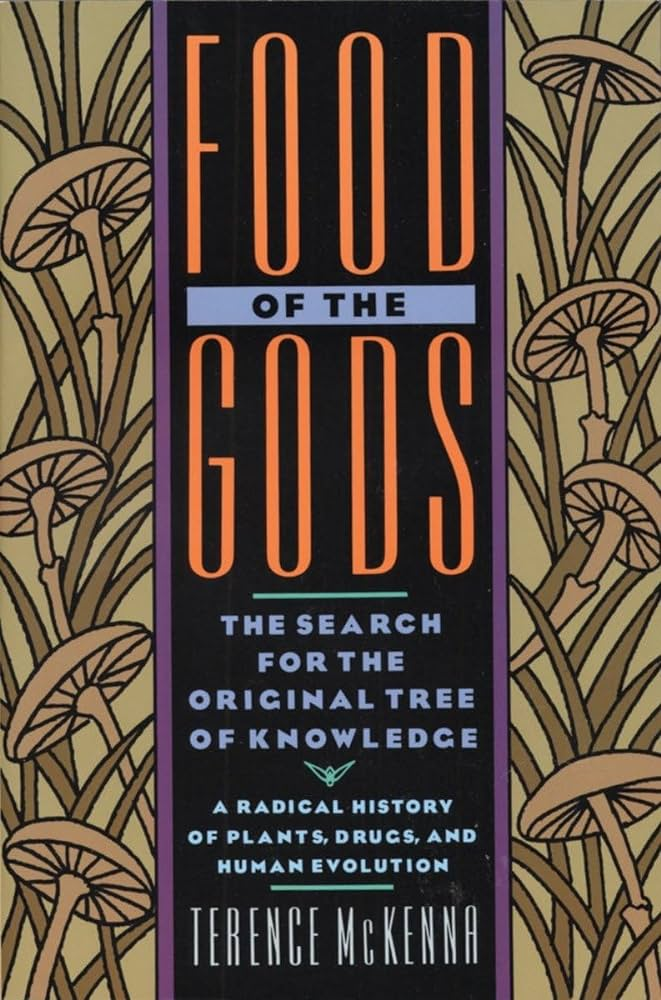
The “Stoned Ape Theory” is too weird for real scientists to take seriously, too convenient for a psychedelic activist to doubt, and too catchy for anyone to forget.
Almost everyone I ask about it knows the gist: human consciousness came from ancient monkeys eating mushrooms (or some variation of that). It’s basically preposterous. Similar to how the Victorian minds of the 19th century just couldn’t bear the thought of growing out of an ape, it’s equally weird to think our minds bloomed from fungus. The Origin of Species (1859) faced decades of cultural resistance; now it’s obvious. New paradigms of evolution are hard to swallow.
Unlike Darwin’s theory though, the Stoned Ape Theory is based on speculative leaps and shaky science, spreading mostly through its catchiness. It’s in the opening animation of official Joe Rogan YouTube clips. It’s made popular by entertainers (watch: Bill Hicks in 1993). It’s the subject of Comedy Central shorts. It’s animated in Netflix documentaries. Now, this evolutionary hunch occupies a small sliver in many of our heads, whether we believe it not.
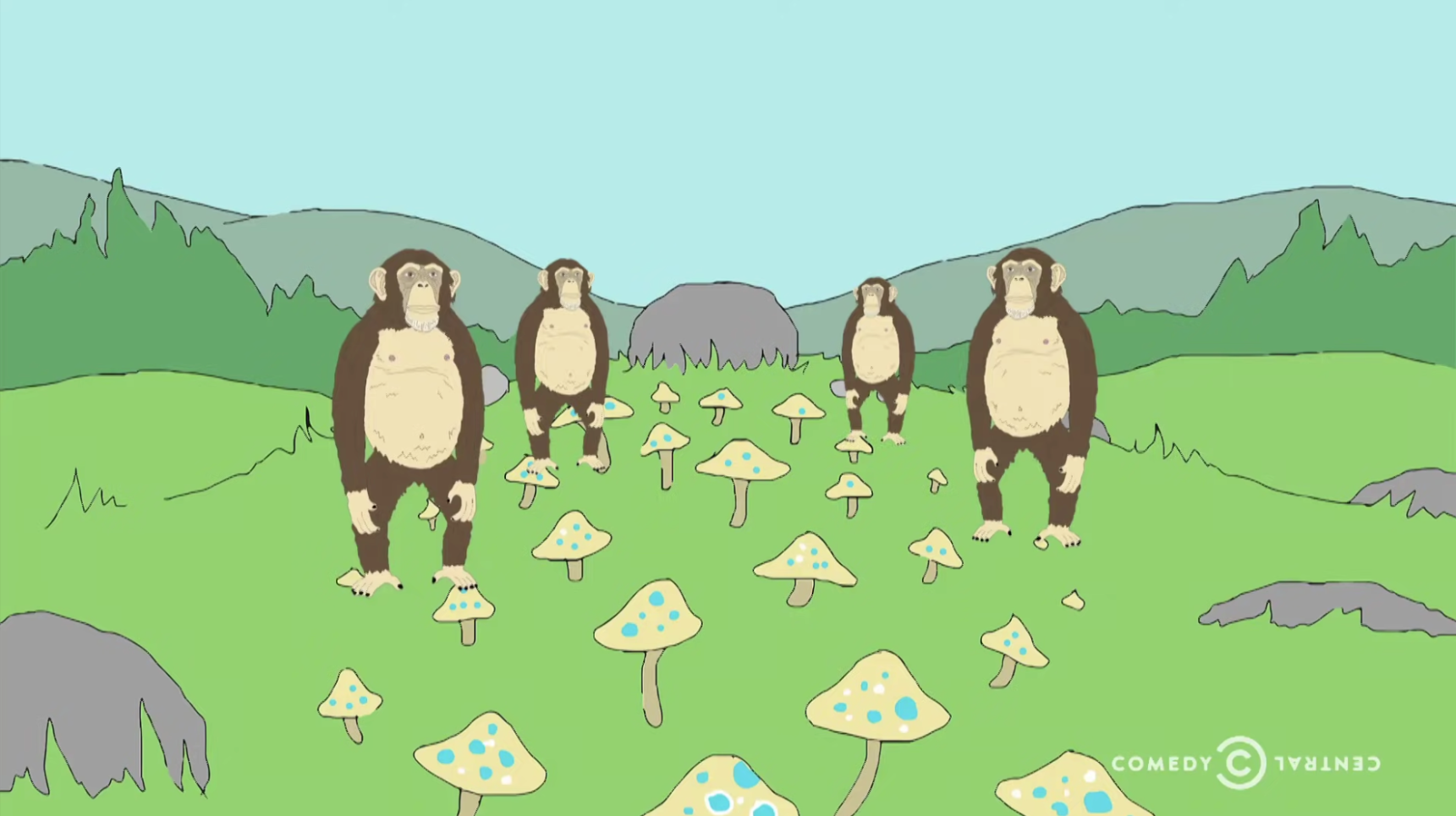
From the Comedy Central animated short, Stoned Ape Theory__.
Despite how popular the theory is, most don’t know where it comes from. This memetic virus spreads without pointing to its source: Food of the Gods, a 1992 book by Terence McKenna—who happens to be one of my favorite thinkers.
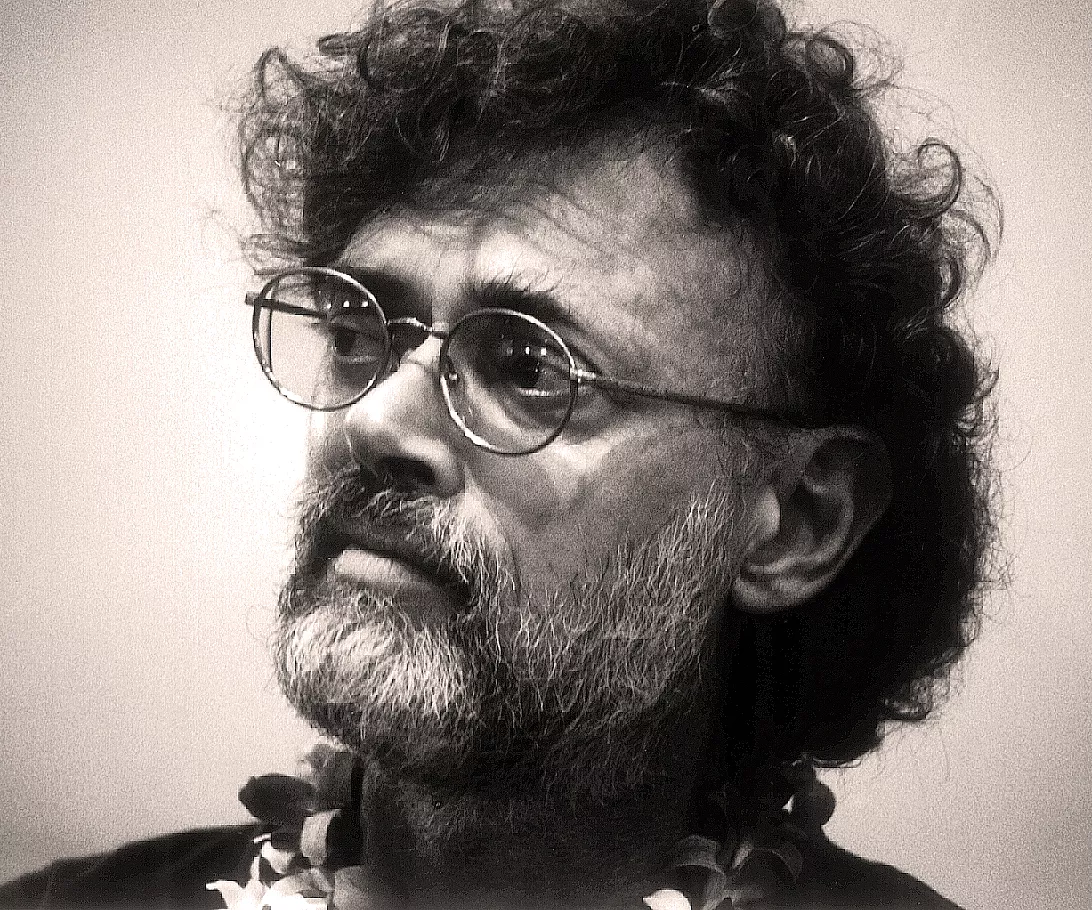
Terence McKenna at a panel discussion in Hawaii, 1999.

I’ve listened to 100+ hours of McKenna lectures in the last decade, but didn’t read a full book of his until this year. He’s like the Grateful Dead in philosopher form (a psychonautic, encyclopedic bard); just as the band’s live shows are way better than their albums, McKenna’s improv lectures are leagues better than his books. He'd riff on audience questions for hours, weaving trip reports with the craziest theories you’ve ever heard, all in a mytho-poetic-comedic style, delivered to a roaring crowd (it’s no wonder he became a cult figure to stoners and fringe intellectuals alike).
Food of the Gods is his most popular book by tenfold, and I chose to read this first because I needed clarity on the Stoned Ape Theory: how could a psychedelic trip get into the genome?
The concept always intrigued me but the details never made sense, and so I hoped his 332 pages of careful research and writing could unpack his viral theory for me. I browsed Goodreads reviews before diving in, and was disappointed to learn that no such rigor existed:
"Possibly the worst researched book I've ever read, it is nonetheless a fascinating meditation on a variety of radical ideas."
“Whether the musings of a fungus-obsessed false prophet or [an]... invite into the realm that granted sentience to our great ape ancestors, Food of the Gods is a must read, and a must discuss.”
"Rambling, ridiculous, and incoherent.”
After finishing it myself I can confirm that Food of the Gods is a painful read, even to a seasoned McKenna fan. It is more like psychedelic propaganda than anthropological research. It’s also a structural disaster that seems to miss the point: only 13% of the book covers the Stoned Ape Theory (I was expecting something like Sapiens on shrooms, but evolution was only the focus in 3 of the 17 chapters).
All that said, within the book is a kernel of an idea that’s not worth abandoning just yet.
It seems likely and significant that pre-lingual humans were exposed to psychedelics during a critical evolutionary moment two million years ago, but McKenna has no serious explanation for how this moved us “out of the stream of animal evolution and into the fast-rising tide of language and culture.” (p. xvii)
While his evolutionary mechanism is flimsy, his premise is fascinating.
In the last 32 years, the Stoned Ape Theory has been rightfully critiqued, but wrongfully dismissed. It’s a bold and weird idea, filled with lots of holes, but hovering around something huge. Could McKenna have laid out a tapestry of points around the mysteries of our origins that are yet to be properly connected? The goal of this review of Food of the Gods is to: 1) present his setup, 2) critique his evolutionary mechanism, 3) consider how other mechanisms could arise from that same setup.
PART 1:
The Food of the Gods Grows in Cowshit
Terence McKenna’s hypothesis is a response to one of the biggest mysteries in human evolution: how did the brain size of the Homo genus double in only 2 million years?
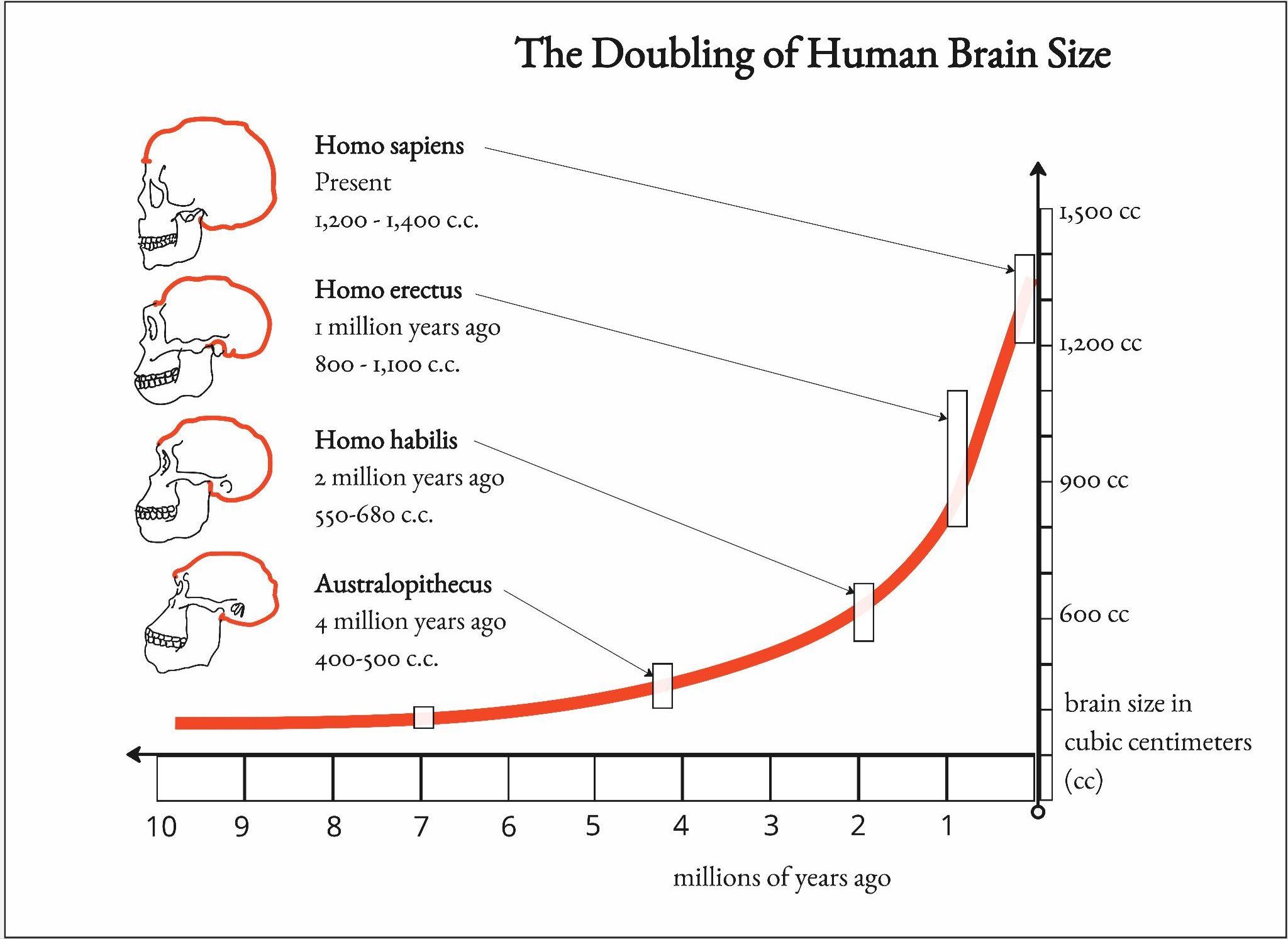
Original graphic.
For context, he states that “evolution in high animals … operate[s] in time spans of … tens of millions of years” (p.20). From 4-7 million years ago, the brain only grew around 7%. Then, from 2-4 million years ago, it jumped to 32%. Since Homo habilis emerged, our average brain size has grown 124%. Why the “sudden and mysterious expansion?” (p.22)
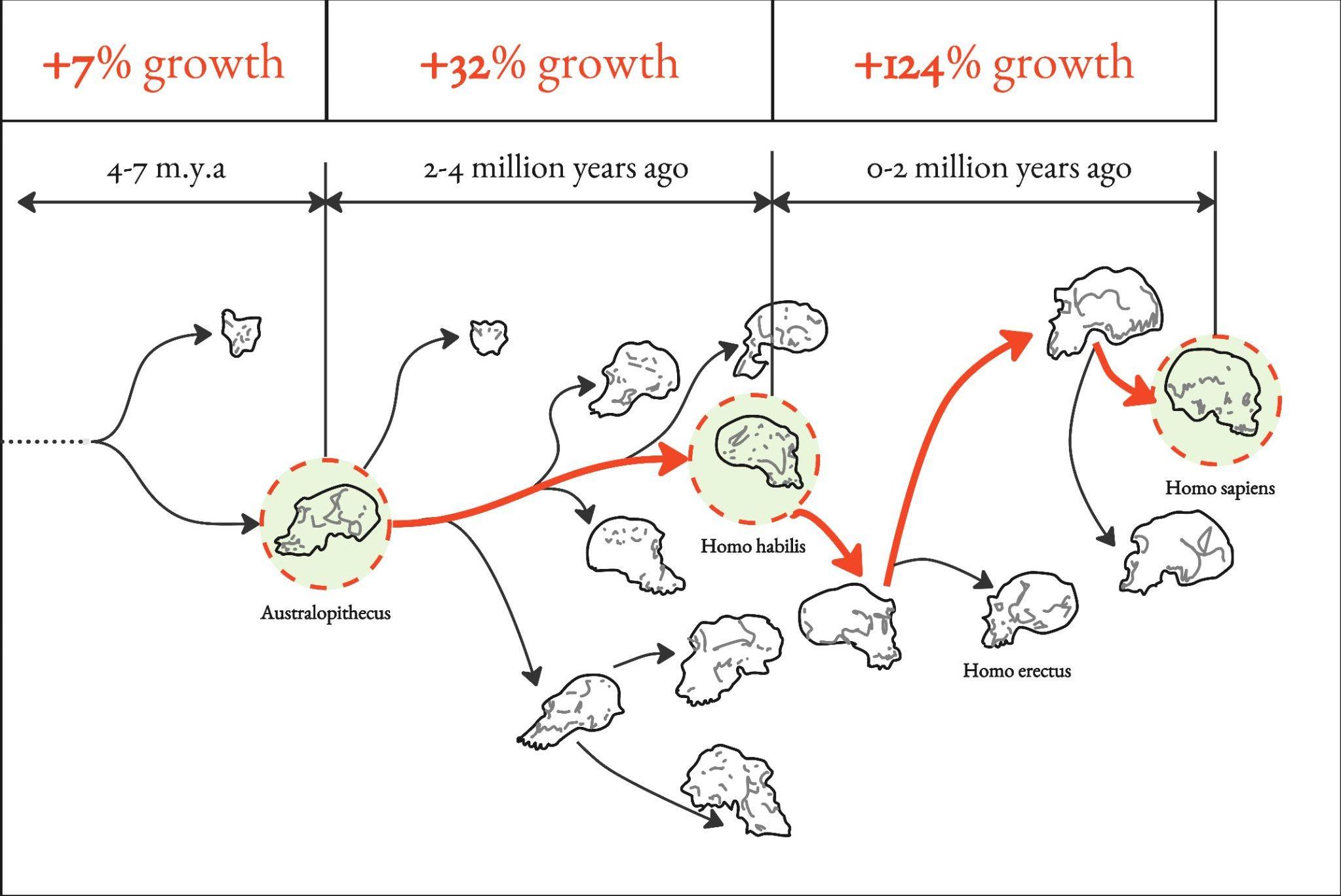
Original graphic.
McKenna cites Lumsden and Wilson (authors of Genes, Mind, and Culture from 1981), who call this “perhaps the fastest advance recorded for any complex organ in the whole history of life” (p.24). Even the first chapter of Sapiens—the pop anthropology book of our times by Yuval Noah Harrari—addresses this mystery: “What then drove forward the evolution of the massive human brain during those 2 million years? Frankly, we don’t know.” (Sapiens, p.9)
While we don't know exactly what sparked this growth, most theories point back to an extreme moment of climate change.
Between 2-8 million years ago, there were several periods of glaciation across the Northern Hemisphere. Expansive sheets of ice caused the air to cool and dry, reducing rainfall in the South. Rain forests receded and hominids were pushed out of their habitat and into the grasslands and savannahs that were emerging across Africa. This is called the “Savannah Hypothesis,” and McKenna alludes to it to frame his theory.
Every theory on how the human brain evolved is some kind of adaptation to the grassland. We relied more and more on bipedalism to navigate an open plain, which freed our hands to carry food, build tools, throw spears, and upgrade our thumbs. These tools—paired with social coordination—let small packs hunt bigger and bigger mammals, which required the invention of fire to eat meat, which led to more calorie-dense and nutrient-rich food.
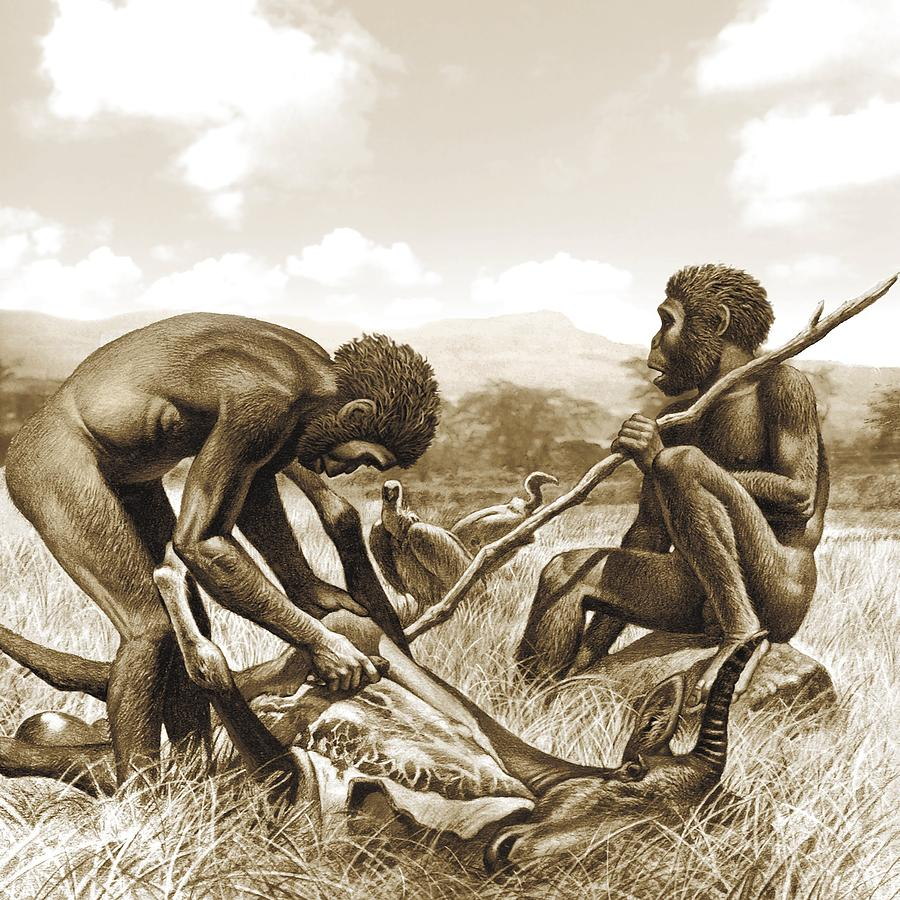
From Science Photo Gallery__.
According to McKenna, there’s another big factor in the grasslands that no one has accounted for:
“Grasslands have far fewer plant species than forests. Because of this scarcity, it is highly likely that [an omnivorous] hominid would test any grassland plant encountered for its food potential” (p.35) [...] When our remote ancestors moved out of the trees and onto the grasslands, they increasingly encountered hooved beasts [along with] the manure of these same wild cattle and the mushrooms that grow in it.” (p. 37)
McKenna points to a blindspot in evolutionary theory: among all the other forces on the African plains were little mushrooms that accidentally led to synaesthesia, self-reflection, abstract thinking, symbolic communication, and divergent problem solving (you know, the pre-flickers of humanity). Yes, our brains also probably grew from bipedal tool-enabled meat hunting, but en route we likely got enticed by the food of the Gods growing in cowshit.
According to Terence, “ human emergence … is a you-are-what-you-eat story,” (p.16) and it isn’t just meat. After a species moves into a new environment, their diet is in question and they’re desperate to experiment. “The strategy of the early hominid omnivores was to eat everything that seemed foodlike and to vomit whatever was unpalatable” (p.17).

From the Wikipedia entry for Coprophilous fungi (a mushroom that grows in dung).
Psilocybin cubensis is a species of mushroom that grows in the dung of not just cattle or bovines, but all herbivores. A new 2024 study dates Psilocybe back to 60-65 million years ago (around the time when the dinosaur-ending asteroid hit). They are pre-hominid. The wind spreads spores over fields, dropping them in hot, damp, nutrient-filled cow dung, the perfect microclimate for fungus growth.
It’s entirely possible that Homo habilis had psychedelic experiences, but how readily available were mushrooms in Africa 2 millions years ago? If mushrooms were the catalyst of the brain boom, then they must have been everywhere, right? Unfortunately we don’t have direct evidence of this, and McKenna doesn’t estimate volume, but we can at least anchor our speculations in the gross volume of cowshit.
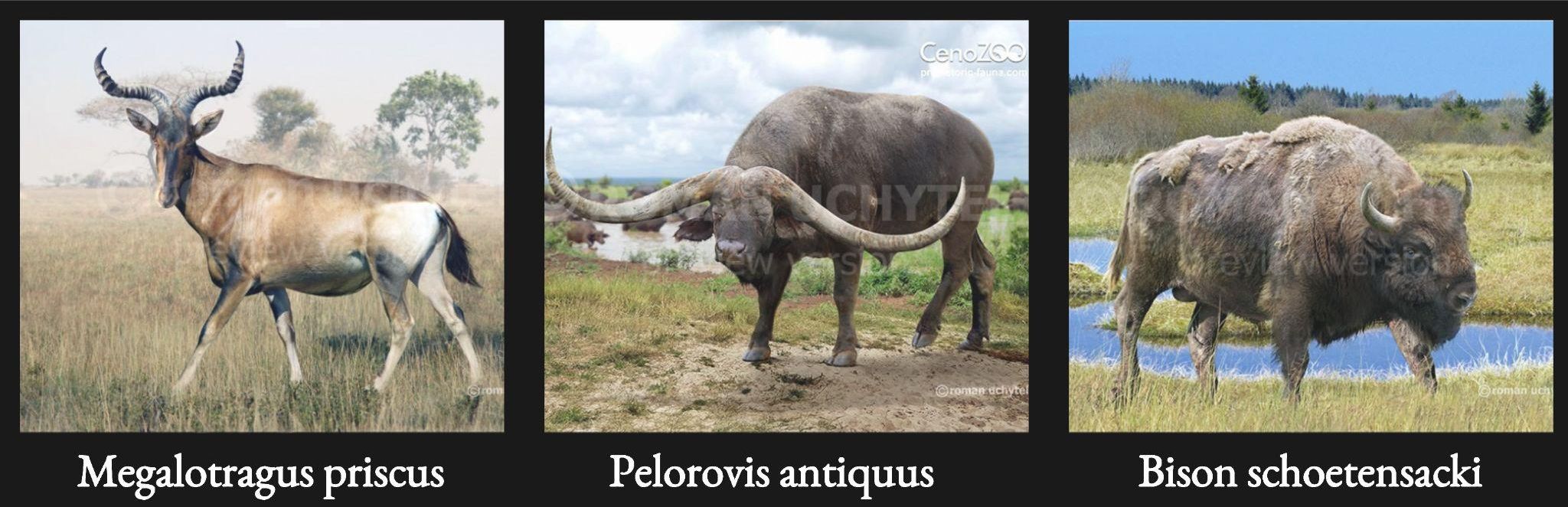
Ancient African herbivores, images from Prehistoric Fauna__.
Hypothetical: 10 million African herbivores, dumping 10 dung per day, leaves us with 100 million patties per day (incredible). Maybe 1 in 3 patties grow mushrooms, but not all of those mushrooms are psychedelic. We can’t know the exact rate, but we can speculate it’s much rarer. If 1 in 1,000 patties are magic, then that’s something like 100k shrooms per day. If it’s a lot rarer (1 in a million), it’s only 100 shrooms per day.
According to a study by Navarette (2016), there were 18,500 members of Homo habilis at this time. This means there were either 5 shrooms per person every day (way too much), or that only 1% of the population was getting high. Wherever we landed in the range, there was enough cowshit to get at least some apes stoned.
McKenna was the first to propose a human/cattle/mushroom symbiosis as an answer to the mysterious surge in brain size. Since the 1960s, others have speculated on the role of psychedelics in human evolution—apparently, Francis Crick, discoverer of the double-helix DNA spiral, was the first (!?)—but McKenna was an ethnobotanist who could refine the details and pitch the premise.
According to Terence, we “bootstrapped to higher and higher cultural levels” (p.39), and the theme of cattle and mushrooms eventually spilled into Neolithic art and religion (around 10,000 BC). He shows us Sahara Desert cave art that features “shamans with large numbers of grazing cattle … dancing with fists full of mushrooms” (p.70). Then we see Catal Huyuk, “a huge [9th millennia BC] settlement, spreading over 32 acres … accommodating over 7,000 people”; the excavation is revealing “amazing shrines with cattle bas-reliefs and heads of now extinct aurochs” (p.82). This proto-culture eventually shifts into the soma-fueled Vedic religions of India, where cattle are also worshiped.
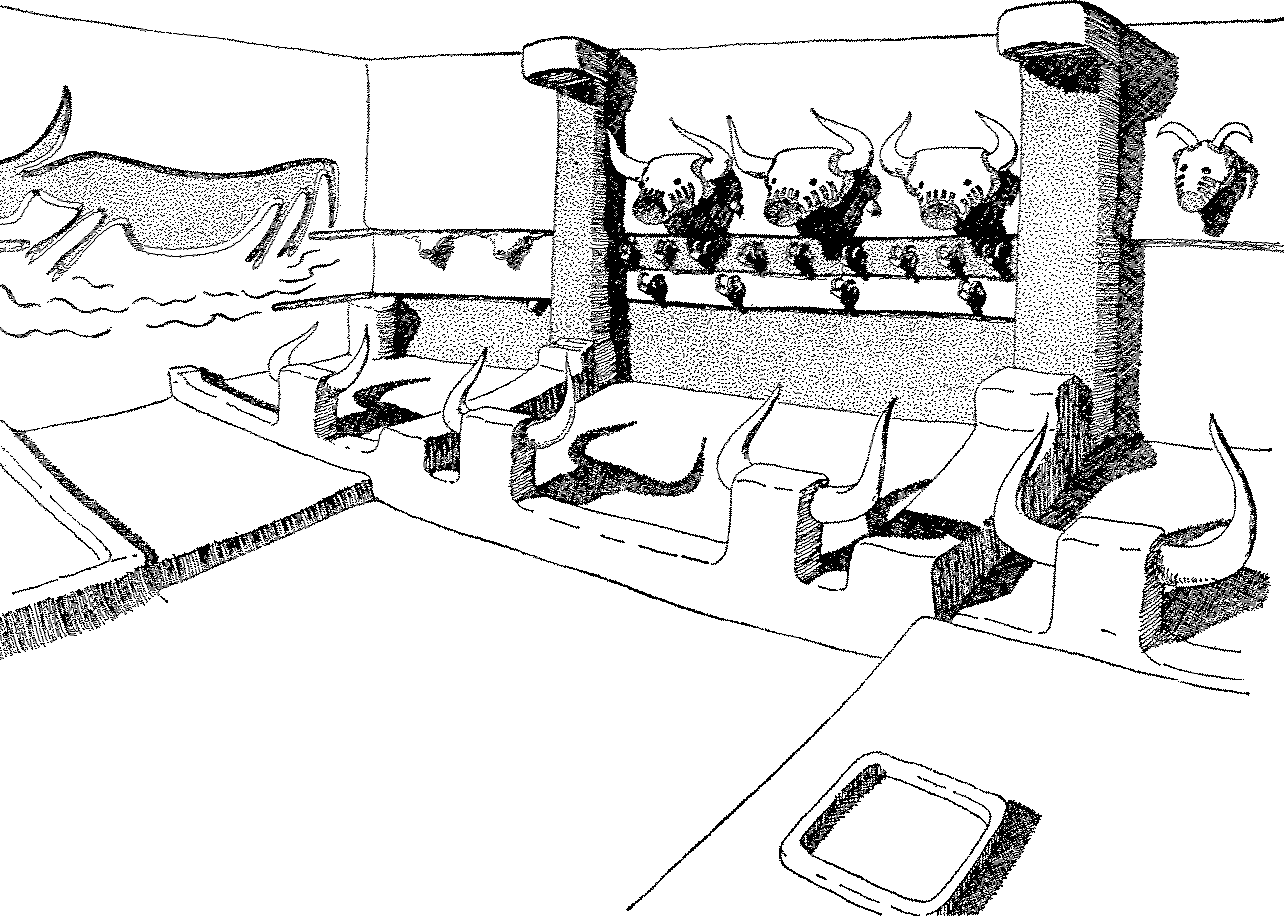
On p.83, from “Catal Huyuk: A Neolithic Town in Anatolia” by James Mellaart.
McKenna, in his typical interdisciplinary fashion, pulls threads from anthropology, mycology, and comparative religion to make a compelling case: during an important moment for the Homo genus, we were in the presence of a consciousness-expanding mutagen. The food of the Gods was in the humblest of places. Great premise. The problem is, the proposed evolutionary mechanism isn’t nearly as convincing.
PART 2:
Binoculars, Orgies, and Language (but mostly, bullshit)
So let’s assume that proto-humans had access to some quantity of psychedelics for the last 2 million years. Wouldn’t these hominids get high, come down, and be biologically identical? Even if the mushroom promoted neurogenesis, that doesn’t make it inheritable. In fact, the whole idea that LSD “may alter the chromosomes” was a media-fueled cultural hysteria in 1967 that had to be debunked. If mushroom experiences don’t pass down to your offspring, then how could they have guided evolution?
McKenna has a 3-point theory on how the hominids who ate mushrooms outbred the others; this framework shows McKenna’s strength as a meme-maker. The section header is titled: “THREE BIG STEPS FOR THE HUMAN RACE.” It’s a triad—a 3-step explanation—forged in a way to be memorable, repeatable, and spreadable. This is exactly what happened.

Here’s a clip of Joe Rogan reciting the three-part explanation__.
To summarize:
- In low doses, it sharpens your vision into “chemical binoculars” to make you a better hunter.
- In medium doses, it makes you horny, orgy-ready, and more likely to reproduce.
- In high doses, it leads to mystical experiences, problem solving, and language.
The framework is an anthropological cartoon, where the tribes who ate mushrooms were better hunters, better bonkers, and better thinkers, giving them a chemical advantage.
“In such a situation, the outbreeding (or decline) of non-psilocybin-using groups would be a natural consequence.” (p.25-26)
McKenna couches his theory by framing it as a “constructed fantasy.” He poetically encourages ut to “stand outside the gene swarm …[of] biological history,” and then analytically explains how the three forces are “interconnected and mutually reinforcing” (p.25). The framework is a solid meme, and easy enough to remember and riff to your friends; but when you investigate each point, it falls apart.
Low doses: Microdosing as “chemical binoculars” for hunting
The first part of McKenna’s theory comes from a research study done by Roland Fischer in the late 1960s:
“[He] gave small amounts of psilocybin to graduate students and then measured their ability to detect the moment when previously parallel lines became skewed. He found that performance ability on this particular task was actually improved after small doses of psilocybin” (p.24).
Fischer’s study is proof to McKenna that a drug can give you a better model of the world. In terms of evolution, he notes how this chemical mutagen gave hunters an adaptive advantage, and it became “deeply scripted into the behavior and… genome of some individuals” (p. 25):
“... small amounts of psilocybin, consumed with no awareness of its psychoactivity while in the general act of browsing for food … impart a noticeable increase in visual acuity, especially edge detection. As visual acuity is at a premium among hunter-gatherers, the discovery of the equivalent ‘chemical binoculars’ could not fail to have had an impact…” (p.25)
“Chemical binoculars” is a remarkable coined phrase, but there are two big problems here: 1) he doesn’t explain how microdose-powered hunting can be such an adaptive advantage that it gets baked into the genes of the species, and worse, 2) he’s way off on his source: The Roland Fisher study used psilocybin in medium-high doses (160 µg/kg), not low doses (12 µg/kg). It also wasn’t about “edge detection,” but “visual acuity,” and the idea that a faster refresh-rate automatically leads to better hunting in an assumption that ignores the strong body load that occurs on mid–high doses. In fact, Fischer’s paper even says that psilocybin“may not be conducive to the survival of the organism” (the exact opposite conclusion that McKenna draws from the same study). Quite the skew.
Medium doses = Arousal, orgies, and growing tribes
So not only are the microdosing hunters gathering more food, but at medium doses they’re having more kids.
“Because psilocybin is a stimulant of the central nervous system, when taken in slightly larger doses, it tends to trigger restlessness and sexual arousal. Thus, at this second level of usage, by increasing instances of copulation, the mushrooms directly favored human reproduction” (p.26).
And it’s not just an increased amount of sex as we know it, but medium–high doses change the nature of relationships, sex, and parenting:
“The boundary-dissolving qualities of shamanic ecstasy predispose hallucinogen-using tribal groups to community bonding and to group sexual activities, which promote gene mixing, higher birth rates, and a communal sense of responsibility for the group offspring.”
Does more reproduction automatically benefit the tribe and enhance the continuation of their gene pool? If mushrooms led to orgies and population spikes, that could be a liability for a hunter-gatherer tribe. It’s more likely that a stable population size in Ancient Africa would have been ideal for survival. On page 19, he notes that if a species integrates sweet potatoes of the genus Dioscorea (the raw material we use for birth control pills) they would find themselves in a diet-induced reproductive chaos. The opposite could be equally true: a mutagen that leads to uncontrolled tribe growth would put a strain on already limited resources.
High doses = God and language
And now, finally, at the highest, heroic doses of mushrooms, McKenna explains two types of effects: mystical experiences and the advent of language:
“Certainly at the third and highest level of usage, religious concerns would be at the forefront of the tribe’s consciousness, simply because of the power and strangeness of the experience itself. This third level, then, is the level of the full-blown shamanic ecstasy.” (p.26)
While much of the book unpacks the implications of mushrooms spawning religion, there are fewer mentions about how mushrooms could have been a catalyst for language, sparking an adaptive advantage. Here’s the clearest one:
“Psilocybin’s main synergistic effect seems ultimately to be in the domain of language. It excites vocalization; it empowers articulation; it transmutes language into something that is visibly beheld. It could have had an impact on the sudden emergence of consciousness and language use in early humans. We literally may have eaten our way to higher consciousness. In this context it is important to note that the most powerful mutagens in the natural environment occur in molds and fungi. Mushrooms and cereal grains infected by molds may have had a major influence on animal species, including primates, evolving in the grasslands.” (p. 42)
Out of his three points, the idea of mushrooms catalyzing language is the most convincing, but still, McKenna’s case isn’t very rigorous. This is the degree of his supporting material (with no footnotes or citations):
“Researchers familiar with the territory agree that psilocybin has a profoundly catalytic effect on the linguistic impulse” (p. 53).
Right after he explains his 3-point theory, he shifts to address objections from Darwinists. He acknowledges that his theory sounds “smack of Lamarckism.” Jean-Baptiste Lamarck was the first person to develop a full theory of evolution (1802), held the reigning theory until Darwin’s Origin of Species (1859), and is known for being wrong on his theory of “soft inheritance” (that changes to your body or mind within your life can be passed down to your offspring). McKenna frames a question from the lens of Darwinian theory (the question we’re all still thinking):
“While the mushrooms may have given us better eyesight, sex, and language when eaten, how did these enhancements get into the human genome and become innately human?” (p.27)
McKenna’s whole theory hinges on a good answer to this question, and unfortunately he fumbles it. In a dense 200-word explanation, he implies that language, vocabulary, and memory offered such a radical survival advantage that it created an eat-mushrooms-or-die situation. He’s saying that speech-like behavior “spread through populations along with the genes that reinforce them” (p. 28).
Now he’s talking about natural selection, but he’s not being specific... The basics of natural selection says that, over generations, certain gene-environment combinations give members of a subspecies a survival and reproductive advantage; those without the right traits die out, and so the population fills with those who have it.
In order for the psychedelic experience to have altered the path of evolution from Homo habilis to Homo sapiens, three things must have been true:
- Due to location, only a subset of the population got access to the mushrooms.
- Among those who ate them, only some percent of users had (unspecified) "language genes" that enabled them to better conceptualize and vocalize their intentions.
- The ability to wield language had such a significant survival advantage, that anyone who couldn't talk got outbred.
This is pretty shaky, not just because there’s no detail on how genetic variance causes some to burst into language and not others, but mostly because it makes little sense how a few extra words would put another tribe out of existence. Sure, I’d imagine a Homo erectus tribe of 1,000+ words with advanced grammars could out-smart and out-hunt a nearby Homo habilis tribe with only 50 words. But the accumulation of language likely happened extremely slowly; based on the rate of vocabulary growth, we’re talking 1-5 words per millennia. Humans weren’t just competing against each other, but lions, who don’t play in the realm of words. So even if mushrooms enabled a genetically-blessed subspecies of Homo habilis to invent a few new phrases, McKenna isn’t making a case for how this threatens the existence of non-psychedelic tribes.
Basically, all three points of McKenna’s framework—vision, sex, and language—are cartoon mechanisms for evolution. It’s totally possible that 2 millions years ago, hominids were surrounded by fields of mushrooms and had profound psychedelic experiences, but there’s still no real explanation for how it catalyzed humanity and fostered the explosion in our brain size, structure, and function. Based on what’s presented in Food of the Gods, it’s not clear how mushrooms are a factor in evolution at all, let alone the main factor.
Food of the Gods makes more sense when you understand the climate it was written in: a psychedelic blackout. In 1971 they were made illegal, and until 1995, the most qualified researchers in the world couldn’t touch them (after serious breakthroughs in the ‘50s and ‘60s). Now, it's obvious we’re in a “renaissance” with forward progress. But from ‘71-’95, there was no knowing if the situation would ever change. This led to an intellectual counter-movement, where whole books were written as a plea for legalization (their argument generally goes, “Look! Psychedelic use existed here, here, and here, so therefore, we have no right to keep these sacred plants illegal.”
Look at 1992 (the year Food of the Gods was published): publications on psychedelics were at an all-time low (since their discovery), and 0 clinical trials were conducted with LSD or psilocybin. It was bleak.

From a 2023 report on psychedelic assisted therapy.
As soon as McKenna introduces the Stoned Ape theory he moves on, and from page 57 on we’re in the territory of his psychedelic manifesto, which I can summarize in 3 points:
- Chapter 5: Agriculture is the fall from Eden into history, ruled by a “dominator culture” of “pathological monotheism” (p.64). He makes a Learian plea for an Archaic Revival: “a clarion call to recover our birthright … It is a call to realize that life lived in the absence of the psychedelic experience upon which primordial shamanism is based is life trivialized, life denied, life enslaved to the ego and its fear of dissolution in the mysterious matrix of feeling that is all around us. It is in the Archaic Revival that our transcendence of the historial dilemma actually lies.” (p.252)
- Chapter 6-14: Our substance addictions stems from an “existential incompleteness” from losing touch with the mushroom. He covers the history of drugs, from prehistory through the 20th century. He gives a literally exhaustive survey of mushrooms, ergot, cannabis, hashish, sugar, coffee, tea, chocolate, tobacco, LSD, cocaine, heroin, DMT, and television.
- Chapter 15: The last page of the book is a 10-point drug policy, showing the real intention of this whole effort: activism. He covers taxes, the IMF, cartel laws, research, and education.
Here are two more quotes from Goodreads on how the messianic mushroomism gets tiresome:
“You can like mushrooms without believing they are the cause of all human innovation, religion, and culture."
“The contortion of historical evidence to make the mushroom the [center] of human evolution, societal development and ultimately suggesting we should all go back to its regular consumption eventually became ridiculous.”
You might be surprised to learn that Terence McKenna confessed to having little concern for academic accuracy. Here’s a quote from one of his lectures:
“Since I feel pretty much around friends and fringies here, it doesn’t trouble me to confess … FOOD OF THE GODS, I conceived of as an intellectual Trojan horse. Written as though it were a scientific study, citations to impossible-to-find books and so forth … simply to ‘assuage’ academic anthropologists. THE IDEA IS – to leave this thing on their doorstep; rather like an abandoned baby, or Trojan horse.”
This pisses off a lot of McKenna fans, and causes accusations ranging from him being a complete fraud to a mal-intended CIA agent. When asked about his book in this interview, he sees it as a catalyst in a larger culture war. He wanted the unjustly illegalized drugs to be situated in a human origins scenario. In the same way that Darwin’s theory reset the 19th century Victorian mind, he hoped that equating psychedelics with evolution would trigger a new openness to them. He wanted to make the switch from:
“ ‘Drugs are alien, invasive and distorting to human nature’ to:
‘Drugs are natural, ancient and responsible for human nature.’ ”
For what it’s worth, I don't think McKenna was lying or intentionally deceptive. I think he had a good hunch and acted on it, but in the act of crystallizing it into a book, he was less interested in careful analysis and more interested in using his position as a psychedelic guru to shift the culture. His target audience was “drug-friendly 18-25 year olds” who would spread the ideas into the mainstream.
“You've heard me talk about meme wars, and how, if we could have a level playing field, these ideas would do very well.”
It was only ever about the meme… and it worked. While it’s impossible to know the degree of influence McKenna had on today’s resurgence in psychedelic interest, his theory went viral without any real grounding. Maybe McKenna succeeded in his goal, but passionate activism doesn’t lead to good science.
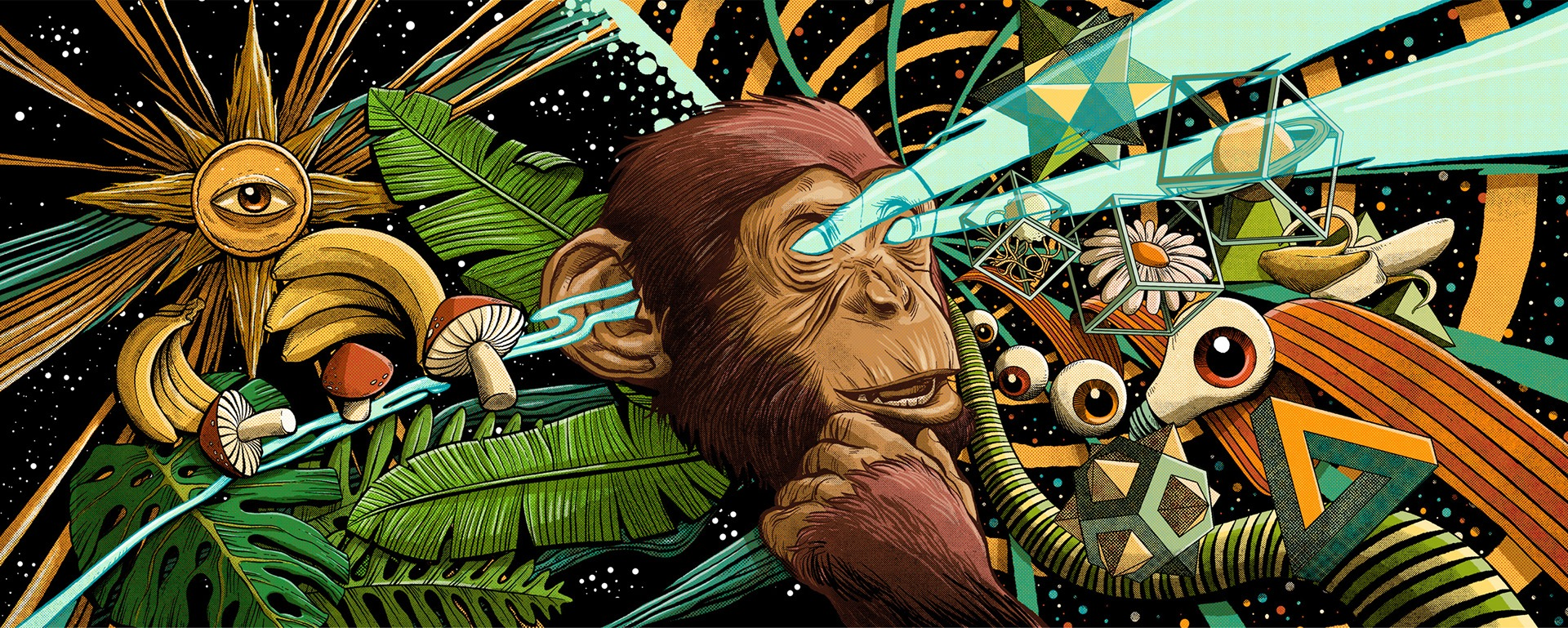
Illustrated beer label by Pedro Correa__.
PART 3:
The Babbling Idiot and the Tribe
Despite all the problems laid out above (bad research, bad arguments, bad intentions), I still think he’s onto something: psychedelics never got into the genome, but at a critical moment in our evolution, our pre-language ancestors moved into a new grassy environment, one filled with mushrooms that are now proven to radically activate the language-forming centers of our brain.
Since 2014, a new wave of university-backed studies have confirmed a lot McKenna’s intuitions: psilocybin aids in abstract thinking and symbolic communication; it reduces top-down control and fosters spontaneous language; it increases semantic association, expanding the repertoire of usable words, and even facilitates the creation of new ones. Damn. We can’t know exactly how mushrooms affect Homo habilis vs. _Homo sapien_s, but there’s reason to believe something happened.
For one paragraph, I’d like you to entertain my own anthropological cartoon. It exists within McKenna’s premise, but without the glorification of the mushroom or the user. I call it: The Babbling Idiot & The Tribe.
Imagine a hungry apex hunter stalking a Megalotragus, and in the process he comes across a dung patty that’s filled with a few mushrooms (appetizers). Unknowingly, he consumes a heroic dose of Psilocybin cubensis. An hour later, hunting is out of the question. There is slight nausea, a weirdness, and eventually, the spontaneous creation of mouth noises. As he comes back into contact with the tribe, he’s not just tripping, he’s grunting and riffing in ways they can’t understand. It’s frightening. From a state of synesthesia, the Babbling Idiot is attempting to make abstract connections between his intentions and sounds. You can imagine hundreds of proto-words coming through over the hours, none of them crystallizing into meaning. But in rare cases, perhaps aided by gestures, the tribe groks what he means. Still, in most cases the words are forgotten, but some are coined in such a way that they’re useful and memorable. The babbling idiot was a temporary conduit for the logos, and comes down with little to no memory of the ordeal. Sobered up, he hears a new word moving around the tribe, and asks, “what do you mean?”
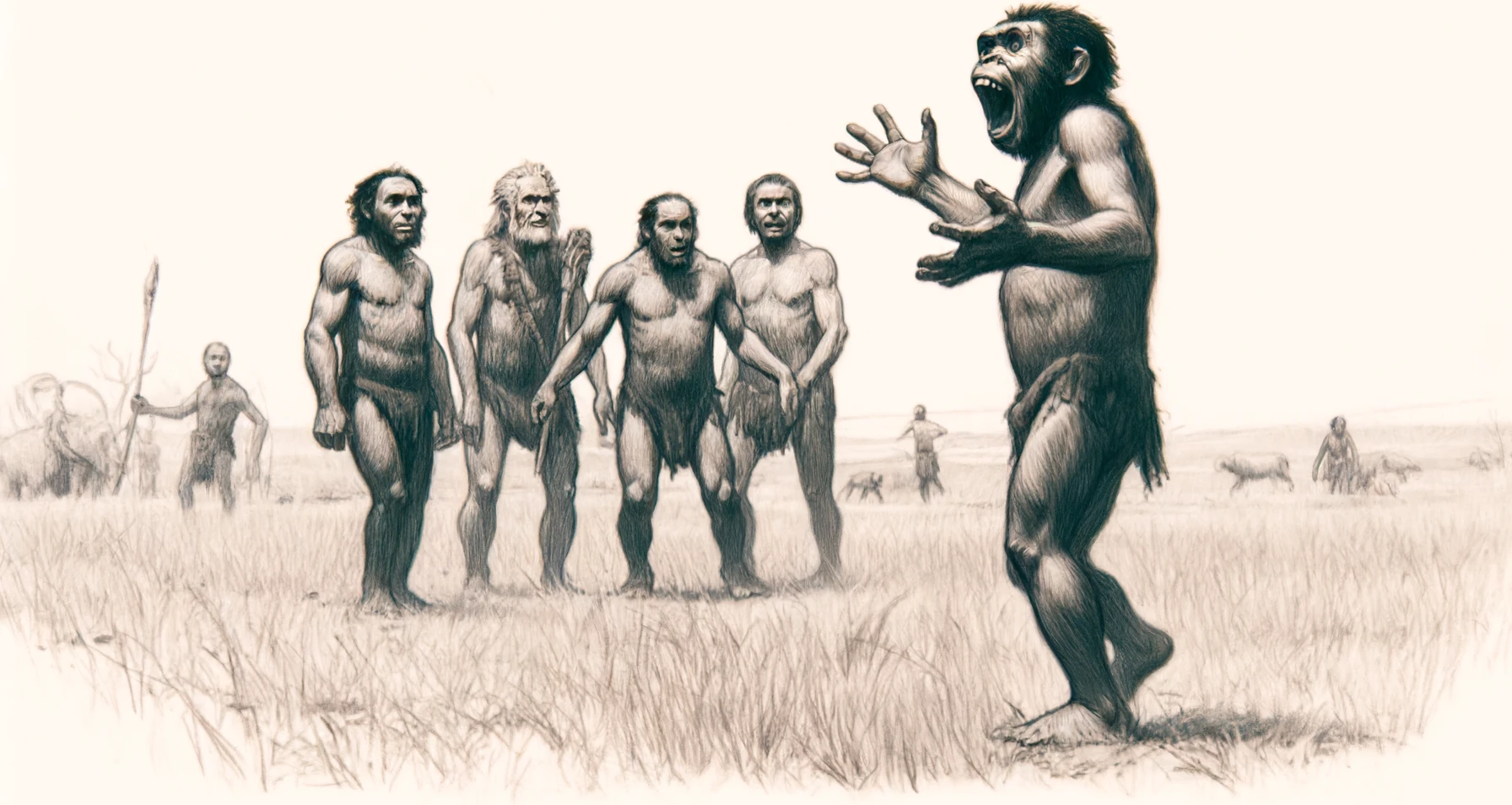
Generated with GPT-4.
This story inverts all of psychedelic romanticism that was baked into McKenna’s theory:
- Mushrooms didn’t need to be plentiful; this might have happened once in the life of a tribe.
- The whole tribe didn’t need to take them; it could’ve been a single person.
- It wasn’t brave or intentional; it could’ve been accidental.
- They didn’t turn into a superhuman hunter, lover, or linguist; they became a babbling idiot.
- They didn’t come down more evolved; they barely remembered it.
- The hero isn’t the psychonaut; the hero is the sober tribe who paid attention through the chaos to catch and remember the words that mattered.
To bring this back to evolution, magic mushrooms may have simply been a catalyst for linguistic mutation. Over a tribe’s life, the lead hunters would accidentally get stoned a few times, and it would lead to outpourings of gibberish. In some cases it would threaten the survival of the tribe, in most cases it would have been kind of annoying, and in rare cases it would lead to the creation of a re-usable word.
McKenna was—literally—a remarkable babbler, and would even demonstrate it to his live audiences. He referred to it as “glossolalia,” the spontaneous urge to form speech on high-doses of psilocybin, despite it being void of meaning. It sounds eerie, almost like he’s speaking in tongues. This happened to him often enough that he started recording his outbursts on tape recorders. Now he can simulate it at will while completely sober. You can check out this 15-second version, or a longer version titled, “Recordings Which People Find Extremely Alarming.”
It’s not that psychedelics got into the genome, it’s that over many millennia they mutagenically expanded our repertoire of language.
The evolutionary mechanism here isn’t the mushroom, it’s language itself. Psychedelics can restructure your brain, but not your kid’s brain, and that’s okay, because the artifacts from a single trip are strong enough to infect everyone around you—e_ven if they’re sobe_r. Think of the words, music, art, culture, and technology that came out of the 1960s from a small subculture of trippers. Through mimesis, language ripples through culture like a shockwave. It’s time we consider that the word itself might have been the original burst from the mushroom.
Consider the power new words might have had on a Homo habilis with a vocabulary of less than 50 words. They had the linguistic range of a 1-year old, and used basic utterances and gestures for food, danger, and water. A million years later, homo erectus, with brains almost double the size, had fire, technology, but also a modern vocal tract, with a vocabulary over 1,000 words, putting them at the fluency of a 3-4 year old. By the time Homo Sapiens were forging words in Egyptian cuneiform, their vocabularies were over 10,000 words.
The doubling of our brain size matches a logarithmic growth in our vocabulary, and so it brings us into a chicken-or-the-egg situation. Which guided which?
The natural assumption is that a growing brain breeds the hardware for language, but what if the opposite is also true? Over millennia, could increased vocabulary put pressure on the brain to grow? Could the two have existed in a feedback loop? Were ancient brains significantly smaller because of the absence of language? How does this relate to the critical window of language learning? Might the mysterious doubling of our brains come down to a lineage of babbling idiots on mushrooms who slowly brought words to the tribe?
Answering these questions is beyond my expertise, and beyond the scope of a book review on Food of the Gods. But these musings have led me to the book I’ll read next: The Symbolic Species: The Co-evolution of Language and the Brain (1998), byTerrence Deacon (Amazon, Goodreads).
While Food of the Gods is dense, and the Stoned Ape Theory is flawed, Terence McKenna’s viral idea is an outlier in that there’s actually more depth the further you look into it. After reading Terence, I’m more energized than ever to return to his lectures and engage with his exotic ideas. If McKenna is the babbling idiot, then we are the tribe tasked to listen carefully, patiently, and forgivingly, because the guy on mushrooms might be onto something.