In 2008, journalist Lenore Skenazy let her 9-year-old son take the subway by himself. She was a bit nervous, but he wanted to do it, and she wanted to avoid having to escort him everywhere. After he took the subway (and was fine), she wrote an article about it. While this might sound like a boring topic for an article (“Boy uses commuter rail”), it actually created a massive controversy. Various outlets described her as “America’s worst mom”. So, disturbed by the popularity of paranoid attitudes towards child rearing, Skenazy wrote a manifesto: Free-Range Kids (2009). This book has mostly been read as a description of the culture of paranoia that has taken root among American parents, and a practical guide for parents who want to raise free-range kids. While those are worthy topics, most people have probably heard a lot about them already. What I think makes Free-Range Kids stand out is that it provides the beginning of an explanation of why helicopter parenting has become so common. I call the explanation the Skenazy-Jones model (after Skenazy and Chad Jones, an economic theorist). In the model, as incomes rise, the marginal value placed on safety increases. This leads to smaller and smaller risks becoming the focus of parental concern. At a certain point, because the risks have become so small, it is no longer possible to assess the size of a risk by thinking about whether it has befallen someone you know. Parents, deprived of experience relevant to assessing risks, turn to outrageously alarmist sources such as TV news. This terrifies them so much that they subject their children to house arrest.
Skenazy's experience when she wrote about letting her son ride the subway illustrates that something has changed in American parenting. In the mid-twentieth century, for example, it was not national news when 9 year old children used the New York subway by themselves. Surveys confirm that American parents are parenting much more intensively than they were in the mid-twentieth century:
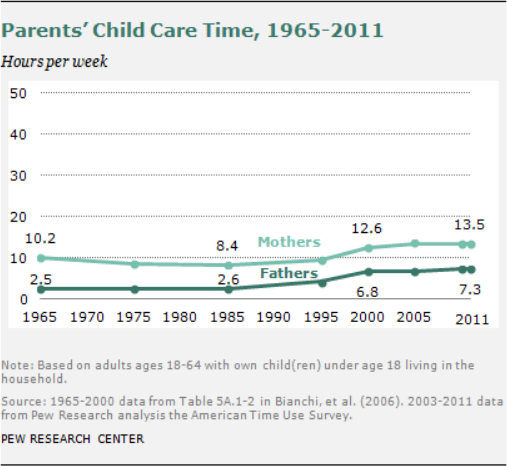
From: Pew Research Center
Parenting effort from both mothers and fathers has increased, in a period when mothers have also dramatically increased the amount of time they are spending on paid work. Some of this time with children is probably valuable, but much of it must consist of annoying activities invented since the 1960s, such as driving one’s children to soccer practice.
There has been a lot of debate lately about the mental health consequences of the transition to intensive parenting. I don’t want to get into the case for and against phones and the related data analysis issues here. I will just say that, intuitively, I think the idea that being subject to luxurious house arrest is depressing makes sense. Consider this reader letter that Skenazy reprints in her book:
“I’m fifteen right now and get pretty much no freedom. I’m limited to what’s inside the house and the backyard. I can’t even go as far as the sidewalk—I might be ‘abducted or killed.’ I used to walk to a bus stop, but my dad said it was too dangerous, so he started driving me there (it’s a five-minute walk!), and eventually he just started driving me to school. Today, after playing video games for two hours or so, I went downstairs and realized that the only things I could do there were eat and watch TV. Watching TV, playing video games, and eating junk food are fun and all, but after even just a few days, it gets old. (I’ve been on winter break for half a week now.) I don’t want my kids (if I ever even have kids) to live like me at all.”
To me, this sounds pretty bad. Regardless of whether living under such intensive parental supervision actually makes more kids meet the diagnostic criteria of anxiety or depression, they lose out on good experiences and happy childhood memories.
Child Safety and Economic Growth
In the US in the distant past, and in the more recent past in most of the rest of the world, people accepted much more dangerous conditions for children. My father immigrated to the US as an adult. He grew up in a much poorer country. When he was a small boy, he broke a thermometer. He played with the mercury from the thermometer for a few days, before becoming concerned that it might be a dangerous substance when it corroded a ring he was wearing. When he was a bit older, he and his friends found a bee hive. They decided it would be fun to douse the beehive with gasoline and light it on fire. He turned out fine, but I think it is a good thing that American children today are generally not allowed to play with mercury or gasoline. Skenazy alludes to related international differences: “A family I know traveled to Southeast Asia with their 2-year-old still in a stroller. All the local people thought the child had stumbled across a landmine. When the child got up and walked around they were amazed, but confused: Why would a healthy child need a wheelchair?”
The premium on safety in richer times and places isn’t just arbitrary cultural variation, like which side of the road you drive on. As people get richer, they spend more on everything, including products to keep them safe. They can also spend less time doing chores or working for wages, and more time monitoring their kids. The economist Chad Jones has shown that, as income rises, it becomes rational to pay not just a greater dollar amount but also a greater percentage of income for safety. The intuition behind this result is simple. People have diminishing marginal utility in money. That is, as their incomes increase, they benefit less from each additional dollar. Going from an income of $10,000/year to $110,000 dramatically changes your life. Going from $110,000 to $210,000 is no doubt nice, but it is much less of a change to your quality of life. For the moment, think of safety products as products that increase life expectancy (this ignores the value of avoiding nonfatal injuries, but that is probably fine for now). You can eventually buy enough consumer goods that you barely benefit from more. But the higher your income, the more valuable each additional day of life you get to enjoy will be. This is because, on that incremental day, you will enjoy a higher quality of life. The value of safety is therefore marginally increasing in income—at least, given certain assumptions, which Jones explains in detail in the paper linked above (which I encourage everyone to check out).
Jones’s theory predicts that, as the economy grows, a larger and larger proportion of it will be devoted to products and services intended to keep people safe (doctor’s office visits, bicycle helmets, car seats, etc.). This, Jones argued in another paper, helps to explain the growth of the healthcare sector as a fraction of the American economy. More direct tests of Jones’s theory are also available. The value of a statistical life (VSL) represents the amount of money that a given group of people would be willing to pay to avoid a marginal increase in their risk of death. The Environmental Protection Agency’s explanation of the concept of VSL gives the example of a group of people who are each willing to pay $100 to eliminate a 1 in 100,000 risk of death. For this group, VSL = “$100 per person × 100,000 people, or $10 million”. The VSL can be estimated using the wage premium that workers doing more dangerous jobs are able to command. This table uses that method to estimate the VSL of American workers between 1940 and 1980:
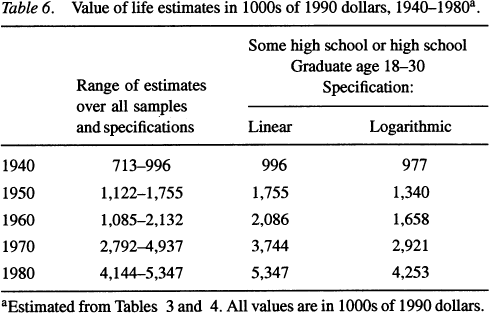
From: Costa & Kahn, “Changes in the Value of Life, 1940-1980”, pg. 172
VSL over this period increased faster than GDP per capita, as Jones’s theory predicts. Willingness to pay for safety grew faster than the economy.
Child safety is important. And now that parents are much richer than ever before, it is rational to allocate more resources to safety (both in absolute terms and as a percentage of total resources). Skenazy:
“At the Babies R Us near me, there’s an entire room devoted to child safety devices: unsurprising stuff like cabinet locks and electrical outlet covers. Ridiculous stuff like easy-to-grip baby soap. [...] And then there’s a whole display of special car mirrors that allow you to watch your baby in the backseat as you drive. ‘Why do you need one of these?’ I asked a dad reaching for one. ‘To see if the baby’s OK,’ he said.”
Skenazy recommends that readers “Walk through the baby safety department of a store with your oldest living relative asking, ‘Which of these things did you need?’” But I think this test actually doesn’t settle the question of whether you should buy easy-to-grip baby soap. It makes sense to buy more safety products today than it did 75 years ago. If seemingly paranoid practices actually yield significantly greater child safety, giving up some amount of fun, mental health, money, and parent time may be worth it. But do they?
No. Skenazy talks a lot about the case of kidnappings, one of the most common parental fears:
Having pretty much dispatched with diphtheria, whooping cough, polio, TB, scurvy, smallpox, consumption, cholera, typhoid, scrofula, Spanish flu, malaria, yellow fever, and the bubonic plague—at least here in the comfort of the First World—the towering parental fear is now the thought of one’s child being kidnapped, carried off, and killed by a creep in a van. (Vans are in need of some major PR.) This particular scenario is known, in the juvenile justice world, as “stereotypical kidnapping.” And even though it feels as if it’s happening all the time—and on TV, it is—it’s actually exceedingly rare and getting rarer. As of 1999, the latest year for which we have statistics, the number of U.S. children abducted this way was 115. Of those, 40 percent were killed, bringing the total to about fifty, or 1 in 1.5 million.
A risk of 1 in 1.5 million is not really worth worrying about, yet this particular scenario exercises an amazingly strong hold on the minds of parents. In 2019, the last year I could find statistics for, there were an estimated 182 stereotypical kidnappings or about 1.2 in 1 million—also negligible.
It is true that many—not a large proportion, but a large number in absolute terms—of children are victims of homicide every year. This situation has unfortunately gotten worse since Free-Range Kids was published. However, homicide in general and child homicide in particular are highly concentrated problems. Most homicide victims, child or adult, are low income. The trend towards overprotective parenting exists mostly among middle class or rich parents, who live in areas where the risk of violent crime is very low regardless of parenting style.
The Skenazy-Jones Model
Risks to children have fallen dramatically over the past seventy years:
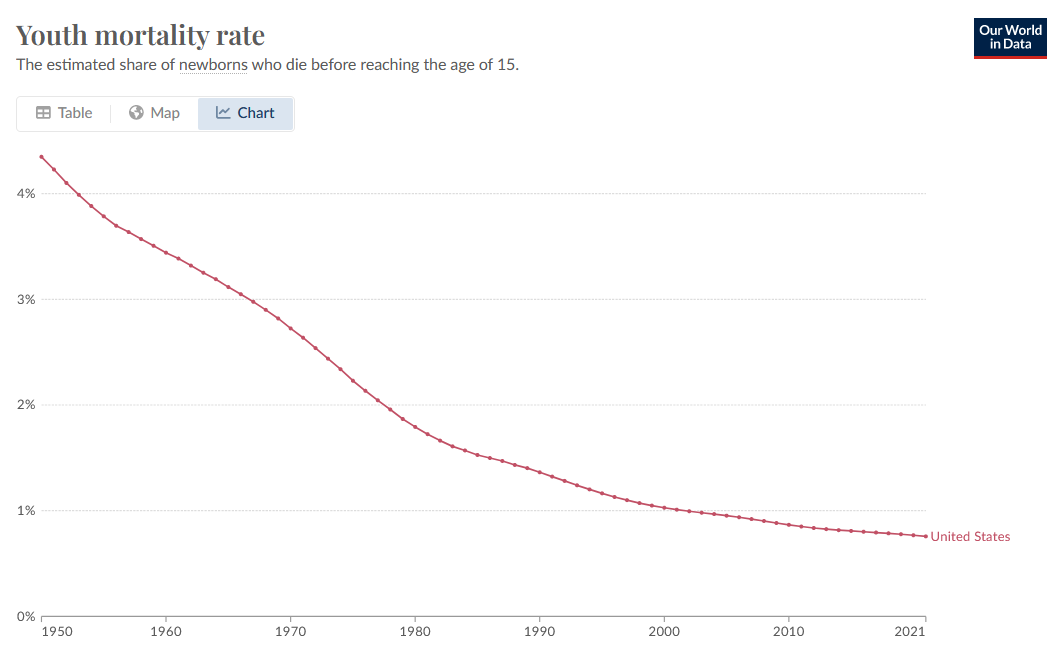 From: Our World in Data
Some of this decline comes from improvements in medicine, some from improvements in nutrition, and perhaps some from greater parental caution about accidents and crime. Given that the overall risk of mortality before age 15 in the US is now less than 1%, any individual risk of death for children must be small. Economic growth means that mitigating these small risks is still, in principle, well worth spending money on. However, the magnitude of small risks is intrinsically difficult to estimate.[1] For an event rare enough that you may never observe it first-hand, it can be very difficult to internalize just how likely or unlikely it is. And this brings us to the explanation of the bizarre excess of parent paranoia depicted in Skenazy’s book: as incomes rise, risks to children become smaller and smaller. However, spending time and money on improving child safety becomes more attractive. Therefore prioritizing among risks becomes both more important and more difficult. As a result, parents will predictably waste lots of time, energy, and money trying to mitigate already miniscule risks. Call this the “Skenazy-Jones model” of intensive parenting.
Skenazy’s book doesn’t just show that parents don’t calibrate perfectly on risks. The observation is stronger than that: parents are outrageously overcautious. And it is easy to extend the model to account for this specific form of miscalibration. The trick is taking account of media and interpersonal effects. Generally speaking people tend to estimate risks based on how often the underlying negative event has happened to them or to someone they know.[2] This does not work for risks of rare events. So we have to rely on the media. But this strategy can go wrong. As Skenazy writes:
“‘As a former TV news producer,’ a dad confessed in an email to Free-Range Kids, ‘I can tell you that news is all about fear. Sometimes, the first criteria we used when judging a story involving children or families was, “Is it scary enough?”’ When the answer was ‘no,’ that didn’t necessarily kill the story. It just changed the way it was reported—and teased. ‘A tease has to hit people in their heartstrings, where you know your words are going to have some impact: their personal safety, or the safety of their family,’ said another former TV news producer, Thomas Dodson. ‘It has to grab the viewers’ attention, and you have a very short time to do it.’”
[....] When Anderson Cooper hosts an hour-long special on missing children, as he did in 2007, he never says, ‘First off, remember: this will probably never, ever, ever happen to you. In fact, it’s almost ridiculous that I’m even here talking about it.’ No, he turns to the camera with those devastatingly earnest eyes and says, ‘It is every parent’s nightmare.’”
Many people have observed that media organizations tend to overemphasize stories that will be personally frightening to their readers relative to those stories’ objective importance. Child safety is an almost uniquely frightening issue, and the media seems to focus disproportionately on the most horrifying risks to imagine, rather than the most likely risks to befall any given child. Uncritical media consumers will draw the wrong lesson, assuming that the news not only accurately describes the events reported on (which is generally true) but that it gives an accurate sense of the relative frequency of different events (which, sadly, is not).
Media dynamics do not fully explain the distorted decision making of intensive parents. Another factor is that it is interpersonally easier to take too little risk than it is to take too much risk. Skenazy: “Usually after I replied to my detractors by rattling off all my safety stats, the person would probe, ‘But what if that one was your kid?’ followed by, ‘How would you ever forgive yourself?’” Thus, even if you personally have some inkling that it isn’t worth subjecting children to house arrest to protect them from fantastically rare bad men with vans, you may not act on that inkling, because contemplating the possible downside is just too horrible or because you are worried what others will say. Skenazy suggests a good rebuttal to this sort of objection to free-range parenting: bringing up the risks of ostensibly cautious choices. For example, confining your child to quarters deprives him of exercise, and being sedentary is bad for your health. Keeping a child at home means that he might be burned in a fire (unlikely, but far more likely than kidnapping). And so on. It is possible that the desire to avoid this kind of highly emotional criticism might make parents try too hard to mitigate small risks against their better judgment. More strictly within the Skenazy-Jones model, it might also prevent objections to overcautious behavior from being voiced and thereby enable overly high estimates of low magnitude risk to persist.
This brings us to the final source of distortion. Risks of acute events are easier to imagine, and therefore more likely to attract attention, than risks associated with some chronic condition. For example: it is easy to imagine a horrifying violent crime being perpetrated against a child. It is harder to imagine a child growing up perhaps 5% less healthy than he would otherwise be because he rarely exercised or played outside. Chronic risks are less likely to be noticed, and therefore we should be concerned that bad trade offs will be made between smaller, dramatic, acute risks, and larger, more boring, chronic risks.
Practical Recommendations
Onto practical recommendations. These are purely based on the analysis above, and not on my personal experience as a parent, because I am not a parent, and I have no relevant personal experience (caveat lector, I suppose). Or, rather, I have personal experience as someone who was once a child and whose parents took a relatively hands off approach, which I think allowed me to enjoy my childhood more than I otherwise would have.
First: try to avoid the news. News is probably actively misleading about which risks to children you need to focus on. It would be better to try to calibrate on risks based on what happens to the people you know. And if something hasn’t happened to anyone you know, it probably isn’t something you need to worry about.
Second, estimate risks by using frequency data when possible. Skenazy provides a good example:
“If you go on the Consumer Product Safety Commission’s website, you will find an alert reminding parents, ‘Infants Can Die When Their Heads Become Trapped in Strollers.’ Which is true. Infants can die when their heads become trapped in anything, and it’s an awful thing to contemplate. But how many children under age five die when their heads become trapped in strollers? The answer is . . . one to two a year.”
More relevantly than the risk of heads trapped in strollers, you can look up official sources for the rate of violent crimes against children and pedestrian fatalities in your city, and calibrate the amount that you let your children move around without supervision based on that.
Third, if you cannot find trustworthy frequency data for your situation, try to use sober, scientifically minded sources. Emily Oster seems good. I personally like to use the NHS website when investigating medical questions of personal interest. I find that the NHS tends to make less absurdly overcautious recommendations than American medical websites. For example, if you use WebMD’s symptom checker: “A search for bloating in the lower abdomen suggested one could have anything from menstrual cramps to ovarian or colon cancers. A query on back pain spit out this terrifying list of potential possibilities: gas pains, shingles, ovarian cancer, acute kidney failure, and tick bites.” Maybe the NHS website is more relaxed because the NHS tries to balance medical needs with the need to prevent hypochondriacs from clogging up British hospitals and crowding out real sick people, whereas American sites are solely concerned about avoiding lawsuits.
Fourth, given that middle-class American parents seem to be too cautious about almost everything related to their children, it might be good to just try to be one of the least cautious parents in your social group.
Any future children I may have, I now speak directly to you. I will try to avoid helicopter parenting and becoming a paranoid wreck. If you at any point feel that I am straying from this goal, please direct my attention back to this review.
Footnotes
- ↩
Sometimes it is said that small risks of ex post very bad events are particularly hard to estimate, but I think the issue is general to all small risks, and it is just that small risks of catastrophic outcomes are more important and hence more worth discussing.
- ↩
This is related to the idea of the availability heuristic.