In defense of free speech, John Stuart Mill wrote, “But the peculiar evil of silencing the expression of an opinion is, that it is robbing the human race; … If the opinion is right, they are deprived of the opportunity of exchanging error for truth: if wrong, they lose, what is almost as great a benefit, the clearer perception and livelier impression of truth, produced by its collision with error,” (On Liberty, 31). If I had five minutes to show him the collisions of truth and error on Twitter, I think he’d gouge his eyes out with his quill pen.
If Mill lived in an information desert, we live in an instant delivery mega-mart. Free DoorDash on steroids constantly delivering you stuff you never even asked for. When the price of entry is high, only the wealthy and the disciplined can afford to play. When the price couldn’t be lower, you welcome the masses. Who do you think produces higher quality opinions?
In Mill’s time, the suppression of opinion was a tragedy because there wasn’t enough to go around. Any potential new idea was an innocent summer child, full of world-changing potential. Snuffing them out before their time was, as Mill says, “evil.” Now we have more information about more things than we could possibly care about, and instead of steadfastly limiting ourselves to only forming an opinion when we have questioned and defended it, we shoot off id-level thoughts as fast as our fingers allow us. I would argue speech is freer today than ever before, particularly for Americans. Not only are we free to spout nearly anything into the ether of the internet without worrying about the state chasing us down, but broadcasting your opinion to millions of people has never been cheaper. For the early free speech advocates, this is total victory. If they saw our society today, would they agree?
The answer would probably depend on which free speech theory they believed in. I think these fall into three broad categories:
-
Freedom of speech allows for the fulfillment of the intrinsic human desire of recognition and expression, so any society that values human freedom and flourishing should allow it. -
Freedom of speech allows for ideas to operate like goods in a marketplace, so if we allow free discussion the best ideas will naturally rise to the top and shape society. -
Freedom of speech promotes an informed public, which is necessary for the proper functioning of democratic governments.
At a glance, I wouldn’t bet the mortgage on any of these holding true in the modern age. Social media, the top facilitator of modern free speech, gives people a historically unprecedented opportunity to express themselves and receive recognition from the world, yet it has continually come under fire for ruining mental health, and continuing the degradation of other forms of community. I think the second theory can easily be put to rest with the rise of modern misinformation movements like anti-vax. This once fringe position has now even penetrated the halls of HHS. Obviously, the best ideas don’t necessarily stay at the top [1]. This also applies to the third theory. As we can see in our modern political moment, one in which free speech is under explicit attack while the state’s actions get supported by people who call themselves “free speech absolutists,” the unrestricted spread of information does not necessarily lend itself to preserving a healthy democracy.
Perhaps it’s time to reevaluate. The first arguments for free speech arose in the 17th century, and America’s commitment to it began in the 18th. Back then it was absurd to acknowledge that a woman could say anything meaningful. Today people converse with an algorithm tailored to their personality on a metal and glass device assembled from pieces across the globe. In the time it took to send one letter back to England, you can now find likeminded people thousands of miles away, create a discord, exchange hundreds of ill-thought messages between rounds of League, and then plan a community protest/fundraiser /car bombing. The world has changed, and it’s time to change our outlook on free speech. It’s time to reevaluate the arguments for it with a modern lens, and decide how we can still achieve their original aims in the present.
Intrinsic Human Need
I think the desire to express oneself and need for recognition are self-evident. Art has existed in some form since the first homo sapiens walked upright and thousands (millions?) throughout history have chosen self-expression at the expense of death. Expressing yourself feels good, and being forcefully suppressed doesn’t (citation needed). And in fact, forcefully suppressing the masses is usually a bad idea, because eventually they get fed up and revolt, and then you end up in the situation your suppression tried to avoid all along. So, if our goal is to allow all humans to meet their basic needs, and doing so will create a stable society, free speech sounds swell.
But…let’s not forget how we deal with other human needs in society. After nutrition and shelter, sex is arguably the next most important human need out there, and we have a host of laws, rules, and norms regulating that. No one calls themselves a “free sex absolutist” and claims that anyone should be having sex wherever and whenever they want with whomever they want. Perhaps we as a species have lived through enough sexual violence to know that to truly maximize everyone’s sexual freedom, we need to limit that freedom to certain times and places under specific circumstances. The specifics can be and constantly are debated, but we all recognize that restrictions must exist. Maybe we’re approaching this point with free speech as well.
Of course, the liberal democracies of the world have already recognized this. You cannot literally say anything with impunity. In America for example, death threats are illegal. Also, the rules change in specific contexts. Lying in general is legal but lying under oath is not. I think these are sensible exceptions that don’t deny anyone’s intrinsic desire for expression while protecting everyone else’s. It’s easy to imagine someone threatening someone else with death if they ever say “X” again, which would be limiting one person’s freedom of expression. If we take the view that freedom itself is an intrinsic human desire, and our societal goal is to maximize it, then of course, we need restrictions, even if they sometimes interfere with some people’s desires [2].
Accepting this, we’ve admitted that speech has societal consequences. Sometimes these consequences are predictable. If a pop artist expresses their gratitude to their fans, they will probably compel thousands of them to respond with heartwarming messages. But not every case is so straight forward. Sometimes a female media critic will make comments about video games and boom we’ve opened a new front on the culture war that still rages on in some form today. I think all the speech described in this situation from all parties could be defended as someone feeling compelled to express themselves. Anita Sarkeesian felt it was necessary to criticize the way women were portrayed in video games and I think many of the Gamergaters responded as if they were under attack. Whether the criticism or backlash was justified is not the point, instead it’s this: what starts as perhaps legitimate free expression can quickly spiral into freedom limiting speech when you have near lightspeed information travel and no internal or external oversight.
In the past, the freedom limiting problems of free speech arose slowly, and while the state may have dealt with these problems with varying levels of competency, the magnitude was not the limiting factor. Free speech problems can arise for the state from either someone publishing a controversial work, or from more organic word of mouth discussion and action. If the state exerts control over all the publishers, method one is out, and the speed of method two is directly proportional to how physically spread out the citizens are. Compared to today, this might as well be a canoe racing a rocket ship. This meant pre-internet the deck was always stacked in the state’s favor, making it very easy to argue for allowing more free expression. Virtual reality completely flips the power dynamic. First it creates a mega-commons, shrinking the distance between everyone to exactly one DM/tweet/comment/post/subscription. Second, underneath this mega-commons are infinite sub-communities hidden from the light of day. They can exist with entirely different norms and attitudes, but are always in close proximity with everyone else. This is not inherently bad, but it’s risky. Some communities tend towards emotional, freedom limiting speech, and they can instantly inflict it on the masses before anyone can stop them.
On the one hand, people in these communities now have access to greater freedom of expression, and in many cases, I would say they are satisfying a need, or at least that’s how they interpret it. I would also say this level of unchecked freedom has been harmful both directly to others and indirectly to the quality of discourse in general. As I mentioned earlier, we’ve lowered the price of entry to have an opinion, and now anyone can blast their intrusive thoughts across the world. Most of these get ignored, but some go viral. And even if we do have some law in place against specific kinds of speech, we don’t have laws against the kind of speech that breeds the illegal speech, and that seems like a near impossible thing to even legislate against.
Understanding exactly how ideas spread and breed is complex, perhaps impossible, but I think one observation is clear. As the amount of information has increased in the world, so has the entropy of communication. We’ve conquered the natural restrictions, and like so much of the rest of nature that humanity has conquered [3], we need to impose our own restrictions, lest we hamper our own freedom in the name of freedom.
Marketplace of Ideas
Perhaps the most common prevailing idea behind freedom of speech is a belief in the marketplace of ideas. We believe that accepting all contributions would necessarily result in the best rising to the top. But a marketplace with no structure is not a market. Instead, it regresses to the jungle. Only our basest desires determine the outcomes. The desires that think only of what we need right now, regardless of our future needs, or the needs of others.
Classical neoliberal economics assumes that people behave rationally. I think this is an assumption that weakly holds when it comes to buying goods and services. No matter how many mental hoops you jump through, your money is a physical constraint and eventually it forces you to deal in reality. However, ideas seldom need to be directly confronted, and even when they do, the human brain is exceptional at finding new ways to justify what you already want to believe. If I’m a bike manufacturer and all my bikes fall apart after three rides, eventually everyone will catch on and I’m bankrupt. If I’m a pundit and the brand of masculinity I peddle makes you repulsive to your wife, you blame her not me. Especially if I keep you angry at her.
Ideas are less like goods in a marketplace and more like organisms subject to the inescapable force of evolution. I’m hardly the first to make this observation—the whole field of memetics exists—but I think it’s a perspective that’s often overlooked in free speech discussions. As I quoted earlier, Mill thought clearer perceptions of truth came from their collision with error. This isn’t necessarily wrong, iron sharpens iron when both instruments are used correctly, but if you give everyone you see on the street a whetstone and a sword, save yourself the trouble and call 911 now.
Developing coherent, consistent ideas about human rights and social welfare takes carefully managed effort. This of course describes Mill, Milton, and anyone else who managed to get published pre-television. The masses don’t have this discipline, and are subject to the whims of passion and custom. Milton says as much in_The Tenure of Kings and Magistrates_ when he leads off with, “If Men within themselves would be govern’d by reason, and not generally give up their understanding to a double tyrannie, of Custome from without, and blind affections within, they would discerne better, what it is to favour and uphold the Tyrant of a Nation,” (3). In On Liberty, Mill wrote extensively against the tyranny of the majority as well, saying “there needs protection also against the tyranny of the prevailing opinion and feeling; against the tendency of society to impose, by other means than civil penalties, its own ideas and practices as rules of conduct on those who dissent from them;” (8). Even two of the earliest and strongest proponents for speech recognized that it could be hijacked by the masses; that the best ideas wouldn’t necessarily rise to the top, and left to their own memetic evolution inevitably it’s the most appealing and spreadable ideas that succeed [4]. Yet despite these reservations, they were confident free speech would tend towards the discernment of truth.
Hang on, I have some good news about the state of the world over the last century.

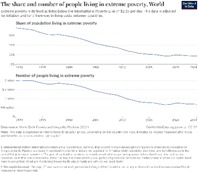
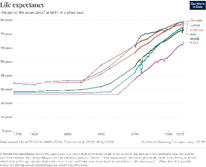
Now let me remind you what this cost us. Yes, all these achievements took millions of hours of collective human labor and ingenuity, and thousands of failed experiments before finding the right ones. But that’s not the cost; those hours would’ve been spent regardless. Achieving all this has required advances in human expertise and hyper specialization, which is great for our collective wealth and the experts’ sense of importance, but we’ve lost the ability to easily communicate how the world works.
At first glance this doesn’t seem like a huge loss. Do you really care how your iPhone is made? But there’s a security in feeling self-sufficient, even if that feeling is based on falsehood. Ancient farmers lived at the whim of the weather, but they felt like they had some control over their circumstances when they made their sacrifices. But we divided labor far beyond self-sufficiency centuries ago, and when people feel impotent over their survival, they turn to knowledge. Again, even if what they believe to be knowledge is incorrect, at least it provides a feeling of control. “I know how that works, so I feel confident it won’t break. And if it does, I can fix it.” Flashforward a few more centuries and now we have scientists in all fields explaining that the way things really work is actually very complicated and relies on a deep knowledge base that requires close reading, genuine curiosity, and years of study, and the average viewer fell asleep the second you opened your mouth and uttered your monotonous [bicoastal] unaccented voice (or in the case of racism, your extremely accented voice, but that usually stokes rage instead).
So, evolution continues. And the most spreadable ideas aren’t the complicated ones given by institutions, but simple ones from trusted sources. A friend, a priest, a mistress. Interestingly there was a moment post-modernity but pre-internet when the public intellectual thrived. There was a time when people actually watched policy debates with intrigue, and, even if most people were resistant to change as they naturally are, at least the pervasive feeling was that debate could lead to learning. This was as close as we ever came to a fully realized marketplace of ideas. The amount of information in the world was still larger than ever before, but with limited means of dissemination, the experts still held the reins. The choke points were a check on wild evolution. You can argue that a democratization of information dissemination is better, that it allows more views to be heard, that concentrating it in the hands of a few is inherently oligarchic, that putting too much trust in any one source is risky, and I think those are fair arguments, but just know that the alternative is not a world in which everyone argues like scientists. It’s where everyone argues like your drunk uncle. The mid-twentieth century offered us a glimpse into what a true marketplace of ideas could’ve looked like. But then we finished building Babel, and God wasn’t there to save us this time.
Where do we go from here? If we’re agreeing on maximizing human freedom, and you believe in that in the negative sense, then maybe you’d say it’s best to just let memetic evolution run its course. Maybe it’ll lead us to the dark ages, but at least we didn’t prevent anyone from saying anything. We let the most popular ideas win and that’s how it should be, right? And if the most popular ideas lead to tribalism, low-trust, and war, as humans have a track record of doing, what then? Sometimes you need some restrictions to truly be free [5]. The capitalist ideal of a perfectly free market has always been just as much a pipedream as the communist ideal of a perfectly centrally planned one. There have always been powerful interests that used their resources to shape public discourse, and even if they are suppressed, they will always lurk just beneath the surface. Maybe we can use them.
No matter the time in history, the government or the largest corporations or the wealthiest families have always put their thumbs on the scales of the market. Both in the real marketplace and in the realm of ideas. I think we can easily see that this will happen in any form of government or economy. In our society, corporate interests exert massive influence over what messages get spread, and it has gotten even more explicit recently. Historically, when states have had relatively more power, well that’s where freedom of speech originated from (see Mill, Milton, etc.). Essentially, we will never have perfectly balanced power in society (and if we did I doubt that’d be a steady state), and those with power will use it in their own interests, often whether they want to or not. So instead of reflexively blowing a gasket whenever we see a larger entity exerting its power in the realm of speech, perhaps we could do what we can to channel it towards a greater collective end.
Backbone of Democracy
Concerned with defending personal liberty, the American founding fathers established a republic, and defended free speech as a pillar of that republic in the Bill of Rights. Perhaps no individual freedom is more embedded into the American ethos. Instrumentally, it’s obvious why the founders saw this as a necessity. In a system where the government is supposed to carry out the will of the majority, the majority needs to be able to communicate its will. Unfortunately, most people don’t know what they want. Fortunately, the modern age has provided a solution. Infinite information. Perfect product placement. Shiny simulacra. Rampant rage. Turns out this is what the powers that be think will uphold their status. Shame.
It’s true, you can find well-reasoned policy memos, scathing political criticisms, and meaningful debate if you look hard enough. These haven’t been censored. But one third of the population is allergic to politics and another third haven’t separated political emotion from fact in over a decade (or ever) [6]. If you’re a genuinely curious and self-driven individual, there’s never been a better time to be alive. You can access more information, learn about more topics more deeply than any scholar in history. Yet it’s become a joke that every person walks around all day with a device that can direct you to the entire wealth of information humans have discovered, yet we use it to kill time watching TikTok. Sure, it’s a joke, but when TikTok, Instagram, Facebook and the like begin to hold sway over millions of people’s opinions and political actions—usually replacing the influence of more well-informed actors—when do we stop laughing? When do we admit that unchecked free speech on the internet does not create a well-informed electorate? I think the answer is: when we start to see a reversing of material human progress.
Welp. Looks like it’s time for an admission. This wasn’t a problem that the founders didn’t see coming. James Madison discusses this extensively in The Federalist No. 10. He notes how easily factions of people can be swayed by passion to hate one another. While he focuses on how this can lead to one group violating the rights of another, I think the argument can easily extend to one group working against the common interest of the nation. To protect against this, he says we can either suppress opinion (evil), fully align all opinions (impossible), or try to control the effects of mass passions. Shocker, he defended option three and explained how a representative democracy accomplished this goal. He writes, “A rage for paper money, for an abolition of debts, for an equal division of property, or for any other improper or wicked project, will be less apt to pervade the whole body of the union, than a particular member of it; in the same proportion as such a malady is more likely to taint a particular county or district, than an entire state,” (The Federalist No. 10). It’s the law of averages. Even if one district elects a crackpot representative, most won’t be as crackpot in the same way. In a world more shaped by physical distance than our current one, each group would have more diverse interests—all somewhat based in material reality—and where one group wanted to kill the Catholics, another three would defend them but each want to kill someone else. Diversity of passion was the immune system. It allowed the agreeable, reality-aligned ideas to pass through while blocking some of the most anti-freedom ideas [7].
Then ideas got the internet, which is what a college basement rave is to a disease: a superspreader event. Unchecked evolution, and every new infection is a chance for a mutation. But ideas have another leg-up that (most) viruses don’t. Some ideas benefit the powerful, and they will always exert their power to push the ideas that (they think) benefit them. So, what do you get when a particularly virulent meme helps the elite? The memetic equivalent of smallpox blankets.
“The elite” is an ambiguous term so let me clarify here. I’m not saying there’s a shadowy unified cabal of actors polluting the meme supply. Rather there’s a diverse set of powerful actors that often prevent the memetic immune system from healing, sometimes consciously sometimes not. Elon Musk is one prominent example, first calling himself a free speech absolutist then turning around and banning several journalists from Twitter and boosting specific accounts. Fox News positions itself as a news organization, yet intentionally spreads misinformation while not following journalistic practices when these falsehoods are uncovered. Perhaps less consciously, there’s Joe Rogan who is essentially a personification of Twitter. By this I mean he has hosted world-renowned experts alongside conspiracy theorists, giving similar levels of non-scrutiny to either, making them appear to have equal legitimacy. Why do these actors do this? Because it makes them wealthier and higher status. And in the case of Musk and Fox News, it’s not just their own pockets they care about, but also their political power. These entities could be more careful and approach topics with more nuance, but then they would lose their mass appeal. As we’ve already acknowledged, it’s the simpler ideas that spread easier.
It’s important to note though that while these elites hold more individual sway, the same phenomena play out at all levels of wealth and influence. The stereotype of woke-scold SJWs didn’t rise out of nowhere. It’s a constant source of infighting, even acknowledged by leftists themselves. That’s because to these individuals, the status (and for a select few, monetary) gain of performing purity politics is more important than understanding the truth of the subject at hand. Thus, we once again see the creation of “factions” facilitated by social media. The immunity granted by representative democracy works by averaging out the fringe views and amplifying the common ones. But when factions can capitalize on the simpler fringe views so quickly and widely, this fails.
A side effect of modernity is that the amount of information has exploded, which probably sounds like a paradise to the 18th century thinkers. Yet more is not always better, in fact when inundated with too much information at once, our reasoning shuts down, and emotion takes over. Throw in deliberate bad actors to stir the pot, and we’ve foiled Madison’s dreams. I can’t fault him for not realizing this. Just as proto-humans would never have imagined a society where obesity was more prevalent than starvation, we live in a world where unfathomably distance doesn’t dictate communication spread. Yet even some free speech absolutists saw potential flaws when it came to deliberate misinformation. In his famous dissent in Abrams vs. United States (1919), Justice Oliver Wendell Holmes said “Only the emergency that makes it immediately dangerous to leave the correction of evil counsels to time warrants making any exception to the sweeping command, ‘Congress shall make no law abridging the freedom of speech.’ Of course I am speaking only of expressions of opinion and exhortations, which were all that were uttered here[.]” It seems Holmes is leaving the door open to shut down freedom of speech on some other types of speech. In fact, in Schenk vs. United States (1919), Holmes created the “fire in a crowded theater” exception. Also, as I noted earlier, we already have restrictions on lying and misinformation in certain contexts where we highly value the truth, like in court. If we think a function of free speech is to promote an informed public for the purpose of creating and running a democracy, I think we can reasonably extend these exceptions to speech that deliberately undermines this ideal. Have we passed that point with misinformation campaigns? What about when people are genuinely ignorant yet still hold massive influence in culture?
The Modern Age
Recently, new norms around internet speech have tried to assert themselves, and chief among these is the infamous “cancel culture.” I do think modern cancel culture brings up a few good points. On the one hand, it seems perfectly legitimate for private individuals and corporations to disassociate from someone based on their speech. Isn’t that the marketplace of ideas working as well as it can? Maybe, but people have significantly more interactions with influential private entities than they do with the government. Who do people blame when their lives suck? Their boss. What forces do people brush up against in their daily lives? Private companies—whether as a consumer or worker—and social obligations [8]. If they lose their job or their friends, what do they have? It’s not like there’s another town they can flee to, because on the internet every community is adjacent to every other community.
However, I think the bigger concern for many cancel culture targets is loss of narrative control. When information moved slower you had more time to control your narrative. In fact, there were fewer narratives to go around, so the shape you gave your narrative carried at least some weight to the audience. Now before you’ve even uttered your second syllable you get coded as left or right, and you have a whole media pipeline reinforcing whichever image they’ve assigned you. The second you put our message out, you lose control, and when there’s backlash, it feels unfair. The problem is the feeling of impotence.
How do these compare to government censorship? I would say it’s better than death or prison (and thankfully a side effect of the modern age is twelve second attention spans), but if you try explaining that to your friend who got fired over a meme they posted two years ago without a second thought, don’t be shocked when you receive a screed about the downfall of western civilization. In a world where people haven’t been (until recently) imprisoned for their speech, this still feels like unfair coercion. This becomes even more true when it’s your identity under attack and that’s all you have. You can come back from prison if you still have your identity, but if it’s been stolen from you and distorted by the public, well I’d recommend keeping your gun safe locked for a couple nights.
But does it work? Some people certainly think more before they speak now, which seems like an ok direction to me. However, I do think honestly framed questions and observations that originate from a genuine curiosity about the world and a desire to understand the truth, should be stated and discussed. I think cancel culture has prevented this, but maybe this is only an ideal [9]. Maybe we will always need some guardrails because the dishonest actors will take advantage of any opening they can get.
Two excerpts sum up these points. First, from Matt Yglesias:
“I have noticed that Black people are significantly overrepresented in the top ranks of professional basketball, and my guess is that you have noticed this as well. You need to be more of an NBA fan, though, to have noticed that residents of the former Yugoslavia are also overrepresented. I’m not sure why people from the Balkans outperform other people experiencing a lack of melanin. I am also not sure why Black Americans outperform white ones. You could imagine these dual outperformances having similar underlying causes or very different ones. I have not looked into it, and frankly I don’t intend to, because I am happy living in a society where it is considered unseemly and inappropriate to preoccupy oneself with such questions.”
On its face, this seems unnecessary and contrary to the goal of finding truth. But TracingWoodgrains arrives at the reason for this in this tweet, and the reply makes Yglesias’s point explicit:
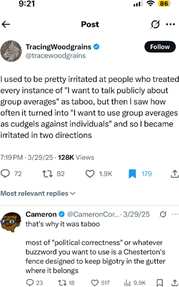
In light of this does cancel culture work? If there are dishonest actors who are anti-truth seeking and who want to limit the freedom of others, then I think it’s good to have some kind of pushback mechanism, and perhaps it’s better that this mechanism is wielded by a collection of private actors as opposed to the government. Still, we can improve this, and I will return to this later.
First though, I want to point out the anti-cancel culture backlash, which asks what is the statute of limitations on speech? One more egregious case I found was that of Alexi McCammond. She tweeted some pretty racist stuff back in 2011 (at age 17), apologized for it and deleted the tweets in 2019, but was then fired in 2021. As far as I can tell, her apology strongly condemns her past actions and her work as a journalist seems to back up her sentiments. It’s surely reasonable that in ten years someone who has explicitly apologized and condemned their past actions could have changed. This highlights a problem with the “collection of private actors” mechanism I described above. Instead of being dealt with in a systematic way according to established rules, this mechanism runs on emotion. No one cared about her racist tweets for years until she gained some prominence, and then it became news to people, and as far as internet strangers are concerned, a tweet from yesterday and a tweet from ten years ago look the same. Even if you know one is old, it takes effort to give yourself the additional context, and that’s a level of effort most people won’t exert. After reading a news story about this that presents all the facts in a more organized way, I think most people can see that this is kind of absurd, but in the moment, we’re subject to the tides of emotion.
The internet distorts both space and time, making everything appear on equal footing, anywhere instantaneously accessible from anywhere else. On top of this you get a platform where anyone can send their most impulsive thoughts into the void. Of course you’re going to get mob violence online. It’s an inevitable consequence of the structure. No context, no distance, just inflammatory statements and reaction and reaction to reaction [10]. When there was more institutional/governmental control, you had to write your opinions longform (or at least in_a_ form) to get them distributed to the masses. Even if you wrote drivel dressed up in the king’s English, at least there was some context, at least people knew how to orient themselves with respect to your opinion, at least people could judge you on scale with more precision than ALLY or ENEMY. But without this we default to the basics. Enemies must be crushed; allies must be saved. Overreaction one way begets overreaction the other way, and now racial slurs are making a comeback.
How do we fix this? I’m going to borrow from Kyla Scanlon here and say: context, context, context. I agree with Scanlon’s claim that how something is said is more important than what is said in the modern age, yet most of the focus on free speech is centered around content. The cancel culture focus on limiting discussion of certain topics is essentially a hedge against undesired second order effects (e.g. bigotry). I think Elon’s Twitter has shown this idea to be a failure. Expelling ideas outright from the public sphere just pushes them to the fringes where they can thrive, and thanks to the compression of distance on the internet, it doesn’t take much for these ideas to hit escape velocity.
If instead there were parameters around how things could be said, if there was a requirement on the structure, length, and thoroughness of each post, maybe we could avoid the de-evolution of discourse to the most instantly emotionally appealing memes. This is a restriction on free speech, but not a silencing of opinion. It’s an attempt to prompt better opinions. The exact parameters would need to be fine tuned with experimentation, but I imagine something like this:
· Claims must be falsifiable
· Must include a well-reasoned justification for your claim
· Must pre-empt/address at least one potential counter argument
· If the claim includes objective information like numbers or a chain of events, must include a link to a source
· Must include a stated goal in the first post of the thread – I’m less married to this one
Perhaps these specific parameters are infeasible, but I think they’re a good attempt, and the more objective the better. Of course, implementing these will require top-down power, and the corporations certainly won’t do it, so it would likely need to come in the form of government regulations. And while I think these parameters would generally elevate the thought required for discussion, and keep discussion participants correctly oriented towards the goals of the discussion, I think the better effect will actually be something else. It will allow for the censorship of genuinely freedom limiting speech when it doesn’t meet the criteria for discourse, which I think is more virulent as a meme when it’s presented in a thoughtless emotional way, without suppressing whole topics outright. As with any new rule, this could be inconsistently applied depending on the interests of the platform owner, but I think erring this way is better than the current wild west.
I think the most important thing these guidelines promote is the completion of the thought. When you see something you already agree with, it’s easy to nod, feel superior, and move on. This won’t defeat that—you can’t force everyone to read the whole post—but it at least provides more opportunities to complete the thought. You can see why someone believes what they do, and it gives you the chance to evaluate your beliefs against theirs. Similarly, instead of dismissing anything you disagree with, it will provide a chance for some more granular evaluation [11]. People can still lie, they can still cite fake or faulty sources, but at least those avenues are now open for attack. If someone’s Twitter history is just a chain of one sentence anti-vax tweets, there’s not much you can do to pushback. You may not change the mind of the poster, but for everyone else, they will have the chance to see fuller arguments, a chance to use reason rather than defaulting to enemy or ally. Partial thoughts clog the mind, and only when they are written on the page can they become complete. Only then can we truly think.
Will this work? I don’t know. I’m not even sure how consistently these rules need to be applied. Should this apply to joke posts and parody accounts? Would this literally be making comedy illegal? It might. It’s easy for me to scroll through Twitter and deem posts as productive, non-productive and harmful, or non-productive but harmless, but my perceptions are not universal truth. Posts that I perceive as obvious jokes could be misinformation to someone else, or vice versa. I think we would need a democratic process to establish where to draw the line.
As we progress into a full-fledged intellectual obesity crisis, the only way out is structure. Assaulted by endless waves of information, we can’t think. I believe we have a right to be free from this assault. Lies used to be riskier. In a sparser information environment, each lie stood out and so did the speaker’s reputation with it. While I wish we could make everyone intrinsically value the truth more, that’s like trying to solve murder by getting everyone to intrinsically value human life more. In a vacuum, easy. In the real world, not so much. Everyone is capable of lapses, and the stakes are even higher for truth because of the risk of memetic mutation and evolution. And when bad actors intentionally push misinformation for their own ends, it spoils the game for everyone. If we’re going to live in a time of unprecedented information freedom, we need to make it easier for everyone to behave responsibly with the information they’re sharing, and punish those who don’t.
Footnotes
- ↩
At least the popular way we define “best”, which I think is “most closely aligning with truth.”
- ↩
Full disclosure, I do believe that the ultimate human societal goal should be to maximize freedom in the aggregate and minimize the distance between the most and least free individuals. I think this helps put a limit on potential “tyranny of the majority” type of abuses as well.
- ↩
Namely the environment, but I think it also applies to markets.
- ↩
For a more in-depth version of this argument, I’d recommend Claudio Lombardi’s 2019 essay from the American Journal of Public Affairs.
- ↩
This is true societally and individually. If you have no knowledge of your own limitations or where the boundary between you and the world begins, you will waste your life staring at reflections.
- ↩
Yes this includes people of every political affiliation. Spend ten minutes on Twitter and you’ll easily find both MAGAs and leftists completely disconnected from reality running on pure emotional heat. At the upper levels of the party though, this kind of emotional takeover is certainly more prevalent among Republicans.
- ↩
Of course this didn’t work perfectly when there was less diversity of passion. See: slavery.
- ↩
In America at least, the government is often involved (or intentionally uninvolved) in many of these processes, but they are hidden from citizens who don’t perceive reality this way. It’s corporations all the way down.
- ↩
One area I think this is the case is therapy and mental health treatment. Fear of mass pushback has caused some therapists to change the way they give therapy. I think this clearly causes suboptimal therapy results and prevents the patient from discovering how to really improve their mental health.
- ↩
This reminds me of the episode of Buffy the Vampire Slayer “Earshot,” where Buffy gains the uncontrollable ability to hear the thoughts of everyone around her. Imagine if the 99% of people who have the sense not to post all their thoughts to Twitter all of a sudden posted them and you were tied to a chair and forced to read them all. You’d go crazy, and Buffy spends the episode figuring out how to get rid of the power before she goes crazy too. Most thoughts are passing visitors in your mind, not pure representations of you. Part of what gives you an identity is your choice in which thoughts to heed and which to ignore, which to voice and which to stifle, which to act on and which to work against.
- ↩
One behavior I specifically want to limit with these is when someone posts a graph of crime statistics by race with no additional argument or additional information and then lets the comments run wild, which is a behavior I would call “plausible deniability of implications.” Usually, the account knows exactly what they’re doing—they want everyone to think one race is inherently more criminal—but since they never stated this, they can deny this was their intention. No. Own your position. If you want to make that argument, make it with your chest, and if you’re too much of a coward, you should be banned from discourse until you shape up. Either you truly believe this in which case you should make a fuller argument, or you’re lying for some ulterior reason. And yes, I would also like people to stop posting the meaningless “60% of Americans live paycheck to paycheck” stat.