Reparations for Black Americans in the Twenty-First Century

Reparations – a transfer of money to modern descendants of enslaved people to compensate them for the wrongs done to their ancestors – is about the most blue-coded idea imaginable. Polls consistently find something like a 40% gap in support between Republicans and Democrats (1, 2), which makes it more partisan than support for gay marriage (35% difference), abortion (31%) and about as partisan as support for gun control (40%). If you don’t think too hard about it, support for reparations is almost a more reliable indicator that you’re a Democrat than voting Democrat, since the number of registered Democrats who didn’t vote for Harris in the last election is also around 40%.
On the whole, From Here to Equality (FHtE) is not a book which challenges this equilibrium. It is a left-wing perspective on a left-wing hobbyhorse written by left-wing academics using left-wing shibboleths and reviewed by left-wing hero Ibram X Kendi on the dust jacket. So committed are they to the bit, you even read the book left to right. However, buried within the detail of Darity and Mullen (D&M)’s proposals is an explosive aside which I think recontextualises the whole reparations debate. They parenthetically note that paying reparations would mean the end of government-funded racially-preferential policies, forever (FHtE, pp35):
“Once the reparations program is executed and racial inequality eliminated, African Americans would make no further claims for race-specific policies on their behalf from the American government”
As soon as I read this sentence, I wanted to write this review, because it frames FHtE as the opening offer in a negotiation between black and white Americans which could, in theory, be welfare-enhancing for both groups. White conservatives can pay to end race-preference policies that they find objectionable (I call these ‘DEI policies’ as a zeitgeist-y shorthand), and Americans who are descended from slaves (‘ADOS’) are compensated for this in a one-and-done payment which ends all future reparation claims. It invites the obvious question – could there be a zone of possible agreement for this hypothetical deal in real life?
FHtE is not a book about the blue tribe striking a deal with the red tribe. D&M would probably find this framing rather distasteful; they clearly believe the reason to pay reparations is that it is the right thing to do, and they provide hundreds of pages of careful economic history to prove it. In fact, D&M would likely say that paying reparations just to avoid DEI policies is a rather objectionable way of framing what is supposed to be an emancipatory project. However, neither is the quoted aside just a careless typo. Ending race-based policies is just a logical downstream consequence of eliminating the underlying need for race-based policies, just like stopping painkillers is a logical downstream consequence of healing the underlying injury.
If there is one theme of FHtE which shines through more clearly than any other it is that D&M really passionately believe reparations will end generations of trauma for black Americans: “our hope is that this book will play a role in encouraging more Americans to recognize that black reparations are not only morally justified but practicable” (FHtE, pp413). If I had offered to translate this book into – for example - Spanish, I think they would be delighted that their argument would have the opportunity to reach more people. What I am doing instead is translating it from left-wing academia-ese into a rationalist cost-benefit frame, and aiming the results at rationalist-leaning conservatives.
I’m hopeful that this translation effort will be successful, because it positions FHtE as the sole left-wing entry in a series of “Faustian bargains” (FHtE, pp383) of the same kind proposed by a subset of the American political right. For example, Ross Douthat and Charles Krauthammer proposed a direct trade of reparations now in exchange for no further Affirmative Action in the future. Predictably, these individuals were dismissed without serious engagement by the left.
D&M looked at this response and concluded not that Douthat and Krauthammer were wrong to trade money against a sacred value of the left, but that they simply didn’t come up with enough money to make it worth the left engaging in the trade – “the ante seems to have declined” (FHtE, pp384). By D&M’s calculations, the value of reparations is approximately 14 trillion dollars, which is about 15x more than Douthat and Krauthammer offered. This is an enormous amount of money, but - to America - not an unfathomably enormous amount of money. It is the sort of amount America could find if it really had to, approximately five Iraq wars. This translates as a payment of about $40,000 from each American and $350,000 to each ADOS. Note that in D&M’s scheme all Americans pay for reparations via quantitative easing, so each ADOS both pays in (via reduced buying power) and gets a payout (via direct transfer).
Let me set out the punchline to this review before I begin; some conservatives (like Douthat and Krauthammer) have signalled that they are open to a negotiated end to the reparations debate, in exchange for rescinding DEI-type policies. D&M have a theoretical framework that allows for the left to engage in that sort of trade, which I will describe below. The key contention of this review is that I believe there is a defensible reading of FHtE that makes reparations a net positive for conservatives, and that therefore conservatives should support reparations on the FHtE framework.
In this review I will not defend that reading; instead, I will set out D&M’s framework and then ask you – armed with a piece of paper and a pen – to assess their methodology at each step. At the end, I’ll tally up the impact each methodological decision has on the final bill. If I am correct about my reading of the book, you will have convinced yourself that reparations are welfare-enhancing for the typical American. This is a review of the methodology of FHtE, not the writing or historiography.
I’m positioning this review in the grand rationalist tradition of being a ‘tax on bullshit’. If your own methodological choices indicate that reparations on the D&M model would be welfare-enhancing for you, but your stated position is that you oppose them, then something other than rational logic is making that position sticky for you. If you are not arriving at your beliefs logically, then this is a gap which is important to examine.
1. D&M’s model of reparations
1.1 – What are the harms of slavery?
If you are the sort of person who enjoys book-length book reviews, you are presumably already familiar with the broad strokes of the Transatlantic slave trade and why people like D&M believe reparations are owed for it. You may find it rather bloodless that I am reviewing methodology rather than focussing on D&M’s lengthy examination of the human and moral costs of slavery. To be clear, you’d have to be inhuman not to be affected by the litany of horrors inflicted on enslaved people. My focus on methodology is simply because I believe I can make a useful contribution here, and other authors (including D&M) have already covered the moral enormity of slavery far better than I could.
To summarise several hundred pages of strong scholarly work (FHtE is literally 50% references by volume!): D&M propose slavery was harmful for two reasons:
Firstly, it dehumanised and murdered millions of completely innocent people with “ferocious cruelty” (FHtE, pp374). Everyone agrees this is bad, but there is disagreement between pro- and anti-reparation camps as to what extent modern white Americans are culpable for it.
Secondly, value was stolen from enslaved people in the form of coerced labour. This value still exists and “all of that slave labor that was amassed in unpaid wages, is due someone today” (FHtE, pp49, quoting Malcolm X).
D&M go a little further than this though. They argue that the majority of the harm of this seizure of value is that black people were unable to invest it in capital assets, and so were unable to benefit from the wealth compounding white people could. D&M write, “because the black community has been denied so much in wealth-building tools; blacks, even middle class blacks, have no paper assets to speak of” (FHtE, pp69, quoting Randall Robinson).
This is probably the central novel methodological step in FHtE because it explains why reparations specifically are needed beyond just new DEI-type laws. D&M are diagnosing the problem as generations of path dependency, for which the only solution is radical intervention since “blacks cannot close the racial wealth gap by independent or autonomous action” (FHtE, pp73) as a result.
By describing the harms of slavery as being about stolen value, D&M defuse two extremely important counter-objections from conservatives. Some conservatives object to being made morally responsible for the actions of their ancestors. But in D&M’s framing, it is “not specific individuals or social groups that carry a special burden of guilt or shame” (FHtE, pp377) but rather ‘the American government’ in the abstract. Some conservatives object to making arbitrary payments to ADOS, but D&M’s framework allows us to conceptualise the payment not as arbitrary but grounded in a construct which will be highly recognisable to conservatives; the government respecting property rights they were supposed to be enforcing.
1.2 – What do reparations achieve?
The two kinds of harm map on to a framework D&M introduce for two kinds of redress:
- Atonement is “when perpetrators or beneficiaries meet conditions of forgiveness that are acceptable to the victims” (FHtE, pp33). This maps to the first kind of harm, where the moral horror of slavery is the thing that must be apologised for.
- Restitution is “the restoration of … a condition [victims] might have attained had the injustice not taken place” (FHtE, pp33). This links directly to the second kind of harm of slavery; there exists money in the world which rightfully belongs to the descendants of enslaved people, and reparations is returning that money.
D&M point out that these two kinds of redress need not be mutually exclusive, but that in practice “there is no existing mechanism for establishing when African Americans collectively will have reached an agreement that sufficient steps have been taken to justify forgiveness” (FHtE, pp33). As such, atonement isn’t really a methodologically appropriate measure. This is a notable concession to the conservative side, and really emphasises to me how serious D&M are about getting reparations done vs selling books to left-wing critics who already agree with them.
This leaves us with restitution, and D&M propose that restoring black people to the conditions they would have been in absent slavery involves closing the mean wealth gap. To D&M the black-white wealth gap is “the best single measure of the harms of slavery” (FHtE, pp15). Elsewhere they suggest that restitution would also mean closing gaps in income, education, health, sentencing, incarceration, political participation and “subsequent opportunities to engage in American political and social life” (FHtE, pp34), which seems a more expansive target. Although D&M are not totally clear here I think they have in mind that closing the wealth gap will also – as a downstream consequence – fix all that other stuff too, and therefore all that other stuff isn’t really central to the discussion in FHtE.
1.3 – How do D&M define restitution for slavery?
D&M argue that there are three main eras of slavery, each of which has locked black people out of wealth formation to different degrees.
-
Slavery itself, which lasts from the early American colonial period to the Civil War. In this period the labour of enslaved people was being actively stolen, meaning they accrued next to no wealth, and were completely locked out of capital markets
-
Jim Crow era, which lasts from the Civil War to the 1960s. In this period black people were systematically discriminated against meaning that whatever wealth they were able to accumulate was not able to be leveraged as hard as white contemporaries
-
Modern era, which lasts from the 1960s until reparations are paid at some point in the future. There are no legal barriers to black wealth compounding (though the legacy of the previous two eras means that social and cultural barriers still exist). However, black people will never catch up to white people because they start from such an unequal initial endowment.
I think they have in mind a model a bit like the below, where white people earn a fixed real income each year (which they invest and compounds) but black people only reach that stage in 1965. Therefore, even if there was exact equality between black and white people today, the legacy of slavery would be the gap between the red and black lines.
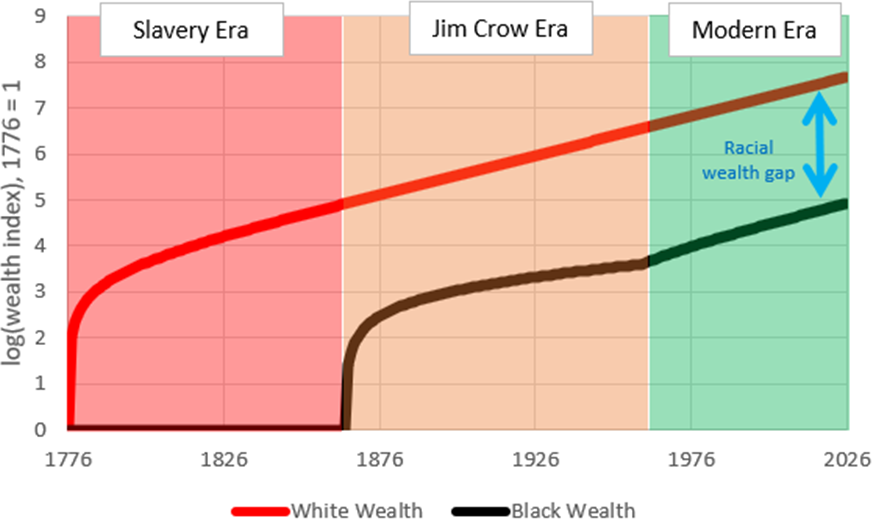
Conceptual diagram of D&M’s argument for how a wealth gap arises over the three eras of slavery
As an important pre-emptive counter-objection – this gap already includes the payment you’re thinking of which offsets the harm of slavery. For example, perhaps you believe that the Northern States contributed a very great amount of money in the Civil War, such that this counts as a partial offset against slavery reparations. But this is already captured in the red line, which would be steeper if the US hadn’t fought a civil war and had grown faster. Perhaps you believe so much money is spent on DEI each year that black people are better off than white people today – but again, this is already captured in the gap between the two lines, which will eventually converge on this theory but have not converged yet meaning there is still a wealth gap. Similarly, insofar as African countries that participated in the slave trade owe any reparation to black Americans for enslaving them in the first place, that’s not something America can compensate for on D&M’s framework; white Americans owe black Americans exactly the difference between these two lines and no more, because exactly that gap is the net amount stolen from enslaved people from the moment they touched down on American soil to today.
D&M calculate this gap as $14tn, which is in line with modern attempts to quantify the harms of slavery – I summarise D&M’s literature review in the table below. The agreement between a handful of left-wing authors on the total cost of slavery should not be taken as evidence that $14tn is the correct figure. Since there are no right-wing authors producing quantitative estimates like this there is no methodological counterbalance. It is clear that some slightly idiosyncratic practices have crept into the methods as a result; estimates for the harm of slavery increase considerably over time. For example, D&M describe an early approach taken by Ransom and Sutch as taking the value of enslaved people’s labour, subtract the cost of room and board, and then inflate the final figure to today’s currency. They are so aghast by this their academic register slips for a moment: “astonishingly, those enslaved are charged with the maintenance expenses of their own coerced labour” (FHtE, pp400). While not exactly a nice thing to think about, this seems so obviously the methodologically correct step (and the way we would estimate any other comparable value) that I am surprised D&M are so thrown by it.
| Author (year) | Approximate methodology | Value inflated to 2019 dollars |
|---|---|---|
| Ransom & Sutch (1990) | Value of stolen labour, subtract room and board | $19.7bn |
| Mittal & Powell (2000) | Current value of “forty acres and a mule” promised to free slaves | $733.2bn |
| Neal (1990) | Value of employing non-slave labour to do the same job, subtract room and board | $8.1tn |
| Judah P Benjamin (1860) | Contemporaneous estimate of slavery’s contribution to the economy (Benjamin was a pro-slavery politician) | $9.3tn |
| Marketti (2020) | Value of income diverted from enslaved person | $12.1tn |
| D&M (2020) | Value of black-white wealth gap | $14.0tn |
| Craemer (2015) | Value of stolen time (24h day) costed at average prevailing market wage | $17tn |
2. Key methodological challenges to the $14tn figure
Many conservative responses to pro-reparations advocates have essentially conceded the methodological point about the total reparations bill being very high, and instead argue exclusively about the morality of repayments – “Yes the cost of reparations would be [BigNum], but we shouldn’t have to pay because [reason]”. I don’t understand why they have made this concession; if there is one thing economists love, it is creating different ways to measure exactly the same thing, and the multiplicity of different ways of measuring the wealth gap creates an opportunity for the two sides to negotiate about what the most appropriate final bill for reparations actually is.
In this review, I propose that there is a defensible methodological reading of FHtE which leaves a conservative net better off paying reparations than not; more defensible methodology from D&M reduces the bill, stopping DEI payments offsets a lot of the remainder, and the moral / aesthetic value of stopping DEI most likely closes any remaining gap.
In order to get the final bill for reparations to be low enough, D&M need to concede at least a handful of major methodological points. In the most plausible pathways to a negotiated solution that leaves pro- and anti-reparations sides both better off, D&M need to make concessions on four such points. Note an important point here – a ‘concession’ is one of methodology; throughout this entire review I assume both liberals and conservatives are committed to ending the wealth gap in exchange for no further DEI – they just disagree on how to define and measure ‘the wealth gap’.
I don’t want to tell you exactly how to get from a cost of $14tn to a net positive value. This isn’t an essay about defending my own assessment of FHtE, it is a review of how effectively FHtE alters your understanding of the reparations debate via its methodology. Consequently, for each methodological challenge I will provide a range of possible approaches, alongside a letter key. For each challenge, you will get more out of the conclusion if you read each section, decide which methodological approach is most correct, and then write down that letter, so you can see whether you would fall into the ‘support reparations’ camp at the end of the review. It is a bit like a Cosmo quiz but, we must assume, marginally more methodologically rigorous.
2.1 – Means vs medians
Almost every serious academic study of wealth uses median household wealth as the correct figure, because “the median level of net worth better captures the more typical experience of members of each group because the median, unlike the mean, is unaffected by outlier values at either the upper or the lower ends of the distributions.” (FHtE, pp15). That is to say, the existence of a hyper-wealthy individual like Elon Musk changes nothing about the lived experience of the typical American, black or white.
D&M argue for bucking this trend and using the mean household wealth in calculating the wealth gap. This is for two reasons:
-
“The intense degree of concentration of wealth in the United States.” (FHtE, pp15). The USA has a very skewed wealth distribution. D&M inform us that households with above median wealth own 97% of all wealth (because below the median there is a lot of debt, i.e. ‘negative wealth’). They point out that “targeting the median gap excludes from consideration an overwhelming share of white wealth” (FHtE, pp15) and it is inconsistent with trying to return stolen wealth if you ignore a massive proportion of that wealth just because some crusty methodologists prefer median to mean.
-
They also point out that focussing purely on billionaires like Elon Musk is a red herring (Elon Musk walks into a crowded bar; everyone is now a billionaire by mean wealth); one quarter of white households have a net worth >$1m, and “significant relative differences in wealth exist at all points along the income distribution” (FHtE, pp16).
The upshot of this, however, is that the choice of mean or median makes a big difference to the total repayment. Median wealth produces a systematically lower estimate of the wealth gap because it ignores outliers, and outliers skew mean wealth upwards. By D&M’s own numbers, the black-white wealth gap is $350,000 using the mean figure and only $164,100 using the median figure.
I found myself surprisingly convinced by D&M’s argument that mean might be the better measure here, but it leads to an odd conclusion – reparations would make the typical black family better off than the typical white family (significantly better off, actually). Quite apart from likely being an unacceptable red line to conservatives in a negotiation, this seems odd enough that it demands explanation because it implies that a counterfactual black American would have held onto their money better than an actual white American. But, I don’t see why this would be the case – even in a racially utopian United States there would still be an axis of redistribution whereby elites steal money from working-class people, and that will affect black and white people equally. In real life, however, ‘elites’ are endogenous to the slavery story; it was the existing elite in America that owned the plantations which created the demand that brought slaves to America. So, we would expect elites to be disproportionately white, as they were elite prior to the start of slavery. D&M agree with this as far as inequality being “far from a mere product of class inequality” (FHtE, pp16), but they don’t get into details about how the initial endowment of class position could affect the ex-post class inequality (and how that might interact with race).
Just as a reminder – write down the letter corresponding to your preferred methodological approach now, so you keep yourself honest when we score the results in Section 3.2.
| Key | Methodology | Rationale | Multiplier |
|---|---|---|---|
| P | Mean wealth | D&M’s methodology & calculations | 1.00 |
| T | Median wealth | D&M's calculations, but not their preferred methodology | 0.47 |
| S | Geomean of mean and median wealth | (Arbitrarily) splits the difference between mean and median to account for some of the endowment effect of white pre-slavery elites extracting wealth from working class Americans of all races | 0.68 |
2.2 – Household adjustments
D&M propose that the calculated amount of reparations be adjusted for the fact that black households are typically bigger than white households (3.30 vs 3.16). If you simply lower the household wealth gap to zero then each individual black person is still poorer than each individual white person, and D&M believe that is wrong – this is consistent with their logic in using means rather than medians to (approximately) equalise the amount of wealth each white and black individual has. There are methodological counterarguments which conservatives could make but 3.30 is only about 4% bigger than 3.16 and there’s only so many hours in the day so fine, whatever, let’s grant this one to D&M.
However, if D&M are going to raise the idea of population adjustment, we really ought to apply this standard consistently; as well as larger households, black families tend to be younger (31 vs 44 mean age). Younger people have had less time to accrue wealth, and so a wealth gap would exist between younger and older people even in the absence of systematic discrimination running from old to young. In fact, this understates the importance of this correction, because peak wealth acceleration happens between 35 and 45 according to the Federal Reserve. Therefore, this is an age gap which is particularly likely to produce high apparent wealth gaps.
Annoyingly, I can’t find figures to tell me specifically how much black wealth grows between 31 and 44, so I’ve had to make some assumptions about how much this figure could reduce the final bill. I fitted a regression to wealth-by-decade data produced by the Federal Reserve and got something out of the back end of it, but I was missing a lot of data so I can’t promise this is the answer a proper labour economist would get. To be fair to D&M, I also picked a second method I was confident would underestimate this ageing effect to act as a sort of middle ground.
Methodologically, this story is complicated because household composition (size and age) is also endogenous to slavery. Slavery left black people poorer, poorer people have larger families as a rational economic response to poverty, and larger families have more children and so we see a skewed age distribution. I don’t think that makes the project of picking a methodology impossible (D&M were happy to do it to correct for household size), but it does mean we should be epistemically humble about over-interpreting these figures.
| Key | Methodology | Rationale | Multiplier |
|---|---|---|---|
| I | Adjust for household size but not age | D&M’s methodology, seems inconsistent to adjust one but not the other | 1.00 |
| A | Adjust for both household size and age using regression approach | Use each ten year boundary in Fed database to fit a polynomial regression, then calculate difference between 31 and 44 years old using this regression (exact, but methodologically less defensible) | 0.59 |
| O | Attempt to fully match population pyramid | Calculated exact proportion of population which is in each age decile, and then weight Fed database by this proportion (less exact, but captures full population effect so methodologically more defensible) | 0.82 |
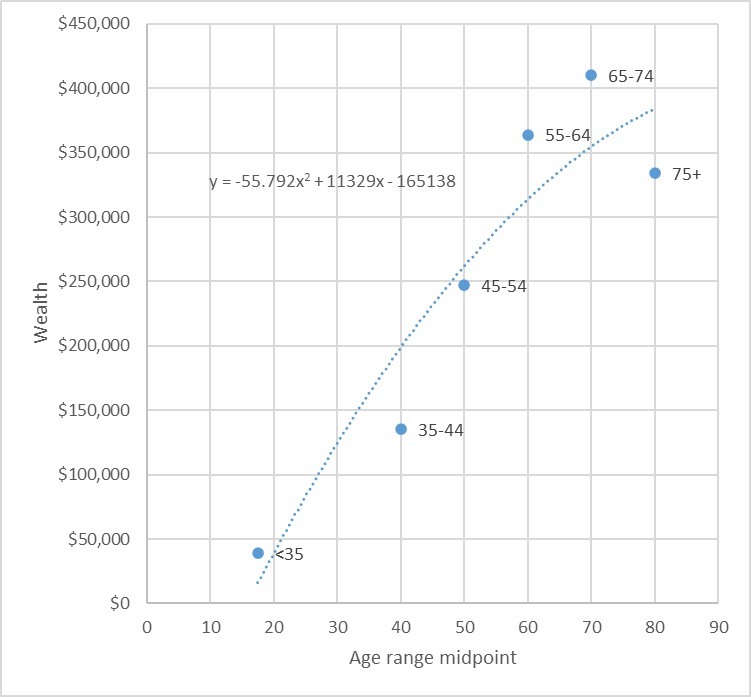
Output of a simple polynomial regression model run on Fed wealth database
2.3 – Different measures of wealth
D&M are clear that wealth – and not, say, income - is the best measure of economic well-being (FHtE, pp74):
Wealth serves as a primary indicator of economic security … Simply put, wealth gives individuals and families choice; it provides economic security to take risks and shield against financial loss
I’m broadly convinced by this. It tracks with what I know about how economists think about wellbeing, and it is consistent with D&M’s position that the harms of slavery accrue over a long period. I do worry that D&M are resting a massive piece of their argument on the unproven assumption that closing the wealth gap will result in durable racial equality. We know empirically that wealth gaps are not always the result of discrimination. For example, Asian Americans are richer than American whites, and yet Asians do not discriminate against whites on a society-wide level to cause this – the prevailing view amongst conservatives is that Asian Americans work harder and save more, accounting for their greater wealth. D&M argue vociferously that this is because Asian immigrants are positively selected – speaking about Japanese migrants, they say “they tended to come from districts that were less poor … than [non-migrant] Japanese.” (FHtE, pp87), and they devote an entire chapter to refuting the idea that “source of black-white economic disparity [is] dysfunctional or self-defeating behaviors on the part of black Americans” (FHtE, pp20). Nevertheless, if any part of the wealth gap is explained by different group-level cultural practices, it will reassert itself after a few generations. I’m not sure a conservative really cares about this – they’ve already got what they want out of the deal by that point – but it is a weakness of D&M’s framework which they don’t really address in detail.
Beyond this, D&M make a sound methodological choice in my view by sticking with the most commonly accepted measure; net worth is a count of your assets minus your liabilities. For a median US citizen, the majority of their net worth is their house. However, for a median black US citizen, this proportion is even higher because black people tend to have fewer other savings. This is interesting because the engine of D&M’s case rests on capital compounding – you take your money, earn some interest on it, and then reinvest the principal and the interest to make even more money. You can’t really do that with a house. So, there is a case at least to hold D&M to a different standard; if they insist on using nonstandard averages and corrections, perhaps conservatives can insist on using liquid net worth as the measure of the wealth gap (assets which can be invested minus liabilities). This would greatly lower the overall reparations bill.
D&M could counter that there are measures of wealth which increase the bill too though. For example, social security payments are an income stream which often dwarfs the value of someone’s house, but because they are not really a fungible asset, they are usually ignored in wealth calculations. However, a conservative who opened the definition of wealth as a point to be argued over would certainly find D&M ready to argue that actually the bill is more than twice what they originally calculated using the conventional methodology.
| Key | Methodology | Rationale | Multiplier |
|---|---|---|---|
| L | Net worth | D&M’s methodology, more conventional | 1.00 |
| R | Liquid net worth | Removes illiquid assets which cannot be compounded so easily, like housing | 0.76 |
| N | Augmented wealth | Includes very illiquid assets which nevertheless affect lived experience of wealth | 2.44 |
2.4 – Target of payments
D&M have thought extensively about who receives reparations, and have come to the following proposal (FHtE, pp14):
1. The first criterion is a lineage standard: individuals must demonstrate that they have at least one ancestor who was enslaved in the United States.
2. The second criterion is an identity standard: individuals must demonstrate on a legal document that they have self-identified as black… at least twelve years before the enactment of an African American reparations plan
An absolutely incredible amount of space is then dedicated to how the first criterion might produce “lucrative opportunities for private genealogists” (FHtE, pp397) and alternatives to private genealogists like the internet, Census data, slave ship manifests or “the establishment of a congressional or presidential commission to study and develop reparations for African Americans” (FHtE, pp398). I am mostly impressed with D&M’s scholarship in FHtE, but this is a bit of a whiff for me – surely this is just bikeshedding?
Nevertheless, note that this slightly confusing digression distracts from the fact that D&M’s criteria don’t follow from their position on the wealth gap; while I think D&M do a good job arguing that the wealth gap is the most reasonable target for a reparations programme, they do hardly any work at all to establish that their preferred population is the right one to target. I would describe D&M’s position as ‘population-maximalist’ – it is almost impossible to imagine anyone who could potentially have a claim to reparations who is not covered by their proposal. The only major carve-out is an obviously reasonable retroactive identification criterion to include only those people who thought they were black “before the existence of a reparations commission or reparations programme makes it advantageous to do so” (FHtE, pp396). Being ‘population-maximalist’ greatly inflates the final bill, simply because more people are being paid.
Population-maximalism does not have any particular methodological claim to superiority. In many ways it seems like it must in fact be methodologically wrong. For example, imagine a hypothetical mixed-race child who identifies as black. By D&M’s methodology their black mother (say) is disadvantaged by slavery, but their white father (say) is advantaged by the same process. On net, this child is partially advantaged and partially disadvantaged by slavery, but by D&M’s logic this child receives 100% of the planned reparations payment and so is 100% advantaged by reparations. I don’t think there is an unambiguously correct way to think about the morally correct target of reparations, but in the table at the end of the section I consider a few possibilities that I think a good-faith negotiation could throw up.
An interesting methodological quirk I noticed while reviewing; D&M have correctly adjusted the final bill downwards by about 6% to exclude black people with no enslaved ancestors (e.g. those migrating recently from the Caribbean). This is why I keep using the ugly ‘ADOS’ abbreviation rather than just saying ‘black Americans’ like a normal person, because not all black Americans are ADOS. However, they calculate the wealth gap as just the naked black-white wealth gap, without this adjustment. This matters because Caribbean migrants are typically wealthier than African Americans, so the wealth gap would be higher if they were correctly excluded. My best guess is that this only underestimates the final bill by about 2% and we’ve previously said we won’t lose sleep over adjustments that small – but I thought it was interesting that D&M missed an opportunity to raise the bill very slightly.
| Key | Methodology | Rationale | Multiplier |
|---|---|---|---|
| O | Pay all with a black ancestor & who identify as black | D&M’s methodology (NB this already implicitly adjusts for non-enslaved black ADOS) | 1.00 |
| I | 23andMe says at least one black grandparent | Example of reducing target population with reasonable-ish alternative, capturing those with a more 'direct' connection to slavery | 0.71 |
| A | 23andMe says no white ancestors | Very maximalist position - Capturing those who are 100% intended target of reparations (but excludes descendants of black women raped by white slaveholders, which excludes a central harm of slavery) | 0.14 |
| E | Bryc 2015 | Use the percentage of African DNA in the average black American as a proxy for percentage of enslaved ancestors. This commits you to some slightly weird beliefs about DNA and ancestry such that you might be better off treating it as illustrative. | 0.53 |
Also, I had promised I was only going to talk about methodological issues, but this aside is important; realistically only those party to reparations are bound by the deal. A conservative might think themselves very clever for reducing the population to just those who have direct matrilineal descent (or whatever), only to find that those mixed-race individuals left out of the deal but who identify as black continue to push for Affirmative Action programmes. There could be a case for considering the actual goal here is to genuinely build a coalition to end DEI rather than just negotiating the final number down until the pips squeak.
2.5 – Payment sequencing
D&M make the very sensible point that “sequencing the payments over a series of years would increase the prospect of financing the reparations program” (FHtE, pp407). They don’t, however, connect this to the point that a sequenced payment could be staged over time and thus end up materially cheaper for each individual American than the $14tn sticker price might suggest.
D&M give a bit of stick to another left-wing author, Boris Bittker, for suggesting “somewhat arbitrarily” that two decades is a reasonable length of time over which to pay (FHtE, pp405). They then turn around two pages later and suggest exactly as arbitrarily that “wealth should be equalised in a decade” (FHtE, pp407). The timeline for payment is basically a pure negotiation, not a methodology step; black Americans would always prefer all the money up front for a variety of reasons, and there’s no methodological uncertainty about that. But given D&M have conceded that staggered payments over a decade are acceptable for practical reasons, there is no reason not to also take advantage of that and financialise the deal in a more efficient way.
In the table below, I’ve been strict with myself that this review is about methodology only and we aren’t allowed to negotiate the decade timeline with D&M. I’ve also assumed D&M are not talking about waiting a decade for any payments – they want an annuity paying $1.4tn each year. Therefore, the only options I’m allowing you to consider as part of our Cosmo-esque letter recording approach are for D&M’s one decade repayments with methodological uncertainty over the social time preference rate (basically the way a government thinks about opportunity cost). However, as a little treat to myself, I’ve run a scenario with Bittker’s two decade plan so you can see it. I have selected three illustrative compounding rates:
- 3.5% is the UK government’s calculation, which is based on extensive methodological research.
- 5% is the midpoint used for compounding in FHtE (FHtE, pp399)
- 7% is the value used for the US Office of Management and Budget, and is based on the real rate of return of private capital.
As a Brit, 7% seems like an unbelievably cavalier way of thinking about social time preference rates, but in fairness all our infrastructure is decaying around our ears so there’s potentially something to recommend the OMB approach.
| Key | Methodology | Rationale | Multiplier |
|---|---|---|---|
| T | Reparations paid in full up front | D&M’s explicit methodology | 1.00 |
| S | $1.4tn per year, 3.5% compounding | D&M's implicit view, using UK government compounding rate | 0.83 |
| N | $1.4tn per year, 5% compounding | D&M's implicit view, using D&M's midpoint compounding rate from elsewhere in the book | 0.77 |
| D | $1.4tn per year, 7% compounding | D&M's implicit view, using OMB compounding rate | 0.70 |
| X | $0.7tn per year, 5% compounding | Don't pick this as D&M explicitly reject two decades, I just thought it was interesting illustratively! | 0.62 |
3. Is welfare-enhancing trade possible?
3.1 – Capitalisation benefits of paying reparations
We have looked so far at the final bill that D&M will present to us, and argued that it might not be as high as D&M originally proposed. However, we have not considered the other side of the equation – the value of the government stopping all race-based policies black people might otherwise campaign for.
My impression is that conservatives mostly believe these programmes should end for moral reasons – that it is un-American to prioritise one person over another because of their skin colour. The amount you would pay to end DEI for its impact on ‘option value’ is quite personal and I won’t try to quantify it here.
However, conservatives also believe that DEI-type programmes waste a lot of money. The Economic Report of the President suggested that this value could be as high as $94bn / year. This is calculated by assuming that discrimination – even positive discrimination – causes a drag on the economy by filling roles with less qualified candidates. The report looks at the productivity of industries which pursued DEI heavily vs those that didn’t after controlling for what the report claims are all relevant non-DEI effects. The proxy variable is the fraction of minority managers left unexplained after this adjustment, which they attribute entirely to DEI. Then actual 2023 productivity is compared against a counterfactual 2023 with no “unexplained minority manager share”, and $94bn is reached.
Let’s be reasonable here; this number is total bollocks. I know it, you know it, the chaps who wrote The Economic Consequences of DEI almost certainly know it too. At a minimum, this methodology doesn’t survive contact with COVID-era changes to the economy, since it codes any structural changes to an industry due to COVID as being a downstream consequence of DEI. When it says, “discrimination causes a drag on the economy” it cites Hsieh et al. (2019) who calculate the economic cost of racial negative discrimination as being orders of magnitude higher than racial positive discrimination. Moreover, this methodology misses costs which anti-DEI conservatives would probably care about. For example, the salaries of the Federal DEI enforcement infrastructure, or the chilling effect of economy-wide cost of structuring HR, lending, housing, and policing practices to avoid disparate-impact liability.
Nevertheless, here is some important payoff from my earlier goal that this review function as a ‘tax on bullshit’; that $94bn / year is going to offset a pretty significant chunk of what D&M say they want out of reparations. Therefore, the higher the capitalisation value of DEI (as reported by the White House), the more attractive deals involving higher values of reparations become (because more of them is offset). Either conservatives can stand by their claim that DEI has a significant and highly material impact on the US economy (in which case they end up being much more pro-reparations than a sceptic) or they can concede that actually DEI doesn’t harm the economy so much that it is worth paying reparations to end it (in which case they should probably accept a lot of their anger at DEI is performative).
A conservative might argue that the two positions can be held at the same time. The costs of DEI are astronomical, but the ability of D&M to end them is more muted.
First, they might argue that a lot of the harms of DEI are entirely separate from the government. When the University of Virginia pay their VP of DEI >$500,000 a year that could well be a distortion on the economy relative to using that money productively, but the Federal Government can’t just force Universities to stop doing that without significant overreach. Further, they have no power at all to stop private companies from doing it if they want. Of the $94bn / year, the taxpayer could only recover a tiny fraction of that and the Trump government has already ended about all the DEI spending it is possible for a government to end. This is probably true in general, but misses that up until now DEI spending has been adversarial; conservatives hate it and liberals want more of it. Post-D&M, the whole of the American political system is at least nominally committed to ending all DEI policies.
Second, conservatives might believe that liberals can’t be trusted; that as soon as reparation payments are made liberals will renege on the deal and advocate for DEI policies anyway. Conservatives will be unable to claw back the money they spent for a purportedly ‘one-and-done’ transfer, and so be worse off. Probably the biggest fear of conservatives here is that the deal holds in letter but not in spirit; the ever-grinding mill of academia produces a brand-new set of oppressions, ‘Race-Based Affirmative Action’ becomes ‘Culture-Based Positive Procedures’ (or whatever), and conservatives once again have to spend time and political energy defending against infinite and unbounded obligations upon their money. D&M point out that the same trust issue creates symmetric risk for black Americans – race-specific policies could only end “…on the assumption that no new race-specific injustices are inflicted upon [black people]” (FHtE, pp35). On the one hand, this is eminently reasonable; the point here is to do away with Affirmative Action and the like, not give white Americans carte blanche to be as racist as they possibly can be. On the other hand, veterans of internet culture wars will have their antennae pricked for this - because what counts as a ‘race-specific injustice’ and who gets to define it?
It is notable that this is an argument which proves too much; by this logic, no agreement could ever be made by a party who gives up something now in exchange for a stream of obligation from a counterparty. But empirically, we observe such agreements. We even observe them in the reparations space; the 1988 Civil Liberties Act closed the Japanese-American internment debate in a way that, forty years on, has held without comment. Instead of thinking of liberals as either untrustworthy or not as a binary, conservatives could think of the deal itself as having a certain chance to collapse each year – whether driven by liberal perfidy, conservatives being unable to resist inflicting new race-specific injustices, or just some exogenous shock – and hence the risk is quantifiable as part of cost-benefit analysis.
An imperfect proxy for the risk of undertaking the deal would be the length of time a military treaty holds; in general, this will look structurally similar to an ‘agreement now in exchange for ongoing obligations’, especially in the form of e.g. defensive alliances like NATO (which has held) or security guarantees like the Budapest Memorandum (which has not). The Alliance Treaty Obligations and Provisions (ATOP) is a database of such agreements from 1815 to the present day, and my analysis suggests that the probability of a treaty collapsing each year is about 1.15%. This slightly undersells the mechanics though; treaties are quite likely to collapse in the first decade, but if they survive a decade they are extremely likely to persist indefinitely. Therefore, a best case for conservatives might be something a bit like the Voting Rights Act of 1965 – a political compromise which is contested and relitigated for a generation, but after which becomes part of the fabric of American society so totally that even private businesses who are not bound by it would never dream of undermining it.
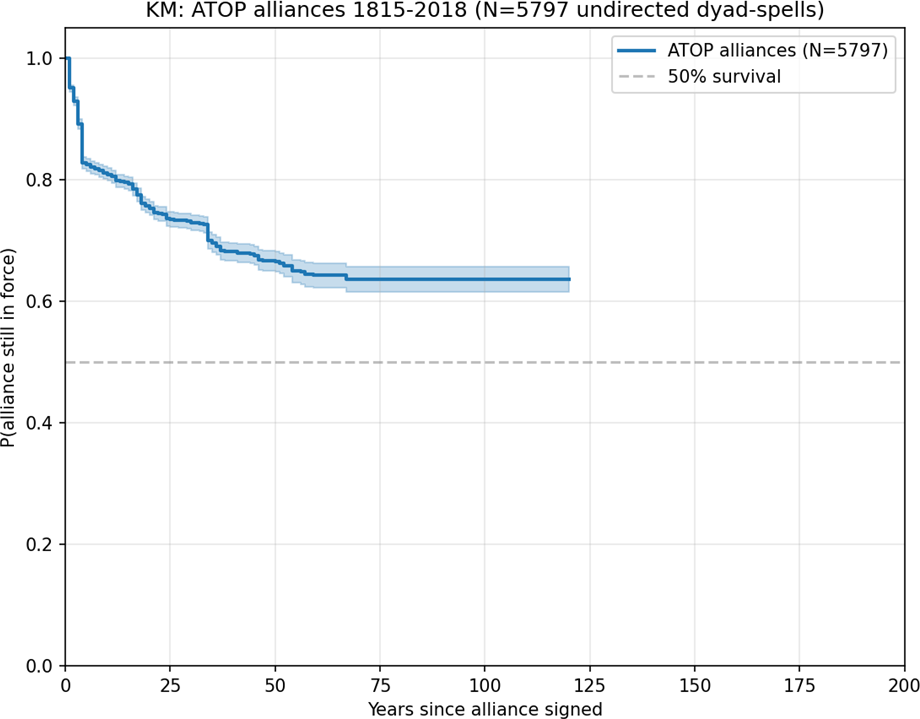
Visualisation of a Kaplan-Meier curve derived from the ATOP database
Just in case military alliances were less structurally similar to reparations than I expected, I sanity checked this approach by asking Claude to generate a list of historic reparation payment treaties. From this n=12 database I calculated a decay rate on these kind of agreements as 0.72%. Although this implies D&M’s deal would be slightly more stable than a typical military alliance, Claude cautioned that its training data will over-represent successful / long-lasting agreements and so the real value could be a little higher. This is disappointing to me, because it is exactly the sort of methodological caveat I would have liked to have made.
The maths of this works out quite straightforwardly. The value of ending DEI is the net present value of ending a stream of payments in the $94bn range. The net present value is affected both by compounding (like the payment structuring section) and by the risk that the agreement completely collapses in any year. Since any reasonable set of numbers (3.5%, 5%, 7% compounding, plus 0%, 0.72% or 1.15% decaying) gives approximately similar outcomes, I’ve just abstracted this away in the Cosmo letter-recording process.
| Methodology | Rationale | Deduction ($) |
|---|---|---|
| Ignore offset from DEI cost reduction | D&M’s methodology | - |
| NPV of offset 3.5% compounding | Ceiling value - UK government compounding and no renege risk | 7,853 |
| NPV of offset 5% compounding | Midpoint value - 5% compounding and 0.72% renege risk | 4,805 |
| NPV of offset 7% compounding | Floor value - US government compounding and 1.15% renege risk | 3,372 |
3.2 – Cost-benefit analysis
Throughout the review, I have asked you to keep a running tally of the arguments you found most convincing in each methodological critique section. For example, if you were D&M (and my critique didn’t move your stony hearts) you would have written down PILOT. In contrast, if you were a conservative maximalist looking for the lowest possible number at each stage you would have written down TARAD.
I have arranged some strings of five letters on the diagram below. The x-axis shows how much you personally would owe under your preferred methodology. The y-axis shows a completely arbitrary scale of ‘methodological purity’ I invented for myself so I could space the points out and fit more on the chart. The rough interpretation is points higher on the y-axis would be more likely to be accepted as the default by a statistician (ie prior to reading FHtE and considering their specific arguments). I have also colour coded the graph into three sections. In the green section, reparations are definitely a net positive on pure financial terms (with a bit of uncertainty about the exact net present value of ending DEI). In the orange section, reparations are not net positive on pure financial terms, but could potentially be worth it once you consider the social / cultural value of ending DEI. Eventually the orange section will give way into the red section, where no specific economic argument can justify paying reparations; you’re either convinced by the morality or you’re not. Note that the graph doesn’t show the full range of outcomes which include strings like PINOT which increase the payment from D&M’s base case.
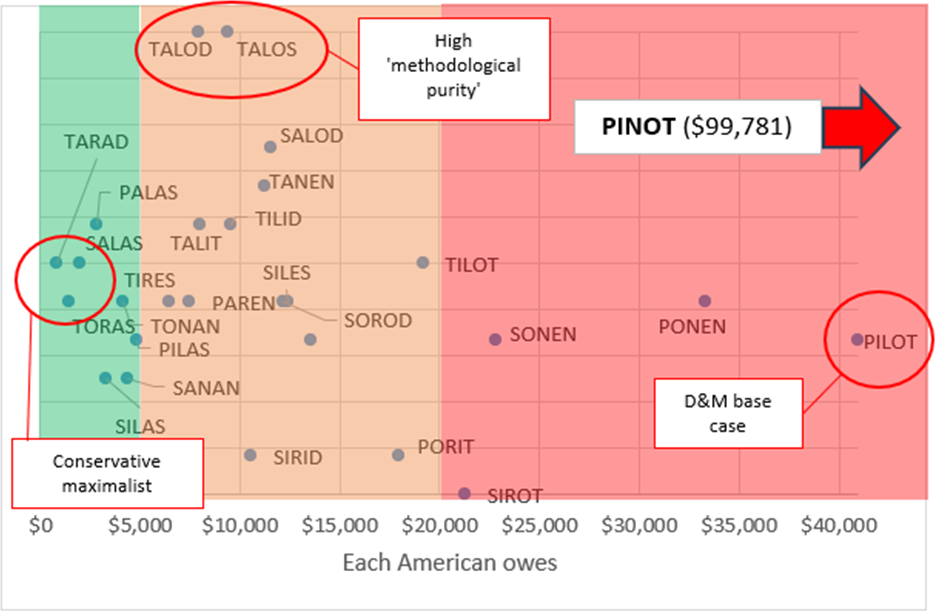
Possible reparation payments depending on methodological decisions taken during this review
If you can’t find your specific string, you can either pick one which sort of looks the same or work out where you are exactly by multiplying the total $14tn bill under D&M by the ‘multiplier’ at each stage. For example, take the string TALOS, which is my best guess for what a ‘methodologically neutral’ approach would be in a vacuum. That is to say, for each choice, TALOS gives you a sort of default textbook approach. This creates the following chain of logic:
-
Start at $14tn
- Multiply by ‘T’ (0.47) because median wealth is the default number used by researchers = $6.56tn
- Multiply by ‘A’ (0.59) because regression is the correct methodology to adjust for household age differences = $3.86tn
- Multiply by ‘L’ (1.00) because net worth is the default instrument used by researchers = $3.86tn
- Multiply by ‘O’ (1.00) because there’s no default methodology for calculating who is owed reparations, I reckon D&M are experts on the topic and they say ‘O’ = $3.86tn
- Multiply by ‘S’ (0.83) because I’m British and His Majesty insists that I use a 3.5% social time preference rate = $3.21tn
-
End with $3.21tn, which divided across 342m Americans is a payment of $9,377 per American.
-
This is narrowly more than the high end of the DEI offset (note that TALOS implicitly uses a 3.5% discount rate in the ‘S’ step, so it would be odd to change horses at this point). Therefore, paying reparations is welfare maximising if the option value of ending DEI is around $1,500.
I have highlighted some specific strings below which I think are of high interest for various reasons – they roughly tell a story of how reparations might look if D&M concede more and more methodological points. For illustrative purposes I have included a column where I show what 8x the cost per American, which roughly corresponds to the amount each recipient will get. However, this starts to get a bit complicated since a couple of the steps modify the denominator or the sequencing of payments such that individual black Americans might end up with significantly more than 8x the payment made by each other American, so treat it just as a guide for your intuition.
| String | Cost per American | Transfer per Black American | Rationale for Interestingness |
|---|---|---|---|
| PINOT | 99,781 | 798,246 | Largest possible payment |
| PILOT | 40,936 | 327,485 | D&M proposed payment |
| TALOS | 9,377 | 75,013 | Methodological 'purist' approach looked at above |
| TALOD | 7,919 | 63,351 | As close as I can get to the top end of DEI offset ($7,853) |
| SILAS | 3,297 | 26,377 | As close as I can get to bottom end of DEI offset ($3,372) |
| PALAS | 2,831 | 22,650 | Approximately in line with previous (conservative) suggestions of ~$20,000 |
| TARAD | 851 | 6,812 | Conservative maximalist approach |
There are a few interesting points about this table:
-
First, you will be disappointed that none of these strings spell out something funny or apposite for their place in the table. Sadly, after multiple rounds of review and correction they are now essentially random, and none of my planned jokes survived. You can pretend to some kabbalistic significance with what remains if you wish.
-
Second, you can see that D&M are much closer to a ‘reparations maximalist’ position of PINOT than they are to the majority of possible configurations of methodology. This isn’t perhaps all that surprising since D&M are very explicitly committed to reparations being a good thing, but it is worth noting.
-
Third, you can see that previous conservative suggestions for payments match up with approximately PALAS. For example, Ross Douthat proposed $10,000 to each black American to end Affirmative Action ($15,000 today), and Charles Krauthammer proposed $50,000 to each family of four (approximately $23,500 per person today). It is notable that these are well short of where D&M expect the final bill to be – D&M say “these are extremely low amounts to meet the debt owed to black America” (FHtE, pp384). They are approximately as extreme compared to the ‘conservative maximalist’ approach of TARAD as D&M are to the ‘reparations maximalist’ approach of PINOT. This emphasises the point to me that liberals and conservatives have barely even begun to explore the space in between where a genuinely welfare-enhancing deal could live.
-
Finally, you can see a TALOD and SILAS approximately bracket the range where the cost of paying the reparations bill is exactly offset by the economy-wide benefits of ending DEI. Of very high interest to me is that the ‘methodologically pure’ approach of TALOS I describe above lies only just above this crossover point – that is to say, there’s a sort of plausible default position which needs only a tiny amount of actual negotiation (rather than methodological review) to make conservatives net better off. Switching the payment structure to two decades rather than one, for example, would be enough to do it.
Although there are some strings like TARAD which are nearly certain to be offset by the cost of DEI, the majority of results lie in the orange zone like TALOS; they are close to being offset by the DEI rebate, but not quite there. We must consider here the non-monetary benefits of ending DEI from the conservative perspective. After all, when most conservatives argue for an end to DEI they are not thinking about whether the UK or US social time preference value best represents the capitalisation costs of economic drag, they are expressing a moral belief that – for example – hiring decisions should not weight race as a factor. We might think of this as the ‘option value’ of ending DEI. This will be different for each different conservative, but my personal opinion is that it could easily raise to encompass at least the orange zone for a typical conservative. Consider:
- Ending DEI would be a straightforward aesthetic improvement for most conservatives. Ending DEI gives them significant ‘option value’. This is hard to quantify, but I would observe that American conservatives seem comfortable supporting expensive policies for purely social / cultural reasons. Democrats claim Americans are spending around $1,200 per year to pay for Trump’s tariffs, so it seems that the floor on supporting economically harmful policies in exchange for cultural victories is at least the net present value of $1,200/year for conservatives. This alone would add $17,000 - $34,000 to the value each conservative gets out of ending DEI.
- Paying reparations changes the political calculus. Black Americans form a permanent and predictable Democrat voting bloc, which makes it harder for conservative governments to win power. At least part of the persistence of this bloc is because Democrats have positioned themselves as the party of race-specific policies.
- Small-government conservatives in particular must never set the precedent that “any society can delay the provision of reparations until all of its direct victims have died” (FHtE, pp385). The government has a strong incentive to violate your rights if they can get away with it and a time horizon that makes waiting until you are dead a reasonable prospect. If rights were violated, repayment must be made to avoid moral hazard – and you might be the beneficiary of that rule one day. So, a little value is added to the deal for conservatives by reinforcing the norm of the government being punished for violating rights which are explicitly enumerated in the Constitution.
I propose that under most methodological assumptions, and especially under the scenarios which are most defensible under scrutiny, the financial impact of ending DEI alone does not quite justify paying reparations. However, there are a number of powerful but hard-to-quantify benefits pushing in the direction of paying reparations. Taken together, it seems highly likely to me that most conservatives would agree that paying reparations on D&M’s framing would be welfare-enhancing for them.
Conclusions
FHtE contains a radical bargain within it; we could negotiate an end to all laws with an element of racial preference in them by trading off sacred values on the left against reparation payments on the right.
The best and most interesting implication of D&M’s framework is that - from the point of view of conservatives – you don’t have to believe that it is right to pay reparations to engage in a negotiation with the aim of ending DEI forever. If you would burn $40,000 cash to end DEI today, it seems petulant to refuse to place the same $40,000 in a box labelled ‘reparations’ which achieves the same ends. Therefore D&M create a fascinating paradox; those most against DEI are those most likely to be attracted to paying reparations.
D&M might suggest that they never really intended for this radical bargain to be the most interesting part of FHtE, to which I would respond that it was certainly the most interesting part to me. Read purely as a cost-benefit analysis, FHtE is quite a significant failure. We have seen five major methodological critiques in this review which are not substantially rebutted by D&M, and there is no real attempt at methodological balance in their process; every methodological decision raises the total cost. However, FHtE is robust enough that it can support this reading, and in the process it can support an argument the authors probably didn’t intend or plan for.
Because FHtE was the focus of this review I have been quite critical of D&M. This is a bit unfair, because I’m forcing them to defend a reading they never made central and would probably regard as rather morally dubious. However, I have also been quite critical of conservatives; they have spent so much time and energy contesting the very idea that reparations should ever be paid that they haven’t stopped to ask themselves if – after engaging in good-faith negotiation with the left – they couldn’t reach some value that actually leaves them net better off.
My stated goal of this review was to act as something of a ‘tax on bullshit’. If you followed along at home, writing down letters and considering your position at each junction, you will be left with a number that is likely much smaller than $14tn. What you do with this number dictates how strongly you cleave to rationalist virtues. I think this number puts an anti-DEI conservative on the prongs of a dilemma. I believe such a conservative must:
- Accept that paying reparations would leave them personally better off, and support it.
- Accept that paying reparations would not leave them personally better off, and therefore accept that their anger at DEI is mostly performative.
Of course, there’s an escape from the dilemma, but you might not like it: a common conservative belief about reparations is that advocates are fundamentally unserious. They might feel strong emotions that reparations should be paid, but the amounts they are asking for are so ridiculously foolish that it is the duty of the adults in the room (conservatives) to prevent them from causing such economic harm to the nation. Rejecting this dilemma turns that belief on its head; in fact, conservatives are the ones who are refusing an economically efficient deal, because of strong emotive beliefs about some sacred value they are unwilling to trade. This is a complete reversal of the way reparations are usually discussed. It is also, as far as I can see, the price of escaping the dilemma my reading of FHtE eventually presents.
In conclusion, my reading of From Here to Equality is that it largely succeeds at being a pro-reparations argument, even when subjected to the Procrustean treatment I have given it in this review. D&M believe that all Americans should support reparations because reparations are morally right, and I agree that all Americans should support reparations because they are a Pareto optimal welfare-enhancement under the FHtE framework. Both D&M and myself believe everyone can be made better off by paying reparations, and nobody needs to be made worse off. I hope this review has been helpful in raising the issue in a way you might not have considered before, and I would be absolutely delighted to read a published response to From Here to Equality from the conservative side, setting out what they see as the most robust possible case for a low negotiated reparation bill in exchange for an end to all race-based policies that they dislike. I am confident D&M would agree with this conclusion despite the nonstandard approach I took to reach it – they say that they are “hungry for a serious conversation” about reparations (FHtE, pp26) and I believe the ball is now in the conservative court to give it to them.
Your message is stored now and emailed to the author after the contest ends. The author can reply to you, but their identity stays hidden unless they choose to respond.