-
Intro
Is it possible to write about gender without worsening the already-terrible gender relations? I’m not sure.
First, it seems like overall gender relations as a whole would improve drastically if everyone who is the kind of person who complains online about gender relations would just shut up.
Second, the topic seems to have an unusually high load of brainworms floating around. I don’t want to catch or spread brainworms. By “catching brainworms” I mean “absorb gender takes that, on average, negatively affect the social and romantic outcomes of the meme-carrier”. I think that nearly all the gender memes in our civilisation’s water supply (on all sides!) have a negative expected value in this sense, and that most people could improve their outcomes by preventing exposure. I also think that this is not a coincidence, and part of this review is an attempt to understand what happened.
I have tried to only include things in this review that have made it easier for me to be sane, and have plausibly improved my real-life outcomes. It is my hope that this review will fight the brainworms rather than spread them. Nevertheless, it is possible that I only believe I succeeded at this because the brainworms have thoroughly gotten to me; I urge the reader to exercise caution, and treat my gender takes, like all other gender takes, as potentially hazardous to engage with.
My argument will have two parts: First, a parallel argument to the one Scott Alexander makes about political partisanship in “The Psychopolitics of Trauma”.
Second, I will argue that, while biology is real, there are currently certain things ascribed to “biological reality” that can also be understood as the outcome of group dynamics (e.g. minority vs. majority gender, pursuing vs. pursued gender). I will also discuss how men’s and women’s perception of the opposite gender is systematically distorted due to several effects.
The final part of this review contains some ideas for how we, as a community (gestures at rat/postrat/TPOT/EA/… spaces), could experiment with the aim of improving our own average social and romantic outcomes. I tried to be as concrete as possible and, where appropriate, nominate specific people who might be well-suited to experimenting with those ideas. Be as sceptical of that section as of everything else in this review.
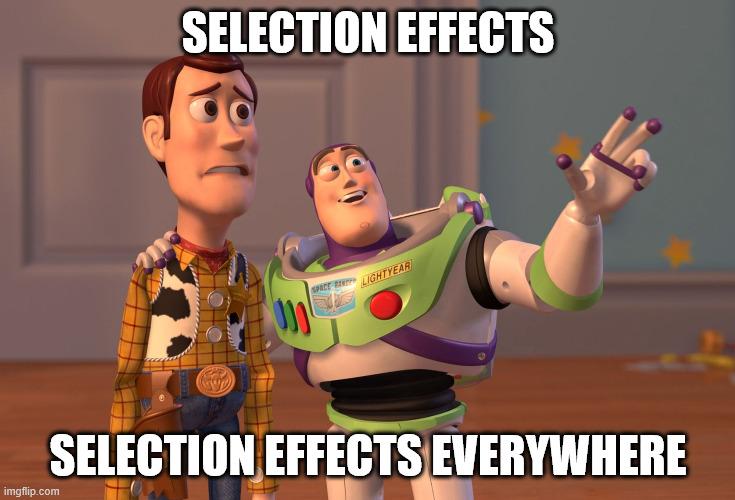
Spoiler: about ¾ of the argument can be summarised like this:
Why should you consider what I have to say? I’m a young woman, not exactly a demographic known for their firm grasp of gender dynamics. My claim here is that my range of experiences is unusually broad. I identify as cis now, but I experienced intense dysphoria for about eight years, more than half of which I identified as trans. I was able to pass as a boy in my teens. On the 12th August 2024, I found a mental switch that turned off my dysphoria, hence why I identify as cis now.
Experience of gender is influenced by culture, socio-economic class, attractiveness, age, and so on. I have lived in three European countries and have close ties to a fourth. I’ve spent significant time in both conservative right-wing spaces (my family of origin) and very progressive spaces (university). I served in the military for several years. I have significantly changed my attractiveness level through recovering from chronic illness (moving from ugly to mid, I can’t claim to have ever been hot). More trivially, I’m not straight. I haven’t sorted out whether I’m bi or lesbian, but my only relationship (>1 year) was with a woman and I’ve dated both men and women.
Given how unusually sensitive gender takes are to the speaker’s personal experience, here are some more details on my background. Read them if you want to correct for whichever distortions you think my observations have, or skip them as you wish.
-
I am in my early twenties and assigned female at birth (AFAB).
-
I’ve lived in several Western European countries, but never in America.
-
Socio-economic background: progressive public schools, family of origin and non-school influences mostly self-identified “conservative and right-wing” who, by their own admission, would have voted for Trump if they were eligible to vote in America.
-
I served in the military ages 18-21, including several deployments.
-
Childhood: more tomboy than girly girl, but gender nonconformity wasn’t a big deal.
-
Age 14: Rapid onset gender dysphoria.
-
Ages 14-16:
- Worked on getting HRT, top surgery etc. approved (not a quick process in the country where I lived).
- Could pass as male in bathrooms and new contexts where I introduced myself with a gender-neutral nickname, which I did wherever I could.
- Never transitioned socially in school, never voluntarily came out to anyone, or did anything else that is congruent with “attention-seeking”. Never had any piercings or unnatural hair colours.
-
This phase ended when I came across an account by someone who made a choice to be a gender non-conforming woman rather than trans. Not “having to transition” came as a relief.
-
Ages 17-22:
-
Intense dysphoria (visceral disgust and revulsion towards my body, especially gendered aspects) remained, with a significant detrimental effect on my physical and mental health and well-being.
-
During this time, I went back and forth on identifying as trans (which I never, at any point, wanted to be) and believing that “there must be something else going on, this doesn’t make sense, I need to figure out my “gender issues” some other way”. During the times where I thought being trans was the inevitable conclusion:
- I tried to get prescribed hormones (or buy them on the black market) at least five times, but always changed my mind at the last minute. I’ve never taken cross-sex hormones.
- Insurance denied my application for chest reduction surgery, I had a private consultation but I delayed it due to cost.
- I had (minor) facial masculinisation surgery (liposuction for a more pronounced jawline). Never regretted it. People who haven’t seen the before photos wouldn’t know I had anything done, but I like my face more now.
-
Also during this period:
- I got progressively sicker due to a not-yet-diagnosed autoimmune disease and other reasons; this also led to weight gain.
- I would no longer have been able to pass as male if I had tried, due to puberty and weight gain.
- My attractiveness during this period was, controlling for age, definitely bottom tier.
- I got progressively sicker due to a not-yet-diagnosed autoimmune disease and other reasons; this also led to weight gain.
-
-
Age 21: autoimmune disease finally diagnosed.
- Physical and mental health improved drastically over the next years. Also some weight loss.
- Attractiveness: moved from bottom to mid tier. Still “mid” as I write this.
- Physical and mental health improved drastically over the next years. Also some weight loss.
-
12.08.2024:
- I discovered a mental “switch” that turned off dysphoria. It has not returned since.
(As an aside: yes, I know my use of English military terms is weird. That’s because English is not the language of the country whose military I served in.I’ve been accused of stolen valour before due to this, so I want to clarify.)
-
Why is this a problem at all?
How is it possible that gender relations are so fucked up? What is going on with the low birthrate? Why should we bother at all with this apparently intractable problem?
Eliezer Yudkowsky argued (in 2009) that sexual and romantic entanglements represent the peak complexity of the human species. Men and women were not subjected to the same evolutionary pressures, and have not evolved to be each other’s ideal mates. If the average man were the average woman’s ideal mate, then we’d expect the preferred sexual frequency of the men and women to be the same on average, and so on. But they aren’t. Heterosexual relations are inherently a compromise. While some individual males and females may hit a “jackpot” in terms of compatibility, the average individual of either gender will not.
So, why bother?
One possible answer is this:
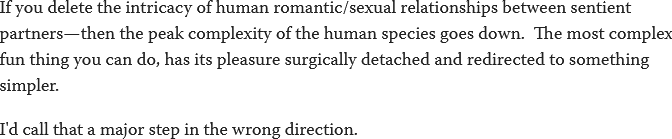
You can read Yudkowsky’s full argument here: https://www.lesswrong.com/posts/Py3uGnncqXuEfPtQp/interpersonal-entanglement
He argues that, even if we could supply everyone who wants with their “ideal mate” catboy/catgirl/cat-enby, we probably shouldn’t. We would lose something if we did.
My United Nations Presidential Campaign platform in 2035: I will solve the low birthrate with artificial wombs! There will be FREE Catpeople for Everyone!
… what do you mean, you’re not voting for me? Pff. Spoilsport.
So, to recap: it’s a hard problem. It hasn’t yet been made fully tractable. (I hope that this review helps with making it a tiny bit more tractable than it currently is.)
Ava (Substack writer - bookbear express) expresses a similar sentiment:
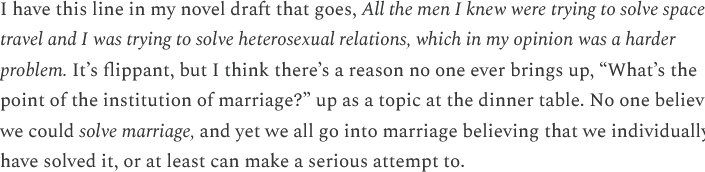
Remember her - she, and her substack, will make an appearance in the final section of this review.
(Source: https://www.avabear.xyz/p/what-is-partnership-for )
-
A Hypothesis
There is an essay by Scott Alexander called “The Psychopolitics of Trauma”.
I feel compelled, at this point, to mention that I’m from a non-liberal socio-economic background and had, for most of my life, a severe allergy to the word “trauma”. My brain auto-replaced the t-word with “whining that is designed to get the speaker attention and points in the Victimhood Olympiad, and shield them from criticism because you become a social pariah if you argue against someone’s ‘trauma’”.
I am mentioning this because I suspect that some people reading this will have a similar mimetic allergy to discussion of “trauma”. I had an explanation here of how and why I changed my stance, but it got too long, so it’s now in the appendix.
The tweet-sized version is this:
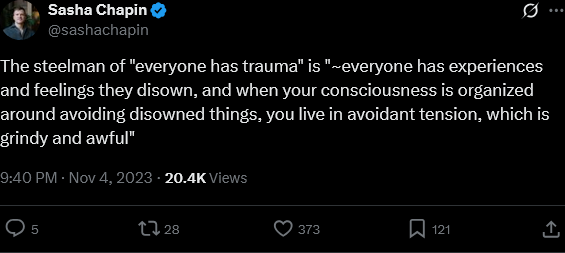
So what is Scott Alexander’s argument about the psychopolitics of trauma?

(...)

Read the full post here: https://www.astralcodexten.com/p/the-psychopolitics-of-trauma
Read it? No? Then go and read it. He’s a psychiatrist and I’m not; he explains it better than I could.
Another excerpt:
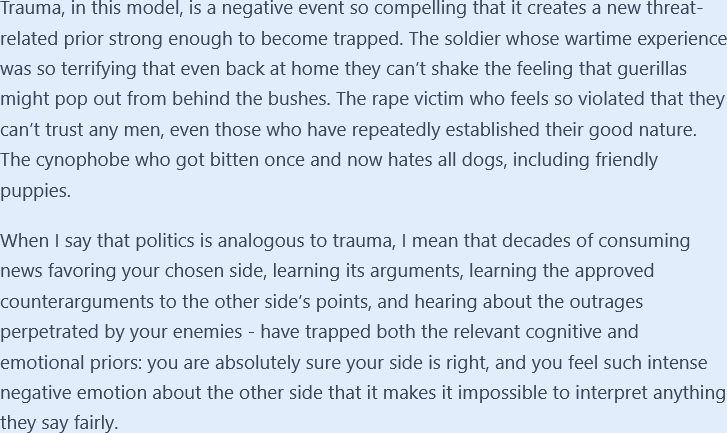
I am arguing that a similar thing has happened to gender relations. This (the next screenshot) is Scott Alexander’s conclusion about trauma and political partisanship. I think it also describes the worse battlegrounds of the gender wars. It’s a self-perpetuating cycle. And the people stuck in those trenches are also the people who produce the vast majority of gender takes. That’s why engaging with gender takes is so likely to have negative consequences. The gender discourse is produced by people who have been hurt in gender-specific ways and whose perception and strategies are now warped around the gravitational fields of those injuries. It’s a psychological minefield.
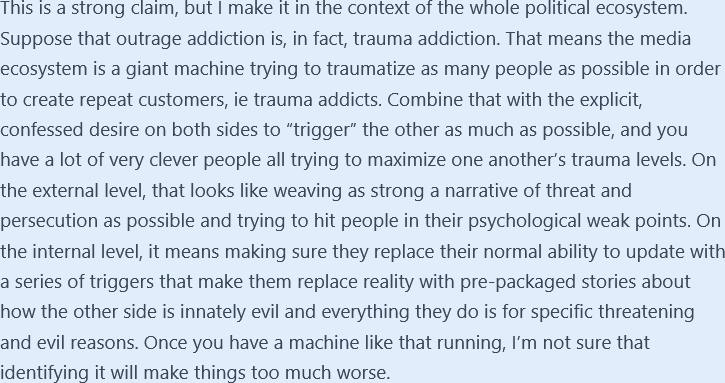
If this is accurate - if this is really a major source of toxicity in gender relations - then the implications are both horrifying and hopeful.
The horrifying part is that it would be a problem on a similar scale as political partisanship. Has anyone figured out how to solve that one yet?
But maybe it’s not quite that bad. There are several reasons to be hopeful.
First, severity:
It seems plausible to me that fewer people are gender-traumatised than politics-traumatised, and that the average level of gender-trauma is less severe. (I don’t have empirical data to back this up - it’s just my impression.)
Second, individuals don’t need to change the system before they can succeed at the individual level.
Most of us are mainly interested in solving the problem at the level of n=2. That’s a much easier problem than solving it at N=society.
If the above is accurate, a main part of the problem is that the most severely affected people make up the legions of “highly engaged” gender warriors that dominate the discourse and set the frames and narratives for everyone else. The downstream effects of that make things worse for everyone else. The downstream effects can be mitigated at the individual level - and the more individuals do so, the more the gender wars will lose their hold over us.
-
Objection: That would not solve the root cause of the problem
As we’ve established above, part of the problem is that men and women are not perfectly matched in their average desires. This set up the conditions for us to all traumatise each other, but it is upstream of the trauma problem.
Fair enough. I would like to reframe that.
Reproduction through sexual selection is so omnipresent in nature because it’s efficient.Instead of waiting for random mutations, a sexually reproducing species gets to try new combinations of genes constantly, and then the cosmos observes what works and what doesn’t. In self-help books or startup lingo, this concept is called “accelerating the rate of learning”. It’s the price we pay for existing as complex lifeforms. Would you rather be an amoeba? It’s also utterly cruel, perhaps the most cruel thing there ever was.
Calling the misalignment inherent to heterosexual relations “a problem” implies that, in some fundamental sense, it ought to not be there. But it has to be there. It is a necessary component of existence as a complex, social species. Saying that it should not exist makes as much sense as saying that death should not exist. Of course you can be anti-death, and work on cryonics. But cryonics doesn't work yet. Maybe someone will come up with a solution in the future, one that actually works. And it’s good that there are people refusing to accept the status quo, and working to change it. We need visionaries! But we would be foolish to rely on the visionaries to solve the problem tomorrow. And in the meantime, we should encounter it with the same acceptance that we strive (and usually fail) to have towards death
This - sex, romance, love - will hurt. That is inevitable. We can still try to be grateful for it, because without these things, there would be no life, we would not be alive. We can strive to practice gratitude rather than resentment, and try to not add avoidable pain to the unavoidable pain, with the understanding that, sometimes, our efforts will fail.
The next section of this review is an attempt to locate and describe sources of unnecessary pain, mostly by describing misconceptions the genders have about each other and how they arise.
-
Things correlated with gender that are not actually gender
Most of us have encountered variants of this graph before:
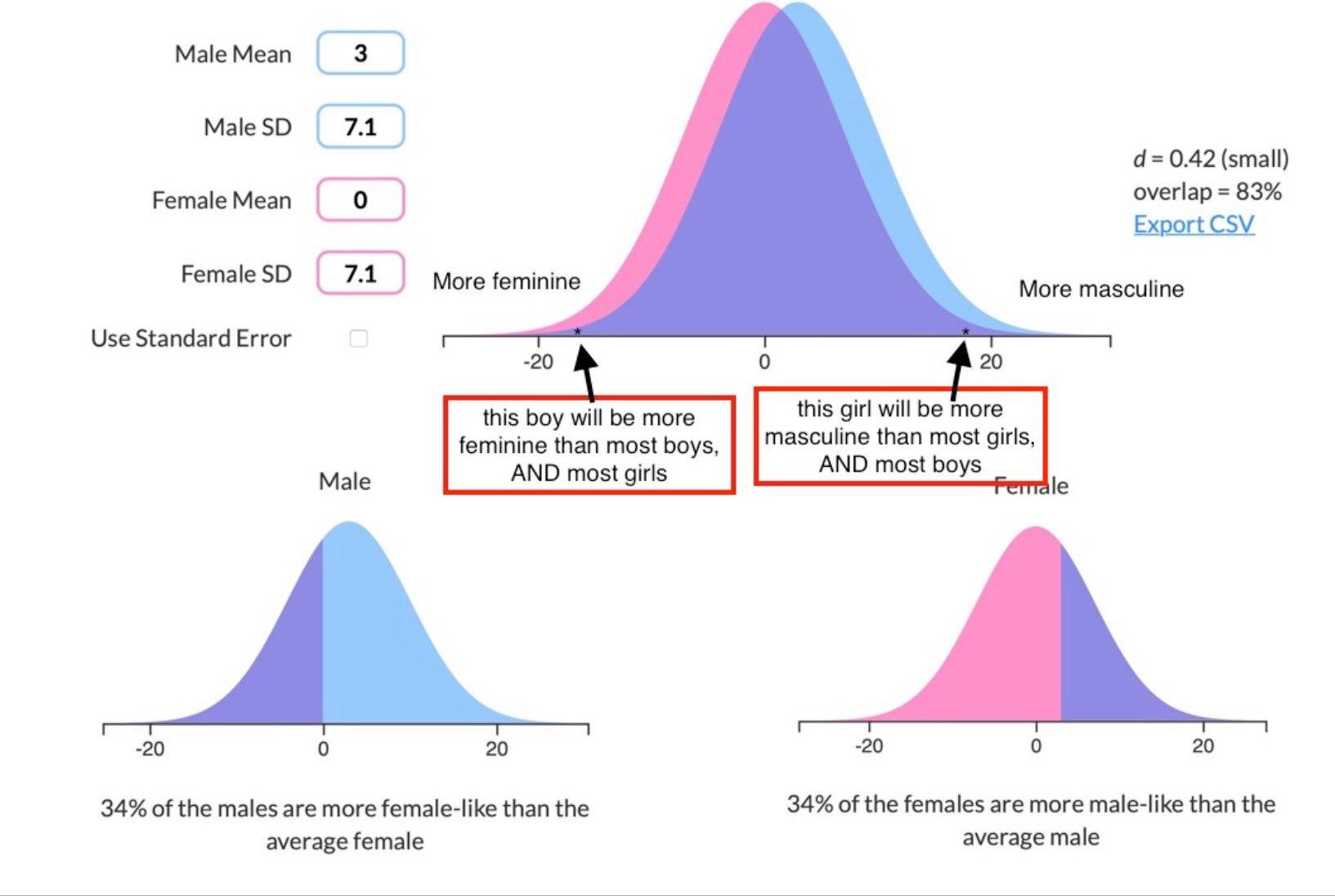
Men and women differ, on the population level, on lots of dimensions. The mean of the male bell curve is usually not the same as the female mean.
Some examples:
- In the MBTI personality system, ~⅔ of women score as feelers and ~⅔ of men as thinkers
- Women tend to have a more anxious attachment style, men tend more avoidant
- In the OCEAN personality system, women tend to score higher on e.g. neuroticism and agreeableness, and men e.g. on assertiveness
- Etc etc etc
It’s important that for many of these dimensions, relative position matters more than absolute position. Let’s say we have two people who tend to be anxiously attached. The less anxiously attached one will still, in a sense, be the avoidant one in the context of that relationship. Or, to use an often-cited example, orderliness. (Dimension in the OCEAN model; aspect of conscientiousness.) It’s often brought up that the average woman scores higher on orderliness than the average man. This has some explanatory power for the unequal distribution of housework. The higher you score on orderliness, the faster you are bothered by mess. If one partner is slightly more orderly than the other, that partner will be the one to be bothered first by most messes, even if the absolute difference between the two is small. This is a consequence of the relative position of the two partners. It’s a dynamic that still happens if one is 5th and the other 10th percentile on orderliness (both are less orderly than most men and most women) or if one partner is 90th percentile and the other 95th.
Most cultural narratives, clichés, advice columns and self-help books, and so on, are written for most people. “Most people” are not necessarily that similar to the median man or median woman, but they will still tend to find themselves in dynamics where the relative position is the one typically held by their gender. That’s what our cultural scripts assume, that’s what we are familiar with, that’s what we have internal software for.
Of course the “standard” dynamic can be flipped. For example, see here for discussion of a hetero relationship where the woman is more avoidant: https://sashachapin.substack.com/p/my-mind-transformed-completely-and

Conceptual precision is useful. If it’s an attachment thing, call it an attachment thing, instead of making generalisations about how “women are clingy” or “men don’t communicate”. And so on. Zoom in on what’s actually going on. That is more likely to be productive - you can’t do anything about “men’s nature” or “women’s nature”, but you can do something about anxious-avoidant relationship dynamics. It increases the resolution of our culture’s mental models, and that in turn increases the degrees of freedom we can operate in without leaving the cultural scripts.
-
Non-Innate Gender Dynamics and Misperceptions Downstream of Selection Effects
Biology is real
We are a sexually dimorphic species. In some areas it’s obvious (average height), in others it’s more subtle.
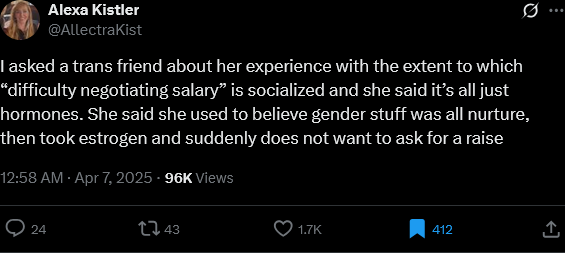
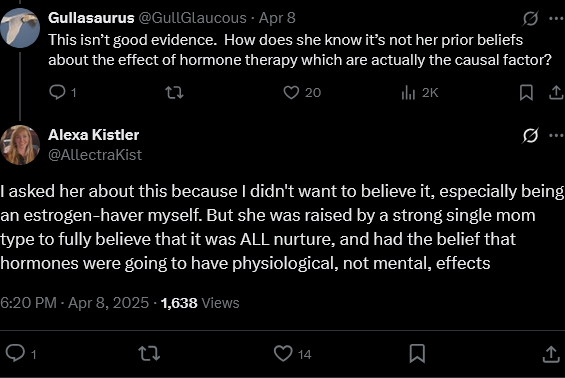
Other people have discussed this extensively. I don’t have anything to add to the biology discussion itself, other than to say that yes, obviously, Biology Is A Thing.
There are two arguments I will make in this section:
First, even people who are careful to hold nuance in biology discussions and acknowledge that outliers exist tend, in my opinion, to ascribe gender essentialism too much explanatory power. Some gendered dynamics are also predicted by models about, for instance, minority gender/majority gender dynamics, or pursuing gender/pursued gender dynamics. These are, mostly, testable hypotheses, and I hope this will actually be researched eventually.
Second, most men and most women have a distorted view of the opposite gender. This is because most people are not exposed to a random selection of members of the opposite gender. Instead, there are various selection effects at play.
Minority gender and majority gender dynamics
Sympathetic opposition deserves the credit for this observation: https://www.sympatheticopposition.com/p/thoughts-on-gender-ratio-and-social

Several areas where this applies (all credit for the insights goes to her; if I am misrepresenting her argument the error is mine):
- The minority gender is more likely to interrupt, and receives more attention when speaking.
- The majority gender is more likely to attempt mate-poaching (=trying to couple with someone of the minority gender who is already in a relationship (assuming heterosexuality))
- Intrasexual competition, as well as competition for the attention of the opposite gender, is more fierce for the majority gender than for the minority gender.
- Individuals of the majority gender are more likely to initiate PDA’s (public displays of affection) and show mate-guarding behaviour towards their opposite partner than individuals of the minority gender.
Sym Opp’s analysis is more detailed and she goes into how men and women differ in how they occupy the roles of minority and majority gender; go read it.
She also makes a point that is VERY, VERY important for understanding why people engaging in gender discourse often seem to be living on different planets. Few spaces (occupations, hobbies,..) have a 50/50 gender split. The average woman encounters, in her daily life, the average man who spends time in female majority spaces. The average man encounters, in his daily life, the average woman who spends time in male majority spaces. Those are not random samples!!! They differ systematically from the average man and average woman at population level. Add to this the fact that most people, by definition, experience gender dynamics primarily from the perspective of the majority gender, and we have significant sources for misperception of what the other gender is really like.
I realise that the above claims may seem implausible to some. All I can say is that my lived experience bears it out. Almost all my friends are women, and more than half of them spend more time in female-majority spaces. I’ve also spent time in language and literature-related spaces with very few guys.The average dude in those spaces is, uh, different from the average dude in the military. Likewise, I was always either the only woman in my unit or one of two women. The average woman in either of my former units (I transferred once) is not representative of the average woman in the after-school literature club I used to run.
I realise this would be more convincing with concrete examples. But any concrete examples I could present would need a lot of context (culture, class, and so on) to elucidate rather than obfuscate. The best way to observe this is to go out and spend time in spaces that have a different gender ratio than the one you are used to. (The average woman reading this is probably used to male majority spaces, based on ACX demographics. If the average man reading this would want to know my thoughts about how to implement this, the first thing that comes to mind is yoga.)
I think this selection bias is subtle in spaces with lightly (60/40) or moderately (70/30) skewed gender ratios, which is most spaces. The margins are where it gets really extreme. Most women I met in the military were in logistics or medics. The overall gender ratio on my deployments was ~10% women, and that was considered very high. But they were almost all in logistics or medics. Those two departments (or whatever you would say here in place of “department”) had even or majority female gender ratios. Everything else was all men and occasionally one or two women. The average woman in either my first or my second specialisation (~0-5% women) is not representative of the average woman in the military (~10-20% women).
To give an example of what this selection bias looks like at the margin:
The women all slept in the same quarters, regardless of specialisation. During my first deployment, I got into a conflict with one of the medics. I was socially oblivious and totally blindsided. She accused me of “not understanding the hygienic requirements of life in close quarters” and ordered me to “Shower every time you sweat, like me, it’s not hard.”. What she somehow didn’t get was that she had a desk job and I did not. If I had taken her literally, I would have needed to take a shower every thirty minutes. (In retrospect, I can’t tell how much of this was about the object-level issue of my hygiene and how much was bullying. I will say, however, that my hygiene would have been above average in the male quarters.)
The most extreme case of this are groups that are all one gender except for one person. The cliché is that the only man or only woman in that situation will be hostile towards a second man or woman, should they appear, because they then have to share the opposite-sex attention and favours that was previously only on them. There is even a TVTropes entry about it:
https://tvtropes.org/pmwiki/pmwiki.php/Main/TerritorialSmurfette
Personally I haven’t seen this; but I do have heard about it from others. I was usually glad if there was another woman in my shift. But I’ve heard, from several people, that in another unit a female commanding officer preferred to have a male-only watch and gave worse assignments etc. etc. to the women. The female comrade who told me this traded so she could be in a different watch.
Sym Opp points out, and I agree, that the dynamics of a group with a strongly skewed gender ratio are different from the dynamics of a single gender group.

At least some of that seems to me to be the result of the absence of direct intersexual competition (assuming heterosexuality). I’ve often heard male comrades say that they prefer an all-male watch to a watch with one woman, because some portion of the guys will… the term they used would translate to “acting like a rooster”. I’ve also heard from women (many such cases, mostly civilian) that they like women-only spaces for the absence of being evaluated. (Sometimes this is phrased as “not being subjected to the male gaze”, but the underlying phenomenon is not political and there is no need to use politically charged terms to describe it.) I’m not straight (I was closeted during almost all my service, and other than three obvious out lesbians everyone (that I know of) was too.) I feel weird about, like, locker rooms. If I’m not out (and, again, I don’t have rainbow hair) then it feels a bit deceptive to me, to continue to let other women assume they are in a space where no one is attracted to them when it’s not true.
This is apparently a fairly common non-straight experience, and I don’t have any particular insight about it. I’m only bringing it up as an example for how edge cases and minority experiences can help us understand the majority’s experience. In this case, my guess would be that the preference is not only about wanting a reprieve from having one’s attractiveness evaluated. I can recall two instances where finding out that there were bi/gay women present led to weird (in one case, homophobic) reactions from other women, and far more instances where no one gave any indication of caring. This could be an instance of typical mind fallacy (a straight girl learning that another girl is bi or gay and updating to “she might mention a girlfriend during smalltalk”, but forgetting to update to “she might find my naked chest arousing”). But it’s probably more complicated - status hierarchies among men work differently than among women [citation needed], and intersexual competition is not just about physical attractiveness (in both directions!). There is also the feeling of “being in a group where people can relate to your experiences”, and sex and gender are pretty major factors that influence what we experience. The point I want to make is that I have sympathy for wanting to have, and preserve, single-sex spaces, and I wouldn’t automatically assume that someone must be sexist, misogynist, misandrist, woke, TERF, mean, or evil for expressing that preference.
The opposite preference is “let’s make gender as a category less salient”. There are so many ways we can divide humanity into ingroups, outgroups, and fargroups, and right now we are often using gender as a dividing line when something else (e.g. being high or low in agreeableness, having a more anxious or avoidant attachment style, …,...) would be more precise and useful for the concrete issue being discussed. “Don’t make it about gender if it doesn’t have to be about gender.” One example of this is “The Gender Wars are Class Wars” by Cartoons Hate Her: https://www.cartoonshateher.com/p/the-gender-wars-are-class-wars
She points out (if I’m misrepresenting her argument, the fault is mine) that a lot of “gender war takes” make more sense if you assume that the average male combatant in the gender war trenches is from a different socio-economic class of origin than the average female combatant. Men’s rights activism is associated with a, uh, different social strata than feminism is. Maybe this kind of conversation can help detoxify the gender wars! Assuming it manages to, y’know, stay tethered to reality at least sometimes.
Selection Bias because “the kind of people you date” are not randomly selected
As argued above, the average man or woman does not form his or her view of the opposite gender. Instead, they are primarily exposed to two groups:
- The kind of opposite gender person who is into the same things as them (that is, on average, women who skew more masculine than the average woman, and men who skew more feminine than the average man), and
- The kind of opposite gender person they tend to date.
The first is a systemic bias affecting most people, the second is a selection effect that operates at the individual level. It’s not a distortion in how women as a group view men or vice versa, but a distortion in how an individual man or woman sees women or men as a group. It is still important to be aware of it at the individual level.
The most salient example is probably also the most tragic.
I’ve read it in several places, but I can’t find a source right now: “The people who are attracted to a gender they don’t actually like are among the most miserable people on earth.”
This isn’t just about misandric straight women or misogynistic straight men; it’s also about homophobic gay guys and lesbians. Disliking the people in your dating pool means the people you end up dating are selected for being the kind of person who is okay with dating someone who does not like people like them. That’s not exactly a good predictor of being sane and mature, and having good self-esteem and boundaries. So, the people most caught up in misogyny or misandry will probably end up dating mostly people who confirm their horrible view of the opposite gender, because they repel everyone else.
Related take:
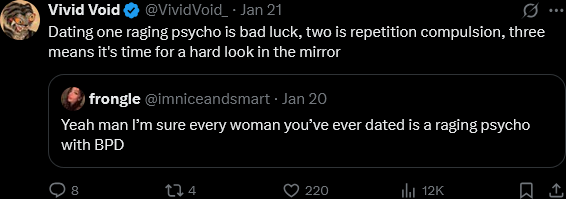
Another potential source of dating toxicity:
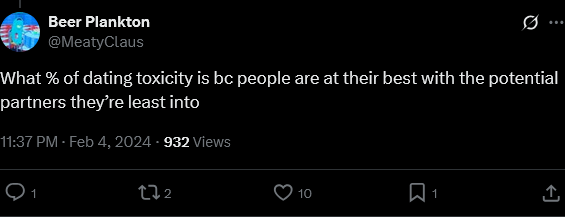
A good resource for this is https://goblinodds.com/
Distortion from cross-gender eavesdropping
Another insight from sympathetic opposition: https://www.sympatheticopposition.com/p/problems-with-cross-gender-eavesdropping
Read her analysis, she’s more socially perceptive than I am. To repeat the argument, the kind of opposite gender people you can most easily eavesdrop on online are not necessarily representative of the opposite gender as such, or the subset of the opposite gender you would be most interested in dating. Also, this:
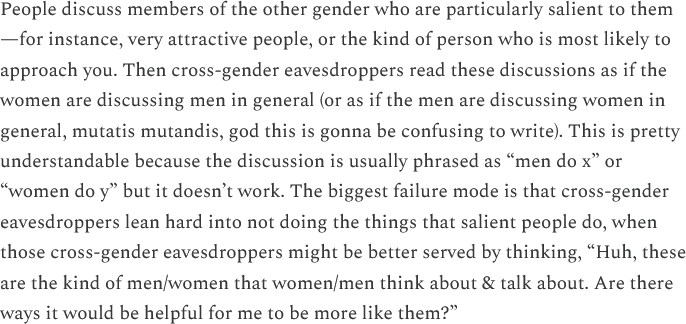
Pursuing gender and pursued gender
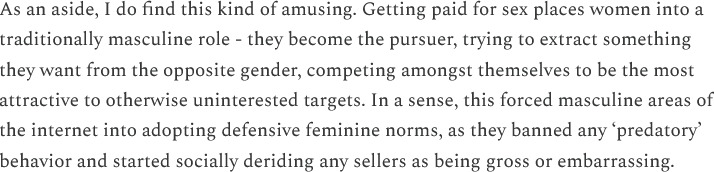
I got this one from Aella’s discussion of the success of onlyfans: https://aella.substack.com/p/how-onlyfans-took-over-the-world
Red Pill Seduction Advice
I discovered this one by accident, and I’m sorry. Really, I am.
Red pill content (at least that I’ve read, mostly years ago) will often have descriptions of “how women are”, complete with evolutionary just-so stories. I think some of it is more usefully described as pursuer-pursued dynamics than anything “innate”.
To make a long story short, a while ago I decided that gender relations would be less terrible if asking people on dates were lower-stakes; specifically, if people generally say yes to first date requests unless they have a very strong reason not to. A consequence of this was that I ended up on dates with a bunch of people I wasn’t really into. I mostly saw those dates as an opportunity to practice social skills. “Not really being into someone” makes it easy to be “outcome indifferent”. I’m also, uh, unresponsive to text messages a lot of the time. My friends are used to me intermittently ignoring them, but for the people I was dating it was effectively the same as running a hot-and-cold game. It wasn’t on purpose, I’m just really avoidant about texting.
Anyway, the outcome was more or less what red pill advice promises for “being engaging to talk to, outcome indifference, and running a hot-and-cold game”. There is nothing special about the feminine psyche that makes this work. It works the other way round too.
What could we do?
Workshops to improve your relationship with the opposite gender
Something like this is probably already a thing. I got the idea from Aella describing a workshop she contributed to here: https://aella.substack.com/p/this-practice-made-men-arouse-me
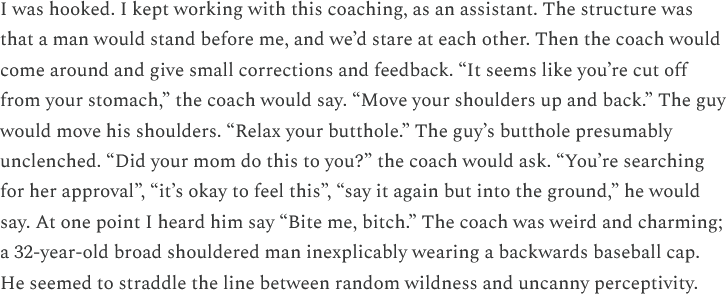
This could have exercises like the one Aella describes, discussion circles where you can try to actually understand the perspective of the other gender, talking about selected media or case studies and listening to how people of the other gender interpret them, and much more. There could also be workshops tailored to undoing the damage of the gender wars.
I would like to nominate Goblinodds to do this: https://goblinodds.com/
https://goblinodds.substack.com/p/the-gender-wars-dont-need-you
Matchmaking and a Dating Doc Tsar
Scott Alexander in defense of dating docs: https://www.astralcodexten.com/p/in-defense-of-describable-dating

Matchmaking in Orthodox Judaism is discussed more here: https://www.astralcodexten.com/p/highlights-from-the-comments-on-dating
We already have a dating doc registry: https://dateme.directory/
We could appoint a “matchmaker/dating doc tsar”. This person would be up to date on the dating docs currently online, and email people if they might be compatible with someone else who also wrote a dating doc. Maybe it would also be possible to give them your dating doc privately, if you don’t want it to be publicly accessible. (Though this could easily become a lot of work for the matchmaker.) We could set up some sort of community crowdfunding or patreon so they get a recompense for the work they’re doing.
This idea is a bit half-baked in its current form, but given that matchmaking has evolved independently in several cultures (as pointed out above), there are probably ideas in the adjacent idea-space that it would be worthwhile to experiment with.
It’s recently become a thing that substack writers matchmake their readers, like Ava from bookbear express: https://www.avabear.xyz/p/matchmaking-is-open-what-ive-been
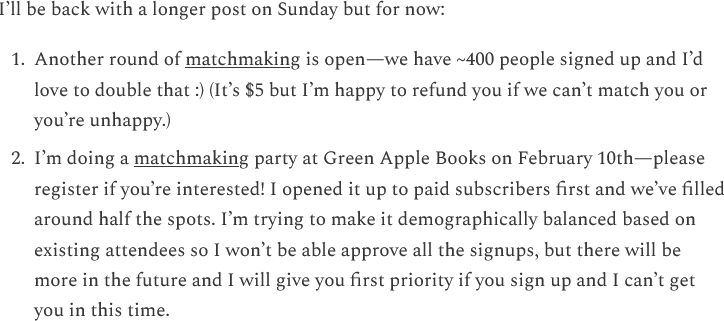
Hopefully more people will do experiments like this!
I would like to nominate Ava for the role of Dating Doc Tsar.
Timed relationship experiments
This is more of an “I wish this social institution existed” kind of thing.
I got the idea from Aella: https://knowingless.com/2021/11/15/what-i-learned-from-my-date-me-experiment/

(...)
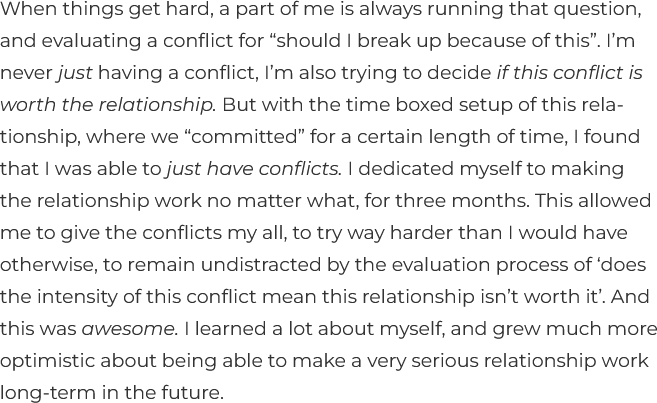
I don’t have that much relationship experience, and I’d like to know more about what I’m like in a committed relationship. What is my communication style, what are my actual preferences, what kind of attachment stuff would come up. Seems like useful information!
If someone else is in the same boat and is compatible on the relevant dimensions, we could set up a committed-for-a-time relationship (between two weeks and three months, maybe?), which includes the precommitment to not have any contact for a month after the experiment is over before you meet for the debrief (so you don’t accidentally end up in a relationship through inertia). Maybe there are problems with this idea that I’m too naive and inexperienced to see, but it seems like it could be a really useful thing. (You could also take the opportunity to see what it’s like to seriously date someone who is not your usual “type”.) If I were doing worldbuilding for a science fiction novel, I might include this as a totally normal thing to do 1-3 times as a young adult.
Concluding Words
Right now, our culture makes wedding cakes that look like this:
⁹
C’mon. I mean, seriously. I believe we can do better.
Appendix
Allergy to the t-word and priors on trauma
This section is mostly for people who share my former allergy to discussion of trauma, aka “whining that is designed to get the speaker attention and points in the Victimhood Olympiad, and shield them from criticism because you become a social pariah if you argue against someone’s ‘trauma’”.
This take is not without merits! Social hierarchies where you gain status by “being worse off” are terrible incentive structures. It gets worse from there, because there is an element of self-fulfilling prophecy. If you believe that XYZ is utterly horrible and harmful, you are more likely to be adversely affected if XYZ happens to you, for any given XZY. This isn’t to say that we should dismiss the harms of any particular XYZ, or pretend that “it’s not a big deal” if it is, in fact, a big deal. But no one is done any favours if we consistently describe things that are, unfortunately, part of the world we live in, as worse than they have to be. Aella has written about this much better than I could, so I’ll just give some links. I found her essays about this idea life-changing. One phrase in particular has been stuck in my head since I first read it: “I wish at least one person would not have reacted with horror.”
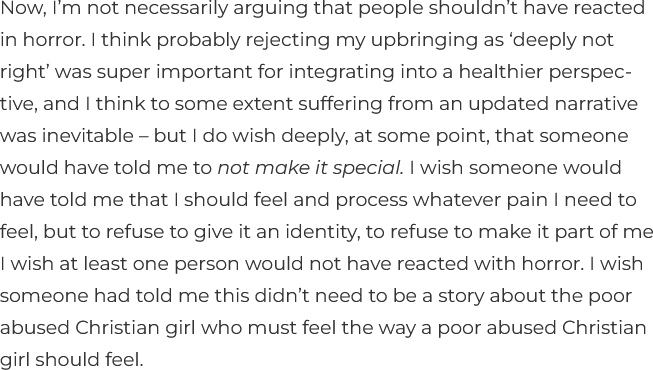
https://aella.substack.com/p/trauma-as-physics
https://aella.substack.com/p/the-trauma-narrative
https://aella.substack.com/p/me-too-on-sexual-assault
https://aella.substack.com/p/frame-control
I lost my allergy to discussions of trauma when I read Sasha Chapin’s How I Wish Trauma Had Been Explained To Me.
https://sashachapin.substack.com/p/how-i-wish-trauma-had-been-explained
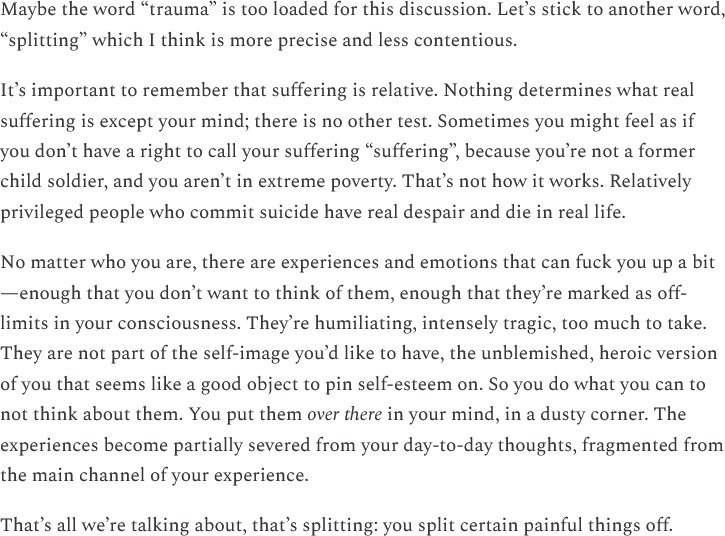
Anyhow, here’s the summary: