The signal and the noise: Welcome to rape, pedophilia, incest, madness, euthanasia, why Nietzsche’s übermensch is not fit to live & more in Henrik Ibsen's Ghosts (1881)
Do not underestimate the old guys.
The playwright Henrik Ibsen, claimed by Harold Bloom to be "the principal Western playwright since Shakespeare", was a multilayered person. His outward appearance was conventional, but the outward surface of a person can be deceptive. Quote Bloom: "I stood...by Ibsen's writing desk, and shuddered to remember that on it he kept a pet scorpion under glass, whom he delighted in feeding fresh fruit".[1]
A challenge when performing Ibsen on stage is that he usually puts in two-three very different interpretations in each play. This is difficult to convey when the play is performed, since a stage director must choose one of several competing interpretations to avoid confusing the audience. To sort out alternative interpretations you must read the plays. Here, then, is the darkest - but also the most logically consistent - way to interpret his 1881 play “Gengangere”, titled "Ghosts" in English. It is a descent into the hidden sides of interpersonal relationships, and the psyche of each of us.
Setting the stage
We are in a small city by the sea. The play starts when the main character, Helen Alving, is about to dedicate an orphanage she has built in the memory of her deceased husband, Captain Alving. She reveals to her spiritual advisor, pastor Manders, that she built the orphanage to deplete her husband's wealth so that their son, Oswald, shall avoid inheriting anything from him.
During their talk, the audience learns that decades ago she left her husband due to his many affairs. Back then, pastor Manders successfully advised her to return. She followed his advice hoping that her husband would reform. This did not happen. Her husband continued to sleep around, but Helen was unable to leave him again for fear of being shunned by the small-town community.
Her son Oswald (whom she had sent away as a child) returns home from Paris, where he has lived for ten years as a painter. She discovers that he suffers from a severe illness, probably syphilis. And that he has fallen in love with Regine Engstrand, Helen Alving's maid. Regine is then revealed to be an illegitimate daughter of Captain Alving (conceived with the former household maid), and thereby Oswald's younger half-sister.
Regine is furious when she learns that her legal father, the alcoholic carpenter Engstrand (who married her pregnant mother due to the money the Alvings had given her), is only her stepfather. Regine states that she will leave Helen Alving who has raised her as a lowly maid, to work elsewhere - perhaps in a "seaman's home" (read: brothel) her now widowed stepfather is about to establish in the harbor. Helen Alving states that if she leaves, she will destroy herself. Regine answers the Norwegian equivalent of "whatever" and leaves.
During the play, her stepfather Engstrand gets hush money from pastor Manders to cover up that Manders accidentally (?) caused a fire that led to the orphanage burning down (this happens mid-play). He states that he will use the money to start the "seaman's home" (Ibsen hints he will actually start a brothel).[2]
Late-stage syphilis is slowly driving Oswald mad. The play ends with Oswald breaking down and asking his mother to give him an overdose morphine to kill him ("mother, give me the sun"). Helen Alving's final words are "no; no; no! - Yes! No; no!" ...The curtain falls before her choice is known.
The key to the play: How Oswald was infected with syphilis
Over the past 145 years Ibsen scholars – as well as medical doctors - have debated endlessly how to explain Oswald’s disease. The only thing everyone agrees on is that this must be the key to the play. The obstacle that all interpretations must get around, is that Ibsen portrays Helen Alving as healthy. Thus Oswald cannot have inherited his disease from her. At the same time, Ibsen clearly hints that “inheritance” is involved.
The dominant position among scholars after more than 140 years of debate, is that Ibsen meant that Oswald inherited syphilis from his father, but that medical luck prevented his mother from also being infected. Scholars have dug up information suggesting that Ibsen may have read (now rejected) epidemiological research of his day, which suggested that in rare cases, syphilis induced by the father could skip the mother and only manifest itself in the fetus.[3] However, apart from being a rather inelegant solution, this interpretation begs the question of why Ibsen suggests Regine is in excellent health. It appears rather haphazard to indicate that when Captain Alving slept with his wife Helen she lucked out, but her son Oswald was smitten; while when he later slept with Regine’s mother, Regine went scout-free. From a logic-of-the-intrigue point of view, relying on luck is unsatisfactory.
Faced with this problem, some scholars ditch Ibsen’s hints that some form of inheritance is involved, and conclude that Oswald must instead have caught syphilis from prostitutes while living as a painter in Paris. But Ibsen plays down this possibility as well, by letting Oswald tell his mother that he despises men who buy sex. More importantly, this possibility does not fit with Oswald’s symptoms resembling late neurosyphilis (such as memory impairment, confusion, agitation, seizures). Late neurosyphilis usually takes many years or even decades to develop, and Oswald is only 26 or 27 years old when he returns from Paris. Ibsen was aware of the symptom progression in syphilis. He knew of late-stage syphilis cases from his social environment, and had probably read medical texts on the subject. Why would Ibsen weaken his story by hinting that Oswald has a disease that usually takes longer than ten years (the period Oswald lived in Paris) to develop? Finally, if one chooses this interpretation, Oswald’s illness is external to the interpersonal dynamics in the play – and interpersonal dynamics is what all of Ibsen’s plays are about.
The third possibility is to assume that Ibsen was simply a sloppy writer who forgot that Helen ought to be sick. But this is also very unlikely, since Ibsen put extreme care into each sentence in his plays. Ibsen’s plays, in particular his later plays, resemble Agatha Christie detective stories – they are full of hints that lead in different directions. Ibsen was a master of the subtle hint.
Leading to the final, and most logically consistent, possibility Ibsen has put into the play: Oswald was born healthy, but caught syphilis as a young boy when he was raped by his syphilitic father. If Captain Alving caught syphilis from one of his many affairs after Helen had given birth to Oswald (and then raped him), this can explain why Helen is healthy and Oswald is smitten, without having to rely on speculative assumption about congenital syphilis skipping the mother. This can also explain why Oswald suffers from late neurosyphilis. Being raped as a boy, the disease has now had sufficient time to reach his brain.
Ibsen has put in three hints that pedophilic rape & incest is the cause behind Oswald’s disease. The first hint is in the following exchange between Oswald and his mother: “I was very little at that time, and then I remember, that I came up to father’s chamber one evening, he was so cheerful and merry.” Helen replies: “Oh, you cannot remember anything from those years.” Oswald: “Yes I remember clearly, he took me and put me on his knee, and let me smoke his pipe. Smoke, boy, he said – smoke sharply, boy! And I smoked all I could, till I felt I became quite pale, and sweat broke out in big drops on my forehead.”
...although Oswald appears to remember the pipe as really a pipe, his father’s “pipe” can be something else, and the scene serves no other function in the play.[4] Oswald later comments that the only thing he remembers about his father is that he once made him throw up.
The second hint is by Helen Alving in a dialogue with pastor Manders, her old-time friend. In mid-play it turns out that Regine and Oswald have strong feelings for each other, and may leave the house together, perhaps even conceive a child. Pastor Manders is horrified at the prospect of sibling incest, but Helen replies: “Hand on the heart, pastor Manders; do you not think that, across the country, there are quite a lot of couples, that are equally close related?”
Later, Helen states: “Yes, all of us do, after all, originate from those kinds of liaisons, they say [implicitly referring to Genesis 4, the sons and daughters of Adam and Eve]….when I heard Regine and Oswald in the other room, it was as if I saw ghosts [gengangere] before me.”
In Norwegian folk mythology, genganger (literal translation: "again-goer") has a particular meaning. It is not just any ghost (which is “spøkelse” in Norwegian), but a particular type of ghost: A ghost of someone you know, who is acting in the same way as when he/she was alive.
To elaborate: when Helen Alving hears Oswald and Regine making out or more (sibling incest) in the next room, it reminded her of how her husband seduced Regine’s mother. (Captain Alving is undoubtedly the "genganger" she has in mind.) At the same time, it might have brough back painful memories of what her husband did to her son (parent-child incest).[5] Helen Alving’s comment is a key sentence in the play, further emphasized by Ibsen by making "Gengangere" (Ghosts) the title of the play.
The third hint is in the subtitle to the play as such: “A Family Drama In Three Acts” [Et Familjedrama i Tre Akter]. A Drama in Three Acts refers to the composition of classic Greek tragedies, of which Oedipus is the most well known.[6] Oedipus is a family drama about incest. This hint may be too subtle for most modern theater-goers, but in the 1880s knowledge of the structure of a classic Greek drama, plus that Oedipus is the most famous of these, was something an educated person could be supposed to know. (Ibsen, who chose the subtitle, obviously knew.)
How about Regine’s mother? Was she also smitten? Consulting the timeline in the play, Helen ran away to pastor Manders after one year of marriage. Oswald was born the next year. Even though Helen returned, she probably stopped having sex with her husband (explaining why she is healthy.) Regine’s mother became the household maid when Oswald was four years old. She served for three years, and was pregnant with Regine (and made to leave) when Oswald was seven years old. Since Helen states that Oswald was so young when he was forced to smoke his father’s ”pipe” that he was unlikely to remember anything from it, this must have happened before he was seven years old. Implying that Captain Alving was highly likely syphilitic when he seduced Regine’s mother. We do not know if she caught the disease, but like Captain Alving she is already dead when the play begins, perhaps suggesting her life has been cut short by a serious disease.
Why did Captain Alving rape Oswald, perhaps deliberately infecting him with syphilis?
Why would anyone rape their own child? The answer lies in the final hint Ibsen has put into the play: That Captain Alving is not Oswald’s biological father. Oswald is instead the lovechild of a short affair between his mother and Reverend (pastor) Manders, the highly moral pillar of community in the play. This happened when Helen Alving escaped to Manders in the past, during a crisis in her marriage (referred above in setting-the-stage).
The first clue to this possibility is that Helen makes clear that she never loved her husband, but that she loved - and still loves - pastor Manders. When she entered his house those many years ago, she said: "Here I am, take me".
The second clue is a scene when pastor Manders first meets Oswald after he has returned from Paris, and claims he looks just like his father. Helen Alving replies: ”Not at all. I think Oswald has rather a streak around his mouth that resembles a priest.”[7]
…It is worth mentioning that I have watched the play performed several times, and sometimes this crucial sentence is removed by the stage director. Perhaps because the possibility that Manders is Oswald’s father does not tie into the rest of the plot unless this provides a motive for Captain Alving to rape Oswald. Or perhaps because few stage directors have done a sufficiently close Agatha-Christieesque reading of the play to understand why this sentence is significant.
The third and last clue that Manders is Oswald’s father is in the time-line in the play. The action in the play takes place over just a few days, but if one pieces together information from different parts of the play, Ibsen tells us that Helen Alving’s marriage to Captain Alving lasted 19 years; that she ran away to pastor Manders after one year of marriage; and that it is 10 years since her husband died. He also tells us that Oswald is now 26 or 27 years old. Implying that Oswald may well have been born 9 months after Helen spent the night in Manders’ house. This hint is impossible to get when watching the play performed. It requires, as all Ibsen’s plays (in particular his later plays), close reading.
If pastor Manders is Oswald’s biological father it becomes less incomprehensible if his legal father, Captain Alving, has raped him as a child; perhaps also deliberately infected him with syphilis. The rape can then be interpreted as an act of revenge against an unfaithful wife. A very cruel revenge, letting a child inherit your syphilis to punish its mother. But few of Ibsen’s characters are nice people.
This interpretation is strengthened by Ibsen not portraying Captain Alving as simply an irrational monster. When Oswald’s mother reminiscences about her late husband he emerges as a larger-than-life Nietzschean character, whose immense life-force was stifled and perverted by the narrow social environment he had to live in. Helen Alving states that she made life as much hell for him, as he made life hell for her.
Inspiring, perhaps, Jean Paul Sartre's dictum "hell is other people" in his 1944 play No Exit.
Ibsen hid the clues that suggest rape and parent-child incest. The easier-to-discover hints that Oswald suffers from syphilis, and that his mother contemplates euthanasia of her own son, were enough to make the press and theatre goers of 1881 scream with horror. It took years before theaters started to perform the play. Had Ibsen not buried the clues suggesting even darker family secrets so that only a close reading reveals them, he would have had even bigger trouble getting the play performed.
Ibsen dealt with themes so forbidden to show publicly that also today many may have problems with how he treats them. This is why it is fruitful to use a so-called Straussian approach when interpreting Ibsen. Based on Leo Strauss’ reading of the classics (such as Plato), a Straussian approach to a text is to be aware of ideas an author may have wanted to get across that could not be stated openly in the social environment of his time, but that are revealed if one does a sufficiently close reading.[8] Being aware of subtle hints, and also of red herrings the author has put in to cover his tracks.[9]
The signal and the noise
This interpretation of Ghosts accounts for the facts Ibsen presents us with in a more logically consistent way than other interpretations of what goes on in the play. But in order to work, it must assume that much of what Ibsen lets his characters say to each other is either lies or self-deception. They may have repressed memories that contradict their own images of themselves, to such an extent that - on a conscious level - they do perhaps genuinely believe that something entirely different happened. Doctor Relling, a central character in another Ibsen play (The Wild Duck), is worth quoting here: “If you take the life-lie away from an average human being, you take his joy of life away at the same time.”
Assuming this is also Ibsen’s view of life (not a farfetched assumption), and that it informs how he writes his characters, Oswald may have convinced himself that the “pipe” his father forced him to smoke was really only a pipe. And pastor Manders may have convinced himself that he did not fall for temptation when Helen Alving in desperation knocked on his door 28 years ago, since sleeping with another man’s wife is contrary to everything he stands for as a priest. Here, it is significant that Ibsen tells us Manders accidentally (?) burns down the orphanage only after first having convinced Helen not to buy fire insurance. Suggesting that on a semi-conscious or subconscious level, his hatred of Captain Alving is as strong as Helen’s. Perhaps deep down he has not fully managed to repress what happened the night he shared with her, and knows in his heart of hearts that he is Oswald’s father.
Nor is Helen Alving free of more-or-less conscious dark motives. She can be played as Ibsen’s mouthpiece – this is a common way to stage the play. But Ibsen has given her lines, and behavior, that suggest she should rather be seen as the main spider in the family cobweb. She is positively gleeful when she tells Manders how she got the upper hand in the marriage with Captain Alving and used her power to make his life hell. Also, what kind of stepmother hires her stepdaughter to serve as a maid in her own household, raising her as a servant, and never telling her anything? Cinderella's stepmother looks positively benign in comparison. Raising Regine as a lowly maid can be seen as her revenge on Captain Alving, just as his syphilitic rape of Oswald can be seen as his revenge on her.
From this view much of what Ibsen lets his characters say in his plays is noise, which Ibsen uses to obscure the signals that he has also inserted in the play, allowing a careful reader an alternative - and more logically consistent - interpretation of “what is actually going on here”. Ibsen had a keen sense not only of darkness and aggression hidden in families, but also of darkness and aggression hidden in the psyche of each of us.
This is where Bloom’s comparison between Shakespeare and Ibsen is most apt. Shakespeare’s plays also open up for more than one interpretation (Hamlet being the most obvious example). Like Ibsen, competing interpretations primarily reveal themselves when one reads the plays. 9 Watching them performed is not enough, unless the stage director is a genius.
Moral
Ibsen's plays lack an easily digestible moral. But Ibsen, like his contemporary Nietzsche, had an interest in larger-than-life transgressors of ordinary morals. A common theme in his plays is the strong-willed individual violating socially acceptable behavior.
Examples from other plays include the idealistic Nora in A Doll’s House, the intense and sinister Hedda Gabler, the righteous doctor Stockman, Master Builder Solnaess, and the religious firebrand Brand. They are all larger-than-life characters that transgress social conventions. They can be played as heroes. But the Janus-faced Ibsen has also put in hints that they, deep down, are not fit for life. The survivors in his plays are instead the small-souled and socially adaptable people. They are the ones most fit to survive.
In Ghosts, the larger-than-life character is Captain Alving. He, whose immense life-force has been stunted and perverted by the narrow rules of small-town society, is already dead when the play begins. But his genganger (ghost) still dominates the others. His two children, Oswald and Regine, both choose to self-destruct. Only the hypocritical pastor Manders, the cunning "sailor's home" owner Engstrand, and Helen Alving - hated by her husband but hating him in return (and in the end being able to destroy him) - are left standing.
A similar story of the-übermensch-ironically-not-fit-for-life can be read into other plays, although Ibsen always puts in more than one possible interpretation. Nora in A Doll’s House (Ibsen’s most well-known play) leaves husband and children, perhaps going on to fame and glory (as befits a feminist icon). This is a possibility, and this is how the play is most often performed. But if one reads the play, hints in the text suggest that she more likely goes to her death, as her high ideals make her unfit for life’s inevitable compromises. Her smug and overbearing husband Helmer is upset when she leaves (after Nora discovers his love is not as brave and unconditional as hers), but is otherwise fine. Ibsen has given him lines making it possible to play him as a small-souled yet level-headed and clever businessman. Helmer is a survivor. Nora? Far less certain.[10]
Hedda Gabler, fired up by twisted love, gleefully burns the manuscript (“child”)[11] of her love interest Løvborg, and goads him toward suicide. Her nerdy husband Tesman plods on with his books, blissfully unaware of Hedda’s fatal attraction to the more talented writer Løvborg. While the sexual predator assessor Brack - who informs Hedda he prefers the back door, “they can be rather piquant” - just shakes his head (“such a thing one simply does not do”) when Hedda, finding herself in his power, puts a bullet in her head at the end of the play. Brack and Tesman, small-souled survivors, get on with their lives. Hedda, a female übermensch twisted by her suffocating social surroundings, kills herself.[12]
Master Builder Solnaess falls down from his tower, knowing that he has aged and that his power is waning. It is left unclear if he falls or let go. Doctor Stockman in An Enemy of the People discovers a truth than can destroy his hometown, is socially ostracized by his fellow townsmen, and – if one (unlike Ayn Rand) reads the play as a tragedy - ends up pathetically trying to convince himself that he is strongest who stands alone. His townsmen likely continue to ignore him. The preacher Brand allows his own son to die to stay true to his calling, then dies in an avalanche in the wild mountains at the end of his search for God. His congregation leaves him, and goes down to the shore to live ordinary lives by the sea. They, not he, are survivors.
The ones left standing at the end of Ibsen’s plays are those willing to compromise in life, or delude themselves, or successfully con others, or be lukewarm in their love, or settle for less.[13] They are the ones most fit to survive in human society. Not the full-of-life but unable-to-survive-in-practice heroic übermenschen.
Here, Ibsen foreshadowed the fate of his great contemporary, Friedrich Nietzsche. He who hailed the übermensch turned out in the end not fit for life himself, suffering a total nervous breakdown (1889) he never recovered from. Nietzsche’s life story is very similar to the fate of the larger-than-life characters in Ibsen’s plays.[14]
Based on such readings of the plays, Ibsen’s view of humans rhymes with classic sociology. We are controlled by our social environments. It is not the state, but society itself, that keeps us in line. And while the state can at least theoretically be done away with, society cannot. “We have met the enemy and it is us”, as the cartoon character Pogo says in another context. In Ibsen’s view, the resistance of the übermensch can be admirable (or in the twisted and perverted versions, at least psychologically understandable). But since it is bound to lead to self-destruction, it is a tragic fate. People that are fit to survive learn to compromise and adapt. Those who live larger lives - sometimes beyond good and evil - destroy themselves, or they are destroyed. A certain melancholia prevails when reading Ibsen. Life? It is what it is.
Is this a moral of any use for present-day psychiatrists or other people interested in improving the lot of humans? That depends on what you see as worthy human goals to strive at. Not everyone wants to live a long and quiet life without much trouble. Some think and feel differently, and are willing to pay the price. Ibsen’s treatment of his characters illustrates that there are more things in the psyche of each of us, and in the society we live in, than are dreamt of in the human and social sciences.
Postscript: The reception of the play
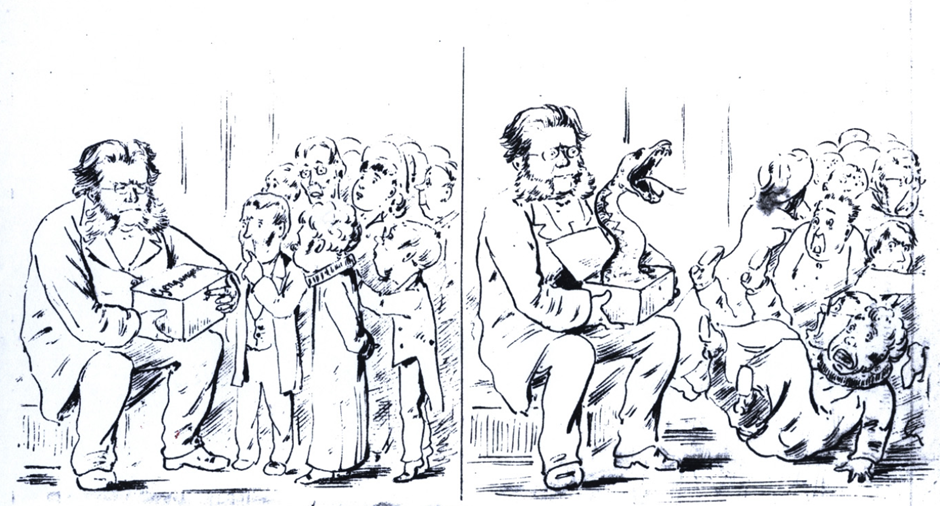
Ibsen, with characteristic cleverness, timed the release of his plays to Christmas. Since he knew that many gave his new plays as Christmas presents. The attached contemporary cartoon depicts the reaction among the literary public when Ghosts/Gengangere was released in 1881.[15] All the eager petit-bourgeois literati-children gather round papa Ibsen to see what present he brings them this Christmas. And then comes their reaction when he unpacks “Ghosts”.
Your message is stored now and emailed to the author after the contest ends. The author can reply to you, but their identity stays hidden unless they choose to respond.
Footnotes
- ↩
Harold Bloom (2002): Genius. Warner Books, page 233.
- ↩
Engstrand, deadpan or with a smirk, says it will be a seaman’s home “worthy of Captain Alving”. He recruits his own stepdaughter as one of the girls.
- ↩
The various medical theories that have been launched over the years are summed up in Per Vesterhus (2007): How did Oswald become ill? [Hvordan ble Osvald syk?] Journal of the Norwegian Medical Association [Tidsskrift for den Norske Legeforening] no. 127, pages 1814-6.
- ↩
The possibility of pedophilic incest was first pointed out by Frode Helland and Arnfinn Åslund (1996): This is not a pipe. [Dette er ikke en pipe.] Bøygen no. 1, pages 8 – 12.
- ↩
Oswald: ”No mother, it [being forced to smoke father’s “pipe”] is not something I dreamed. Because – you must remember – you entered and carried me into my room. There I was ill and I saw, that you wept.”
- ↩
The tree acts (or stages) in a classic Greek drama consists of the Protasis, the Epistasis and the Exodus. Protasis is the prologue and set-up when the drama is introduced. Epistasis is the build-up of conflict to a climax of action. Exodus is the fall-out and end stage where the conflict is resolved, or (in tragedies) the catastrophe is fulfilled. Both Oedipus and Ghosts display this structure.
- ↩
In the original Norwegian: "Aldeles ikke. Osvald har snarere noget prestelig ved munden, synes jeg."
- ↩
Catherine Zuckert (2011): The Straussian approach. In G. Klosko (ed.): The Oxford Handbook of the History of Political Philosophy. Oxford University Press.
- ↩
To illustrate, here are some Agatha Christiesque clues leading to alternative interpretations of Ghosts. First, Ibsen has put in the possibility that it is Engstrand who burns down the orphanage, then cunningly makes pastor Manders believe it is his fault, and uses this to con pastor Manders out of money to pay for his brothel. Second, and as a Straussian red herring hiding the dark interpretation of the play favored here: Helen Alving also refers to “Ghosts” as simply being dead traditions weighing down the lives of the living. Implicitly channeling Marx’ 1852 dictum: “The tradition of all dead generations weighs like a nightmare on the brains of the living.” This is probably Ibsen’s opinion, so Helen serves as his mouthpiece here; but conveniently it also distracts the reader from Helen Alving’s much more personal meaning of “Ghosts” a few pages earlier, when she hears Regine and Oswald doing sibling incest in the next room.
- ↩
No stage director I am aware of has ever chosen to play Nora in A Doll’s House as an admirable but hopeless believer in high ideals, unaware of how the world really works. Or portraying her husband Helmer as a level-headed businessman who, unlike her, understands how disastrous Nora’s forging of a signature on an important legal document will be for them. But if one reads the play, the interpretation of Nora as a lost-in-the-clouds believer in ideal love, and Helmer as the small-souled but sensible person of the two, is clearly a possibility Ibsen has put into the play. I wish someone would play it like this, if only for variety’s sake.
- ↩
Hedda: “Now I burn your child” (act III). Hedda resembles a female Captain Alving, minus a pleasure in sex.
- ↩
Peer Gynt, Ibsen’s most fun play (further boosted by Edvard Grieg’s music, cue: In the Hall of the Mountain King), is a further example of the amoral hero. He is a womanizer and slave owner and an absolute scoundrel, but Ibsen writes him so that you cannot help rooting for the guy. (It also helps that all sentences in the play – through all five acts - rhymes in the original.) His name, Gynt, is close to grynt (oink-oink in English), further alluding that he is basically a swine. He barely notices as his sick mother passes away while he feeds her one of his tall tales about himself. Yet he has tons of charm, is a successful con artist, and gets all the ladies. Including poor Solveig, who wastes her whole life waiting for him, and does perhaps even save him at the end from having his soul melted down by the soulmelter and distributed piecemeal to future others - since he did not care to make himself into a sole, single, solid persona while living. Ibsen leaves the soulmelter's final choice open, though, as the curtain falls.
- ↩
The most striking example of a cunning survivor is the shipbuilder Karsten Bernick, the central character in Pillars of the Community. He is a liar and deceiver, who tries to get his former business partner killed to cover his tracks. He almost gets his own son killed instead, while his business partner escapes – free to reveal that Bernick is a swindler and a con man, unless he acts fast. So, when the city folks come together to honor him as a pillar of the community, Bernick tells the truth about himself – but he tells it in such a way that they may think he is a reformed sinner. And if a stage director adopts a naïve reading of the text, he can be played as a truly reformed sinner. But Ibsen has also put in the possibility that in the end he is an exceptionally clever deceiver, who masterfully manages to turn truth-telling into a reputational advantage that gets him off the hook.
- ↩
Ibsen was sixteen years older than Nietzsche. Both lived in Germany and Italy when they wrote most of their works. There is no record if they read each other, but it is documented that they knew about each other. If Ibsen directly associated his characters with Nietzsche’s übermensch is debatable. It can also be that both were influenced by the European Zeitgeist of the time, where the Great Outsider was a Leitmotif for many writers (and to a less extent still is). Nietzsche hailed the heroic breaker of social taboos as the future of mankind; Ibsen saw him (or her) as a tragic hero unfit for the (social) environment man is fated to live within. For more on Ibsen’s awareness of Nietzsche, see (among others) Thomas van Laan (2006): Ibsen and Nietzsche. Scandinavian Studies vol. 78 (3).
- ↩
First published in Vikingen, December 31st 1881.