I bought this book because of the title. I came across mention of it while browsing something vaguely related, and was immediately intrigued. When the International Astronomical Union (IAU) voted to relegate Pluto to “Dwarf Planet” status in 2006, I was one of an apparently-small minority of outside observers who applauded the decision instead of decrying it and mourning the erstwhile ninth planet. The flippant tone of the title appealed to my sense of humor, and I looked forward to learning more about what happened behind the scenes and (hopefully) getting a more detailed and authoritative explanation of the IAU’s decision.
I was even more intrigued when I looked up the author and realized that he was someone whose work I’d been excitedly following for most of my adult life, even though I had somehow never put the pieces together that his various discoveries, theories, and arguments were the work of the same person. The discovery of Eris and several other large Kuiper Belt Objects, the demotion of Pluto, the ongoing search for a Neptune-sized “Planet Nine”, and several discoveries about the icy moons of Jupiter and Saturn.He’s in the middle of enough stuff that if somebody were to claim that “Brown Dwarfs” [1] were named in his honor, I would double-check before disbelieving.
As the title of the book implies, it covers Brown’s discovery of Quaoar, Sedna, Eris, etc and the subsequent demotion of Pluto. It does explain the case against Pluto in a detailed and nuanced way, but this is not quite the main focus of the book. On his website, Brown says of it, “[This book] is a love story, to my wife, my daughter, and the solar system,” and I think this is fair as far as it goes. I would describe the book as a personal memoir of a particularly interesting and accomplished astronomer, and as such, as a case study in what this particular astronomer does all day, what he’s like, and how he got that way.
The book itself is relatively short (288 pages), written in a witty, conversational style. It strikes a good balance on technical depth withoutassuming an academic background from the reader, but still goes into enough detail to be interesting for those who do care for the details; and if you want more depth, it gives you more than enough information to track down more scholarly papers and lectures on the subject. As I prepared this review, I explored these papers and was pleasantly surprised to learn that Brown is far from unique among astronomers in his talents as a writer: Virtually every paper I read was engagingly written, and most of them were relatively accessible to a non-astronomer with decent but nonspecialized background knowledge. My one serious criticism of the book is its lack of illustrations and diagrams, an oversight which I shall amend by using too many visuals in my review.
What even is a planet?
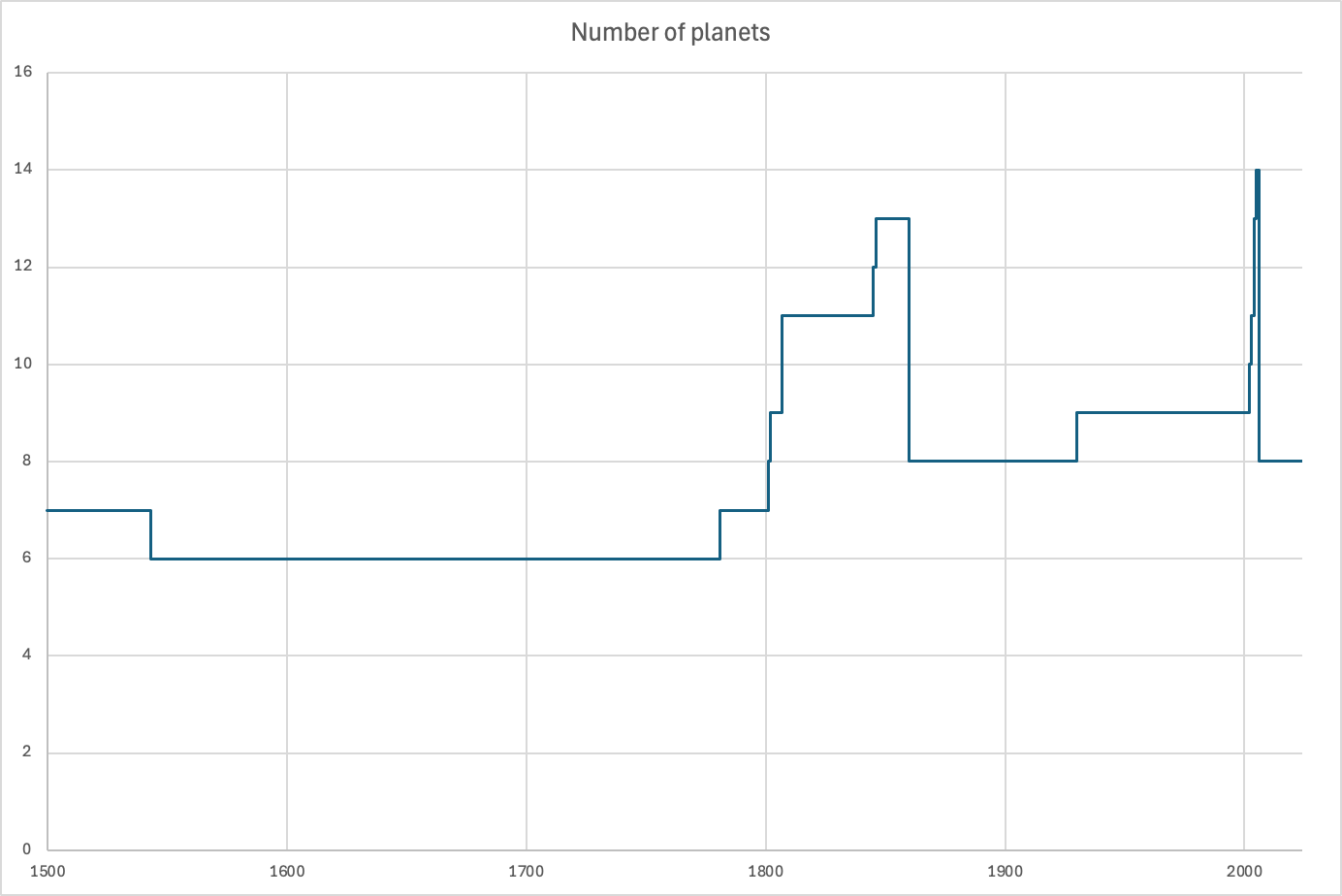
My very approximate chart of “how many planets are there” at any given time between 1600 and 2010, based mostly on Brown’s description.
Near the beginning of the book, Brown sketches out a history of how our growing understanding of the solar system and what’s in it has driven changes in what we mean when we say “planet”. In ancient and classical times, just about every culture that has left us records of how they interpreted what they saw in the sky has noticed that most of the stuff can be grouped together as “fixed stars”, points of light that all move together in the sky as if they’re painted on the inside of a sphere spinning around the Earth. But some things don’t stay put relative to the others; the Greeks called these planḗtai, or “Wanderers”, for obvious reasons. There were seven Wanderers, the Sun, the Moon, Mercury, Venus, Mars, Jupiter, and Saturn. Understanding and predicting their motions was a major area of astronomical study for millenia.
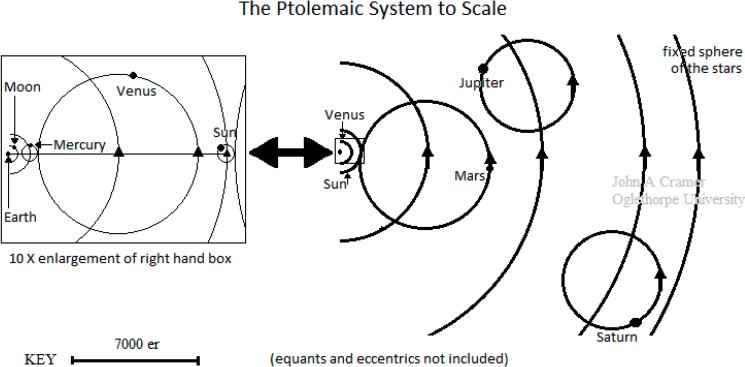
Claudius Ptolemy’s geocentric model of the solar system, c. 150 (source)
A major reinterpretation happened when Copernicus came along and made the case that the Earth went around the Sun, not the other way around. This reduced the planet count by one, as the Moon and Sun left the roster of planets while the Earth joined it. Not long after, Galileo pointed his newly-invented telescope at the planets and discovered that, like the Sun and Moon and unlike the fixed stars, the planets seemed to be discs rather than mere points, and that Jupiter had moons of its own.
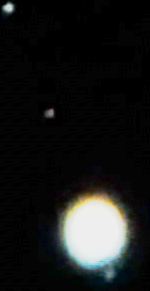
My photo, taken through a 70mm telescope. From top to bottom, Ganymede, Europa, Jupiter, and Io. Callisto is out-of-frame to the lower right. Note that Jupiter and Ganymede are well-formed disks.
In 1781, William Herchel pointed a much better telescope at what he thought were fixed stars and noticed that one of them was disc-shaped and moving. He assumed it was a comet at first, but after observing it for long enough to realize its orbit was circular, concluded that it was actually a new planet far beyond Saturn. Herschel’s conclusion was gradually accepted, and the new planet was eventually named Uranus.
Then, in 1801, Guiseppe Piazza discovered an eight planet through similar means to Herchel’s. Unlike Uranus, this planet, Ceres, was too small to resolve as a disc even though it was much closer, and it was between Mars and Jupiter rather than beyond Saturn. Ceres, too, was generally accepted as a planet. Curiously, three more planets were soon found in similar orbits to Ceres: first Pallas in 1803, then Juno and Vesta in 1804 and 1807. After the discovery of Pallas, Herchel proposed the new term “asteroids” (Latin for “starlike”) for them, but they continued to be considered “planets” by most people. Fifteen more “asteroid planets” were discovered by 1851 (although most references only counted the biggest four asteroids among the main list of planets), when one more large planet was discovered beyond Saturn. This new planet, Neptune, was decently alone in its orbit. At some point between then and 1900, people quietly and unobtrusively stopped counting even Ceres among the “planets” and relegated asteroids to their own category.
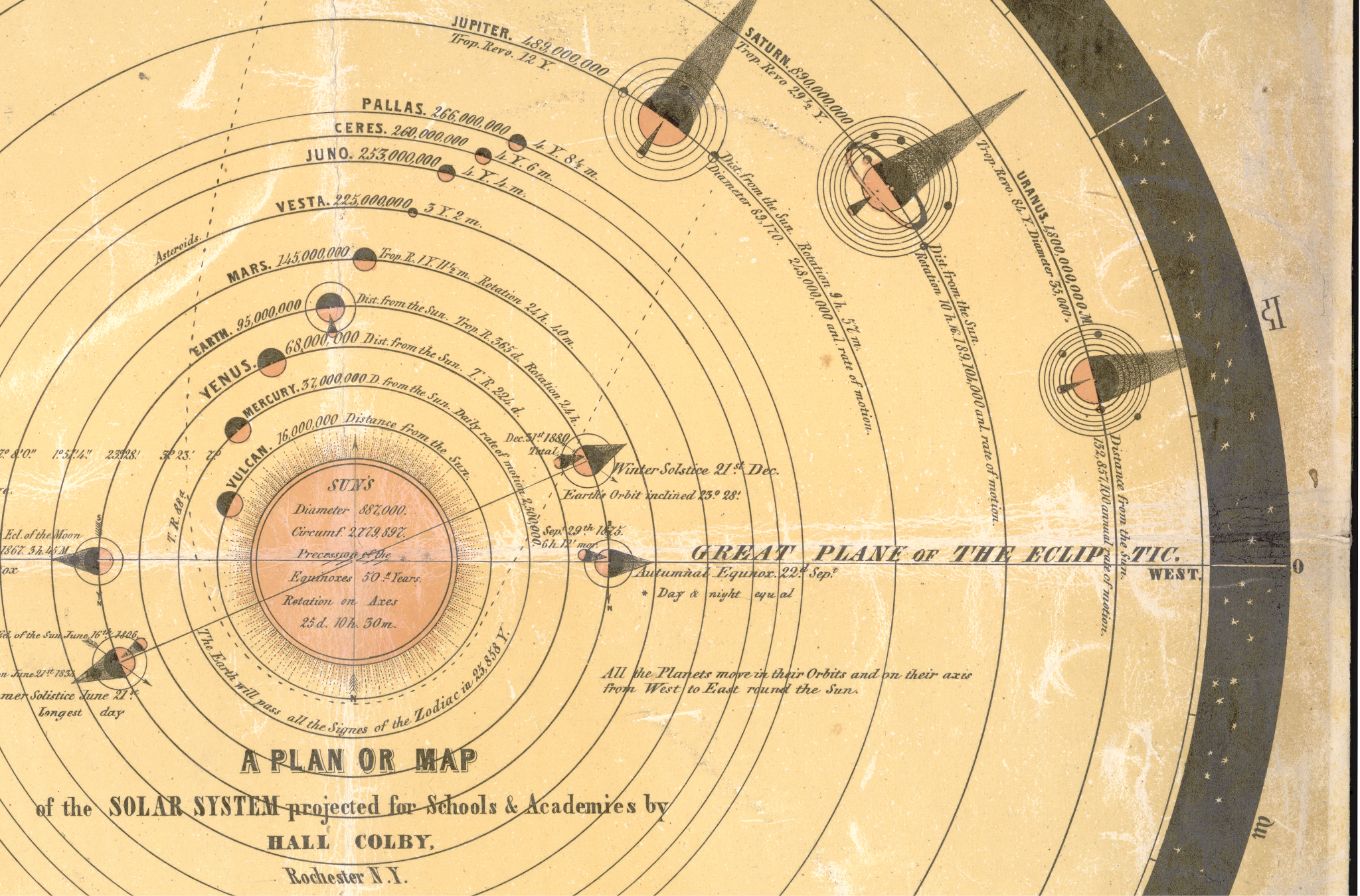
A 1846 diagram of the Solar System, with all eleven known planets and the hypothetical innermost planet Vulcan, by the inventor and science writer Hall Colby
Finally, in 1930, Clyde Tombaugh, armed with an even better telescope and searching for another planet beyond Neptune, found another Wanderer around where he was expecting another big planet to be. This new planet, Pluto, turned out to be weird: a starlike point like Ceres, and an oblong and tilted orbit more like a comet than any known planet or asteroid, but (apparently) all by itself and (mostly) beyond Neptune’s orbit, like you’d expect of a self-respecting ninth planet. And so, for the next three quarters of a century, Pluto would be accepted as the ninth planet.
How do you look for planets?
In his story of the history of the concept of planets, Brown heavily emphasizes the original “wanderer” meaning, and for good reason: That’s still the heart of how you look for planets in the modern age. you choose a patch of sky and keep looking at it over several nights to see what changes. Herchel, Piazza, and other 19th century planet hunters did this by taking note of everything they thought worth measuring and writing down their exact positions in the sky. 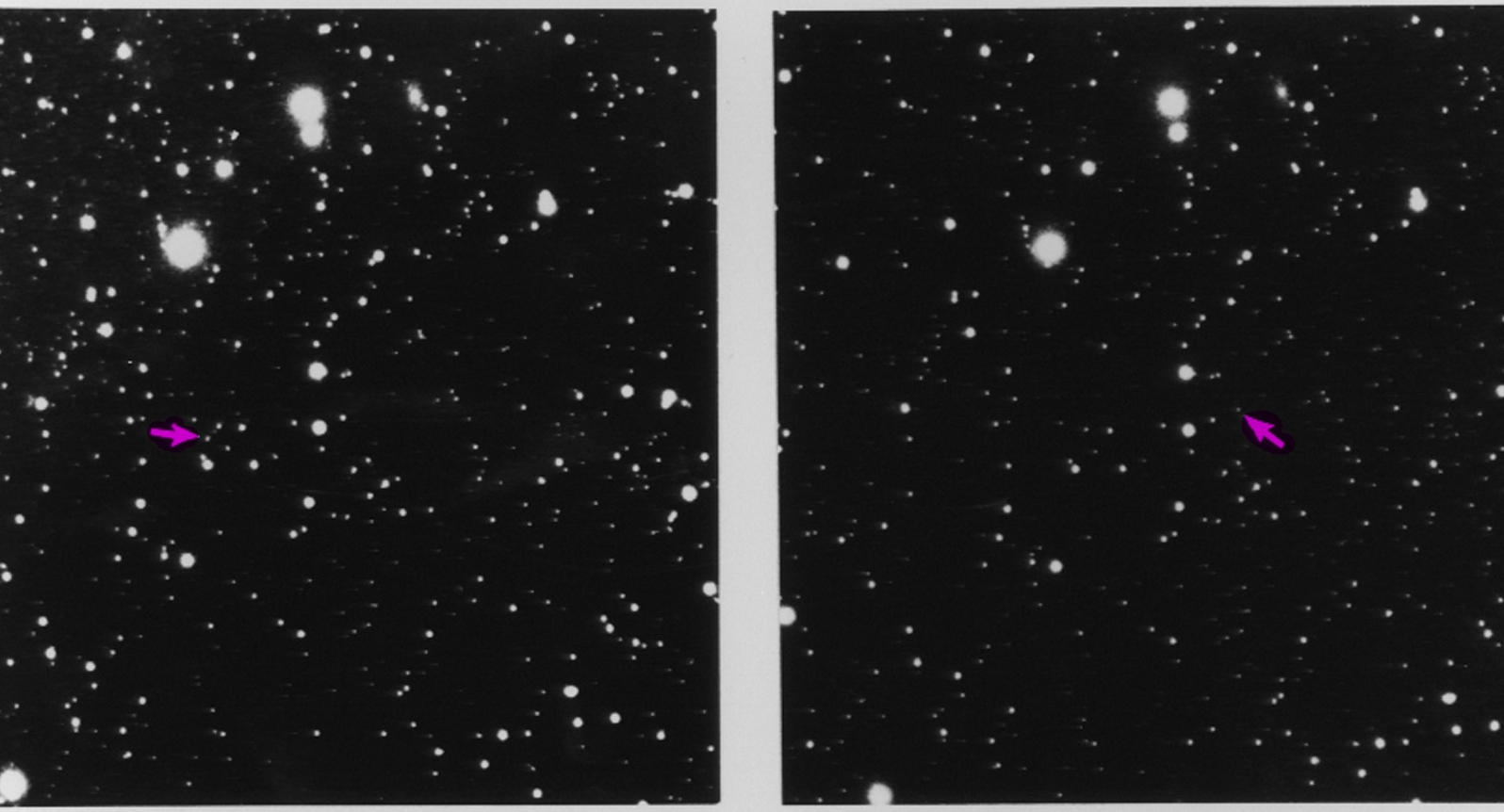
The discovery images of Pluto (source). The arrows were added afterwards and would probably have made Tombaugh’s task considerably easier had they appeared in the original.
Besides the benefit of even better telescopes, Tombaugh had two big technological advances from the 150 years between the discoveries of Uranus and Pluto, The first was the ability to take detailed photographs of what the telescope saw so that the analysis didn’t have to be done in real time. The second was the Blink Comparator, a device for viewing two glass photographic plates [2] in rapid succession through the same eyepiece for easier and faster comparison.
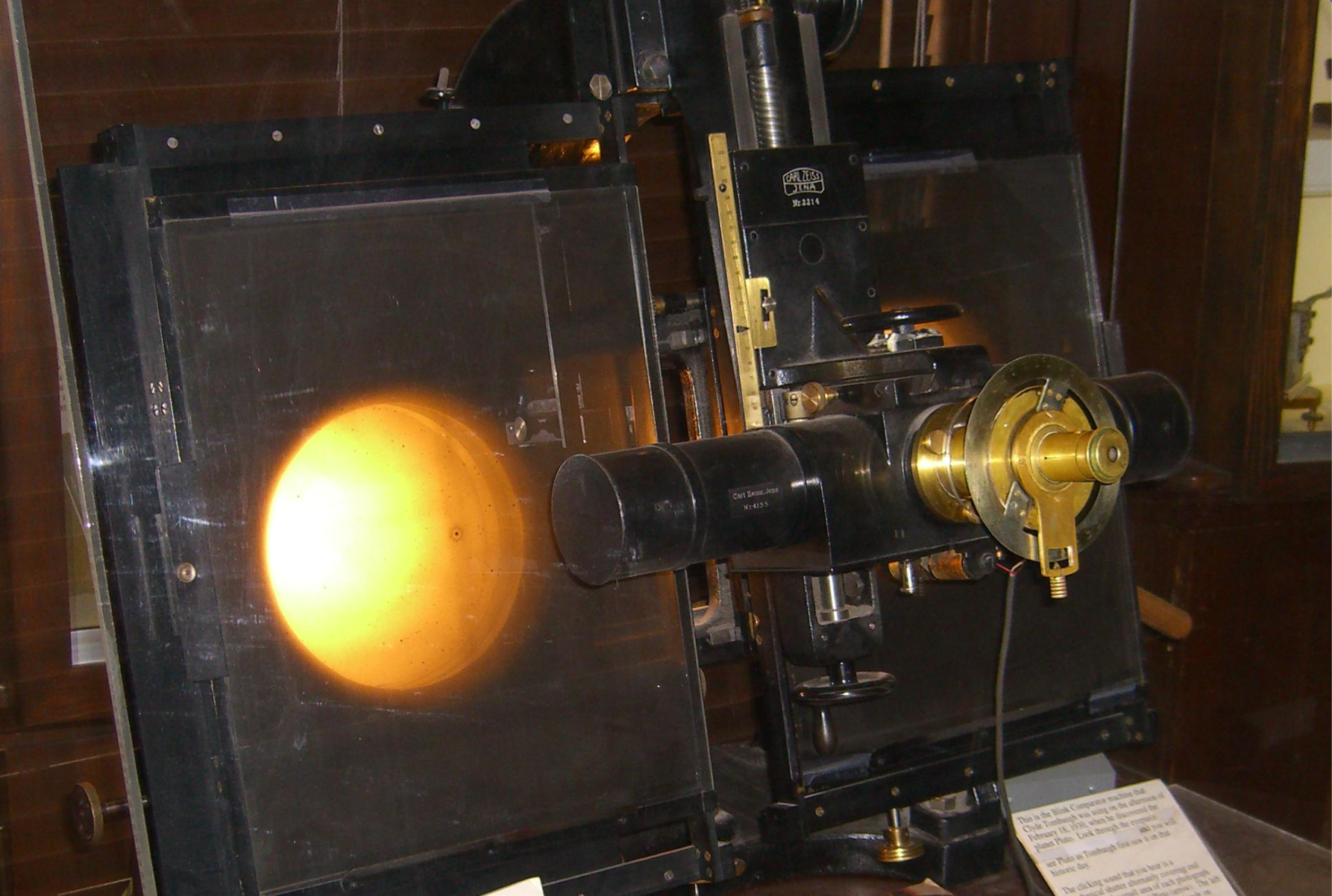
Tombaugh’s blink comparator
There were several other systematic searches for objects beyond Neptune before Brown’s. First Percival Lowell searched for a hypothesized gas giant called “Planet X” in the late 19th and early 20th century. Tombaugh continued this search and found Pluto. In the 70s and 80s, Charlie Kowal of Palomar Observatory did his own search for Planet X and found several interesting minor bodies but no planets. And in the 90s, David Jewitt and Jane Luu used similar techniques to look for and find the Kuiper Belt, a band of small-to-medium bodies beyond the orbit of Neptune whose existence had been hypothesized as a source for short-period comets.
In the case of Tombaugh and Lowell, one key difference is that Brown had a much better telescope. Lowell used a 5-inch telescope [3] for most of his survey. Tombaugh used a 13-inch telescope. Brown used a 48-inch telescope, which collects about 2000 times more light than Tombaugh’s and can generate images that show about 100 times more stuff per photograph.
However, this does not explain Kowal, who also used exactly the same telescope that Brown did: the Samuel Oschin 48-inch Schmidt Telescope at Palomar Observatory. Brown’s big advantage over Kowal was that Kowal was using exactly the same Blink Comparator technique as Tombaugh. The downside of the bigger telescopes being able to see 100 times more stuff is that there are a hundred times more stuff to look at. Brown estimated that it would have taken forty years to analyze his survey data, while Kowal’s survey was done in ten. Haste and fatigue means that even the best observers (and Kowal was an extremely good one by all accounts) would inevitably miss stuff.
Brown offloaded most of the tedious work to computers. The photographs were scanned, and Brown wrote software to analyze the photos and flag anything that seemed like it might be moving. Brown would manually review the thousands of possible matches, almost all of which turned out to be noise, but the software still reduced decades of work to weeks and allowed Brown to give a much higher level of personal scrutiny to things that might be a planet or large KBO (Kuiper Belt Object).
If you were to ask why Brown succeeded while Jewitt and Luu failed, then that would be a wrong question. Jewitt and Luu were using bigger and better telescopes than Brown. They were also using a similar software-aided approach to Brown’s. Their search was extraordinarily successful, but they were looking for different things than Brown was, and each team found what they were looking for. Jewitt and Luu were looking for a large population of small-to-medium bodies, while Brown was looking for a small population of larger bodies. This is actually why the former were using bigger and better telescopes: the smaller bodies would be fainter and you need better telescopes to see them, and using better telescopes past a certain point comes at a cost. The largest telescopes are designed to get a really close, deep look at a small patch of sky while Brown wanted to look at as much of the sky as possible. Brown surveyed 5108 square degrees (about 12% of the sky) as of June 2003 and about 20,000 square degrees as of 2012 (about half the sky, and most of what you can see from the Palomar Observatory), while Jewitt and Luu surveyed only a total of 71.7 square degrees (less than 2% of Brown’s) in the two surveys I could find, but Brown’s survey was limited to finding objects of magnitude 20.7, while Jewitt and Luu could spot objects a hundred or a thousand times dimmer. As Brown put it:
Imagine being interested in exploring the inhabitants of the ocean but all you have is a small handheld net. If you did your net in the sea many times, you will certainly find a vast collection of microbes and krill, but you will never know that there are dolphins and sharks and even the occasional whale. In contrast, the photographic plates from the 48-inch Scmidt were not nearly as sensitive [...]–the net was so large that the krill and the microbes would fall right through–but we had a net big enough that we could cover the whole ocean. The big fish would have nowhere to hide.
I thought about the biggest fish.
Jewitt and Luu discovered about 50 KBOs, including almost all of the first KBOs discovered besides Pluto. Brown and his team discovered about half that many, including most of the largest (again, except for Pluto). All three of them have done massively important interpretational work on their discoveries, and in 2012 the three of them shared the Kavil Prize for Astrophysics for their efforts.

Jewitt (left), Luu (center), and Brown (right) (source)
What do you do when you find one?
Brown makes clear in the book that discovering KBOs and even planets is not just an exercise in describing and classifying things for its own sake. The point of discovering new planets and other solar system bodies is so we can do planetary science on them. Each body in the solar system is part of our data set for forming and testing theories about geology, astrophysics, and how the Solar System formed. Discovering a new planet is really cool and gives you huge bragging rights, but the real prize from an academic astronomer’s perspective is that you get first crack at studying it and writing papers about what you find.
The first thing to do is to confirm that you’ve actually found one. The initial search will give you some number of image sets where there’s something that seems to be moving between them. Brown used sets of three images, so his software could filter for objects that seem to be moving consistently between all three. Brown and his collaborator Chad Trujillo [4] configured the software to minimize false negatives at the cost of allowing more false positives, so Brown had thousands of potential finds to manually analyze as “yes” (very likely real), “no” (definitely noise), or “maybe” (worth taking another look). Once you have some maybes or even a yes, you extrapolate where the thing should be now if it’s real, and you go look for it with a more powerful telescope. This rules out almost all of the maybes, but if there is something there, you should be able to see it clearly in about the spot you expected, and it should continue moving across further nights.
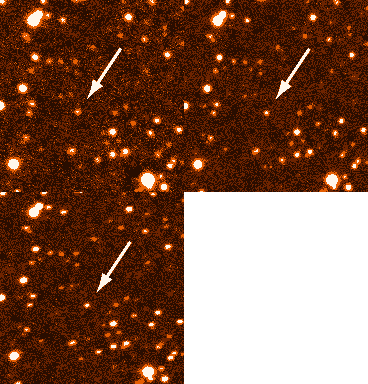
Animated discovery images of Quaoar (source), pronounced “KWA-wahr”
Once you are confident you have actually found something, the next thing to determine is its orbit, and you do this by taking more observations of it so you have more dots to connect. The further apart the observations are in time, the better they are for this purpose. Brown doesn’t go into the math in this book, but explains that you need more observations over longer periods of time to estimate a distant object’s orbit with reasonable precision. Each spotting gets you a better estimate that you can use to predict where to look for it even further in the future. Or better yet, where to look for it far in the past: Waiting and watching a new discovery for years to determine its orbit is tedious and time-consuming, but fortunately the sorts of thing Brown is looking for tends to have been spotted before by other astronomers who didn’t recognize it for what it was, in the background of photos taken to study other stuff. Most recent imaging from the big telescopes is digitally archived, while older observations are often available as glass photographic plates stored in university archives. Confirmed older images of a newly discovered object are called “precovery” images, and the search for precovery images is a big part of the process of determining trajectory.
The orbit can imply some really interesting things, especially in terms of raising questions. Quaoar has an exceptionally regular (circular orbit and relatively close to the ecliptic) compared to other then-known Trans-Neptunian objects, which called into question some theories about the structure of the Kuiper Belt. Sedna has an extremely elliptical orbit whose outer reaches are much farther from the sun than any other known object except for comets, and explaining how a body the size of Sedna got such an orbit has major implications for the formation and structure of the Solar System (much more on this later).
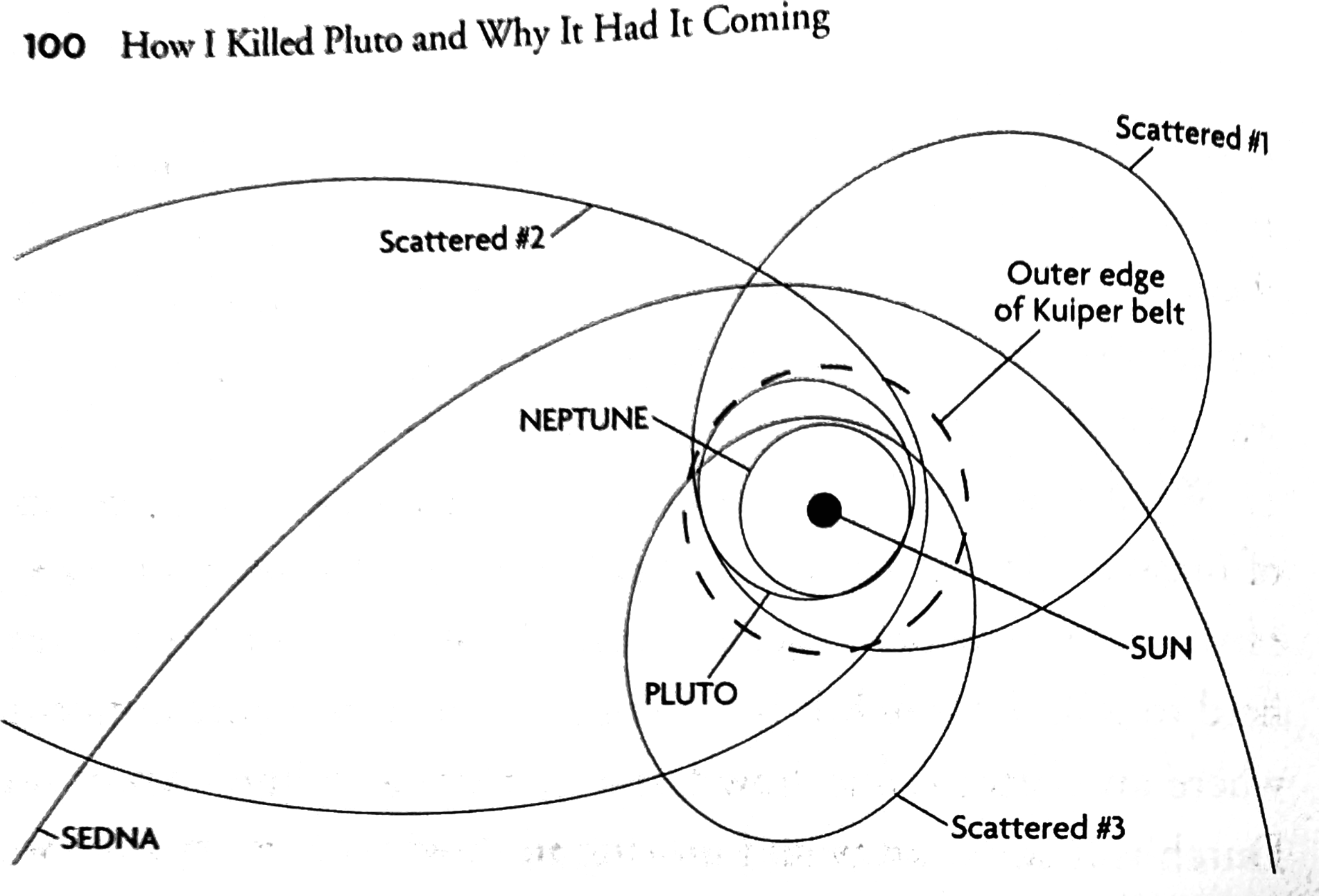
Brown’s diagram of Sedna’s orbit.
Next, you probably want to get some idea how big it is. There’s two kinds of “big” here: mass and radius. You might get lucky and find that the thing you’re observing has a moon orbiting it, so you can use some fairly basic physics to determine its mass based on its gravitational effects on its moon(s). If not, you’ll have to guess based on its radius and composition. You can guess its radius from how bright it is, but that’s tricky because a bright, shiny object (high albedo) is going to look a lot brighter than a dark, dull (low albedo) one. You can also directly observe the radius, by looking at it with a powerful enough telescope that you see a defined disk you can measure rather than a mere point of light. For Brown, this meant using the Hubble Space Telescope (more on this later), since no Earth-based telescope was powerful enough to resolve even a relatively large KBO as a disk.
Composition is somewhat easier to study, especially surface composition. Point a powerful enough telescope at it, and you can analyze what specific frequencies of sunlight are reflected and absorbed by the object’s surface, which lets you determine which elements are there. You can also figure out how quickly it rotates by watching it over periods of hours or days and noticing how its brightness and color vary over that time as that suggests that you’re looking at different parts of its surface. Composition helps you with size estimation because of what it implies about both density and albedo, and is interesting for its own sake as a body’s composition informs theories about how it formed and what it’s like now. Rotation can also give you interesting clues, especially for bodies like Haumea which is the fastest-rotating known body in the solar system with a 3.9 hour day; this lead to a theory that Haumea had suffered a high-speed glancing impact with another KBO in its past, which has been corroborated by the discovery of many smaller bodies similar in composition to Haumea, in similar orbits, which fits what we’d expect to see from other bodies that originated as debris from the same collision.
At some point, you’re going to want to announce your discovery and publish your papers. The timing of this is a delicate subject and a source of significant concern for Brown throughout the book. On one hand, the big prize for discovering something is that you get the first opportunity to science it, so you want to keep your discovery secret for long enough to take proper advantage of this. There’s also a question of responsibly announcing your discovery, making sure that you’re reasonably confident of what you’ve discovered and its significance when you make the public announcement, and also having enough detail in your announcement to make it more informative than just pointing and saying “Hey, New Thing!”
On the other hand, you don’t want to wait too long. In Brown’s case, and I doubt he is unusual in this respect among astronomers, he seems to be really excited about his discoveries and eager to tell people about them, so keeping secrets goes against his grain. There’s also a more practical consideration that by convention, Astronomy (and I think most other fields of science) gives credit for discoveries to the first person or team to announce, even if somebody else had spotted it first. Sit on a discovery too long and you risk someone else independently discovering it and announcing first. Brown discusses this system in the book and defends it as a pretty good compromise to balance the incentives to pursue discoveries with the incentives to announce them relatively promptly. In most cases discussed in the book, Brown settles on taking a bit under a year to study his discoveries before announcing them, which he presents as a very fast pace for this kind of Astronomy given the amount of work involved and the delay involved in scheduling time on the really good telescopes to collect data.
The last step before you announce is to take advantage of the prerogative of a discoverer to propose the official name for an object. The International Astronomical Union (IAU) has rules for what kinds of names are appropriate for a given type of object (e.g. names associated with creation myths for small bodies beyond the orbit of Neptune), and names must be ratified by the appropriate committee, but it’s very uncommon for them to reject a name proposed by the discoverer which fits the guidelines.
Brown’s villain origin story, or, what do astronomers do all day?
This is very much a personal memoir, describing events from Brown’s perspective as a narrative of his own life and work. The technical and historical details are there, at least in broad strokes, and form a large theme of the book, but the focus throughout is on Brown’s own story. His discoveries are a major portion of that, but they’re far from the only thing going on that’s important to him and the book very much reflects that. I think this works very well, because Brown’s personal life comes across as interesting and sympathetic, and because the personal context is often genuinely important to how the scientific history plays out.
Brown tells the technical aspects within a framework of his personal story. The explanation of the history of the concept of “Planet” is interwoven with a brief telling of Brown’s childhood in Huntsville, Alabama, how young Mike took an interest in planets as a tangent from his father’s career as a rocket engineer supporting the Apollo program, how he had a poster in his bedroom with artists conceptions of the surfaces of each planet, how he as a teenager noticed a conjunction of Juptier and Saturn and made an emotional connection with the planets as real things you can see with your own eyes rather than just things you read and hear about. We learn about Jewitt and Luu’s discoveries from Brown’s perspective as a grad student at Berkeley, taking a break from working on his thesis; Jane Luu, who was friends with Brown and had an office near his, was also taking a break and happened to mention to him that she’d just discovered the Kuiper Belt, to which Brown replies “What’s a Kuiper Belt?”
There are a lot of little anecdotes about what the day-to-day life of a working astronomer is like. A lot of it, particularly for a tenure-track professor like Brown, is teaching, mentoring grad students, and writing papers. Actually observing things is also an important part of the job, of course, and that part of the job puts an astronomer at the mercy of a number of external factors, some more predictable than others. One obvious constraint is that most astronomical observations happen at night, because the sun is very bright and tends to get in the way. The moon is also bright enough to make it hard to get good observations of dim celestial objects, dividing the month into “dark time” when little or no moon is illuminated and spends most of the night below the horizon, “bright time” when the moon is near full and above the horizon most of the night and renders the night useless to astronomers, and “grey time” when the moon is between these two states and dim objects can only been seen in part of the sky for part of the night. This proved inconvenient enough to Mike Brown that, early in his career, his complaints about it inspired the young daughter of a friend of his to exclaim “The moon is Mike’s nemesis!”
High-end telescopes also tend to be fairly remote, to keep them away from city lights and above as much atmosphere as possible, so astronomers making observations tend to spend a lot of time travelling. Sometimes a mere drive of a few hours, like the 2.5 hour drive from near the Caltech campus where Brown teaches to Palomar Observatory 120 miles away. Other times, it involves flying to Hawaii or another distant destination. Astronomers also seem to spend a lot of time travelling for things besides observing, such as conferences.
The limited availability of the best telescopes, particularly on prime “dark time” nights, is a significant factor in an astronomer’s life and, as it happened, a major factor that helped shape Brown’s career. In order to get a night at one of the “great telescopes”, you need to apply for time months in advance and you only get a few nights a year at any of these. The application involves proposing what observations you plan to do and justifying their scientific value over other proposals, but once your application is accepted, the general rule is that for better or worse, the night is yours to do with as you see fit. We see Brown get both sides of this at different points. On the “better” side, he’s able to repurpose part of a night at the Keck Telescope in Hawaii, which he’d originally intended to use to study cryovolcanos on the moons of Uranus, to do spectrographic analysis of Quaoar (pronounced Kwa-wahr) which he didn’t even know existed at the time he’d put in his application. On the “worse” side, if the night you are assigned happens to have inclement weather or otherwise be unsuitable for observation, you’re out of luck and don’t get to observe anything, as happened to Brown at least twice as he recounts in the book. Once over Thanksgiving in 1997 (more junior astronomers tend to get holidays and other less-desirable nights), and another time in December of 1999, both at the Hale Telescope at Palomar. The 1999 incident is particularly significant to the story because he passed the night chatting with his colleague, Sabine, about the Kuiper belt and his hunch that there’s something significant as-yet-undiscovered past Pluto. This conversation culminated in Brown betting Sabine five bottles of champagne that such a body would be discovered in the next five years.
This scarcity of time on the Great Telescopes would shape Brown’s career in another important way. Because of this scarcity, and because of the frustration of losing one of your few nights each year with one of them to the caprice of the weather gods, Brown conceived a visceral aversion to the idea of a telescope going unused. Shortly after the snowy Thanksgiving of 1997, Brown had visited a much smaller telescope in the same observatory, the 48 inch Schmidt originally built for the Palomar Sky Survey, and got to know Jean Mueller, an astronomer completing another project there. He learned from Mueller that the telescope would likely go almost completely unused after her project wrapped up, which confirmed his then-vague notions of making a serious search for large KBOs using the telescope. The Schmidt, though small compared to the 200+ inch great telescopes like Hale and Keck, would be large enough to find anything Pluto-sized or larger, had a wide viewing angle that made it particularly well-suited to planet hunting, and most importantly it was free for the using: rather than being lucky to get a handful of nights a year, he’d be able to use it all night, every night, weather and moon permitting.
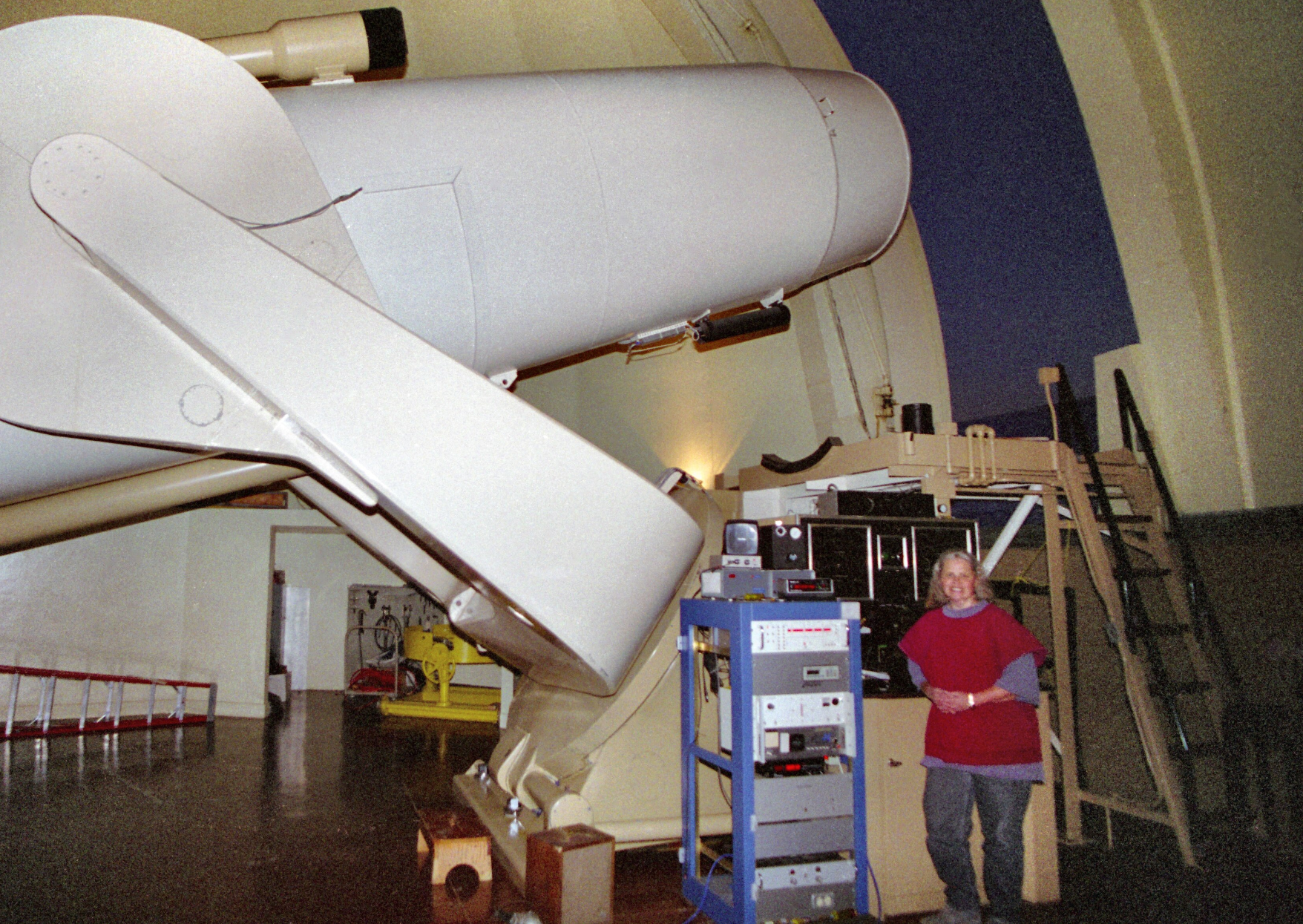
Jean Mueller with the 48-inch Schmidt, via Wikipedia

Mueller and her colleague Kevin Rykowski would join Brown for the first phase of his search. They were experienced in the telescope’s operation and knew how to work the glass photographic plates it still used at the time, so they stayed up nights photographing the sky while Brown worked days planning the search and writing and testing the software to analyse the images. After the first round of imaging, Brown’s software found 8,761 possible hits, all of which would eventually turn out to be false positives.
Another one of an academic astronomer’s responsibilities is community outreach, giving lectures and tours to donors, alumni, and members of the public. In 2001, while Brown was using a somewhat larger Palomar telescope to check one of the 27 “maybes” he’d identified among the 8,761 possible KBOs his software had flagged, he volunteered to give a talk to a group that was touring the telescope he’d been using. The organizer of the tour, Diane Binney, was the director of the Caltech Associates and thus a long-time coworker of Brown whom Brown had been too wrapped up in his research to have noticed. Brown was quite taken with Binney, who likewise seemed impressed enough with Brown to invite him to give a similar lecture for a tour she was organizing at an observatory in Hawaii.
Brown and Binney hit it off quite well over the next several months. Brown was quite smitten with Binney, but maintained a properly respectful and professional distance. Then, with the help of some mutual friends, it gradually dawned on Brown that the woman who was regularly going out of her way to spend time with him, to the point of taking three-hour coffee breaks in the middle of a work day, might return his affections. The two of them struck up a relationship.
One week in 2002, three extremely good things happened in Brown’s life. The third-best of these, by his accounting, was that he got tenure. The second best was the discovery of Quaoar; the 48-inch Schmidt had been upgraded with a digital camera, Brown had continued his sky survey and recruited Chad Trujillo to assist with it, and the search finally bore fruit with an unambiguous “yes”. The very best thing happened on a trip Brown took with Diane Binney. On the flight out, Brown told her about a personal crisis one of her grad students was having involving her fiance’s failure to buy her a proper engagement ring. Brown pretended to sympathize with the fiance’s anti-ring position, which Binney politely but firmly disagreed with. In actuality, Brown had an engagement ring in his pocket and planned to propose during the trip. As Brown describes the climax of the saga,
I knelt. I proposed. I then went on for several verbal paragraphs about the symbolic importance of the ring [...] I then produced the ring. Diane was stunned silent. I could almost hear the machinery in her head reprocessing the last few days. Her first words, after considerable pause, were “You are such as shit.” She continued processing the days, the conversation about rings, the fact she thought I was hopeless. She wanted to know where I’d gotten the ring [...], who else knew about it (my mother, of course), why it fit perfectly (I had surreptitiously tried on all of her rings, and they all fitted perfectly on my pinky, which I then had measured), how I had managed to pick one she liked so much (I modelled it somewhat after her grandmother’s wedding band, to which I knew she was much attached). Finally I had to remind her that I had actually proposed and she had not, in fact, given me an answer. She looked up and said, “YES!”

“Diane (in pink) and Mike (in white), two days post-engagement, east side of Cozumel (in the Caribbean).” [5]
There are many interesting anecdotes about slices of an astronomer’s life in the book. Many of these are faintly slapstick. The account of how the Sky Survey photos are used: before they were digitized, you’d use a special photo rig to take a polaroid of the section of the relevant plate you needed to guide your observing in the coming night. Then, at the telescope, you’d struggle to remember which was was “up” in the plate and how that particular telescope’s optics rotated or inverted its image, so a night of observation tended to start with astronomers holding up a polaroid next to the viewfinder and rotating it and tilting their heads until they managed to find their bearings. Or the story of the naming of Quaoar, where Brown and Trujillo picked a seemingly suitable name from the pantheon of the Tongva people, on whose land the Palomar observatory was built. Since the Tongva tribe still existed, they decided to consult the tribe before announcing. They got a number off the tribe’s website, which turned out to be the chief’s personal cell phone. After Trujillo tentatively persuaded the chief that he actually was an astronomer who wanted to name a new discovery after one the tribe’s gods, and not some random crank, the Chief referred Trujillo to the tribal historian, who (after another round of persuasion) gave his blessing after correcting the preferred spelling (“Quaoar” instead of the more phonetic English spelling “Kwawar” that Brown and Trujillo had found in the reference they’d consulted).
Brown gives an enormous amount of credit to Trujillo for doing most of the day-to-day work for that phase of the search, allowing Brown to, for the first time in his adult life, live like a “normal person” rather than an astronomer. When Trujillo left Caltech in the fall of 2003, Brown seriously considered abandoning the search due, especially since shortly after he ran into some severe technical difficulties with the new digital camera on the Schmidt telescope. He was persuaded to continue, partly by his colleague Antonin Bouchez who asked him how he’d feel years later if he read about somebody else discovering the bodies he’d despaired of finding, and partly by Diane. When Brown explained to his wife the choice he was facing and the sacrifices that continuing the search would mean for their personal lives, she smiled and told him, “Go find a planet.”
Brown did work through the problems with the camera, and wound up partnering with Yale astronomer David Rabinowitz. Trujillo remained involved in the project, too, from his new position at the Gemini Observatory in Hawaii; not at the level he had been, but involved enough to warrant codiscoverer credit on Sedna, Haumea, Makemake, and Eris.
Mike Brown and Diane Binney have one child, their daughter Lilah, who was born just as Brown and his collaborators were in the later stages of preparing to announce Haumea and Eris. Brown gives an extensive and highly relatable account of his experiences as a first-time father, both before and after Lilah’s arrival. The anticipation, the apprehension, the frustration with the apparent statistical innumeracy of doctors [6] in the weeks leading up to the birth. The foolish assumptions of first-time parents about what they’re going to get done during parental leave. How labor catches you by surprise no matter how prepared you are. The degree to which your child and the caretaking thereof consumes all your thought, energy, and emotions when she actually arrives. The delights of seeing your baby encounter everything for the first time. And the blur of fatigue from giving round-the-clock care to a completely helpless being who is dependent on you for literally everything; I never put cat litter in the washing machine after mistaking it for detergent, as Brown confesses to have done, but I do (vaguely) remember being tired enough to do so and have nothing but sympathy for the mistake.
Brown applied somewhat more statistical rigor than I did to the experience of parenting an infant, keeping logs of sleeps and feedings and compiling charts thereof which he published to a website, whose URL he gives in the book and which he says he will leave up until Lilah is old enough to be embarrassed by it and make him take it down [7].
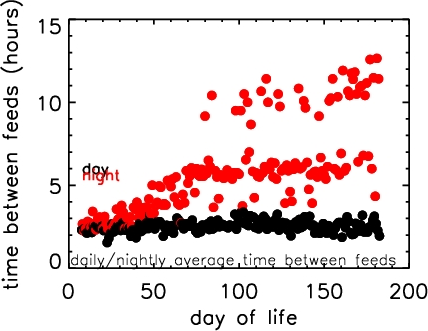
One thing that Brown had to deal with during his parental leave which I did not was a crisis at work. As the conference approached where Trujillo and Rabinowitz would announce the discovery of the KBO they then called “Santaclaus” (Haumea), news broke that a Spanish astronomer named José-Luis Ortiz had beaten them to the announcement after seeming to discover it independently. Brown’s immediate reaction was private frustration, then a decision to gracefully concede the discovery according to the long-time rule that credit for a discovery goes to the first team to announce it. Gradually, however, evidence trickled in that what Ortiz actually discovered was an unsecured website containing observation logs [8] from one of the telescopes Brown et al had been using to study Haumea. An investigation determined that the website had been accessed by someone at Ortiz’s university in the brief window between when the abstracts of Brown team’s conference papers were released (containing a “license plate” alphanumeric code for Haumea that could be used to find the website) and Ortiz’s announcement. Ortiz first ignored and eventually denied accusations of plagiarism, and responded by attacking Brown for (Ortiz argued) taking an unreasonable length of time before announcing the discovery. The controversy got picked up by a major online community of amateur asteroid hunters who already had a grudge against Brown for taking liberties in announcing names for Quaoar and Sedna before they were officially approved by the IAU’s naming committee. The kerfuffle eventually died down without definitive resolution; years later, the IAU approved Brown’s proposed name for Haumea and rejected Ortiz’s, but listed Spain as the place of discovery and left the official discoverer blank. Brown’s account of the controversy strikes me as remarkably evenhanded; he’s always very precise about what he definitively knows vs his suspicions and conclusions, and he finds inconclusive resolution unsatisfying both for the obvious reasons and because he says Ortiz deserves to be exonerated if he (Brown) is wrong about what happened.
While this was playing out, Brown found that Ortiz’s team had also accessed logs of when Brown’s team had been using the same telescope to study two other discoveries, one of which (codenamed Xena) was larger than Pluto. Brown announced both of these at 4pm Pacific time on a Friday, after the weekend print deadlines for East Coast newspapers.
As the rest of the story plays out over the course of several years, Brown shares a number of other stories about Lilah’s childhood. My favorite is about Lilah learning sign language as a baby. One of the signs she liked using was “turn on the lights’ (hold her fist out, then spread her fingers). Brown tells how one night, he took nine-month-old Lilah outside to show her the moon.
And then the moon ducked behind one of the thick clouds, and everything got dark.
Lilah looked around, looked up to where the moon used to be, and looked at me. Then she held her fist up in the air and flung her fingers open. She looked at me expectantly. [ed: Turn the moon back on, Daddy]
The cloud passed. The moon came back out and once again brightened the landscape.
Lilah smiled at me and tapped her heart. [ed: Thank you]
What is a planet, redux
When Brown was consulting with Caltech’s press office about the announcement of Xena, they pushed him to announce it as the tenth planet, which he reluctantly acquiesced to despite his conviction that neither Xena nor Pluto really deserved the label. Both before and after the announcement, Brown had done quite a bit of soul-searching on whether Xena should be called a planet, and the first step there was to figure out exactly what a “planet” did or should mean. This was a tough one, since astronomers don’t really go in for “lawyerly definitions”. Most important terms in the field are defined the way the Supreme Court famously defined pornography: “I know it when I see it.”
The chapter in which Brown goes over this covers a lot of ground that will be familiar to long-time readers of this blog, about the philosophy of definitions, and how we categorize and name things as a tool to better understand the world, and that this world is often more than a little messy, not neatly sorted into Platonic forms. Brown discusses analogies with questions from geology like when does a hill become a mountain, or a pond become a lake or a sea, or when an island becomes a continent. He eventually settles on the idea that planets should be like continents, as a small number of major landmarks that can be conveniently used to discuss the major structure of the Solar System.
The discovery of Xena forced the IAU to finally take up the issue of clarifying what was and wasn’t a planet, which had been simmering quietly in the background for many years. A few months after the Xena announcement, Brown worked with Caltech’s press office to prepare drafts of press releases for what the IAU might decide. The four possibilities they covered were:
- Ten planets, including Xena and Pluto. This would keep the existing nine and follow the rule most non-astronomers Brown had polled seemed to intuit: that anything Pluto’s size or larger was a planet. This was the one Brown considered the most likely at the time, and had the backing of Brown’s wife Diane.
- Eight planets, relegating Pluto to the status of a particularly large asteroid like Ceres or Vesta. This was Brown’s own preference and the preference of most other astronomers of his acquaintance.
- Nine planets, applying a more exclusive standard to newly-discovered bodies like Xena while making an unprincipled exception for Pluto.
- Two hundred planets, applying a broad definition that would encompass not just Pluto and Xena but also Quaoar, Haumea, Sedna, Ceres, and likely a very large number of newly-discovered and as-yet-undiscovered bodies deep in the outer solar system.
The death of Pluto
The IAU finally got around to addressing the question in its August 2006 meeting, over a year after Brown had announced the discovery of Xena. As the meeting approached, the chairman of the committee preparing the recommendation contacted Brown and told him that under their proposal, Xena would be a planet and Brown would become the only living discoverer of a planet. Brown took this to mean that the IAU was going with a ten-planet definition, as Xena being a planet ruled out eight and nine planet definitions, and the 200-planet definition would also include Jewitt, Luu, and several other living astronomers who had been studying the Kuiper Belt.
When the proposal was announced, Brown was startled to learn that they actually had gone with a variant of the 200-planet definition (counting all gravitationally-round bodies as Planets unless they were moons), but were presenting it as a 13-planet model by only counting bodies which were definitely confirmed to be round. They also, oddly, were also counting Pluto’s moon Chiron as a planet on the grounds that the center of gravity between Pluto and Chiron was in empty space between the two bodies.
Brown did not attend the IAU meeting, having made other plans before the agenda was announced, and also not being an official member of the IAU. What he did was argue to anyone who would listen, both the media and other astronomers, for rejecting the committee proposal in favor of an eight-planet definition. Brown was far from the only astronomer who hated the committee proposal, and last minute negotiations replaced it with a two-stage proposal to be voted on by the full body. The first vote would be on an eight-planet definition that would require planets to be both gravitationally round and to “clear its orbit”, the latter requirement excluding Pluto, Xena, Ceres, and the others. Bodies orbiting the sun that met the first requirement but not the latter would be “dwarf planets” but not full-fledged planets.
The second vote was (in Brown’s estimation) an attempt by the committee to sneak the 200-planet definition in by the back door by amending the rule from the first vote to call the eight planets “classical planets” rather than merely “planets”. This would fundamentally change the meaning, as instead of “dwarf planets” being a separate category distinct from “planets”, “planets” would instead not be directly defined except by the implication that it encompassed both “classical planets” and “dwarf planets”. Brown disliked this as parliamentary shenanigans, and also because “classical planets” was already an established term that meant something quite different: The seven “wanderers” known to Classical Greece, or more narrowly, the five of those bodies (Mercury, Venus, Mars, Jupiter, and Saturn, but not the Sun or the Moon) that are still considered planets.
Brown watched the decisive floor vote from his office at Caltech, in the company of a number of reporters for whom he was narrating the deliberations. I would dearly like to be able to see a video of this, but Brown’s blow-by-blow account in the book is probably the next best thing. The first proposal passed overwhelmingly, the chair of the meeting (legendary astrophysicist Jocelyn Bell Burnell) explained the implications of the second proposal, and the second proposal was voted down almost unanimously. Brown announced to his audience, “Pluto is dead.”

Brown, 2026, preparing to give a lecture on Dwarf Planets
When it came time to give Xena an official name, Brown decided to use a Greco-Roman name to emphasize its almost-planetness [9], but most of the good ones were taken by various asteroids. One of the few still available, Eris, struck him as perfect. Eris is the Goddess of Discord, who started the chain of events that lead to the Trojan War by tossing a golden apple labeled “To the fairest” between Hera, Athena, and Aphrodite. She’s an important and well-known mythological figure, has a catchy name, and the apple of discord is an apt symbol for how the discovery led to the demotion of Pluto and much consequent wailing and gnashing of teeth.
Eris’s moon, codenamed Gabrielle, was given the permanent name Dysnomia, after the daughter of the mythological Eris. It’s also indirectly named after Brown’s wife, Diane “Di” Binney, in much the same way that James Christy named Pluto’s moon, Charon, partially after his wife Charlene. Dysnomia’s literal meaning, “Lawless”, is also the surname of the actress who played Xena, but Brown swears this is unintentional. I believe him; Brown strikes me as the sort who would be proud of such a pun had it been intended.
Did Pluto have it coming?
The title of the book promised the reader two things: The story of how the author killed Pluto and a case for why Pluto had it coming. On the first question, I think Brown engaged in a bit of hyperbole. It was Brown’s discovery of Eris that forced the decision on whether or not to kill Pluto, and Brown was one of the louder voices arguing for the eight planet model, but taken literally, “killing Pluto” is too great a claim for any one man. There are several people who were more directly involved in drafting and debating the adopted proposal who could put in a plausible claim to rival Brown’s, but I judge Brown’s claim to the title of “Pluto Killer” [10] to be as good as any and better than most. To the extent Brown deserved credit (or blame) for killing Pluto, the book is an excellent summary of how he did so.
I’ll look at the second now: Having read the book and done some thinking about the subject on our own, do we agree with Brown that Pluto had it coming?
Brown’s case against Pluto
I definitely think so, but I was already convinced of the matter before I ever heard of this book. The core argument Brown makes here against Pluto is the precedent of Ceres, Pallas, Vesta, Juno, and the rest of the asteroid belt. Pluto, like Ceres et al, is merely the first-discovered and one of the larger of a very numerous population of similar objects which share an orbital zone.

In the late 19th century, the astronomy community quietly and gradually reached the collective decision that the larger bodies of the Asteroid Belt should be grouped in with the smaller bodies in the same reason as “asteroids” or “planetoids” or “minor planets” and not considered peers of the eight “major planets”. Brown argues that the same is true of the Kuiper Belt, and that Pluto, Eris, Quaoar, and the others should get the same treatment as Ceres and company. Revisiting that decision and counting what are now considered Dwarf Planets as full-fledged Planets would leave us with dozens or hundred of planets [11], which is too many to serve as legible landmarks of a meaningful understanding of the Solar System. He argues there is no sensible scientific rationale for singling out a handful of these second-tier bodies for planetary status. There’s a certain emotional appeal to making unprincipled exceptions for Pluto and Eris (Brown admits he is not immune to this appeal himself), but doing so would present a distorted model of the structure of the Solar System that would have to be unlearned by anyone taking an interest in the matter.
Secondarily to this, when astronomers study the dynamics of the Solar System, modelling how it may have formed and why various things have the orbits, shapes, and compositions that they do, certain bodies are tremendously more important than others. The Gas Giants collectively, especially Jupter, loom particularly large here. Neptune was discovered because of its gravitational influence on Uranus during close approaches, and the structure of the Kuiper Belt and environs is defined largely by the influence of Neptune. Brown asks us to imagine an alien explorer without any preconceived notions about “planets” approaching our Solar System for the first time and attempting to understand it. Our hypothetical alien would first notice Jupiter, and then Saturn. Then, it would recognize Uranus and Neptune as being smaller versions of the same basic thing. Much later, looking closely at the inner system, our alien would notice the four rocky planets of the inner system and consider them significant, but would create a new category to describe them, separate from the Gas Giants. They would, much later, notice the large populations of smaller-still objects in the asteroid belt and the Kuiper belt, and would probably give each of these populations their own categories separate from what we call the inner and outer planets.
Here is a visual that Brown has used elsewhere illustrating the relative sizes of various solar system bodies, which I have annotated with labels in place of Brown’s verbal explanations.
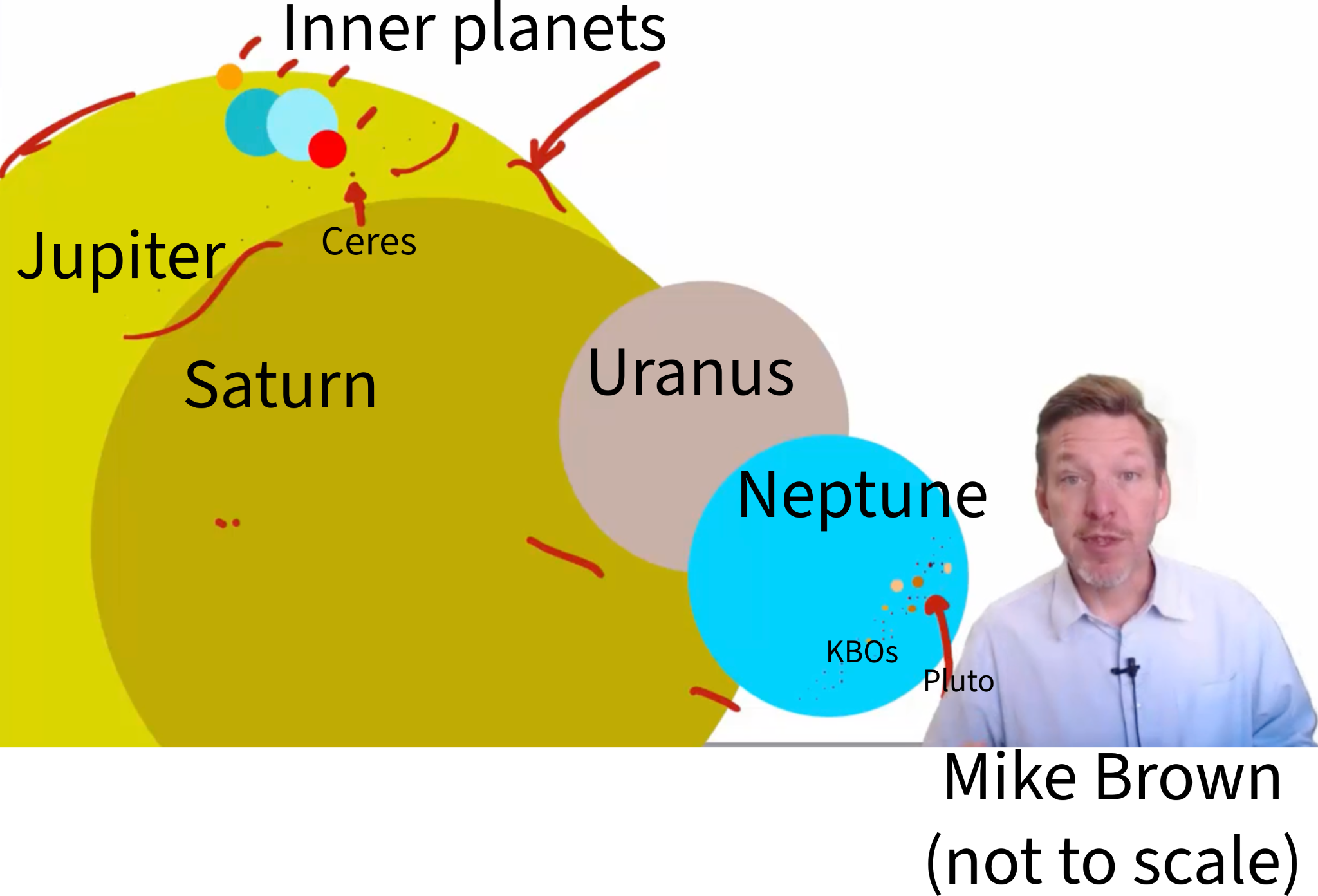
The tiny black dots below the four inner planets are the largest bodies in the Asteroid Belt, and the large KBOs (including Pluto) are shown superimposed on Neptune. It is very hard to look at this diagram and argue for nine or ten planets, although reasonable people could argue for four, eight, or several dozen.
The case for Pluto
I’ve come across three lines of argument in favor of Pluto’s planethood that I think are worth acknowledging and considering.
The first is simply the way the IAU definition distinguishes between a “planet” and a “dwarf planet”: to be the former, a body must “clear its neighborhood” of other similar-sized or large bodies not under its gravitational influence. This criterion is a bit of a mess, the argument goes, and it makes more sense to define “planets” based on their own characteristics and not on their relationships with other bodies. Brown expresses some sympathy for the first part of this in the book, and I also felt reservations about the definition when I first learned of it. Astronomers have since attempted to propose more rigorous standards for what it means to “clear the neighborhood”, which I think go a long way towards salvaging that.

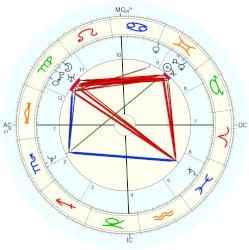
Left: Sailor Pluto from the Sailor Moon anime.
Right: Mike Brown’s birth chart, with Pluto in the 11th house, which supposedly indicates “a potent ability to effect change within their community or society”.
The second is that Pluto, by virtue of being considered a planet for seventy-six years, has been baked into our culture as a planet and it isn’t the place of the IAU, or Brown, or astronomers generally to attempt to overturn that. Let people who grew up with nine-planet diagrams of the Solar System continue to enjoy them. Let Sailor Moon fans enjoy their nine-woman Sailor Scouts team [12]. Let the New Horizons probe (launched towards Pluto in January 2006, mere months before the IAU decision) be understood as a full-fledged planetary flyby mission. Let astrologers make nine-planet charts and use Pluto as a signifier of destruction. This would argue in favor of making an unprincipled exception for Pluto, and maybe Eris, in favor of a nine-planet or ten-planet solar system, which I’m pretty sure is the strongest emotional motivator for the pro-Plutonian camp.
The final, and I think scientifically strongest, case in favor of Pluto’s planethood is the proposed Geophysical definition championed by Alan Stern, the planetary scientist who was the Principle Investigator for the New Horizons mission to Pluto. The heart of Stern’s argument, as I understand it, is that a thing should be considered a Planet if it’s big enough for the sorts of things Planetary Scientists study to happen on it, regardless of where it is and what company it keeps. This standard would include not just Dwarf Planets like Pluto, Eris, and Ceres (and probably dozens or hundreds of other bodies likely to turn out to be Dwarf Planets), but also something like ten to twenty “planetary-mass moons” like our own Moon, the large moons of the gas giants, and possibly the large moons of Pluto, Eris, and a few other large TNOs (Trans-Neptunian Objects) besides. Pluto and many of the planetary-mass moons are known to have at least trace atmospheres (much more than traces in the latter cases), complex internal structures, signs of volcanism and tectonic activity, planetary magnetic fields, and so on.
Stern’s proposal is to embrace a definition of “planet” that includes the Dwarf Planets and the Planetary Mass Moons, for a likely total of well over a hundred planets, but to maintain an informal or semi-formal division between a manageable number major landmark planets and the much vaster number of second-tier planets. In 2002, shortly prior to Brown’s discovery of Quaoar, Stern and his colleague Harold Levinson proposed a division between “Überplanets” and “Uberplanets” based on the former clearing their neighborhoods and the latter not doing so. In more recent statements and interviews, Stern seems to have moved away from this and instead seems to favor a semi-arbitrary size cutoff that would include Pluto, Eris, and a handful of the very largest moons, but would exclude most other dwarf planets and planetary-mass moons.
My case against Pluto
I’ve mentioned a couple times now that I already favored demoting Pluto long before I read or even had heard of this book. How did I come to favor that position, and why do I continue to take Brown’s side against Stern and others in this debate?
Part of it is that I’m pretty sure I was exposed to Brown’s public statements on the matter during the years spanning the core events described in this book, even if I didn’t form a clear recollection of reading specific arguments by a specific person. Still, Brown’s arguments in the book about the likeliness of Pluto being merely one of a great many medium-to-large objects in the same orbital zone, and the analogies with the history of the asteroid belt, definitely ring a bell. I was excitedly reading magazine articles and watching PBS specials about the discoveries of Quaoar, Haumea, Sedna, Makemake, and Eris, and Brown definitely would have been all over those articles and specials by virtue of being front-and-center in the events, not to mention also being witty, telegenic, and an enthusiastic public communicator.
Another part is that around 2001 or 2002, I read several of Isaac Asimov’s nonfiction essay collections in rapid succession. Asimov was definitely Pluto-skeptical when he wrote the essays in the 70s and 80s, if not a full-blown Pluto-denier like Brown. Asimov made two major anti-Pluto arguments that I remember resonating with me. The first was that Pluto was turning out to be much, much smaller than had been assumed at its discovery, to the point that it now seemed more akin to Ceres than to Mercury, and moreover, was smaller than seven of the Planetary-Mass Moons that Alan Stern now wants to count as planets. The second was that Pluto was turning out to be really weird as planets go, being an extreme outlier in terms not just of size, but also having a much more elliptical and inclined orbit than the (other) eight planets, and having an absurdly large moon relative to its own size. In Asimov’s 1988 collection The Relativity of Wrong, he proposed a new category he called “Mesoplanets” for objects smaller than Mercury but larger than Ceres, of which Pluto would have been the only instance known at the time.
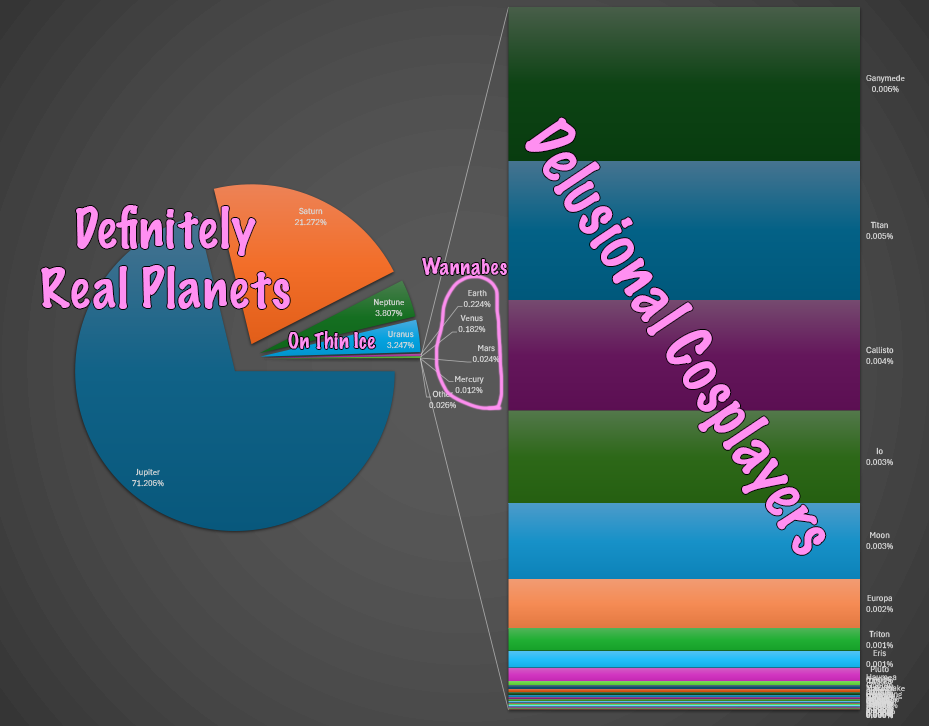
In the interests of doing things with numbers and not just with words, I just now threw together a few charts and graphs to try to quantify my anti-Pluto reasoning and see if it holds water. First, here’s a pie chart of the relative masses of the top thirty-something objects in the Solar System besides the Sun, and it definitely bears up Brown’s argument about how an alien observer would classify the solar system. Jupiter and Saturn absolutely dominate the main chart, with Neptune and Uranus registering as much smaller but still significant slices. The four inner planets are minuscule slivers, and the rest make up an illegibly tiny slice. The breakout chart of this tiny slice (collectively 0.026% of the total mass) is dominated by the seven biggest moons. If you zoom in, you can just barely make out Eris and Pluto as the light blue and hot pink slices just above where even the tiny labels I used all get jumbled together. Ceres is buried deep in that jumble.
Next, I decided to take a look at a number of dimensions, not just mass, to compare Pluto, Eris, and Ceres to the least planety of the eight official planets and to the most planety non-planet (the last restricted to Dwarf Planets and major moons). The first are two measures of size: mass and radius. Next, two measures of “clearing the neighborhood”, one based on theoretical orbit-clearing potential (Jean-Luc Margot’s Planetary Discriminant) and the other based on how clear the orbit actually appears to be (Steven Soter’s Planetary Discriminant) [13]. I also included orbital inclination (relative to the invariable plane) and eccentricity, based on the observation made variously by Isaac Asimov, Scott Alexander, and Alan Stern and Harold Levinson [14] that Pluto’s orbit is weird in these respects compared to all (other) planets except maybe Mercury. Last, based on the late 19th century distinction between “planets” which resolve as discs when viewed through medium-sized Earth-based telescopes and “asteroids” which appear as points, I included criteria for the size (in arcseconds) of the object as viewed from Earth: a good pair of binoculars have a resolution of about 1-2 arcseconds, and a high-end hobby telescope might have a resolution of half an arcsecond or less. I have omitted the Earth and Moon from consideration here since they would dominate the question to an absurd degree, as the Earth covers about 180 degrees (more than half a million arcseconds) and the Moon a little more than half a degree at 1900 arcseconds).
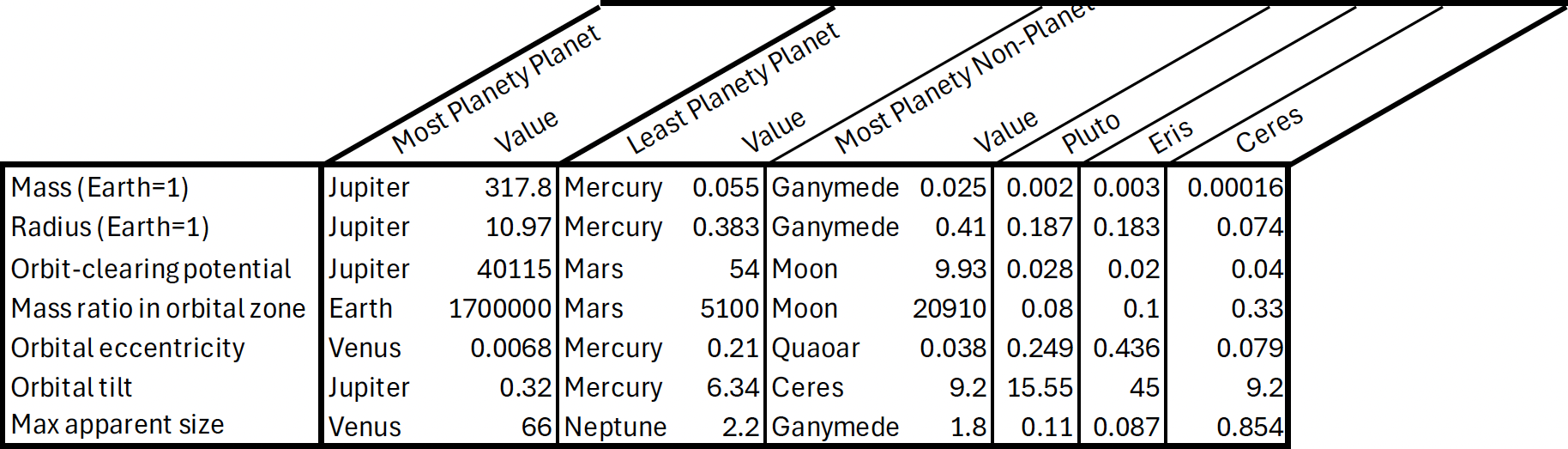
This is a little awkward to make sense of, so I’ve also taken the further steps of turning the values into orders of magnitude, normalizing them so that the least planety planet has a value of zero, and reversing the signs of the Eccentricity and Tilt rows where smaller values are more planety. So for example, this chart indicates that Jupiter is a bit less than 104 = 10,000 times the mass of Mercury, while Mercury in turn is substantially more than ten times the mass of Pluto and Eris and between a hundred and a thousand times the mass of Ceres.
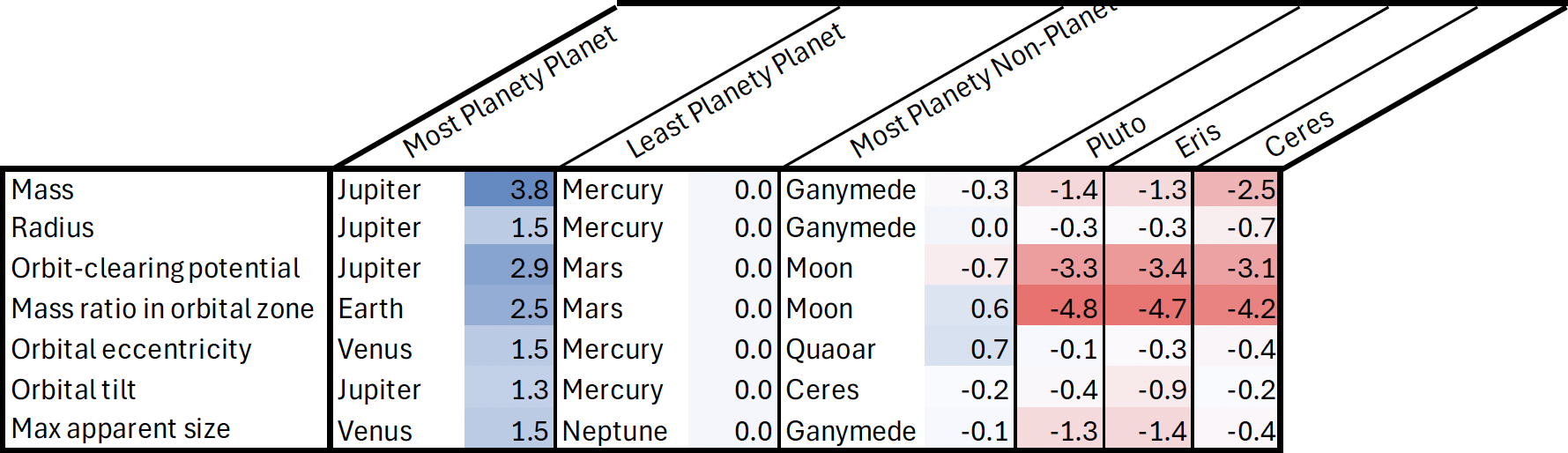
Interestingly, neither Pluto nor Eris qualifies as the most planety non-planet by any of these definitions: Ganymede and our Moon run away with the honors there, except for the sketchy metrics of orbital characteristics where the winners are Quaoar (!) and Ceres. The concept Stern has been promoting of planetary-mass moons is looking pretty good as Ganymede and the Moon are by some criteria slightly more planety than Mercury or Mars, although the Moon is cheating on the empirical orbit-clearing question because the Earth has presumably been doing the heavy lifting there [15]. Mars and Mercury are consistently the least planety planets except on my (extremely sketchy) criterion of apparent size as viewed from Earth, while Jupiter, Earth, and Venus share the honors of “most planety planet”. There's a substantial gap between the least planety planets on one hand and Pluto, Eris, and Ceres on the other hand, but except on the orbit-clearing questions, the gap is usually less than the gap between the most- and least-planety planets.
I’d call this a mixed result that favors a multi-category model. Brown, Stern, Asimov, and a number of others seem to be in general agreement that there are several natural types of medium-to-large solar system bodies, not just two or three, with the core disagreement being between whether the umbrella category of “Planet” should encompass two categories (terrestrial planets and gas giants) or three or more (such as dwarf planets, Asimov’s “mesoplanets”, or Stern’s “planetary-mass moons). This analysis seems to favor of orbit-clearing as a recognition criteria for a category to distinguish between the big two categories of mesoplanets or dwarf planets, as opposed to the pure size and orbital shape/orientation criteria that make Mercury look like it might belong in the “mesoplanet” bucket along with the dwarf planets. As to whether orbit-clearing matters enough to define a top-level distinction, I understand both Brown’s and Stern’s positions: Brown as an astronomer (albeit one in a specialty closely aligned with planetary science) naturally sees the macrostructure of the Solar System as highly salient, while Stern as a planetary scientist naturally sees the characteristics of individual bodies as more relevant.
For one last chart, let’s take a look at the question of “does planetary science happen there” for the eight planets, a selection of the most significant moons, and Pluto and Ceres. I omit Eris because we know a lot less about it than we do about the other bodies. This is by far the lowest-confidence part of my analysis, as I filled in the chart largely by skimming Wikipedia pages and assigning numerical values to qualitative characteristics by gut feel. The rough benchmark is Earth=1, much less than Earth is a fractional value, and much more than Earth is 1.5 or 2.
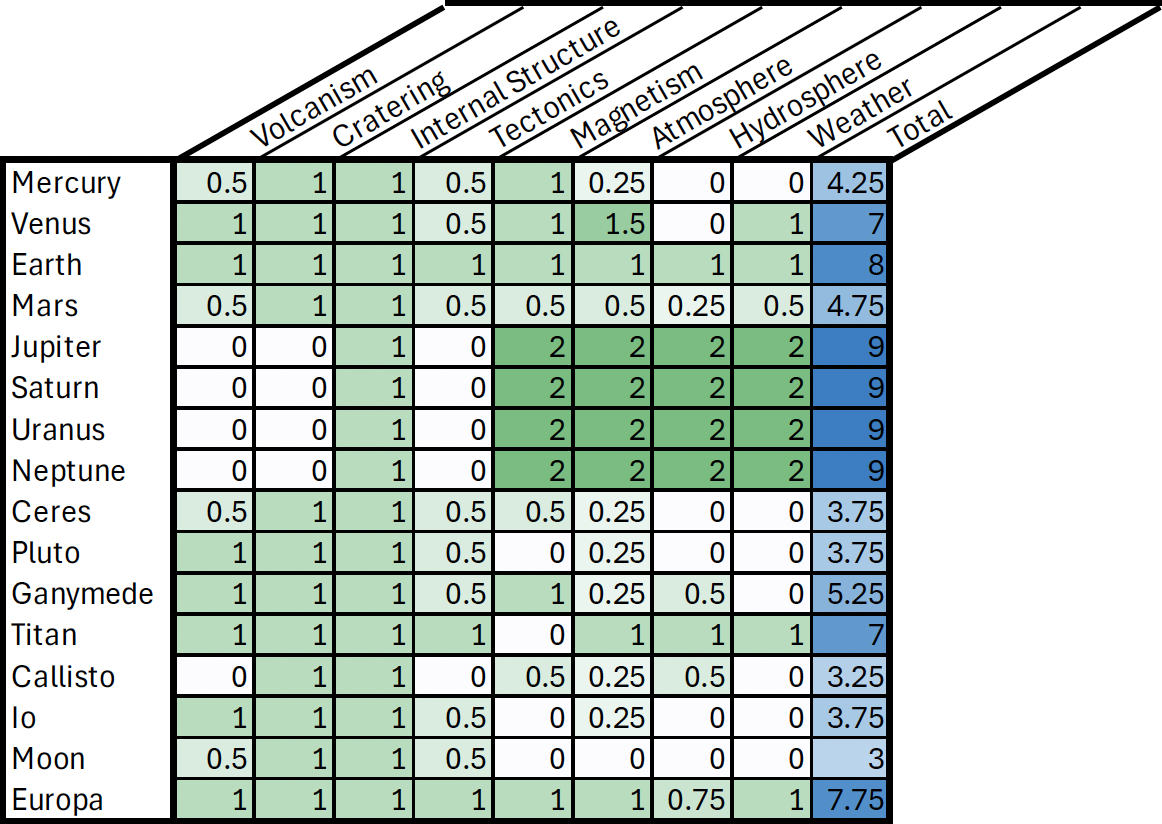
Here, once again, the seven largest moons come off looking pretty planety. Especially Europa and Titan, which fills me with joy for childhood media nostalgia reasons. Ceres and Pluto are looking somewhat less planety than many of the others, but are still within the range of values for the larger moons and only marginally less planety than Mercury or Mars. Given how unrigorous my methodology is here, I think this counts as mild-to-moderate support for Stern’s position.

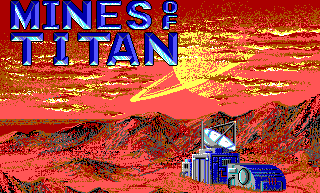
Left: The message from the Monoliths at the end of the film version of Arthur C Clarke’s 2010
Right: The loading screen of the 1989 CRPG game The Mines of Titan
Finally, let’s consider the question Brown raised in the book when considering for himself what “planet” should mean: if a new object is found, how do we know if it should be considered a (major) planet?
Bodies like Quaoar, Eris, and Sedna are not hypothetical anymore: quite a few have been found, and there is general agreement that they are not planets. The IAU definition fits.
A Neptune-sized or larger body discovered in the far reaches of the outer Solar System definitely feels like it should be considered a planet. The most likely candidate here, Planet Nine, would almost certainly qualify on the IAU definition. Again, it seems to fit.
Next, consider Theia, the Mars-sized body believed to have collided with Earth around 4.5 billion years ago, leading to the formation of the Moon. My intuition is that Theia should be considered a planet, but I’m not sure it would be under the IAU definition. It might be disqualified as a quasi-satellite of Earth, or each might prove the other had failed to clear its orbit (with the collision being Earth’s true birth as a planet), or both might be considered planets because they were under one another’s gravitational influence. I’d call this a mixed result.
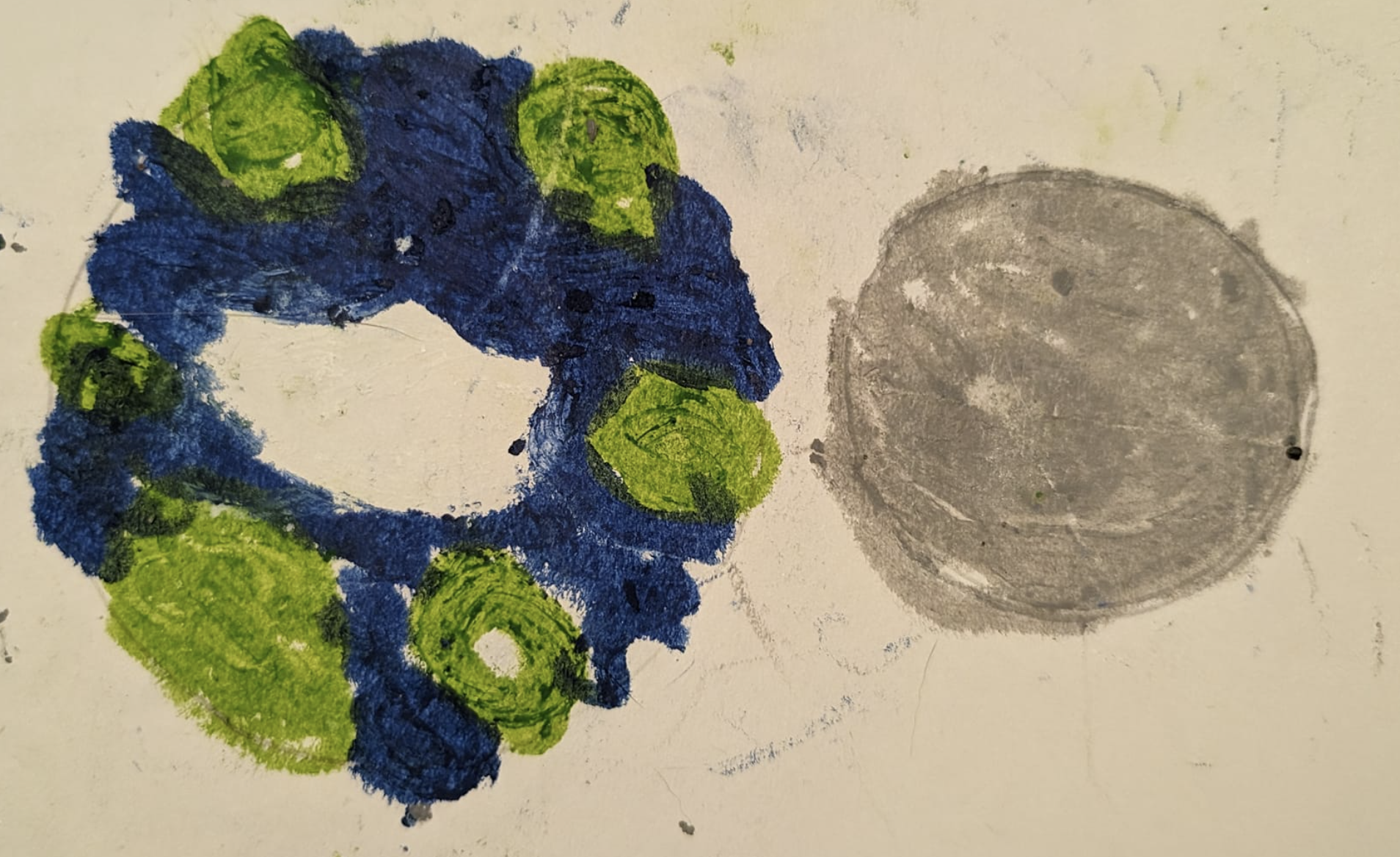
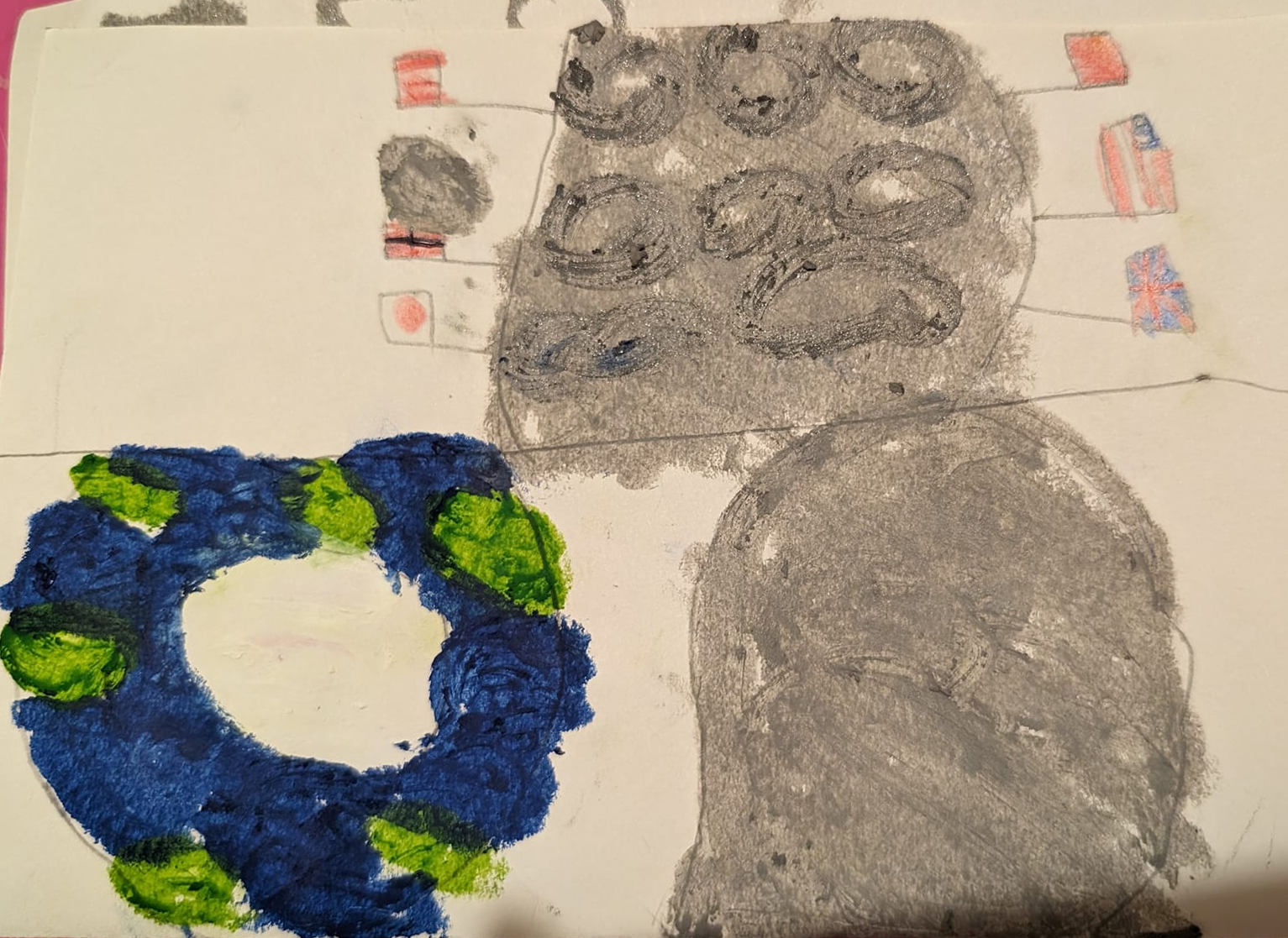
Artist’s impression of Theia about to collide with the Earth (left) and an anachronistic group shot of Theia, the Earth, and the Moon. Earth is viewed end-on, with a polar ice cap oriented towards the point of view. Drawn 2024 by the reviewer’s then-six-year-old daughter, and accompanied by a note that read, “I’m sad Theia is gone.”
So, what’s the final word? My heart is still firmly anti-Pluto, and I still think the case against Pluto is a fairly strong one, but I have to admit that Stern’s position is a fairly strong one in its own context, especially the concept of planetary-mass moons. The eight-planet model with a neighborhood-clearing criterion makes the most sense for the purposes of discussing the macro structure of the Solar System, but it also should be acknowledged that there are dozens or hundreds of qualitatively (if not quantitatively) planety things out there worthy of study, both dwarf planets and planet-like moons. The "macro structure of the solar system” perspective is, I think, quite a bit more relevant in most of the contexts in which people talk about planets, but I sympathize with Stern’s desire for an overarching term that encompasses dwarf planets and planet-like moons in addition to the eight major planets.
Epilogue
The main body of the book ends with the official naming of Eris, Haumea, and Makemake between 2006 and 2008, and with Brown telling his readers the five bottles of champagne he’d won from his 1999 bet with Sabine [16] remain undrunk, awaiting more auspicious circumstances. So, what has Brown been up to since then?
The book went to press in 2010, and Brown brings us up to that date with a brief epilogue, giving us a few more cute Lilah stories, as a treat. His daughter now four years old, we hear about her naming the corners of their backyard swimming pool after various locales where her daddy has visited in order to talk about planets, riding on his back as he swims her to “Berlin” and “Taiwan” and “Chicago” and “Boston”, before returning to “Pasadena”, where mommy is waiting with snacks. Lilah has picked up her father’s fascination with planets, loves spotting them in the sky, and has independently rediscovered their defining feature, much like the ancient Greeks, that Jupiter moves in the sky from night to night.
Planet Nine
At a couple points, Brown mentions ambitions to discover a ninth planet: Once when recounting a radio interview he gave just after the IAU vote on Pluto, and again at the very end of the book. I don’t think he meant much more than a general hope that if there was something else large in the outer fringes of the Solar System, he hoped to have a hand in discovering it. But since then, it’s started to look like another major planet is a real possibility.
There have been several hypothesized planets or other large bodies out beyond Neptune, but so far none have borne out. A dubbed “Planet X” was hypothesized as a way to explain anomalies in the orbits of Uranus and Neptune, but search for it turned up only Pluto, and data from Voyager 2 in 1989 resolved the anomalies by giving us a more precise estimate of Neptune’s mass. Other much larger and more distant hypothetical bodies like Nemesis (a dim brown or red dwarf on a 26 million year orbit) or Tyche (a super-Jupiter sized gas giant on a 1.8 million year orbit) have been proposed to explain apparent patterns in long-period comets and mass extinction events related to comet impacts on Earth, but both have been mostly ruled out by the WISE survey.
Do you remember how Sedna’s orbit was extremely surprising and implied some important things about the formation of the solar system? A number of other TNOs have since been detected with the same kind of extremely eccentric and highly inclined orbits as Sedna. And most curiously, almost all of these seem to have their orbits tilted in the same general direction as Sedna. An undiscovered planet in the outer solar system could explain it, but such hypotheses had been formulated so many times for so many reasons with so little fruit as to make astronomers wary of serious proposals along those lines. Brown and his colleague Konstantin Batygin spent some time around 2015 on computer simulations intended to rule out such a hypothesis to explain Sedna and its kin, but instead they wound up finding a remarkably consistent model that fits almost perfectly. This hypothetical planet, which Brown dubbed “Planet Nine”, would be several times larger than the Earth but somewhat smaller than Neptune, and is on an elliptical orbit pointed the opposite direction from the Sednoids. It’s small enough to lack the internal heat of a Jupiter-sized gas giant so it would have been missed by WISE’s infrared sensors, and it’s distant enough for surveys like those Brown has already done looking for TNOs to have missed it.
Batygin and Brown formally proposed Planet Nine in 2016, and they and many other astronomers are actively looking for it. It hasn’t turned up yet, but the search is ongoing and there’s quite a bit of additional indirect evidence for it that has turned up since 2016. If you’re interested in learning more, I recommend this brief lecture by Brown from 2017 (specific discussion of Planet Nine starts around the 10-minute mark, with most of the earlier part of the video devoted to a brief history of Planet X, Pluto, and the Kuiper Belt), or this much longer one from 2024.
As I write this, I have my fingers crossed that Planet Nine will be discovered during the judging period for the review contest and thus make my entry suddenly be extremely timely.
Lectures and Courses
Brown is still a Professor of Planetary Science in Caltech’s Division of Geology and Planetary Science. It looks like most of his energy is going into research (he’s involved in several projects, not just Planet Nine) and supervising student researchers, but he’s also teaching a couple of introductory planetary science classes and the occasional undergraduate seminar on the icy moons of the outer planets or on the possibility of extraterrestrial life.
There’s an online version of his “Science of the Solar System” course available via Coursera or from Brown’s faculty website. I’ve been gradually working through this and like it very much so far. The accessibility level is an advanced High School or introductory College class, but the subject matter goes into quite a bit of detail into not just what we know about various planets and small solar system bodies but also how we figured it out. If you’re interested in knowing why we’re pretty sure Jupiter has a solid inner core inside a layer of liquid metallic hydrogen, or precisely how KBOs inform our knowledge of the formation of the solar system, or how we first measured the surface temperature of Mars long before we were able to send landers or even orbiters there, this course will answer your questions.
My eight year old daughter has been watching the lectures with me. It’s accessible enough to mostly keep her interest, even though some of the crunchier details are likely going over her head, and one section of mathematically demanding lectures (working through the derivation of how dense Jupiter should be if it didn’t have a solid core) seems to be a little much for her.
Pool Bears


Brown and his family live in a house near Pasadena, far enough out in the boonies that he’s often visited by various wildlife. His most frequent visitor, it seems, is a Cinnamon bear [17] whom he has dubbed Patch. Patch enjoys swimming in Brown’s backyard swimming pool, presumably the same one whose corners four-year-old Lilah had named after cities where her father had recently travelled to give lectures.
My own daughter is a very big fan of Patch the Pool Bear, and it is by pointing out the connection between Patch and Brown that I persuaded her to watch his Science of the Solar System lectures with me.

Your message is stored now and emailed to the author after the contest ends. The author can reply to you, but their identity stays hidden unless they choose to respond.
Footnotes
- ↩
A category of objects larger than supergiant planets but smaller than the smallest proper stars, characterized by being big enough to sustain deuterium fusion but not fusion of regular hydrogen. They are named by analogy with Red Dwarf stars.
- ↩
The glass “film” used to take high-quality photographs with this kind of telescope.
- ↩
Telescope sizes refer to the diameter of aperture from which they collect light, which is the limiting factor in how much light they can collect and also affects ability to resolve fine details. Galileo’s telescope was little more than half an inch. Herschel discovered Uranus with a 7.1 inch telescope. A good pair of binoculars or a low-end hobby telescope might be about 2 inches. Mid-range hobby telescopes are commonly 4-6 inches, and high-end ones may be 12 inches or more.
- ↩
When we first meet Trujillo, he’s Brown’s postdoc assistant. He later left to take a job at the Gemini Observatory in Hawaii. Before working with Brown, Trujillo had been a grad student assisting Jewitt and Luu’s search for KBOs.
- ↩
Picture and caption are both taken from their wedding website.
- ↩
Brown’s specific complaint was that nobody was able to give him a straight answer about the probability distribution of birth dates relative to due dates. Mine was about rates of Type I and Type II errors in prenatal testing for very rare conditions.
- ↩
As I write this, Lilah is 20 years old. The site remains up although most of the photo album links are now dead.
- ↩
2005 was a more innocent time for network security.
- ↩
The codename Xena was also chosen for this reason, and also as a nod to “Planet X”.
- ↩
Brown uses “@PlutoKiller” as his handle on Bluesky, Twitter, and YouTube.
- ↩
As of 2025, there are five bodies officially recognized by the IAU as Dwarf Planets (Pluto, Ceres, Eris, Haumea, and Makemake) and another four or five that are generally considered all-but-certain to qualify. Brown has a programmatically-updated page on his website which buckets the top 2000-something non-planets based on some heuristics about their likelihood of being Dwarf Planets, which suggest a confidence interval of between several dozen and a few hundred Dwarf Planets in the Solar System among currently-discovered objects.
- ↩
Strictly speaking, the team is nine young women, one man, and a time-travelling immortal child.
- ↩
Simply the ratio of the mass of the object to the combined mass of everything else in the same orbital zone, excluding its satellites, trojans, and bodies locked in orbital resonance with it. So the Earth doesn’t get penalized for failing to clean up the Moon and neither Neptune nor Pluto gets penalized for failing to clean up the other.
- ↩
N.b. Stern and Levenson bring up eccentricity as an example of an unsatisfactory criteria for distinguishing planets from non-planets.
- ↩
We’re pretty sure that the Moon is the result of a major piece of orbit-clearing by the Earth, being formed from debris from a collision between the proto-Earth and a hypothetical Mars-sized body that has been dubbed Theia.
- ↩
Eris was discovered five days past the deadline, but Sabine was gracious enough to grant Brown an extension.
- ↩
A subspecies of American Black Bear with reddish-brown fur.