How many Super Mario games are there NOW?
I don’t actually expect to have the weirdest review subject in the contest, but I’d like to be in the runners up.
Mitch Halley runs a YouTube channel formerly called Conlang Critic. I assume if you’ve heard of him before, it would be from his series of the same name, in which he ranks and reviews artificially made languages from Esperanto to Dothraki. He eventually changed the channel’s name to jan misali (which is a translation of Mitch into Toki Pona, his favorite constructed language), to reflect the increasingly eclectic nature of his content. I’ll be calling him jan Misali, or Misali for short. One strain of videos would see him attempt to categorize which Super Mario games were “mainline” and which were not, and our subject today is the magnum opus of this project. how many Super Mario games are there NOW? is a two hour long extravaganza, centered on a survey taken by thousands of people over a period of several months, and covering just about every game in the Mario series. The survey took several hours to complete even in a single sitting, which I can personally attest to. I’m going to do my best to make this review digestible even for readers who haven’t seen the video or have a staggering level of Mario knowledge, but you may want to watch it before or after in case I fail at this lofty goal. If you’re understandably unsure of whether to commit two hours to this topic, jan Misali's inaugural video on the topic how many Super Mario games are there? is around 45 minutes, features a shorter survey, and covers a much more constrained set of games in detail, so you may want to start with that.
The video itself waits for around an hour to ask the question
Why does anyone care?
But since I don’t have the luxury of having built an audience partially answering this question, I think I should adress it now. Why should you consider this topic interesting enough to read about, even if you’re not a big Mario or games person? In my view, the categorization and fan debates surrounding media are legitimately important for how art gets remembered and culturally preserved. What Star Wars films and series should enjoy the franchise’s full pedigree is a question that has defined public response to billion dollar creative projects. Comic book runs from decades ago are fondly remembered or largely forgotten based on the opinions of hyper opinionated fan tastemakers. Simply put: these kinds or arguments matter in the cultural space. Nintendo is certainly to gaming what the Jedi’s corporate overlords Disney are to films, so it’s no stretch to imagine that the debates surrounding the big N’s biggest franchise today will shape the cultural impact of these hugely popular games for decades to come (assuming, of course, that humanity has several decades left to live). If the Gameboy’s Super Mario Land is either considered on par with the all time classic Super Mario Bros. or dismissed as a dusty relic depending on the canon established today, at least you can say you were in on the ground floor.
jan Misali has structured his quest on the idea of a mainline Mario game, or “Super Mario” game for short. If you’re unfamiliar, this division between mainline and spinoff games is widely accepted within Mario and wider gaming fandom. “Super Mario” games are generally thought of as the games where the most stereotypically Mario things take place. If you’re clearing platforming challenges to beat a gross monster and rescue a princess, you’re probably playing a Super Mario game. If Mario and friends are doing something else, like driving go carts, playing tennis, or using RPG battle mechanics, you’re probably playing a Mario spinoff. Misali’s survey took (almost) every Mario video game ever released and asked its participants if they were mainline, spinoffs, or not Mario games at all. He also asks whether a game is a “distinct entry” in the Super Mario series, in order to account for the many, many rereleases of Mario games over time.
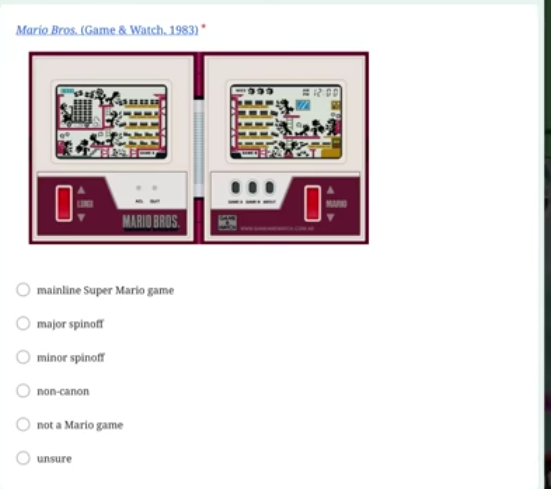
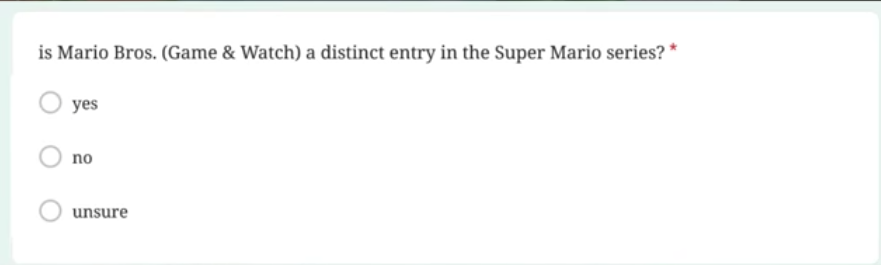
Source: An example slide from the survey asking both questions about a chosen game. “Non-canon” did not end up being used to classify games very often, so I’m mostly ignoring it for the purpose of this analysis.
After tallying the votes:
The way I’ve decided to count it is that if someone counts a game as part of the series, then they probably will have said it’s a “mainline Super Mario game” for the question that asks them to categorize it, and “yes” to the question that asks if it’s a distinct entry in the Super Mario series. So, their personal list of games should be the set of games where they answered in that specific way to both questions.
Games with 80% or more respondents answering in this way from the most popular individual list of mainline Super Mario games. Overall, I think this is a fairly logical way to design a survey answering this question. Its sheer breadth obviously selects for people passionate enough about the Mario series to devote the time and energy to complete it (a fact Misali readily acknowledges), but given that the target audience who would be heavily interested in this sort of question are likely to be Mario nerds as well, this doesn’t seem like a massive deal. The list of games that cross this threshold also seem fairly reasonable from the perspective of someone like me, with a lot of familiarity with the series. More or less all of the 2D and 3D platformers starring Mario are included on this list, with a notable edge case I’ll adress later.
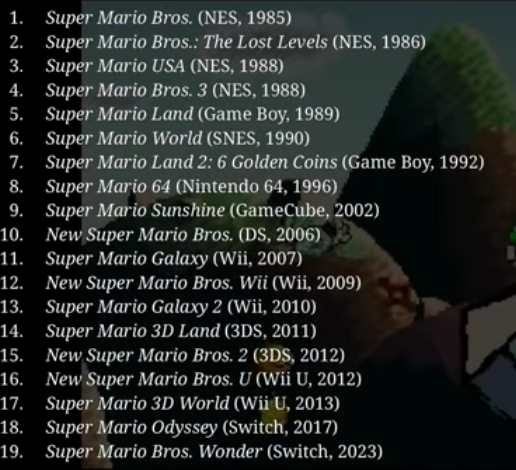
Probably the most contentious individual point to make is about how Misali interprets the data. His purported reason for starting this video series is that there is “no consensus” on what Mario games count as mainline, and that this lack of consensus is interesting. He’s certainly correct that Nintendo doesn’t have an internally consistent list of Super Mario games (any official lists usually don’t claim to be comprehensive and vary by region), and that content creators invoking the concept of the “Super Mario series” use it to describe varying sets of games. The inclusion rate of games outside of this set of 19, however, falls off dramatically. The 20th most included game has a rate of under 50%, with the 19th game boasting over 80%! Misali’s chief defense is that
[a]lmost everyone who took the survey disagrees with this list in some way. They either think this list is incomplete, or some of these games shouldn’t count, or they’re just unsure about some of these.
Indeed, the percentage of people who selected the consensus list exactly is around 5%. That being said, this means the conceit of the video more or less depends on what your personal bar for consensus is, especially considering that many more respondent lists were certainly very similar to the most common one. Thankfully, Misali doesn’t belabor this point too much and quickly moves on to other aspects of the titular question that don’t require you to accept his consensus thesis.
A more personal problem for me, but not something Misali can be argued to be objectively wrong about, is how he decided to classify certain games. There’s no way to quickly give this context, so bear with me for a moment. Super Mario 3D World is (almost certainly according to Misali’s survey takers) a mainline Mario game originally released for the Wii U, a previous generation Nintendo console. It was later rereleased for the Nintendo Switch, but including a new side game, Bowser’s Fury.
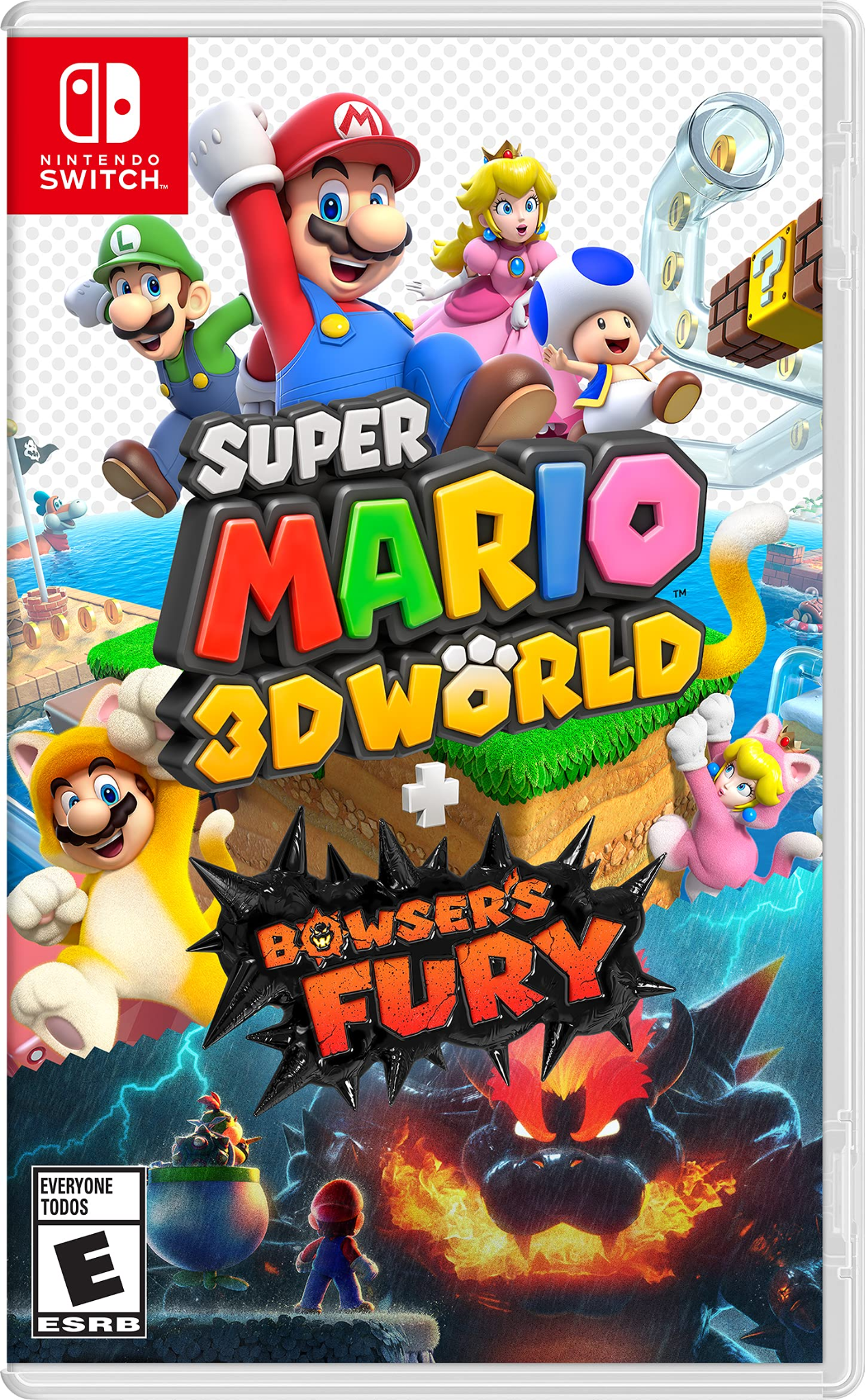
Boxart of Super Mario 3D World + Bowser’s Fury, illustrating the divided nature of the two games.
While Bowser’s Fury borrows assets from 3D World, and a handful of game mechanics, it’s essentially a completely different game. 3D World sees Bowser kidnap a group of fairy princesses, who Mario and friends rescue in a linear, level based game. Bowser’s Fury sees Mario transported to a mysterious island chain where he allies with Bowser’s son to free him from a curse that twists him into a giant, unthinking beast. This island chain is completely open, with objectives completed however and whenever the player wishes. The controversy stems from the fact that Bowser’s Fury was only ever sold as part of 3D World’s rerelease, despite the fact that the games operate totally separately from each other. This makes it perhaps the most divisive game in this wider discussion, and a question Misali certainly should’ve answered.
Only, he didn’t. Because Bowser’s Fury technically never had an independent release, he only included the combination pack you saw above, without Bowser’s Fury as its own option.
I spent a very long time thinking over… what the best way to ask about Bowser’s Fury would have been, until finally in 2023 with the new survey, I still didn’t have the answer. So I just, didn’t include Bowser’s Fury.
I could have made special categories for just Bowser’s Fury, but I could not justify to myself doing that for Bowser’s Fury without doing the same thing for every single other game included as a side mode or subgame of some other release. And that’s a problem, because if I asked people to classify every single WarioWare microgame, nobody would ever complete the survey.
Now, in the interest of fairness, I can see where he was coming from. I’m just personally opposed to this conception of fairness as the most important principle for this survey. Misali’s goal was to get actual figures on what people thought about these games, and Bowser’s Fury is one of the most spirited debate topics in that context. It was more important, in my view, to get answers on this question than to be absolutely fair to the likes of Donkey Kong Jr. + Sansū Lesson.
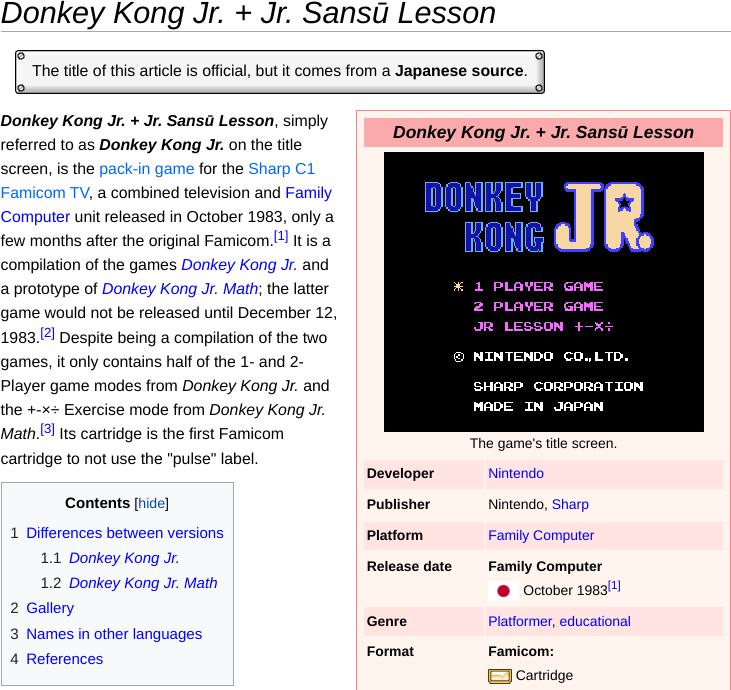
Yes, this is real.
I’m definitely biased on this question, since I’m strongly of the opinion that Bowser’s Fury should be classified as a mainline Mario game regardless of 3D World, so if you have a different conception on how surveys like these should be structured you may not have sympathy for this critique. But in my defense, when will I realistically get a chance to talk about this again?
I feel that I’ve brought you through the weeds enough on Bowser’s Fury, so I won’t get too into detail on how Misali goes on to meticulously pick apart the various schemes people have used throughout the years to try categorizing these games in a more “objective” way. He adopts a frame of using his two other chief interests, linguistics and mathematics, to introduce alternative sorting methods. He even castigates an old Game Theory video. The video is dripping with his personal charm and manages to turn what could be a cold and impersonal seeming topic into another labor of love. If what I’ve said so far managed to pique your interest, I don’t think you’ll regret taking the dive if you have the hours to spare.
Given the nature of a review contest about any non book thing, I think it’s acceptable to leave some surprises. I’m not robbing you of content, it’s not as though you need to pay to access Misali’s magnum opus. Instead, I’ve decided to just let you in on the process. Do you want to see everywhere it leads?
“Mountaintop,” Rude Tales of Magic
Where the sacred collides with the profane
I’m going to become the concept of, like, mouth and hunger. And I’m going to meet the nachos and try to become a perfectly complementary, platonic ideal to the nachos, that meets and reveals the falseness of duality and the truth of oneness.
-Kreedus (Brennan Lee Mulligan), “Mountaintop,” Rude Tales of Magic
In this pandemonium of a podcast, absurdity and irreverence open a door to surprising sincerity—and, occasionally, spiritual depth.
Some Brief Context
Like all Dungeons and Dragons campaigns, Rude Tales of Magic involves a ragtag band of assorted creatures bumbling their way through a magical world. In this case, that world is Cordelia—a realm where the rules are bent, broken, or laughed at entirely. Our heroes meet at Polaris University, named after the city and its patron deity: Polaris—the god of going to the bathroom. Then, one day, after a strange sorority ritual gone wrong, the school disappears. Everyone and everything is gone, except for five students. And the only thing left to do… is quest.
This episode in particular centres Albee Dawn (played by Carly Monardo): a loveable, punky, driven faun determined to become a Monk of the Four Elements. Her path—both literal and emotional—takes center stage in this episode. She is accompanied by her friends:
-
Cordelia Sasquatch (played by Ali Fisher): A self-assured, jean-jacket-wearing sasquatch who took the name of the land as her own.
-
Frederick de Bonesby (played by Christopher Hastings): A once-human noble-turned-fancy-wig-wearing-skeleton by way of a botched lich ritual.
-
Stir Fry (played delightfully by Tim Platt): A hyperactive Kenku chef who was granted the ability to speak by de Bonesby, and has been overcompensating ever since.
-
Bellow Gorramael (played by Joe Lepore): A hot, blue, druid tiefling with “psychotically chill” vibes.
-
And the Game Master, Branson Reese, whose voice and and narration is just exciting enough without being overstimulating to me, and who performs an impressive array of characters throughout the course of the show.
So—quest. Naturally, unhinged improvisation coincides with meandering paths and shenanigans as the group traverses the Teenage Woods and what lies beyond. This show is, at turns, hilarious, horrifying, and every now and then—against all logic—profound. What happens is fairly typical. There’s some owlbears and bearowls. Attempting to potty-train a ratman in exchange for answers. A reunion with a brother. The murder of a brother. A Kebin—a “stupid as fuck” yet horrifying monster made up of mutilated body parts and flesh who can turn anything inside out.
There’s a decadent crimelord toad man by the name of Scrum Fabulous. A witch hunter. A rescue from said witch hunter by Danny Timeshare, the god of vacation. Danny offers to transport the group anywhere they want to go, and they agree to be transported to the location of Kreedis, the legendary monk whom Albee has always dreamed of meeting—setting the stage for the events of “Mountaintop.”
“Mountaintop (with special guest star Brennan Lee Mulligan)”
“Mountaintop” is the thirteenth episode of Rude Tales of Magic. The gang have just been planeshifted from the realm of the vacation god to the foot of a mountain in a place called The Trashlands—the location of Kreedis.
The first half of the episode follows the gang as they try to scale the mountain and deal with a boulder-shaped golem blocking the path, along with a giant neon sign that reads: 'LEAVE.'
Albee, in true determined-faun fashion, does some surprisingly graceful parkour.
Of course, everyone almost dies repeatedly, but luckily they are saved by the unlikeliest of creatures—a sentient cloud named Fractus who inexplicably has the voice of Peter Griffin from Family Guy. He’s the creation—and companion—of Kreedis, who lives in splendidly depressed, high-as-a-kite isolation at the top of the mountain.
I would imagine Albee was expecting someone Gandalfian, or at least Yoda-esque. Instead, she gets… a cranky, robe-clad, middle-aged faun who eats fake frittatas and deeply resents having company.
They say don’t meet your heroes—”they” being mostly heroes, because that’s a lot of expectations to put on a person.
Kreedis, it turns out, really does not want to be met. So much so that he’s secluded himself on a magical mountain guarded by a big rock monster and a giant sign telling visitors to kindly fuck off.
So understandably, he is a little pissed when a bizarre looking group appear at the top of his mountain, one of whom immediately starts fangirling over him, and excitedly announces that they have passed his “trials.”
The first words he says to them?
“Are you in my mind?”
Off to a great start.
Kreedis (voiced with beautiful, weary apathy, and just the right degree of dry sass) by guest Brennan Lee Mulligan) is a deeply disillusioned, “spent as hell” monk who’s reached enlightenment and found mostly... despair. He doesn’t want disciples. He didn’t ask to be an icon. He mostly wants to be left alone to vibe and get high with his cloud buddy. Did we mention he has a neon sign that literally says “LEAVE?”
Albee does not leave, and is thus in for a rude awakening that shatters her long-held expectations. Kreedis berates her for breaking into his home and criticizes her hero worship of him—along with her beloved book on Kreedis that he didn’t write and gets no royalties from.
The group gives Kreedis a basic run-down of their adventures that led them here. It turns out that Kreedis also does not remember their university, but remembers having remembered, since he has achieved a complete state of nirvana (said with just the slightest valley girl accent).
Somehow placated, Kreedis offers them a deal: if Albee can achieve nirvana by nightfall, he'll let her and her friends go. Each of them is granted a 'wish,' while orbiting the emotional gravity of Albee's spiritual reckoning.
Stirfry gets obliterated on Fractus’ “fuck-up gas,” so overcome with joy that he bursts into “Hey, Soul Sister.”
De Bonesby chills out in his dream library.
Cordelia and Bellow enjoy some infinite self-replicating nachos—each bite spawning three more, like some cheesy hydra.
Finally, Kreedis turns to Albee. No more jokes, no more trials. Just the question—
“So… what do you want?'"
Zen Buddhist Principles
Kreedis’ teachings are steeped in Zen Buddhist philosophy, drawing heavily from its core concepts while twisting them through brilliant writing, narration, and masterful improv. Familiar ideas become uncanny, hilarious, and newly profound—delivered in a way that somehow makes them hit even harder.
If you’re interested in listening to part of the episode but don’t have the energy for the whole thing, you could start from this point—1:04:40—give or take. It’s the meat of the episode, where all the deep shit happens.
There are so many quotable lines in this stretch that I was tempted to break it all down moment by moment. But for clarity’s sake, I’ve grouped things around three core Zen teachings Kreedis imparts to Albee: ego dissolution, direct perception, and interconnectedness.
Koan
In Zen Buddhism, a koan is a paradoxical riddle or story meant to bypass rational thought and awaken intuitive insight. It’s not something you “solve”—it’s something that unsettles the logical mind and stirs something deeper. One example of a well-known koan: “Two hands clap and there is a sound. What is the sound of one hand?”
When Kreedis asks Albee, “What do you want?” it sounds like a simple question. But in the context of a stoned monk speaking from the belly of a D&D campaign, addressing a desperate faun with a spiritual ache—it transforms. It becomes a mirror, a trap, a key.
Dissolution of the ego
What does Albee want? Her answer is simple: her brother back. “ Everything back to the way it was—before we messed up.”
But Kreedis has no patience for spiritual nostalgia or wishful thinking.
When I look at you, I see a person completely gripped by their wants, by their attachments, love; I see someone who is in a constant state of panic, both at insecurities of the self, and also at the state of the world and how other people are depending on them (‘but—’); a rolling ball of fear, attachment, and desire.
“But… that’s everything about me,” protests Albee. All Kreedis says to that is “okay.” Not a judgement. Not a condemnation or compliment. It just is.
He isn’t giving her friends a hard time because none of them are monks. This isn’t their path. This is Albee’s, and her obsession with her path is fucking up the path. It’s preventing her from accessing her deeper strength, which lies, Kreedis reminds her, in her “ability to emphasize the importance of everything outside of [her] own ego.”
“Do you understand that it’s possible to be a very caring person, and still be totally ego-driven? Kreedis asks. “You’re obsessed with your journey, all of your friends are here to support your story, and even though you’re very nice to them, it’s still about you.”
As Kreedis dissects her ego, her need for control, her desire to be “good,” he underscores a central tenet of the show: personal transformation rarely comes from someone handing you the answers. It comes from letting go of the very questions you’ve been clinging to. That leads us to another core teaching introduced.
Mindfulness and observing the world as it truly is
I’m giving you these riddles to solve because they’re worth solving, but I’ll state it plainly as well. Your inner monologue is distracting you from your ability to actively observe. There is a direct correlation between your ability to perceive and intuit the nature of reality and the strength of your key. (Kreedus, “Mountaintop,” Rude Tales of Magic)
At one point, Kreedis poses a thought experiment: what if her brother’s life—and death—weren’t real?
Albee can only respond with uncertainty. “I don’t know what it means. I just know he was here… and now he’s not.”
“There is an implied assumption that is the most dangerous thing I can imagine,” Kreedis tells her. One “so deep that I don’t think you noticed it…”
The assumption: that things are supposed to mean anything.
_“_Well, if nothing means anything, then what’s the point of doing anything?” asks Albee.
Kreedis instructs her to say that sentence 1,000 times while he gets nachos.
He returns: “Cool, that was about thirteen times before you started having a full conversation with yourself.”
And then, he points out another assumption she has just made: “that something has to be right to do.”
Meanwhile, the rest of the gang checks in—Cordelia and Bellow, surrounded by an increasingly absurd mountain of nachos, assume Albee must be crushing it.
Bellow: The thing is, Albee’s like a really good student, so like naturally she’s gonna, like, do well here.
Cordelia [agrees, through a mouthful of nachos]: She’s gonna kick ass.
We cut back to Kreedis and Albee.
Kreedis: The worst thing you can be is a good student.
This episode is a clear critique—of perfectionism, of moral performance, of educational systems that reward compliance over actual awakening. It reminds us that true realization doesn’t come from a classroom or from mimicking someone else’s journey. It comes from direct, often uncomfortable experience.
Kreedis points out that the one thing great monks have in common is a journey that led to “a deep realization about the fundamental truth of the universe. To have a deep realization, you need to quiet the voice of your own inner monologue and truly receive the universe as it is. In none of those cases were those monks at a class being taught by another monk.”
He’s challenging the whole premise of spiritual authority and inherited wisdom. The episode even nods to the old Zen koan: If you meet the Buddha on the road, kill him.
Kreedis takes that concept further, folding himself into the contradiction.
“If you meet Kreedis on the road, you have to kill him. Do you get what I’m saying?”
Albee, confused:
“Do you want me to kill you?”
Kreedis, without hesitation:
I wanna be dead. But what I’m saying is, your hero worship is holding you back. There is nobody who found anything meaningful out from someone else’s journey. Your journey is what is teaching you.
This moment is raw and complicated. Kreedis isn’t trying to guide Albee to a specific answer—he’s trying to shake her out of the belief that answers come from outside herself. He’s asking her to stop narrating her own growth, to stop grading herself, and instead, perceive.
“What would happen to you if you were able to quiet the voices of self-congratulation and self-criticism in your own head, and just perceive the world?”
It’s not about achieving peace or enlightenment—it’s about seeing things clearly, without the noise. He tasks her with meditating. Not to become calm or good or even powerful, but to simply become present.
Of course, this comes at the worst possible time. The nachos—which started as a bit of absurd comic relief—are now becoming a genuine threat. Cordelia and Bellow are getting overwhelmed, DeBonesby and Stirfry aren’t far behind. But even amidst the chaos, Albee tries to follow Kreedis’s instruction.
Her first attempts at meditation fail spectacularly. She can’t stop overthinking. She gets in her own way. At one point, Kreedis notes, not entirely unkindly, that “people at a strip mall yoga center can meditate.”
It’s not meant as a dig, exactly—it’s just another attempt to get her to stop overcomplicating what is, at its heart, a simple act of presence.
Eventually, he returns to her, pushing a little further. The nacho situation is escalating, and Albee is distracted—her desire to help her friends pulls her focus. Still, she tries again.
Then he says it:
“Your friends aren’t real, and neither are you.”
Not to be cruel, but to force her to confront the absurdity of her reality—and to remind her that everything she's clinging to, including her own self-concept, is fluid.
“It is important for you to grapple with the absurdity of that.”
This is the turning point.
Kreedis: You can walk away from nirvana. Most people do.
Albee: I mean, it doesn’t seem to have brought you anything but more pain.
Kreedis: This reality is pain, yeah absolutely.
The scene continues to cut back and forth between Albee’s internal unraveling and the external absurdity of the nachos threatening to engulf her friends. It’s a surreal juxtaposition: cosmic truth and food-based apocalypse. But it works.
Kreedis delivers another teaching:
The power that will come from you accepting the world as it is, is a power that can unlock every star in the universe. The acceptance of the things that are beyond your control is the path to self-control, and the self and the universe are one and the same. Accept doesn’t mean endorse. Accept doesn’t mean admire. Accept doesn’t mean approve. It just means accept.
And here, finally, Albee lets go.
Interconnectedness
She imagines her body melting into the lake. Not metaphorically—literally. She becomes the water, the foam, the surface tension, the air. It’s not peaceful. It’s vast. It’s real.
“Don’t go back,” Kreedis tells her. “Keep going. Become more than the lake… what else can you become?
And she does. She becomes awareness itself. Not to escape, but to witness. To act.
This isn’t a triumph. It’s not a level-up. It’s a breakthrough—because it isn’t about control. Or achievement. It’s about connection. About finally being able to perceive the world, and act from a place of radical presence.
It is while she’s in this state that Kreedis tells her “the most important instruction [she] will ever receive as a monk. Become the nachos."
For a moment—you can come back to your ego later. Trust me. It will always be there waiting for you, no matter how much you learn. Leave your ego for a moment, and try to understand what it is the nachos want, with no regard for your friends. (Kreedis, “Mountaintop,” Rude Tales of Magic)
Albee: … Someone has to eat all these nachos.
Kreedis: That’s right. That’s right, yes.
Albee: There’s too many nachos. (‘You’re doing it.’) Someone has to eat us. Someone has to eat all of the nachos.
Kreedis: There’s more and more of them, and they just want someone to eat them.
Albee: We just wanna be eaten.
Kreedis: WE JUST WANT- THAT’S RIGHT. THERE IS NO BARRIER BETWEEN YOU AND THE NACHOS.
Albee: SOMEONE EAT US.
[lightning strikes]
And here, we come to the epigraph:
“I’m going to become the concept of, like, mouth and hunger. And, I’m going to meet the nachos and try to become a perfectly complementary, platonic ideal to the nachos, that meets and reveals the falseness of duality and the truth of oneness.”
[beat]
DM: The… yeah, of course, uhhh… you… but yeah, I was gonna say the same thing.
Albee’s Enlightenment
It all starts with a simple, absurd truth:
“Against the vastness of all the cosmos, it doesn’t matter.”
The weight of the statement hangs in the air—the notion that, in the grand scheme of things, none of this really matters. And then, as though to balance that weight, Kreedis sharpens the focus:
“But the desires of the nachos to crush your friends also doesn’t matter.”
There it is. The cosmic perspective and the chaotic urgency of the nacho crisis. Both are meaningless in the end, a paradox that demands contemplation. And Kreedis, in his strange wisdom, presses this point home:
Kreedis: And when you move through the world with the understanding of that truth, you can accomplish your goals; you can be the hero you want to be; and you will be at one with the universe because those heroic desire will rest in a heart that truly understands that those desires…
Albee: ... mean nothing.
Kreedis fist pumps so hard (that the author imagine his fist crashes through into another dimension.)
_Kreedis: “_It doesn’t matter. And it doesn’t matter that it doesn’t matter, and so you can fucking go ham as hard as you want, and do the things you want...”
This is the freedom Kreedis is trying to communicate: total release. Once you stop giving meaning to things that are beyond your control, you can act with all the intensity and joy you desire—because your desires are no longer weighed down by the fear of making them “matter.”
But Kreedis doesn’t stop there. He asks Albee to go deeper, to “become a conduit for what [she] perceive[s] as being the movement of the universe. Try to allow something to act through you, rather than acting for yourself.”
It is a call to surrender, a push to let go of the self entirely. Albee tries, and in that space, she imagines herself and Kreedis becoming one. His experiences pass through her—his childhood, his monkhood, the weight of his choices. And the moment of realization comes:
She feels it—the guilt, the pain, the failure. She feels his life, both the destruction and the strange solace he found in it. But it’s more than just the memory of a life—it’s the physical weight of all of it.
All at once, she’s enveloped in it:
The drinking, the drugging, the high-profile interviews… the shame, the seclusion—all deliberate choices made to numb the pain and the guilt of having destroyed an entire peninsula of living souls minding their own business. (Game Master, “Mountaintop,” Rude Tales of Magic)
She feels it all. The joy in the power. The crushing realization of consequence. The burden of it all. It becomes a kind of plan—slowly forming, aimless, yet deliberate.
The grim skeleton of a plan begins to form and amble about. Become nothing. Albee feels musculature and a nervous system begin to form around the plan. Destroy the path behind me, so that nobody may follow where I go… I can never again have my hands on the wheel. I am a vehicle I never learned to drive. (Game Master, “Mountaintop”)
She’s experiencing the full scope of what it means to have lived a life of both overwhelming power and destructive isolation. Every toxin Kreedis has ever consumed, every failure, every moment of confusion, and every ounce of shame is now coursing through her, too.
You feel every single toxin that he has ever pumped through his bloodstream voluntarily. You feel sixty-plus years of failure and disappointment and weight and… just absolute existential… death. You feel it. You feel the guilt. You feel the power. You feel the excitement at the power. You feel the shame that comes along with it. You feel the confusion. You feel the anger, you feel the acceptance…” (Game Master, “Mountaintop”)
The magnitude of it nearly overwhelms her, but Albee realizes,
“I don’t need to have that much power.”
Kreedis’ voice echoes, softer now, but still present, like a challenge she can’t avoid:
“Why?”
Albee’s response is rooted in the hard-won understanding that power, unchecked, leads nowhere. It’s empty.
“It doesn’t bring anything but destruction. It doesn’t help anybody.”
Kreedis nods, as if acknowledging the weight of her words.
“... You’re right. But there’s another answer to that question too. You don’t need that much because you don’t need anything. You don’t even need to be here.”
This is the core of it: nothing matters. Not even existence itself. If you can accept that, you can free yourself from the chains of striving. The truth isn’t about what you want or what you need—it’s about realizing you don’t need anything to begin with.
In a sudden surge, Albee is transported back to her childhood home. She finds the book on Kreedis she once revered, and she rips it in half. It’s an act of rebellion against the very idea of hero worship, an acknowledgment that the answers she’s been searching for were never meant to come from anyone else.
Her eyes open, and she’s back on the mountain with Kreedis. Her friends, all safe now, are no longer in danger of being crushed by the nachos. She bows deeply to Kreedis—a gesture of respect, but also of finality.
“Thank you.”
In that moment, everything clicks into place for Albee. The power she’s been grappling with, the truth Kreedis has tried to impart, all of it finally coalesces within her. There’s no hesitation, no conflict. She knows exactly what she must do. With a quiet, determined breath, she summons the fist of unbroken air. The gesture is decisive—clear and final, a symbol of both release and completion.
The spell hits Kreedis with a tremendous impact. His body bucks and jerks violently, before he’s slammed back into a rock, the force of the blow leaving him crumpled at its base.
Kreedis offers a final acknowledgment, the smallest of gifts—a quiet, fleeting recognition of her growth. His last words, almost an afterthought but with the weight of a mentor’s approval, slip from his lips:
“Good.”
It’s not a judgment, not an accolade. It’s just a quiet recognition, an acknowledgment that in this moment, she has done what was needed.
And then, he dies. Not with drama, not with grief—just a serene acceptance. The lesson has been learned, and in that silent moment, everything has come full circle.
Further Commentary
The whole episode is bursting with thematic layers and emotional resonance—not just through the central koan of Albee and Kreedis, but in all these glancing moments, side conversations, throwaway lines that hit like freight trains. It’s not off-topic; it’s textured. The group defending Albee like it’s school—but Kreedis is playing a different game. You can’t earn spiritual insight through grades or loyalty. In fact, trying to “protect” someone from discomfort might be the very thing that halts their growth. As Kreedis tells Albee, “You can walk away from nirvana—most people do,” reframing spiritual awakening as an option, not an obligation. A moment you can reject. That ties into everything—free will, avoidance, even comedic timing.
There’s the idea of parasocial spirituality—being obsessed with a teacher you’ve never met, almost more so than the actual teaching
There’s the absurdity of sacred—the nachos, the snark, the meta-humor, the outbursts of “Hey, Soul Sister” all sneaking in bits of truth.
The episode is a masterclass in comedic tension: razor-sharp improvisation balanced against surprisingly profound existential exploration. Albee’s deep yearning—for meaning, for guidance, for her lost brother—is laid bare against Kreedis’s cool detachment. His teachings are both completely valid and completely exasperating: “Your friends aren’t real. Neither are you.” “There is no meaning. That’s the most dangerous assumption you’re making.” “The worst thing you can be is a good student.
He also, somewhat surprisingly, cares. Not in the warm mentor way that Albee craved or thought she needed, but in an honest, if brutal, way—it’s a burned-out monk genuinely wanting to spark
“Mountaintop” has a harmonic blend of the crass and heartfelt, moving from stoner humor to deep philosophy and back, effortlessly and without warning. Brennan Lee Mulligan and Carly Monardo are both so so good with their performance and improv, not to mention Branson Reese’ narration. It demonstrates the art of taking yourself seriously and simultaneously not taking yourself seriously at all. It has a similar poetic hilarity to the movie Everything Everywhere All At Once, with both merging the stupid and the sacred in a bizarre yet unexpectedly delicious smoothie. They both show how absurdity can open the door for sincerity—and maybe even enlightenment.
And both pieces of art embrace the expansiveness of the realization that nothing matters.
Bo Burnham’s “All Eyes On Me” from his special Inside also breaks into transcendence through absurdity. It’s kind of a stupid song. But there’s something about the eerie intimacy in it, like he’s saying something he didn’t mean to say out loud, low and echoey. I remember watching it for the first time and getting these eerie flashbacks of Christian worship concerts, while also feeling like I was watching a person slowly go more and more insane and wondering if I should do something.
This episode got me thinking about that odd distinction between “high art” and “low art,” and why I wanted to zone in on this small, single piece of media in a sea of content.
Is it possible that “low” genre work sometimes allows for more radical emotional space than capital-F Fiction sometimes does?
I have read fanfiction that split me open and and made me ache in all the right places. I saw Into the Spider-verse for the first time a couple of years ago, and loved it so much that it felt like a spiritual awakening, opening me up to the expansiveness of the multiverse.
And now, I’ve experienced a spiritual awakening from a Dungeons and Dragons podcast.
Final Thoughts
“Mountaintop” is a highlight episode for Rude Tales of Magic not just because of the hilarious performances, but because of its surprising willingness to pause and ask: what happens when your deepest beliefs are gently, lovingly demolished?
It’s a story about disillusionment. About hero worship and spiritual burnout. About the seductive danger of meaning-making and power (even power over oneself) and the absurdity of thinking you’ll ever “get it.” And it’s still very, very funny.
End Note
I questioned whether or not to submit this review, not sure if I actually had anything of value to share other than “I fucking loved this thing.” Not sure if my voice really fit. And maybe it doesn’t.. But maybe, either way…
Kreedis: These beautiful memories. Do they matter to the universe?
Albee: No.
Kreedis: Do they matter to you?
Albee: Yes.
Kreedis: Is that enough?
Albee: Yes.
Kreedis: Hell yeah.
Albee: Hell yeah.
… it is okay for something to matter only to you.