Cornell University Press, 2020
If, like me, you’re not a Delta Force assault team member, nor possess high level security clearance, on the morning of January 3, 2026, you may have been similarly astonished to read that the United States carried out a snatch and grab of Venezuelan dictator Nicolás Maduro and his wife from their compound in Caracas and transported them to the US for narcoterrorism charges.
What made the news even more pressing was a particularly lucid essay by Poly Sci professor Orlando Pérez that detailed why a surgical military operation to oust Maduro would be fraught with problems, the most intractable of which being that dictators are, generally speaking, aware of threats to their regime, and often take efforts to “coup-proof” their hegemony. His analysis seemed like a relatively straightforward post-mortem of the operation’s risks, until I noticed the time-stamp: November 17, 2025. Eyebrows sufficiently raised by this point, I went through his piece once more to see what insights allowed him to read the tea leaves well before Maduro’s kidnapping. One in particular stood out: Hamilton College professor Erica De Bruin’s book, How to Prevent Coups d’État.
De Bruin’s book is, ostensibly, a well-researched academic thesis nicely dressed up into hardcover form (40% of the total page length is references), albeit a highly readable one. The first thing one learns before even prying the cover open is DON’T BE A RUBE! The correct plural form is “coups d’état.” If you go around blabbing about “coup d’états” and “attorney generals,” you’ve immediately outed yourself as a governmental ignoramus. And as we shall see, if there is practical advice to be found within this book—should you ever find yourself in the position of preventing a coup, or depending on how one interprets the data, plot a coup—you will come to realize that success hinges substantially on your perceived legitimacy.
Ignore this at your peril.
Beyond the title, De Bruin defines a proper coup as “a forceful seizure of executive power by a faction within the country’s ruling or political elites.” To talk about an “armed coup” would be redundant (add this to the list of Phrases To Avoid if you are plotting your own coup!) because although many coups are bloodless, without the threat of violence, whatever you might wish to call a change in state leadership, it’s not a coup. It’s what distinguishes coups from voluntary, peaceful transfers of power. This is why coup perpetrators tend to be members of the country’s military or security forces under state control, and who, not coincidentally, also have lots of guns.
A little definitional housekeeping: “security force” strictly refers to armed groups beyond the traditional divisions of the military, and might include presidential and republican guards, militarized police or gendarmerie forces, but, notably, excludes private military companies or for-hire mercenaries. Because “control,” as De Bruin sees it, means specifically of the administrative variety: the ability to organize, recruit, train, equip, and monetarily support, rather than specific moment-by-moment operational control.
Which leads us to the most important term in her book; “counterbalance,” or as she uses interchangeably (and arguably, the more precise term given that “balance” is not the first word that would come to mind as these situations escalate), “counterweight.” These include essentially any weaponized security force that is independent of military command in which the executive branch retains control, AND (this is an important and) is close enough in proximity to the capitol that it at least stands a chance of defending against a coup.
Indeed, we learn that the most obvious and frequently utilized method to prevent regime change via coups d’état is to bolster the number of counterweights. A sprinkling of counterweights, the thought process goes, makes the likelihood of a successful coup decrease for two primary reasons. Firstly, any would-be coup plotters are—in lieu of the numerous other armed factions that stand in their way—less likely to believe the coup will succeed and may abandon their aspirations before gathering momentum. Or at the very least, the outsourcing of coercive armed groups outside of direct military chain of command complicates the organizing of a coup so no single rival can easily maneuver within the power structure. And secondly, even if any would-be coup plotters decide they are doers rather than dreamers, the coup is more likely to fail if one or more counterbalances can defend the dictator and the regime. The first point—that counterbalances deter coups—like a cyanide capsule, is a tough pill to swallow, given the sheer number of rumored coup plots and the difficulty in verifying abandoned attempts: one seems unlikely to find testimony along the lines of “My guy, I was totally planning to throw a coup, but in the end decided not to, so it’s all good, amiright? Please don’t tell the boss, because like I said, I’m definitely not planning a coup anymore!” Thus, much of the book focuses on the second point, the observable effects of counterbalancing as it relates to coups.
For any self-respecting dictator that has a copy of How to Prevent Coups d’État on their nightstand, surely the most dog-eared section of the book—other than the sentence, “Coups are the most common way dictatorships begin and end”—is where De Bruin argues that the inclusion of counterbalances does reduce the probability of a coup’s success, but increases the probability of a coup attempt![1]
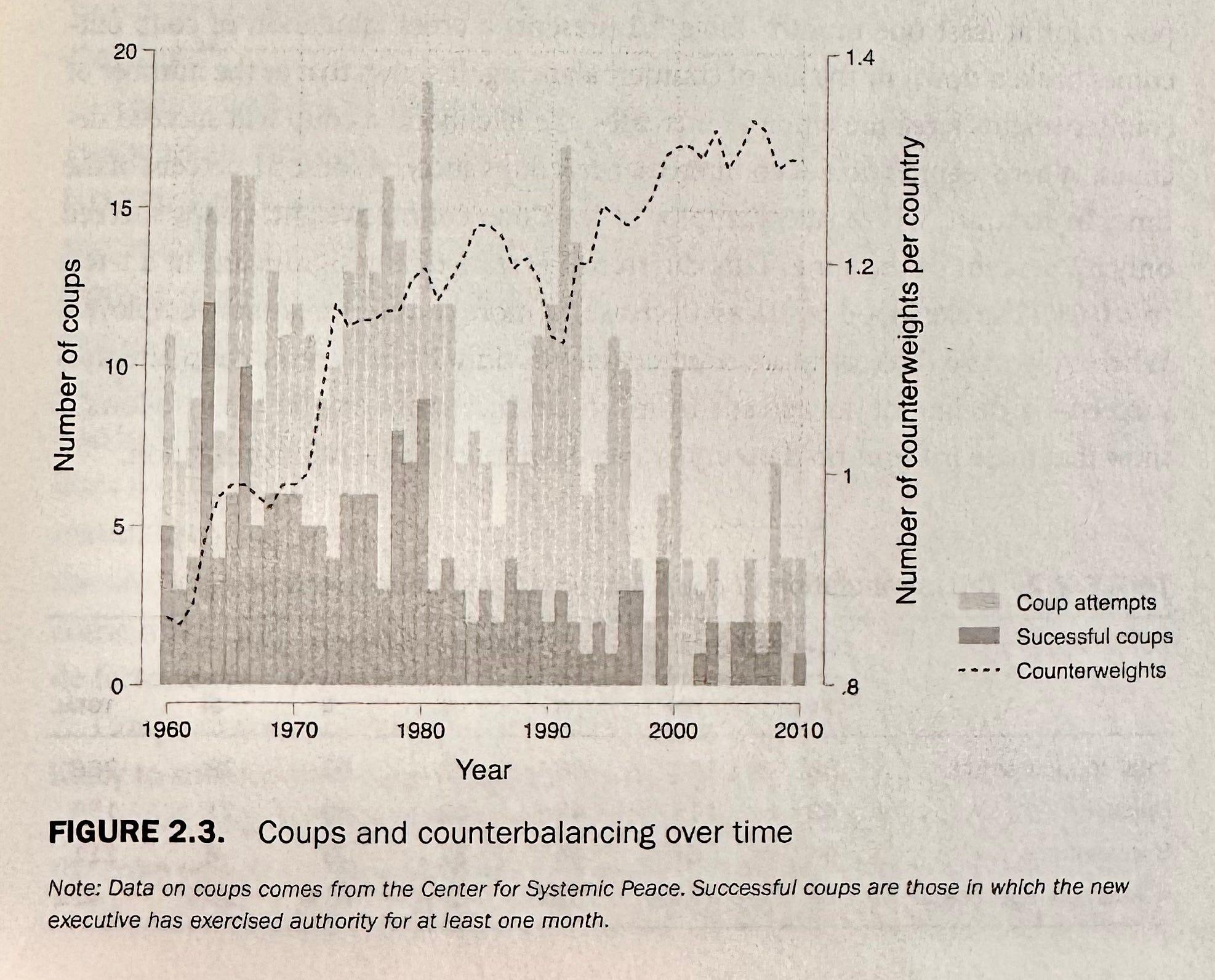
Note: “Success” is narrowly defined by the new authority lasting at least one month—apparently operating on the same timeline as a gym membership: if you make it past the first billing cycle, you're committed! *FLEXES GUNS*
Why might this be? Well, typically, if you are a dictator who has seized power illegitimately, or perhaps legally obtained it but decided retirement is for suckers, the people you are going to most likely want to appoint in positions of authority within your counterweights—which is to say, when putsch comes to shove, the people who may be risking their lives to defend yours—are going to be hardcore loyalists.[2] You definitely don’t want them getting squeamish trigger fingers when the shit hits the fan. They are mostly going to be kin, or if you’ve somehow not yet established a well stocked pool of blood relatives from which you can bequeath your throne to someday, a good back up choice might include cherry picking for ethnic or sectarian homogeneity from which you can rely on for tribal allegiance. In the absence of these (or better yet, in addition to), a generous splash of cash to buy loyalty doesn’t hurt, either!
Now, even as a dictator, there are budgetary constraints to consider and one’s discretionary spending on regime loyalists can come at the expense of building resentment among those unlucky folks who cannot count themselves among the coterie of an elite presidential guard: namely, the military. Ideally, each armed group has specific carve outs and can serve as checks on other counterbalances. Interviews with insurrectionists have revealed that one of the most common reasons chosen to defect from the regime was a fear in decline of status.
If there were such a thing as a Coups d’État for Dummies book, chapter one would lay out neatly the three phases of a coup: planning, attack, and consolidation. The planning stage, in game-theoretical terms, is a prisoner’s dilemma. The coup plotters must initially be very secretive and limit the number of people they coordinate with; otherwise they risk exposing the plot prematurely. If they are able to organize extensively in advance, there may be less chance of bloodshed if they can simply announce they have taken power. De Bruin uses an example of a high level military officer holding a secret meeting of elites, in which face-to-face agreement of the plan to be hatched strengthens the chance of it becoming a self-fulfilling prophecy if the officers trust one another’s commitments, and if they can reasonably assume that lower level officers will follow chain of command.
Although there is some minimum number that must be required to coordinate the attack phase, there is a delicate balance struck between keeping the actual numbers of committed coup plotters low during the planning phase while simultaneously exaggerating their numbers during the attack, giving the impression that their number of supporters are sufficiently overwhelming. By doing so, they can keep their political opponents guessing as well as psychologically tip the scales for those not initially privy to the coup plot to believe that joining is in their best self-interest, or at least remain on the sidelines long enough for the coup to consolidate power.
During the attack phase, for this reason, primary goals include not only subduing the regime leader and taking control of symbolic monuments to power such as a parliament building or presidential palace, but ideally, the commandeering of radio or TV broadcast facilities so they can quickly publicize the coup and control the flow of information. This remains true even in the smartphone/internet era, because as we have seen recently in the 2026 Iranian protests, by shutting off the internet, not only do the Ayatollah and mullahs obfuscate the murderous and repressive actions of the regime, they make it less likely for any coup plotters to be able to advertise and consolidate support.
Even those who join a coup during the planning stages—or latecomers during the attack phase—are likely to switch sides if they sense the coup will fail. The year 1981 offers the most extreme contrasts and demonstrates that troop numbers can be misleading predictors of outcome: in Thailand, a coup failed despite initially having thousands of troops behind it, while in Ghana, a coup succeeded with only ten (!) soldiers. Each soldier or member of a security force is internally performing a cost-benefit calculation that evolves in real time, knowing that being on the losing side may imply death, torture, exile, or imprisonment for themselves and those under their command.
If a military coup is successful, the question becomes what to do with the remaining counterbalanced forces. These forces typically remain loyal to the former regime and pose a potential threat, so the military has three options: assume authority while preserving the counterweights' separate role, absorb them into the military, or disband them entirely. For obvious reasons, counterweights are disincentivized from cooperating in a coup—they know their power and status are likely to be eliminated if the regime is toppled. This is why, despite being a risky gambit, they remain among the most common coup-proofing strategies.
It is, after all, in the coup plotters best interests that their efforts remain non-violent. Even the most blood thirsty, cigar chomping officers cosplaying as revolutionaries need to understand that odds of legitimizing control over the populace improve significantly if they haven't had to slaughter their fellow countrymen in the process. For a coup’s inertia to sustain itself, expediency is key. Counterbalancing increases the chance of resistance. If the seizure of power is not consolidated quickly enough, involvement of non-state actors risks tilting conflict into a civil war.
Take the Dominican Republic in 1965. Two years earlier, a military junta had seized power from the country's first democratically elected president in a bloodless coup. Once in control, the regime converted the national police into a dictatorial force—nicknamed "los cascos blancos" for their white helmets. When a second coup attempt occurred in 1965, the Cascos Blancos now served as a counterweight, offering enough resistance to stall the coup. The situation quickly deteriorated into civil war—Santo Domingo was flooded with thousands of guns and grenades, and rebels were forcing filling station operators to “fill Coca-Cola bottles with gasoline for anybody on the street; they made Molotov cocktails from them.” ¡Viva Coca-Cola!
De Bruin shows after collating a data set of 110 countries spanning a half century, including “fine-grained information on individual security forces, their respective chains of command through which they report to the regime, as well as detailed assessments of 400 coup plotters”—*Dictator licks finger, flips page*—that coups succeed about 50% of the time against regimes that lack counterbalances, and coups attempted in the presence of three or more counterbalances succeed only half as often. The annual coup risk remains essentially constant, at 5%, regardless if a country has any counterbalances. However, countries that add a counterbalance have a 170% increased risk of a coup attempt within the following year!
Dear Reader, you may be wondering, as I did—and to her credit, as De Bruin does too—is this a chicken-or-egg problem? Do counterbalances increase coup attempts because of military resentment over lost status and redistributed resources? Or is the counterbalance merely symptomatic of something upstream—a regime sensing instability and reacting to perceived coup risk from other factors, making the counterbalance correlative rather than causal?
In addressing this problem, De Bruin reassures us that, yeah no, it’s the counterbalances, gesturing at “controlling for variables.” This phrase makes my eyes glaze over—admittedly, in part because I am as ill-equipped for statistical analysis as an aspiring militia member without a rifle—but nonetheless, there seem to be, quite frankly, too many variables to control for.
To highlight an example, we can explore Manuel Noriega’s regime in Panama. (Don’t worry, De Bruin goes into several other juicy coup case studies if this one does not fully whet your appetite for chaos)
The U.S. was involved in protecting and operating the Panama Canal. As they negotiated transferring management rights to Panama, the administration wished to ensure continued American access to shipping. Since 1971, the CIA had Manuel Noriega on their payroll, who, as the military strong man in Panamanian president Rafael Trujillo’s dictatorship, Noriega was initially paid hundreds of thousands of dollars annually to restrict illegal drug shipments and provide intelligence to the CIA, supporting efforts to undermine communist movements in Nicaragua, Cuba, and El Salvador. Eventually, Noriega dipped his toes into the international waters of drug trafficking and money laundering, which the DEA let slide for a while because of his status as a CIA asset (I am shocked, SHOCKED I tell you!).
Relations eventually soured through a series of transgressions—such as Noriega’s cancelling of the May 1984 election in which his preferred puppet candidate lost in a landslide despite extensive rigging. The U.S. decided enough was enough and they attempted to persuade Noriega, who by now had assumed de facto control as a military dictator, to step down. Noriega politely declined this option by murdering political activist Hugo Spadafora, who had threatened to expose Noriega’s drug trafficking. The most egregious breach of conduct, however, was Noriega’s turn towards the Cuban and Libyan communist enemies of the U.S., an unforgivable sin in the eyes of U.S. leadership because of their obsession with domino theory. They then turned to internal measures to depose Noriega, first by (*CIA cracks knuckles*) backing an attempted coup in March 1988, which failed.
In 1989, having already gained some experience in election rigging—but apparently not enough to do it right this time—Noriega’s candidate was so badly defeated that when Noriega planned to announce him the winner anyway, the candidate himself refused, forcing Noriega to nullify the second election in five years. No longer able to hide behind his puppet strings since his own candidate backed out, Noriega pronounced himself “maximum leader” of Panama, which, to be fair, doesn’t exactly roll off the tongue in English or Spanish, but as far as made-up titles go, does get the point across. The U.S. pressured the Panamanian army to plot another coup, this time via the disgruntled leadership of army Major Moisés Giroldi. Though they did capture Noriega, the counterbalance forces stamped out the remaining supporters of the coup, and Noriega purged any officers suspected of disloyalty (including executing Giroldi).
In response, the U.S. invaded Panama in December 1989. Noriega’s forces were overwhelmed, so he fled and took refuge in the Holy See’s apostolic nunciature (basically an embassy that lacks a consulate and does not provide visas). Ironically, given the dubious legality of invading Panama to begin with, this barred the U.S. from entering due to international diplomatic law.[3] Determined to bring Noreiga to trial on U.S. soil, they set up a perimeter around the building and resorted to psychological warfare to force his surrender within 10 days. Their audiological tactics included revving car engines day and night, landing helicopters nearby, and—my personal favorite—blasting “disturbing chicken noises at deafening levels.” And just because you are extraditing a dictator does not mean you can’t have a sense of humor: they also played shitty songs at deafening volumes, including but not limited to: “Panama” by Van Halen, “Welcome to the Jungle” by Guns N’ Roses, and “Never Gonna Give You Up” by Rick Astley.[4]
One of the biggest risk factors for a coup attempt is… a recent coup attempt. In this way, coups are an example of a self-organized criticality, a complex system that naturally evolves toward a tipping point, without any external control telling them to do so, much like how adding grains of sand to a pile eventually triggers an avalanche. I have a theory of my own: reviews of books about coups d’état increase the odds of more book reviews about coups d’état.
This seems to happen in part because deciding who books about coups are written for is like taking a Rorschach test. One reviewer described Ed Luttwak’s Coup d’État: A Practical Handbook as a guide for how to run a start-up. I’ll make the broader claim that analyzing coups d’état reveals insights applicable far beyond their immediate context: political or militaristic ideologies, business strategies, any group conflict, and ultimately, basic human psychology. An alternative title for How to Prevent Coups d'État could just as easily be How To Get People To Like You and Come to Your Party Instead of Your Neighbor's When They Can't RSVP.
De Bruin herself cites Luttwak’s Coup d’État, several times in her own book. This represents an amazingly recursive accomplishment on Luttwak's part because, although he eventually secured a PhD in international relations and established himself as a war historian, at the time his book was published he was a mere 26-year-old energy consultant. And so it seems Luttwak has pulled off a literary coup of sorts, a non-expert who wrote a book proclaiming his expertise in pulling off coups, which has since been cited as a source in an expert’s book on coups—the ultimate vindication that proves that the legitimacy of authority need not rest on any credentials, but on how daring, brash, and convincing you are when you stick the landing.
Which, I suppose, makes this book review a non-expert’s take on coups d’état of an expert’s book on coups d’état that includes source material from a non-expert’s book on coups d’état. It’s coups, all the way down, baby!
Your message is stored now and emailed to the author after the contest ends. The author can reply to you, but their identity stays hidden unless they choose to respond.
Footnotes
- ↩
Lest you think this is a historic phenomenon regulated mostly to the dustbin of history, although coups were more common in the past, there have been more than 50 coup attempts among 31 different states between 2000-2019.
- ↩
This sentence was originally, “push comes to shove,” but I could not resist the pun. Don’t like it? COME AT ME (I have plenty of counterbalances).
- ↩
The author of the cited paper, “The Invasion of Panama and the Rule of Law,” is one Carl T. Bogus, so you don’t even need to read the paper to know which side of the debate he landed on.
- ↩
Yes, this whole aside was worth it to get to this fact: Well before the days of internet trolling, the US Delta Force and Navy Seals were the OG Rickrollers in Operation Nifty Package.