Imagined Communities: Relfections on the Origin and Spread of Nationalism
The concept of nation is such a smashing success so massive that nation, state and nation state are often used interchangeably despite ostensibly being quite different things.
It has taken over the world in so many ways, to the point where thinking about a state that is not a nation is genuinely hard. I can only come up with the Vatican as a clean example. Everywhere else in the world, we expect a state to be made of at least one nationality of people made expressly to serve those nationalities.
The reason I like Imagined Communities so much is because it takes a concept, nationalism, that often has a negative connotation and shows that it's everywhere. It made me realize that it's like a fish taking a contemptuous view of water. The current global order is indisputably organized around the concept of nations.
Taking a value-neutral definition of nationalism [1], it's admirable how hardy it is. None of the other great ideologies, not capitalism, not any religion or even communism, an explicitly anti-nationalist project which in practice needed that icky national sentiment to get revolutions off the ground, can hold a candle to nationalism as a state-wide organizing principle. Democracy, the other great victor of the 20th century, is the other twin pillar of the legitimacy of modern states and actually gets its due.
Even more interestingly, the sweep of history makes clear that multi-ethnic empires are the norm. From the Akkadians to the Ottomans, Qin to Qing Dynasties, Mauryas to Marathas, they aren't hard to find in the history books but are much more challenging to find today.
How did nationalism take over the world?
Imagined Communities is all about Benedict Anderson's attempt to explain this phenomena and by the by ponder on nationalism.[2]
Theorists of nationalism have often been perplexed by, not to say irritated by, these three paradoxes:
- Objective modernity to the historian's eye vs their subjective antiquity in the eyes of nationalists
- The formal universality of nationality as a socio-cultural concept - in the modern world everyone can, should and will 'have' a nationality, as he or she 'has' a gender - vs. the irremediable particularity of its concrete manifestations, such that by definition, 'Greek' nationality is sui generis
- The 'political' power of nationalisms vs. their philosophical poverty and even incoherence. In other words, unlike most other isms, no nationalism has never produced its own grand thinkers: no Hobbeses, Tocquevilles, Marces or Webers.
Anderson's definition of a nation is [3]:
it is an imagined political community - and imagined as both inherently limited and sovereign.
He then goes into some more detail:
It is imagined because the members of even the smallest nation will never know most of their fellow-members, meet them, or even hear of them, yet in the minds of each lives the image of their communion. [...]
The nation is imagined as limited because even the largest of them, encompassing perhaps a billion living human beings has finite, if elastic, boundaries, beyond which lie other nations. No nation imagines itself coterminous with mankind. The most messianic nationalists do not dream of a day when all the members of the human race will join their nation in the way that it was possible [...] for Christians to dream of a wholly Christian planet.
It is imagined as sovereign because the concept was born in an age in which Enlightenment and Revolution were destroying the dynastic legitimacy of the divinely-ordained, hierarchical dynastic realm.[...]
Finally, it is imagined as a community, because regardless of the inequality and exploitation that may prevail in each, the nation is always conceived as a deep, horizontal comradeship. Ultimately it is this fraternity that makes possible, over the past two centuries, for so many millions of people, not so much to kill, as willing to die for such limited imaginings.
He even addresses the common complaint on the same page:
With a certain ferocity Gellner makes a comparable point when he rules that 'Nationalism is not the awakening of nations to self-consciousness: itinvents nations where they do not exist'. The drawback to the formulation, however, is that Gellner is so anxious to show that nationalism masquerades under false pretenses that he assimilates 'invention' to 'fabrication' and 'falsity', rather than to 'imagining' and 'creation'.
Nationalism, a worked example
In school in Barcelona we were taught that by the matrimony of Ferdinand and Isabel in 1469, uniting the crowns of Aragon and Castile in an explosion of Catholic piety that booted the moorish and Jewish people from the peninsula, Spain was born. What we weren't taught is that when Isabel died Fredinand didn’t just continue ruling Castile because Spain was not a thing yet. It was just the two Crowns that happened to belong to the same royal marriage, so he stayed as regent of Castile for a bit and was eventually pushed out as merely king of Aragon. We also weren't taught that he then married Germaine of Foix, a noblewoman from southern France, and had a child that would have inherited the Crown of Aragon while the Castilian crown passed down Isabel's line [4], except he died prematurely. Nobody wanted to keep Spain together because Spain wasn't a thing yet.
By Spain not being a thing, I mean it was neither a unified state, was two kingdoms, with separate laws, bureaucracies, feudal rights and so on, until the Decrees "of the New Plant" [5] passed in the 1710s, nor a unified nation because nationalism wasn't a thing yet. The consensus view is that birth of the concept of Spain as a nation in a modern sense is as a response to Napoleon's invasion in 1808 and the ensuing war that led to the Constitution of 1812.[6] As an example of Anderson's first paradox, Spain's closest thing to a national day is October 12th, the day Columbus spotted land.
The point of this little detour is that this experience is the norm. Hereditary titles were passed on, people had no expectation to be ruled by a king that spoke your language or was your ethnicity or anything of the sort. Russia had a French-speaking court and large amounts of German nobility in the provinces in the 1800s [7].
Who killed the multi-ethnic empire?
In the mid 1800s Europe was full of multi-ethnic, polyglot empires. This is before Italian or German unification, when the Austrian empire spanned double digit nationalities[8]. Now basically none remain. How did we get from there to here?
Anderson says "print-capitalism."
But before we get there, let's talk about why the multi-ethnic empire was in decline. Older states drew their legitimacy from two main sources: religion and ancestral lineage. Of course their real legitimacy was the sword and spear, but only the crudest of warlords would actually say that.
The language landscape was also completely different. There was Latin, the proper language for proper things, and then whatever bastardization the vast majority of people in any given region actually spoke, which changed the further you moved from any given point, creating a mesh of gradients. These vernaculars don't inspire protonationalistic fervor yet because Latin is the language of law and Mass, of everything transcendent, and whatever you speak is clearly not as important as the language of the Romans who built the aqueducts. The most prominent imagined community of the day is Christendom.
Changes are afoot though. The printing press has been invented and there is an industry of printing in Latin for the various literati in each country, though the market remains small.
Then the Enlightenment hits the scene and foundations of God and heredity as sources of legitimacy start to look wobbly. Then the French Revolution sets up Louis XVI for a date with Madame Guillotine.
Most of the rest of the book attempts to have a whole world scope, spanning the Americas to Japan, including meaningful digressions into southeast Asia. Not this part. This part is Eurocentric because nationalism, according to this telling, is born in the revolutions of France and the Americas, though the French Revolution is the one that does the conceptual heavy-lifting of birthing nationalism as a concept.
The part where I finally explain the argument of the book
The basic argument goes something like this: print-capitalism enabled people to feel community with people quite far removed from themselves. This gave rise to nationalism as a political movement in three ways.
First is that printing as a business exploded by standardizing vernaculars, piggybacking off the fad of grammar books being published in the 1800s, could expand by reducing costs and increasing circulation beyond the market for just printed Latin. Reading different accents is easier than understanding them spoken [9], increasing the number of people who felt connected. Newspapers in particular have a way of evoking a sense of a whole group of people reading something at the same time. There also was a process of more successful dialects being catered to and clobbering smaller ones, for example: [10]
‘Northwestern German’ became Platt Deutsch, a largely spoken and thus substandard, German, because it was assimilable to print-German in a way that Bohemian spoken-Czech was not.
At this stage, in the 1700 and 1800s, this process is driven by market forces and not yet by states coercing their citizens to speak properly, but that will come soon.
Language turns out to have a special way of bonding people. Anderson is mostly focused on history but he does leave us with passages like:[11]
What the eye is to the lover - that particular, ordinary eye he or she is born with - language - whatever language history has made his or her mother-tongue - is to the patriot. Through that language, encountered at the mother's knee and parted with only at the grave, pasts are restored, fellowships are imagined, and futures dreamed.
The second force of community formation was the colonial administration. Why did the people who bleed to fight off the Spanish Imperial yoke, inspired by hot new liberal ideas intent on remaking the world, keep the same boundaries? Because they had spent a few hundred years with these borders and because these subdivisions of the colonial administration were economically cut off from each other, as it was common practice in those times to not let colonists trade with each other and only trade with the motherland. Newspapers, the main source of community in this telling, were primarily trade and business focused, and thus stuck to the borders as well. It doesn't hurt that since these boundaries predate modern transportation, they conform to the geography well.
Another big deal is that the criollo elite was only allowed to operate within their colonial unit. As they would climb up the ranks of the administration they would be posted to various parts of the province/colonial kingdom/viceroyalty, but never outside of it. Anderson describes this as the functionary's pilgrimage, being posted first to the middle of nowhere but slowly getting more glamorous assignments until finally getting assigned to their Rome, the provincial capital. When these same elites join the revolution and boot the Spaniards, all of them have a shared mental map.
The third way was that since the French revolution was kind of a big deal, everyone had heard of it. And although the actual revolution was a chaotic, leaderless mess until Napoleon, it provided a template for what to do once you get rid of your king and ushered a new kind of government into the world: the state that draws legitimacy from the nation. Even regimes that were more on the conservative side could tap into if they needed a source of legitimacy, though it often meant accepting some of the revolutionary ideas baked into the concept like the deep, horizontal comradeship Anderson referenced in his definition.
Nationalism: Made in America
Anderson loves to reference this quote by Jose de San Martin in 1812 that "in the future the aborigines shall not be called Indians or natives, they are children and citizens of Peru and they shall be known as Peruvians." This is notable because nations in the Americas predate European nationalism. This is true in the strict sense that the American Revolution predated the French Revolution. It is also true in the broader sense that via the Spanish American Wars of Independence, Simon Bolivar and San Martin were founding nations left and right. With the dissolution in 1831 of Gran Colombia, a pet project held together by Bolivar's sheer force of personality, and the United Provinces of the Río de la Plata a map emerges that is quite familiar.
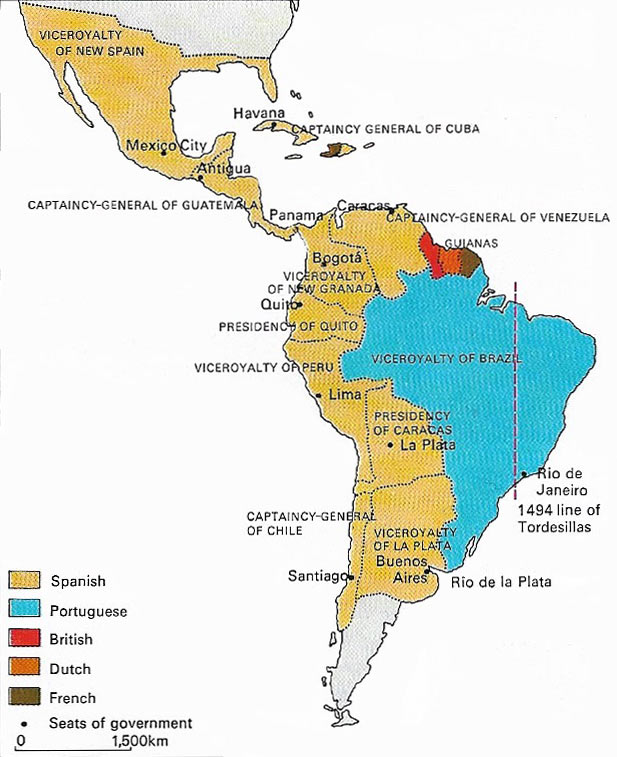
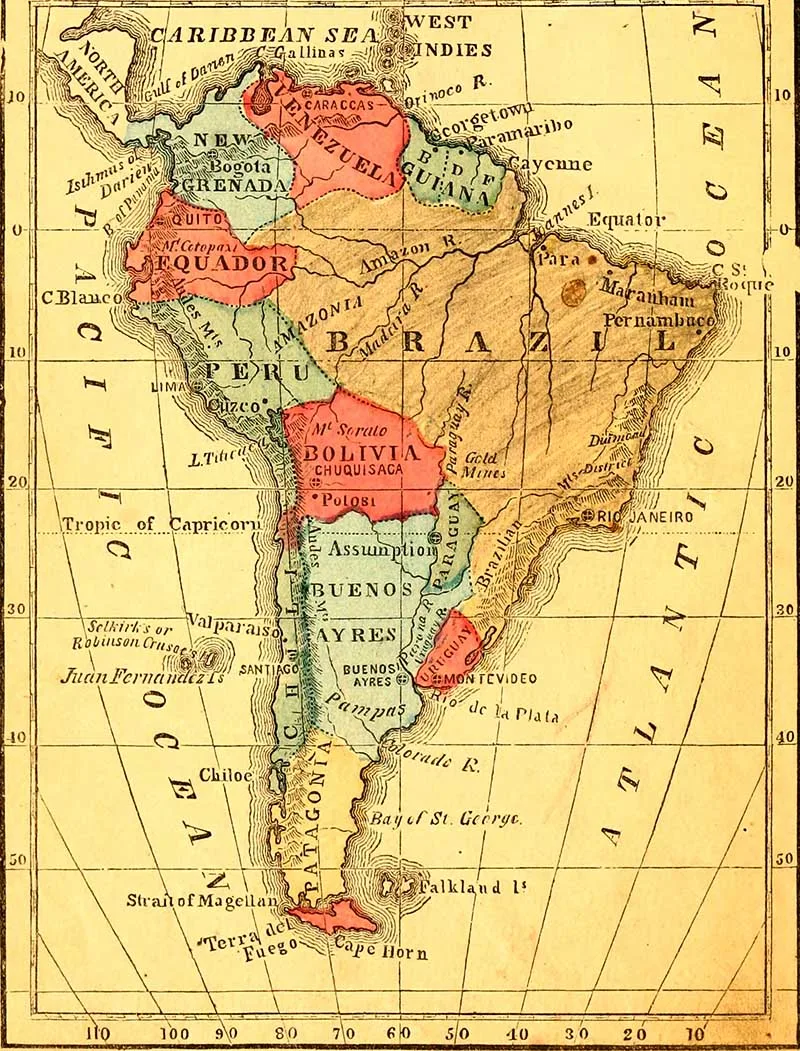
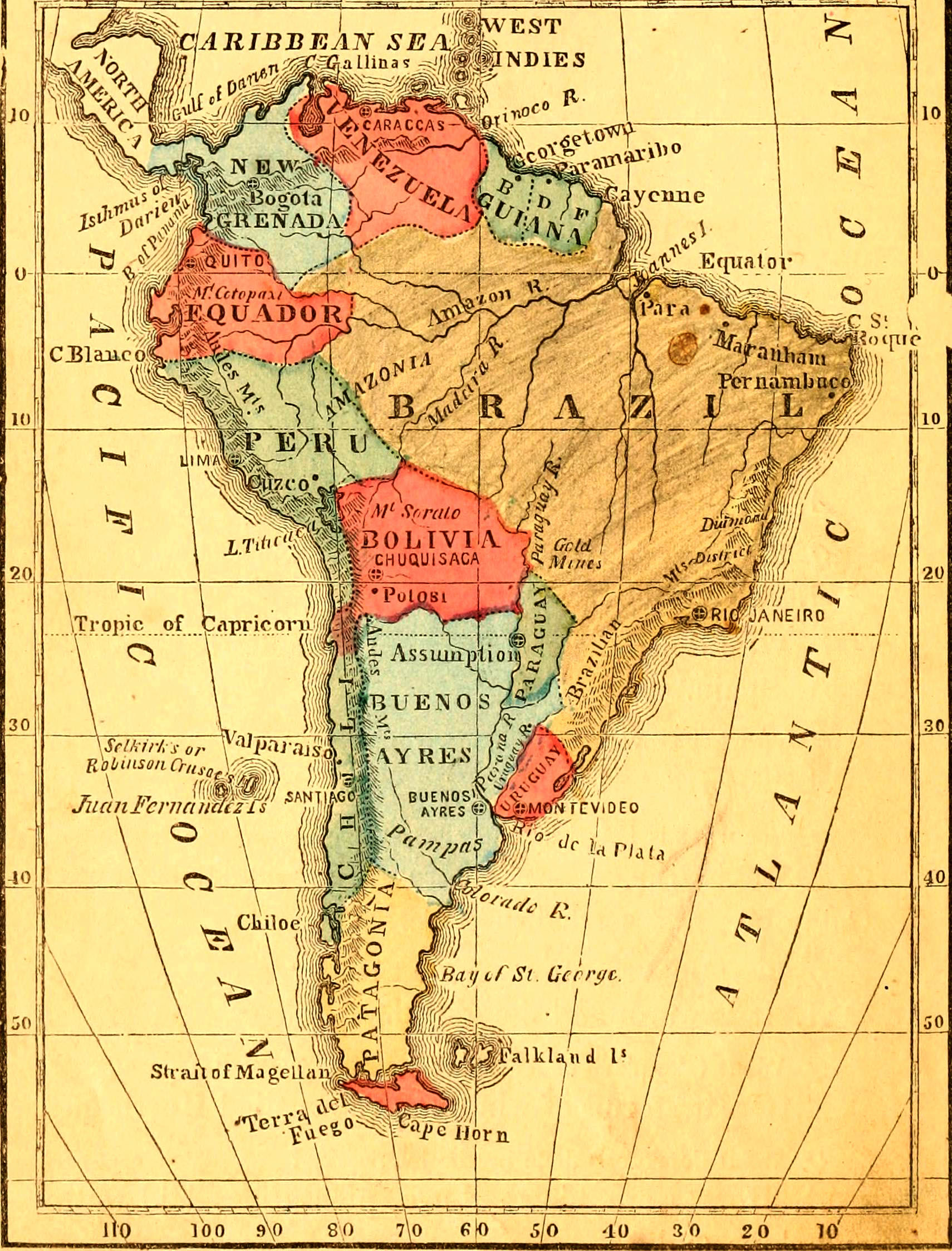
What might also be quite familiar are the names and shapes of pre-independence administrative borders.
Anderson takes special interest in Latin America because they lack the two elements usually attributed to the rise of nationalism: a distinct language and middle-class populist fervor. These movements were led against an empire that spoke their same language by criollos, the upper class of purely "peninsular" blood that was nevertheless shut out of power for the mere fact of being born in the Americas. It took some persuading in Bolivar's case, but eventually both Bolivar and San Martin would embrace everyone in their newly founded states as citizens.[12]
These factors might seem idiosyncratic to the Spanish Empire, but the basic outline of the story repeats itself in many post-colonial nations.
This quote about Indonesia during its revolution in the 1940s is illustrative.[13]
The case of Indonesia affords a fascinatingly intricate illustration of this process, not least because of its enormous size, huge populations (even in colonial times), geographical fragmentation (about 3000 islands), religious variegation (Muslims, Buddhists, Catholics, assorted protestants, Hindu-Balinese and 'animists') and ethnolinguistic diversity (well over 100 distinct groups) [...]
Nothing nurtured this bonding more than the schools that the regime in Batavia set up in increasing numbers after the turn of the century. [...]
From all over the vast colony, but nowhere outside it, the tender pilgrims made their inward, upward way, meeting fellow-pilgrims from different, perhaps once hostile, villages in primary school; from different ethnolinguistic groups in middle school; and from every part of the realm in the tertiary institutions of the capital. [...]
To put it another way, their common experience, and amiably competitive comradeship in the classroom, gave the maps they studied (always coloured differently from British Malaysia or the American Philippines) a territorially specific imagined reality which everyday was confirmed by the accents and physiognomies of their classmates.
These same university elites would then be the revolutionary class that had been taught to think of all of themselves as a common entity, which they had on hand when they succeeded.
What language does a polyglot empire think in?
If the process of deciding borders post-revolution was surprisingly chill in the Americas, trouble was brewing in Europe.
At the turn of the 1800s culture in all these new standardizing languages was flourishing, novels were being published and people were deepening their affinities to their newfound nations spanning centuries into the past. Adamantios Koraes, a Greek lexicographer, gave this speech to an audience in Paris: [14]
For the first time the nation surveys the hideous spectacle of its ignorance and trembles in measuring with the eye of the distance separating it from its ancestors' glory. This painful discovery, however, does not precipitate the Greeks into despair: we are descendants of Greeks, they implicitly told themselves, we must either try to become worthy of this name, or we must not bear it.
While this new consciousness is forming, the bureaucracy in these multi-ethnic empires is growing and it causes tension. What language should this business be done in? Anderson quoting Jaszi gives the example of the Habsburgs: [15]
When the enlightened absolutist Joseph II decided in the early 1780s to switch the language of state from Latin to German, ‘he did not fight for instance, against the Magyar language, but he fought against the Latin… He thought that, on the basis of the medieval administration of the nobility, no effective work in the interest of masses could be carried on.[...] Under this necessity he could not choose any other language than German, the only one which had a vast culture and literature under its sway and which had a considerable minority of his provinces’ Indeed ‘the Habsburgs were not a consciously and consequentially Germanizing power…. There were Habsburgs who did not even speak German.
Picking a language for internal state use put them in a bind where if they did pick German, all the other newfound nationalities would be pissed, whereas if they made concessions to the smaller groups, Germans would feel slighted.
The largest eruption of this time would be the Springtime of the Peoples in 1848 [16], where France, the German Confederation, the Austrian Empire, Italian states and more would all be roiled by revolts kicked off by Louis-Philippe’s abdication at street fighting in Paris. Revolutionaries would have stunning short term victories, setting up parliaments to demand constitutions. Eventually the forces of absolutism would mount a counter-revolution, including pitting these budding nationalisms against each other, and little would come of this springtime other than scaring the crap out of the absolutist rulers that still dominated Europe.
What do these big empires do in response to this looming new threat? Co-opt nationalism. [17]
Romanovs discovered they were Great Russians, Hanoverians that they were English, Hohenzollerns that they were Germans - and with rather more difficulty their cousins turned Romanian, Greek and so forth. On the one hand, these new identifications shored up legitimacies, which, in an age of capitalism, scepticism and science, could less and less safely rest on putative sacrality and sheer antiquity. On the other hand, they posed new dangers. If Kaiser Wilhem II cast himself as ‘No. 1 German’ he implicitly conceded that he was one among many of the same kind as himself, that he had a representative function, and therefore could be a traitor to his fellow-Germans (something inconceivable in the dynasty’s heyday. Traitor to whom or what?).
This transformation still had a problem. What about all the non-Russian subjects of the Romanovs? Russification, naturally, described by Anderson as “stretching the short, tight skin of the nation over the gigantic body of the empire.” Note that this is different from earlier colonial projects like the conquest of the Americans. The Spanish Empire was primarily interested in conversion (and gold), not making them Spaniards.
WW1: Imperial Murder-Suicide
I’ll keep the rest of it short, even though Anderson writes quite a bit more. During WW1 a bunch of empires blow themselves to bits, as is the case for Ottoman and Austro-Hungarian Empires and by end of WW2 most are getting out of the business of colonies, like the British. A few remnants remain and they will be plagued by nationalist uprisings until they finally let go of their possessions, like France in Vietnam.
The world is thoroughly nationalism’s world by now. The League of Nations and then the United Nations use the n-word despite being formed by states, exhibiting that the state-nation synonymization that is nationalism’s main goal has taken deep root.
From here many of the same trends we have seen play out: new, post-colonial nations need principles to organize themselves by and nationalism is right there for the taking, language politics creates bloody and bitter disputes and colonial borders become Schelling points for new states. This last point is markedly worse because due to modern communication and transportation, administrative boundaries are less likely to conform to the actual geographies of maps and more likely to be high-modernist, looks-good-in-on-map disasters.
Why do people like this nation thing so much?
I’d feel remiss if I didn’t include Anderson’s explanation of how non-language based nationalisms inspire such loyalty. Anderson notes that nationalism often uses family based language, like motherland and fatherland:[18]
Rather, the family has traditionally been conceived as the domain of disinterested love and solidarity. So too, if historians, diplomats, politicians, and social scientists are quite at ease with the idea of ‘national interest’, for most ordinary people of whatever class the whole point of the nation is that it is interestless. Just for that reason, it can ask for sacrifices.
As noted earlier, the great wars of this century are extraordinary not so much in the unprecedented scale on which they permitted people to kill, as in the colossal numbers persuaded to lay down their lives. Is it not certain that the numbers of those killed vastly exceeded those who killed? The idea of the ultimate sacrifice comes only with an idea of purity, through fatality.
Dying for one’s country, which usually one does not choose, assumes a moral grandeur which dying for the Labour Party, the American Medical Association, or perhaps even Amnesty International cannot rival, for these are all bodies one can join or leave at easy will. Dying for the revolution also draws its grandeur from the degree to which it is felt to be something fundamentally pure. (If people imagined the proletariat merely as a group in hot pursuit of refrigerators, holidays, or power, how far would they, including members of the proletariat, be willing to die for it?) Ironically enough, it may be that to the extent that Marxist interpretations of history are felt (rather than intellected) as representations of ineluctable necessity, they also acquire an aura of purity and disinterestedness.
What it is like to actually read Imagined Communities
It makes me feel like a dumbass. I think I understood the point of the book but it took me quite a few tries. The style is dense and hard for me to understand where he is going, but I will say upon rereading it for this review I found the first and last page of each chapter to be quite a good summary.
Anderson also spends a fair bit of time talking about how the pre-enlightenment world works on a quasi-biblical sense of time and the particular statuses of Latin, Arabic, Hebrew and Sanskrit with respect to the vernaculars, but it seems to me that his arguments hold up well without this bit.
I tried to crop out his longer, bloviating sentences with frequent [...], but there is only so much I can do. Also, he just assumes the reader is fluent in German and French. Spanish and Asian languages he will translate, but my man just drops [19]
Quel dommage de n'être pas venu ici dix ans plus tôt! Quelles carrières à y fonder et à y mener. Il n'y a pas ici un de ces petits lieutenants, chefs de poste et de reconnaissance, qui ne développe en 6 mois plus d'initiative, de volonté, d'endurance, de personnalité, qu'un officier de France en toute sa carrière.
without translation in the footnotes!
To his credit, he is meaningfully less eurocentric than I am in this review. I felt that sticking to a central throughline would make the review more digestible. He spends quite a bit of time on the Philippines, Japan and Indonesia.
Lastly, he had a chapter about the reception of the book in the edition I have and drops this gem: [20]
For the reasons indicated above, as well as others, the original version, published simultaneously in London and New York, had completely different receptions in the two countries. In those distant days, the UK still had a 'quality press,' and IC was almost immediately reviewed by Edmund Leach, Conor Cruise O'Brien, Neal Ascherson, and the Jamaican Marxist Winston James. In the US, which has never had a 'quality press,' it was scarcely noticed.
But hey, my copy has a quote on the cover from the Economist that says ‘An intellectual giant’, so who am I to disagree.
Why I found IC helpful
I grew up listening to my mom’s side and dad’s side argue intensely about politics which, given that their families were fierce Spanish and Catalan nationalists respectively, was often just about nationalism. Then the Catalan Independence movement woke up in 2012 and made every conversation about independence, nationalism and the source of legitimacy for a state. Needless to say, I heard a lot of bad arguments in those years. Yet, standing packed in the street waiting for a few hours to be allowed to participate in an illegal referendum that would do nothing other than have the Spanish state jail a bunch of Catalan politicians nevertheless made me feel that tug at my heart strings.
At the same time I had the anti-nationalist prejudice described at the top. Nationalism is bad, obviously, it's literally Hitler. But IC helped me gain a more grounded, dare I say objective, vision of what nationalism really is: it’s one of the main building blocks used to build the modern world and an under-appreciated one at that. The same way that believing that free markets are broadly good doesn’t mean you are committed to supporting Purdue selling oxy on every street corner, many of the downsides of nationalism are implementation issues. Under the definition of nationalism that believes states should be made of nations, no genocide is required and maybe be in fact an auto-immune reaction, where the body mistakes a healthy organ as an invader and mutilates itself.
IC also made me more sympathetic to the idea of plurinational states, where states contain several nationalities and honours and respects them all. Transparently, this is my hope for Spain.
Practically, this newfound respect for nationalism makes the left’s refusal to be patriotic that is common in so many countries as just another self-inflicted shot in the foot. It seems to me that a healthier fight would be over how to define nationalism to have it be more compassionate, inclusive, less race focused and better aligned with other political goals.
Your message is stored now and emailed to the author after the contest ends. The author can reply to you, but their identity stays hidden unless they choose to respond.
Footnotes
- ↩
Something like countries should be organized by and for people who share a combination of shared features across a given population, such as language, history, ethnicity, culture, territory or society coalesced into a collective identity, which I've cobbled together from these two Wikipedia pages: https://en.wikipedia.org/wiki/Nationalism, https://en.wikipedia.org/wiki/Nation
- ↩
Imagined Communities, p. 5
- ↩
Imagined Communities, p. 6
- ↩
Yes, it sounds that stilted in modern Spanish too. https://en.wikipedia.org/wiki/Nueva_Planta_decrees
- ↩
Although, ironically Catalonia does celebrate the events immediately leading up to it, as our national day is losing in the War of Spanish Succession on September 11th, 1714. https://en.wikipedia.org/wiki/National_Day_of_Catalonia.
- ↩
Imagined Communities, p. 87
- ↩
Germans, Hungarians, Czechs, Poles, Ukrainians, Romanians, Croats, Serbs, Slovaks, Slovenes, and Italians at least.
- ↩
Consider how much easier it is to understand someone with an unfamiliar accent (Northern English?) in speech than in writing.
- ↩
Imagined Communities, p. 45
- ↩
Imagined Communities, p. 154
- ↩
To complicate the tidy narrative, voting still had other requirements like property as was the case in the US, though they moved faster on abolishing slavery.
- ↩
Imagined Communities, p. 121
- ↩
Imagined Communities, p. 72
- ↩
Imagined Communities, p. 84
- ↩
Imagined Communities, p. 85
- ↩
Imagined Communities, p. 144
- ↩
Imagined Communities, p. 152
- ↩
Imagined Communities, p. 211