Review
Invisible Cities & Life: A User’s Manual [1]
I
You’ve heard that all ravens are black.
Now, if I know you, you’re not going to take on trust that all ravens are black just because some ancient windbag like Pliny or Aristotle tells you so [2]. You’re a rational agent, a modern sceptic, a free thinker; you demand evidence. But you don’t want to overdo it, because you have a full and flourishing life (the general goals of which are raven-unrelated) and you honestly don’t give much of a shit about the colour of any kind of bird. Still, if you can casually collect some data while going about your everyday life, why not?
Logically, there are two ways you can gather evidence to test the hypothesis and thus Advance Knowledge [3]. You can look, every time you encounter a raven, to see whether it’s actually not-black. Simple enough, but maybe you don’t personally come into contact with ravens all that often? Fear not, because the next is even simpler: you can look, every time you encounter a not-black thing, to see whether it’s actually a raven. It might not seem obvious each time you peel a banana, glance up to see a London bus trundling past, or gaze longingly into your beloved’s eyes (the soft grey-blue of early morning mist over the tarn: quiet, gentle and utterly breathtaking [4]) that you’re gathering experimental data on corvid chromatology. But you absolutely are.
A similar dialectic exists with this review, where it’s my intention [5] to show that in the mid-1970s two masters of 20th century European literature demonstrated the intrinsic flaws in the human experience and the ultimate absurdity of human endeavour: one by writing a perfect, crystalline work of unashamedly fantastical whimsy; the other by writing a deeply human yet magnificently epic paean to failure. The books under consideration are Italo Calvino’s Invisible Cities, published in Italian (Le città invisibili) in 1972, and Georges Perec’s Life: A User’s Manual, published in French (La vie mode d'emploi) in 1978 [6].
II
There are some writers whose career consists in repeating essentially the same book, and others who make a clear effort to avoid repetition. In the former category go most genre writers (where consistency and familiarity are usually part of the point) but plenty of literary writers too. However, firmly in the camp of constant innovation are Italo Calvino (1923 – 1985) and Georges Perec (1936 – 1982).
Calvino’s work encompasses essays, operatic libretti, short stories derived (extremely loosely) from scientific theories [7], and a remarkable variety of novels, from a neo-realistic coming of age story in the backdrop of the war [8], through a semiotic parable told via tarot cards [9], to a genre-pastiching literary conspiracy thriller written in the second person [10]. Similarly experimental, Perec’s first novel was a description of the material possessions of a trendy young couple [11], another work is a semi-autobiographical-utopian-dystopian fantasy [12] and, perhaps most famously, he wrote a noir parody without using the letter ‘e’ [13].
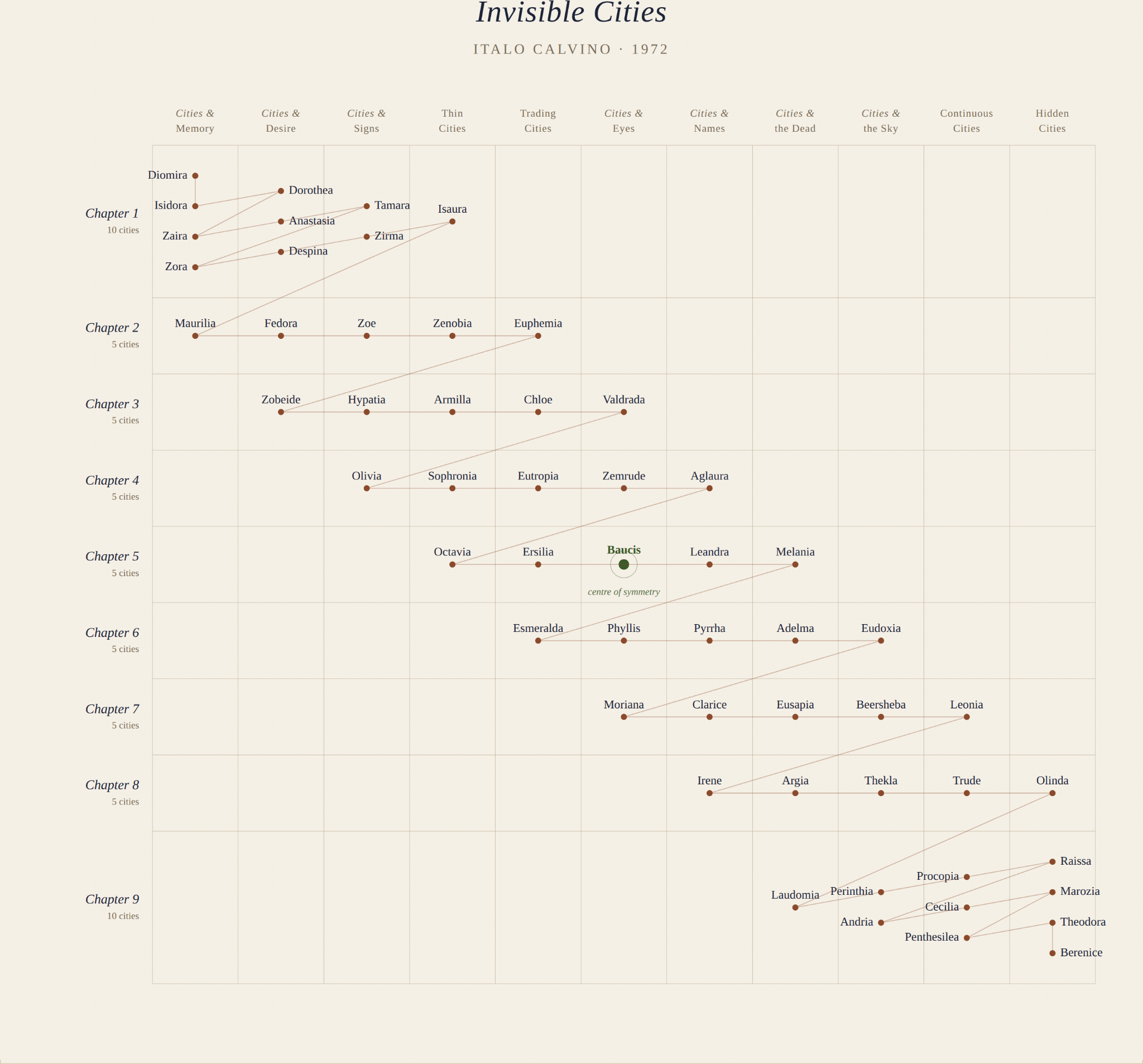
Both were associated with the literary-mathematical Oulipo group [14], a loose collection of authors who experimented with elaborate patterns, arithmetic sequences and other deliberate constraints to create new possibilities in fiction. This is evident in the structure of several of Calvino’s works. Invisible Cities has 55 descriptions of cities in eleven groups of five each (‘Hidden Cities’, ‘Cities and Memory’, ‘Trading Cities’ and so on), which unfold in a perfectly balanced, symmetrical zig-zag sequence (see below). Mr Palomar describes the observations of a character who is a cross between Bertrand Russell and Mr Bean [15] through a 3 x 3 x 3 pattern of sections and chapters of increasingly metaphysical nature. In Perec’s case, the most obvious constraints are found in A Void, written without the letter ‘e’, and Les Revenentes, where ‘e’ is the only vowel used. Fondness for patterns, puzzles and games is also a central part of Life: A User’s Manual, whose chapters follow a knight’s tour through the rooms of a fictional Parisian apartment block (also see below).
These are not idle games, nor are they simply literary flexing. The Oulipians believed that formal constraints offered a potential path to literary freedom. Their view of creativity can be thought of as diametrically opposite to that of the surrealists, free jazz, or free verse. To an Oulipian, rejecting form altogether results in a kind of creative anarcho-tyranny where everyone is lost and nothing truly meaningful can be expressed. By contrast, as with the fourteen lines of a sonnet, the interlocking symmetry of a crossword puzzle, the sonata form of a symphonic movement, or the immense majesty of a Himalayan peak, constraint enables expression. The writer has something to push against and, by pushing hard enough, can break out into fruitful new territories.
The challenge the movement set itself was to do something with the constraint, to transmit a liberated message via a constricted medium. In Calvino’s Mr Palomar, the matrix of the book’s chapters reflects the title character’s clownish, academically pedantic personality, and the ridiculousness of structuring a human story in this rigid way matches his humorously artificial manner. And in Perec’s A Void, the unusual word choices forced by avoiding the letter ‘e’ create an unsettling tone, entirely in keeping with the genre conventions of a missing person hunt. Superficially things seem normal but, hidden below the surface, something is missing, something is terribly wrong. There is a vast chunk of human experience which cannot be talked about, which can only be referred to obliquely. For a Jewish European writer in the aftermath of war (Perec’s father died in the Nazi invasion of France) and the Holocaust (his mother was a victim) [16], a novel with a missing letter becomes a metaphor for the devastated ruin of a continent with a gaping human hole.
But we’re not here to talk about that – ugh, depressing! We’re here to talk about the novel which serves as a demonstration of the fundamental futility of all human effort – yay! So let’s crack on with that.
III
There's a quote which The Internet mostly attributes to Henry Ford: "whether you believe you can do a thing, or you believe you can't, you're probably right". It seems unlikely that Ford originally said it, if he said it at all (and here's something you definitely can't do: look through the genuine attributed quotes of Henry Ford without it spoiling your day [17]), but I'm sufficiently interested in the idea of belief-as-self-fulfilling-prophecy that I'm going to borrow it as a way in to Perec’s work. So: whether you think this is a towering masterpiece of postmodern literature, or a borderline-unreadable mountain of pretentious drivel, you're probably right.
To begin with, what even is Life: A User’s Manual [18]? Well, it’s a sort of novel, except that it's a novel in which, from the literal perspective, absolutely nothing happens. The book is a description, chapter by chapter, room by room (via the pattern of the knight’s tour [19] as previously mentioned), of a fictional apartment block (11 Rue Simon-Crubellier [20]) in the 17th Arrondissement of Paris, façade removed like a doll’s house, frozen in time (just before 8pm on 23rd June 1975).
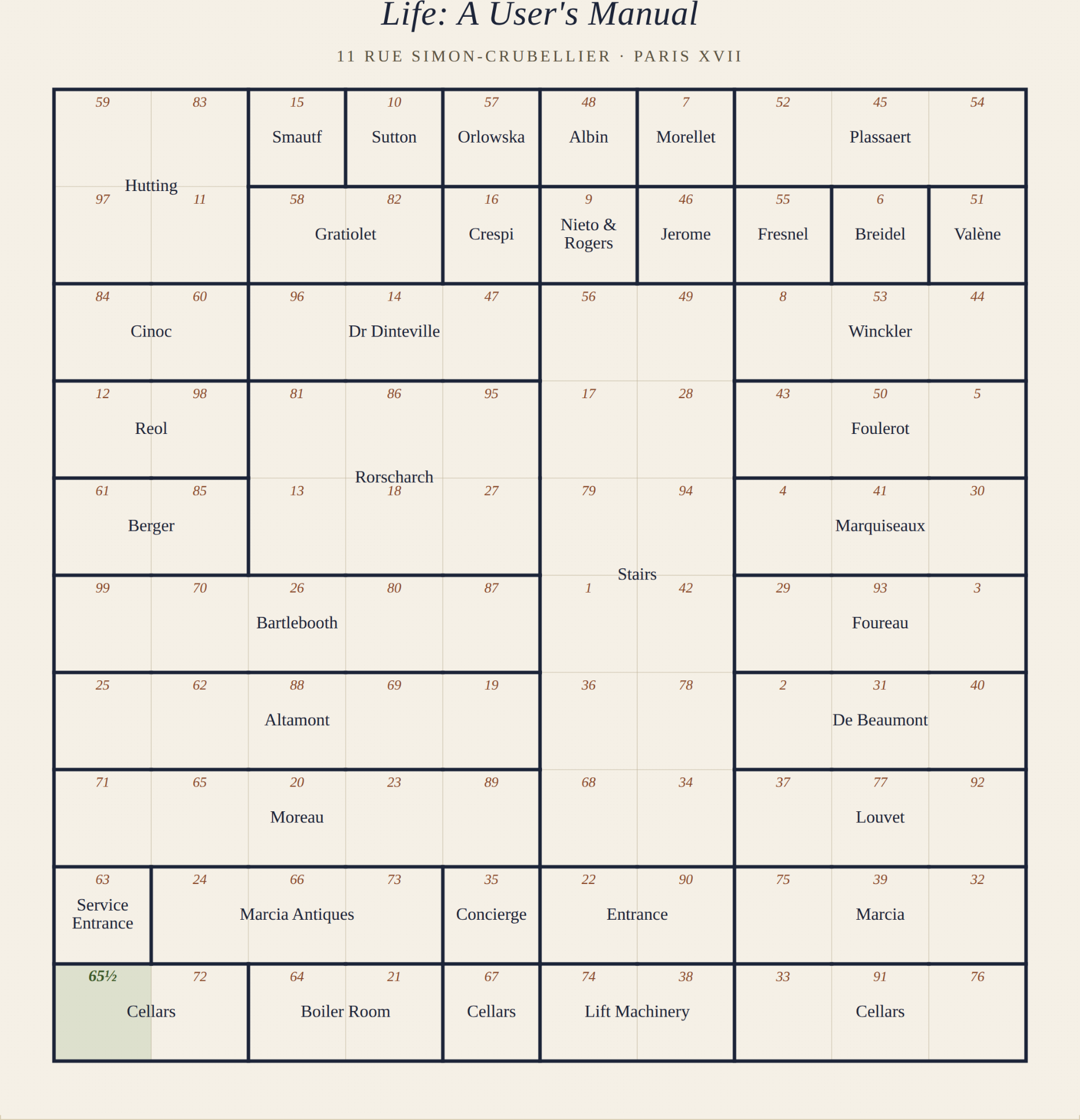
There are some amusing touches in the descriptions – three initiates are joining an esoteric sect, two cats have just knocked over some milk, a couple are having sex in the bath – and there are a lot of lists. Lists of books, of meals, of countries, of people; descriptions of architectural plans and paintings and possessions and puzzles and crosswords and cutlery and crimes. The density occasionally feels suffocating.
But mostly this serves as a framing device for the backgrounds and intertwining histories of the current tenants and, as the apartment block is rather old and the properties have passed down the generations, their ancestors and predecessors. So nothing happens, but also The Twentieth Century happens. The astonishing masterpiece / pretentious drivel dichotomy is perhaps becoming clearer.
So it's more like a set of short stories? It certainly has that quality, and one of the several indexes lists the various tales told in the book by inferred title (so ‘The Polish Beauty’s Tale’, ‘The Tale of the One-Armed Skeleton’ and so on), but as the knight hops around the building, gradually revealing room by room a little more of each apartment and therefore bit by bit a little more of each life, one of the stories emerges as the thread which ties many of the others together.
At the centre of Life is its tragicomic antihero, Percival Bartlebooth. He is an eccentric (English, naturally) millionaire, who decides as he enters adulthood to dedicate his entire life and considerable fortune to a deliberately grand but absurd task, employing several of the other tenants to assist him. First he spends ten years learning to paint, tutored by the artist Valène (Chapter/Room 51). Next, he spends twenty years travelling the globe accompanied by his valet, Smautf (Room 15), and painting a watercolour in each of 500 different port locations. These pictures are each mailed back to Paris where craftsman Winckler (8/44/53) mounts them on wood and cuts them into ingenious jigsaw puzzles, which are packed into identical boxes obtained by Mme Hourcade (previous tenant of Room 12). Once back in Paris, Bartlebooth spends another couple of decades solving these jigsaws in turn, and the re-assembled paper is bound with a solution invented by chemist Morellet (7). Thus reconstituted, each painting is sent back to its place of origin, dipped in a detergent solution, and dissolved into pristine blankness. After fifty globe-spanning years of meticulously crafted labour there will be no trace of what has been done.
It is a plan which is audacious in its scope, beautiful in the meticulous intricacy of its execution, and obviously completely mad. What Bartlebooth undertakes is a kind of anti-Bildungsroman. The traditional hero's journey from ignorance to wisdom, from weakness to strength, from being lost to arriving home, is subverted. Bartlebooth's journey moves from nothing back to nothing, leaving no monument and accruing no meaning. The apartment block is full of people who collect things – postage stamps, ink blotters, playing cards, art works – and Bartlebooth's project is, among other things, a systematic refusal of this impulse. He is conducting, with the full resources of his inherited wealth, a carefully controlled experiment in the production of nothing. And this is the heart of Life.
IV
Invisible Cities is also a book which resists categorisation, which features travel as a major theme, and which nonetheless has a remarkable quality of stasis to it. Marco Polo, the Venetian merchant and envoy, sits in the garden of Kublai Khan, the great Mongol conqueror, and describes the cities of his travels. From this single point of peace and tranquillity, the sprawling chaos of the Khan’s diverse empire is ostensibly catalogued.
But Polo’s descriptions are not what you expect, even for a medieval storyteller. There are cities made entirely of pipes and valves, or of coloured silk; cities hanging precariously over a chasm, or perched on stilts; cities underground in darkness where everything is hidden, or where every building visually resembles something unexpected. There is a city where, every few years, the populace are so bored with their lives that they completely abandon the existing city and build a new one from scratch, with each inhabitant picking up a new life and fresh social relations. Each city is described in a passage of just a few hundred words, like a tiny, perfectly cut jewel. And the theme of each city – desire, memory, the sky, death, names – unfolds in the twirling, arithmetical pattern of its chapters.
Framing the descriptions, at the beginning and end of each chapter, is a dialogue between Polo and the Khan, attempting to make sense of it all. On the one hand, the emperor commanding armies, treasuries and bureaucracies of unimaginable complexity, despairing at the impossibility of ever comprehending his imperial project: “I know well that my empire is rotting like a corpse in a swamp, whose contagion infects the crows that peck it as well as the bamboo that grows, fertilized by its humors.” The Khan’s fundamental difficulty is the information problem of all human endeavour: the gap between the territory and the map, between the thing and its meaning, between what exists and what can be comprehended or even described.
And on the other hand, the courtier seeking more profound truths beyond the messy reality: “This is the aim of my explorations: examining the traces of happiness still to be glimpsed, I gauge its short supply. If you want to know how much darkness there is around you, you must sharpen your eyes, peering at the faint lights in the distance.” Of course the crystalline structure of this book and the fantastical cities described within it are the embodiment of perfect artificiality. Every city is a thought experiment, a human tendency taken ad absurdum to its logical extreme. Polo’s descriptions are unreal, because to try to describe the reality of the empire would be, well, a Herculean project of epic futility. So instead, we get these imaginary, invisible cities, which have a kind of perfection precisely because they are impossible, uncontaminated by existence.
V
Despite this, Polo’s accounts are neither meaningless, nor purely ornamental. What both books do, but Cities in particular, is hold up a kind of negative mirror to our experiences, whereby we contemplate what is not, to better comprehend what is. No city is really like those Polo describes, but we recognise a kind of twisted, distorted reality nonetheless; like Bartlebooth in his study, we can take the jigsaw pieces of Polo’s cities and, holding them up to the light and examining them, begin to piece together an understanding of how our societies really are.
Polo even makes this explicit himself when he admits to the Khan that in reality he is each time describing one city in particular. “Every time I describe a city, I am saying something about Venice. [...] To distinguish the other cities’ qualities, I must speak of a first city which remains implicit. For me it is Venice.” So Venice is the city which none of these others are in whole, but which all of them are in part. And it’s noticeable how often doubles and mirrors occur in Cities. There is a city reflected in a lake, another which is the mystical twin of a carpet, another which is built on the pattern of the celestial bodies. Again and again Calvino shows us one bizarre thing, and its equally bizarre opposite twin, and we understand that reality is sort of both, and sort of neither, and ultimately something in between.
Life’s version of this is most clearly demonstrated with Perec’s exposition of Bartlebooth’s insane scheme. When it is first explicitly stated in Chapter 26, Perec sets out the three guiding tenets of its endeavour. They are ‘moral’ (it will be difficult but not impossible; vast but not spectacular); ‘logical’ (it will proceed algorithmically, controlling time and space without recourse to chance); ‘aesthetic’ (it will be useless, circular and self-nullifying). Just as Polo’s cities are carnival mirror versions of real societies, here we have three parodies of philosophical principle.
To want a morality which is not heroic (because we are not all heroes), which is challenging and life-encompassing: this is perfectly sensible. But this can’t be all there is to it: morality has to have some account of how we relate and what we owe to each other as fellow humans. Similarly, logic is a tool for understanding the world, not a closed loop blindly and unthinkingly generating its own erasure; furthermore the very idea of a human life being ordered without recourse to chance is absurd. And while there is by definition something useless about aesthetics, the fact that we place such a high value on beauty despite this shows the critical importance of what Bartlebooth is missing. His aesthetic has only uselessness, there is explicitly no audience, no preservation of legacy, no possibility of being moved, no connection to something ineffable beyond ourselves. There is something almost diabolical, or (dare I suggest?) something AI about the way Bartlebooth’s principles make superficial sense whilst in reality being a chilling inversion of humanity.
VI
This tactic of demonstrating through ironic inversion is not all the two novels have in common. Though they are stylistically very different, with Cities like a perfectly calibrated Swiss watch and Life like an elaborate Rube Goldberg machine, nevertheless they have certain themes and literary approaches in common.
Both play around with time and space. Life is supposedly fixed in one point of time, but the focus naturally zips back generations in order to explain the circumstances leading up to the present, and also on one or two occasions darts into a projected (imagined, dreamed?) future. That the present contains the past and the future within itself, and that in some sense they are not truly distinct, is thus suggested by Life’s narrative approach. The same idea occurs in one of Polo’s cities, where a present unjust city contains the seed of the future just city: those who yearn for freedom here are already organising, plotting, planning the overthrow of tyranny. But within them is the seed of the future injustice which will corrupt their plans: the self-righteousness and fanaticism of those who will go to any length to achieve their goals. And within that is the seed of a further, wiser and more tolerant city, tempered by the failings of the previous regime … and so on, and on, like Matryoshka dolls jointly designed by Einstein and Hegel.
Calvino also plays with the structure of time in a manner which is more fundamental to the composition of Cities. For the most part, Polo’s descriptions operate somewhere on the margin of plausible and fantastical medieval. But there are occasionally deliberately anachronistic references to radar antennae, airports or railway trains, and the Khan possesses an atlas which maps out cities of (from his point of view) the future, including New York and San Francisco. So we’re mostly in an exoticised faux-medieval world of bazaars, bath houses and caravanserais, but when Calvino wants to make a grander, more transcendental point, he’ll happily step outside it.
Something similar happens with space. Are Polo and the Khan really located in the emperor’s garden, talking late in the evening? They aren’t even sure themselves: perhaps, they ruminate sceptically, they are the merchant haggling in a market and the conqueror fighting in a battle, having some kind of shared dream or astral projection into a liminal thought-garden, or perhaps they are not even the merchant and the emperor at all. The reader suspects that they would not be hugely surprised to learn that in fact they are words on a page in a book.
Life’s version of this is found in the painting which the elderly Valène is working on, in his room towards the top of the building. It is a painting of the apartment block, and he has planned out all the characters to go in it (including himself painting the painting (recursion is something both authors like to play with (as we’ve already seen with the unjust/just city))). But some of the characters he intends to paint make no sense in the context of his painting, if understood as a plausible project within the world of the novel. One character on his list, for example, is Mark Twain, who is casually mentioned once in the book in the context of a postcard previously left on the stairs. Valène cannot possibly be planning to paint Twain into his picture of the building in some way that makes any ‘realistic’ sense. So in ‘reality’, Valène is painting not the ‘real’ apartment block he lives in, but some visual version of the book about the apartment block which the reader is holding, in which Valène himself is a fictional character.
At this point I sense the ‘pretentious drivel’ argument sidling up to us, with a sly grin and a cynical eyebrow. Well, I mean sure, ok, maybe. I think the only defence I can offer is to grin along. It’s all a joke, a game. It’s … fun? These are books which consider serious matters: life and death, grief and loss, meaning and purpose, the imperative of living together in just communities and the impossibility of doing so. And they do so by using games, and puzzles, and dazzling literary tricks, and jokes (the final joke of Valène’s painting is revealed in the final sentence of the novel), by being unafraid of embracing the absurdity.
Just one further example of this can be found by paying careful attention to the plan of the building shown above. Chapter 65 tells the story of ‘Lorelei’, a previous tenant in the apartment now owned by Mme Moreau. Chapter 66 skips down to the Marcias’ antique shop, with a little more of the story of David Marcia’s motorbike accident. But by carefully reconstructing the apartment block, room by room and chapter by chapter [21], we see that this skip abandons, for once, the knight’s move. In fact, it implies the existence of a missing chapter! The room in the very bottom left corner of the building, next to the cellar belonging to Bartlebooth described in chapter 72, is the intermediary step which the knight needs to complete the hop from room 65 to 66 (I’ve labelled it 65 ½ on the plan). Is this a mistake? A puzzle? Another metaphor for grief and loss? Is the cellar empty? Or does it contain some key to the whole mystery? Is it a deliberate authorial choice? Or the random result of some Oulipian narrative calculation? I think the answer has to be simply: yes.
VII
I’ve attempted, over the course of this review, to offer some thoughts on these books, their themes and the way they develop various ideas in a fictional context, focusing in particular on what I think makes them unusual or noteworthy as intellectual texts of the second half of the twentieth century. But what of the actual experience of reading them?
I’d say the answer is very different for the two works. Invisible Cities shows Calvino’s mastery of technique. It’s short (perhaps 40,000 words), and broken up into sections of only a page or two each, so if one city doesn’t click for you, there’s a completely different one on the next page. The writing (at least as conveyed by William Weaver’s translation) is exquisite, and the beautiful economy of its expression enables Calvino to dance with agility from a city description functioning as a short horror story (several of the ‘Cities & The Dead’ are like this), to another which is more like an extended joke (for example the city where everyone is extremely formal and reserved in their conduct with their fellow citizens, because they are constantly imagining the most outrageous fantasies about each other).
There’s also an unashamed, unselfconscious ‘other’-ness about Invisible Cities, which might be too orientalist for some, but which for me displays a genuine delight in things which are paradoxical, fantastical, exotic or bizarre. ‘Marco Polo’ is not a real European, or a representative of The West, he is the archetype of the traveller, storyteller, performer, idealist, observing from outside. Similarly, ‘Kublai Khan’ is neither the historical emperor nor an imagined Eastern ‘other’, he represents the passionate man of action, concerned with the practicalities of government, the problem-solver who listens, evaluates, decides and then acts. They are the Platonist and the Aristotelian, perhaps.
So while I understand that Invisible Cities will not be to everyone’s taste, I do feel confident in suggesting giving it a try: you’ll know within a dozen or so pages whether it’s for you. Life: A User’s Manual is trickier to recommend. It’s much longer (perhaps around 200,000 words), and where Calvino writes with an apparently effortless lightness and grace, Perec’s style is sometimes dense and cluttered. This is a deliberate choice given the form he has chosen, and it doesn’t apply to the whole book: the histories of the residents include shocking murder-mysteries, picaresque tales of madcap adventures, and an elaborate long con on the subject of the holy grail. There are also, perhaps more surprisingly, moments of intense emotional power in amongst the lists of possessions and descriptions of bric-a-brac. Perec is deeply aware that we spend our lives in consumer society surrounded by things, and whilst many of these will be interchangeable and freely disposable, there are inevitably some to which we give meaning, which embody memories of all kinds, and which therefore come to capture something essential about who we are. Here is one resident, described in the immediate aftermath of his wife’s death while giving birth to their stillborn child, more than 30 years before:
For the entire winter, [he] stayed seated at the table where she used to work, holding in his hands, one by one, all the objects she had touched, she had looked at, she had loved, the vitrified pebble with its white, beige and orange grooves, the little jade unicorn saved from a valuable chess set, and the Florentine brooch he had given her as a present because it had on it, in minute mosaics, three Paris daisies, or marguerites.
Then one day he threw away everything that was on the table and burnt the table; he took [their dog] to the vet in Rue Alfred-de-Vigny and had him put to sleep; he threw away the books and the turned-wood shelf-stack, the mauve quilted bedspread, the low-backed, black-leather-seated English armchair in which she sat, everything which had her trace, bore her mark, and he kept in the room only the bed and, opposite the bed, that melancholy picture of the three men dressed in black.
The bedroom is today a room grey with dust and sadness, an empty, dirty room with faded wallpaper; through the open door that gives onto the broken-down bathroom, you can see a rust-stained, scale-incrusted sink on whose chipped rim a half-drunk bottle of orange pop has spent the last two years going green.
I find that a moving account of both the lethargic and catastrophic aspects of grief, done mostly through a description of one couple’s relation to their possessions. There’s a kind of perverse pedantry in the way Perec invites you to study the minutiae of everyday life, and then occasionally hits you with something much deeper. But there can be no doubt that he knows what he’s doing, and why.
There are also rare moments in the book where a character speaks out in their own words. Amid the general voice of the detached, ironic narrator, at the end of one chapter Perec quotes a banker’s letter to his wife, who he feels has never forgiven him for helping her to get an abortion when she was carrying another man’s child before their own relationship began. But I won’t quote it here: it is, I think, precisely because of the way Perec gradually assembles the pieces of his apartment block, hopping around between characters, jumping between historical eras and narrative styles, telling part of a story here then upending our understanding of it elsewhere, that gives this sudden scream of unfiltered emotion its shocking power.
So if Invisible Cities is an intricately choreographed minuet, Life: A User’s Manual is more like a long hike through rugged but occasionally breathtaking terrain. I leave it up to you, esteemed reader, to decide whether either might be worth your very valuable time. But both these books speak to me, decades after their authors’ deaths, in a way that feels worth preserving and sharing. Indeed, on that note, here to finish are Polo’s final words to the Khan, as the emperor frets about the possibilities of a dystopian future:
And Polo said: “The inferno of the living is not something that will be; if there is one, it is what is already here, the inferno where we live every day, that we form by being together. There are two ways to escape suffering from it. The first is easy for many: accept the inferno and become such a part of it that you can no longer see it. The second is risky and demands constant vigilance and apprehension: seek and learn to recognise who and what, in the midst of the inferno, are not inferno, then make them endure, give them space.
Your message is stored now and emailed to the author after the contest ends. The author can reply to you, but their identity stays hidden unless they choose to respond.
Footnotes
- ↩
Before we start, some thoughts on spoilers. I’m reviewing two works of fiction, and it’s inevitable, in going into some detail about them, that I’ll refer to things here which would be revealed to the reader of the original works gradually, and in the particular manner which the authors intended. Neither work has a plot as normally understood, and I’ve taken some steps to minimise the impact of anything I reveal here, such that I don’t believe it would detract to any great extent from the experience of reading them. Still, if you don’t need persuasion from me to read these books, you should probably get to it!
- ↩
I daresay you’ve already noticed this, but if not, feel free to jot it down and find an opportunity to use it. You’re welcome.
- ↩
This isn’t my intention at all. My intentions are (roughly in order): to see if I can write a book review that I’m satisfied with; to introduce people to two writers who I think are still worthy of attention four decades after their deaths; to stand a theoretical chance of winning some money; to see if I can write a book review that some other people who are not my wife are satisfied with; to get people to pay more attention to anything else I might write.
- ↩
Lest, dear reader, you overestimate my linguistic cunning, I confess I have only read these works in English, in the translations from French by David Bellos (1987) and from Italian by William Weaver (1974).
- ↩
Cosmicomics (Le cosmicomiche)
- ↩
The Path to the Spiders’ Nests (Il sentiero dei nidi di ragno)
- ↩
The Castle of Crossed Destinies (Il castello dei destini incrociati)
- ↩
If on a Winter’s Night a Traveler (Se una notte d'inverno un viaggiatore)
- ↩
Things: A Story of the Sixties (Les Choses)
- ↩
W, or the Memory of Childhood (W ou le souvenir d'enfance)
- ↩
A Void (La Disparition)
- ↩
Ouvroir de littérature potentielle (workshop of potential literature)
- ↩
I definitely thought I stole this description but a half-arsed search doesn’t reveal it anywhere so I’ll let it stand as original until corrected.
- ↩
Perec’s mother was deported to Auschwitz in 1943. Because her death was never officially recorded, the family had to obtain an ‘acte de disparition’ rather than a standard death certificate. The title of A Void in French is La Disparition.
- ↩
You’ll naturally assume the title is a joke. But having read it, I think the title may be the least playful and most unironic aspect of this book. It actually does what it says on the tin. (Although, it's not a particularly useful user's manual, it's more like one of those ones for self-assembly furniture that's been Google Translated from Huizhou.)
- ↩
As in the chess piece: each successive room is reached by moving two spaces in one direction and one space orthogonally.
- ↩
The name of the street is (probably) significant. ‘Crubellier’ is a rare but real French surname, which possibly suggests etymologically the verb cribler: to sift or sieve, but also to fill with holes. Both meanings have clear resonances in Life.
- ↩
Again, you’re welcome.