Why Can’t I Find Our Rightful Italo Calvino’s Invisible Cities Fan Cookbook, Already?
Introduction
Well, where is it? We may as well investigate. Italo Calvino’s Invisible Cities first came out in 1972, two years later in English. Joseph McElroy reviewed it favorably at that point, leading with the hook that this “new book” is “this time not a book of stories. Something more.” And I suppose I agree–it isn’t just a book of stories.
But I also disagree–because it also is just a book of stories. Each section of the book is bookended by Marco Polo & Kublai Khan dialoguing in his palace, and between the dialogues fall a number of 1- to 3-page city portraits, the meat of the book. The 55 cities themselves are imaginary (mostly), each one taking a woman’s name: Isidora, Zoe, Hypatia, Olivia, Leandra, Phyllis, Beersheba, Trude, Theodora–for a likely sampling. And each city’s portrait does qualify as its own story–one of its origin, or one of traveling through it–always one which is being told within the frame story.
These premises could have been enough, but just as notably within the structure of the book, the city portraits follow different themes, from “Cities & memory” through “Hidden cities” – and the themes themselves fall into a (mathematical? poetic?) pattern of AABABCABCD ABCDE BCDEF CDEFG DEFGH EFGHI FGHIJ GHIJK HIJKIJKJKK, if that makes sense.
If it doesn’t make sense, don’t worry–the book’s Wikipedia page has a table of its structure. Or you can just take a stern look at the table of contents. Or ignore both tables & let the book flow naturally (as nature is full of patterns). Or ignore the headers entirely, because with so much inevitable overlap between types of city, you may as well stop having to check back which title the author has officially given.
Anyway: If everything from Jane Austen's novels to The Witcher series has its own fan cookbook, why not Invisible Cities? And if Invisible Cities has been adapted into everything from abstract art to an opera performed in an active train station, why not a cookbook? Alarmingly, it may not exist & we won’t know why. More alarmingly, it may exist & we just can’t find it.
-
The basic premise disallows it
-
The format of the thing
-
The spirit of the thing
-
For as thin as a book as this is, the complex structure & spare prose make it dense stuff to read. I can’t read it very well before bedtime or naptime, because once my mind wanders from Invisible Cities, I miss city after city before noticing approximately none of it has adhered to my recent memory. In that way, I would think it similar to a cooking manual. But on the other hand, Invisible Cities is itself no manual. Kublai Khan remains in his palace, unable to follow Marco Polo’s steps, sometimes fearfully claiming, “Your cities do not exist. Perhaps they have never existed. It is sure they will never exist again.”
“More than 55 recipes inspired by Calvino’s world-famous Invisible Cities” is what our little spiky, embossed blurb should say on the front cover. More than 55 recipes, because a single recipe from each city would not allow much in the way of menu construction. At the same time, 55 cities’ worth of menus makes a lot of work, and each city has to have their unique character expressed in the food.
And some of the cities are so abstract or fantastical that the culinary expression of those cities may feel mismatched or simply inedible. We take Perinthia (Cities & the Sky 4), whose astronomers designed the city to “reflect the harmony of the firmament; nature’s reason and the gods’ benevolence would shape the inhabitants’ destinies” but after the first generation of mild-to-horrific birth defects, “Either they must admit that all their calculations were wrong and their figures are unable to describe the heavens, or else they must reveal that the order of the gods is reflected exactly in the city of monsters.” Given the unsavory nature of the city, must it also repel our palate?
And should the themes be bound by some culinary technique or ingredient, to signify the underlying similarities between cities? Or is that too on the nose? Certainly they will have to arrange in order of the chapters in the book. Unshuffling the themes would make for an antithetical approach.
PBSSoCal’s Artbound Special Episode “Invisible Cities” –a documentary on the opera adaptation–interviews Thomas Harrison, PhD, the ULCA Italian Department chair about the origins of Invisible Cities. He claims that in conversation, Calvino described filling a cabinet of index card ideas & descriptions; when enough cities cropped up, the author could see the themes weaving from city to city: “...some were about cities and memory, & some were about cities & desire, & some were about cities and death. And then–by taking all of these index cards–he started figuring out the structure for the book…” A cute story, if true.
But the opera itself drops Calvino’s basic thematic structure, focusing only on the cities Isidora, Armilla, & Adelma, surrounded on every side with Marco Polo’s & Kublai Khan’s philosophical dialogues. One of these dialogues focuses on Venice, which in the book occupies a mere page–and only to note its place as the merchant’s inevitable but otherwise-mute reference point for all other cities he brings forth. Polo reveals, “Every time I describe a city I am saying something about Venice,” but he also refuses the Khan’s request to describe it directly: “Perhaps I am afraid of losing Venice all at once, if I speak of it. Or perhaps, speaking of other cities, I have already lost it, little by little.”
In the book, of course, Marco Polo formally describes fifty-five cities, plus all the cities brought up in passing during the portraits and dialogues. In the opera, the tenor Marco Polo gets only three formal city scenes, which makes Venice’s dialogue (the sixth of eight total scenes) almost rear and loom over them. I understand the time limitations of live theatre, but to me it still feels uncomfortably saccharine to let them all sing about a visible city for so long.
Of course, now I’ve gone on about the opera long enough, it will loom over the rest of my book review. Suffice to say I hope our cookbook doesn’t make the same mistakes.
Perhaps the strongest argument against us, Calvino’s writing at large simply resists adaptation in the first place. In a 1985 interview with the BBC’s Bookmark programme, Calvino’s translator William Weaver backs up Calvino’s own claim that his work is untranslatable: “Everything is untranslatable, but Calvino’s books are particularly difficult–because although he doesn’t use words that you don’t know [...] he writes in a very special, very–deceptively simple way.”
It’s more-or-less the same with Calvino’s book covers, too. Wikipedia provides a low-res cover of the original edition, an artist clearly reveling in the fantastical elements of the book, it seems to me. No, no, no–I look again–that’s a Magritte, painted over a decade before Invisible Cities, the artist dead before the book’s publication. So I guess I can’t strictly hold Magritte responsible, but Calvino(’s publisher) thought this pitted rock castle suspended over the air and waves had kinship with the cities described within. And in the case of portraits like Baucis (Cities & Eyes 3), The Castle of the Pyrenees appears in the same world: “lost above the clouds [...] Nothing of the city touches the earth except those long flamingo legs on which it rests...”
Meanwhile, here is the cover of my modern edition:
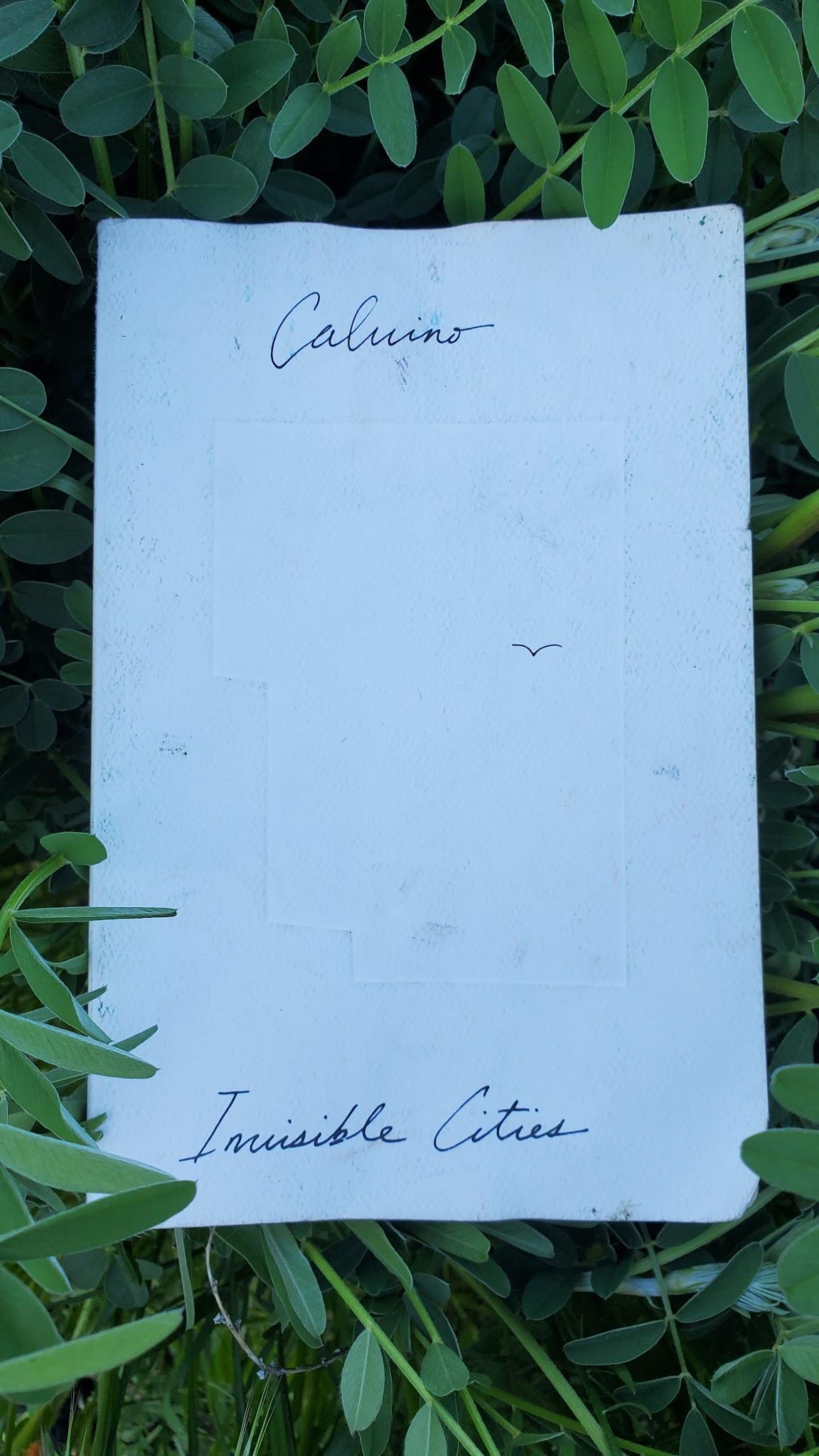
At this point the cover is as much about the places to which I’ve dragged it as it is the places it contains.
Very minimalistic: a bare embossed city border, punctuated only by a bird traveling through/over/down. User bias, maybe, but to me this new cover feels more tonally consistent. Because this book is as much about what it doesn’t describe as what it does. The Khan can only project these narrated city-portraits on his blank mind’s eye, their elements derived from words or objects or gestures, sometimes even a board game: “At times he [Kublai] thought he was on the verge of discovering a coherent, harmonious system underlying the infinite deformities & discords, but no model could stand up to the comparison with the game of chess.” But chess does not ultimately bring clarity, either.
Anyway, since its publication, enough artists have used Calvino’s Cities as inspiration, complex ideas typically finding form in dense architectural lines.
Representative in that style is Karina Puente, who self-describes as “one of those people who wanted to be an artist but became an architect instead” – and whose [In]Visible Cities Collection sets out to illustrate every city in the book. My mind appreciates her work but rebels at the sparse use of negative space–very little room to breathe, and that might be her point.
Another architect turned Invisible Cities illustrator, Matteo Pericoli, writes, “At some point of their creative process, spatial and literary narrative share a similar forma mentis, which isn’t made of bricks and concrete or words and syntax, but of essential compositional ideas.” His resistance to the representational in favor of understanding through cardboard models is unfortunately not ultimately reflected by his representational line drawings.
A little more Escher-like (Seussian?), Colleen Corradi Brannigan leans into mathematical complexity. The geometric shapes and color choices draw me in, though I’m less able to remember what city portrait goes with each name. Perhaps that’s for the best.
Here’s an abstract city I like very much, too: artist rodcorp explains,
The diagram, a network of curved lines connecting to every other node on a 6 x 5 grid, has two configurations: if the picture is hung one way up, it shows the "Ersilia configuration" (where the lines are like the threads strung between the buildings of Ersilia); if hung the other way up, it shows that of Trude (where the lines are like a complicated airline route map).
Again, very much my personal preference (and conviction that visual minimalism jives well with the structure of the novel), but I would hang the “network of curved lines” in my home sooner than the other artists’ work.
The spirit of the book is also where I think the opera finds some footing, by the way. The costumes are never fully representational across the cast, the singers’ voices echo ethereally off the walls of the station & its spaces–but it is clearly a structure they never themselves describe. The audience have headphones to unite the musical elements, circulating through the station to follow characters, while the everyday commuters & campers are left with disjointed facets of production. The dances appear sometimes a bit too frenetic, but it’s difficult to tell from the documentary excerpts if the excessive movement works well when punctuated by periods of rest.
To return to a culinary adaptation: can we make a cookbook full of incomplete portraits?
And what do we do when, on the rare occasion, Italo Calvino writes clearly about food? Of Anastasia (Cities & Desire 2) Polo tells, “I should praise the flesh of the golden pheasant cooked here over fires of seasoned cherry wood & sprinkled with much sweet marjoram” though this would “not be telling you the city’s true essence.” If I then create a recipe of the roast pheasant with thyme as a culinary interpretation of Anastasia, I assume it will seem fairly crude & fleshed out (no pun intended)--not just too densely detailed & too on-the-nose, but also not what Marco Polo believes will reveal the core of the city’s treacherous enslavement of its citizens to their desires.
As with the other adaptations, it feels more appropriate to dance in the gaps–and somehow cook as sparely as the book’s prose without ever touching the obvious. It also has to be real food that real people want to cook. We can’t just serve the front cover of my book. Much as I’d like to.
-
Invisible Cities food would taste weird
-
Geographical fusion
-
Anachronistic fusion
-
This sort of goes without saying. These places, other than the palace itself, are wholly fantastical, and so would their cookery. But is there anything strange enough to wholly prevent a cookbook?
I’m sorry to say that I only include this argument for thoroughness’ sake. Obviously trans-geographical fusion cuisine happens all the time, and for food in the medieval world it was well-rooted in the East-West trade routes Marco Polo himself traveled. It might taste weird to people outside of (& unfamiliar with) the geographical regions in question, at least. But probably not weird enough to find no interest whatsoever.
For instance, Dan Alexander + Co. blog mentions Invisible Cities as they consider an unwritten chapter for their book, On the Hummus Route, the chapter itself of Hebron unreachable. Kublai Khan’s own palace had access to chickpeas, and there are documented recipes using them (in English! Thank you, Buell & Anderson). These trade regions have access to great ingredients from all over, and it doesn’t take much of a stretch to suppose that even invisible, ridiculously-planned cities within that Khanate can have delicious food.
This argument seems slightly more likely, at a glance.
Is it just an American thing to endlessly vilify the cuisine of the 1970s–its endless Jell-O salads and weird photo props? Do we extend that scepter of condemnation to 1970s Italian food? In the pop history Delizia! The Epic History of the Italians & Their Food, Italian Studies lecturer John Dickie characterizes the 1970s as Sophia Loren’s domain–the union of sex appeal & motherhood in food writing–meeting the advent of mass-produced tortellini, a dish finally available to the busy masses. Sophia Loren’s 1971 In the Kitchen with Love definitely embraces some weird photo props, but surely not any worse than Fergus Henderson’s 2004 The Whole Beast. (The latter book’s photos I am having difficulty tracking down online, I assume due to copyright. But for the nose-to-tail-curious–it’s worth the interlibrary loan just for the looksee.)
Anyway, maybe a cookbook based on a 1970s Italian novel still instinctively makes us worry about tortellini salad set in lime gelatin, despite whatever normal alternatives the era may offer.
But Invisible Cities is specifically not set in the 1970s. (Not that Calvino goes out of his way for historical accuracy–just as his Marco Polo finds a reference point in Venice, so Italo Calvino is a product of his time & his table. His reference to an ancient recipe for squash flower, for instance, could not really have been squash until after the introduction of American imports.)
But here again on the older side of things–when will we get over our mythic disgust of ancient foods? I somehow keep bumping into the spices-just-covered-the-bad-meat-taste joke, despite historians debunking it over and over. And while it’s popular to eat as the royals do, there’s also a certain “eat the rich” strain that has no interest in how great leaders of the past managed to feast. Honestly, food of the common people seems more Calvino’s speed, as well. And maybe our contemporaries don’t trust 13th century Venetians & Mongolians about what to eat? It may be a silly barrier, I know, but it might well be what’s prevented our Invisible Cities cookbook.
-
People who have read Invisible Cities just don’t want a cookbook
Not that they’ve poured that much thought into it. Of 6,954 Goodreads reviews, I only get 23 hits for the word “food”. Here they are: (or skip the list–I’ll sum up the highlights after)
- Fergus, Quondam Happy Face portrays the book as a “delectable Angel’s Food Cake”–that is, of escapist fantasy. (5 stars)
- Tom mentions “shouting food vendors and markets, [. . .] coffee shops” and the call of a strawberry seller in a tribute city portrait. (5 stars)
- Walter Arvid Marinus Schutjens: “As an avid Dungeons & Dragons [...] player this book gave me a ton of food for thought” (3 stars)
- Aishwarya Pant laments at the tourist’s dilemma of only “eating the food and the wine someone recommended to you.” (5 stars)
- 50 Cups of Coffee describes dams providing “access to food” in Richard Dawkins’ The Extended Phenotype: “Perhaps too our cities are our phenotypes.” (no star rating given)
- Paloma warns, “you’ve got to digest each city on its own the way you would take tiny bites of extremely decadent food.” (5 stars)
- Karim Mahamed writes, “the material is solid and put together in such way that makes it food for your mind!” (4 stars)
- Nancy Lewis quotes from Calvino’s first city, Diomira (Cities & Memory 1), “...the multicolored lamps are lighted all at once at the doors of the food stalls…” (3 stars)
- Brian Sergi claims, “It felt especially fitting to read this as a tribute to the recently departed Anthony Bourdain; through the experience of food, Bourdain was able to illustrate the wonders of people and the places they call home, thus serving as a modern day Marco Polo.” (5 stars)
- Quinn Monette: “Comfort food.” (5 stars)
- Parth also excerpts the passage from Diomira. (4 stars)
- Scott: “For those of a philosophical bent, there is plenty of food for thought here.” (5 stars)
- Sabrina: “Beautiful, poetic, and food for thought.” (5 stars)
- Leo Dutch characterizes the reading experience: “...the positive memories of adventure and food come to mind, but later on i remember homesickness, struggling with the heat and seeing the negative parts of cities.” (5 stars)
- Gonçalo Matos: “Each [city] feels like a lesson, with food for thought and the most bizarre characteristics.” (5 stars)
- Alex Lam: “Lots of food for thought - I'll be reflecting for years - but not too esoteric.” (4 stars)
- Taylor Norman gives the Diomira quote, again. (no star rating given)
- Linda C: “Lots of food for thought.” (3 stars)
- Maryann portrays the book as “a cup of miso soup. I don't have it very often, so it's still exotic to me, and the little bits of onion or sprouts or whatever yumminess the cook may have put in add to the experience. It gives me pause, as something I don't consume often, and I take the time to savor it.” (3 stars)
- Anita: “This particular text is nothing but food for thought.” (5 stars)
- Miriam gives tip #3 for enjoying Italo Calvino’s Invisible Cities: “Let anachronisms (traffic islands, modern plumbing) serve as food for thought. Don't dismiss them as inaccuracies.” (4 stars)
- Beenish Khan also references the tourist: “...look at a city in a literary way and not just the usual mix of food, entertainment, and bucket list items.” (4 stars)
- Bookamante: “writing a review of this book is like trying to tell what food tastes like to someone else. Salty. Bitter. Sweet.” (3 stars)
No strict comment on all these reviewers’ taste, if you will, but there are a few people here who at least in some small way have adapted the book in culinary language: an angel food cake, a strawberry vendor, a bowl of miso soup. Not a whole cookbook here, obviously, but we can still regard them as kindred spirits.
(I originally wondered if nobody really likes Invisible Cities at all, these days, or if nobody reads it at all, but with 4.11-stars out of 84,284 ratings on Goodreads, we can obviously shoot that down. It’s not Eco’s The Name of the Rose, in terms of reach, but it’s not Buzzati’s The Bears’ Famous Invasion of Sicily, either.)
And if we believe Pericoli, from earlier, Invisible Cities is required reading for Italian architecture students, so we should have a reliable supply of readers–so long as formal architecture education doesn’t collapse. Now if they only required it in culinary school, we’d have our object.
-
Search engines are the worst
-
What does turn up?
-
What about in Italian?
-
Sadly, I am no SEO wizard
-
I must confess myself rather homespun in this regard, but in my quest to find anyone else interested in a cooking project of Invisible Cities, I have turned up very few candidates.
Basically as close as we get is the Valerie Stivers’ Eat Your Words installment where she attempts to “invent a series of Calvino-inspired pies, interlocking like the chapters of If on a Winter’s Night a Traveler and utilizing tree fruits and tree nuts from The Baron in the Trees.” Stivers makes five pies, and although she really only quotes Invisible Cities in support of her Baron in the Trees life philosophy/evaluation, it takes a sizable place in her overall reflection. Note that when she mentions “two alternate endings” she is simply referring to the two options out of the “living inferno” Marco Polo describes at the end of the book:
There are two ways to escape suffering it. The first is easy for many: accept the inferno and become such a part of it that you can no longer see it. The second is risky and demands constant vigilance and apprehension: seek and learn to recognize who and what, in the midst of inferno, are not inferno, then make them endure, give them space.
And I should have mentioned in the “spirit of the thing” section, but this quote demonstrates it well: all the cities in this book, all the dialogues, have this double nature. Double-meanings intertwine, double-natures live in paradox, double-faces exist without touching. A difficult table service, perhaps.
Other findings:
The dramatic adaptation Impossible Cities: A Utopian Experiment mentions a cookbook in connection to the real-life Amana Colonies, a utopia under consideration.
This Invisible City literary journal features a poem called “Recipe” . . .
I also turned up a page from the (non-Calvino) Invisible Cities organization, which trains “people affected by homelessness to become walking tour guides of their own city and offer these alternative tours to tourists and locals.” Unfortunately, the PDF cookbook it advertises has a broken link or something.
To my greatest annoyance: using Google, the keyword “cookbook” also brings up results using the word “book”. Given that we’re searching for something based on a famed author’s book, most results in this vein actually have nothing to do with cooking. Trying to remove the keyword “book” leaves the word “novel”–after which point almost nothing remains but book reviews which manage to never mention the word “book” or “novel” (or “cookbook” for that matter).
When I substitute the word “cooking” or “recipe” or “kitchen” –Google’s top hits tend to omit it, and I’m left again with book reviews. None of which, obviously, devote much time answering my question, or they’d have those terms riddled through them.
Occasionally, I forget to add “Calvino” and end up with the cooking blogs of harried travelers.
I do not know the Italian language, but I tried anyway. The Amazon listing popped up from my Italian keywords only because “Customers who viewed this item also viewed Le città invisibili…”
Italo Calvino: il sapore del racconto: Le ricette delle fiabe italiane (Leggere è un gusto) appears to feature 10 recipes based on Calvino’s Italian Folktales collection. Despite having to pare down from 200 stories, this ricette equally samples different regions represented throughout that book. Not Invisible Cities, but another kindred project. (Unless Google Translate is really letting me down. Italian-speakers, report.)
Overall with my amateur Internet-trawling, I know I’ve failed in multiple ways, because my own previous musings on my own barely-started Invisible Cities cooking blog STILL DON’T SHOW UP AT ALL. (And I tell you not just because I’m mad about it, but also so that you don’t go searching on my behalf with your own overpowered search engine skills and accidentally turn up my blog, after all. Wait to do all that till after the book review contest.)
On the plus side, that lack of hits is the only reason I feel I can write this book review without accidentally revealing identifying information. So it goes.
Conclusion
Thank you for your consideration of Calvino’s Invisible Cities & its potential challenges for adaptation. If you haven’t read this thin volume, yet, I encourage you to do so–certainly if you frequently travel, but especially if you don’t.
Anyway, see you for my next book review, “Why Can’t I Find Our Rightful Italo Calvino’s If on a winter’s night, a traveler Fan Cookbook, Already?”
Although that will probably just lead us back to Stivers’ pies. Maybe I should consider its equal puzzle, given that book’s opening scene:
“Why Can’t I Find Our Rightful Italo Calvino’s If on a winter’s night, a traveler L.A. Union Station Headphones Opera, Already?”