Jacobitism: The First Four Thousand Years
The Jacobites (fr: Jacobins) are an ancient movement. They believe that the existing order must be overthrown, recentralizing power around someone named Jacob and his descendants, or at least their culture’s equivalent of that name. To Anglophones, they’re primarily associated with their efforts to restore King James II, or an heir, to the English throne. However, the Jacobite ideology is far older than the House of Stuart. Though tenacious, and occasionally successful, Jacobitism is, I will argue, fundamentally flawed.
The Original Jacobites (circa 2000 BCE, give or take a millennium)
The name Jacob first appears in the Book of Genesis. Jacobitism, per the book, was born with him. Literally. He was the second son of Isaac and Rebecca, born moments after his twin Esau. His name derives from a word for “heel” because he was born clutching Esau’s heel, as though trying to overtake him and be born first.
In the narrative, Rebecca had already formed a proto-Jacobist philosophy. During her difficult pregnancy, she prayed to the Lord for an explanation, and received one:
Two nations struggle within you. Both shall be born, but the elder shall serve the younger.
Rebecca interpreted this as a command, and was therefore Jacob’s ally in his quest to become his father’s primary heir. The two accomplished this through a series of dirty tricks. In the end, Jacob fathers the Twelve Tribes of Israel, while Esau begets the Edomites, a rival kingdom in the region.
When interpreted as a cultural artifact, this early text is telling in its unusually frank expression of the Jacobite worldview. Its clear intent is to justify the dominance of the self-described descendants of Jacob over the already-ancient kingdom of Edom. But rather than ascribing grave sins to Esau, the story is framed as triumph of brains and treachery over brawn and simplicity.
Esau is a manly hunter, covered since birth in red hair (his name derives from a word for red). He’s his father’s favorite, both as the presumptive heir and because he’s always bringing him fresh venison. Jacob and Rebecca prefer different foods, e.g. lentils and goat, both of which are much easier to slay than a deer. They leverage this superior caloric efficiency to defeat Esau. Their cunning is contrasted with Esau’s impulsivity–even though he doesn’t do anything morally wrong, it’s suggested that he would have been a less competent patriarch. The narrative frames the Jacobite ascent as ordained by God, sure, but also as cultural commentary: “You may have been here first. You may be stronger, in a simplistic sense. But we are smarter and more sophisticated. You’d win in a fair fight, but that’s never going to happen.” Even today, Jewish Jacobites (more often referred to as Israelites, after the name Jacob adopted later) often frame their struggles in essentially the same way.
The Jacobite Heresies
Jacobitism is also popular among Middle-Eastern Christians, although the term is more often used by outsiders to describe them–for example, in their entry in the 19th-century Cyclopædia of Biblical, Theological and Ecclesiastical Literature. Syriac Jacobites believe primarily in the theology of Jacob Baradaeus, a sixth-century bishop. Baradaeus taught that Jesus was at once fully divine and fully human, in contradiction to the fifth-century Council of Chalcedon, which held that Jesus was one being who composited both a human nature and a divine one. In the manner of things, this barely-intelligible distinction has led to considerable strife. It’s probably roughly analogous to the “composition vs. inheritance” debate in software engineering, but with an even higher body count.
This particular Jacob was born to rich parents, from whom he inherited a house and some slaves. However, he then freed the slaves and gave them the house. To protect himself from the Chalcedonians while proselytizing, Jacob dressed in “ragged clothes,” from which his name Baradeus is derived, so that he’d appear to be working-class and therefore unthreatening. This is clearly a variant of one of the Biblical Jacob’s tricks, wherein he dressed in his brother’s clothing in order to impersonate him. This theme, elites co-opting the trappings of labor in the service of a greater cause, is core to Jacobitism.
The Syrian Jacobite Church, founded via this trick, adopted the Liturgy of Saint Iacobus, attributed to one of Jesus’s brothers, who is variously anglicized as James or Jacob. The people of Jesus’s home town saw James as the populist one–Jesus went off, forgot his roots, and put on airs as a fancy prophet, while James stayed home. But they’ve of course been deceived–Jesus is the humble brother, while James is clearly cunning and ambitious. Soon after Jesus’s death, he’s depicted as the leader of all Jewish Christians, and he quickly transforms the movement. Whereas Jesus taught that prayer should be solitary and terse, under James and his liturgy it becomes communal and verbose. In Acts 21, Paul returns to Jerusalem to find that there’s a new power structure of conservative elders, led by James, who demand ritual purification and some money in order to demonstrate his submission, and tell him to stay more on message in the future: circumcision is out, restrictions on sex and diet are in.
Jacobitism has continued to be the source of schisms throughout Christian history. A 1685 text describes the various sects, all commonly referred to as Jacobites, that developed from the teachings of Jacobus Arminius: the Coptics, the Abyssinians, the Arminians, and lastly “those who are properly called Jacobites.”
Here we can begin to see why Jacobitism is so inherently divisive. By enshrining a single Jacob as the one legitimate source of power, it ensures that he will have many namesakes, some of whom themselves will seek power, necessitating another Jacobite revolution, and so ad infinitum. This proliferation continues to cause confusion. Several sources refer to an early settlement in Virginia named “Jacobopolis.” There is debate over whether this refers to a religious community founded by followers of the schismatic cleric Henry Jacob, or whether it’s simply the classical name of Jamestown, named for King James the First.
The Jacobite Succession
King James the First was, as you can imagine, a hardcore Jacobite. In his 1598 The True Law of Free Monarchies, he quotes liberally from an ancient Jacobite text, one which he would soon order retranslated and published as the King James Bible. He makes no effort to disguise his agenda – legitimizing his own rule. Ever since the subjugation of Esau, he argues, it’s been clear that God wants each kingdom to obey a single, divinely ordained ruler. Kings, therefore, rule by “divine right,” and to question their succession is impious. They are, in a sense, God’s presence on Earth. While previous kings and queens had been the spiritual successors to someone named Jacob, James was now the purest-yet expression of God’s will in Albion, as the first ever King James (if you don’t count five other Scottish kings).
James was somewhat successful in consolidating power–he dissolved Parliament and ruled alone for years. His next two successors, not so much. They were both inexplicably named Charles, and struggled to hold on to what James had built. Their lowest point saw them spend ten years deposed and decapitated, respectively. After his restoration, Charles II was succeeded by his brother (he’d fathered many children, but none of them were with his wife, so they didn’t count). Finally, a James was back on the throne.
But public opinion had shifted against Jacobitism under the Charleses. Charles II secretly, and James II openly, had acknowledged the Pope and his hierarchy as the rightful rulers of Christianity, a concept which had recently been subjected to heavy criticism. He was begrudgingly tolerated for a couple of years, because he was expected to be succeeded by his daughter Mary or nephew William, neither of whom were “Popish.” But then he had a son, and named him James. The threat of a Jacobite dynasty led to his deposition and exile. William and Mary averted the next succession crisis via marriage, jointly assuming the throne and allowing Parliament to pass the Act of Settlement, which rewrote the laws of succession in a profoundly anti-Jacobite fashion. There has never again been a King James, despite numerous rebellions, plots, and political movements by the Jacobites.
The Jacobins
Jacobite presence in France was officially established in 1216 by Pope Honorius III. The Church was divided, broadly speaking, into two camps. One, the Franciscans, believed that priests should emulate Saints Francis of Assisi and Dominic de Guzmán, who traveled the world doing good deeds and eschewing personal possessions. The other, the Dominicans, believed that priests should instead emulate Saints Dominic de Guzmán and Francis of Assisi via the performative pseudo-poverty of monasticism. This latter group became the Dominican Order, which headquartered itself in Paris with the founding of the Couvent Saint-Jacques, the Saint James Convent. They were soon nicknamed the Jacobins.
These early French Jacobites, at least by reputation, adhered to the ancient Jacobite principle of working smarter, not harder. While the exact provenance of the traditional song Frere Jacques is unknown, some scholars argue that it is specifically mocking the laziness and comfort of the supposedly ascetic Dominican Order. Regardless of the details, it’s clearly a song about Jacobitism– “Brother Jacob” is sleeping in, past the morning bell, while the unnamed speaker has presumably been up working for hours. While commenters tend to assume that we’re meant to side with the speaker, it’s not his name that actually gets remembered. This may, in fact, be a Jacobite song.
Jacobitism struggled in France. The well-established tradition of the French Monarchy, in which a king was only legitimate if his name included his pronouns, pretty much limited the crown to people named Lui. French Jacobites, therefore, were of necessity republicans.
True to form, it was more than five hundred years before the Jacobins made their big play. The French Revolution was led by two disparate groups. The largest were the populist proletariats, referred to as the Sans-Culottes due to preferring practical pants over the fancy breeches worn by people like King Louis.
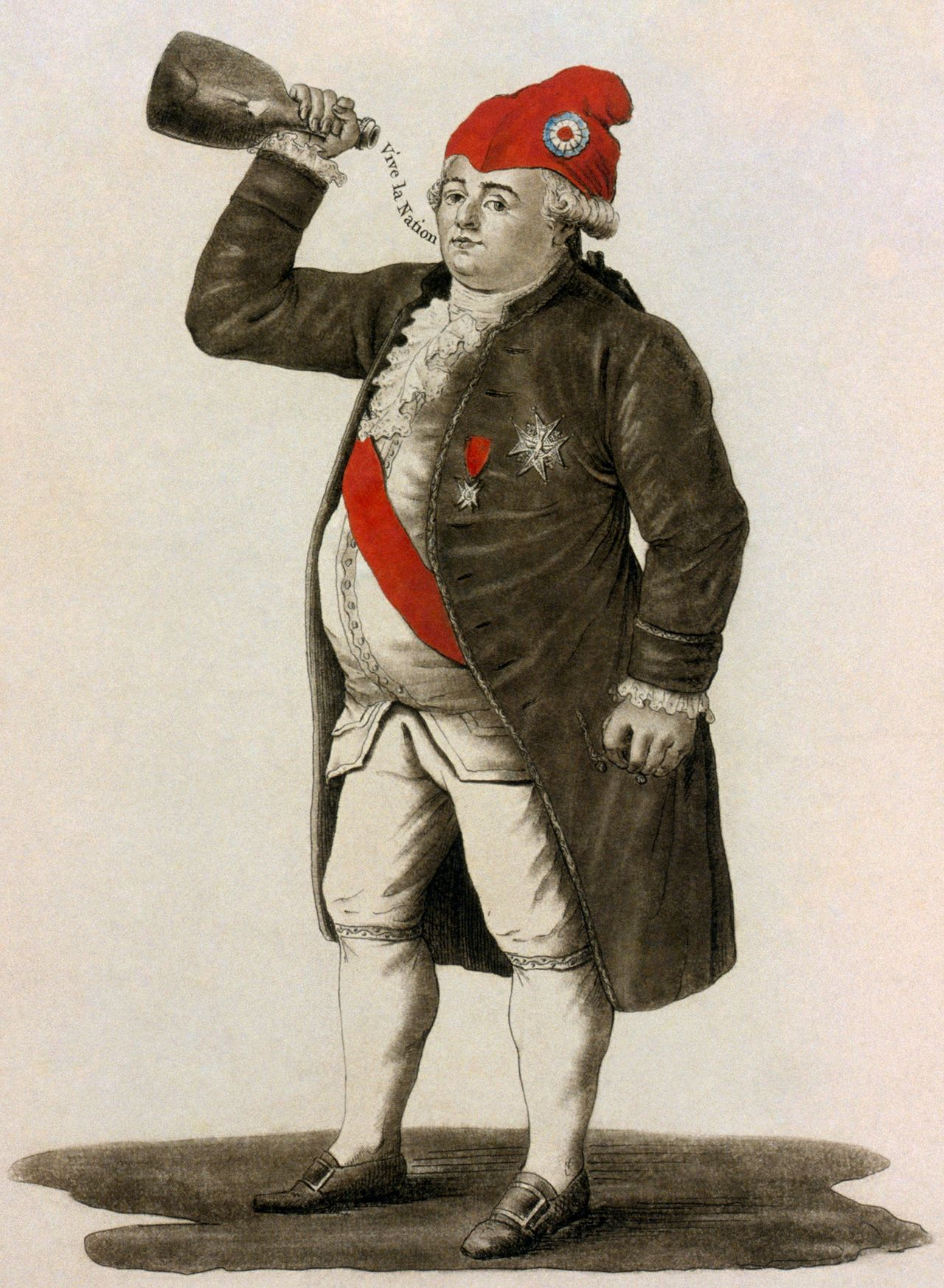
The other was a small circle of intellectuals. After Louis’s head was severed from his breeches, they began openly meeting in a Dominican convent, and so became known as the Jacobin Club, or simply the Jacobins. These former rebels worried that diffusing power among the unwashed masses would lead to disaster. Power needed to be recentralized–not on a new king, but on them.
In the short term, the Jacobins won. They consolidated power by guillotining anyone who tried to take Liberté, égalité, fraternité too literally. They did eventually realize they were probably guillotining too much, so they guillotined the guy whose idea it was to do all the guillotining. But rather than return power to the people, they vested it in Napoleon, who, to be fair, never declared himself king. He skipped right to emperor.
In the long term, though, it’s the Sans-Culottes who achieved near-total dominion, with cosplayers among the last holdouts.
Jacobitism Today
The Jacobites were the victim of their own success in France. Not that they didn’t have any victories after that. The Jacobinismo movement in Portugal is a notable example, although plagued by controversy over whether people named Diego count. But the French Reign of Terror had tarnished the Jacobite brand, illustrating that centralized power was always a threat to the people, even if it called itself populist. The popular support needed for revolution became harder to muster. In Spain, Infante Jaime, Duke of Segovia and theoretically the rightful King of France, made barely any effort to gain the throne of either country, beyond just declaring himself the rightful king every so often.
Jacobitism has dwindled, but not vanished. Israelite nationalism remains a significant force, although even they are divided between Zionists and “diasporic nationalists.” The Syriac Orthodox Church has over a million members, and many of the other Jacobite religious sects have survived in one form or another.
In terms of heads of state, though, it looks pretty grim. The only modern nations led by Jameses are Papua New Guinea and Montenegro. Oh, Jacobites had a good run in the United States, at first. The ascension of James Madison was positively textbook Jacobitism. Madison inherited slaves and land in Virginia, the Jacobite colony. Unusually for the time, he chose not to attend the College of William and Mary, named of course for the married cousins who had supplanted the Jacobite succession. Instead, he attended college in New Jersey, a colony that had backed the Jacobites. After the revolution, he eventually became the leader of one of the two major factions. The other had been led by Alexander Hamilton, who had lived a dangerous and hardscrabble life, long on manly derring-do and short on inherited plantations. Like Saint Iacobus, the first President James ascended by default after his chief rival was martyred. He endorsed James Monroe to succeed him, who won easily after the dying Federalist party made the critical mistake of nominating someone named King. But, by design, it’s hard to sustain a Jacobite dynasty in America. The Jacobites only won four Presidential elections after that, and none of those four (Polk, Buchanan, Garfield, and Carter) won a second term. The first pair, like Trump, is two of our worst presidents. Garfield only lasted a few months before being assassinated on a Monday, and Carter went by “Jimmy,” so arguably he shouldn’t even count.

During what I guess we’re still calling the “Biden Administration,” the Oval Office included a prominent display of an antique plate, made in China, commemorating the Jacobite Rising of 1745. There’s no explanation for this odd choice, official or otherwise, that I could find. Trump was compared to James II during the same period, due to his insistence that despite what the legislature said, he was the rightful President.
The British Jacobite line of succession currently falls to Franz von Bayern, who refers to this fact as a “charming historical curiosity.” A humble man, he seems content with a mere two palaces and the title of Duke of Bavaria, never seeking a throne. Also, he’s gay, so after him, the succession will…continue indefinitely, because it’s designed to always produce an heir, no matter how distantly related. We’re all in the Jacobite line of succession somewhere, so it will last as long as humanity itself does–according to recent projections, probably at least five years. A few organizations, such as the Royal Stuart Society, still consider Franz the rightful king, and list among their objectives “to uphold rightful Monarchy and oppose republicanism.” As bad ideas go, somehow making Franz the King of Something isn’t the worst. His family were active anti-Nazis, resulting in him spending some of his childhood in concentration camps. Knowing that Nazis are bad is not a sufficient condition for running a country (nor, these days, a necessary one), but it’s a start.
The French Jacobite line of succession, in contrast, devolves to whichever group of intellectuals wants to claim it. Currently, they seem content to run a leftist magazine, but we should probably keep an eye on them.
Note that as of this writing, the Papal Conclave had just started, so it is possible that by the time you read this, we’ll have a Pope with the birth name James Michael Harvey, Willem Jacobus Eijk, or Jaime Spengler. However, Popes are not permitted to retain Jacobite names, lest they found a hereditary dynasty.
Chinese Jacobitism
China has never had proper Jacobitism due to its paucity of Jacobs, but the Chinese version of Divine Right does exist: the Mandate of Heaven. It’s the same core idea, that the current ruler must be beloved of heaven or else he wouldn’t be ruler. Difference is, it has mechanisms for turnover: any large-scale disaster, whether or not the ruler was directly at fault, was historically seen as indicating that the mandate had been lost. This built-in explanation for regime change made the Chinese system a lot more meta-stable than the European one, although Chinese dissidents do occasionally try to game it by arguing that widespread dissent is itself a disaster and therefore automatically justified.
A Han dynasty encyclopedia entry, collected in the fifth-century Book of the Later Han, shows that China projected this idea onto Western republicanism. Their confused, and already-outdated, description of the Roman Republic includes the claim that
When a severe calamity visits the country, or untimely rain-storms, the king is deposed and replaced by another. The one relieved from his duties submits to his degradation without a murmur.
It also may be telling that the phonetic transcription of de jure, 德 聚熱, translates to “rightful due to strength/popularity/heat,” while de facto, 德 發出, translates to “rightful due to a line of descent.” But I’d warn against putting too much stock in doing comparative political philosophy based on linguistic coincidence. We see the folly of this in confused attempts to trace the history of ideologies such as “socialism,” “capitalism,” or “voluntaryism,” when there’s often very little actually linking the various groups advocating doing something involving society, doing something involving capital, or not being forced to do a certain thing.
Why I Am Not A Jacobite
The fatal flaw of Jacobitism is that it both demands and forbids the recognition of de facto legitimacy. Jacobites claim to be overthrowing an illegitimate leader in favor of a legitimate, de jure one. But their concept of legitimacy is always, when you dig deep enough, based on reasoning along the lines of “this ruler must have a divine mandate or else he couldn’t have won.” Why is Jacob the rightful ruler over Esau? Well, his mother said God wanted it that way, and obviously she was right because God always gets what He wants. Why is King James the rightful king? Well, the Norman Conquest established a line of hereditary High Stewards of Scotland, and then a Steward married the daughter of a victorious revolutionary, yadda yadda yadda, the House of Stuart is on the throne of Scotland, gosh wouldn’t it be convenient if they inherited England too, let’s make it happen. Why privilege the Jacobins over the Sans-Culottes? Well, they were the thought leaders of the revolution, because they were born into enough privilege to be able to read and write about political philosophy.
Invoking divine right is just iterating Jacobitism another step. I’m the rightful duke because the rightful king made it so. He’s the rightful king because God made it so. God has moral authority because He’s all-powerful. If God is literally or metaphysically prior to the Word, as some believe, he can’t be deus de jure, only deus de facto.
And don’t think you can escape this regress by invoking some kind of natural law instead. If your faction’s ascendancy is justified due to Marxism or Social Darwinism or whatever, you still have to argue that this isn’t a law we should try to fight. Humanity overturns natural laws all the time. We beat Malthus, why can’t we beat Marx? We defied gravity, why not also defy survival of the fittest?
The social utility of an arbitrary succession rule is real. It’s a Schelling point–as long as it happens to fall somewhere vaguely close to a fair compromise, the factions who got shafted probably won’t start a war. But this system only works if you’re willing to be a little que sera, sera about it. If your response to the wrong guy becoming king is to decide that we need to pick a different succession rule altogether, and make it retroactive…that’s just a standard civil war with extra steps. If blood’s being shed, the concept of legitimacy isn’t earning its keep. The precedent you’ve just set helps ensure that your chosen line will be overthrown, as soon as another Jacob comes along and makes his case.
Revolution is often necessary. The tree of liberty must from time to time be nourished with the blood of someone red (price-gouging Esau, purging socialists, electorally defeating Rufus King, and so on). But the justification for revolution should not rest on abstract notions of legitimacy–that only perpetuates the cycle. Revolution isn’t for fixing a broken system. It’s for smashing an unfixable one.