-
The Lyric
We will complete our series on Joanna Newsom’s music with the analysis of a single sentence from the last track of her last album. Heretofore our study has consisted of describing the emotions, images, and instrumentation of each song on the album. In this last installment we will get to reflect on deeper philosophical themes.
It might be an inanity to say, but music is a very different guide to emotions, ethics, and philosophy than social science. Much as I am drawn to using statistical evidence for understanding the world, in the secret revealed preferences of my actions, I find myself listening to music as though it is a true expression of these things as well, and by squirreling myself away with my earbuds or catching time alone on a long drive, I increase my active participation in those emotions, stories, and philosophies, philosophies which I might not feel justified in giving lease to if I was restricted myself to the thin light of inductive reason, universally acceptable first principles, and statistically significant findings. Music contains definite ideas, mostly about sex and drinking, but it also opines about love, death, joy, society, God or gods, romance, and fate. Music is not philosophy. Yet it is often about the emotions of particular philosophical experiences.
Nonetheless, that does not mean music is without reason or antithetical to analytic philosophy. Music can be analyzed and measured, and from that exercise we can size up the value, the utility, and the truth of its message. Certain albums, in particular, have always struck me as uniquely suited to drawing my own philosophical questions and inchoate intuitions to the surface. In stunning lyricism an entire album becomes an extended meditation on a sequence of philosophical questions and conundrums. Some albums even attempt to answer them.
Of all the music I have ever heard, Joanna Newsom’s album Divers (2015) perhaps does this best. And so in this review, we turn our attention to the simple task of explaining the full meaning of a single sentence from Newsom’s song “Time, as a Symptom.”
And it pains me to say, I was wrong.
Love is not a symptom of time.
Time is just a symptom of love(and of the nullifying, defeating, negating, repeating joy of life;
the nullifying, defeating, negating, repeating joy of life). [1]
First, we will look at this lyric's immediate content before turning to the broader context of the set of tracks in the album with occasional reference to where this album sits within Joanna Newsom's entire oeuvre. The lyric begins with a plaintive and mourning “I was wrong.” The sentence prepares us for the negation of a thesis outlined in the rest of the album. By saying that it causes her pain, Newsom indicates the new thesis might not be happy news. Perhaps it is painful because of the embarrassment of being wrong and the pain of changing one’s mind or because of the content of the new thesis containing a hard truth or both.
Admitting that one is wrong, of course, is the first skill one needs to arrive at any truth. And Newsom immediately follows up this declaration of fallibility with a crystallization of an old view and the statement of a new thesis. Causality does not flow the direction she originally thought. Namely, what seems to be true about the inevitable and inexorable power of time is not as inevitable as it seems. In other words the causality between love and time - which our immediate experience tells us runs from time to love, instead runs from love to time.
Newsom's diction is revealing here. In particular she uses the keyword: symptom. The track title invites us to consider “Time, As a Symptom.” The word symptom evokes a medical or diagnostic context—and the possibility of death. Because symptoms are simply consequences of some deeper cause, just as allergies are signs of sinus agitation, symptoms have no intrinsic meaning and thus are not the ultimate operative power. The question here is of priority: love is either a consequence of time or vice versa. So when Newsom says that time is just a symptom of love she is denying time's ultimate power. Time is not fundamental. But the question remains what does she mean by ‘time’ and ‘love’. We will have to compare her usage of ‘time’ and ‘love’ in the rest of the album to get a sense of the full claim being made.
Turning then to the next line, Newsom’s description pivots to a cascade of modifiers: nullifying, defeating, negating, repeating—and then finally their noun joy. The first three participles are explicitly negative; repeating is more ambiguous, yet it is still colored by monotony or burden. The noun comes as a surprising antithesis - joy. There is a joy that nullifies, a joy that defeats, a joy that negates, a joy that repeats and is a cause of time.
Thus our sentence admits an error and corrects the record. Time is caused by love and, perhaps to a lesser extent or in a different way the joy of life.
Within the track “Time, as a Symptom” our sentence is actually the second and stronger version of the thesis. The first version of the thesis was that ‘Time moves both ways in the nullifying, defeating, negating, repeating joy of life.” In the wider context of the song and album this means that the apparent tragedies of life can be undone.
As we saw in earlier songs like “Anecdotes” with its transmigration of bird souls, and “Divers” with the infinite regress, or the exhaustion of time in the “Waltz of the 101st Lightborne”, Newsom has been building up a series of poetic thought experiments in which conventional notions of time breakdown.
Thus the preceding stanza’s claim that time moves forward and backwards is a conclusion from a series of thought experiments. This prior description makes it sound as though the joy of life is an ether in which time moves, though I would not bet that the ether is what is intended. Nonetheless, it is clear in the context of our line that all the negatives of life are deeply linked and transmogrified by the joy of life. “Not axe, nor hammer, tumor, tremor can take it away.” The joy of life outshines cancer and earthquakes.
Here you might recall the Goddess of Cancer from The Goddess of Everything Else, the prose-poem in which all evils of the world caused by the primordial goddess of cancer are inexorably transformed by the great Goddess of Everything Else, who turns the evils into joy. “I won you by pieces and hence you will all be my children. You are no longer driven to multiply, conquer and kill by your nature. Go forth and do everything else, till the end of all ages.”
Even in the beautiful vision of The Goddess of Everything Else though, the gradual turn towards freedom happens within the medium of unconquerable time. We still expect time to ultimately destroy all value, and we expect that all the value that was lost in the march of time has been lost forever. Because death is just a biological phenomenon, it is easier to imagine an end to it than to time. If death is an enemy to be destroyed or routed, we can imagine technologies that successfully do that. But Time is such a dictator of our existence that even most speculative fiction can hardly mess with it without making terrible logical errors or crashing upon unresolvable paradoxes. There’s a reason the shaky handwriting reads, “DO NOT MESS WITH TIME”. And so most of the time we must accept the conventional view of the all destroying power of entropy.
-
Meaning of Love and Time as Outlined in the Secondary Imagery of Other Tracks
And it pains me to say, I was wrong.
Love is not a symptom of time.
Time is just a symptom of love(and of the nullifying, defeating, negating, repeating joy of life;
the nullifying, defeating, negating, repeating joy of life).
In order to fall into a proper understanding of our sentence, we must start with seeing the way the concept of love and time evolve throughout the album.
As you may recall the first track “Anecdotes” has a line which runs, “Anecdotes cannot say what time will do”. Here we have philosophy beginning with wonder.
Newsom starts out the album by casting doubt upon certainty and prediction. She takes on skepticism about what we can figure out regarding the nature of time. These things are cosmic and so it'd be presumptuous that the little twittering souls in this track, literally birds, can give precise or accurate answers on the nature of time or the nature of love.
These questions are motivated by some tragic loss. Commentators consider it the separation of a child from its mother through miscarriage or something like it. The song is addressed in parts to a child whom the family is waiting for. And the notion of miscarriage or a regretful abortion has been part of Joanna's oeuvre at least since the song “Baby Birch” in Have One On Me. In “Anecdotes” we are treated to a vision of birds in trenches, running recon missions, looking for “temporal infidelity.” As birds, they spend their time singing.
“We sing to the garden, and we sing to the stars,
and we sing in the meantime,
Wherever you are”
Singing is a universal sign of waiting or of actions that are inevitably lost. Because when a song is done all that remains is the temporary memory of its performance. Recall in Orson Welles’ movie F is for Fake the classic scene about Chartres cathedral and the loss and ultimate destruction of all things.
And speaking of inevitable destruction we must come to the next track’s perspective on time.
“Sapokanikan”, that next song, provides what we might call the first statement on the nature of time. The first line of which is “The cause is Ozymandian.” In this opening line, we find a statement on the philosophy of time very different from “Time_,_ As a Symptom.”
Here, Newsom offers us a sweeping, panoramic view of New York City, which was called Sapokanikan before the Europeans came. And ‘Ozymandian’ – yeah, quite the adjective. I like the pronunciation “Ah-zee-man-dee-an” personally. Most take the adjective as a reference to Percy Shelley’s poem, “Ozymandias”, the great poem about the fall of empire and eventual leveling of hubris and accomplishment. In fact, Newsom is intentionally referencing not the famous poem of Shelley, but the forgotten poem of the same name by Horace Smith, whose poem fortune has not preserved for posterity as an equal to Shelley’s. Poor Horace.
In Egypt's sandy silence, all alone,
Stands a gigantic Leg, which far off throws
The only shadow that the Desert knows:—
"I am great OZYMANDIAS," saith the stone,
"The King of Kings; this mighty City shows
The wonders of my hand."— The City's gone,—
Naught but the Leg remaining to disclose
The site of this forgotten Babylon.We wonder — and some Hunter may express
Wonder like ours, when thro' the wilderness
Where London stood, holding the Wolf in chace,
He meets some fragment huge, and stops to guess
What powerful but unrecorded race
Once dwelt in that annihilated place.
In reference to either poem though the thematic reference is the same. The noble cause of building New York City is like the magnificent efforts of the ancient kings, and like them ultimately doomed.
An alternative interpretation of ‘the cause is Ozymandian’ is that the foundation of all history is the painted over, ruined, reappropriated spoils of a now-forgotten something else. Just as New York is built over Sapokanikan, or Shelley has eclipsed Smith, and the paintings of Titian have first drafts of different subjects hidden within them, history is not merely one thing after another, but also one thing replacing another ad infinitum.
The city, with its shifting names, forgotten peoples, rusting monuments stands as a symbol of how utterly time obscures meaning. This is a common enough theme in literature. From F is for Fake by Orson Welles, which we already saw, to “The One Moment” by OKGO. The tender idea of rejoicing
“Look on my Works, ye Mighty, and despair.” And yet there are no mighty left to do the looking. Time devours indiscriminately. The good and the bad are buried side by side, and the future will not know the difference.
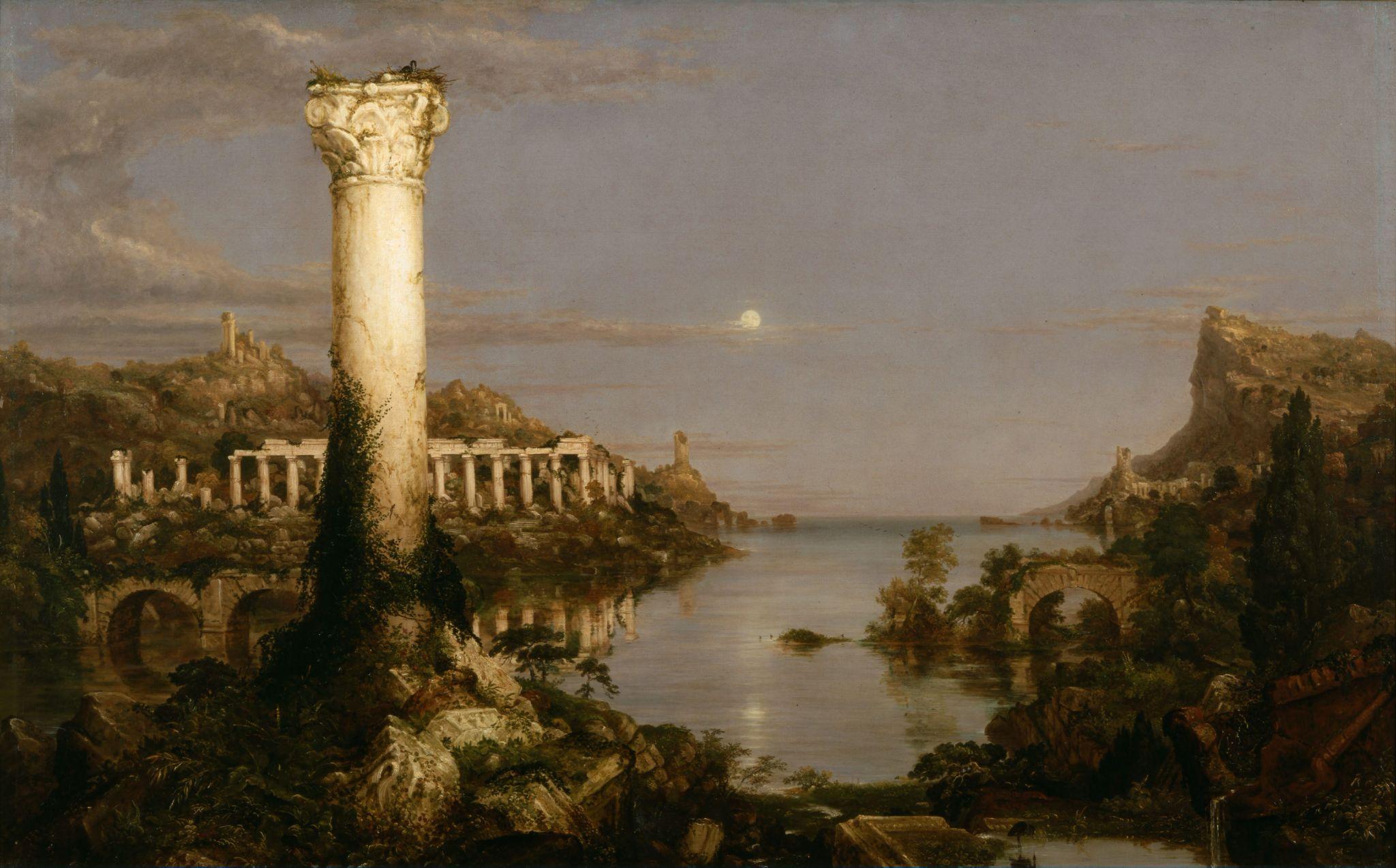
Desolation, Thomas Cole 1836
—
Newsom provides a counterexample to the standard Ozymandian view of time. She presents a different experience in the later track “The Waltz of the 101st Lightborne.” Told in the style of an English lament or love waltz - you know the typical motif: a maiden sings of the separation of her love who has gone off to war or out to sea - “The Waltz of the 101st Lightborne” transfers the theme to a lover gone off to fight in a slipshod space war spanning galaxies, a World War IV between worlds. How does this contradict our standard view of time? As we know from our standard science fiction fare, at sufficient distances or speeds the notion of a shared present breaks down. Time passes slower or faster for different parties.
In the words of the song, “you and I cease to mean now and began to mean only right here.” And while her lover is off fighting a war, she is left like the legendary Ariadne on “a round desert island beneath the sky where the sailors have gone.”
In this strange spacetime, “you and I” no longer mean now; 'Now’ stops having meaning when each lover's now means something different. This shift from time stamps to distance marks the collapse of shared presence. Does love persist when it is unmoored from time?
Newsome adds that the war is locked in “eternal return and repeat” and time has become like a stack of slides we can sort through but for which there is not enough space to fit all the times. The idea of seeing time as a series of slides is not new. In a previous post discussing this waltz, several commenters wanted to point out the similarities with the ballad "Time Adventure" from Adventure Time. That ballad accepts the conventional "Ozymandian” view that time beats on. In "Time Adventure" the picture gallery view that we could walk down the hallway of times past is fleetingly wished for. The point of the "Waltz of the 101ˢᵗ Lightborne” is that the universe isn't made up of time in any conventional sense, and so the idea that we can wait for the return of our lover is simply wrong; time doesn’t flow the same for us anymore. He is “lost in those windy highlands.”
Turning from the concept of time to the concept of love (and death) the album title song is “Divers”. Divers is a pun in “Anecdotes” for the birds which dive bomb in the war and literal pearl divers, and in the context of the album, each track is its own type of diver into unique themes.
“Divers” opens up a new question, which will prove relevant for understanding how it is that love could be a symptom of time. Admittedly, “Divers” has a lot going on in its 7 minutes. But we will try to narrow down our discussion to one question explicitly asked in sincerity, “Why is the pain of birth lighter-borne than the pain of death?”
The phrasing here is relevant. Lighter-borne is an explicit reference to the previous 101st Lightborne Elite, the name of the military unit the maiden's lover had been sent off with, some intergalactic paratroopers. Why is it lighter-borne? Whether we are coming into this world or leaving it, it's all the same within the picture gallery view of time. The causal model is ambivalent about direction. Yet because we rejoice at birth and we mourn at death, there must be something tragic about death, namely that the distance between life and death is infinite.
In the penultimate song of the album A Pin-Light Bent Newsom assumes the perspective of a plane flying at night over a coastal city —headed, it seems, toward a terrible crash. From this vantage, the speaker peers down at the scattered lights of towns and homes below, each one glowing in the darkness, fleeting and fragile. These lights become metaphors for individual souls—points of consciousness in the vast, dark box of the universe.
When you were a child you might have taken a cereal box and put pin holes in it and looked into the top of the box and pretended each little light coming in was stars in a black night sky. Now of course, stars are their own little chemical reactions, they are not holes in the sky from which the eternal light of the beyond pours through.
Newsom takes this ancient celestial idea about stars and applies to the soul in this track. Is the souls simply a self-contained flicker within this dark enclosure—a little light caught in the box? Or is it something more—something from outside the box, something not of this world, that has pierced the cosmos and lodged itself inside?
The Great Light that shines through a pin-hole,
When the pin-light calls itself Selfhood,
And the Selfhood inverts on a mirror
In an Amora Obscura
Just as a camera obscura takes light and flips into an image, the “Amora Obscura” flips the infinite light that comes from beyond and shines it into love and loving beings. We carry this light inside us until we die, just as we carry “the borrowed bones” mentioned in track 1 “Anecdotes.” Our life is lent to us by the Great Light.
This proposal is crucial in getting us back to an understanding of what Newsom means by “Time is just a symptom of love.” The first ten tracks of the album explore key ideas about time, love, and death so that the conclusion is not a trite statement but an outworking of many intertwined ideas, which will work themselves out again when we relisten to the whole ensemble.
So when we combine the philosophies of “Divers” and “A Pin-light Bent” the pearl of Selfhood is gathered from the infinite sea of existence or is a funny light which reflects on itself. In either case the origins of the Self originates from beyond the universe.
And at last I think we are ready to explicate it fully.
-
Conclusion: Transcend…
And it pains me to say, I was wrong.
Love is not a symptom of time.
Time is just a symptom of love(and of the nullifying, defeating, negating, repeating joy of life;
the nullifying, defeating, negating, repeating joy of life).Hardly seen, hardly felt–
deep down where your fight is waiting,
down till the light in your eyes is fading:
joy of life.
Where I know that you can yield, when it comes down to it;
bow like the field when the wind combs through it:
joy of life.
And every little gust that chances through
Will dance in the dust of me and you,
With joy-of-life.
And in our perfect secret-keeping
One ear of corn,
In silent, reaping
joy of life.
Newsom began the album with Job-like wonder about a lost child and questions the nature of time, and through a series of reflective vignettes on love, life, rent (we never got into her descriptions of NYC apartments), she settles on the idea that the self comes from some infinite unbent light that extends from forever, and the good things in life, the soulful things in life, have a repeating eternal aspect locked in them. But because each self is its own geographically distinct bottling of light, all the tragedy of separation is contained in our world as well. It cannot be any other way. For there to be selves, there must be distance between the selves that exist. Time and existential pain and woe come about as a result of the distance between ourselves and the original light.
Though we fall in love, are separated, weep tears for ourselves, or never meet our expected child, these little slides of time can be faced bravely. Not with the grim determination of something like Henley’s “Invictus,” but with the tender spirit of hope in the Eleusinian mystery of rebirth, the possibility that all the broken pieces return to their original source. Instead of ashes to ashes, we ascend light to Light.
Joy, whether it be recollection of the original blessedness of universal light or the face of your own newborn child, allows us to fight against death and despair and, ultimately, to yield to death when it comes. Those lines “And in our perfect secret-keeping // One ear of corn // In silent, reaping” are a reference to the Eleusinian mysteries of the ancient Athenians in honor of the goddess of grain Demeter and the cycle of rebirth of the earth.
The Eleusian mysteries were based in the Attic fields northwest of Athens, where the first ear of grain grew. These rituals to Demeter were one of two cults that emphasized rebirth and held a candle out for overcoming death (the other was the cult of Orpheus).
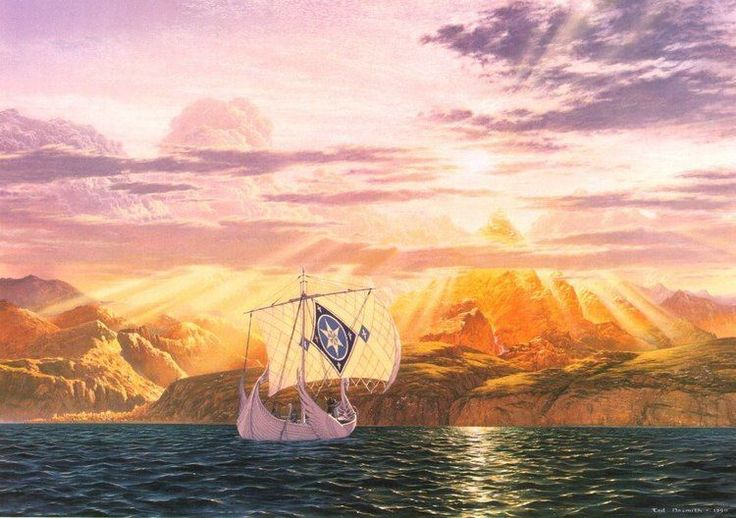
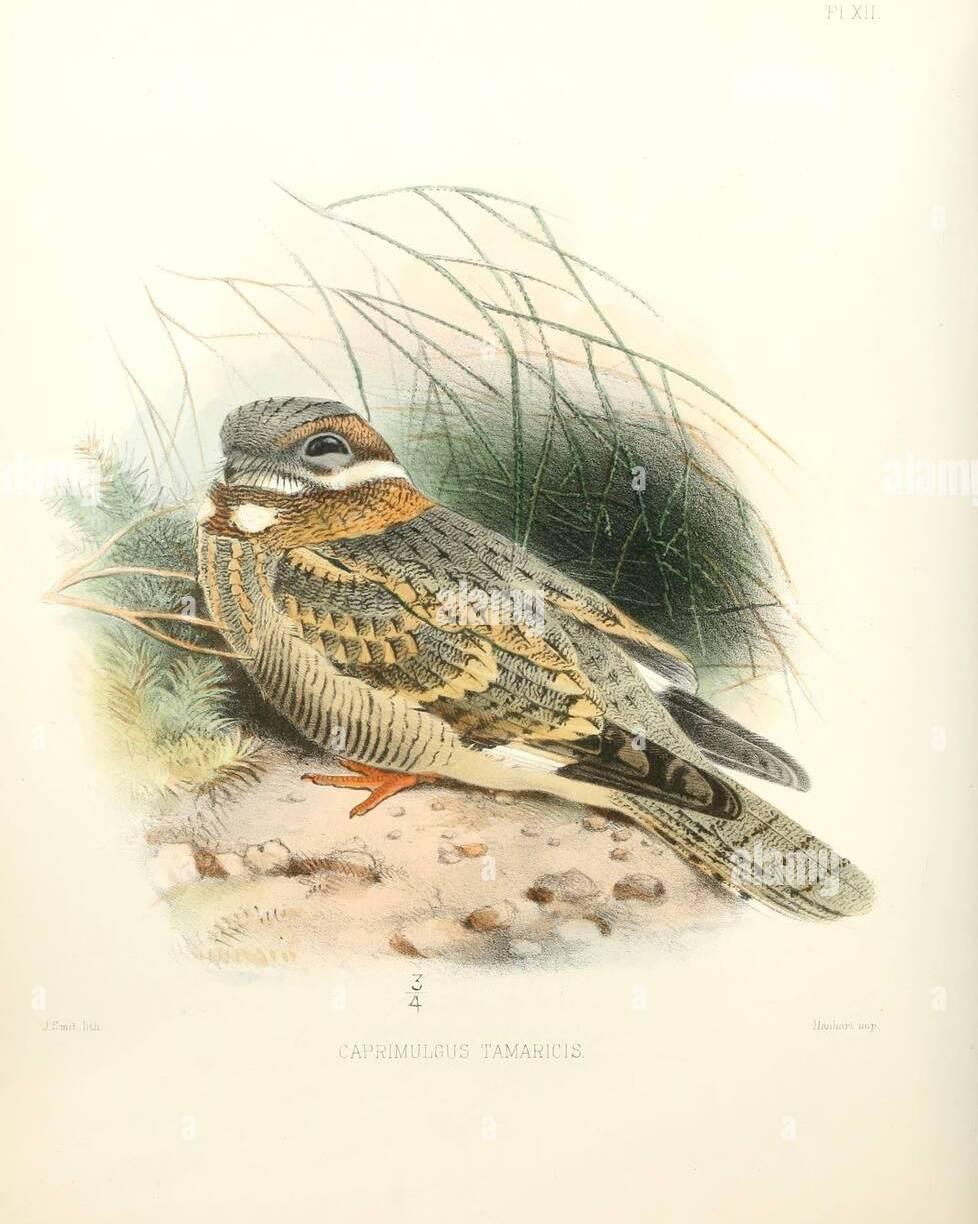
Newsom claims more than Orson Welles' F is for Fake. Welles said that we should go on singing and go on building cathedrals and beauty in spite of the ultimate destruction of all things. It's not enough that we end the human story with there being joy in spite of the sorrow. So Newsom finishes the album with a vision. She quotes that mad-cat, fever-dream of a book Finnigan’s Wake by James Joyce, you may know the book. It ends “A way a lone a last a loved a long the”... and continues where it ends “riverrun, past Eve and Adam's, from swerve of shore to bend: of bay, brings us by a commodius vicus of recirculation back to: Howth Castle and Environs,” thus breaking off mid-phrase to continue with the first line of the book again. Newsom, like Joyce, will also refuse to end the album, leading us right back into the beginning again. She invokes cyclic history, the Resurrection, the Eleusinian mysteries, Valinor, the end of time, and a command to her comrade the fellow bird in the first track, Rufous Nightjar, to transcend. At the end of our individual and collective histories Newsom places transcendence and continuation. No end.
Joy! Again, around-a pause, a sound-a song:
A way a lone a last a loved a long.A cave, a grave, a day: arise, ascend.
(Areion, Rharian, go free and graze. Amen.)A shore, a tide, unmoored–a sight, abroad:
A dawn, unmarked, undone, undarked (a god).No time. No flock. No chime, no clock. No end.
White star, white ship–Nightjar, transmit: transcend!
White star, white ship–Nightjar, transmit: transcend!
White star, white ship–Nightjar, transmit: trans
https://www.youtube.com/watch?v=PYefVGPHAE8
[1] I used the official lyrics sheets from the vinyl album for punctuation, line breaks, and capitalization in these lyrics. This does frequently affect the meaning. Use internet lyrics with care, my friend!