As two single women living in the populist era, we’ll start this review of Kakistocracy by Richard Hanania with a sample of people that we've dated. Identifying details have been abstracted out, but the spirit is accurate.
- A talented, popular writer and exited founder who started posting increasingly outlandish theories about the world on his Instagram story. First obliquely, then overtly. One day, he sends his girl an episode of Candace Owen’s podcast discussing how Brigitte Macron was really a man, urging her to watch it. She humored him and listened to the entire six-hour series. Unconvinced, she reports back that (a) Owen’s ‘evidence’ was circumstantial, and (b) for such a claim to be true, we would have to accept that basic record-keeping in one of the world’s wealthiest, oldest, and most well-established states was utterly unreliable. This would imply an epistemic epidemic fatal to bureaucracy and human knowledge. This man replied Exactly, don’t you get it? We’ve also been lied to about the Holocaust.
- A once-progressive physics postdoc leaves his university, disgusted by how woke-cucked the universities have gotten, despite the fact that his field remains decidedly unwoke. Soon he shifted his focus to how American society at large had become race-cucked, starting to identify explicitly as racist, and expressing concern that illegal immigrants were committing mass voter fraud to elect Democrats. When friends said they were worried about the rapidly declining quality of his epistemics, he was too angry to speak, and refused to engage.
- Lest we be accused of female chauvinism: Our male friend, a venture capitalist making seven figures started dating a lawyer. Her expectation was that our friend would become a stay-at-home Dad while she focused on her career, because he’d already peaked professionally, and she deserved the opportunity to do the same. When he objected, she accused him of being a misogynist.
So, while we picked up Kakistocracy to understand the rise of populism globally, we found our minds often wandering to its undeniable impact on our personal lives, wondering how the hell we’re supposed to date in a climate like this. Given the notable decline in marriage, fertility, and even sexual activity rates among adults under 40 relative to earlier generations, we’re far from alone in this. Politics is eating us alive, and many people (especially women) are opting out of the heterosexual dating market entirely. This further drives the bifurcation of Gen Z (and the world at large, but especially those who’ve never known life sans-internet) to two populist extremes. On the one hand, there’s bitterly anti-capitalist, pro-queer, pro-minority left-wingers in an eat-the-rich-and-kill-all-men memeplex. On the other, we have gleefully homophobic, misogynistic, racist right-wingers who fantasize about a retvrn to a past that never existed. Both of these sides nominally want bloodshed. It’s not clear which of them are serious about that. The reasonable, rational middle is shrinking every day as slop-filled social media feeds profit off of heightened emotions and poor thinking.
Now, you may question our taste after discovering we’d have let such people kiss us, but we swear that we didn’t date extremists knowingly. And if you’re furrowing your own brow, thinking “But the universities are cucked! At least those guys are rejecting woke orthodoxy. The woman who wants to oppress her partner is worse.” — then Hanania’s takedown of populism is required reading for you, specifically. You’re reading ACX in your free time, or while Claude orchestrates agents in the background at your six-figure job, so you’re probably smart, curious, and interested in truth. At some point, you’d have agreed that racial and genetic determinism are unserious, and should not be entertained as a basis for state policy. (We agree that race is nonfungible & that men are obviously stronger than women, but we still want to vote and have credit cards, thanks.) But disillusionment with DEI, #MeToo, cancel culture, and generalized white-guy-hating (perhaps from dating women like #3 above) can balloon into reflexive skepticism for all mainstream attitudes and the elites that shape them.
Reclaiming intellectual independence means questioning everything, obviously. Institutions deserve mistrust, and mavericks brave enough to dismantle them deserve credit, right? Hanania would say you’re wrong, and that you really don’t want to make your bed (metaphorically) with people like this, because they’ll produce worse outcomes for your country if you put them in charge.
We’re going to follow Richard Hanania’s example and focus for now on the right-wingers, because those are the populists rising to power around the world, and they snuck up on us. Somehow, we anticipated the political movement but failed to predict it materializing in men we admired. Those men were smart by any objective standard, charismatic, intellectually curious, disagreeable-in-a-hot-way, conventionally attractive, professionally successful in cognitively demanding fields, and enthused about the idea of putting babies in us. We met them through friends and thought they’d make great partners, until they decided that women are constitutionally incapable of making good decisions for themselves, that the demographic decline of white America is the seminal spiritual and moral issue of the era, and that the Jews are deliberately encouraging mass migration to undermine the white man.
We’re too post-woke to say that we’re “liberal” on Hinge, but we’re not based enough to stomach worldviews like these. Our objections are primarily epistemic, because we thought we were selecting for good epistemic hygiene. We’d avoided the “white supremacist cis-hetero-patriarchy is responsible for every problem” types because their oversimplified explanations for complex issues made us nuts. We’d sought social circles that prized intellectual integrity, and we basically succeeded—our mutual friends are as wide-eyed at their transformations as we are. Initially, they shared our eagerness to look granularly at complex issues, our preference for evidence-based arguments over vibes-based proclamations, and a willingness to admit error when presented with data that ran counter to previously held beliefs.
This all went out the window when they started to meet legacy institutions with baseline distrust. Their pet theories—which drove them to varying degrees of obsession—were tenuously supported at best, and fabricated at worst. When they started pointing fingers at the same villains for every issue, their once-tight grip on reality loosened. Rejecting overly-libbed-out institutions meant embracing an intellectually impoverished media ecosystem that amplified every identitarian grievance. They became mirrors of the unmeritocratic movement they’d derided. By the time we stopped speaking to them, we feared they were angling for a race war.
One of us had a boyfriend in high school who said politics was pointless. While she chewed him out then for his straight-white-guy indifference to social issues that didn’t affect him, she now laments the extinction of center-right Mitt Romney types and old-school genteel bigotry too subtle for her former sweetheart to clock. Kakistocracy, in a sense, is a call to resurrect that bygone era, sounded by one of the men most responsible for killing it. That starts with learning what went wrong, how, and why, so we know why it’s worth bringing it back. But first…
Who is Richard Hanania?
Long before he was famous under his own name, Richard Hanania pseudonymously penned white supremacist diatribes as part of the budding alt-right movement in the early 2010s. He'd long disavowed such views—even cringing that he’d once been bitter and hateful enough to hold them—-by the time wrote what’s arguably one of the most impactful Substack articles of all time. In “Woke Institutions are just Civil Rights Law,” he points out that repealing Executive Order 11246 would undo the legal basis for the DEI regime that underlies cancel culture. Fellow nerd Vivek Ramaswamy read it, invited Hanania onto his podcast, and incorporated it into his platform while running for the GOP presidential nomination. Afterwards, Hanania wrote The Origins of Woke and even became a co-author of Project 2025—yes, the roadmap Trump is currently following—spelling out the unmeritocratic, ideologically-motivated overreach of an order originally intended only to prevent blatant discrimination. President Trump put his pen to the relevant paper on the very first day of his second term, a resounding victory for the anti-woke crowd, handed over by a technocrat who quickly regretted his endorsement of the movement he openly derides. He’d already derided them by the time he cast his 2024 ballot for Trump; he believed that capitalism was simply more fragile than democracy, but he soon learned he was wrong on multiple counts. Kakistocracy isn’t exactly a mea culpa, but a detailed warning about what happens when a country continues down the path of populism, and a suggestion of how to course-correct back to governance by organic elites, instead of rule by the worst. Hence the title, a Hellenistic term that literally means “rule by the worst.”
We think that Hanania’s checkered history and undeniable influence make him the perfect person to write such a tome. He’s reflexively dismissive of cancel culture and Marxism, but he's not a nativist or a misogynist. He used to be, but he walked away because he became convinced that pro-market liberalism is empirically superior to every other political ideology. He openly admits that he was unhappy with the state of his personal life and career prospects while he was indulging in violent fantasies about white supremacy—the fact that his parents are Palestinian and Jordanian only underscore that his past self was living in delusion, not reality. He even admits that his derision for the most rabid bigots in MAGA base comes from seeing a version of himself in them, a guy he could have been if he weren’t smart enough to earn a law degree and a PhD simultaneously. It takes a remarkable degree of integrity and humility to confess to such a thing publicly.
That said, this book isn’t for everybody. It was unabashedly written for the type of intellectual policy wonk who’ll hungrily gulp up detail after detail. Those who enjoy his funny and snarky style on Substack may be surprised by how dry and serious Kakistocracy is in comparison. We laughed occasionally, but he’s not flippantly using memes or cartoons from ChatGPT to lighten the mood. He is, after all, a trained political scientist, not just a blogger, and his treatment of the facts is thorough. He carefully contextualizes social science research, often commenting on clever methodologies or the strength of a particular finding. He shares numerous historical case studies on the rise and outcomes of various populist movements worldwide, only rarely making caveated moral statements on the nature of their rhetoric. He identifies limitations to empirical investigations (for example, we can’t randomly assign populist leaders and controls in order to test whether bad outcomes are primarily the result of a bad starting point, or bad governance) but suggests how we can still usefully extrapolate from data that we do have.
The only bias that Hanania displays is his clear preference for what he calls “organic elites,” who tend to be smarter, more open, more honest, and generally more capable than the common man. He thinks that organic elites deserve to rule because they’re better at it, and that electing populists ensures that they won’t.
The core thesis of Kakistocracy is that populism is bad for Western democracies, and that elites should wrest back control. A revolution in communication technology—social media, podcasts, the internet in general—has amplified anger and cynicism, driving anti-elite sentiment despite their objectively good governance. Elites make mistakes, sure, but they’re still far better at governance than “artificial elites” appointed through cronyism. The opportunists who necessarily rise in populist movements have either compromised epistemic integrity or basic morality in order to gain power, or fell for its bad arguments out of pure cognitive deficiency. Because organic elites try to impress each other, not the masses who’ll revolt if you tell them a truth that they don’t want to hear, they produce better outcomes for their countries.
Hanania makes some great points, so we’re wingmanning—making Kakistocracy legible so that you have a sense of what you’re getting into. The book comes out in July 2026. Plus, as women who used to be woke, we’re dialed into some dimensions of social reality that Hanania only slightly touches on, so we’re going to intersperse our summary with explorations of concepts we found particularly useful or intriguing.
Summary of Kakistocracy’s Main Arguments (pt. 1)
This is most of his arguments, as concisely as we can manage. If you want to nerd out over specific historical examples and social studies (like we did), you simply need to read it.
“Populism begins by deciding who the heroes and villains are and works from there.” It’s an identity-based, tribalistic worldview that positions “the people” against an “elite” that they resent for being “self-interested, out-of-touch, and corrupt.”
- All populists “assign status based on a direct connection to a mass audience or voters, rather than success within established institutions.” They hate credentialism and love mavericks with millions of followers. They’re more open to “mysticism and the supernatural” than elites, and they hate hierarchy. Ironically, populists also love a charismatic leader, whom they’ll rally behind to the extent of deification.
- Right-wing populists resent an “elite” that’s forcing diversity and ‘gender ideology’ down their throats. They’re social conservatives with traditional views—so they lean religious, xenophobic, misogynistic, homophobic, and transphobic relative to both liberals and elites. In the modern era, they tend to read less than other groups, and are largely uninformed about news and skeptical of science (because those are the domains of the “elite” they mistrust.)
- Left-wing populists get less attention from Hanania, but he acknowledges that their resentments are often class-based: Communists hate the rich, and blame them for everything. We’d suggest that left-wing populism also villainizes men, the West, America, and white people specifically.
Elites mostly interact with “people of similar cognitive ability and personality traits,” and they’re less beholden to the opinions of the masses. This meaningfully changes their behavior and worldviews.
- Elites “participate in or have contact with established institutions that have traditionally had cultural, political, and social power.” Think Harvard, The New York Times, the NIH, and dozens of other gatekept institutions.
- Elites often had to leave home to seek opportunities that intellectually excited them, so they’re naturally higher openness compared to populists. They congregate in bubbles where they’re exposed to brilliant people of all stripes, so they grow a higher tolerance for diversity, and even come to see its merits. So, organic elites trend less xenophobic and traditionalist than the average person, independent of political leaning.
- Their norms and professional incentives center around impressing each other with intellectual prowess and cultural refinement. This means, in short, that they’re better behaved. You can get cheers from an angry mob by crucifying their enemies, or the fawning love of a crowd by flaunting ostentatious wealth, but such displays are gauche and low-status among elites. (We’ll get into this later.)
Organic elites tend to maximize meaning, rather than maximize wealth, so earning status means displaying both epistemic and moral integrity. (Prepare for diagrams. We had to map this.)
- Journalists, researchers, and professors are all intellectually capable of landing high-paying jobs, but choose careers that allow them to produce knowledge—aka, seek truth. Since these aren’t good paths to making lots of money, most people are in it for the love of the game.
- Their in-group norms and professional standards are highly effective at discouraging dishonesty and corruption. While it would be trivially simple for grad students and their professors to coordinate bribery for grades, this virtually never happens. Academics whistle-blow on each other in the rare case of fabricated research, and the replication crisis in social science became a key issue within the field because the researchers themselves were inclined to address it. Being exposed as an intellectual fraud permanently tanks your reputation within elite circles, both professionally and socially; the same cannot be said elsewhere.
Populism, like all forms of tribalism, makes people bad at logic. Following populist logic, therefore, generally leads to worse outcomes.
- “There is a general finding in social science that people become worse at reasoning when political identities are invoked,” and group identity is even more salient than stated ideology. Read: people don’t evaluate information accurately when it would turn them against their in-group. This is a general human tendency, but some people are better inoculated against it than others.
- Elites want to impress smaller and smarter audiences that value epistemic integrity even in the face of personal inconvenience, while “populism has the further problem of making a virtue out of its tribalism.” So organic elites look especially favorably on a liberal who can admit the merits of a conservative position, but left-wing populists will excise dissidents from their midst. (You can reverse the polarization, and the logic holds.)
- Because populists have to perform for a larger and yet less sophisticated audience, they favor oversimplified explanations that don’t have to map onto reality. They have lower epistemological standards, and lean on “charisma and emotion-heavy or sophistic debating tactics” over boring, complicated, unsexy, and/or unflattering truths.
- Populist rule—when populists pander to the tribalist demands of their base, rather than making decisions based on empirical reality and sound moral judgment—is associated with lower GDP, weaker checks on executive power, erosion of judicial independence, declining civil liberties, and attacks on the press, academic institutions, and research institutions. In fact, the countries with the worst growth outcomes between 1950-2023 fall exclusively into 2 categories: countries that elected populists over a long time horizon, and failed states, meaning that populist regimes can be as economically damaging as civil war.
A revolution in communications technology, rather than widespread failures of elites, has caused the rise of populism internationally. These movements feed off of each other and inspire each other, and savvy populists leaders motivate their own bases by pointing to horrors and successes abroad that serve their own ends.
-
Standards of living across the world have been increasing over the last many decades, with fewer casualties in fewer wars than in any previous century.
-
While populist movements often center nationalism, the rise of populism isn’t correlated with immigration, nor with economic outcomes.
- The American economy has bounced back stronger from COVID than other Western democracies, and Americans are about as likely as Belgians, Swedes, and Spaniards to affirm that elites are doing well. Yet, America has the most powerful populist movement of any wealthy nation.
- India and Hungary have also elected populists, despite benefitting immensely from the globalism embraced by their predecessors.
- In general, Europe’s checks on populist power persist despite weaker economies and greater criminality of their immigrant populations (which might justify an even greater nativist uptick than in America, where immigrants are less likely to commit crimes than native-borns).
- Meanwhile, Latin America has seen a rise in populism despite experiencing low immigration.
-
Hanania suggests that this international phenomenon is stoked by a new media ecosystem that operates on a currency of rage, combined with local conditions that may enable any particular populist movement’s rise to power, independent of the objective performance of their elites. The populist crafts his message to his people, and charisma is often a driving force of his success.
- “There is a general discontent that is being spread across the globe due to the internet and smartphones, which people all over the world have access to, and the resulting cynicism and anger manifest themselves in different countries according to the extent to which local conditions are conducive to the rise of a populist challenge to elites.” In Latin American countries with high crime rates, you get figures like Bukele, who enjoy high approval ratings for taking brutal measures to drop the murder rate. In America, which prides itself on being the wealthiest country in the world, you get a celebrity like Trump, who lives the lavish rich-guy life that proves he’s better than his haters while still voicing his base’s nativist resentments. In Hungary, you get strongmen like Orban pointing to an influx of migrants elsewhere to justify his own regime.
Populism is inherently pessimistic and often leads to conspiratorial thinking, which in turn drives populists to more and more extreme beliefs.
- The classic newsroom adage that “if it bleeds, it leads,” captures that shock, horror, and outrage have more mass appeal than detailed, nuanced, and unbiased information about complex situations. Hanania only touches on social media briefly, but the overwhelming popularity of ragebait on X also speaks to the truth of this logic. Anger is easy to evoke—so mean, pithy dunks on a public enemy go megaviral far more often than lengthy, well-researched, and counter-intuitive claims on the same subject.
- “The informational environment we find ourselves in matters, and determines how connected we are to reality.” Because populists disavow legacy institutions, they turn to independent ‘sources’ (read: podcasters) who aren’t held to any standards of rigor or objectivity. This means they’re often exposed to outright conspiracies framed as hidden knowledge. Joe Rogan, Tucker Carlson, and Candace Owens all come to mind.
- One of the few grievances that MAGA has expressed with President Trump is that he delivered a COVID vaccine. This is utterly illogical, because the vaccine inarguably saved millions of lives: comparisons between death rates in blue localities (where vaccine rates were high) versus red states (where they were low) provide incontrovertible evidence of its effectiveness. Even the timeliness of Operation Warp Speed was hailed as a victory by Trump’s most ardent, chronic critics on the left, but the anti-science contingent of his base has grown so powerful that he’s stopped bragging about it. He even capitulated to their lack of reason by appointing anti-vaxxer Robert F. Kennedy Jr. as the Secretary for Health and Human Services.
The calibre of personnel in populist administrations falls off a cliff as an “artificial elite” rises due to cronyism rather than merit.
- When a populist administration is still largely staffed by organic elites—like in the case of President Trump’s first administration—their worst impulses are held in check, and economic outcomes don’t suffer. Unfortunately, organic elites are often allergic to populist leaders, because they have bad ideas and demand uncompromising loyalty. Many of those career bureaucrats have since disavowed him, and the field of qualified and willing administrators winnowed by his second term.
- Talented opportunists like JD Vance can easily take advantage of the power vacuum. His currently stated beliefs perfectly contradict those from his breakout book, Hillbilly Elegy, and as a Yale-educated lawyer, he certainly has the intelligence to know when he’s making false statements, but he lacks moral fibre. Or, perhaps, he’s gulped down all the koolaid and is now a true believer.
- Less-talented opportunists and true believers simply perform their jobs poorly, like FBI Director Kash Patel, HHS Secretary Robert F. Kennedy Jr., or former Attorney General Pam Bondi. Hanania is especially disgusted with the appointment of Kash Patel—unlike every recent FBI Director, Patel’s nomination passed on a partisan 52-48 vote, rather than nearly unanimously. This is unsurprising, because his credentials were “loyalty to Trump,” rather than any elite affiliations or even a distinguished career that would have inspired literally any other president to offer him such an office.
- While former Dir. James Comey refused to even play a friendly game of basketball with President Obama for fear of conflict of interests, Patel was previously a board member for the company that owns Truth Social, and regular guest on right-wing podcasts discussing the supposedly stolen election. Recently, Patel was in the news for taking his girlfriend snorkeling at Pearl Harbor—the largest gravesite in American waters. This million-dollar date on taxpayer dime certainly makes him a trailblazer.
Populism trends to authoritarianism, just as authoritarians embrace populist rhetoric to justify their continued reign. Both undermine democracy while pretending to represent the will of the people.
- Organic elites will block ill-advised populist policy if given the opportunity, so illiberal actions secure populist rule. Both Trump and Brazil’s Bolsonaro denied the results of a democratic election—instead of rejecting democracy on principle, they legitimize the idea of the system and claim they were cheated, which gives their base something to be angry about. In Hungary, Orban imposed burdensome regulations on troublesome media outlets and bought them up when they financially struggled, consolidating a media arm & preventing critical coverage of his party. He also attacked Central European University directly, imposing legislation that made it impossible for them to remain in Budapest. Poland’s PiS forced judges into early retirement and appointed loyalists, and responded to criticism by turning their state broadcasters into “an organ of progovernment propaganda.”
- Meanwhile, “spin dictators” like Vladimir Putin and Xi Jinping embrace rhetoric that carefully paint themselves as representing the will of the people, protecting them from foreign elites with questionable values like femininity, homosexuality, and liberalism. They “buy off pestering journalists” instead of locking them up as traditional dictators would have done, and run sham elections rather than ban them. Since their parties have long-ago consolidated power, the “elites” must be foreigners, and Putin comments on culture war issues that have little practical relevance to his base—as with all populists, emotional salience trumps policy considerations.
Rather than continuing to summarize, we present this graph of modern archetypes that the populist-authoritarian axis reminded us of. 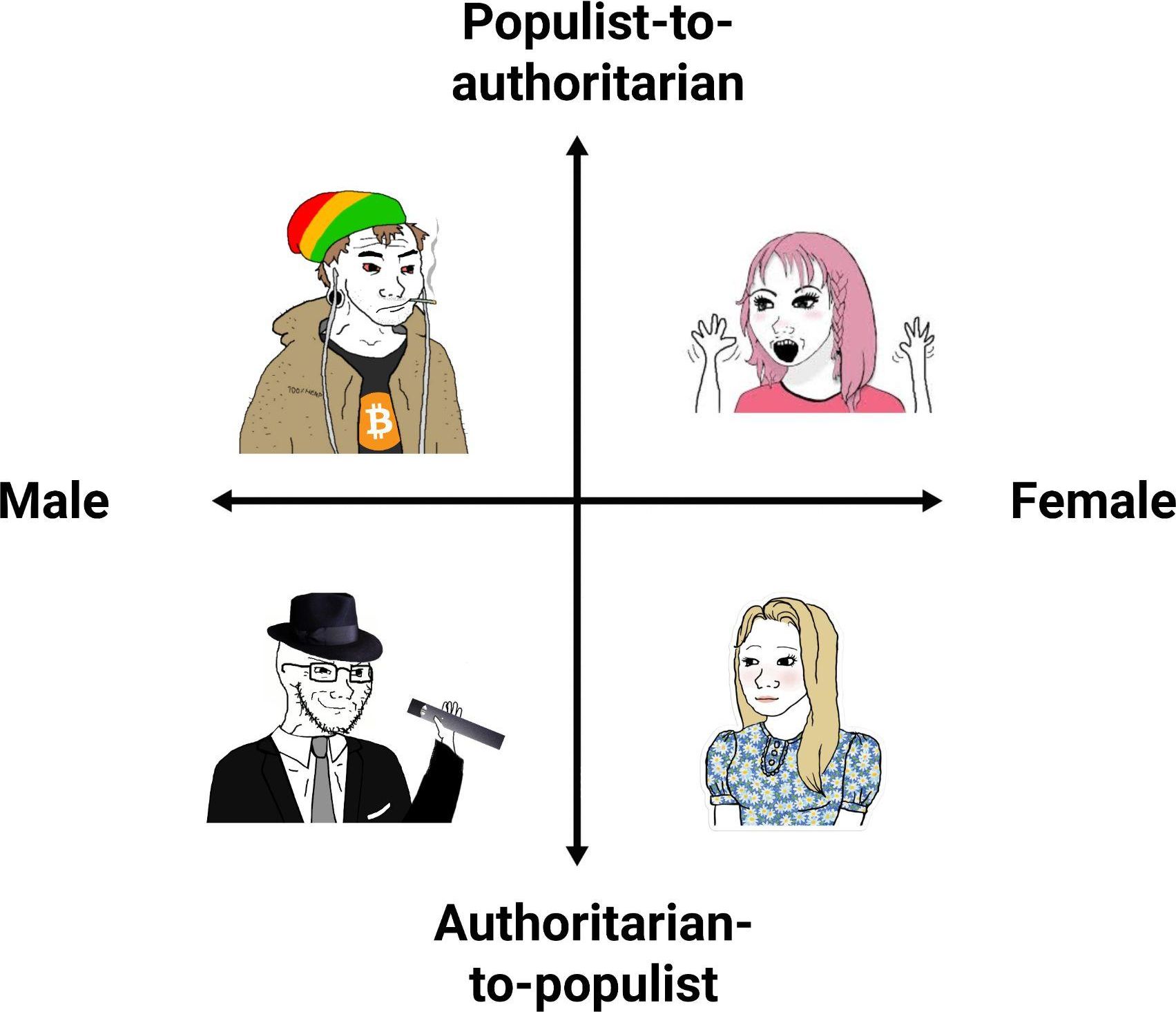
The real tradwife has strict, uncompromising beliefs and gets up at 5am to run her homestead, spending most of her day doing physical labor. This is a completely unreasonable life for most people to aspire to, and yet, girls who spend 23.5 hours/ day indoors now believe that they want a salt-of-the-earth life, living off the land, because they saw too many TikToks of girls in modest sundresses churning their own butter, or whatever other propaganda brought this about.
Meanwhile, the wokescold cares deeply for the oppressed masses in theory, but hates everybody in practice. Neurosis drives her to constantly assess the purity of your values. She judges based on what you say, and not at all how you behave. Make sure that you know all of the magic words—which you can learn in cognitive behavioral therapy—and she’ll defend you for cheating on your girlfriend.
On the male side auth-pop, we have the Yarvin-types. They like to talk about monarchy and how women would be better off if they didn’t have to worry about voting, or even working, and were fully dependent on the men in their lives. They won’t take a girl to dinner on the first date lest she gets too uppity about her value, but they will buy rounds at the bar and share ketamine generously at the afters. They also like the aesthetics of Roman Catholicism, even though they’re definitely hoping you’re on birth control.
And finally, the male pop-auth: libertarian crypto-bros. They’ve got a million friends from all over, thanks to the crypto conference circuit. They think one day everything’s gonna be on the blockchain, so they want the borders closed. Third-worlders are a threat to this country, and everything’s on the internet anyways. They don’t literally believe that the Earth is flat, but they like to pretend it is, as a bit, so people will have to debate them about it. (They’ve also asked ChatGPT, and they didn’t really understand the answer.)
Wealth-Mazimizers, Meaning Maximizers
Hanania distinguishes between wealth maximizers and meaning maximizers: “Smart and talented people have in a broad sense two choices before them: either to maximize income, wealth, and control over tangible resources, or to seek status and purpose through their careers. Sometimes these goals converge, but other times they don’t. Academics, journalists, writers, and artists are all employed in areas that pay little relative to the cognitive ability and work ethic it takes to succeed in them. The reason the pay is low is because these are generally desirable jobs. Many people are willing to compose essays or produce works of art for little or no pay, so those who try to make a decent living as writers or painters face a lot of competition. The same can’t be said for accounting or organizing a logistics chain for a major corporation, which no one would ever choose to do in their free time.”
He also talks about how both of these categories have low and high status variants. Your high-status wealth maximizer could be a billionaire business owner, while your low-status wealth maximizer might be a not-super-successful plumber. Your high-status meaning-maximizer could be a tenured professor at Stanford, while your low status meaning maximizer could be an unsuccessful artist, or a mediocre podcaster. We can map these on a quadrant: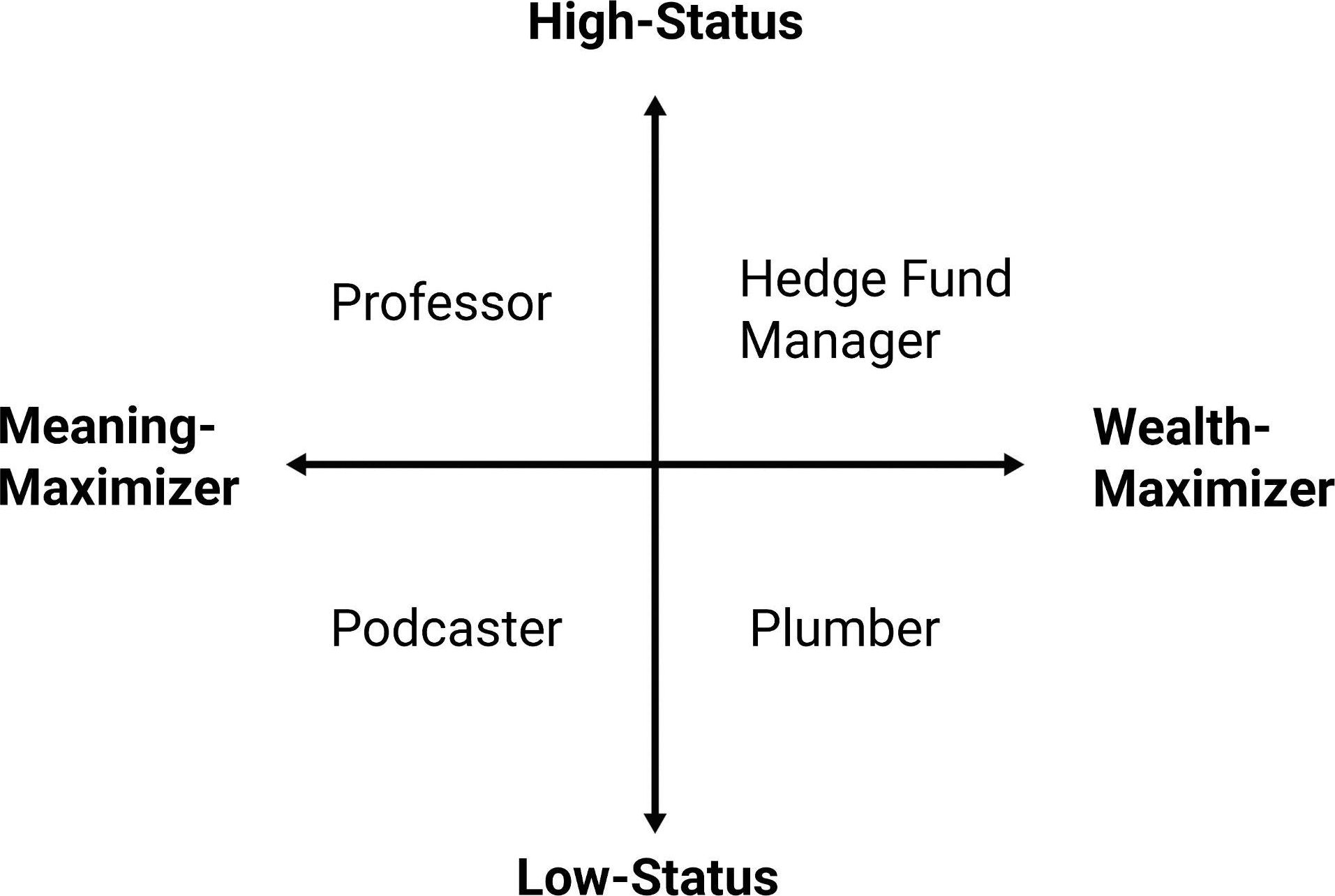
Beware though reader, because status doesn’t mean the same thing on both sides of this graph. In the wealth maximizing world, status is determined by dollars and cents, as below. 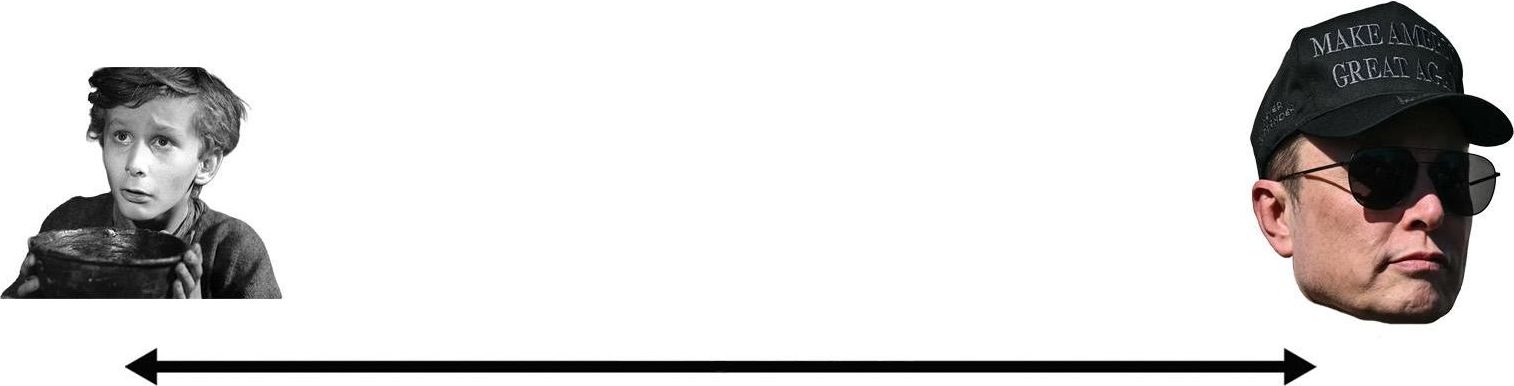 And then there’s meaning maximizing. Here, “individuals gain status through displays of intelligence, cultural refinement, and moral character.” Spurning a high-earning path in favor of abstract or artistic pursuits can even be high-status, as proof of the purity of one’s goals.
Now, imagine a guy who owns used luxury car dealerships showing up at a Harvard law school reception. He could be the richest guy there, but if he shows up bragging about his money, comparing Maseratis and BMWs, “do you know how much money you can make if you sell a blah, blah, blah,” he’d seem crass, and that’s low-status to a crowd of elites who care about meaning.
But it’s more complicated than that purely “money making careers are frowned upon.” The scale of meaning-maximizing is more complex. Something older, more implicit, is at play. Most of us have a sense that being a banker is higher status than being a used car salesman, even if the latter is richer. We might have something like this meaning-maximizer status line embedded in our heads, even when we’re thinking about money:

Certain psychological complexes are characteristic of relationships between the four quadrants. Successful meaning-maximizers are often humanists who fret about the low-status quadrants. They might draw their own privilege as a “professor at an elite university” into question. At the same time, the Harvard professor eyes the high-status wealth maximizer with suspicion. He (correctly) blames societal problems on systems, not individuals. But when he looks across the aisle, at a man who pursued wealth at the expense of meaning, he can’t help but feel that such men’s complicity is deeper and more tangled and his own. Worse yet (from the perspective of the meaning-maximizer)--the high-status wealth maximizer doesn’t even know enough to feel bad about it.
Meanwhile, the other three quadrants all tend to resent the high-status meaning maximizer, regardless of how much money they make. The low-status wealth maximizer finds them alien, inscrutable, and suspicious. This is still a less personal resentment than that held by the low-status meaning maximizer, who often places them directly in their crosshairs: think the anti-vaxx influencer railing against the “medical establishment.” The high-status meaning maximizer is the symbol and evidence of his failure. The failure can only be expunged by proclaiming that the hierarchy is a false inversion: really the low status anti-vaxxer is the free-thinking genius who sees the truth of the world, and the virologist is the brainwashed sheep repeating what he’s been told.
The low-status wealth maximizer holds no such resentment towards the high-status wealth maximizer. There’s the old truism that communism never caught on in America because the poor consider themselves “temporarily embarrassed millionaires.” They view themselves as in affinity with the rich, but only the rich that they can see themselves in: as is often pointed out, Trump fills this role. Loves money, doesn’t care what it takes to get it.
But there’s no resentment like the resentment of the successful wealth-maximizer staring across the aisle at the successful meaning-maximizer. The man who’s bought everything, staring at the one thing he can’t buy. This is the psychological impulse behind many of the Trump administration, from Elon Musk to Pete Hegseth to Trump himself. They’re populists because on a deep, psychological level, they don’t feel like elites.
Back to dating
There’s a lot of discourse already out there about how social class relates to dating, but we think that adding in the meaning/wealth maximizer dimension is helpful. Compare the aspiring artist to the plumber: these are clearly different dating cohorts. Women get a lot of flack online for their unwillingness to date men in the low-status quadrants, particularly low-status wealth maximizers.
Despite the widespread stereotype of rich men dating super-hot young women, most wealthy men prefer women close to their age, from their own social class, and with a similar educational background. Doctors marry doctors, lawyers, and professors; not waitresses or aspiring influencers. But it’s too simple to say the stereotype is merely false: it’s just more likely to be true if the rich guy in question is an upstart real estate tycoon than if he’s a neurologist. The latter couldn’t bring an influencer to dinner with his friends. That said, a high-status meaning-maximizer is more likely to end up with a teacher than a store manager earning six-figures, if the former went to a similar college and reads the same newspapers, because she can play well with his social sphere. Meaning matters more to him than money, and he earns enough to support the family anyways.
Unfortunately for low-status meaning-maximizing men, women in his quadrant have an easier time dating “up” than he does, which narrows his already-limited pool. While the starving artist has always had an inexplicable pull, he’s not marriage material for a woman who wants a family unless he’s willing to be househusband to a girlboss. With the state of gender relations lately, I suspect more women in the 90s were willing to accept such an arrangement in the name of feminism than women now—although my friend’s situation from the start of this essay perhaps counters that claim.
Still, she was with a high-status, wealthy man, and wanted him to compromise both wealth and status to stay home with children. Usually this dynamic is gender-swapped, but we live in a brave new world, and anything goes. Either way, she should be looking for a different kind of guy, which is the same critique lodged at men who want highly-educated, successful women to give up their careers for child-rearing. Trying to redirect the intellect and drive that you find attractive is a fool’s errand, and extremely selfish. Recalibrating what you find attractive might literally be easier than finding a unicorn who somehow fits your highly idiosyncratic preference.
Given that more women than men have been earning degrees lately, more women have access to high-status careers, whether they seek wealth or meaning. Some will either have to date “down,” or stay single, especially because some low-status meaning-maximizing women have access to their dating pool, too. It’s the low-status wealth-maximizing women who probably have the worst odds, but men like to fantasize that they’re getting snatched up by rich guys instead of dating them themselves, it seems.
While women and men both complain online about being single, the men are generally angrier about it. Women recognize that their own pickiness is in the way, but they refuse to compromise. They’re more likely to get angry at men they’ve already dated, or declare that they’re happily single. Both of these rile up men she’s never met, who become even more convinced that women’s expectations are beyond unreasonable. Men, meanwhile, rarely stop to reflect on whether their own expectations are unreasonable. The advice about recalibrating your own attraction is broadly applicable to anybody who’s unhappily single, but the unhappiest are least likely to listen.
The grievances of the woke right often stem from their own inability to join the institutions they now deride. It’s the classic mentality of incels: they’re so beside themselves at being rejected by the women they desire, that they claim women are worthless and worthy of scorn. Populism is a form of grievance politics, which can swirl around socio-economic status, social class, and the difficulties of modern males. It’s no surprise that online, populists and crusaders against women’s rights are increasingly the same group.
Remember the men we mentioned at the start of this essay? Strangely, they were high-status meaning maximizers—organic elites—who adopted the same grievances as men far less successful than them. They didn’t angrily lament their dating prospects, but they seemed to have insecurities that they weren’t as successful as they should have been, and were driven to rage by the same foul internet. While friends hope that this is just a phase, their respect has already been lost. They saw themselves as lower-status than anybody else seemed to, and they dragged down their behavior to match.
Summary of Kakistocracy’s Main Arguments (pt. 2)
Back to your regularly scheduled Hanania summary.
Despite his clear distaste for them, Hanania wants to be as fair as possible to populists, and takes pains to consider whether they make reasonable complaints and offer decent solutions. He evaluates the response to the COVID pandemic—did elites really get everything wrong? Do they deserve to lose the people’s trust for mishandling this crisis?
Well, they certainly messed some things up. Lockdowns had catastrophic effects on the economy, and on literacy and numeracy rates for kids in school, which are still not back to pre-pandemic levels. Masking was probably also bad for children's social development, since learning to read and give facial cues is such an important part of how humans communicate. Both of those interventions were ultimately ineffective at preventing disease transmission, especially relative to their impact on the rest of our lives. On top of that, social media platforms suppressing the lab leak hypothesis was a form of censorship that was patently wrong, whether or not the government had anything to do with it. And any “expert” claiming the George Floyd protests were an appropriate exception to lockdowns because “racism is a public health crisis” was a quack. In Hanania’s eyes, that’s not a great track record, even though policy-making on the basis of limited information is a challenge.
But is that what populists complain about? Not really. The public broadly believes that we didn't take lockdowns or masking seriously enough, despite evidence that those measures weren’t that effective. Moreover, right-wing populists who were coincidentally right to resist masks and lockdowns also refused to take the vaccine. In the years since, they've only become more anti-vaccine, despite all the data that they worked. And, that infamous open letter signed by 1,288 “experts” justifying the George Floyd exception to lockdown rules, was not affiliated with any institution of epidemiologists, doctors, or public health researchers. Only a small fraction listed any kind of formal affiliation at all, and many signatories were anonymous, or only listed their last initial. This was hardly an “elite” misjudgment, as anybody who bothered to look at the letter itself rather than simply reading the headline would have noticed immediately. But if the headline made you angry, that was probably enough to stop reading.
Kludgeocracy
One of our favorite chapters was called "Antipopulist Solutions to Populist Complaints." In it, Hanania looks at five different issues to see whether populists can in fact offer good policy solutions. He resoundingly finds that the answer is no: empirically, they don't.
-
Housing affordability crisis: Left-wing populists tend to blame corporate consolidation, while right-wingers point to their favorite scourge, immigration. Both of these answers are wrong.
- There are too many large-scale property owners for collusion to be driving prices up—it’s market forces. And given that the same people complaining about immigration decry the dropping birth rate, they're masking nativist sentiment and pretending it's an economic policy.
- The truth is, there’s simply a housing shortage. Zoning laws need to be changed. Typically, it is citizens themselves preventing those changes by exercising their vote. NIMBYs are the culprit, which is a little uncomfortable for populists to admit, even if NIMBYs tend to be older, whiter, and wealthier than average.
- In Japan, where land regulations are handled at the federal level rather than by localities, it is much easier to build, and there isn’t a housing affordability crisis.
-
Infrastructure: The price tag for public works projects in America has risen faster than inflation, and is far higher than international norms.
- The reflexive explanation for such a bizarre reality is to assume corruption, when the real answer is “kludgeocracy,” or an overlapping mandates and requirements that make building arduous.
- The NEPA requires that bureaucrats assess the impact of proposed projects. So, citizens and nonprofits deliberately can delay projects simply by invoking this regulation to demand more paperwork—sometimes to the tune of thousands of pages. The average Environmental Impact Statement is 612 pages long and takes 4.5 years to produce. Building new bike lanes in San Francisco entailed a report of 1,353 pages, costing $1,000,000. Labor requirements, permitting processes, and public comment periods also cost time and money.
- Populists who want to attack government spending should focus on regulations like these, but they’re byzantine and often must be tackled at the local level, so they’re not great fodder for incendiary headlines.
-
Science: While there are valid criticisms of the paradigm of scientific research today, populists are motivated by culture war concerns—seeing scientists as political enemies. Instead of attacking inefficiencies, the Trump administration cut NSF and NIH funding.
- Researchers are buried in paperwork, with principal investigators spending a shocking 42% of their time on administrative tasks. Grantees need approval before changing research goals, must implement “effort tracking” measures, and face restrictions when shifting money between budgetary categories. Talented scientists should be able to exercise their discretion in flexibly pursuing new directions, rather than painstakingly justifying every minor recalibration. Scholars funded by institutes that stress flexibility and invest in “people, not projects” produce more frequently cited papers than ones funded by the NIH.
- Working with human subjects is even more arduous, requiring extensive approval processes that also eat into researcher time and energy.
- The nature of scientific research itself means the market will undervalue it—it’s costly, and the upside of any one attempt is unpredictable. For example, it sounds outlandish to invest in fruit fly research that turned out to be “central to bedrock discoveries in modern biology,” without which we’d know far less about sex-linked inheritance. Every single one of 210 recently-approved new drugs and many private patents are produced in part due to federally-funded research. This is one of Hanania’s only exceptions to his generally pro-market sensibilities, because empirically, federal funding of science is highly productive.
- While populists tend to favor less spending and more oversight, “how things sound to the typical voter” is a terrible heuristic in regards to scientific research. “Spending more, but with less oversight, paperwork, and bureaucracy,” is the more rational position.
-
Immigration: This tends to be one of populists’ biggest concerns, but Hanania asserts that the “burnished facts about the economy, labor market, and crime,” from both sides tend to be “window dressing to justify instincts that go unstated.”
- Hanania says that “nativism reaches deep into human nature,” but remains optimistic that humans have overcome or reduced many forms of ingrained bigotry, and that nativism doesn’t have to be different. But, given that he claims “nationalism is a lot more popular than antisemitism,” and that “we acknowledge that the latter is purely evil,” we think he was a bit naive—bigotry has only become more publicly accepted since he wrote this, and we aren’t holding our breath for that trend to reverse any time soon.
- In America, immigrants aren’t prone to criminality, and “the job market was strong and the economy was growing, including for those at the bottom of the income distribution, throughout the Biden administration,” so it’s difficult to see how “creating a stricter immigration system needed to be a major priority in 2024” based on “objective conditions.” Skilled immigration is such a benefit to an economy that “it is difficult to find a respected economist who takes the nativist position seriously on this issue,” yet it’s become a rallying cry for the populists in charge because national identity is so emotionally motivating.
- In Europe, Muslim and African immigrants do tend to commit crimes and be incarcerated at higher rates than the native populations, so he concedes that nativist sentiment in these countries may be more justified by empirical reality.
-
Crime: This is especially complicated, because there’s “little in the empirical research or society-wide data to suggest that violent crime depends on economic factors in straightforward ways.”
-
Left-wing populists are wrong to want to defund the police, which only leads to an uptick in crime, and right-wing populists tend to fall on the correct side of this issue, but it’s “far from clear whether populists are better positioned to stop crime than more mainstream parties,” especially in wealthy countries.
-
In developing countries, populists like Bukele seem justified in taking hardline measures to cut down astronomically high crime rates. There may be no other way to reduce crime in poor countries that simply don’t have the administrative capacity to afford due process to the abundance of career criminals. Hanania explores this in a later chapter, which we’re leaving out in the interest of brevity, because the message is so simple.
-
Solutions
Hanania concludes his book with a “synthesis,” which is really him offering a set of strategic solutions to the horror show of populism that he's just described. To our surprise, he seems genuinely optimistic about the fact that “public opinion is fickle and incoherent” and that charisma matters, because he thinks that these can be used to the advantage of elites who want to wrest back control. Because legacy institutions and elites are still influential, there are many openings to block, channel, and outmaneuver populist energies.
First, he informs us that when a populist administration is ousted, it generally heads in one of three directions:
1. A dictatorship is consolidated.(Venezuela’s Chavez and Maduro)
2. There's long-running dysfunction. (Argentina’s many coups amidst occasional democratic rule following Peron)
3. A decisive repudiation renews the strength of democratic institutions. (Italy, Germany after WWII)
While he says that President Trump should have been held legally accountable after his first term to prevent the comeback tour that he's on right now, he doesn't think that that path is realistic anymore in the United States. Partisan divisions are too deep. (Honestly, we suspect Biden’s administration took such a hands-off approach to prosecution because they feared those passions were already too ingrained.) He says that an American recovery will look like “gradually tiptoeing away” from the Trump era, rather than a dramatic break. To be frank, we're not sure that the possibility of long-term dysfunction or a dictatorship should be easily discounted, but we hope that we're just being paranoid.
One of his most straightforward, practical recommendations is to surrender on “symbolic issues” like announcing pronouns and terms like Latinx, because the benefits of these kinds of linguistic changes are speculative, and the backlash to them is obviously costly. Similarly, don't apply Western liberal values to commentary on crime and dysfunction abroad because that's extremely out of touch. Meanwhile, stay strong on substantive positions like immigration because these are actually consequential to the health of a country. Most people are paying more attention to symbolic signaling than the economy anyways. While his suggestion that elite institutions should stop discrediting themselves is presented as a separate point, we think that this is also, in some ways, a concession on symbolic grounds: elite institutions currently describe themselves as structurally racist, sexist, classist, and so on, because of the cultural influence of left-wing populists. That said, it would certainly be refreshing to see more honest accounts of why elites deserve authority. Lately, we’ve seen more people accept the utility of standardized testing in ascertaining merit, so we hope that the public might actually be more open to a leader or movement that simply calls attention straightforwardly to merit. Embracing a new elite identity that's classically liberal, oriented towards truth, and globally minded, requires distance from DEI excesses and academic ideological purity.
He also takes inspiration from charismatic leaders like Obama, Macron, and Argentina's Milei, who aren’t populists, but charm the public as though they are. Even ideas can be “focal points around which coordination becomes possible.” The masses’ desire for dynamism, or hunger for an outsider can be harnessed in favor of a technocratic slate of policies by a charismatic leader. Being strategically quiet about certain positions, the way that Obama was on gay marriage in 2008, could be advantageous, as long as it isn’t taken to the extent of brazen lying. We think he's right about this, but we just don't know who might emerge who's charismatic enough for a broad base of Americans to rally around.
Hanania also believes that the government shouldn't ban speech, but that social media companies, search engines, and even LLMs should rank credible information higher than things that are simply popular by raw numbers. Electoral reforms like ranked-choice voting can also reign in populist candidates. Sarah Palin, who was extremely polarizing, lost a House seat in 2022 after second-choice votes were redistributed because a majority of voters preferred anybody but her. This is an avenue of reform that’s unlikely to create populist backlash because it’s so technical. We really appreciate this policy proposal and we hope that, perhaps, Hanania's next book takes on kludgeocracy with the same precision that it did D.E.I., so that reasonable people have something to rally around.
That’s what we do about the world. And here’s what women can do about their love lives. In the populist world, elite women have 4 basic strategies:
- Balkanization: only date liberal men. This will unfortunately result in brutal competition, as there are more liberal women than men. Also, if high value women refuse to have sex with populists, it may motivate them to convert.
- Separation: committing oneself to political lesbianism. A lot of women are bisexual, and this path has many advantages. Modern IVF, combined with sperm donation from elite human capital men make this a highly eugenic option.
- Tribalism: accept that everyone has become racist, and stick to one’s ethnicity, reap the in-group benefits. Problem is, once men are racist to this degree they’re also probably also going to be sexist.
- Femceldom: abandon dating and offer oneself to the life of the mind, travel, and adopting many cats. Contrary to the claims of J. D. Vance, childless cat ladies actually aren’t all that miserable, unlike many a childless video game man. This path may include an AI boyfriend.
Wrap up: Is Hanania dateable?
The man’s married, so the question is purely academic.
Hanania’s a polarizing figure. Many people see him as an asshole, a charlatan, or a cynic. Sam Kriss had this to say about Hanania: “In the last few years, Hanania has made a kind of aretaic turn. Instead of the white race, he now believes in a universal herrenvolk stratum of ‘elite human capital.’ He now supports gay marriage and trans rights, because gay and trans people tend to be wealthier, more liberal, and higher IQ, and because openness to sexual minorities seems to be a trait of elite human capital. He supports abortion, and quotes Jessica Valenti while doing so. He opposes Trump and the MAGA movement, because they’re all plainly morons. He no longer opposes mass immigration, because it provides a wider talent pool from which elite human capital might be drawn, even if it’s statistically likelier to come from some groups than others. He likes Jews. He has rearranged his Hitler particles into an almost perfect facsimile of liberalism, with just one piece missing, which is the assumption of a universal human dignity. Perhaps relatedly, he also believes that he, as an instance of elite human capital, could easily write a Jacobean tragedy as good as any of Shakespeare’s, if he had a few days to learn all the old-timey words.”
Note that Hanania liked this description, and reposted the whole thing on his blog. That’s one thing to like about the guy: he has a sense of humor and is honest about his less flattering qualities.
We like that Hanania’s thinking is methodical and backed up. He’s honest about when he’s worked up about something. You’ve got to respect a man who’s on top of his own mind in that way.
One thing we feel Hanania could address more at length is the problem of what to do about the unwashed masses. We respect Hanania for having the balls to be honest about the basic fact that large swaths of the population are badly uninformed; that unfortunately, such people steer the course of US elections; and that this is a reality we must face head-on.
We wish Hanania had spent a little more time discussing where this leaves democracy. It’s hard to get excited about democracy when you don’t believe in the people. His proposed solutions, described above, almost seem like manipulating the masses to follow the policies that are best for everyone.
Writing in 2025, Hanania seems to underestimate the extent to which the populist right would embrace misogyny and antisemitism, focusing instead on Nativism, which was indeed more prevalent at that time. He seems to have underestimated the extent to which Nativism would go malignant, spawning new configurations for each social issue, as woke had done the decade prior, essentially inverting the “oppression Olympics” hierarchy.
Kriss has a point that Hanania’s viewpoints rest uneasily with a belief in universal human dignity. Kakistocracy (the concept, not the book) reminds one of us of the parable of the Grand Inquisitor from Dostoevsky’s Brothers Karamazov. The idea in that story is that Christ returns to earth, and is promptly arrested by the Grand Inquisitor, who goes on to explain that the people can’t handle true freedom of moral choice. The people don’t do well with freedom; they fear it, and they’re too weak to be able to handle it. Instead, they do best, so the argument goes, under the rule of the Grand Inquisitor, who insists on control, out of love, so the people can have a well-tended economy, bread to eat, and so on. The Grand Inquisitor presents two alternatives: leave the people to their own devices and let them destroy themselves; or take them in loco parentis, and manage their lives for them: “Yes; we will make them work like slaves, but during their recreation hours they shall have an innocent child-like life, full of play and merry laughter. We will even permit them sin, for, weak and helpless, they will feel the more love for us for permitting them to indulge in it.”
Hanania could be said to advocate for Inquisitor-lite. He believes smart technocrats should lead, and that they are justified in light manipulation, and in appealing to the people’s biases and copes, to compete against populists. But he’d be a much chiller Inquisitor. Under Hanania, people can do pretty much whatever they want in their free time.
We also wish Hanania had spent more time discussing left-wing populism. He condemns it just as fervently as right-wing populism, but he doesn’t describe its internal dynamics to anywhere close to the same extent. We get that the right is in power right now, but this could easily change within the next few years. We’d have loved to know Hanania’s opinion on Bernie Sanders and the Squad, for example.
Ultimately, both left- and right-wing populism involve an abdication from one’s responsibility in society. It’s giving up the realities of uncertainty and complexity in favor of a comforting conviction that superiority is innate, not something that must be humbly and painstakingly achieved. And in the world of populisms, the thrills of likes, wins, and taboo breaking too often trump long-term consequences.
In the end, these are the motivations of rebellious and arrogant teenagers, not adults doing the hard work of living up to their full potential. If we’re blessed with high intelligence and elite education, it behooves us to put in the hard work to sustain and improve our institutions, instead of tearing them down and replacing them with poorly thought out ideological garbage. And no matter who we are, we are responsible for becoming our best selves, working to uplift everyone in society, being humble about our limits, and even more humble about the gifts of our birth and circumstance.
Your message is stored now and emailed to the author after the contest ends. The author can reply to you, but their identity stays hidden unless they choose to respond.