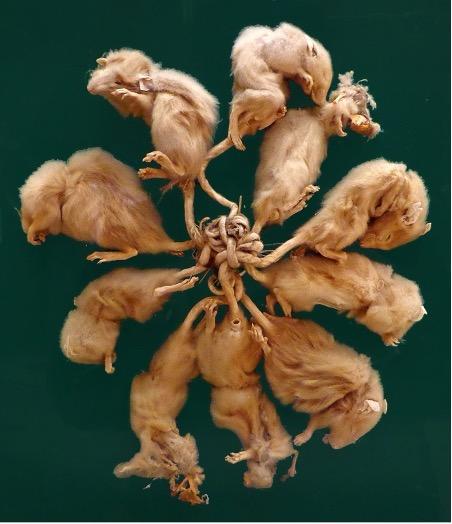
Rat king found in 1895 in Dellfeld, Germany, now in the Musée zoologique de la ville de Strasbourg, France. (source)

A rat king is a tangle of multiple rats stuck together by their tails. The phenomenon is rare and thought to occur when young rats in confined spaces huddle together for warmth. Their tails become fixed by sap, frost, or blood and tighten into a knot as they struggle to free themselves. They die in the knot.
“This is the essence of bad taste: things that are easy even for a dumb artist, work very well at wowing dumb audiences, and become so overused that smart people get tired of them.”
~Scott Alexander, taste
In “The Colors of Her Coat,” Scott Alexander discusses the process of beautiful things losing their magic as they become too common and suggests that we, as individuals, will have to learn how to see the world with fresh eyes if we are to enjoy the future.
Poetry helps [1]. And poetry like Blake’s or Chesterton’s can imbue common things with a transcendence that allows us to feel as if seeing them for the first time.
The novel King Rat is the opposite of poetry.
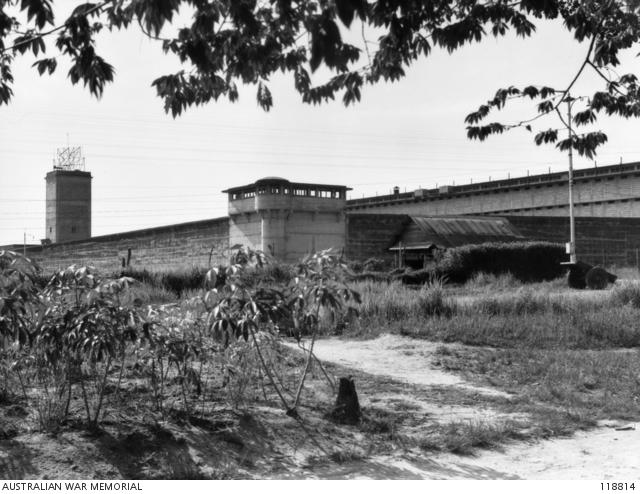
(Left) CHANGI AREA, SINGAPORE. 1945-10-02. A GENERAL VIEW OF CHANGI GAOL.
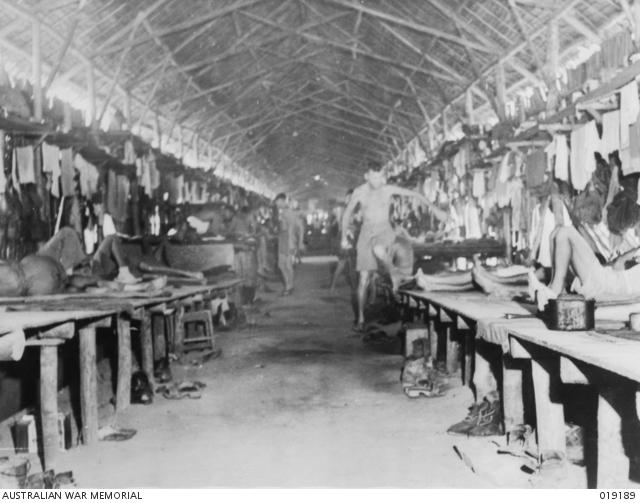
(Right) Changi, Singapore. September 1945. This 50 metre type hut was used by the Japanese to accommodate Allied prisoners of war (POWs). Although classified as a 200 man hut, up to 250 men were accommodated.
Imagine putting The Da Vinci Code author Dan Brown into a concentration camp [2] and tearing away all the pseudo-historical nonsense and mysticism that animates his passions; depriving him of all the cultural tropes he lives by. Really make him feel Sartre’s nausée.
What sort of novel would he produce to describe this experience and come into an understanding with it? The experiment has been run with a different formula/hack author:
“Renowned author
Dan BrownJames Clavell woke upin his luxurious four-poster bedon a ragged straw mat inhis expensive $10 million housea Japanese POW camp– and immediately he feltangryundefinable existential ennui. Most people would have thought that the48-year-old20 year oldmanhadnoevery reason to be angry. After all, thefamous writer had a new book coming outboy had been sent halfway around the world and shot in the face with a machine gun, immediately captured in the sweltering jungles of Java, and sent to starve in an open air prison.”[With apologies to Michael Deacon, who wrote Don't Make Fun of Renowned Dan Brown, which is the book review you should actually be reading.]
James Clavell was born in 1924 in Sydney to a posh British family. As a young man he joined the Royal Artillery to fight in World War II and he was almost immediately captured and placed into Changi prison camp in Singapore, where he survived for three years. Later, he became a Hollywood screenwriter. During the 1960 writer’s strike he wrote his first novel, King Rat, trying to come to terms with and understand his experience in Changi.
When I say that King Rat is the opposite of (good) poetry I mean that, instead of finding novel ways to show the beauty in ordinary things, it uses worn out cliches to show us nothing at all.
And yet…forcing the Existentialist setting of the novel into a Hollywood straitjacket gives it constraints that produces contradictions whose solution sometimes admit a glimpse of insight.
The novel has two fixed points:
The setting--an experience that will absolutely not admit interpretation or meaning
The plot --designed to pull all the little levers in our ape brains that tell us: oh, exciting!
This is a metaphor for the modern world.
The characters must navigate between these two extremes and bring them into resolution. So we’ll look at three of them, each representing a different response and see if they have anything to teach us.
But first,
The Plot
I have claimed that Clavell is a hack and a formula writer, so I will summarize everything you need to know about the plot of King Rat using links to TVTropes.org.
King Rat takes place in a Crapsack World (POW camp) where the Author Avatar (Peter Marlowe) allies with and becomes Number Two to the Übermensch protagonist (Corporal King), and ultimately King's Morality Pet, whom King saves at cost to himself against his own transactional code. Their adversary is an Inspector Javert (Lt. Grey). The plot is driven by what must be the most Platonic example of a MacGuffin ever devised and is executed as The Caper. In the end, it was All for Nothing. There's also an Anvilicious metaphor about rats eating one other.
The Setting
I’ll apologize for using a cliché myself, but the setting of King Rat is the “modern condition.”
And by that, I mean the modern condition as defined by my tenth-grade teacher when he tried to teach us Camus:
There is no God. Every old story told about why life makes sense is false. You still want those stories and you have to take actions and live knowing all they are false (unless you choose death). Pretending you don't know this is not allowed.
In Changi, God is the British Empire, and it is indeed dead. The Europeans have been “humbled” by the Japanese and all their rules that young Marlowe/Clavell understood about honor no longer apply. The prisoners are left alone by the Japanese, so long as they don’t make trouble, and must reinvent how to live.
And just to be sure that they don’t find some solace in material comfort, there is starvation and dysentery.
The Characters
Corporal King
And the rat ruled, for he was the King. Until the day his will to be King deserted him. Then he died, food for stronger, and the strongest was always the King — not by strength alone, but King by cunning, and luck, and strength together, among the rats.
The King is the most boring character in the novel, but the novel is named for him, and we can’t really understand the next two characters except in relation to him, and he is the manifestation of Clavell’s subconscious distillation and reinvention of the a partial Nietzschean philosophy as the active response to the loss of purpose in the modern world, though in a perverse, transactional, and unreflective form…so I guess we have to talk about him a bit.
Put simply, The King is a Randian hero. He is described as the one person in the camp who looks like a man among skeletons. He’s officially a low-ranking American, but he’s a trader who uses the black market to gain riches and bend men to his will. He first meets Marlowe during a quick trade. Marlowe uses his knowledge of Malay to help the King, and the King offers to pay him. Marlowe refuses this money. Since the King’s power over others is monetary, this one act of kindness without expectation of reward allows them to start a friendship.
The King is commendable because of who he is, not what he does. Yes, at one point the King uses his money to buy medicine that saves Marlowe’s life, but it’s ambiguous if that was for friendship or to learn the location of the MacGuffin. He mostly uses his power and cunning to get what actually matters in life: food and cigarettes.
The King’s sin is that he loses the will to dominate.
At the end, when the camp is liberated, the King loses his leverage over everyone, rejects his one friend, falls into despair.
The King is a TVTropes Übermensch, rather than what Nietzsche meant.
Lt Grey on the other hand…
Lt. Grey
It’s made very clear that Grey is the antagonist of the story, and every rhetorical trick is used to make us hate him. He is a pathetic man, always trying to stamp out the freedom of others, clawing his way to success that he doesn’t deserve. Just to really rub it in, we gratuitously learn that his wife is cheating on him and that he probably deserves it.
But let’s step back and defend Grey a bit, because his situation is pitiable. Grey is a working-class fellow who, like the King, is trying to make his way up in the world. He joins the military to increase in status and is promptly captured by the Japanese as a prisoner of war. And like everyone else, he’s been starved. Despite this, he tries his best to work within the system he was taught is correct, and he becomes the camp’s security officer, trying to get everyone to obey rules and maintain order.
Here’s Grey describing the experience of Changi in Clavell’s later book Nobel House:
"...time to read fiction and if he did it, it's got to be upper-class shit and a penny-dreadful and... well Changi's Changi and best forgotten." A shudder went through him that he did not notice. "Yes, best forgotten."
But I can't, he wanted to shout. I can't forget and it's still a never-ending nightmare, those days of the camp, year after year, the tens of thousands dying, trying to enforce the law, trying to protect the weak against black market filth feeding off the weak, everyone starving and no hope of ever getting out, my body rotting away and only twenty-one with no women and no laughter and no food and no drink, twenty-one when I was caught in Singapore in 1942 and twenty-four, almost twenty-five when the miracle happened and I survived and got back to England—home gone, parents gone, world gone and my only sister sold out to the enemy, now talking like the enemy, eating like them, living like them, married to one, ashamed of our past, wanting the past dead, me dead, nobody caring and oh Christ, the change. Coming back to life after the no-life of Changi, all the nightmares and the no sleeping in the night, terrified of life, unable to talk about it, weeping and not knowing why I was weeping, trying to adjust to what fools called normal. Adjusting at length. But at what cost, oh dear sweet Jesus at what a cost...
Stop it!
With an effort Grey pulled himself off the descending spiral of Changi.
What is his sin?
Is it simply ambition? A working-class man rising above his station? I’m tempted toward that interpretation, because Marlowe, Clavell’s stand-in, clearly gets at Grey’s goat by teasing him about his lower-class origins. Yet the King was also born poor.
It’s that he is a slave.
In Genealogy of Morals Nietzsche's claims that the slave morality is a response of the weak to their inability to overcome the strong. They invent a value system in which their weakness is virtue and the strong's strength is vice.
Grey is a textbook example of ressentiment in the Nietzschean sense. His resentment has nowhere to go and so turns inward and becomes generative. Ordinary resentment would make Grey a working-class officer who hates the toffs. Sympathetic and not particularly interesting. Ressentiment makes a man whose entire moral apparatus is generated by his inability to be the King. He cannot break the rules and win, so the rules become sacred. He cannot get rich off the camp economy, so trading becomes evil corruption.
Ultimately, all this rule following turns out to be in service to a corrupt system: the officers above him have been stealing from the prisoners. At the book’s end, Grey learns of this crime. To his credit, he attempts to punish these officers yet can only do so by going one higher level up in the system, which is corrupt through and through. Ultimately, he is bribed into promotion and his failure and disillusionment is complete.
In Clavell’s later novel Noble House, we learn that Grey joins the Labour Party, fueled by the same hatred, to destroy the class system of England. He becomes a useful idiot to Soviet Communist and a spy again becoming slave to a corrupt system.
Sean
“We tell ourselves stories in order to live.” ~Didion
I’m not sure if there was a real King or even a real Grey, but I’m pretty sure that there was a real Sean. I think she is beyond Clavell’s power of invention. There’s a sort of apology, and I read her inclusion as a form of atonement to some real person [3].
If I had to name one thing that will strike the 2020s reader of King Rat as most surprising, it would be that this 1962 formula-novel includes a transgender character that is treated with considerable sympathy. (You may hope for something interesting about gender too, but, sorry, Clavell is not quite getting there.)
There’s a lot of cheap things I could say here: Sean is the counterpoint to the King—the embodiment of the feminine response to the world as opposed to his domineering masculine one. Or with the scattering away of the old morality, one is allowed to explore new and fresh ways of being, and gender expression is one such. But that’s all bullshit.
Sean is about the power of fiction.
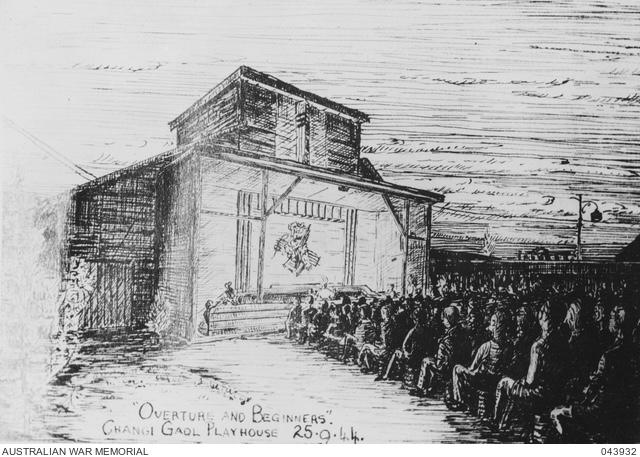
Copy of a sketch of Changi Gaol Playhouse. The theatre was built by Prisoners of War (POWs) in Changi Gaol. Possibly George Napier Sprod. (link)
Sean was Marlowe’s best friend before their imprisonment. At Changi, Sean started to act in plays, and since there were no women in the camp, he played the female parts. This eventually evolved into elaborate subterfuge to maintain the illusion until the fiction and storytelling became reality.
The benefits of this were clear. Sean had the only private room in the camp, was well fed, and had the attention and the admiration of nearly everyone.
Sean's response to the death of God is the Will to Believe. She is a woman because she believes she is and because everyone around her endorses the belief. The womanhood is a Jamesian fact, brought into existence by mutual will.
But it was important that everyone believed. And Clavell’s third person narrator switches pronouns depending on what Sean believes.
At the liberation of the camp, the old world and its values returned. The other soldiers are unwilling to believe. So Sean goes out into the ocean alone and drowns.
Anvilicious
There is a subplot in the book that I haven’t discussed yet. The King and his group find a male and female rat and start breeding them under their hut. There’s no meat in the camp, so they decide to sell the rats to the higher officers as a delicacy — Rusa Tikus. The idea of the higher-ups eating the rats gives everyone joy and gives the King money.
When the camp is liberated, all these rats are abandoned in their cages and they must fight against each other, as there is no food. So there is a King Rat, and he dominates for a while, until he loses his will, and then some other rat takes up the throne.
Conclusion
It’s 1980
James Clavell wakes up in his four-poster bed in his $10 million house, and immediately he feels…
I do wonder what James Clavell felt in 1980. He had just signed a $1 million bonus [4] for his new novel, Noble House. For many years after Changi, he was said to carry around a can of sardines in his pocket. Since then, he became a successful Hollywood screenwriter and published Shogun.
In Noble House itself, we see what happened to some of the characters in King Rat [5]. Marlowe appears again, this time as a self-insert novelist, with his beautiful wife and his two adorable children, hobnobbing with Hong Kong’s high society. Grey also appears, now in the Labour Party, aligned to a new set of rules that govern him. He is a communist stooge. We don’t see the King, though. It’s implied that he never accomplished anything in his life outside the camp.
Here’s a quote: “For us ex-Changi-ites-we're lucky, we're cleansed, we know what life is really all about.”
I like to think Clavell was happy.
“The Colors of Her Coat.” Changi gave Clavell a sense of nothingness and deprivation, and from that contrast he was able to see and thrive in the world. Using clichés [6].
Your message is stored now and emailed to the author after the contest ends. The author can reply to you, but their identity stays hidden unless they choose to respond.
Footnotes
- ↩
“The purpose of poetry is that it’s beautiful and good. Far be it from me to be the sort of Grinch who demands there be a purpose to poetry beyond this.
But if I were that sort of Grinch, I would say the purpose of poetry is to close off your options so that you have no choice but to avoid cliches like the plague”
https://www.astralcodexten.com/p/half-a-month-of-consolation-writing
- ↩
If you’ve read Digital Fortress, you’ve already imagined this.
- ↩
Epistemic status: pulled from my ass.
- ↩
~$3.4 million of today’s mini-dollars
- ↩
As a side note, we also see the MacGuffin (a diamond ring). But here, it is only mentioned in passing, as a ring on the finger of a secondary character, and only there to give emphasis to her much more impressive jade jewelry.
- ↩
I had a good friend from rural Ethiopia, and he grew up with little connection to Western culture. His favorite writer was Danielle Steel.
He said that young lovers from his village would gather around a communal radio at night to listen to broadcasts of her writings.
I like to imagine her paperbacks being uncovered in an archeological dig, when the tired and pedestrian platitudes of this age are forgotten, and her words are new and beautiful to fresh eyes.