My greatest fear in writing this essay was not that it would be bad and not make the finalists. It was not that I would waste my time on something nobody would ever read; spending time rereading and thinking about legendary Norwegian author Sigrid Undset’s masterful historical fiction epic trilogy, Kristin Lavransdatter, was time well spent. My fear is that this review is selected as a finalist, and then the people who read the review feel that they know the story well enough to not read Kristin Lavransdatter.
So with the throat-clearing out of the way, let’s play ‘count the storybook tropes:
- A headstrong young girl who bucks strict social convention
- A girl whose beauty incites desire in others, and is partially blamed for their actions
- A fairy/witchy godmother-of-sorts
- A knight riding in on a horse to rescue a damsel
- A literal roll in the hay
- Seven sons
- An eternal struggle between forces demonic and forces angelic
- A woman who comes to realize, very late but not entirely, that she has spent her life pursuing and getting exactly what she wants. She has not only lived to pay the price, but so have those around her.
Whether that list makes you more or less likely to read the story, I want to show how Undset used those tropes to create a story that is transcendent because it is so firmly grounded in the fundamentals of the craft.
A Touch of Biography
Sigrid Undset is one of the most celebrated authors of the 20th century. She was born in Denmark and moved to Norway as a young girl, where she would spend most of her life. A notable medievalist, she spent her youth crawling around medieval ruins with her archaeologist father in central and southern Norway, until he passed away when she was eleven years old.
As a young woman, she lived in Rome and met a then-married man whom she would eventually marry, and then separate from. In 1919 she returned to Norway with two children, pregnant with a third, and spent the following decade very productively, to understate it, publishing her Kristin Lavransdatter (K.L.) trilogy in three sequential years, and then The Master of Hestviken tetralogy from 1925 through 1927. While she considered The Master of Hestviken to be her superior work, K.L. has endured as both the critical and cultural landmark, making her the most beloved Norwegian author of the 20th century. It was K.L. at the core of 1928 receipt of the Nobel Prize for Literature.
An outspoken Nazi critic, she was forced to flee to the United States during WWII, and her personal home, Bjerkebæk, was requisitioned by the Wehrmacht and used as officers’ quarters during the occupation. Although she wrote (and translated into Norwegian) many works beyond these two historical fiction series, the war took a serious toll on her life, and she did not publish after returning to Norway. She died in 1949, at the age of 67.
It’s tempting but too tidy to draw straight lines from Sigrid’s life to that of her protagonist Kristin Lavransdatter: both were the eldest of three sisters, had a challenging marriage with an older (initially attached) man, an eventual separation, and a mid-life turn towards faith and piety. The trilogy is set in the region of Norway with which Undset was intimately familiar - never have I read mountains, dales, or rivers described with such love or urgency.
A Note on Translation and the Reading Experience
Two English translations are available: the first, composed by Archer and Scott (A&S), was released shortly after the Norwegian originals. The translators knew Undset personally, and likely consulted her on fine points. This is the translation I first encountered, and I love it.
The second translation completed decades later, by Tina Nunnally, allowed K.L. to find a new audience in the English-speaking world. I have only read passages of this translation, which is beloved by many (some have declared it the only translation worth reading), but I quickly returned to A&S. While it seemed pleasant enough, it felt like reading modern, light historical fiction, the type where a clearly modern story happens to be set in some arbitrary time period. This opinion would almost certainly change if I read the whole series, but the sample I read lacked the persistent, specific humanity that I found in A&S. I’m also a sucker for things that sound ‘old.’
For the sake of this review, I will only discuss the A&S translation, which usually has two related critiques.
First: the style is archaic, and even ‘fake medieval’ in tone. Readers often associate this archaic prose style with stuffy works they were forced to read in high school or college: texts from a bygone era that don’t speak to us today, either because their wit and wisdom is irrelevant to a modern audience, but more likely because the juice isn’t worth the squeeze. For K.L., this ‘squeeze’ is a feature not a bug. It forces the modern reader to read deliberately, and good fiction rewards deliberate reading. Within 20 to 30 pages, stilted and prickly language will feel natural.
The second critique is that this prose is not actually what English sounded like in the 1300s. While true, the authors are not translating into Middle English. The fact that a person may have never uttered these particular ‘thees’ and ‘thous’ is not relevant; the authors are attempting to convey to a 20th century reader what a medieval world felt like, while being as faithful as possible to Undset, who was, herself, familiar with Old Norse and the accompanying literary tradition, and used it to inform her writing.
One of the triumphs of the work is its ability to transport a modern reader to a different time and place, and in that regard, the A&S translation more than succeeds despite these concerns.
Before digging in, I also recommend locating one of the rare maps online:
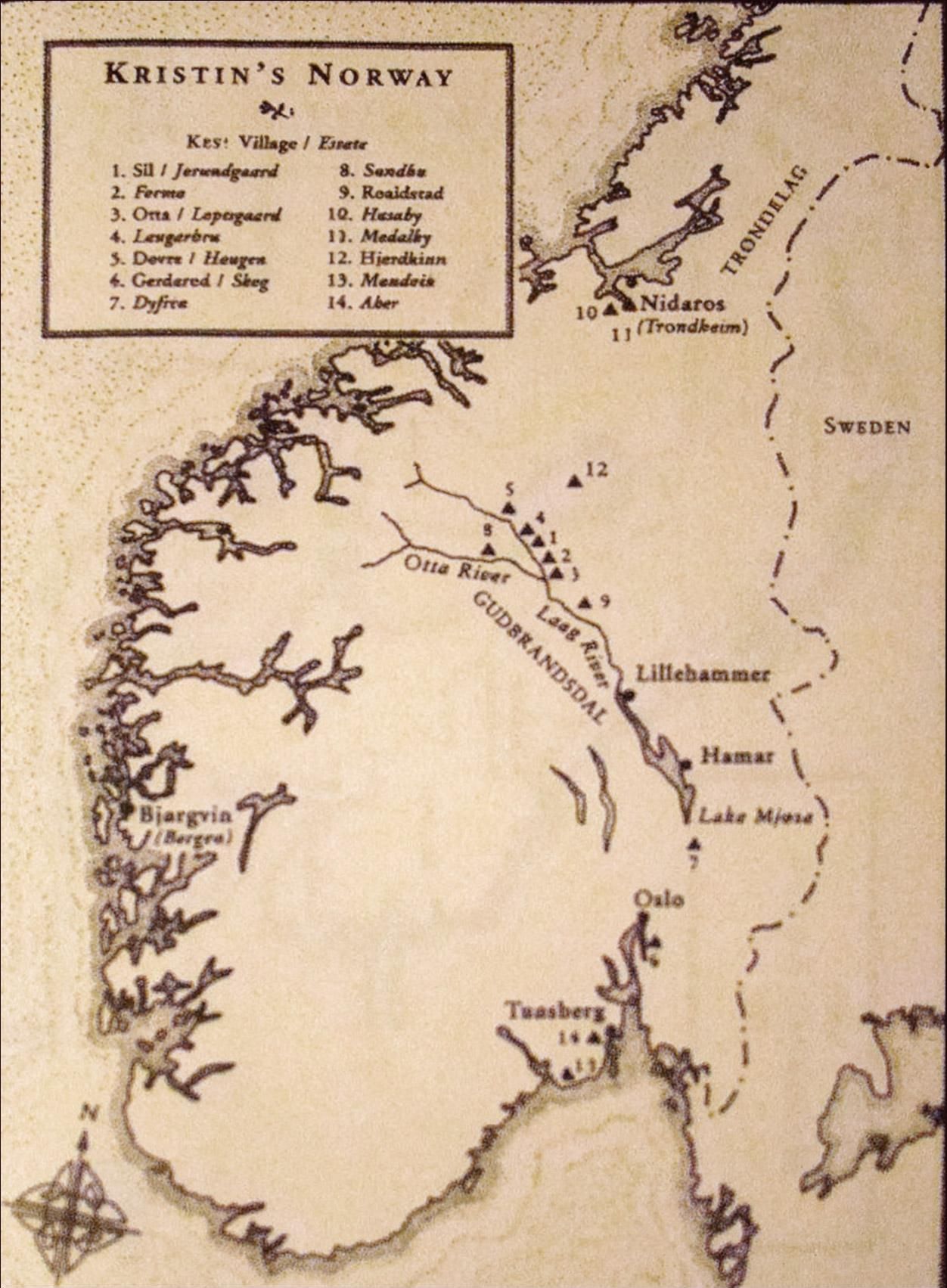
Source: https://www.margueritereads.com/home/kristin-lavransdatter-by-sigrid-undset
as well as a set of family trees.
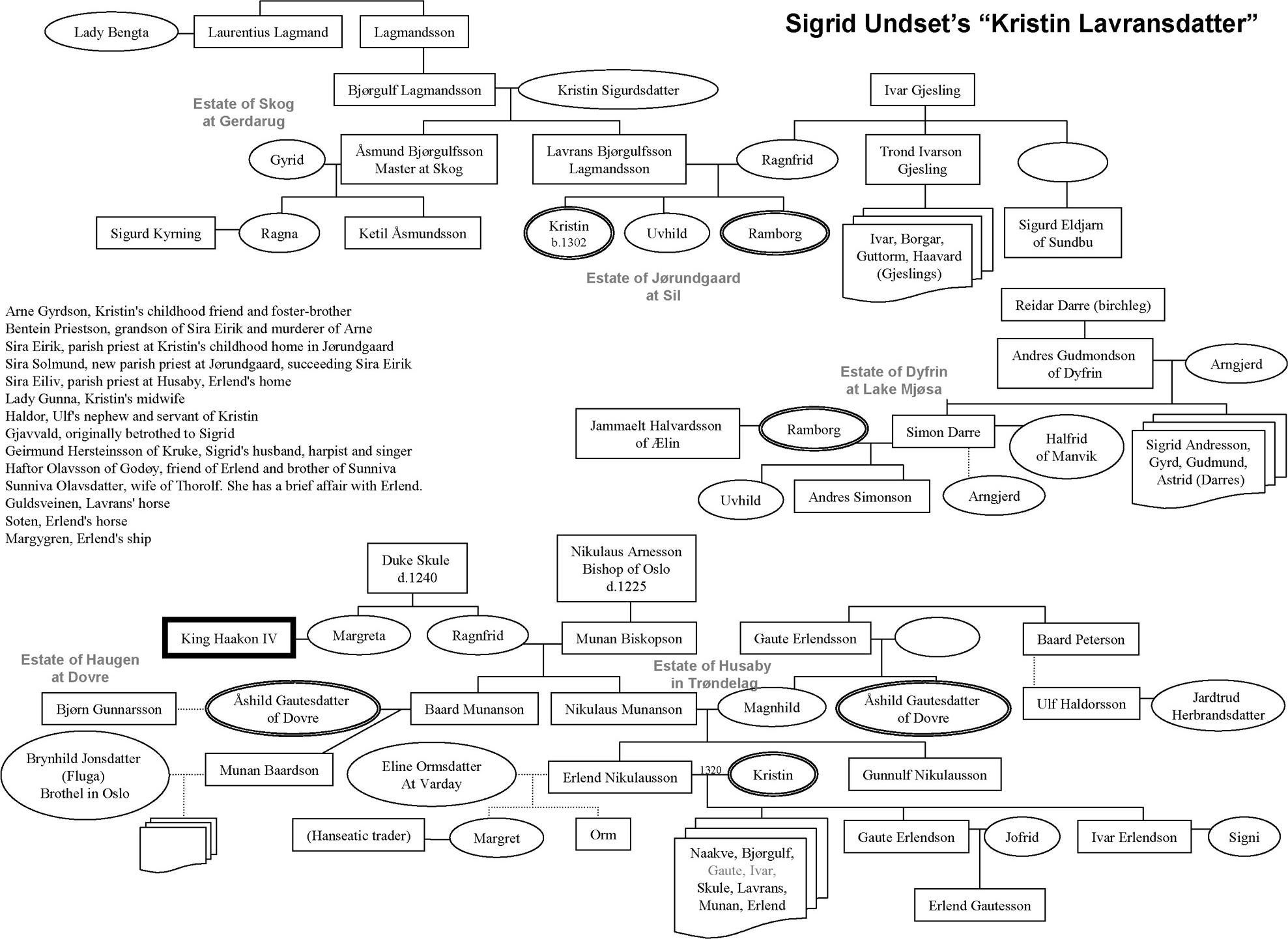
Source: https://www.thenewatlantis.com/text-patterns/characters-of-kristin-lavransdatter
Don’t worry about reading them at first, but they’ll be helpful as you read, much like the list of names/nicknames found at the beginning of a Russian novel.
Characters
Set in the first half of the 14th century, Kristin Lavransdatter recounts the life story of an eponymous Norwegian woman, from cradle to grave. I’m going to attempt to summarize an entire vibrant life, richly described in over 1,000 pages of dense prose - in under 10,000 words, including the ones that got us this far. So let’s meet the main players.
Kristin: Beautiful, willful, and strong, Kristin is the heroine of 1,000 fairy tales made round and human. She loves passionately, is stirred by spiritual pursuits, and sets her own will above all. She is diligent, responsible, and resourceful. As the point of view character for most of the book, the reader encounters the beauty of Norway’s countryside (and the specifics of its culture) through her keen senses. She is fair of face and form, witty without pretention, and somewhat underestimates her own intelligence. As a mother, she is proud, fierce, and doting.
Lavrans: Kristin’s father, and one of my new favorite characters in fiction - a pious, generous, dutiful, sensible man who is well respected by all in the countryside. His tenants appreciate his landlordship, even though he came to live on his manor at his wife’s behest - this is not his ancestral homeland.
And he stood by them and helped them with word and deed; saw to their sick cattle, helped them with their errands to the smith or to the carpenter; nay, would sometimes take hold himself and bend his great strength to the work, when the worst stones or roots were to be broken out of the earth. Therefore were these people ever glad to greet Lavrans Bjørgulfsøn, and Guldsveinen, the great red stallion that he rode upon.
As a young father he is ruddy, handsome, strong, and made of the ‘stuff of a chieftain.’ Merry when drunk, and rarely wroth, he has found his peace as a farmer after a youth spent in service of knights and nobility.
Ragnfrid: Kristin’s mother and Lavran’s somewhat-older wife. A distant but constant presence who is described as being ‘heavy of mood,’ she and Lavrans suffered the loss of three young boys before Kristin’s birth. Initially presented as a stark contrast to both Lavrans and Kristin in many ways, Kristin’s likeness to Ragnfrid is revealed through Kristin’s own motherhood.
Simon: The son of a knight who is courteous, noble, and unfailingly dependable. A modest-looking youth, he is the prize and hope of his parents and siblings. As an adult, he grows large and uncomely, but retains his steadiness and good sense, and is prosperous and respected in the parish.
Erlend: Tall, athletic, handsome, charming - the stereotypical dark rake of courtly romances. High-born and wealthy, Erlend spent his youth in service of royalty, and engages in romantic indiscretion, so that by the time we meet him he has lost a good deal of his land and goods attempting to set things right. He is brave and quick-witted, but careless and irresponsible.
Too many secondary and tertiary characters to name here, so let’s get to the plot.
Book 1: The Wreath
The daughter of a well-loved and respected landholding couple, Kristin’s childhood is rustic but well-off, marked by great affection from Lavrans, praise by all in the countryside, and a cool relationship with her hardworking and dutiful mother. An early adventure in her childhood consists of riding on her father’s great stallion into the high mountains that surround their valley community, where she is doted on by farmers’ wives, and sees how noble her father is in their eyes. While in the mountains, she sees what is described as a dwarf or elf maiden:
But all at once she was aware of a face amid the leaves - there stood a lady, pale, with waving, flaxen hair - the great, light-grey eyes and wide, pink nostrils were like Guldveinen’s. She was clad in something light, leaf-green, and branches and twigs hid her up to the broad breasts, which were covered over with brooches and sparkling chains.
The little girl gazed upon the figure, and as she gazed the lady raised a hand and showed her a wreath of golden flowers - she beckoned with it.
Kristin’s Norway is Christianized, but constant tension persists between pagan practices and Christian ones, and the border between the two is not always clear. Elves, dwarves, and trolls are held to play a role in their world, especially in rural communities. Plenty of characters view the stories as mere superstition, still others view pagan observances as witchcraft or worse, but the legends and practices persist through a mix of tradition and earnest belief. This is a culture in transition.
Kristin has a younger sister, Uvhild, who is critically injured in an accident. We meet for the first time Lady Aashild, who arrives to help heal the child, but she has an unproven reputation for dealing in some of these same pagan practices. Aashild married young, but is now living with a disgraced knight after the death of her husband. Rumor has it that she poisoned him, and bewitched the knight. But like most rumors, conclusive evidence is not forthcoming. Lady Aashild, alongside the parish priest, nurtures Uvhild to a degree of health, and Kristin leaves home to stay and study with Aashild for some time. Lavrans is not excited about this, but assents. Kristin learns much ‘leechcraft’ from Aashild, and for the rest of her life Kristin will be recognized as a skilled healer and essential midwife.
Kristin is soon betrothed to a young man named Simon. He is roughly her age, courteous if bland, and their inheritances would make for a stable and prosperous union, benefitting their families and the parish community. Kristin does not seem to have any issues with the arrangement, although she does not note any immediate connection with Simon - they lack instant chemistry.
After a terrible encounter in which Kristin is nearly raped (the first example of many instances of sudden, male violence), a fight ensues between the perpetrator and a young man of the village who loves her. For not the last time in her life, suspicion is cast her way for something not of her own doing. Kristin shows a child’s poor judgment around the issue, but is otherwise guiltless, yet she is shaken.
Now it was become real to her that she herself and all mankind had a sinful, carnal body which enmeshed the soul and ate into it with hard bonds - he had wrought scathe to the maidenhood of her spirit.
Kristin’s parents send her to live in a convent in Oslo for a year, to prepare for her marriage and let things cool down around the hometown. While with the nuns, Kristin and another young lady accidentally find themselves in the woods with rough characters, and are rescued by a handsome, dashing man on a horse. This charming man (nearing 30 years of age) is Erlend Nikulausson - and she is in love.
It liked Kristin well that he jested not, nor bantered them, but talked to her as though she were his like or even more than his like.
It is during this early romantic phase in which Undset’s mastery of sensory description blooms in full:
She felt she would gladly have stayed for ever in this dark, still church - with the few small spots of light like golden stars in the night, the sweet stale scent of incense, and the warm smell of the burning wax. And she at rest within her own star.
Risking the honor of her family and their standing in their community, the two strike up a discreet romance over the months she stays at the convent, at points even concocting a scheme to meet in town, in the house of a woman of ill repute.
Without knowing it, Kristin gathered up out of all he said each little thing that could make him fairer and dearer to her, and lessen his blame in all she knew of him that was not good.
Erlend loves her desperately, too, but knows he is in the wrong by seducing a betrothed young woman, even though he knows she loves him, too.
When they parted, he gave her a cloak: “So that you may have something to show in the convent,” said he. It was of blue velvet with red silk inwoven, and Erlend bade her mark that ’twas of the same hues as the dress she had worn that day in the woods. Kristin wondered it should make her so glad that he said this - she thought he had never given her greater happiness than when he said these words.
Both parties know this is fraught, and the reader waits for the secret to out. After some public displays of emotion (not dissimilar from Raskolnikov’s fainting spells in Crime and Punishment) the two are discovered by Simon. The scene between the three is electric.
For a while the three stood in silence. Kristin trembled; but yet, in this first moment, she felt a strange, sweet thrill - from deep within her something rose, scenting the combat between two men - she drew a deep breath; here was an end to these endless months of dumb waiting and longing and dread.
Seeing that she does not love him, Simon agrees to release her from their bond, and to tell Lavrans it was his will to do so. But only on the condition that Kristin come clean to Lavrans herself. Simon has enormous respect, even love, for Lavrans, and cannot bear to hurt him.
After Kristin returns home from Oslo, Erlend formally appeals to Lavrans for Kristin’s hand, which is refused. Lavrans knows a few things about this ‘boy’ (as he constantly calls him - in fact, almost all men, even his friends, refer to Erlend as ‘boy’ throughout the three books) - he seduced a married woman (Eline) and has two children by her, was excommunicated from the church for this, during which time she came to live at his manor while still married to her husband. Erlend is wealthy, and higher in social rank than Lavrans, but holds no high office or knightly title after this misspent youth. Oh, and he’s Lady Aashild’s nephew.
In spite of learning these things herself, Kristin is fully committed, and is overcome in her love:
Small threads of water shone high up on the fell-sides, that stood wrapped in blue haze day after day. The heat brooded and quivered over the fields; the brown eather of the plough-lands was nigh hidden by the spears of corn; the meadows grew deep with grass, and shimmered like silk where the breaths of wind passed over. Groves and hillsward smelt sweet; and as soon as the sun was down, there streamed out all around the strong, cool, sourish breath of sap and growing things - it was as though the earth gave out a long, lightened sigh. Kristin thought, trembling, of the moment when Erlend’s arms released her. Each evening she lay down, sick with longing, and in the mornings she awoke, damp with sweat and tired out with her dreams.
Kristin engages in an emotional scorched earth campaign at home because her father will not consent. This leads to one of my all-time favorite ‘dad’ scenes in fiction:
“Father,” said Kristin, “have you been so free from sin all your life, that you can judge Erlend so hardly - ?”
“God knows,” said Lavrans sternly, “I judge no man to be a greater sinner before Him than I am myself. But ‘tis not just reckoning that I should give away my daughter to any man that pleases to ask for her, only because we all need God’s forgiveness.”
Absolute peak dad line. I need to store this one up for some later use. Lavrans’ deep understanding of Christian forgiveness is married to a practical recognition of the costs of misdeeds – not just to an individual, but to the whole community.
“See you not, Kristin - such sins as these - it may be that God may forgive such sins more easily than many others - but they lay waste a kindred in such wise that it can never be made whole again.”
During this season at home, Erlend brings a small troop of armed men to Kristin’s hometown to bear her away by force, a plan to which she is privy. They rendezvous at the home of Erlend’s aunt, Aashild, but there arrives an unexpected guest: Eline.
The heavy riding dress covered up her form, but she bore herself in it as does only a woman most proud and secure in the glory of a fair body. She was scarce as tall as Kristin; but she held herself so well that she seemed yet taller than the slender, spare-limbed girl.
Eline comes with news: her husband has died, and so now must Erlend keep the promise he made to wed her. In another electric scene Eline’s cold malice towards Kristin is made plain, and a scuffle ensues ending in Eline’s death. Erlend’s plan to carry off Kristin is foiled, as he must deal with Eline’s body, and his own children. Fortunately, it is the dead of winter, and Erlend, Kristin, Aashild, and her paramour devise a plan, hinging on her body remaining cold enough to not decompose. The consequences continue to pile up.
“Much have I done already that I deemed once I dared not do because ‘twas sin. But I saw not till now what sin brings with it - that we must tread others under foot.”
After another season of waiting and cold fury, during which Uvhild dies, Erlend ventures another attempt at Kristin’s hand. It takes some serious convincing for Lavrans to eventually relent, one particularly pointed conversation with Ragnfrid included.
“I have seen her heart; not one thought hath she left but her love for this man - ‘twere no marvel if one day she showed us that he is dearer to her than her honour - or her life.” (Ragnfrid)
The deal is made, and the wedding date is set, but in the meantime Erlend and Kristin secretly rendezvous, and she gets pregnant. While Kristin learns more about Erlend’s character and his lacking reputation, this discovery yields the first little kernel of resentment towards him, even before they are married: how dare he force her to suffer this indignity. Upon realizing she is pregnant…
Erlend! She set her teeth hard in anger. He should have spared her this.
After the wedding, through which Kristin is largely in a trance, courtesy of Aashild who observes her pregnancy, we spend a long sequence with Lavrans and Ragnfrid. Roughly 70% of the novel is told from Kristin’s vantage point, but there are three extended segments from the perspective of important men in her life. (You might also call this novel “Kristin and Her Men.”)
Lavrans and Ragnfrid do not yet know Kristin is pregnant, but Lavrans has seen the way they look at each other in the bridal room, and he knows they have been together. He feels foolish at being taken in, but wonders at his own marriage: why has he not felt the same fire witnessed between his daughter and her beloved?
Though none in the countryside would guess at any trouble in their household, and the relationship between the Lavrans and Ragnfrid is kind and respectful, both would agree there is little passion. A vulnerable, heart-rending conversation reveals some secrets, both to the reader and to Lavrans. The first book ends quietly, with the noble parents seeing each other more clearly than before.
Book 2: The Mistress of Husaby
The second book covers Kristin’s years as the mistress of Husaby, Erlend’s manor. As of moving to Husaby, she has still not told Erlend of her pregnancy, and he discovers it by accident. He says nothing at the revelation, and…
Bitterness surged through her heart… Never, it seemed to her, could she forgive him this.
Due to the sinful manner in which he was conceived, Kristin is terrified her punishment will be borne in the form of her son - through death, disfigurement, or some other ill. There is an absolutely harrowing childbirth scene (must be one of the longest in fiction), but her first son (she will bear 8, 7 of which live past childbirth and 5 to adulthood) is a healthy, strong baby.
She soon embarks on a pilgrimage to St. Olaf’s Cathedral in Nidaros to atone for her misdeeds, at the gentle encouragement of Erlend’s priestly brother Gunnulf. The pilgrimage is a pivotal event for Kristin, and she returns home with a renewed spirit to embrace the life she has chosen, and be a dutiful and faithful mistress to her husband.
Where housewives came together, she was taken into council; they praised her ordering of her home; she was fetched to be brideswoman and to be helper at births on the great manors, none made her feel that she was young and unskilled, and a new-comer to the country.
She is often pregnant, and while motherhood is a constant theme of all three volumes, the second one takes an unvarnished look at motherhood in a difficult situation.
She could scarce remember, it seemed, what ’twas like to be free and supple in the waist, to be able to tie her shoe without pain and labour.
Erlend also has some thoughts on Kristin’s constant pregnancy:
“Methought that when once you were mine - ‘twould be like drinking Yule-tide every day. But it looks as though most of the time would be long fasts.”
Though he has managed his lands poorly, Kristin’s upbringing as a hardworking, rural farm girl equipped her well. In short order, she has the manor and surrounding tenant farms in good shape.
And so the talk of the countryside, which so long had seethed with wrath over Erlend Nikulausson’s shameless evil life and shiftless and ruinous husbandry at Husaby, died away now into good-humoured jesting. Folks smiled and said that the young housewife Erlend had gotten had brought much to pass in six months.
The years pass, with Erlend continuing to grate on Kristin, and vice-versa. While there are times of peace and passion, his dissolute nature keeps her from respecting him, and her resentment and bitterness drive him away.
But what Erlend of Husaby said and what he did were not things that counted with full-grown and prudent men. She saw that Erlend was still reckoned as one of the young men - thought he was a year older than the High Steward… Thus was he liked, spoiled and bragged of - but not accounted as a man come to man’s estate. And she saw how willing he seemed to fall in with this and be what his fellows would have him be.
He accepts multiple military assignments as the captain of ships and castles (a role to which he is well suited - both his men and the regional nobles are impressed with his capabilities and daring), partially to be gone from his home. He is stir crazy, but his fractious relationship contributes mightily.
Then belike it was true, what they had told him, the priests, that sin ate up a man’s soul like rust - for no rest, no peace was his, here with his own sweet love - he but longed to be gone from her and all that was hers… And now his one longing was to be gone to strife again. He longed wildly for that outermost barren rock, for the sea thundering round the northern forelands, for the endless coast, and mighty fjords where all manner of snares and pitfalls might await him… for war and the sea, and the song of his men’s weapons and his own.
Over time, Erlend’s reputation improves, due partially to his skill in arms, but in no small part to Kristin’s improvement of his estate; he remains careless as ever. In spite of his shortcomings, he recovers some lost titles of his father, and begins to move in important political circles. During this period, Lavrans and Ragnfrid pass away. Kristin, thinking on them…
Now she seemed to see that betwixt those two, who in their youth had been brought together by their fathers, well-night unasked, there had run strong swift currents both of sorrow and of joy - yet she knew naught of it save that they had passed now, hand in hand, out of her life. Now she understood that this man's and woman's lives had held much beside their love for their children - and yet that love had been strong and wide and unfathomably deep, while the love she gave them back had been weak and thoughtless and self-seeking, even when, in her childhood, those two had been her whole world.
One of the most interesting parts of this novel is that we actually meet some historical figures, notably Erling Vidkunsson and a young king of Norway and Sweden. While Erlend himself is fictional, he participates in a plot to… well… let’s just say:

Source: 20th Century Fox Television
Most of the Norwegian nobles secretly think this is a good idea, and the plot dovetails with historical events. The density of the prose does this part of the story a disservice; it’s quite interesting but takes extra-attentive reading to tease out what is going on with the political situation. (I expect the Nunnally version makes this more legible!) Regardless, the plot might succeed, but Erlend’s carelessness strikes again.
While staying at their townhouse in Nidaros (modern day Trondheim), another marital fight drives Erlend outside (they are now wealthy enough to own a stone house in the city, in addition to their country manor Husaby). Erlend runs into, then sleeps with, a married woman, and though he hates her and hates himself for it, he returns over multiple nights. Eventually this dalliance, too, turns fractious.
“Is it so,” asked Sunniva threateningly, “that I was to be but a whip for you to lash your wife with?”
Erlend stood breathing hard: “Call it so, if you will. But you laid yourself ready to my hand.”
“Beware,” said Sunniva, “that that whip smite not yourself –”
Important (i.e.: treacherous) letters fall out of his trousers, and though Erlend realizes it later, he does not return to collect them. He thinks so little of this woman he assumes she cannot read. Sunniva betrays his plot to the king. Months of imprisonment and torture follow (although without Erlend betraying a single one of his fellow conspirators), through which time Kristin is, yet again, faithful to Erlend. She does everything she can to plead his case, and calls upon an unlikely source of help: Simon.
In the meantime, Simon married an older widow who passed away without leaving Simon an heir, and then re-married Kristin’s much younger sister Ramborg.
Simon remembered the first time he had clasped hands with Lavrans on such a bargain; and his heart grew little and sore in his breast.
While Simon does care for Ramborg, and Ramborg adores Simon, he clearly marries her as much from a desire to be kin to Lavrans as anything. The two men respect each other a great deal.
But so sore and watchful was Kristin now grown that she felt that in Lavran’s kindness for Erlend there was much of that pitying tenderness that Lavrans had always had for every living thing that seemed to him in some measure unfit to stand on its own feet... His love for his other daughter’s husband was not of this kind - Simon could meet him as a friend and comrade.
Simon proves a most faithful kinsman to the desperate couple, approaching Sir Erling to plead Erlend’s case at great personal cost. Simon believes he acts out of duty to Lavran’s memory, who has since passed, and he attempts to ignore his persistent feelings for his wife’s older sister. After a year of prison, and forfeiture of all Erlend’s lands and goods to the crown, Erlend is set free and permitted to continue living in Norway.
Upon the death of Lavrans and Ragnfrid, and Ramborg’s marriage to Simon, Kristin inherits her childhood farmstead, and she moves her husband and pack of half-raised sons back to the mountain valleys. She will share the parish with her sister and brother-in-law. Erlend is set for a more demanding way of living, now greatly diminished in the eyes of all, excepting his sons.
At the end of book two, Simon inadvertently reveals to Erlend he still has (or had) feelings for Kristin, in an unusual (for Simon) emotional outburst. One gets the sense that, after months of dutiful service and frustration with Erlend’s seeming cluelessness, his innermost feelings finally slip out.
The second volume also ends quietly, and it is clear as ever that the three volumes are a single work.
Book 3: The Cross
Book three highlights the challenges of raising a brood of growing boys with fewer material comforts, and Ragnfrid’s tendencies begin to reveal themselves in Kristin’s parenting:
The two little lads had come to her side; they made haste to do as their mother did, kicking the pine root with all their might, and then asking eagerly:
“Why did you so, mother?”
Kristin sat down, laid the Aaron’s-rods in her lap, and began to strip off the full-blown blossoms into her basket.
“ ‘Twas that my shoe pinched me on the toes,” she answered, so long after that the boys minded not that they had asked. But they gave little heed to this - they were so used to have their mother seem not to hear when they spoke to her, or wake up and answer when they had forgot what ‘twas they had asked.
She spends more time with the boys, and away from her husband, of her own volition, busying herself with the endless tasks of a medieval farm. She retreats to a mountain saeter for a season, unable to bear seeing her husband so feckless in this context. While at Husaby, his martial prowess supported a lavish life, in spite of his general carelessness for stewardship. But he is proud and set in his ways, and will not adapt himself to their new station.
She sat and let the bitter old thoughts come to her like old acquaintance. And met them with other old and well-known thoughts…
Her sons, however, will see nothing in their father but the stuff of a chieftain - a sword’s breadth from kinship with the crown, whose bearing and stature is not diminished by his ill fortune. Kristin knows better, and lets the resentment build:
It was then that she had felt the first drop of bitter gall well up in her heart. God shield the lad - may he never see the day when he must fix his faith on a hand that lets all slip through its fingers like cold water and dry sand.
But these deep seeds of resentment can not go so well watered without sprouting, and the third volume is a series of long-gestating consequences.
Early in book three, Simon and Ramborg’s young and only son falls ill. Kristin is called upon, both as kin and leechwoman. Though she would gladly help any ailing child, she sees an opportunity to indebt Simon to her, this man she scorned, but who was yet faithful to her and her family.
As the boy worsens, She proposes a pagan practice (presumably learned from Aashild) to spare the child’s life. Simon does not stop her, and Undset’s powerful prose roars to life:
She knew - had it been for one of her own children’s lives, she had never dared to try this last shift of all. Turn God’s hand aside, when He had stretched it forth to take a living soul! As she sat over her own sick little ones, when she was young and her heart bled with tenderness, she had tried to say, when ready to sink with dread and anguish: Lord, Thou lovest them better than I - thy will be done -
Yet now went she here this night defying her own terror - This child which was not hers - this child she would save, whatsoever she might save it for -
For you, too, Simon Darre, when the dearest thing you owned on earth was the stake, took at my hands more than a man may take with honour unabated…
But she had swooped down upon that single hour when she found him at the breaking point - had seized the chance that moment gave her and gone her way. This secret now she would share with him - that he knew she too had seen him in an hour when he stood not firm on his feet -
For he had come to know her too nearly. At the hands of the man she had thrown off she had taken help each time there was need, to save the man of her choice. The lover she had cast aside was the man she had turned to, each time she stood in need of a shield for her love. And she had never besought Simon in vain - time after time had he stepped forth to screen her with his kindness and his strength…
… she knew not what - was it revenge? - revenge for that she had been forced to see he was worthier than they two -?”
She completes the ritual, and the boy survives, but the events come one after the other, like clouds in the wind. After Simon kills a man in a flurry of passion (largely due to the deceased Lavrans’ honor being called into question), Erlend rescues him from a mob. Emotions run high, and get the best of Simon yet again:
“ - I am not so high-minded as you deem, Erlend - I am not so high-minded as you - I - I bear a grudge to the man whom I have wronged -”
His cheeks palely flecked with passion, he stared into the other’s eyes. Erlend had listened to him with mouth half open.
“This I had never dreamed on till this hour! Do you hate me, Simon?” he whispered, astounded…
“I cannot bear to meet you any more!”
“Man - ‘Tis twenty years agone,” Erlend burst out, in amaze.
“Ay. Deem you not that she is worth remembering for twenty years?”
Kristin and Erlend’s relationship continues to deteriorate, even as she takes up again the labor of providing and maintaining her family’s estate. Undset’s description of aging comes to the fore with Kristin:
Now each day’s toil took away something of what was left of the comeliness that had marked her out as a daughter and wife and mother of men of noble blood - the narrow white hands; the soft fair-skinned arms; the clear and tender hue of face that she had shielded from the sun so heedfully with a kerchief, and tended with cunningly brewed washes. Long ere now she had grown careless whether the sun beat straight upon her sweat-stained face and burnt it brown as any poor peasant wife’s.
Her hair was all that was left to her of her maiden beauty. ‘Twas thick and brown as ever, seldom though she found time to wash and tend it. The heavy, tangled plait that hung down her back had not been undone these three days.
The sons begin to thrive or struggle in their own way on her parent’s estate. None but one take readily to a farming lifestyle (the one who ultimately will inherit the estate) but the various stages of their parents’ relationship are reflected in the traits of the sons.
Björgulf spoke again:“Of naught did you think, father and you, but of this strife of yours - No thought had you that we were growing to manhood the while. Never did you take heed who might come between your weapons and be dealt bleeding wounds -”
All the same, she cannot bear to think of her boys leaving home.
Bloody fibres from her heart’s roots would they drag with them when they took flight, and they would know naught of it.
Eventually, a separate misfortune befalls Simon, and he is gravely wounded. Kristin tends him, while Ramborg is away.
He would tell her, before he died - once only: I have loved you all these years… (Simon)
But Simon instead gives Kristin his greatest gift of all, and remains silent about his love. He passes away. It seems Kristin is not the only character bearing resentments, and afterward she and Ramborg speak for the last time, Ramborg revealing to a dumbfounded Kristin that she knew Simon still loved her:
“Yes, in sooth,” answered Ramborg. “But full well I trow that you know it not. So little have you thought on Simon that I well believe ‘tis news for you. You counted him good enough to turn to when there was need of a helper that had gladly borne red-hot iron for your sake - but never did you fling so much thought Simon Andresson’s way as to ask how much it cost him - I was left free to joy in my youth, ay - blithely and gently Simon lifted me into the saddle and sent me forth from him a-visiting and junketing; even as blithely and gently he welcomed me again when I came home - he patted me as he patted his dog and his horse - he felt no lack of me, wheresoever I went - “
The friction at home comes to a head, and Erlend retreats to the (now allegedly haunted) mountain cabin he inherited from his since-deceased aunt Lady Aashild.
“... I wot well you are more godly in such-like things than I can ever be - yet, Kristin, ‘tis hard for me to see how it should be a right reading of God’s word to go on, as your way is, ever storing up wrath and never forgetting…. Often when you speak so soft and sweet, as your mouth were filled with honey, I fear me you are thinking most upon old wrongs, and God may judge whether your heart is full as pious as your mouth - “
Speaking of Erlend, Kristin releases her venom:
“For once, surely, Erlend might endure to be talked to as he were a grown man,” said the wife, vehemently.
Another priest correctly diagnoses the couple.
“You trod all underfoot and braved all that you might come together; that time Erlend was in peril of life, you thought of naught but of saving him, and he thought more on you than on his seven sons and his name and his goods. But so soon as you can possess each other in peace and safety, then you throw seemliness and peace to the winds - wrangling and miscontent were betwix you at Husaby, too; that saw I myself, Kristin - “
Kristin humbles herself, goes to the cabin, and reconciles with her husband enough to get pregnant yet again. But she will not stay and live with him, and he will not come down from his mountain fastness and dwell in the farmland with her.
“We must see, then,” he said at last, “which of us two is the more stubborn, my sweet Kristin. This will not be our last meeting - that know we well, both you and I!”
Erlend does not return, but the local rumor mill begins again. After her eighth dies shortly after birth, Kristin is charged with infidelity, as the parish knows Erlend has been away from home close to a year. Her past misfortunes, and her own decisions, cost her community trust.
“Ask not us, Kristin Lavransdatter, who saw how your father loved you, and how you rewarded his love - ask not us what we deem is too evil for you to do!”
Riding in on his great black charger, a now-silver-haired mirror of his youthful heroism, Erlend is killed defending his wife’s honour.
After Erlend’s death, Kristin lives with her children and young men on the farm, watching them die or leave one by one, until only a single son is left who will inherit the land. He marries a beautiful, willful young woman named Jofrid. While Jofrid is proud to call Kristin mother-in-law, and she has a place of honor in the home, it soon becomes clear Kristin and Jofrid cannot both rule, and as long as Kristin resides there will be opportunity for strife. Retracing the pilgrimage steps she took as a young bride and mother, Kristin departs her childhood home to begin life in a convent - a path she considered as a youth.
The country-side seemed to lay itself to rest under the flooding white sunshine. Since dewy dawn the song of the scythes in the flowery meadows, the ring of whestones on iron, and voices calling, had sounded from the farms far and near. Now all sounds of toil were hushed; the midday rest sank of all. Kristin sat on the stone heap, listening. Only the rush of the river could be heard now, and the faint rustling of the leaves in the grove; the thin buzz and muted hum of flies and gnats above the meadow; the clink of a lonely cow-bell somewhere far away. A bird winged its way, swift and silent, along the edge of the alder thicket; a bird rose from the meadow tussocks and flew with a shrill twitter to light on a thistle-stalk.
But the drifting blue shadows along the hills-die, the fair weather clouds that piled up over the edge of the fells and melted in the blue summer sky, the glitter of the Laagen’s water between the tree-trunks, the white gleam of the sunlight on all the leaf-trees - these things she was ware of as the voice of the stillness heard by an inner ear, rather than as seen by the eye. With her coif drawn over her brow to ward off the sun, Kristin sat listening to the play of light and of shadows over the Dale.
All fires burn out at last -
While at the convent, the plague comes to Norway. Without knowing which sons are spared, Kristin makes a great act of sacrificial love at the end of her life.
But she could do no otherwise; it was her nature to love with much toil and care.
It is not a spoiler to say the main character dies at the end of a story about their entire life, but the events surrounding her final days I will leave for the reader to enjoy. The novel concludes with another small scene between two of the important men in her life.
Why read Kristin Lavransdatter?
This is a (semi-brief) surface description of a very long story, and it risks undercutting how moving Undset’s work is, by sounding melodramatic-via-reduction. A lesser author would hit these same plot beats with flat characters for a salacious, page-turning, period soap opera. Though Undset is steeped in Norse saga and medieval chivalric romances, and knows exactly how to deploy what we might call a ‘trope,’ she treats the real historical setting as a world to be taken seriously - neither idealized nor set up to fail. She describes real, earnest people in a challenging, beautiful, sophisticated environment.
I hope the numerous block quotes have given you a taste of Undset’s mastery of language, and in my opinion it is worth reading over 1,000 pages of K.L. strictly as an aesthetic exercise. The author is, by turns, funny, passionate, clever, spiritual, and the most careful and caring describer of smells, bodies, and landscapes I have read in some time. But it would be a gross understatement to say that is the only reason.
Undset occasionally spends just a sentence or two on keen, passing observations that would consume other entire novels:
And when Kristin had seen the shoes from the outland Ingebjorg had in her chest - more pairs than one - she felt she could not rest until she too had bought some like them.
K.L. is not primarily, even substantially, about material envy, but the combination of social comparison and the urgency of their analog world make it impossible to avoid. The author has only to nod in its direction, and envy sits alongside all the other vices and virtues that comprise Kristin’s life. Undset does this with dialogue as well, quickly revealing a character trait and then moving on, a tool she shares with Jane Austen.
Simon speaks briefly about Lavrans’ solitary interior existence:
“So it is that he has many friends - but think you there is one who is his fellow?”
Intentionally or not, Undset is channeling Aristotle’s Ethics here, with his observation about rare friendships for excellent individuals.
If there is one character in the whole series who approaches the ideal of selfessness and charity, it is Brother Edvin -
The old, sea-blue eyes were red-rimmed and the lids brown and thin as flakes. A thousand wrinkles spread out from them; the wizened cheeks with the reddish network of veins were scored with furrows which ran down towards the thin-lipped mouth, but 'twas as though Brother Edvin had grown thus wrinkled only through smiling at mankind.
She sees him later in the same novel
“Ay, a young child like you thinks, maybe, there are no other lures in the world than pleasure and riches and power. But I say to you, these are small things men find by the wayside; and I - I have loved the ways themselves - not the small things of the world did I love, but the whole world. God gave me grace to love Lady Poverty and Lady Chastity from my youth up, and thus methought with these playfellows it was safe to wander, and so I have roved and wandered, and would have been fain to roam over all the ways of the earth. And my heart and my thoughts have roamed and wandered too - I fear me I have often gone astray in my thoughts on the most hidden things. But now ’tis all over, little Kristin; I will home now to my house and lay aside all my own thoughts, and hearken to the clear words of the Guardian telling what I should believe and think concerning my sin and the mercy of God –“
While hiking the ridge of historical fiction, it is easy for an author to slip to one side or the other. On one hand is the temptation to idealize this past: social systems work flawlessly, challenges and costs are minimized or ignored entirely, and characters are supernaturally content and free from the burden of imagining a different world. In this case the setting is elevated to an ideal of fairness, purity, ecological stewardship, or virtue creation.
On the other hand, an author can use their setting as a punching bag, highlighting every injustice or social burden without showing their contingency, often placing a modern stand-in character to critique aspects of society (usually government or religion) from a modern reader’s point of view. This can demonize the past generally_,_ or the setting in particular, or even occasionally used as a stand-in by which to critique modern society, with our specific ills amplified in the historical setting.
Undset walks the straight and narrow here. The material and social world presses in on the characters from all sides, and while unfairness is felt the author does not succumb to omniscient critique. She has deep knowledge of the setting, and lets the reader feel the physical and social conditions for what they are. Whether Kristin’s arranged marriage, the social scorn heaped upon un-married un-maids (or men who sleep with married women) are correct social norms from the view of a 21st century reader (or 20th century author) is not the important part. The society is taken as it is, with its clear social costs, and the reader is given the gift of real, human characters to see it through.
Undset’s characters are neither archetypal like those of myth or mere modern stand-ins; rather she plays with the archetypes of historic epic and shows their humanity. Kristin is the headstrong young heroine who chooses her own husband, but rather than a simple, modern tale of 'girl bucks the system and wins,' she shows the immense costs of Kristin always having to have her own way, both on herself and those around her. And it’s not just her immediate family (although those costs are large) but her web of community, too. These characters chafe against societal strictures, and have to weigh the cost of their decisions to themselves and others.
An Enchanted World
Kristin lives in a Christianized community within a pagan world, and the tension on the borders is evident all around her. Even the world of medicine is fraught, with some techniques considered faithful, and others pagan. To be clear, this is not because many Christians of Kristin’s time and place thought trolls, elves (and devils and angels) were imaginary. They knew them to be real (at least some of them) and thought it sometimes wise to give the old pagan gods (and their servants) succor through sacrifice. Lavrans, thinking on his farmers…
It was with some doubt he still let them bear out food to the great stone at Jörund’s grave-mound on holy eves - but yet he deemd ‘twere sin and shame to deny to the tenant of the mound what he had been used to be given ever since folk had dwelt upon the place. He had died long before Christendom had come to Norway, so it was not his fault that he was a heathen... and for small folk ’twas cheaper to give the old ones what they were used to have, rather than make foes of them and trust wholly to the priests.
The history of the Aesir moving from a pagan culture to a Christianized one is long and, frankly, many rungs above my pay grade. Undset uses the friction between the draw of the pagan world and the draw of the Christian church to examine motives and desires, noble and ignoble: the fullness of sin and fullness of virtue within each of our hearts. The tension symbolizes Kristin’s growing realization that her will may not be wholly worthy of pursuit. Which desire is worth entertaining, and which is not? Why does Kristin engage in a verboten pagan healing practice, one she would not pursue even to save her own children, for the sake of Simon’s child?
It would be easy for a modern to say that the Christendom of Kristin has fully won, but really the entire world is different. Charles Taylor’s thesis in The Secular Age is that the playing field is so rearranged that even most modern Christians are no longer reckoning against ‘the rulers, against the authorities, against the powers of this dark world and against the spiritual forces of evil in the heavenly realms.’ (Ephesians 6:12)
A modern deist, even some Christians, might say ‘God of some sort is real, but the devil / devils don’t exist.’
A medieval Norwegian would say ‘Nay, they are all of them real - which will you serve?’
The greatest trick the Devil ever pulled was convincing the world he didn’t exist - Baudelaire
Whether the Satan of the Christian Bible is a single, sentient being, reducible to a pitchfork-wielding devil, or an impersonal force of chaos is irrelevant to this case. Likewise irrelevant is whether his ‘forces’ are an army of individual personalities with agency (a la Milton) or mere, specific expressions of this entropic force. Undset has, intentionally or not, created a work of Taylor’s ‘enchanted age,’ and makes real characters make difficult decisions in this world of imperfect information, using fairy tale tropes to ground it.
Stray thoughts
- The name of the book is fitting. Kristin’s relationship with Lavrans hangs over every other relationship in the book. She compares Erlend’s stewardship (or lack thereof) to her father’s, she imagines what life would have been like with Simon, with his similarities to her father, although not as handsome or regal. A climactic fight revolves around Kristin saying Erlend is less worthy than Lavrans.
- At every stage of Kristin’s life, childhood, maidenhood, motherhood, there is a real sense that ‘things in the world are not as they should be.’ And that flaw is in the whole world. And that flaw is in me. But how can that be, that the world is so bright and big and full of mysterious beauty, and that just on the edge of my sight there is even more of it, more beauty and life than I could ever hope to hold in a lifetime? And yet it is still not quite as it could be? And it is both.
- If you search for podcast episodes discussing this book, the hosts are almost entirely women, but I did hear one male podcaster comment that K.L., alongside Pride and Prejudice, were the two fiction books that he felt most gave him a perspective on what it must feel like to be a woman, and I’m hard pressed to think of a third in this tier. Undset shares several traits with Austen. Most notably she lets the social rules be real and firm enough to provide conflict, and then still critique those rules from within. The phrase ‘the dogma is the drama’ means that it is from operating within those social and religious mores that the drama arises. If it’s no big deal that Kristin breaks her engagement and sleeps with Erlend, then… it’s no big deal. And if it’s no big deal, why bother reading the book?
- Kristin sees Erlend as both lesser and greater than he sees himself.
- Last year I reread Lonesome Dove. While the first time reading that book is an absolute blast, and getting to know the characters is a wonderful experience, much of the gloss came off the second time around. The journey is still adventuresome, the central friendship is still worthwhile, and McMurtry can still turn a phrase every now and again, but you start to see the cynicism that lurks behind much of the book. There is none of that reading K.L. the second time. If anything, the world is more vivid, the characters more human, and the spirituality more earnest.
I cannot recommend K.L. enough. Even though this review is very long, my mind fairly screams “Oh! And there is this character! And this moment! (of which Sigrid Undset is the queen) And this passage!” and anyone who has heard a friend absolutely lose themselves in frenzied praise of a favorite work will recognize that I am now rambling.
So I’ll leave you with this:
Lord, give me but this and this and this - then will I thank Thee and crave no more than this and this and this - Never, it seemed to her, had she prayed to God for aught else than that He might grant her her own will. And she had got always what she wished most. And now she sat here with a bruised spirit - not because she had sinned against God, but because she was miscontent that it had been granted her to follow the devices of her own heart to the journey's end. She had not come to God with her garland, nor with her sins and her sorrows - not so long as the world still held a drop of sweetness to mix in her cup. But she came now, now she had learned that the world is like a tavern - where he who has naught to spend from is cast out at the door.
Your message is stored now and emailed to the author after the contest ends. The author can reply to you, but their identity stays hidden unless they choose to respond.