Book 1: The Singapore Story
Lee Kuan Yew[1] was the Prime minister of Singapore, rationalist folk hero, and one of the few world leaders to successfully become a household name despite not being primarily associated with a major war[2]. He was also, as it turns out, a surprisingly compelling writer. Aside from being interesting for his own sake, he also ended up implicitly producing the closest thing we have to a firsthand account of the fall of the British Empire and rise of the new world order.
His memoirs are split into two books, each covering roughly half his life. The Singapore Story covers his childhood, World War 2 and the Japanese occupation, law school, his legal career and rise in Singaporean politics and Singapore’s independence from the British Empire, joining Malaya to form Malaysia, then leaving Malaysia to finally become Prime Minister of a truly independent country. Third World to First covers his 25 years running Singapore after independence.
These books are part autobiography, part political memoir, part rationalist power fantasy. Every good rationalist, from time to time, can’t help but think Hey, if we just put me in charge of the government I would simply pass the good policies and not the bad ones, and the country would thrive. I’d just have to be clear and direct and explain to everyone why these were obviously good and reasonable ideas, they’d understand and go along with them, and our government would be popular and successful forever. All of us[3] know this isn’t actually that easy, that real-life policy is hard and messy and often unreasonable and our clear bright ideas would struggle when faced with Reality. This couldn’t possibly work in real life.
Except that Lee goes ahead and does exactly that. He passes reasonable, economically-optimal policies and they work out so well that the economy booms and his party keeps winning massive supermajority elections for decades. When a race riot almost breaks out over malay recruits getting turned out of the army during high unemployment, he calmly shows up, picks up a megaphone and explains to everyone that this is all a misunderstanding, there’s no policy against employing malays in the army and they’ll all be processed and get jobs when they come back tomorrow. Everyone understands how reasonable he’s being, calm down, and sort things out the next day.
At another point he handles chinese-malay tensions by writing an epic Scott-length blog post giving an epic speech to the Malaysian parliament about how the new Malaysia needs to be less obsessed with zero-sum culture wars and focus on pragmatic economic policy and even the die-hard Malays stand up and clap[4].
All of which raises the question: How did he actually do all this? Each book covers a seemingly-impossible task (the first, going from middle-class teenager with no connections to Prime Minister of your own country; the second, taking a third-world island nation with no natural resources into one of the richest countries in the world) that we might do well to learn from. The book implicitly offers one explanation - just be consistently brilliant, charismatic[5], incredibly detail-oriented, honest, hardworking,and pragmatic continuously for decades while also having your share of good luck. Still, let’s take a look at the details.
Early Life
Before we get to the rationalist power fantasy story, we take a tour through a few different genres. We start with a peaceful coming of age story.
Lee was born in 1923 in what seems like a typical middle class family for colonial-era Singapore, which is an odd mix of imperial British and a mashup of local cultures. He mostly goes by Harry Lee in his earlier years (He dropped the Harry in the late 1950s[6], except with his British contacts).
Some parts of it (like the school system) feel surprisingly normal. Other parts are, well, this:
“My mother was the eldest child of this union, and when she was married in 1922 at the age of 15, the fortunes of both families were still healthy. She even brought with her, as part of her dowry, a little slave girl whose duty, among other things, was to help bathe her, wash her feet and put on and take off her shoes.”
Lee doesn’t especially respect his dad, who he considers weak, lazy and unreliable[7] and learns his principles from his mother and (maternal) grandfather. He goes to British-run schools, keeps getting top marks and filtering upwards through the system, and ends up at Raffles college, the college for British-educated local elites in colonial Malaya[8].
The story then takes a turn to become a school drama. First, Lee needs to get top grades in college for his dream of getting the Queen’s Scholarship to go to Oxbridge, a prestigious opportunity that only one or two students a year can get. But, frustratingly, there’s this girl a year above him who keeps outcompeting him with slightly better grades.
This is specifically the type of school drama with an absurdly powerful student council. There’s some drama between the Malay and Chinese students and, as an epic debater and naturally take-charge kind of guy, Lee ends up representing the Chinese students on their side of the argument. Everyone involved in this college dispute shows up again twenty years later as some kind of senior government official or public intellectual negotiating the fate of Southeast Asia.
World War 2
Then the war breaks out, and we get a wartime story.
Lee sees the invincible British empire get stomped. The Japanese cut through Malaya in two months, crushing a British force with twice their numbers and capturing 130,000 British soldiers. The mighty white men of the British empire are helpless, hapless and cowardly, making bad decision after bad decision while completely failing to coordinate or organize a panicked retreat. By the time the Japanese get to Singapore, it falls almost without a fight.
We will get back to this momentarily, but I want to take a moment to sit and point this out. The British just lost. They were seen to lose, in a way that made them look selfish and cowardly and weak. Lee does not forget this.
Japanese occupation is a classic wartime story. The Japanese occupiers are cruel in an oddly banal, pragmatic but unfocused kind of way, occasionally kicking the locals down and occasionally ignoring them. Two interesting stories come up during this period.
First, Lee (along with most of the young Chinese men in Singapore) gets picked up by Japanese soldiers and led to a stadium. He stays there for three days, after which he’s told to leave through one gate. He gets a bad feeling about it, says something about forgetting his coat, and is allowed to leave to go back to it, managing to lose himself in the crowd again. The next day he just walks out through a different gate, and nobody bothers to stop him.
Lee was right to have a bad feeling about the first gate. The people who went through it were taken to the beach, then lined up and shot. This was the Sook Ching massacre, in which the Japanese shot tens of thousands[9] of young Chinese men in cold blood across Singapore and Malaya to “suppress anti-Japanese resistance".
Lee ended up doing a lot of business with the Japanese later as Prime Minister, asking them to come build factories in Singapore and help support the economy. He speaks highly of their organization and intelligence in the second book. That he does this after living through this story tells us something about him.
The second story Lee notes is that the Japanese set up a brothel full of their (Japanese and Korean, not local) camp followers within days of arriving. “As a result, rapes were infrequent”, he tells us. He’s impressed with their pragmatism compared to the British attitude towards the men’s needs.
Lee, meanwhile, is living a classic civilian in wartime story. Times are hard and he scrambles around doing various odd jobs to survive. At one point he starts a glue making business with the brother of Choo, the woman who kept outcompeting his grades in school. You can probably guess how that story ends.
There wasn’t any more real fighting in Singapore after the first invasion, though. The Japanese surrendered after the atomic bombs and withdrew from their empire, and the British swept back in unchallenged, coming back to rule Singapore like before. But still, things weren’t the same after that.
This is a good point to take a break and talk about the other story in this book. Both Lee’s personal rise and the later rise of Singapore happen on the backdrop (and, to some degree, as a consequence of) the fall of the British empire and its replacement with the new world order.
There’s an irony in that while Japan lost World War 2 pretty badly on the field, their actual stated goals in the war were to free Asia from western colonialism, and those goals they achieved amazingly well. They may have lost by direct force, but Lee and others like him didn’t forget how weak and disorganized and cowardly the British ruled in defeat. Western empires ruled Asia more through their aura of invincibility than through their technological advantage, and once that was lost their days were numbered and they knew it. The fall of Singapore was the single greatest military defeat the British ever had in terms of soldiers lost; it was also the battle that struck the deathblow to their Empire.
The end of the Empire was replaced with a new globalized world order that was both weaker and stronger than British rule. When the British ruled the world they cracked down on local customs we now find barbaric, like slavery or burning widows. This was rule from above and they never achieved perfect compliance (as Lee mentioned, even in 1920s Singapore there were still some forms of local slavery going on in common practice), although they did ingrain it more over time. But local cultures didn’t just revert to their old forms once the British left. Despite British rule being a distant memory, Singapore’s culture today is a lot more similar to London’s than it was in 1940 (and for that matter, so is Shanghai’s). Slavery is no longer banned with soldiers, but it has become unimaginable to practice it. We may have lost the force of the Empire, but cultural coercion lingers on in much of it[10].
Law school and politics
Lee travels to England after the war to go to law school[11], which immediately leads him to despise the English and develop a burning desire to overthrow them[12].
He starts off at the LSE, where many of the professors are some form of marxist or communist. He notes at this point that quite a few of his fellow students also ended up running their own third world states; the ones who tried to run their countries based on what they thought the marxists taught inevitably ran their economies to the ground[13]. He notes that the communist students’ main recruitment strategy is to send beautiful girls to recruit men to their clubs (this tactic comes up again later, when it’s used by the communists in Singapore)[14]. Eventually he transfers to Cambridge, aces his exams, and heads back to Singapore ready to start a successful law career with some clear plans to get into politics[15].
It’s noteworthy that Lee’s political drive starts in anticolonialism, which ties him to the Labour party, despite his eventual turn to more conservative/Thatcherite economic policy. For Americans, it’s worth noting here that traditionally the British right is more based on classist conservatism than the Reaganite free-markets-plus-church approach.
Meanwhile the British Empire is bankrupt, anticolonialism is on the rise and it’s increasingly clear to everyone that long-term colonial rule is on its way out. Lee believes (as young people often do[16]) that the older generations are too passive and whipped by the British and his generation needs to take a leadership role in achieving self rule, and comes back to Singapore intent on making it happen.
There’s a needle to thread here: The left is a broad alliance of everything anticolonialist from English-speaking moderates to labour unions and communist high schoolers (there’s also an actively illegal communist guerilla group in Singapore and Malaya, which the fringes of the legitimate communist political groups are connected to). Lee makes his name as a firebrand lawyer for all these causes (including fighting for unions and student groups), which leads to him successfully founding the PAP as an alliance of all the disparate anticolonial groups and eventually winning an election as their head. Once they’re in power, the communists (who hold most of the grassroots support) break off, and Lee has to make desperate efforts for the remaining moderate wing of the PAP to survive and hold onto a bare majority[17].
This is probably the most important part of Lee’s personal rise and the most historically critical part, and it takes up a big chunk of the first book. It’s also boring, because it turns out Lee is really good at the boring hard work of politics and happy to talk about his craft. And I cannot emphasise this enough, the hard work of politics is dull. Lee spends pages talking about every specific person and deal he has to make to put the party together and keep its appeal, about finding good candidates for every district and negotiating with individual ministers and candidates to keep them on board. He talks about spending untold hours learning Chinese[18] and going around giving speeches on his megaphone four times a night. He lists a million names of important people that I personally can’t hope to keep track of. When he gets like this (it gets even worse when he talks about geopolitical negotiations, especially because he had way more notes to work off of for those) it’s like reading an engineering documentary by a guy who insists on telling you the exact version of Kafka they used for every messaging layer when building google cloud[19].
Seriously, don’t go into politics. It’s not worth it.
But it was for Lee, whose talent for remembering details and managing people and public opinion leads him to survive the crisis and keep a bare PAP majority of sensible moderates after the communists break off. Meanwhile there’s plenty of communist-tinged civil unrest of various kinds, between the labour unions and the Chinese high schoolers, but Lee (unlike his predecessors) manages to crack down on it hard enough to calm things down without just provoking more rioting and unrest[20]. Lee’s other political project is to push for the merger with Malaya to create Malaysia, since he believes that Singapore is just too small to have true independence on its own.
The rest of the first book is often fun, often boring, but not too illuminating. Lee spends years pushing for the merger with Malaysia, gets it passed, then spends the rest of the book trying to get Singapore fairly treated in Malaysia[21]. The majority Malay-first sectarian parties remain unconvinced and, seeing the PAP winning seats even in majority-malay parts of Singapore, a little nervous. Lee tries to explicitly make the case for a non-sectarian “Malaysian Malaysia”, and while his speech is applauded by all present[22], the Malaysian government eventually decides this is all moving too fast and they need to break up. The Tunku (the Malaysian ruler) ends up sending Lee a signed copy of his book with the dedication
“To the friend who had worked so hard to found Malaysia and even harder to break it up”.
And so the first book ends with Singapore breaking off from both the British and Malaysia, and Lee suddenly in charge of an independent city-state country he’s not sure can be sustainable. The second book, like the second act of Hamilton, has to deal with the question of how do you actually handle independence, once it has been achieved?
Book 2: Third World to First
“Some countries are born independent. Some achieve independence. Singapore had independence thrust upon it.”
This one’s organized by topic rather than chronologically, which is probably easier for a book review, and I’m going to pick and choose which topics I dig into here.
Military, Economy and legibility
We now suddenly have a small independent city-state surrounded by big, powerful, not-necessarily peaceful countries[23]. The British were pulling out from everywhere east of the Suez and leaving a potential power vacuum. Lee, acutely aware of all this, does the obvious thing and asks for advice from another tiny former British colony composed of a majority group of middleman-minority exiles surrounded by massive hostile muslim nations that successfully survived repeated crises[24] to help train up Singapore armed forces. Despite the limited budget and economic crunch, they desperately built up the Singapore military, seeing this as existential.
They also start Singapore’s public housing program, which sells people heavily government-subsidised apartments. The point here isn’t to solve the housing crisis (Lee understands this is economically suboptimal); it’s to give people without a history of a strong national identity something to fight for if they get invaded.
This desperate feeling of precariousness and seeing Singapore as constantly at risk of collapse is a key theme through the book. I’ve heard people say that Singapore is cool and futuristic and experimental, and that it’s probably the best place in the world for e.g. wacky biotech experiments. This is fundamentally misunderstanding the nature of Singapore’s weirdness. They’re not high-openness, they’re just willing to go to extremes to avoid instability[25]. Complicated housing experiments to reduce sectarianism by forcing every neighborhood to be racially mixed? Absolutely. Crazy off-label biohacking labs? Absolutely not[26].
The other crisis caused by British withdrawal is economic. A huge part of Singapore’s economy was based on serving as a British naval base, and those jobs are going away. So emergency economic measures are in order.
Lee got some lucky breaks here. The Vietnam war helped for a while as the Americans needed Singapore as a logistics hub to Southeast Asia[27]. The classic economic advice for developing countries at the time was to start with import substitution, but since Singapore was far too small a market for real domestic import substitution they jumped to working on export support; current economic conventional wisdom is that this is a better path for developing economies and the other developing economies got it wrong.
But mostly it’s just hard work and determination to get results. Unlike the more ideological postcolonial countries, Singapore actively sought out western investment wherever possible, working to make it regulatorily easy and convenient (including Lee himself going around to talk to various foreign CEOs). They kept the association to Raffles as the founder of Singapore instead of cancelling him. They created ports and industrial zones for companies to work at instead of passing datacenter bans. A large part of growing the economy is just wanting to grow the economy (along with the belief that it can be done if you try), and they had that in spades.
This is also probably the place to mention the famous quote Lee’s economic advisor gave him about unions
“… as an economist, I’m not interested in what you do with them. You can throw them in jail, you can throw them out of the country, you can even kill them. As an economist it does not interest me, but I have to tell you, if you don’t eliminate them in government, in unions, in the streets, forget about economic development.”
Lee didn’t literally kill all the unions. But he did manage to weaken them where they would have impeded economic growth.
The third component here is legibility. James Scott may have written seeing like a state as a warning, but Lee took it as an instruction manual. He pushed to tear down winding roads and build an orderly street grid. He pushed everyone to speak one of the four official languages of English, Mandarin, Malay and Tamil (if four official languages sound like a lot, just think how many they were replacing; every Chinese subgroup had their own dialect, just for a start) and pushed for all education to be in English. The massive government housing projects weren’t just to support willingness to bear arms and to force mixed neighborhoods to attack sectarianism, they also forced people out of their messy disorganized homes with farm animals in the backyard into organized clean ones. He couldn’t just eliminate street food salesmen going all over the place, so they built up Singapore’s famous hawker centers to channel them into legible addresses.
Similarly, anticorruption was a whole campaign. It’s not enough for the PAP ministers to run on anti corruption (and, somewhat surprisingly, mostly actually follow through with it), they have to crack down on it throughout the system. You can’t do this overnight (if everyone’s doing it you can’t throw the entire bureaucracy in jail), but they did successfully frog boil it over time. It also involved just reducing the needs for permits and regulations wherever possible, which provide opportunities for corruption you can just not have. Sometimes straightforward libertarian arguments just work.
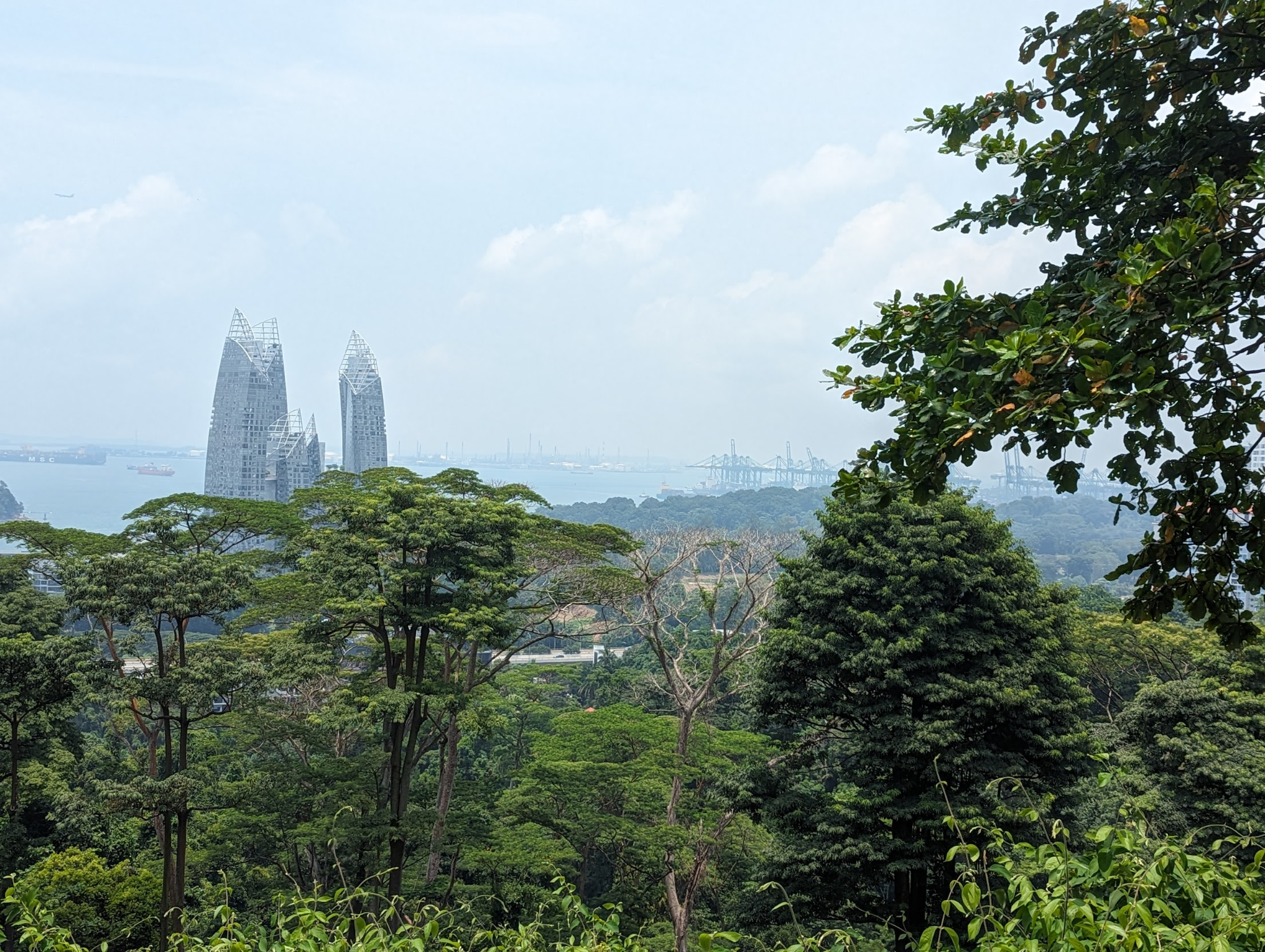
There’s also the massive parks/greening projects. Unlike some anime power fantasy protagonists Lee didn’t have the ability to control the weather - the constant heat and humidity make Singapore’s parks painful to actually hike through - but they are beautiful, and this was a result of a lot of hard work and introducing plants from all over the world.
Listing every world leader he ever talked to
Something like half the book is Lee listing every world leader he ever talked to as PM. This is another part that mostly gets kind of dull (especially if you don’t follow the details, although this case is much easier to track than the internal politics chapters since you’ll probably recognize the characters’ names, or at least their countries). They’re all described as “tough” and “vigorous”, occasionally as “warm”, and usually with some other positive descriptors. This is probably a mix of sincere respect and diplomatic language for most of them.
Except Jimmy Carter. Lee spends an entire chapter making fun of Jimmy Carter for being shallow, undermined, weak-willed and inauthentic. And then takes an aside in the next chapter, when he’s complimenting Reagan, to mention how smart it was of the American people to replace Jimmy Carter with this guy. If you ever want to see someone who’s not a giant swimming rabbit attacking Jimmy Carter, this is the book for you[28].
The other memorable one is Deng Xiaoping. You know how sometimes you ship characters from different franchises, or people from different parts of your life, as friends? I always had this for those two, they just seemed so compatible. I didn’t realize until I read this that they actually were friends in real life. Or, well, as close to genuine friends as world leaders ever get. Lee’s compliments about Deng are genuine in a way they aren’t about anyone else. He notes that when he pointed out to Deng that one of his policies was a mistake, Deng actually listened and changed course despite being over seventy at the time.
This makes sense. If you look at the history of economic policy, Deng might be the only guy in history who was even more brutally pragmatic in the face of all odds than Lee was. Of course he would admire him[29].
The theme of the background decline of the British Empire shows up again here. If Lee got his political start under the British, his last major geopolitical relationship was with Deng, leading the new rising power displacing the British. He spends some time talking about how foolish the British were to try to impose conditions on the surrender of Hong Kong; they just weren’t enough of a world power to make those kinds of demands anymore.
The HBD chapter
Lee seems to have been decades ahead of the curve on both DEI and HBD[30].
On DEI, he realized early on that the Malay minority were underperforming in school compared to the Chinese kids. This is a crisis (remember, sectarianism is one of the two things that kills developing countries), and he launches a range of DEI programs to try to support Malay and Indian students (and also reserve them some government posts).
This helps somewhat, but doesn’t fully close the gap. Lee shrugged, figured that this is just hard-to-fully-overcome subgroup IQ differences, and did what he could to ameliorate it. A decade later Charles Murray released The Bell Curve, and Lee mentions feeling vindicated on reading it. He’s generally pretty harsh on people trying to pretend there are no cultural or intelligence gaps between groups, believing that this kind of self-imposed refusal to face facts is futile and counterproductive[31].
Lee comes back to this theme quite a bit. If he’s pragmatic enough to work with the Japanese after surviving Sook Ching, he definitely doesn’t have the patience for starry-eyed academics who refuse to face facts. He talks later about finding Harvard disappointing, and about learning to rely on people who actually made things that worked in the real world and to ignore academic theorists, who are too likely to be motivated by blinding idealism.
He also worried about the fertility crisis several decades before anyone else, both in that people weren’t having enough kids and specifically that Singaporean Chinese men didn’t want to marry women who were as smart or smarter than them, preferring to marry down to a woman who would look up to them. This is the one area where he ends up admitting total failure - despite Singapore's heavy child subsidizing policies and his intense PR push, he couldn’t seem to get any real traction[32].
The “Am I a dictator” chapter
“I stressed that freedom could only exist in an orderly state, not when there was continuous contention or anarchy. In Eastern societies, the main objective is to have a well-ordered society so that everyone can enjoy their freedom to the maximum. Parts of contemporary American society were totally unacceptable to Asians because they represented a breakdown of civil society with guns, drugs, violent crime, vagrancy and vulgar public behavior”
Many people over the years have accused Lee of being a dictator and Singapore being an authoritarian dictatorship. Some men might try to avoid the issue; Lee explicitly brings it up, spends a whole chapter going through every time he’s been accused of acting dictatorial, and explains why actually he was just doing the right thing. Seriously, this guy loves to argue[33].
The first thing he argues about is suing journalists for libel. Journalists would argue that anyone who ever tries to limit them in any way is acting dictatorial. Lee argues that he’s only suing them for falsehoods, and legitimate criticism should be defended in courts.
There’s a few points to note here. First, you might question whether courts are going to be entirely fair when Lee’s in charge of the government that appointed them in the first place. Surprisingly, I don’t think that’s necessarily the biggest issue - for one thing, for most of this period people could appeal Singapore cases to a judicial committee in London, which didn’t answer to the Singapore government and limited the impact here. For another, Lee clearly relishes the confrontation; he comes off as a guy who wants to win a fair fight because he’s good at it, not someone beating up a weak opponent. It’s possible this too is a cover, but if he was going to cover muddying the issue and pulling attention away would probably have worked better.
The other thing to worry about here is process as punishment and indirect coercion - even if reporters who could defend their criticism would eventually win their libel suits, journalists would hold that it makes their lives unpleasant and deters legitimate criticism, and that politicians should just sit down and take bad press, arguing before the public when they believe it’s false.
Lee argues that it’s wrong for journalists to expect this, and they need to be held accountable for honesty too. I suspect part of this is just that Lee really loves arguing[34].
The dictator-ish behavior I personally found most troubling was the story about prioritizing areas that voted for the PAP by larger margins for housing renovations (remember, most of Singapore’s housing is public and managed by the government). This doesn’t technically make him a dictator, but it’s certainly a pile of bad incentives right there.
The question of Singapore being authoritarian more generally is… complicated. Singapore famously banned gum, because the government thought it was net negative for society to have it. They also had an anti-long hair campaign in the seventies, to discourage hippies. This kind of idea - that if something is bad, the government should ban it - is unimaginable in the American context, where we’re more likely to ask the meta question of whether the government should have the power to do something at all. Lee defends the power of administrative detention without trial on similar grounds - the government uses it well, and if it doesn’t, people will vote for the government to lose that power.
This raises the biggest question about authoritarianism: Where, ultimately, does the government rest its claim to legitimacy?
Lee’s PAP very strongly relies on popular support. They may put a thumb on the scales in some ways (like the housing thing), but they care intensely about popular support[35] as the ultimate source of their legitimacy. Lee drives the party to cover a broad political consensus and deliver prosperity; he repeatedly claims that if they fail, they won’t last as the country’s leaders (although he doesn’t specify a mechanism by which this might happen, and seems insufficiently worried by the prospect of a collapse that would take Singapore’s economy down with it).
The biggest risk of decline under authoritarian rule is a less-competent successor inheriting a powerful apparatus and then making mistakes with it, once the founder figure is no longer around to help guide it. In mainland China, for example, it’s worth noting that Jian Zemin and Hu Jintao were both handpicked as successors by Deng. Once they were replaced by Xi, the government started trailing in a different direction.
In Singapore, Lee was replaced by his handpicked successor Goh Chok Tong, and then by his son Loong[36]. Lawrence Wong, who started his term in 2024, is the first leader Singapore’s had who wasn’t directly chosen by Lee. I guess we’ll have to wait and see how he does (things seem to be going okay so far; it makes sense that replacing a rationalist folk hero with LW would be minimally disruptive).
So what did we learn about Lee?
In some ways, the best historical analogs to Lee are people like Elon Musk and Julius Caesar: Men who went ahead with bold plans, ignored the critics where they were wrong or baselessly skeptical, and made impossible-seeming things work because they were smart enough and correct enough to pull it off.
But the most interesting point of comparison is Thomas Jefferson, because they’re just so different.
When you read America’s founding documents, like the Federalist Papers or the Declaration of Independence, the thing that jumps out is how great the writing is. It’s hard to imagine a modern politician writing like that. It’s hard to imagine a modern politician being smart enough to write at that quality level.
Lee, despite being from the 20th century, actually was that level of smart. And he was direct enough to just write what he really feels, and articulate enough to do it well. So how does he compare?
The first obvious thing is the writing style. Jefferson and Hamilton wrote with bold flourish, with grand ideology and conviction. Lee writes clearly but technically, explaining why his ideas are good and will solve problems. An American founding father might have given grand speeches about his dreams of a free Singapore of equals without racism or outsider control; Lee talked about how racism and outsider controls were barriers to freedom and prosperity and sound economic policy. He’s direct and technical, not a dreamer.
He also doesn’t view government the way Jefferson did. Jefferson wrote about the proper role of government and rights of man; Lee thinks about what the government should be doing on an object level, and does it. He trusts that they will be rewarded with power as they deserve.
Jefferson was writing the first declaration of independence from the British Empire; Lee executed one of the last, against the backdrop of its final decline. When Jefferson dreamed of independence, it was an experiment no one had ever done before. By the time Lee came around it had been done many times; he did his best to learn how to achieve it from the best who had already done it, to perfect the execution like he did with economic and housing and transportation policy. The world got smaller over the two centuries between Jefferson and Lee’s independence declarations, between the rise and the fall of the British Empire. It changed modes from Explore to Exploit.
Jefferson is famous for having lofty ideals he couldn’t live up to, and was tarnished by; he owned slaves and famously had some uncomfortable relations with them even as he wrote about Freedom. Lee had more modest ideals, but he successfully lived up to the ones he did.
Your message is stored now and emailed to the author after the contest ends. The author can reply to you, but their identity stays hidden unless they choose to respond.
Footnotes
- ↩
Technically he’s AHAB (Assigned Harry At Birth), since his full name is Harry Lee Kuan Yew. To save on typing I will refer to him as “Lee” throughout.
- ↩
I keep a (short) list of these. Aside from Lee it contains Deng Xiaoping, Cardinal Richelieu, Teddy Roosevelt, and (arguably) Otto von Bismarck.
- ↩
Okay, most of us.
- ↩
Although this one ends up mostly backfiring. He’s so clear about his non-sectarian vision for Malaysia that the Malay party realizes it’s fundamentally incompatible with theirs and decides to kick Singapore out.
- ↩
Rationalists have a tendency to assume they must be bad at Charisma. I think this is selling themselves short and failing to realize the range of forms charisma can take. Sometimes it looks like being a party boy or a Reagan-esque charmer with a twinkle in your eye. But sometimes, like in Lee’s case, it just means being clear and precise in your statements and reliable in carrying them out. Math brain is its own form of charisma, if done right.
- ↩
Lee later says “When my youngest brother, Suan Yew, was born in 1933, I persuaded my parents not to give him a Christian name since we were not Christians”.
Lee has a habit of making these sorts of statements which are… not exactly jokes, but you can imagine him saying with some kind of inside smile, just slipping a small bit of humor in how he says an otherwise factual statement because he enjoys getting away with it. It took me a while to realize he does it on purpose.
- ↩
“As I grew older, [my mother] began consulting me as the eldest son on all the important family matters, so that while still in my teens, I became de facto head of the family. This taught me how to make decisions.”
There generally seems to be a trend of fatherless world leaders (including about a quarter of US presidents, starting with George Washington). Maybe, like Eliezer says, growing up without a father figure helps push people to take the kind of responsibility that comes from knowing there’s no one above you to take it.
- ↩
In terms of actual selection, we get about one OOM just from being part of the english speaking elite (about 10% of Singapore at the time) and then another 2-3 from Lee getting good enough grades to filter into Raffles (which produced a few hundred students who counted for a large part of the elite), leaving us with just 2-3 OOMs left to becoming PM. So the part where he filtered up through the education system accounts for about half of his journey to leading the country. From this we learn the importance of a meritocratic talent-based school system.
- ↩
International estimates put the total death toll at 25-50 thousand. Lee (and the Singapore government in general) put it at 50-100 thousand.
- ↩
Not all of it. There is less slavery in the world than there was in 1940, but there is not none. What would have happened if the Empire had stayed to ban it in the world by force is beyond my ability to guess; I doubt a global Empire like that would be organizationally viable in today’s world and culture anyway.
- ↩
The scholarship he wanted before doesn’t exist anymore and his family (like everyone in Singapore) is still having a hard time getting by after the war, but somehow they scrape up the money for it. If this was a work of fiction I’d get mad about the inconsistent worldbuilding.
- ↩
Many such cases.
- ↩
Lee repeatedly hammers throughout both books that the two things that end up running countries to the ground are communism and sectarianism. Once he achieves power he goes to extremes to avoid both.
- ↩
This should probably make us pretty worried about our recent surge in gender-biased political polarization.
- ↩
While he’s at Cambridge, he convinces his professors to bring Choo on board, arguing that she got even better grades than he did, and then marries her in secret.
In general he comes off incredibly sweet with her, especially given that both by culture and by temperament he’s a very competitive man’s-man type and not someone you would expect to go out of his way to thank and recognize his wife, especially to this extent.
- ↩
Except correctly.
- ↩
The British, who wanted to avoid letting the communists take more power in Asia, are never quite sure what to think of him.
“Thirty-four years later, after his retirement, Moore told me that by the end of one year, he had concluded that Goode was right when he wrote in his haul-down report that I was not a crypto-communist but a crypto-anti communist”
- ↩
Lee grew up speaking Hokkien, but the Chinese schools and political sphere in Singapore that he needed to persuade mostly spoke Mandarin.
- ↩
Okay yes, Google probably used internal pubsub implementations and not literally Kafka. You get my point.
- ↩
There’s some debate nowadays over whether this is democratically legitimate or if the PAP was just using the riots as an excuse to arrest legitimate political opposition to cement their power. But either way, the PAP was effective in doing this and achieving stability in ways their predecessors were not.
- ↩
There’s also a world travel chapter where he travels around third-world countries trying to drum up international support for this. My favourite part is that he too assumed Timbuktu was a fictional place until actually landing in it.
- ↩
I have no idea how much of this book is literally true and how much is Lee working off decades’ old memories. There’s also scenes where he talks about getting drinks with various politicians and lists exactly how many drinks each of them had. Did he just have a phenomenally photographic memory? Did he write and keep specific notes including drinks counts? Is he making up details that hopefully get the gist right? I have no idea.
- ↩
Indonesia, which saw Malaysia as a British colonial project, had been at a state of low-level unofficial conflict with Malaysia and Singapore since 1963, although this was winding down by independence in 1965.
- ↩
Although in order to avoid provoking the local muslim nations he refers to the IDF delegation as Mexicans (“They were certainly swarthy enough”).
- ↩
An illustrative example of the difference is that Singapore set up their monetary system so that the government wouldn’t be able to print money at will (currency in circulation has to be backed by foreign reserves; for a long time, there was no Singapore equivalent of the Fed). Taking on national debt can be a very good experimental move that a high-openness society would try! But it’s not the stability-maximizing move, so Lee made it impossible to even try.
- ↩
Singapore does have a strong biotech industry. But a very boring and regulated one.
- ↩
Lee was also the first person I read to have been strongly in favor of America’s military action in the Vietnam war. He believes all of Southeast Asia could have fallen to communism if America hadn’t stepped in to hold it off.
- ↩
Interesting to note that Lee sees Carter as too obsessively detail-oriented, while admiring Reagan for not sweating details and focusing on the big picture. Lee himself sweats details quite a lot, although maybe there’s a difference in that he knows which details to sweat.
- ↩
This sentence has deliberately ambiguous references, because it works well either way.
- ↩
Human Biodiversity, the claim that IQ meaningfully varies along genetic subgroups.
- ↩
While this often leads him to be appropriately cynical when others are hopeful (for example, he predicts that American interventions in Haiti will come to ruin since they did nothing to address the underlying economic and cultural issues), it can also lead him to make confident predictions that now seem wrong (For example, that South Korea and Taiwan would remain too violent to really make democracy function well).
- ↩
This may be a rare case of Lee being too hard on himself. While Singapore (like everywhere else in East Asia) has an acute fertility crisis, their TFR is significantly ahead of Hong Kong, which is probably the most directly comparable city-state. So the policies probably did have some effect.
- ↩
A few weeks after reading this book I ran into an old journalist who’d interviewed Lee back in the late seventies. He confirmed the guy loved to argue and seemed delighted to fend off his questions, and recalled with pride how he had one question (something about Singapore trading with sanctioned entities under the table) that made Lee pretty uncomfortable.
From this we learn that the only people who love arguing more than politicians and lawyers are journalists. A good gotcha is apparently a high that lasts for decades.
- ↩
My own conclusion of this debate - not that anyone would ask me - is there really does need to be a balance. Journalists being deceptive or lying outright is a significant problem that has grown worse since Lee’s time, which might imply we’ve gone too far to the other side currently. On the other hand, I don’t live in Singapore and it’s at least plausible to me their media is overly constrained.
- ↩
This isn’t just Lee; if you look at news coverage for Singapore’s 2025 election, Lawrence Wong’s PAP cared intensely about their popular vote percentage, even when their actual supermajority was never under any real threat.
- ↩
How much should we worry about Lee being replaced (eventually) by his son? Back in 2016, Scott tried to calculate the odds that Jeb Bush was the most presidential man in America. We can apply the same calculation here, where it gives much better results: If the single-most-presidential man has a child with the single-most-presidential woman (and unlike Barbara Bush, Choo was by all accounts a strong contender for this role), and we assume presidential aptitude is about 10% heritable, their child will be about 3.6 standard deviations above the norm for presidentialness, which would imply Loong would be among the 800 or so most presidential Singaporeans of the appropriate age range. We can do even better by assuming that he was the most presidential of his siblings (more heavily selected) and that he also seems to have performed abnormally well by various metrics (even before becoming PM, which he seems to have done a good job as). So Loong had a decent prior of deserving the job on the merits.