Letter to a Christian Nation and other writings of Sam Harris
Dichotomies, “Most People,” and Subjective Personal Preferences in the Writings of Sam Harris
Introduction
On the February 4, 2024 episode of his podcast Making Sense, Sam Harris’s guest was Rory Stewart, a former British politician and current Professor in the Practice of Grand Strategy at the Yale Jackson School of Global Affairs.[1] Harris summarized their conversation, titled “Hubris & Chaos,” as addressing:
[T]he fraying world order … the wars in Afghanistan and Iraq, the problems with nation building, cultural ignorance, tolerance for corruption, our catastrophic withdrawal from Afghanistan, the role that Islam played in our failures in Afghanistan and Iraq, conspiracy theories, the influence of social media, cults of martyrdom, the war in Ukraine, the age of populism, Trump and the future of NATO, Brexit, the current state of politics, GiveDirectly, and other topics.[2]
From early in the exchange, it became apparent to me that Stewart was unenthusiastic about discussing the possibility of a link between Islam and terrorism. Because that topic is a longstanding concern of Harris’s, he asked Stewart about his perspective on jihadism for an amount of time that he later described as “about twenty minutes in the context of a nearly ninety-minute conversation.”[3]
The following day on his own podcast, The Rest is Politics, Stewart recounted Harris “hammering [him] for nearly an hour” about the “connection between Muslims and suicide bombers, and Muslims and terrorists—he just wouldn’t let it go.”[4]
Having heard these remarks and finding them “disappointing”[5] and “defamatory in some sense,”[6] Harris invited Stewart to return to Making Sense a few weeks later in order to “do a post-mortem”[7] on their conversation. Stewart began this second interview (titled “Islam & Freedom”) by apologizing for the way he had publicly expressed his discomfort with their prior conversation and agreeing that he had misremembered the amount of time they had spent on the topic of Islam and terrorism:
I heard in your voice and in your response in your emails that it will have felt very hurtful to you. … It was unfair of me to say that we’d spent almost an hour on this, and you’re absolutely right, we’d spent about twenty minutes on this. … You’re absolutely right to be shocked, you’re right that I was exaggerating when I said that we’d talked about this for almost an hour, and you’re right to be upset at the suggestion that I think that you are somehow prejudiced against Muslims.[8]
Nevertheless (and as also revealed by his three uses of the word “this” rather than speaking the words terrorism or jihad), Stewart was still clearly hesitant about further discussion of the topic:
I’d also love to move on to some other subjects—I’d love to talk to you about your life, about your meditation, about other things—and I think one of the things that I worry about, just as a kind of preface to this, is that neither you nor I are Muslims, and although we’ve both read the Koran, I don’t think either of us are deep Arabic scholars. So I think maybe there may be other things that we could also talk about as well as this.[9]
Determined to sort out “the truth of Islam”[10] and undeterred by Stewart’s reluctance, Harris kept the conversation focused on “whether Islam poses a unique threat to open societies”[11] for the rest of their hour-and-a-half-long conversation—remarkably, thereby turning Stewart’s originally inaccurate complaint (and the sole impetus for this second conversation) into a self-fulfilling prophecy.
When Harris originally invited Stewart on his podcast, he described him as:
[A] leading thinker on international affairs and development currently serving as Special Advisor to GiveDirectly, which delivers cash directly to the world’s poorest households. Stewart was a member of the British Parliament for almost a decade, where he served as secretary of state for international development, prisons minister, minister for Africa, development minister for the Middle East and Asia, and minister for the environment.[12]
How did a potentially fruitful dialogue between two such interested and interesting people, with presumably broadly overlapping goals for the future of humanity, get so badly derailed from the start?
At first glance, the disconnect between Harris and Stewart apparently centered on their fundamentally different views about religion. However, I believe that another, more subtle factor was their conflicting values regarding communication. Harris was focused on rationally evaluating the relative merits of different truth claims regarding “Islam as a system of ideas” and “how these ideas produce violence and intolerance,”[13] while Stewart seemed to be much more attuned to the feelings of the people involved, including how listeners who thought of him as an ally might perceive the degree to which he was acquiescing to Harris’s positions:
As with all these things, there’s an element of misunderstanding, and there’s probably an element of some disagreement which is hidden under politeness, and I think the other reason that I probably was obsessing about it in that way and talking about it in that way on my podcast is that I’d felt uncomfortable with myself: I felt I hadn’t done a good enough job standing up for Islam; I hadn’t done a good enough job standing up for my experience of living in the Islamic world. … Maybe what I wanted to say is, “Listen, this just doesn’t sit with my experience of having spent many years of my life living in Muslim-majority countries; it just doesn’t sit with my experience of Muslim friends,” and I should have been braver and less apologetic in talking to you.[14]
Stewart’s discomfort with Harris’s view of Islam, and the mismatch of values revealed by their conversations (hinted at in Stewart’s phrase “disagreement which is hidden under politeness”), suggest the need to move beyond religion as the sole cause for this miscommunication and to consider Harris’s ideas about honesty as well. Looking more deeply still, I think that the links between Harris’s perspectives on these societal and interpersonal issues also extend to his conclusions about mental life—including the self, consciousness, and free will.
I admire Harris for a lot of reasons: he is intellectually curious; he has the courage of his convictions but is open to changing his mind; he is committed to reason and evidence and engaging in good-faith conversations with people who disagree with him; and he has worked diligently within his sphere of influence to effect positive change in the world. Although I share much of Harris’s worldview, I often end up feeling perplexed by his conclusions about certain philosophical topics. Having read his essays and books and listened to his podcast for many years, I think I see a few reasons behind some persistent misunderstandings between Harris and his critics.
I therefore offer this book review in the respectful, slightly bemused, and lighthearted spirit of Benjamin Franklin’s 1783 description of his fellow American diplomat in France, John Adams: “He means well for his Country, is always an honest Man, often a Wise One, but sometimes and in some things, absolutely out of his Senses.”[15] (I had originally wanted to title the essay “Sam Harris is Out of His Mind,” but was eventually convinced that it would come across not as the clever meditation pun I was intending but instead just as an insult. I mean no insult!)
Following are my attempts to identify what I see as several threads connecting Harris’s positions on the diverse topics of religion, honesty, the self, consciousness, and free will, as described in several of his books (Letter to a Christian Nation,[16] Lying,[17] Waking Up,[18] Free Will,[19] and sections of The Moral Landscape[20]) and discussed on many podcast episodes: a tendency to frame complex issues as dichotomies, to make unrepresentative interpretations of the beliefs of other people, and to present his own subjective personal preferences as objective universal truths.
My goal in pointing out my own areas of disagreement with Harris’s arguments in these books and conversations is to provide a productive alternative perspective: if Harris wrong—as he has often noted—his conclusions may need to be updated; if, instead, he is being misunderstood by me or by others, his rhetorical approach could be improved by taking these mismatches between intent and perception into account. Engaging with Harris’s ideas in order to write this review has encouraged me to grapple with my own intuitions and their implications; this opportunity, provided by Harris’s thoughtful, clear, and accessible writing, has made all of these books well worth reading.
I. Letter to a Christian Nation: The Relationship Between Science and Religion
Harris’s approach to many issues seems to involve carefully reasoning his way to a firm principle, with conclusions that he believes should apply across people and situations. As he writes in The Moral Landscape, “The more we understand ourselves at the level of the brain, the more we will see that there are right and wrong answers to questions of human values.”[21] In his discussion of religion in Letter to a Christian Nation, Harris consistently frames his conclusions in rational, absolute, universal, and dichotomous terms:
- “Either the Bible is just an ordinary book, written by mortals, or it isn’t. Either Christ was divine, or he was not. If the Bible is an ordinary book, and Christ an ordinary man, the basic doctrine of Christianity is false. If the Bible is an ordinary book, and Christ an ordinary man, the history of Christian theology is the story of bookish men parsing a collective delusion. If the basic tenets of Christianity are true, then there are some very grim surprises in store for nonbelievers like myself.”[22]
- “The truth, however, is that the conflict between religion and science is unavoidable. The success of science often comes at the expense of religious dogma; the maintenance of religious dogma always comes at the expense of science.”[23]
- “But any genuine exploration of ethics or the contemplative life demands the same standards of reasonableness and self-criticism that animates all intellectual discourse.”[24]
In these passages, Harris is espousing what the cognitive scientist Steven Pinker has called “universal realism.”[25] As Harris puts it in The Moral Landscape, “And science and religion—being antithetical ways of thinking about the same reality—will never come to terms.”[26] Harris is presenting this conclusion as a fact, and I have no doubt that many people find this worldview to be persuasive. However, I am not convinced that it is necessarily the right way to frame the relationship between science and religion for everyone. For many other people, what Harris sees as conflicting beliefs may not be fundamentally incompatible. As Pinker explains:
People divide their worlds into two zones. One consists of the physical objects around them, the other people they deal with face to face, the memory of their interactions, and the rules and norms that regulate their lives. People have mostly accurate beliefs about this zone, and they reason rationally within it. Within this zone, they believe there’s a real world and that beliefs about it are true or false. They have no choice: that’s the only way to keep gas in the car, money in the bank, and the kids clothed and fed. Call it the reality mindset.
The other zone is the world beyond immediate experience: the distant past, the unknowable future, faraway peoples and places, remote corridors of power, the microscopic, the cosmic, the counter-factual, the metaphysical. People may entertain notions about what happens in these zones, but they have no way of finding out, and anyway it makes no discernible difference to their lives. Beliefs in these zones are narratives, which may be entertaining or inspiring or morally edifying. Whether they are literally “true” or “false” is the wrong question. The function of these beliefs is to construct a social reality that binds the tribe or sect and gives it a moral purpose. Call it the mythology mindset.[27]
The following xkcd webcomic[28] illustrates the gap between the two mindsets in the modern world, as well as the absurdity of attempting to combine them for many people:
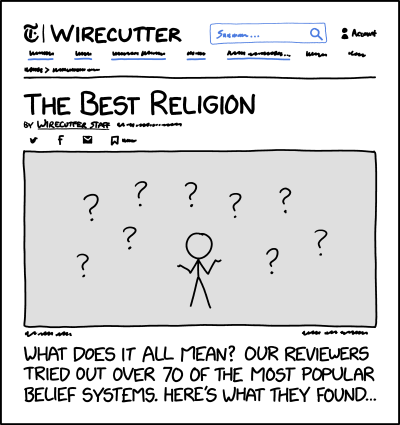
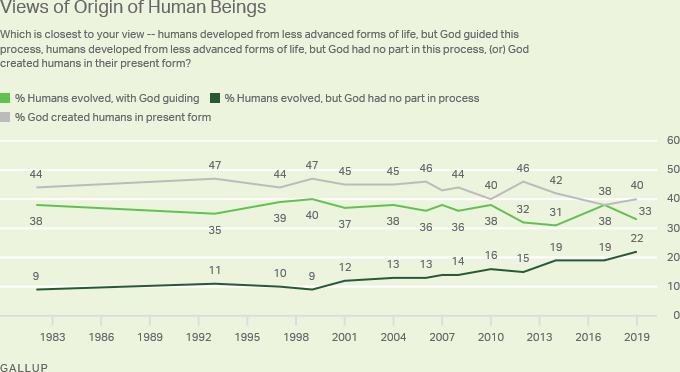
Before accepting Harris’s conclusion that science and religion must always be in conflict, I think that it is worth considering evidence about what people actually believe. As it turns out, several surveys indicate that his framing of science and religion may be counterproductive. When asked by Gallup[29] about the origin of humans, many people do share Harris’s “one is right and the other is wrong” worldview, though of course in divergent directions: some say that God created humans in their present form, and others say that humans evolved with “God” having had no part. For other respondents, though, religion and science can and do coexist just fine: they believe that humans evolved, with God guiding the process.
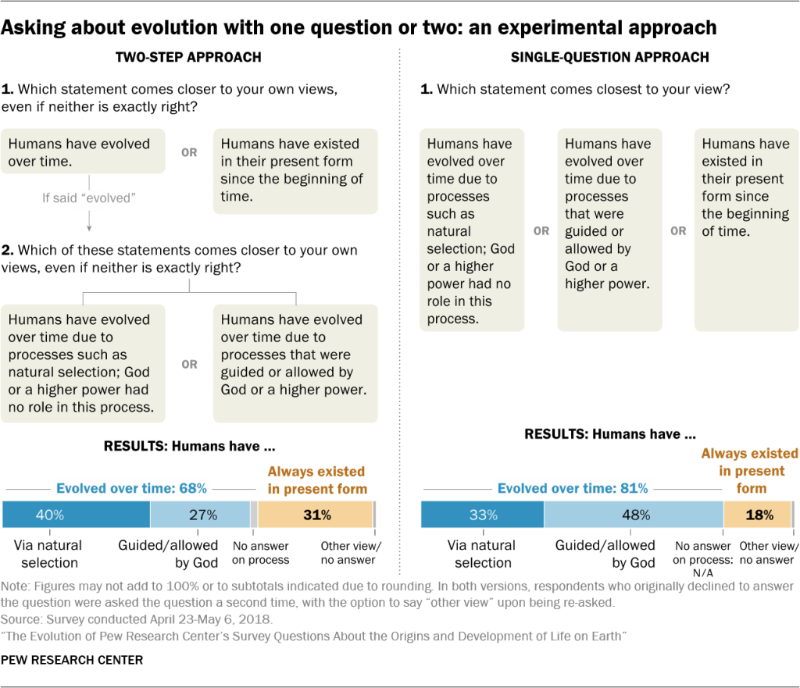
Importantly, evidence from a Pew Research Center poll[30] shows that the framing matters. Presenting science and religion as explicitly in conflict leads more people to reject the scientific explanation of human origins, whereas presenting science and religion as at least potentially compatible results in more people accepting the scientific consensus. When given only two choices—either “Humans have evolved over time” or “Humans have existed in their present form since the beginning of time”— 68% of respondents affirmed the truth of evolution, in comparison with 81% in a different sample who did so when they were given a third option to pick from: “Humans have evolved over time due to processes that were guided or allowed by God or a higher power.” The implication of this finding is that insisting science and religion are incompatible may be detrimental to the goal of increased public understanding of science.
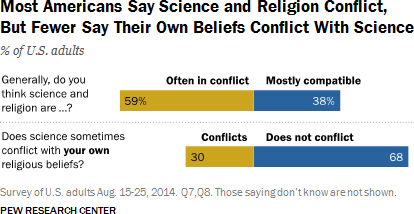
In another Pew poll,[31] more than two-thirds of respondents said that science does not conflict with their own religious beliefs, despite a majority also reporting that science and religion are often in conflict; the pollsters concluded from these results that “People’s sense that there generally is a conflict between religion and science seems to have less to do with their own religious beliefs than it does with their perceptions of other people’s beliefs.”[32] This finding indicates that claiming an unresolvable conflict between science and religion perpetuates a mistaken view about the amount of real conflict between them in society.
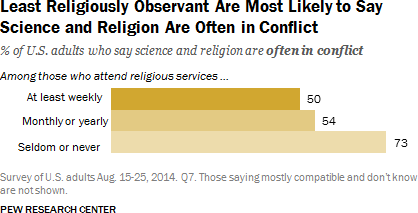
The same poll also revealed that the amount of perceived conflict between science and religion was inversely related to “religious observance”: people who attended religious services the most often were the least likely to say that science and religion are often in conflict. That is, more religiosity was associated with more acceptance of science—again in contrast to Harris’s argument that science and religion are antithetical and will never come to terms.
Finally, a survey from the Religious Understandings of Science Study[33] that compared scientists with the general population reported that similar (though slightly lower) proportions of scientists in the US attended weekly religious services, considered themselves very religious, read religious texts weekly, and prayed several times a day.[34] Diversity of perspective and values among scientists should not be surprising; as the theoretical physicist Lawrence Krauss once noted on Harris’s podcast:
The great thing about science is, well, first that scientists are human—which is a little-known fact—and that means that individual scientists are biased, they're prejudiced, they're pig-headed, they're whatever, they're sexist, or not, you know, some of them may even be Republicans.[35]
In The Moral Landscape, Harris rejects the claim that it is possible to value both science and religion with intellectual honesty:
The fact that certain people can reason poorly with a clear conscience—or can do so while saying that they have a clear conscience—proves absolutely nothing about the compatibility of religious and scientific ideas, goals, or ways of thinking. It is possible to be wrong and to not know it (we call this “ignorance”). It is possible to be wrong and to know it, but to be reluctant to incur the social cost of admitting this publicly (we call this “hypocrisy”). And it may also be possible to be wrong, to dimly glimpse this fact, but to allow the fear of being wrong to increase one’s commitment to one’s erroneous beliefs (we call this “self-deception”). It seems clear that these frames of mind do an unusual amount of work in the service of religion.[36]
I see this perspective as an example of Harris misinterpreting his own subjective personal preference as an objective universal truth; his detection of ignorance, hypocrisy, and self-deception among those who disagree with him notwithstanding, evidence from the various surveys about people’s beliefs discussed above supports the existence of two different zones or mindsets about scientific and religions topics for many people, and also demonstrates that religious people do not necessarily see themselves as anti-science, nor do scientists necessarily see themselves as anti-religion. On Harris’s podcast toward the beginning of the COVID-19 pandemic, the historian Yuval Noah Harari highlighted this lack of conflict:
The good news is that in this emergency we have seen a lot of trust in science and in scientific authorities, even from unexpected subcultures. … The clearest cases for me are what’s happening with religion in this crisis. In Israel, they closed down the synagogues. … In Iran, they shut down the mosques. The Pope is telling the faithful to stay away from churches, and all because the scientists said so.[37]
For members of these varied faith communities across multiple societies and countries, professing personal religious values did not prevent them from taking scientific evidence seriously; conversely, trusting scientific experts did not cause them to abandon their religious identities. Harris may have well-reasoned arguments for his own personal rejection of religion, but many other people seem to have different preferences. It’s worth considering this point made by the journalist David Goodhard: “Humanism has had a very good critique of religion, but it's not been able to replace it.”[38]
Perhaps because of what I perceive to be his rationalism, moral absolutism, and dichotomous thinking about religion, Harris often appears to understand, identify with, and devote disproportionate attention to fundamentalist religious extremists, while having a harder time relating to religious moderates—people who prefer to keep the “reality mindset” and “mythology mindset” separate—as these passages from Letter to a Christian Nation suggest:
- “In the wake of the Asian tsunami … liberal theology must stand revealed for what it is: the sheerest of mortal pretenses. The theology of wrath has far more intellectual merit.”[39]
- “Even the most progressive faiths lend tacit support to the religious divisions of our world.”[40]
- “Clearly, it is time we learned to meet our emotional needs without embracing the preposterous. We must find ways to invoke the power of ritual and to mark those transitions in every human life that demand profundity—birth, marriage, death—without lying to ourselves about the nature of reality. Only then will the practice of raising our children to believe that they are Christian, Muslim, or Jewish be widely recognized as the ludicrous obscenity that it is.”[41]
Harris ends his book Waking Up with this vivid anecdote:
Sometime around her third birthday, my daughter asked, “Where does gravity come from?” … We could have told her, “Gravity might be God’s way of dragging people to hell, where they burn in fire, and you will burn there forever if you doubt that God exists.” No Christian or Muslim can offer a compelling reason why we shouldn’t have said such a thing—or the moral equivalent—and yet that would have been nothing less than the emotional and intellectual abuse of a child.[42]
Harris does not have a personal religious identity or belong to a religious community, and does not seem to relate to the values of moderate religious people; as a result, he appears unable to understand why anyone else might find it meaningful to pass the faith traditions of their ancestors on to their children—to do so in his worldview is a “ludicrous obscenity,” and “No Christian or Muslim can offer a compelling reason” not to emotionally and intellectually abuse curious children with the threat of eternal torture. In a theme that repeats across his books, Harris’s claims about other people’s beliefs seem not to be as universal as he presents them.
A Pew poll about beliefs related to the afterlife provides a different perspective on this topic:
While most U.S. adults also believe in hell, this belief is less widespread than belief in heaven [nearly three-quarters of U.S. adults]. Roughly six-in-ten American adults (62%) say they believe in hell, though once again there are notable differences across subgroups of the population.
Across most Christian subgroups, smaller shares say they believe in hell than heaven. While roughly nine-in-ten Protestants in the evangelical and historically Black traditions believe in hell, only about seven-in-ten mainline Protestants (69%) and 74% of Catholics share this belief. …
Among all Americans, about four-in-ten (39%) say that people who do not believe in God can go to heaven ….
About three-in-ten U.S. Christians (31%) say that their religion is the one true faith leading to eternal life in heaven, while nearly twice as many (58%) say that there are multiple religions that can lead to heaven.
Once again, there are differences on this question across subgroups – including between Protestants and Catholics. Roughly four-in-ten Protestants (38%) say that theirs is the only faith leading to eternal life in heaven, a view that is especially common among evangelical Protestants (50%). Among Catholics, meanwhile, just 16% say that their religion is the one true faith leading to eternal life in heaven, while about seven-in-ten (72%) instead say that many religions can lead to eternal life.
Christians who believe that many religions can lead to eternal life in heaven were asked whether they believe that this privilege is reserved only for members of other Christian religions, or that some non-Christian religions can also lead to eternal life in heaven. Among all Christians, a majority (58%) say that many religions can lead to eternal life in heaven, and within this group, the prevailing view is that members of some non-Christian religions are able to attain eternal life in heaven (43% of all Christians express this view). ...
Catholics are more likely than Protestants to say that many religions can lead to heaven and that non-Christians are included (61% vs. 35%), although most mainline Protestants (55%) also say this.[43]
In contrast to the diversity of views within religious groups and tolerance for interfaith differences revealed by this poll, Harris’s conclusion that religious extremism is the only justifiable form of religious expression places consequential limitations on his ability to engage with people who have less dogmatic views of religion than he does. Such a disconnect was apparent to me in the interactions between Harris and Rory Stewart discussed at the start of this essay. As noted there, I think that Harris’s beliefs about communication demonstrate the same tendency toward dichotomous frameworks, misconstrual of what most people think, and interpretation of subjective personal preferences as objective universal truths.
II. Lying: The Costs and Benefits of Honesty and Dishonesty
In Lying, Harris describes himself as “convinced that lying, even about the smallest matters, needlessly damages personal relationships and public trust.”[44] For him:
Lying is, almost by definition, a refusal to cooperate with others. It condenses a lack of trust and trustworthiness into a single act. It is both a failure of understanding and an unwillingness to be understood. To lie is to recoil from relationship.[45]
The same rational, absolutist universalism that I see in Harris’s perspective on religion is also present here, as he seems to conclude that what he wants is what all people should want in all situations. I think, though, that Harris is missing an important and more nuanced understanding of honesty held by many other people. In his book, Harris primarily emphasizes only one side of this issue—highlighting benefits of honesty while giving less attention to its costs, and at the same time focusing on harms of dishonesty while largely downplaying its potential value.
One aspect of social relationships that I think Harris does not fully consider is that honesty often implies vulnerability and intimacy. Many people do not want to be equally vulnerable with everyone they know, and neither do they necessarily want everyone in their lives to be maximally intimate with them. There are some people that we might prefer to keep at arm’s length, and others who probably feel the same way about us.
In his book Waking Up, Harris reveals his own changed approach toward unwanted intimacy:
I confess that there was a period in my life, after I first plunged into matters spiritual, when I became a nuisance in this respect. Wherever I went, no matter how superficial the exchange, I gazed into the eyes of everyone I met as though they were my long-lost lover. No doubt, many people found this more than a bit creepy. Others considered it a stark provocation. … I don’t remember consciously deciding to stop behaving this way, but stop I did.[46]
For another analogy, consider a different vulnerable and intimate behavior—for example, kissing. It would seem harder to write a book arguing that each of us has the moral responsibility to kiss everyone we interact with: “Not kissing is, almost by definition, a refusal to cooperate with others. To not kiss is to recoil from relationships.” In this framing, the maintenance of personal boundaries seems more obviously defensible.
Harris does acknowledge that there may be times when we do not want to share information with someone, perhaps as the result of a power imbalance, but he still is reluctant to budge from his position of “committing to be honest with everyone”:[47]
Even as a means to ward off violence, lying often closes the door to acts of honest communication that may be more effective.[48]
Sounds plausible—let’s hear the suggestion for what more effective, honest communication to ward off violence could look like:
But that doesn’t mean someone more courageous or capable than you couldn’t have produced a better result with the truth. Telling the truth in such a circumstance need not amount to acquiescence. The truth in this case could well be, “I wouldn’t tell you even if I knew. And if you take another step, I’ll put a bullet in your brain.”[49]
Harris’s imaginary dialogue with a murder at his door illustrates another tradeoff involved with honesty that goes largely unaddressed in his book: an increase in interpersonal conflict. A true statement may also be hurtful, even if no one ends up getting shot in the head; whether sharing such a painful truth will lead to a better and deeper relationship (as Harris suggests) or damage the relationship beyond repair doesn’t seem like a foregone conclusion to me, and likely depends on the personalities of the people involved. In some cases, avoiding painful truths may allow for continued harmony in relationships that one or both parties want to maintain but at a more superficial level.
Harris acknowledges that honesty and harmony may sometimes be at odds, but concludes: “I have learned that I would rather be maladroit, or even rude, than dishonest.”[50] To me, this prioritization—as with religion as discussed above—is another subjective personal preference. Taken to its extreme, a total commitment to avoid dishonesty could even be understood as selfishness: a determination to do only what makes one comfortable, and feel virtuous, while absolving oneself of the responsibility for understanding or respecting what other people in the exchange might want. If one person wants more honesty, and the other wants more harmony, why should the former preference be given priority? Some compromise between competing desires may be necessary in many relationships.
When I have taken the five-factor personality test in the past, I have occasionally come up as low in the dimension of “agreeableness” (the trait that leads people to be perceived as “cooperative, polite, kind, and friendly”[51]). People low in agreeableness may sometimes have a valuable role to play in relationships or in society, given our willingness to voice difficult but important truths that make others uncomfortable. On the other hand, people who are highly agreeable may have more friends and just be more fun to be around than we are. This potential tradeoff between honesty and agreeableness was succinctly articulated in The Big Lebowski by an exasperated Dude: “You’re not wrong, Walter, you’re just an asshole!”[52]
I have made enough miscalculations in my own life, while intending to communicate honestly but inadvertently causing pain to others, that I now make more effort to anticipate other people’s reactions, which are often different than I think mine would be. Unfortunately, correctly anticipating others’ desires can be challenging.
For Harris—and for me much of the time—the purpose of communication is to literally and accurately convey factual information, as he explains in Lying:
- “By lying, we deny our friends access to reality—and their resulting ignorance often harms them in ways we did not anticipate. Our friends may act on our falsehoods, or fail to solve problems that could have been solved only on the basis of good information.”[53]
- “By lying, we deny others a view of the world as it is. Our dishonesty not only influences the choices they make, it often determines the choices they can make—and in ways we cannot always predict. Every lie is a direct assault upon the autonomy of those we lie to.”[54]
I have come to appreciate, though, that for many people a more important function of some acts of communication is to signal a supportive relationship. Harris too is aware of this possibility:
If you sincerely believe that this is the situation you are in—that the text is a distractor and the subtext conveys the entire message—then so be it. Responding honestly to the subtext would not be lying. But this is an edge case for a reason.[55]
As the “edge case” qualifier suggests, and like his rejection of the worldview of religious moderates discussed above, Harris doesn’t really seem to understand how someone could have a different preference than he does:
However, I’m more comfortable relying on the words that actually come out of a person’s mouth, rather than on my powers of telepathy, to know what he is asking. So I answered my friend’s question very directly.[56]
I tend to share this preference for direct communication, but in my experience, not everyone does to an equal degree. An insightful depiction of a different style of communication comes from the Onion article headlined “Female Friends Spend Raucous Night Validating The Living Shit Out Of Each Other.” This story emphasizes the importance of emotionally supportive behavior, nonjudgmental reassurances, admiration, empathy, encouragement, confidence-boosting, and mutual expressions of positive regard in the lives of a group of fictional people. In the end, though, these characters do ultimately acknowledge some potential tradeoffs implicit in their communication:
[One of the women] admitted she was still a bit overwhelmed the morning after her binge-validating spree. The 29-year-old told reporters she was hoarse from loudly singing praises, and simply “wiped out” from so much dancing around touchy subjects. … “I must have told Teri at least 15 times she'd made the right move by deciding to try and work things out with her boyfriend. What the hell was I thinking? That guy's a total shitheel.”[57]
It seems to me that some balance between supportive dishonesty and painful truths may be desirable in many relationships, not just fictional ones.
Another potential role of communication that may be at odds with Harris’s view of honesty involves the dynamics of relative social standing. In a perceptive 1816 letter, the political commentator Margaret Bayard Smith wrote the following about the wife of soon-to-be-president James Monroe:
With Mrs. Munroe I am really in love. … She is charming and very beautiful. She did me the honor of asking to be introduced to me and saying “she regret’d very much she was out when I called” &c and, tho’ we did not believe all these kinds of things[,] it is gratifying to the vanity to hear them. It would not however have flatter’d me half so much from [wife of the outgoing president] Mrs. Madison.[58]
Being honored by a requested introduction and flatter’d by expressions of regret from the right person, one who is beautiful and increasingly important in society, advertises to you and to the observing world that you too are important! Some people apparently desire this kind of social affirmation, though Harris indicates that he does not:
Once one commits to telling the truth, one begins to notice how unusual it is to meet someone who shares this commitment. Honest people are a refuge: You know they mean what they say; you know they will not say one thing to your face and another behind your back; you know they will tell you when they think you have failed—and for this reason their praise cannot be mistaken for mere flattery.[59]
In my experience, most people cannot be neatly sorted into the categories implied here: either “unfailingly honest” or “completely untrustworthy.” This dichotomous thinking is echoed in Harris’s concern about a slippery slope of dishonesty:
- “Sincerity, authenticity, integrity, mutual understanding—these and other sources of moral wealth are destroyed the moment we deliberately misrepresent our beliefs, whether or not our lies are ever discovered.”[60]
- “Unless one commits to telling the truth in situations like this, however, one finds that the edges creep inward, and exceptions to the principle of honesty begin to multiply. Very soon, you may find yourself behaving as most people do quite effortlessly: shading the truth, or even lying outright, without thinking about it. The price is too high.”[61]
For me, a more realistic taxonomy of diverse relationships with honesty was outlined by the comedian Louis CK in the context of explaining what an outlier Donald Trump appears to be:
Sometimes people lie, right? “That guy lied.” They found out he lied. Then there’s somebody who lies once in a while; he can’t quite stay inside the boundaries of truth, right, somebody who lies sometimes. Then you have a liar, who’s somebody who’s almost like it’s like a problem; they can’t help it, they lie a lot. Then you have just lying sack of shit. And that’s somebody who just [proud vomiting noises]. They just lie. They like it. He likes it. He goes “Heh heh, it wasn’t even true, wudn’t even true! And I then I said they were liars.” Like, it’s just an insane, it’s just gross. He’s just a gross crook dirty rotten lying sack of shit.[62]
For many people, the preferred way to handle honesty in most situations is probably to make cost/benefit calculations on a case-by-case basis. The legal system distinguishes “the truth, the whole truth, and nothing but the truth,” and each of these aspects of honesty may need to be carefully managed in social networks including nuclear families, extended families, in-laws, friends, acquaintances, and strangers, with relationships that may develop, persist, or dissolve in a variety of settings, including a shared home, social gatherings, and workplaces.
The psychiatrist Scott Alexander put the issue this way: “The advantage of radical honesty is that it provides a nice bright-line rule for when to tell the truth. The disadvantage of radical honesty is that it ruins your life for no benefit whatsoever.”[63] Steven Pinker endorsed this claim: “What would life be like if you were honest about everything? Miserable, of course, which tells us something about the nature of human social relationships ….”[64]
From my perspective, it is reasonable to want to maintain different levels of vulnerability, intimacy, harmony, and emotional and social support in varied relationships and settings, which may require different levels of honesty with different people at different times. Harris seems to indicate a preference for only total honesty in all relationships:
In those circumstances where we deem it obviously necessary to lie, we have generally determined that the person to be deceived is both dangerous and unreachable by any recourse to the truth. In other words, we have judged the prospects of establishing a real relationship with this person to be nonexistent. For most of us, such circumstances arise very rarely in life, if ever.[65]
This claim does not ring true to me; I suspect that most people want more flexibility in their relationships, which requires handling the various costs and benefits of honesty more delicately. Harris concludes that, “In fact, there are many reasons to believe that lying is precisely the sort of behavior we need to outgrow in order to build a better world.”[66] It seems to me that this approach may work for some people, but for others it would be better to develop the emotional adaptability necessary to accommodate the different needs of different people in ways that are appropriate for the different situations we find ourselves in throughout our social lives.
In Harris’s discussion of our mental lives, I see a similar need for more flexibility than his dichotomous framings of objective universal truths, which strike me as additional subjective personal preferences, disconnected from the actual beliefs of most people.
III. Waking Up: The Existence of the Self and the Nature of Consciousness
In Waking Up, Harris argues that there is no such thing as the self:
The feeling that we call “I” is an illusion. There is no discrete self or ego living like a Minotaur in the labyrinth of the brain. And the feeling that there is—the sense of being perched somewhere behind your eyes, looking out at a world that is separate from yourself—can be altered or entirely extinguished. Although such experiences of “self transcendence” are generally thought about in religious terms, there is nothing, in principle, irrational about them. From both a scientific and a philosophical point of view, they represent a clearer understanding of the way things are.[67]
I see a lot to unpack here.
First, it is noteworthy how closely Harris’s worldview in this passage aligns with fundamental aspects of Indian philosophy, as explained by the scholar of religion Donald S. Lopez Jr.:
The revelations inspired by soma [a drink and/or god in the Vedic pantheon], moreover, are not regarded as mere hallucinations or dreams, but as more real, more true than the awareness of normal consciousness. This is the first example of a recurrent theme in Indian religions: what is ontologically most real is often not accessible through ordinary human experience but must be sought through some other means—whether it be soma, yoga, meditation, devotional fervor, or ritual.[68]
Harris shares this belief that personal, subjective experiences offer a unique window onto reality:
- “Only consciousness can know itself—and directly, through first-person experience. It follows, therefore, that rigorous introspection—‘spirituality’ in the widest sense of the term—is an indispensable part of understanding the nature of the mind.”[69]
- “Like many illusions, the sense of self disappears when closely examined, and this is done through the practice of meditation.”[70]
This insight—that a feeling of “selflessness” arising during meditation can be taken as proof that there never was any self to begin with—comes directly from the Buddhist doctrine that all existence has three characteristics: anatta (the absence of self), anicca (the impermanence of all being), and dukkha (suffering).[71] Harris’s meditation teacher and friend Joseph Goldstein explains the relationship between these purported characteristics in his book Mindfulness:
The Buddha then summed up this first noble truth even more fundamentally and comprehensively, in a way that brings the extent and subtlety of our wrong view into stark relief. He said, “[I]n brief, the five aggregates of clinging are dukkha.” Why is this? Because these five aggregates, which constitute what we claim as self, as “I”—material elements, feelings, perceptions, mental formations, and consciousness—are in constant change and flux. There is nothing in their nature that can provide a place of peace, of rest, of security. And the more we cling to that which in its very nature is subject to change, the greater unease there is in our lives.[72]
This perspective may offer comfort (peace, rest, and security) to someone struggling with a certain feeling of unease; as discussed above, I am persuaded that religion plays an important role in many people’s lives. However, I am less convinced that this particular creed should be accepted as a scientific fact about the brain. The neuroscientist Erik Hoel draws the exact opposite conclusion about consciousness in his discussion of Integrated Information Theory:
[C]onsciousness always has a perspective. There is a self, an “I,” who is experiencing these things. One might reply that there can be states in which there is no “I,” perhaps in deep meditation or, say, during an orgasm, but it is arguable that even for the most close-to-enlightenment bodhisattva meditating on nothingness, there is still a self experiencing these things, there is still a point of view.[73]
The neuroscientist Kevin Mitchell explains why we might expect this to be the case, biologically:
[A]nimals that move around in the world must, at the very least, model their own existence and their own actions to enable them to distinguish self-caused from externally caused perceptual changes. This necessarily entails a subjective perspective, which may in some way anchor subjective experience, however basic that may be.[74]
Here is how Harris’s subjective argument against the objective existence of the self begins:
- “It is, however, possible to notice that consciousness—that in you which is aware of your experience in this moment—does not feel like a self. It does not feel like ‘I.’ What you are calling ‘I’ is itself a feeling that arises among the contents of consciousness. Consciousness is prior to it, a mere witness of it, and, therefore, free of it in principle.”[75]
- “And yet, however one looks for it, this self is nowhere to be found. It cannot be seen amid the particulars of experience, and it cannot be seen when experience itself is viewed as a totality. However, its absence can be found—and when it is, the feeling of being a self disappears.”[76]
- “Whatever causes the brain to produce the false notion that there is a thinker living somewhere inside the head, it makes sense that it could stop doing this. And once it does, our inner lives become more faithful to the facts. How can we know that the conventional sense of self is an illusion? When we look closely, it vanishes. This is compelling in the same way that the disappearance of any illusion is: You thought something was there, but upon closer inspection, you see that it isn’t. What doesn’t survive scrutiny cannot be real.”[77]
From my perspective, Harris has the characterization of events backward here: his feeling that the self disappears during meditation is the experience that would be better described as an illusion. Other meditative experiences he recounts in Waking Up suggest why I think so:
Nevertheless, I spent several years deeply preoccupied with reaching the goal of cessation, and at least one year of that time was spent on silent retreat. Although I had many interesting experiences, none seemed to fit the specific requirements of this path. There were periods during which all thought subsided, and any sense of having a body disappeared. What remained was a blissful expanse of conscious peace that had no reference point in any of the usual sensory channels.[78]
Despite his subjective experience that “any sense of having a body disappeared,” Harris does not seem to have concluded that the body is an illusion. Why not? To follow the subjective argument that the self is an illusion through to its logical conclusion, every experience in the brain that can be even temporarily paused should be called an illusion. Numbness in a limb would prove that touch is an illusion, Covid-induced anosmia would prove that smell is an illusion, and falling asleep would prove that consciousness is just as illusory as Harris regards the self to be: “Like many illusions, the sense of consciousness disappears when neglected, and this is done through the practice of closing one’s eyes when tired.” But here, Harris balks; consistent with Buddhist tenets, he maintains that “Consciousness is the one thing in this universe that cannot be an illusion.”[79]
In Waking Up, Harris acknowledges that there is no agreed-upon definition of consciousness:
Investigating the nature of consciousness itself—and transforming its contents through deliberate training—is the basis of spiritual life. In scientific terms, however, consciousness remains notoriously difficult to understand, or even to define. In fact, many debates about its character have been waged without the participants’ finding even a common topic as common ground.[80]
Despite this caveat, in the process of devoting the second chapter of Waking Up to the topic of consciousness, Harris never explicitly defines what he means by the term. Instead, he begins by introducing the philosopher Thomas Nagel’s question of what it is like to be a bat[81] and ends with a poetic description in the book’s conclusion:
But consciousness is different. It appears to have no form at all, because anything that would give it form must arise within the field of consciousness. Consciousness is simply the light by which the contours of mind and body are known. It is that which is aware of feelings such as joy, regret, amusement, and despair. It can seem to take their shape for a time, but it is possible to recognize that it never quite does. In fact, we can directly experience that consciousness is never improved or harmed by what it knows. Making this discovery, again and again, is the basis of spiritual life.[82]
Harris seems to regard consciousness as a discrete state: “Either the lights are on, or they are not.”[83] My suspicion is that, whatever consciousness turns out to be, it is not all-or-nothing, but rather a set of continuously varying experiences or abilities. In How the Mind Works, Steven Pinker summarizes three distinct proposed meanings of consciousness: self-knowledge, access to information, and sentience.[84] Kevin Mitchell describes the biology of life in the following way, and I wonder whether consciousness could usefully be thought of similarly:
[L]ife is not a state; it is a process. You are not just alive, you are living—that is an activity you are doing, that each of your cells is doing. You are more than the pattern of physical matter that makes up your body right now: you are that pattern persisting through time. The individual atoms and molecules and cells that make up the pattern are being turned over and exchanged with the outside world all the time, but the pattern remains.[85]
Steven Pinker, as of the mid-1990s and perhaps still today, proposes cautious optimism about the future scientific study of consciousness:
The computational aspect of consciousness (what information is available to which processes), the neurological aspect (what in the brain correlates with consciousness), and the evolutionary aspect (when and why did the neurocomputational aspects emerge) are perfectly tractable, and I see no reason that we should not have decades of progress and eventually a complete understanding—even if we never solve residual brain-teasers like whether your red is the same as my red or what it is like to be a bat.[86]
Harris in Waking Up is a proponent of a framework called the “hard problem of consciousness,”[87] as coined by the philosopher David Chalmers:
- “Consciousness—the sheer fact that this universe is illuminated by sentience—is precisely what unconsciousness is not. And I believe that no description of unconscious complexity will fully account for it.”[88]
- “In any case, the task of explaining consciousness in physical terms bears little resemblance to other successful explanations in the history of science.”[89]
- “Is my skepticism that we will arrive at a physical explanation of consciousness analogous to [Scottish physiologist J.S.] Haldane’s doubt about the feasibility of explaining life in terms of processes that are not themselves alive? It wouldn’t seem so.”[90]
The claim being made here—that the emergence of life from nonliving matter is scientifically explicable, but the emergence of consciousness from unconscious matter is not—strikes me as an example of what the biologist Richard Dawkins, with his gift for felicitous phrases, has called “the argument from personal incredulity.”[91] Harris’s belief that consciousness “poses a unique challenge to science”[92] seems to me to be another subjective, personal position, rather than a scientific one:
Given the immense amount of information processing that takes place in each hemisphere, it seems certain that even a normal human brain will be functionally split to one or another degree. Two hundred million nerve fibers seem insufficient to integrate the simultaneous activity of 20 billion neurons in the cerebral cortex, each of which makes hundreds or thousands (sometimes tens of thousands) of connections to its neighbors. Given this partitioning of information, how can our brains not harbor multiple centers of consciousness even now?[93]
Harris’s statements about consciousness—his intuition for how many nerve fibers are sufficient to integrate neuronal activity and his conclusion that information partitioning between the hemispheres requires our brains to harbor multiple centers of consciousness—seem to me to be, as with the topics of religion, honesty, and the self discussed above, not empirical arguments supported by evidence, but instead subjective expressions of personal belief that need not necessarily be shared by other people.
In Free Will, Harris argues that free will is so illusory that even the illusion of free will is an illusion:
Not only are we not as free as we think we are—we do not feel as free as we think we do. Our sense of our own freedom results from our not paying close attention to what it is like to be us. The moment we pay attention, it is possible to see that free will is nowhere to be found, and our experience is perfectly compatible with this truth. Thoughts and intentions simply arise in the mind. What else could they do? The truth about us is stranger than many suppose: The illusion of free will is itself an illusion.[94]
Harris’s fellow neuroscientist Anil Seth takes a parallel tack in his book Being You,[95] eventually expanding the meaning of the word “hallucination” to encompass “the entirety of perceptual experience.”
When we think about hallucination, we typically think of some kind of internally generated perception, a seeing or a hearing of something that isn’t actually there—as can happen in schizophrenia, or in psychedelic adventures like those of Albert Hofmann [the Swiss chemist who invented LSD]. These associations place hallucination in contrast to “normal” perception, which is assumed to reflect things that actually exist out in the world. On the top-down view of perception, this sharp distinction becomes a matter of degree. Both “normal” perception and “abnormal” hallucination involve internally generated predictions about the causes of sensory inputs, and both share a core set of mechanisms in the brain. … If perception is controlled hallucination, then—equally—hallucination can be thought of as uncontrolled perception. They are different, but to ask where to draw the line is like asking where the boundary is between day and night.[96]
To me, Harris’s and Seth’s redefinitions of experiences in the brain are unnecessary and misleading. Why take a word like hallucination, which has a well-understood meaning (“perception of visual, auditory, tactile, olfactory, or gustatory stimuli in the absence of any external objects or events and with a compelling sense of their reality_, resulting from certain mental and physical disorders or as a response to a drug_”[97]), and conflate it, as Seth does, with its exact opposite meaning—normal, non-disorder-or-drug-induced perception of reality?
Starting from the principle that the brain must infer the hidden causes of its sensory inputs, we’ve reached a new understanding of why and how our inner universe is populated with everything from coffee cups to colors to causality-ness—things that seem to be properties of an external objective reality, where this _seeming-to-_be is itself a property of perceptual inference. And it is precisely the property of “seeming to be real” that adds extra fuel to dualistic intuitions about how conscious experience and the physical world relate, intuitions which in turn lead to the idea of the hard problem. It is because our perceptions have the phenomenological character of “being real” that it is extraordinarily difficult to appreciate that, in fact, perceptual experiences do not necessarily—or ever—directly correspond to things that have a mind-independent existence.[98]
Seth pushes this framing—implicit in Harris’s argument—farther than makes any sense to me:
The entirety of perceptual experience is a neuronal fantasy that remains yoked to the world through a continuous making and remaking of perceptual best guesses, of controlled hallucinations. You could even say that we’re all hallucinating all the time. It’s just that when we agree about our hallucinations, that’s what we call reality.[99]
I don’t agree that reality is merely a social construction! Thankfully, this worldview does not fare well when Seth has a run-in with the legal system, which so far has not yet abandoned the principle that reality exists and can be accessed by people operating motor vehicles:
I’d taken a left turn where a “no left turn” sign had recently been installed …. [B]ecause I was extremely pissed off about being unfairly ticketed, I argued in a written deposition that the sign literally was not visible to me, even though it may have been visible “in principle.” My defense appealed to principles of inattentional blindness. Yes, there was a new sign—but because of precision weighting in my brain, I was not able to perceive it. I took the case all the way to the California traffic court …. I even prepared a nice little PowerPoint presentation for the judge, which didn’t help in the slightest.[100]
Ultimately, Seth does step back from complete nihilism regarding the existence of reality:
Nothing in what I say should be taken to deny the existence of things in the world, be they onrushing trains or cats or coffee cups. The “control” in controlled hallucination is just as important as the “hallucination.” Describing perception this way doesn’t mean that anything goes, it means that the way in which things in the world appear in perceptual experience is a construction of the brain.[101]
I’m much more comfortable with this limited claim that the way things appear in perceptual experience is a construction of the brain—neurologically, what else could it be? If, though, we accept this framing, then Harris has described two different subjective perceptions, both of which are constructions of the brain: one of the self existing and another of the self not existing; by what criteria should one illusory hallucination be called false and another one true?
Harris goes on in Waking Up to make a related argument that the self can’t be real because people can be led to misperceive it in artificial experimental settings: “And the fact that people report losing their sense of self to one or another degree suggests that the experience of being a self can be selectively interfered with.”[102]
Several findings in the neuroscientific literature drive a wedge between body ownership and the feeling of being a self. For instance, a person can lose the sense of owning a limb, a condition known as somatoparaphrenia. Conversely, a person’s body image can encompass the limbs of others or even inanimate objects. Consider the famous “rubber hand illusion” …. Amazingly, through the use of head-mounted video displays, this illusion can be extended to the entire body, yielding an experience of “body swapping.”[103]
These observations are interesting, but they strike me as symptomatic of an approach in neuroscience and psychology that occasionally seems to boil down to the somewhat unremarkable observation “people can sometimes be tricked.” The same argument also turns up in Harris’s book Free Will: that an artificial, experimentally induced misattribution of choice is evidence that free will is illusory even under normal conditions:
We know, in fact, that we sometimes feel responsible for events over which we have no causal influence. Given the right experimental manipulations, people can be led to believe that they consciously intended an action when they neither chose it nor had control over their movements. … There is no question that our attribution of agency can be gravely in error. I am arguing that it always is.[104]
Like calling all perception an illusion or hallucination, I think it is a mistake to overstate the significance of parlor tricks for how we construe normal human biology. Erik Hoel points out the problem with such overinterpretation in his description of “change-blindness” research:
The participants don’t notice small changes to lettering, but it’s well-established that participants do notice larger changes—it’s just that those noticings aren’t popularized, since it’s not very interesting to publish a paper saying “Yes, people have peripheral vision and really do see the scenes in front of them,” while it’s very interesting to claim that we don’t see what we think we do. … Our very survival as an organism depends on our stream of consciousness being constantly veridical and richly informative.[105]
There is good reason for this to be the case. For billions of years since the origin of life on Earth, generation after generation without pause, the forms and behaviors of all living things have been mercilessly shaped by natural selection, based on the success of individual organisms in surviving long enough to leave descendants. Doing so has required navigating the extremely harsh constraints of reality, including interactions with other organisms—competitors, predators, and prey—within the unforgiving and dynamic physical context of the environment.
This relentless optimization has led to the existence of organisms that are highly incentivized to make accurate decisions under the conditions their ancestors evolved in. Nonetheless, because they are subject to constraints and tradeoffs, no evolved abilities will be perfect in all situations, and it is unsurprising to me that our senses can be fooled when placed in contrived situations specifically designed to mislead us; such failures under unnatural conditions need not be interpreted as evidence that the faculties do not function under natural conditions.
Like these arguments about experimentally altering people’s perception of the self, Harris makes the (to me, also questionably relevant) point in Waking Up that the sense of self can be disturbed under other abnormal circumstances:
- “The feeling that we call ‘I’ seems to define our point of view in every moment, and it also provides an anchor for popular beliefs about souls and freedom of will. And yet this feeling, however imperturbable it may appear at present, can be altered, interrupted, or entirely abolished.”[106]
- “In a [surgically] divided brain, the hemispheres are unlikely to perceive self and world in the same way, nor are they likely to feel the same about them. Much of what makes us human is generally accomplished by the right side of the brain. Consequently, we have every reason to believe that the disconnected right hemisphere is independently conscious and that the divided brain harbors two distinct points of view. This fact poses an insurmountable problem for the notion that each of us has a single, indivisible self ….”[107]
This conclusion strikes me as a non sequitur. What does “the uncanny fact that the human mind can be divided with a knife”[108] have to do with the normal, evolved function of the brain? If the millennia-old understanding that “the mind is what the brain does”[109] is true, we should not be surprised that surgically altering the brain would alter the mind. Harris continues:
If my brain harbors only one conscious point of view—if all that is remembered, intended, and perceived is known by a single “subject”—then I enjoy unity of mind. The evidence is overwhelming, however, that such unity, if it ever exists in a human being, depends upon some humble tracts of white matter crossing the midline of the brain.[110]
I agree that this is a marvelous fact of anatomy, but I don’t think that it has much to tell us about the question at hand: whether the normal brain is responsible for anything that we should reasonably call a self. It would seem strange for a treatise on the arm to assert that “unity of the upper limb, if it ever exists in a human being, depends upon some humble strips of connective tissue crossing the shoulder joint.” Harris’s framing is like a joke by the late comedian Mitch Hedberg:
You know how they call corn on the cob “corn on the cob”? But that’s how it comes out of the ground, man. They should call that “corn.” They should call every other version “corn off the cob.” It’s not like if you cut off my arm, you would call my arm “Mitch”—but then reattach it and call it “Mitch all together.”[111]
In Being You, Anil Seth makes a parallel equivalence between pathology and normal function:
Just as experiences of redness are not indications of an externally existing “red,” experiences of unified selfhood do not signify the existence of an “actual self.” Indeed, the experience of being a unified self can come undone all too easily, or disappear entirely in dementia and in severe cases of amnesia, and it can be warped and distorted in cases of delirium, whether hospital-induced or not. The volitional self can go awry in conditions like schizophrenia and alien hand syndrome, when people experience a reduced sense of connection with their own actions, or in akinetic mutism, a disorder in which people stop interacting with their surroundings altogether. Out-of-body experiences and other dissociative disorders affect the perspectival self, while disorders of body ownership range from phantom limb syndrome—the experience of persistent, often painful sensations located in a limb that is no longer there—to somatoparaphrenia—the experience that one of your limbs belongs to someone else.[112]
We seem to have arrived at another semantic disagreement about how to categorize what the brain does: to me, these abnormal conditions are all called “disorders” for good reason, and I don’t think it makes sense to interpret them, as Harris and Seth do, as being equivalent to the normal function of the brain. Imagine a book on architecture proclaiming:
Experiences of unified buildings do not signify the existence of an “actual building.” Indeed, the experience of being in a unified building can come undone all too easily, or disappear entirely in strong winds and in severe cases of landslides, and it can be warped and distorted in cases of earthquakes.
Harris’s rejection of the self in Waking Up encompasses what I see as its major role in the body:
The self that does not survive scrutiny is the subject of experience in each present moment—the feeling of being a thinker of thoughts inside one’s head, the sense of being an owner or inhabitant of a physical body, which this false self seems to appropriate as a kind of vehicle.[113]
Again mirroring Harris, Seth writes:
The self is not an immutable entity that lurks behind the windows of the eyes, looking out into the world and controlling the body as a pilot controls a plane.[114]
To borrow an approach from the late philosopher Daniel Dennett to “turn an apparent truth into an obvious falsehood,”[115] replacing the phrases “thinker of thoughts” and “false self” in Harris’s quote and “the self” in Seth’s quote with the alternative phrase “the brain” yields the following statements:
The feeling of being a brain inside one’s head, the sense of being an owner or inhabitant of a physical body, which this brain seems to appropriate as a kind of vehicle.
The brain is not an immutable entity that lurks behind the windows of the eyes, looking out into the world and controlling the body as a pilot controls a plane.
Contrary to these two neuroscientists, and with appropriate humility, I’ll offer that it does make sense to me to describe the perception of a self as a way for the brain—its anatomical and physiological origin—to control the rest of the body, even if many of the details of how this happens are still incompletely understood. As Steven Pinker points out in How the Mind Works, there is nothing necessarily objectionable in this view:
The mind is a society of agents, according to the artificial intelligence pioneer Marvin Minsky. … The society of mind is a wonderful metaphor, and I will use it with gusto when explaining the emotions. But the theory can be taken too far if it outlaws any system in the brain charged with giving the reins or the floor to one of the agents at a time. The agents of the brain might very well be organized hierarchically into nested subroutines with a set of master decision rules, a computational demon or agent or good-kind-of-homunculus, sitting at the top of the chain of command. It would not be a ghost in the machine, just another set of if-then rules or a neural network that shunts control to the loudest, fastest, or strongest agent one level down. …
Why would a society of mental agents need an executive at the top? … No matter how many agents we have in our minds, we each have exactly one body. Custody of each major part must be granted to a controller that selects a plan from the hubbub of competing agents.[116]
Harris’s description of perceptual experience as though unaware that humans have a brain connected to the rest of the body by a peripheral nervous system is not an unrepresentative oversight, but a favorite approach; he often returns to a framing that I don’t know what to call other than feigned obliviousness:
- “As I gazed at the surrounding hills, a feeling of peace came over me. It soon grew to a blissful stillness that silenced my thoughts. In an instant, the sense of being a separate self—an ‘I’ or a ‘me’—vanished. Everything was as it had been—the cloudless sky, the brown hills sloping to an inland sea, the pilgrims clutching their bottles of water—but I no longer felt separate from the scene, peering out at the world from behind my eyes. Only the world remained.”[117]
- “Most of us feel that our experience of the world refers back to a self—not to our bodies precisely but to a center of consciousness that exists somehow interior to the body, behind the eyes, inside the head.”[118]
- “‘I’ refers to the feeling that our faculties have been appropriated, that a center of will and cognition interior to the body, somewhere behind the face, is doing the seeing, hearing, and thinking.”[119]
- “Where am I that I have such a poor view of things? And what sort of thing am I that both my outside and my inside are so obscure? And outside and inside of what? My skin? Am I identical to my skin? If not—and the answer is clearly no—why should the frontier between my outside and my inside be drawn at the skin? If not at the skin, then where does the outside of me stop and the inside of me begin? At my skull? Am I my skull? Am I inside my skull? Let’s say yes for the moment, because we are quickly running out of places to look for me. Where inside my skull might I be? And if I’m up there in my head, how is the rest of me me (let alone the inside of me)?”[120]
As former President of the United States and noted wiseguy Barack H. Obama once said: “Now, first of all … what?!”[121]
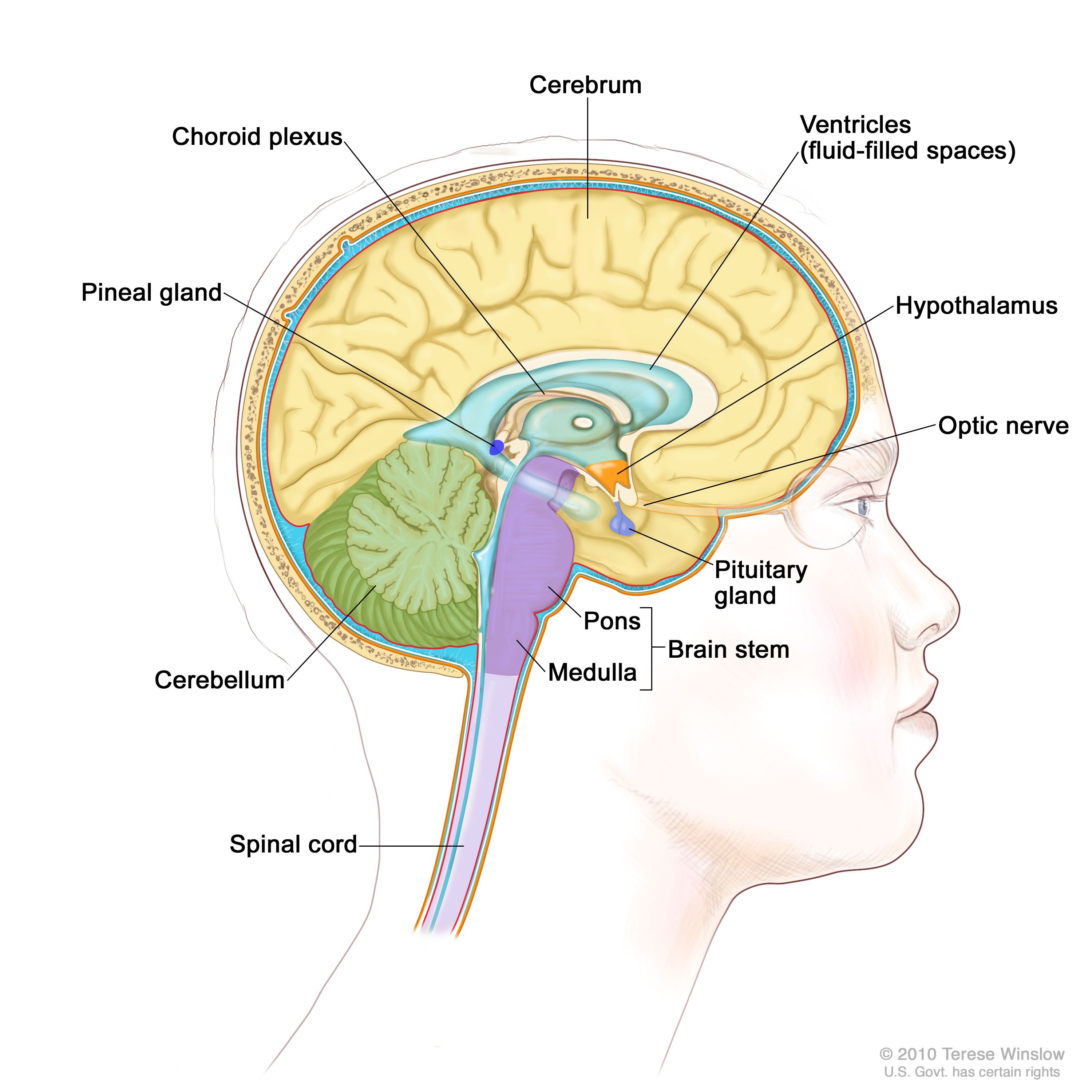
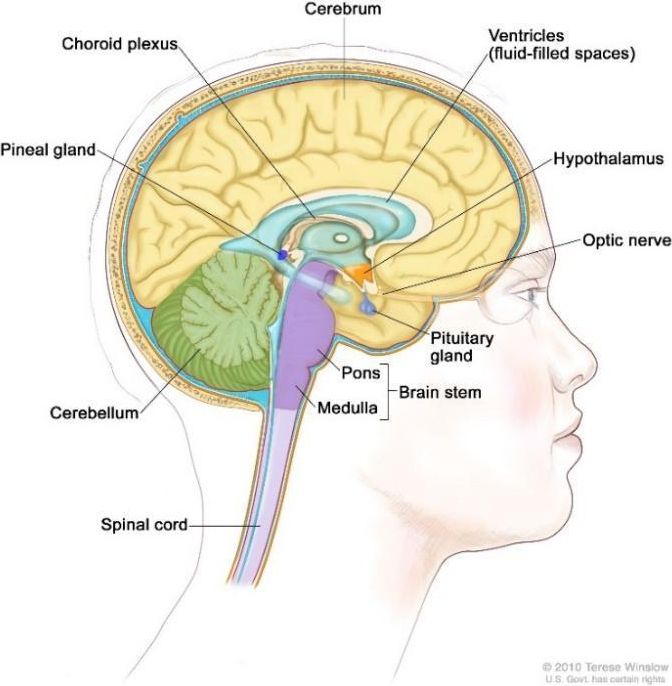
For me, human anatomy sufficiently explains the experience that Harris is describing:
 [122]
[122]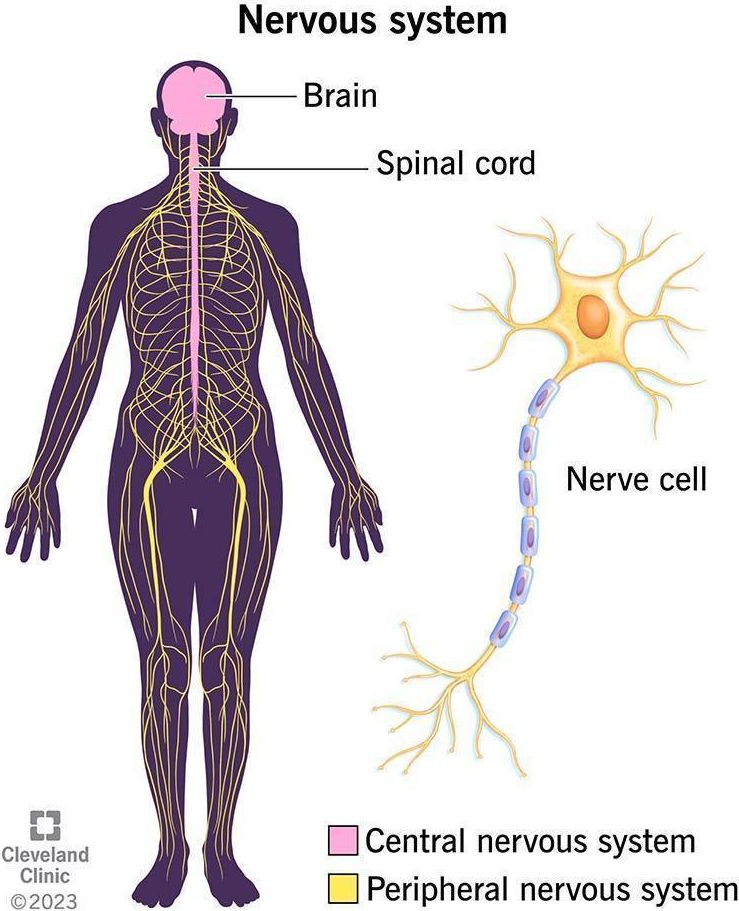 [123]
[123]
The brain is in the head, connected to the eyes by the optic nerves and enclosed within the skull, exactly where Harris describes feeling the seat of his consciousness and sense of self. In addition, the brain is connected to the rest of the body, including the skin, through the other cranial nerves and the spinal cord with its spinal nerves.
Of course Harris knows all of this, but I’m not sure why he isn’t satisfied by it. From my perspective, it is not an illusion that my sense of self and conscious experience feel like they are in my brain, and that my body feels like it is part of me and controlled by my brain, because these facts are anatomically and physiologically true. It would be an illusion if I felt like inanimate objects or other people’s bodies were part of me, or if my unified sense of being a brain in a body disappeared—to me, the contrived and experimentally induced mistakes such as the “rubber hand illusion” and “body swapping,” as well as the sense of disintegration of self due to meditation or mental disorders described by Harris, really are illusions and should rightly be called so.
Echoing his description of life as a process, Kevin Mitchell describes the self in a way that I think may help explain Harris’s experience of failing to find the self when he looks for it:
There is no self in a moment. The self is defined by continuity through time. You, right now, in the present, are just the momentary avatar—the representative in the world—of a self that stretches from the past to the future. Continuity is the defining property of life. … The organism is not a pattern of stuff; it is a pattern of interacting processes, and the self is that pattern persisting.[124]
In an endnote to The Moral Landscape, Harris approvingly summarizes the psychiatrist George Ainslie’s “fascinating” book Breakdown of Will in a very similar way:
To account for both the necessity of human will, along with its predictable failures, Ainslie presents a model of decision making in which each person is viewed as a community of present and future “selves” in competition, and each “self” discounts future rewards more steeply than seems strictly rational.
The multiplicity of competing interests in the human mind causes us each to function as a loose coalition of interests that may be unified only by resource limitations—like the fact that we have only one body with which to express our desires, moment to moment. This obvious constraint upon our fulfilling mutually incompatible ends keeps us bargaining with our “self” across time ….[125]
Harris’s subjective, personal, and dichotomous conviction that the self is an illusion—and his portrayal of this conclusion as an objective, universal truth—parallels his related belief that free will is another dichotomous illusion that should be rejected, and again I think he misrepresents what most people believe. Perhaps unexpectedly, in his arguments throughout Free Will I notice the emergence of a self that is thoroughly denied in Waking Up.
IV. Free Will: The Existence and Nature of Choice
On his podcast, Harris has described feelings of confusion, frustration, and an inability to comprehend the line of reasoning taken by people who argue for the existence of free will:
I find this the most perplexing, and in some ways, annoying response. I don’t really understand how smart people get lured into making it. … I’ve often heard, and I’ve heard it from many smart people, and they always deliver this rejoinder to [my] case against free will as though it really was the coup-de-grace, right—like this is the thing that just is fatally embarrassing to anyone who would doubt the reality of free will. The triumphalism here is just never even slightly concealed …. “If we don’t have free will, why are you trying to convince anyone of this? Why make this argument, because if there’s no free will, people are just going to believe whatever they believe. There’s no possibility of reasoning with anyone. The fact that you don’t believe your own argument is proven by the fact that you’re trying to convince anyone of it.”[126]
Harris himself is certainly convinced, as he explains in Free Will:
Free will is an illusion. Our wills are simply not of our own making. Thoughts and intentions emerge from background causes of which we are unaware and over which we exert no conscious control. We do not have the freedom we think we have. … Either our wills are determined by prior causes and we are not responsible for them, or they are the product of chance and we are not responsible for them.[127]
Again, I find a lot to unpack here.
I think that one important source of miscommunication around this topic is different understandings of the word “free”—dozens of shades of meaning are commonly used[128] —which lead to different interpretations of what “free will” represents. Given this opportunity for linguistic ambiguity, some level of people talking past one another is not surprising. On the other hand, Harris’s definition makes so little sense to me that I don’t really know what to do with it. For his own part, Harris describes the position of compatibilists as “deliberately obtuse,”[129] so arriving at a common understanding here may be extremely difficult. Still, I’ll try to identify where I think the differences lie.
Harris seems to be using “free” to mean “totally unconstrained.” Understood in that way, “free will” would be the ability to do anything, with no influence from any prior cause in history:
- “Choices, efforts, intentions, and reasoning influence our behavior—but they are themselves part of a chain of causes that precede conscious awareness and over which we exert no ultimate control.”[130]
- “Consider what it would take to actually have free will. You would need to be aware of all the factors that determine your thoughts and actions, and you would need to have complete control over those factors.”[131]
- “But the next choice you make will come out of the darkness of prior causes that you, the conscious witness of your experience, did not bring into being.”[132]
Harris is describing a counterfactual reality in which “you, the conscious witness of your experience” (more on that later) would be an Uncaused Causer—a being with the power of the creator of the universe, or at least the Genie from Aladdin. This does not strike me as a credible belief to attribute to psychologically normal people.
By contrast, I take the “free” in “free will” to mean “not under coercion, compulsion, or control by someone else.” It is this understanding of free will that allows an observer of human nature as astute as the author JK Rowling to write:
“A clever plan,” said Dumbledore in a level voice, still staring Mr. Malfoy straight in the eye. “Because if Harry here”—Mr. Malfoy shot Harry a swift, sharp look—“and his friend Ron hadn’t discovered this book, why—Ginny Weasley might have taken all the blame. No one would ever have been able to prove she hadn’t acted of her own free will. …”[133]
Harris does understand Dumbledore’s meaning:
Compatibilists generally claim that a person is free as long as he is free from any outer or inner compulsions that would prevent him from acting on his actual desires and intentions.[134]
What Harris goes on to argue (implausibly, to me), is that this widely understood, commonsense meaning of free will is not what people are talking about when they say they’re talking about it:
Today, the only philosophically respectable way to endorse free will is to be a compatibilist—because we know that determinism, in every sense relevant to human behavior, is true. Unconscious neural events determine our thoughts and actions—and are themselves determined by prior causes of which we are subjectively unaware. However, the “free will” that compatibilists defend is not the free will that most people feel they have.[135]
Claiming to know what most people think without providing evidence is not persuasive to me here. I did not find Harris’s perspectives on science and religion, honesty, consciousness, or the self to be representative of typical understandings. What do “most people” really mean by free will?
The late historian of science William Provine anecdotally reported that he polled the several hundred students in his undergraduate evolution course each year about their belief in free will. This is what he found:
Year after year, 90 percent or more [of the students] favor the idea of human free will for a very specific reason: They think that if people make choices, they have free will.[136]
Provine and his colleague Gregory Graffin went on to survey professional scientists:
Our questionnaire offered evolutionary scientists only two choices on the question about human free will: A, all organisms are locally determined by heredity and environment, but humans still possess free will; B, all organisms are locally determined by heredity and environment, and humans have no free will. To our surprise, 79 percent of the respondents chose option A for this question, indicating their belief that people have free will despite being determined by heredity and environment. Only 14 percent chose no free will, and 7 percent did not answer the question. … Comments from the evolutionists suggest that they were equating human choice and human free will.[137]
It’s not surprising to me that vast majorities of both groups (>90% of hundreds of college students surveyed every year for decades and ~80% of the evolutionary scientists in the sample) would agree that free will means the ability to make choices, notwithstanding the influence of factors out of their control. This understanding matches the very first dictionary definition of free will: “the ability or discretion to choose; free choice,” with the adjective free-will meaning “done of one's own accord; voluntary.”[138]
Harris himself describes this normal conception of free will in a passage from Waking Up:
I can, for instance, reach for my cup of coffee or set it down, seemingly as I please. These are intentional actions, and I perform them. … The feeling that I intended to do what I just did seems to be only that: a feeling of some internal signature, perhaps the result of my brain’s having formed a predictive model of its ensuing actions. It may not be best classified as a feeling, but surely it is something. Otherwise, how could I note the difference between voluntary and involuntary behavior? Without this impression of agency, I would feel that my actions were automatic or otherwise beyond my control.[139]
Harris’s impression of agency, his feeling that his actions were under his control, not automatic, and “the result of [his] brain,” (who else’s brain would it be?)—these are what most people mean by free will, not the expectation of a Genie-like ability that he imputes to them.
I think that a second important source of mutual misunderstanding about free will comes from selecting the appropriate timescale (or level of analysis) at which to describe causation. Kevin Mitchell argues for “cognitive realism”—the view “that neural patterns have causal power in the system solely by virtue of what they mean; that is, by virtue of their status as representing goals, beliefs, intentions, or other elements of cognition (whether conscious or not).”[140]
Although it is necessarily instantiated in a set of physical mechanisms, the causation in the system is informational. The criteria for how each neuron or each population responds to incoming information are set over multiple timeframes: over millennia by evolution; over a lifetime by individual experience; over years, months, days, or hours by the adoption of different goals; and over minutes, seconds, or even tens of milliseconds by processes of attention, arousal, and moment-to-moment decision making. The choices the organism makes based on parameters at a high level filter down—sometimes extremely rapidly—to change the criteria at lower levels, thereby allowing the organism to adapt to current circumstances, execute current plans, and achieve current goals.
In this way, abstract entities like thoughts and beliefs and desires can have causal influence in a physical system. The idea that they are mere epiphenomena that just come along for the ride, while neural mechanisms do all the real work, could not be further from the truth. Patterns of neural activity only have causal efficacy in the brain by virtue of what they mean. Of course these higher-order abstract entities must be instantiated in a physical medium, but they are not reducible to the underlying physical mechanisms. Nor do they magically just emerge from those mechanisms. The meaning of the various (often arbitrary) neural patterns arises through the grounded interaction of the organism with its environment over time.[141]
As discussed above, I am persuaded that most people understand free will to involve making choices that are within our individual control; by contrast, Harris’s rejection of the concept consistently focuses on causes that we all agree are out of our control:
- “There is not a person on earth who chose his genome, or the country of his birth, or the political and economic conditions that prevailed at moments crucial to his progress.”[142]
- “You did not pick your parents or the time and place of your birth. You didn’t choose your gender or most of your life experiences. You had no control whatsoever over your genome or the development of your brain. And now your brain is making choices on the basis of preferences and beliefs that have been hammered into it over a lifetime—by your genes, your physical development since the moment you were conceived, and the interactions you have had with other people, events, and ideas. Where is the freedom in this? Yes, you are free to do what you want even now. But where did your desires come from?”[143]
Certainly, our free will is constrained by events that occurred before we were born, and not everything in our lives is under our direct control—but, to draw attention to another example of Harris’s dichotomous framings, there are a lot of numbers between the 0% control that he seems to think we have, and the 100% control that he thinks everyone else thinks we have.
As discussed above, I am not persuaded that psychologically normal people believe themselves to have phenomenal cosmic power, but neither do most of us feel like we are being powerlessly dragged through our lives by external forces. In addition, “Your brain is making choices” just sounds like another way of saying “you are making choices,” and “Yes, you are free to do what you want even now” seems to concede the whole point of free will for most people.
Harris accuses compatibilists of “changing the subject”[144] about free will, but in his rejection of human causality because other things happened beforehand, I think that he is the one changing the subject! He’s like everybody in Hollywood in Mitch Hedberg’s joke about comedy:
I got into comedy to do comedy, which is weird, I know. But when you’re in Hollywood and you’re a comedian, everybody wants you to do other things besides comedy. They say, “All right, you’re a standup comedian. Can you act? Can you write? Write us a script.” They want me to do things that’s related to comedy, but not comedy. That’s not fair. It’s as though if I was a cook and I worked my ass off to become a good cook, they said, “All right, you’re a cook. Can you farm?”[145]
I think it’s also worth contesting the claim that “You had no control whatsoever over … the development of your brain.” Before birth, and into infancy and early childhood, this conclusion seems fairly persuasive. As Louis CK observed of young children: “They have no ability—no five-year-old ever goes, like, ‘No, go ahead and finish. I'll tell you after, it's fine.’”[146] The psychologist Paul Bloom describes the developmental differences in more detail:
Adult attention is willful and endogenous. Although it can be captured by external events—we will turn if we hear a loud noise—we also have control over what to think about and what to attend to. By sheer will, we can choose to focus on our left foot, then think about what we had for breakfast, then focus on … whatever we want. Adults are also blessed, to varying degrees, with the power to ignore distractions, both external and internal, and to stay focused on a single task.
This is all harder for babies and young children. They are largely at the mercy of the environment. Simple experiments demonstrate that babies are, for the most part, trapped in the here and now, a conclusion supported by the finding that the part of the brain responsible for inhibition and control, the prefrontal cortex, is among the last to develop.[147]
Kevin Mitchell explains the significance of this neuroanatomy for decision-making:
The prefrontal cortex is particularly well suited to play a high-level role in monitoring and guiding behavior because it has connections to and from all other areas of the cortex and to the extended circuitry of action selection in the thalamus, basal ganglia, and midbrain regions that are involved in evaluating goal progress and action outcomes. This gives the prefrontal cortex a bird’s-eye view of the distributed and diverse processes of decision making.
Prefrontal regions seem to be required for the aspects of cognitive control that we recognize as acting rationally …. These include planning over long timeframes, coordinating among multiple competing goals, inhibiting actions that otherwise would be favored, monitoring progress, maintaining information relevant to current tasks in working memory, assessing certainty, directing learning to the most reliable sources of information, and switching among goals when conditions change or new information becomes available.[148]
Eventually—at different points and to greater or lesser degrees in different people—most of us begin to develop more and more deliberate control over the decisions we make. I expect that the exercise of this control would feed back to influence the brain’s structure, and in The Moral Landscape, Harris argues that it does: “What if I could change the architecture of my mind? On some level, this has always been possible, as everything we devote attention to, every discipline we adopt, or piece of knowledge we acquire changes our minds.”[149]
The dictionary definition of will is “the mental faculty by which one deliberately chooses or decides upon a course of action.”[150] For me, free will seems best understood as a continuously varying ability to make choices—again, in contrast to the dichotomous “you-have-it-or-you-don’t” conception presented by Harris. My impression is that people seem to understand this variability; we don’t treat all actions by all individuals as deriving from an equal, uniform ability. Rather, we seem to assign responsibility to others based on how much control we expect them to have over their own actions.
Once again, a Mitch Hedberg joke highlights the distinction:
But alcoholism is a disease; but it’s like the only disease that you can get yelled at for havin’. Provocative! “Dammit, Otto, you’re an alcoholic!” “Dammit, Otto, you have lupus.” One of those two doesn’t sound right.[151]
Harris acknowledges this point (seeming to credit it as an insight from Steven Pinker):
One way of viewing the connection between free will and moral responsibility is to note that we generally attribute these qualities to people only with respect to actions that punishment might deter. I cannot hold you responsible for behaviors that you could not possibly control. If we made sneezing illegal, for instance, some number of people would break the law no matter how grave the consequences. A behavior like kidnapping, however, seems to require conscious deliberation and sustained effort at every turn—hence it should admit of deterrence. If the threat of punishment could cause you to stop doing what you are doing, your behavior falls squarely within conventional notions of free will and moral responsibility.[152]
Despite acknowledging this link between (what most people seem to mean by) free will and moral responsibility, Harris doesn’t seem willing to accept its implications; he still prefers to stress the ostensibly unconquerable importance of fundamental causes outside of anyone’s control:
No human being is responsible for his genes or his upbringing, yet we have every reason to believe that these factors determine his character. Our system of justice should reflect an understanding that any of us could have been dealt a very different hand in life.[153]
This is a fair and fair-minded point about how to interpret the ultimate nature of crime and punishment, but it does not (as I think Harris would agree) lessen the importance of the latter to the degree that it can predictably reduce the former.
There is also another relevant card-based expression that reflects the role of free will in most of our lives: “playing the hand you’re dealt.” For me, Harris’s continual focus on people who commit crimes—like his emphasis on mental disorders when discussing the self—is misleading. I suspect that these are likely to be individuals with less self-control and more compulsive behavior than average, providing an unrepresentative view of the amount of free will exhibited by most people.
And unlike most people, who I believe recognize a range of responsibility reflecting a range of effective free will based on a range of potential control over one’s actions, as discussed above, Harris in his rejection of free will seems to be unwaveringly locating it in the wrong place—too early in the chain of causation. A segment on The Daily Show discussed the implications of this approach:
And now, a legal verdict might have set an important precedent. … That’s right: for the first time ever, parents are going to be liable for their kid’s school shooting, which, honestly makes sense to me. You know, we already blame the parents for a lot less. When a teenager throws a loud party, we blame the parents, or when a kid has a stupid haircut, we blame the parents. We should blame the parents when a kid shoots up a school, and why stop at the parents? The grandparents raised those parents, so throw them in prison too—in fact, go all the way up the family tree, you know, great-grandparents, great-great grandparents. Exhume all the bodies and put them in a special ghost jail.[154]
In an unrelated podcast episode about cultures of honor, Harris made a similar point:
Except for the consequences of holding people responsible in those cases—I mean the reason why it makes sense to hold you responsible for much of what you do is that doing that reliably modifies what you will do in the future, whereas if I held you responsible for what other people did, it can't actually modify what other people will do in the future, unless you are a lever that influences them, reliably. Your brain will influence another person's behavior less reliably than his brain will, and that's why the locus of control is the other person.[155]
Another example from Free Will also shows Harris’s commonsense understanding of this issue:
If I were teaching a self-defense class for women, I would consider it quite counterproductive to emphasize that all human behavior, including a woman’s response to physical attack, is determined by a prior state of the universe, and that all rapists are, at bottom, unlucky—being themselves victims of prior causes that they did not create. There are scientific, ethical, and practical truths appropriate to every occasion—and an injunction like “Just gouge the bastard’s eyes” surely has its place. There is no contradiction here. Our interests in life are not always served by viewing people and things as collections of atoms—but this doesn’t negate the truth or utility of physics.[156]
And when he wants to win an argument against a strange analogy he has put into an imaginary Daniel Dennett’s mouth, Harris is again willing to discount the relevance of fundamental causes, and even criticizes the imaginary Dennett for bringing them up:
Imagine that a person claims to have no need to eat food of any kind—rather, he can live on light. From time to time, an Indian yogi will make such a boast, much to the merriment of skeptics. Needless to say, there is no reason to take such claims seriously, no matter how thin the yogi. However, a compatibilist like Dennett could come to the charlatan’s defense: The man does live on light—we all do—because when you trace the origin of any food, you arrive at something that depends on photosynthesis. By eating beef, we consume the grass the cow ate, and the grass ate sunlight. So the yogi is no liar after all. But that’s not the ability the yogi was advertising, and his actual claim remains dishonest (or delusional).[157]
Harris’s denial of free will—it would be uncharitable to use his own phrase and call it “dishonest (or delusional)”—extends in a few additional directions, which strike me as similarly misguided:
The popular conception of free will seems to rest on two assumptions: (1) that each of us could have behaved differently than we did in the past, and (2) that we are the conscious source of most of our thoughts and actions in the present. As we are about to see, however, both of these assumptions are false.[158]
First, the past. Harris seems to find a thought experiment about resetting the universe to be very persuasive, concluding that actions taken by violent criminals couldn’t have occurred otherwise:
To say that [rapists and murders] were free not to rape and murder is to say that they could have resisted the impulse to do so (or could have avoided feeling such an impulse altogether)—with the universe, including their brains, in precisely the same state it was in at the moment they committed their crimes.[159]
In his rejection of free will, Harris consistently regards all preceding causes in the universe as completely deterministic of those that follow, occasionally making room for probabilistic quantum effects:
- “The freedom that we presume for ourselves and readily attribute to others is felt to slip the influence of impersonal background causes. And the moment we see that such causes are fully effective—as any detailed account of the neurophysiology of human thought and behavior would reveal—we can no longer locate a plausible hook upon which to hang our conventional notions of personal responsibility.”[160]
- “If a man’s choice to shoot the president is determined by a certain pattern of neural activity, which is in turn the product of prior causes—perhaps an unfortunate coincidence of bad genes, an unhappy childhood, lost sleep, and cosmic-ray bombardment—what can it possibly mean to say that his will is ‘free’?”[161]
- “If determination is true, the future is set—and this includes all our future states of mind and our subsequent behavior. And to the extent that the law of cause and effect is subject to indeterminism—quantum or otherwise—we can take no credit for what happens. There is no combination of these truths that seems compatible with the popular notion of free will.”[162]
- “What I will do next, and why, remains, at bottom, a mystery—one that is fully determined by the prior state of the universe and the laws of nature (including the contributions of chance).”[163]
On his podcast, Harris has described human behavior as “all determined—it’s just one domino hitting the next”[164] and the result of “a bunch of complicated billiard balls slamming into whatever's next in line.”[165] I think that this is a fundamentally mistaken metaphor: the biology of the brain making decisions is not like lifeless dominoes or billiard balls knocking into one another; it’s like a soccer game being played by living, decision-making agents. (Though even this sport has been playfully described as fully deterministic: “Football is a simple game. Twenty-two men chase a ball for 90 minutes and at the end, the Germans always win.”[166])
If you could watch a soccer match but see only the ball and not any of the players, its path would be totally unpredictable: the movement of the ball only makes sense as the result of living agents impacting it by making decisions based on their expectations of the future decisions of other living agents. The human brain is estimated to contain 86 billion neurons[167] commonly described as connected by 100 trillion connections; each of those cells in their countless networks is a living thing, acting in the world, making predictions, and adjusting its behavior based on the behavior of other living cells, both within and outside of our bodies.
For what it’s worth, the premise of Harris’s thought experiment (about “rewinding the tape” of the universe to the moment before a decision was made) is contested by other neuroscientists, including Kevin Mitchell:
The problem with this argument is that no such imagined “moment” exists. There is no such thing as a point in time of zero duration, when a system (or the universe as a whole) has a completely defined state: the Heisenberg uncertainty principle rules that out. In the present, the universe is still in a state of becoming, in the process of resolving all that indeterminacy, of the indefinite becoming definite. There’s no point at which you can catch it with full precision until it becomes the past. By that point, of course, you could not have done otherwise because what’s past is passed, but before that—during the present—things remain undetermined and real choice exists.
… The constant jitteriness of neural activity means that the whole system is not predetermined to adopt any particular state: there are degrees of freedom in the system that the organism can exploit. The agent itself has both the power and the time to decide. Indeed, we have time to think, and choose, and change our minds, and think again if we need to. Even in the experiments of Libet and colleagues, where arbitrary noise is allowed to drive the decision of when to move, the subjects still retained the power to consciously veto that urge, up to just tens of milliseconds before execution of the movement.[168]
If the universe is deterministic, Harris believes that physics invalidates the kind of free will he believes most people believe they have—the Genie from Aladdin kind. As discussed above, I think that free will is understood by most people to instead mean the ability to make choices. We act as agents in the world, and the ability to do so is what free will means. In practice, the truth of physics—regardless of whether the universe is predetermined or indeterminate—also does not invalidate the variable amounts of agency that we and other living organisms possess.
Eukaryotic organisms behave with more agency than bacteria and archaea; animals behave with more agency than other eukaryotes; mammals behave with more agency than other animals; humans behave with more agency than other mammals; and psychologically normal adults behave with more agency than psychologically normal children. What’s more, we know that factors like distraction, tiredness, and intoxication can reduce our effective agency. Whatever that ability is that allows us to make decisions—which varies from lineage to lineage and from person to person; which emerges through development; and which we can act with different amounts of, from moment to moment—it makes sense to me to continue to call free will.
Leaving the past behind, an additional important aspect of free will is that by learning from our previous choices, psychologically normal people have the ability to make different choices under similar circumstances in the future. To me, this fact is another way of understanding how our brains instantiate whatever amount of free will we have in any given situation, and explains the feeling we have of making a choice: we are not forced to do the same thing we did the last time, and we could choose to do something different the next time a comparable situation arises.
A thought experiment about robots might help make this point clearer.
In his second book, The Extended Phenotype, Richard Dawkins discusses misunderstandings of some remarkably prescient passages from his first book, The Selfish Gene, written in 1976:
… I myself wrote of genes swarming ‘inside gigantic lumbering robots …’, and of ourselves as ‘survival machines—robot vehicles blindly programmed to preserve the selfish molecules known as genes’. These passages have been triumphantly quoted … as examples of rabid genetic determinism. I am not apologizing for using the language of robotics. I would use it again without hesitation. … A robot is a programmed machine, and an important thing about programming is that it is distinct from, and done in advance of, performance of the behaviour itself.[169]
From my perspective, if you wanted to program a robot to have free will, you would need to give it a will. Neither programming it to always perform the same behavior, nor programming it to perform behaviors randomly, as Harris rightly points out, would do the trick; I am suggesting that programming the robot to perform the behavior when it wants to would instantiate choice in a meaningful way. As discussed above, I understand the neuroanatomy of the brain to allow this ability—though of course, to varying degrees in different brains and at different times.
So much for the past; second, on to the role of consciousness in free will. To me, Harris seems to be unnecessarily conflating consciousness and free will, and to be reading too much significance into the mysteriousness of our brains in action:
But the deeper truth is that free will doesn’t even correspond to any subjective fact about us—and introspection soon proves as hostile to the idea as the laws of physics are. Seeming acts of volition merely arise spontaneously (whether caused, uncaused, or probabilistically inclined, it makes no difference) and cannot be traced to a point of origin in our conscious minds. A moment or two of serious self-scrutiny, and you might observe that you no more decide the next thought you think than the next thought I write. … Although we continually notice changes in our experience—in thought, mood, perception, behavior, etc.—we are utterly unaware of the neurophysiological events that produce them.[170]
Here, Harris’s apparent (and to me, premature) assumption that there is a sharp line dividing two discrete states of consciousness from one another—either conscious, or unconscious—has important implications. As discussed before, it seems to me that consciousness would be better described as a set of continuously varying experiences or abilities. As a result, Harris’s concern about the relevance of consciousness for free will strikes me as another non sequitur: I would argue that whether we are fully or partially aware of the details of our minds at work is not a crucial distinction in making choices.
In a passage from The Moral Landscape, Harris seems to concede a similar point:
[W]hile it is true that all conscious processes, including any effort of reasoning, depend upon events of which we are not conscious, this does not mean that reasoning amounts to little more than a post hoc justification of brute sentiment. We are not aware of the neurological processes that allow us to follow the rules of algebra, but this doesn’t mean that we never follow these rules or that the role they play in our mathematical calculations is generally post hoc. The fact that we are unaware of most of what goes on in our brains does not render the distinction between having good reasons for what one believes and having bad ones any less clear or consequential. Nor does it suggest that internal consistency, openness to information, self-criticism, and other cognitive virtues are less valuable than we generally assume. There are many ways to make too much of the unconscious underpinnings of human thought.[171]
As with his rejection of the self, in his rejection of free will Harris again seems too willing to treat subjective observations derived from introspection as conclusive facts about reality, and unjustified in concluding that the subjective mysteriousness of a process is evidence that it isn’t real; the fact that the brain is complex, and its workings are not completely transparent to us, seems unsurprising and not so problematic to me.
Another example from Harris may help illustrate these potential areas of disagreement:
I wanted coffee more than I wanted tea today, and I was free to have what I wanted. Did I consciously choose coffee over tea? No. The choice was made for me by events in my brain that I, as the conscious witness of my thoughts and actions, could not inspect or influence. Could I have “changed my mind” and switched to tea before the coffee drinker in me could get his bearings? Yes, but this impulse would also have been the product of unconscious causes.[172]
In both cases, Harris made a choice, even if there was more apparent agency the second time—again, with regard to my position that his dichotomous framing of discrete states of consciousness is misleading. The example also raises the question of who this “conscious witness of [his] thoughts and actions” Harris is referring to is, if not the self that, under other circumstances, he tries so hard to kill off? To me, this phrasing is indefensibly dualistic, with choices being made for an uninvolved, separate “him” somehow isolated from his physical brain. It would make no sense to describe the action of any other part of the body in this way: “Did I bend my knee? No. The bending was done for me by events in my leg.”
Perhaps I am misunderstanding Harris, but in attempting to reject the existence of free will, he seems to have fully resurrected the self from its prematurely celebrated death:
- “However, when I look for the psychological cause of my behavior, I find it utterly mysterious … the actual explanation for my behavior is hidden from me. And it is perfectly obvious that I, as the conscious witness of my experience, am not the deep cause of it.”[173]
- “You are not in control of your mind—because you, as a conscious agent, are only part of your mind, living at the mercy of other parts.”[174]
- “Some moments before you are aware of what you will do next—a time in which you subjectively appear to have complete freedom to behave however you please—your brain has already determined what you will do. You then become conscious of this ‘decision’ and believe that you are in the process of making it.”[175]
- “The distinction between ‘higher’ and ‘lower’ systems in the brain offers no relief: I, as the conscious witness of my experience, no more initiate events in my prefrontal cortex than I cause my heart to beat.”[176]
Again, for me, human anatomy and physiology provides some clarifying context.
Although the details of how events are initiated in the prefrontal cortex (and how they relate to consciousness) may as yet be incompletely understood, there is still a meaningful distinction between voluntary and involuntary action in the body. Skeletal muscle, which pulls on the bones to produce movement, is voluntarily controlled by the somatic nervous system; cardiac muscle, which contracts to pump blood through the heart, is involuntarily controlled by the autonomic nervous system.
A reflex, which can temporarily cause otherwise voluntary skeletal muscle to contract without conscious input, is involuntary: a person who kicks you because their patellar tendon was tapped is in a different situation with regard to will and choice from someone who makes a decision to kick you. Daniel Dennett called this voluntary/involuntary distinction “part of the foundation of our moral and legal understanding of free will.”[177]
Harris knows all of this:
This difference between nonvolitional and volitional states of mind is reflected at the level of the brain—for they are governed by different systems. And the difference between them must, in part, produce the felt sense that there is a conscious self endowed with freedom of will. As we have begun to see, however, this feeling of freedom arises from our moment-to-moment ignorance of the prior causes of our thoughts and actions. The phrase “free will” describes what it feels like to identify with certain mental states as they arise in consciousness. … But from a deeper perspective (speaking both objectively and subjectively), thoughts simply arise unauthored and yet author our actions.[178]
To me, this sounds like a return to Buddhist dogma, not the pursuit of a scientific understanding of the brain. How does Harris suggest that these mystical unauthored thoughts are able to author our actions—and who is immediately responsible for them if not our “selves”?
I may not have succeeded in solving the age-old paradox of reconciling a materialistic universe with the importance of choice in our lives, but I don’t think that Harris has either. In attempting to bridge the disconnect between these two levels of analysis, some of his statements begin to make less and less sense to me:
My choices matter—and there are paths toward making wiser ones—but I cannot choose what I choose. And if it ever appears that I do—for instance, after going back and forth between two options —I do not choose to choose what I choose. There is a regress here that always ends in darkness. I must take a first step, or a last one, for reasons that are bound to remain inscrutable.[179]
“I cannot choose what I choose” again locates freedom in the wrong place in the chain of causation, and is ultimately an incoherent statement. Substituting “choose” with any other activity makes the confusion clearer: “I cannot drink what I drink. I cannot breathe what I breathe.” And again, who is the “I” that Harris refers to, and if it isn’t him doing the choosing, then who is? And why is the inscrutability of the brain processing information important?
Becoming sensitive to the background causes of one’s thoughts and feelings can—paradoxically—allow for greater creative control over one’s life. It is one thing to bicker with your wife because you are in a bad mood; it is another to realize that your mood and behavior have been caused by low blood sugar. This understanding reveals you to be a biochemical puppet, of course, but it also allows you to grab hold of one of your strings: A bite of food may be all that your personality requires. Getting behind our conscious thoughts and feelings can allow us to steer a more intelligent course through our lives (while knowing, of course, that we are ultimately being steered).[180]
What does it mean “to grab hold of one of your strings”? Who is doing the grabbing if not our selves? What is required “to steer a more intelligent course through our lives” if not free will?
Despite his exhaustive arguments that it does not exist, Harris seems to end up agreeing with pretty much everything that I think we should care about with regard to free will:
- “This is not to say that conscious awareness and deliberative thinking serve no purpose. Indeed, much of our behavior depends on them. … And we know that the brain systems that allow us to reflect upon our experience are different from those involved when we automatically react to stimuli. So consciousness, in this sense, is not inconsequential.”[181]
- “And the fact that our choices depend on prior causes does not mean that they don’t matter. … Decisions, intentions, efforts, goals, willpower, etc., are causal states of the brain, leading to specific behaviors, and behaviors lead to outcomes in the world. Human choice, therefore, is as important as fanciers of free will believe.”[182]
- “There is no question that human beings can imagine and plan for the future, weigh competing desires, etc.—and that losing these capacities would greatly diminish us. External and internal pressures of various kinds can be present or absent while a person imagines, plans, and acts—and such pressures determine our sense of whether he is morally responsible for his behavior.”[183]
- “It may seem paradoxical to hold people responsible for what happens in their corner of the universe, but once we break the spell of free will, we can do this precisely to the degree that it is useful. Where people can change, we can demand that they do so. Where change is impossible, or unresponsive to demands, we can chart some other course.”[184]
If Harris is right that free will is an illusion, then so are all of our choices—as well as the deliberative and reflective thinking, decisions, intentions, efforts, goals, willpower, and moral responsibility that he is defending here. In denying the reality of free will and the self, but still remaining dependent on both of these concepts, Harris seems to be in the same situation as the guy in the joke at the end of the movie Annie Hall:
[T]his guy goes to a psychiatrist and says, “Doc, my brother’s crazy! He thinks he’s a chicken!” And the doctor says, “Well, why don’t you turn him in?” And the guy says, “I would, but—I need the eggs.”[185]
The eggs that Harris ultimately argues for sound indistinguishable from the free will that I have been describing, which is the free will that both the dictionary and surveys indicate that people think they have. If it’s purely a semantic disagreement, then the next question should be whether there are any real-world consequences that follow from how free will is framed.
In Free Will, Harris considers the argument that people might benefit from believing in free will, or be harmed by abandoning it, but he quickly dismisses these possibilities:
Many people worry that free will is a necessary illusion—and that without it we will fail to live creative and fulfilling lives. … It is surely conceivable that knowing (or emphasizing) certain truths about the human mind could have unfortunate psychological and/or cultural consequences. However, I’m not especially worried about degrading the morality of my readers by publishing this book.”[186]
For Harris, not believing in free will is subjectively liberating:
Losing a belief in free will has not made me fatalistic—in fact, it has increased my feelings of freedom. My hopes, fears, and neuroses seem less personal and indelible. There is no telling how much I might change in the future.[187]
But if other people feel like abandoning belief in free will would lead them to fatalism, Harris (once again, treating his subjective personal preferences as objective and universal truths) says that these people would be wrong:
This is pure confusion. To sit back and see what happens is itself a choice that will produce its own consequences. It is also extremely difficult to do: Just try staying in bed all day waiting for something to happen; you will find yourself assailed by the impulse to get up and do something, which will require increasingly heroic efforts to resist.[188]
Once again, I feel obligated to ask how representative Harris’s worldview is. From my perspective, there do seem to be good reasons to expect that beliefs about free will are more important to many people than Harris seems to think. Erik Hoel summarizes the evidence:
In a number of studies the belief in free will has been correlated with all sorts of positive psychological traits, like greater gratitude, more life satisfaction, less stress, reports of a more meaningful life, a greater urge to pursue meaningful goals, and even more commitment in relationships and a greater tendency to forgive.[189]
Consequences of belief in free will for the outcomes of romantic relationships are discussed in more detail by the social scientist Arthur Brooks:
Even though it’s a fantasy, believing in love at first sight is relatively harmless for couples. That’s because it’s a retrospective narrative, not one that sets expectations about the current relationship or the future. Other idealistic but unrealistic beliefs can do a lot of damage. Take the idea of romantic destiny, or “soul mates”—the belief that two people are deliberately brought together by unseen forces. Research on hundreds of college students has shown that such expectations are correlated with dysfunctional patterns in relationships, such as the assumption that partners will understand and predict each other’s wishes and desires with little effort or communication because they’re a cosmically perfect match. In other words, a belief in destiny leads to a belief in mind reading.
This wreaks havoc on relationships. For one, it hinders forgiveness after a fight (“You should know what bothers me without me having to tell you!”), which in turn increases distress and escalates the severity of conflicts. Researchers have also found that people who believe in destiny are more likely to end a relationship via “ghosting,” in which one partner abruptly cuts off contact, leaving the ghosted partner to suffer a breakup with no explanation. Perhaps people in search of their soul mate feel less of a sense of responsibility to the other person if that particular relationship simply wasn’t meant to be.
The opposite of “destiny beliefs” is a conviction of free will—the view that partners decide whether they should be together, and thus, that they are responsible for the relationship’s success. Lest that sound a bit unromantic, researchers have found clear evidence that when the belief in free will increases, so do one’s feelings of passionate love in a relationship.[190]
These results, like any in social science, may turn out not to replicate perfectly. They do suggest, though, potential reasons to reconsider Harris’s framing. Importantly, I’m not saying that Harris is wrong here and other people are right; I’m just again suggesting that Harris’s conclusions about free will are additional examples of subjective personal preferences—and one person’s subjective personal preference may not necessarily be a good fit for someone else.
As a guest on Harris’s podcast, the neuroendocrinologist Robert Sapolsky—whom Harris described as “one of the only scientists who has fully accepted the implications of science as we know it on this topic”[191]—acknowledged the challenge inherent in getting other people to share an enlightened rejection of free will:
Throw out the criminal justice system, and all we have to do is protect society from dangerous people by constraining them: blah blah blah, simple. Throw out meritocracies in [their] conventional sense, and the problem is, you still gotta motivate people to work really really really really hard—and not go out and party with their roommate, and study instead—in order to become a competent neurosurgeon somewhere down the line. I don’t know the solution for that one. Because you gotta use reward pretty powerfully as an instrumental tool there, that it’s gonna take a lot of work to—instead of somebody coming out the other end saying, “Whoa, I worked incredibly hard there,” somebody to come out and say, “I am so grateful that I happened to turn out to be the sort of person with these abilities.” That one’s been challenging me; that one I think is a harder problem: it’s easier to constrain people without moralizing at them, than to motivate people without doing a different version of moralizing.[192]
Harris (characteristically, as I see it, mistakenly regarding his subjective personal preferences as normatively universal) did not seem to consider this obstacle to be very difficult to overcome:
I feel like maybe there’s not that much adjustment needed apart from this emphasis on the role of luck, and the appropriate emotion being gratitude, right, and a general disposition to spread the luck around insofar as that is possible. … You just have to recognize that you’ve won whatever lottery you’ve won, and lost others; and the appropriate emotion for those of us who are anything like the lucky side of any of these distributions is just gratitude, and a desire to give whatever opportunities anyone can use to everyone in sight, and all the while knowing that there’s going to be a wide range of differential success and aptitude for everyone. … And we celebrate that, not because we’re taken in by the illusion that anyone really at bottom earned it, but because the heights of creativity and insight and every other aptitude matter to one or another degree, and we want to encourage them and benefit from them.[193]
Sapolsky (despite Harris’s assertion that “we’re the two people on Earth who agree”[194] about his framing of the subject) still seemed unconvinced about the achievability of Harris’s proposed approach:
Yes, but—“but,” as in: it’s a really tall order to get someone to the point—you know, a concert pianist—where all they really feel is just gratitude that, “How in hell did I wind up with these fingers? How did I wind up with fingers that could do things that bring audiences to tears?” That sort of detachment, that’s a very—“How did I wind up being somebody who would work my ass off like crazy?” without feeling anything other than, “Huh—I just wound up that way.” … But that’s not a one-week project; that one’s a long-haul one.[195]
If there are general benefits of believing oneself to have free will, and general costs of believing oneself not to, it does not surprise me that many of Harris’s statements would strike some members of his audience as downright alarming:
- “But the idea that we, as conscious beings, are deeply responsible for the character of our mental lives and subsequent behavior is simply impossible to map onto reality.”[196]
- “And there is no way I can influence my desires—for what tools of influence would I use? Other desires? To say that I would have done otherwise had I wanted to is simply to say that I would have lived in a different universe had I been in a different universe.”[197]
- “From the perspective of your conscious awareness, you are no more responsible for the next thing you think (and therefore do) than you are for the fact that you were born into this world.[198]
- “You can change your life, and yourself, through effort and discipline—but you have whatever capacity for effort and discipline you have in this moment, and not a scintilla more (or less). You are either lucky in this department or you aren’t—and you cannot make your own luck.”[199]
I suspect that free will may be like courage, in that acting as though you have it can be a large part of what it means to have it. And of course, Harris’s framing is not the only way to think about luck. As Thomas Jefferson never actually said, “I'm a great believer in luck. The harder I work, the more of it I seem to have.”[200] In addition, an acceptance of free will seems likely to align with many people’s concept of an internal locus of control, leading them to “believe that the things that happen to them are greatly influenced by their own abilities, actions, or mistakes” while denial of free will seems consistent with an external locus of control, leading people to “feel that other forces—such as random chance, environmental factors, or the actions of others—are more responsible for the events that occur in the individual's life.”[201] Unsurprisingly to me,
Researchers have identified several areas in which one’s sense of control appears to affect outcomes, including education, health, and civic engagement. Overall, such research has generally suggested that those with a more internal locus of control are more successful, healthier, and happier than those with a more external locus.[202]
A sample of science writer Michael Shermer’s suggested New Year’s resolutions illustrates the difference between these two ways of viewing one’s own agency in a world full of challenges:
The universe doesn’t care about you so when things go bad don’t take it personally. Shit happens. Deal with it. … Be true to yourself and know your limitations and adjust your goals accordingly, erring on the side of aiming a bit higher than expectations therein. … More than being resilient, or standing strong against adversity, grow even stronger from tough times and stressful situations, and learn how to improve yourself as a result. Be self-disciplined. … Action is character. What you do is who you are. Be and act that person. Your habits reflect your discipline, and that builds your character. … Delay gratification. Plan ahead. … Be your own choice architect. … Be the master of your fate, the captain of your soul.”[203]
I’m not suggesting that Harris would necessarily disagree with any of this advice—just that, for many people, viewing their own actions as deriving from free will might be more effective in producing the positive outcomes that Harris has apparently succeeded in achieving for himself by viewing free will as illusory; conversely, internalizing his rejection of free will seems likely to discourage people from taking responsibility for their own lives.
Conclusion
Richard Dawkins has called the common impulse to divide continuous variables into discrete ones “the tyranny of the discontinuous mind.” His objection “... is to the very idea of a line: a gratuitously manufactured discontinuity in a continuous reality.”[204] In my reading of Sam Harris’s books Letter to a Christian Nation, Lying, Waking Up, Free Will, and The Moral Landscape, I see a tendency for Harris to frame many different issues as dichotomies:
-
Religion:
- “Either the Bible is just an ordinary book, written by mortals, or it isn’t. Either Christ was divine, or he was not.”[205]
- “The truth, however, is that the conflict between religion and science is unavoidable. The success of science often comes at the expense of religious dogma; the maintenance of religious dogma always comes at the expense of science.”[206]
- “And science and religion—being antithetical ways of thinking about the same reality—will never come to terms.”[207]
-
Honesty:
- “Honest people are a refuge: You know they mean what they say; you know they will not say one thing to your face and another behind your back; you know they will tell you when they think you have failed—and for this reason their praise cannot be mistaken for mere flattery.”[208]
- “Sincerity, authenticity, integrity, mutual understanding—these and other sources of moral wealth are destroyed the moment we deliberately misrepresent our beliefs, whether or not our lies are ever discovered.”[209]
-
The self:
- “How can we know that the conventional sense of self is an illusion? When we look closely, it vanishes. This is compelling in the same way that the disappearance of any illusion is: You thought something was there, but upon closer inspection, you see that it isn’t. What doesn’t survive scrutiny cannot be real.”[210]
-
Consciousness:
- “Consciousness—the sheer fact that this universe is illuminated by sentience—is precisely what unconsciousness is not.”[211]
- “Either the lights [of consciousness] are on, or they are not.”[212]
-
Free will:
- “There is no question that our attribution of agency can be gravely in error. I am arguing that it always is.”[213]
- “Consider what it would take to actually have free will. You would need to be aware of all the factors that determine your thoughts and actions, and you would need to have complete control over those factors.”[214]
- “Either our wills are determined by prior causes and we are not responsible for them, or they are the product of chance and we are not responsible for them.[215]
Harris seems to believe that everyone should share his subjective, personal preferences regarding these ostensibly binary topics: rejecting religious tradition because he see it as irreconcilable with science; communicating exclusively in entirely factual statements because he values complete honesty in relationships; viewing consciousness as inexplicable because it is unlike all other topics; and denying the reality of one’s sense of self and one’s own free will because he perceives them to be illusory. In spite of Harris’s repeated claims to know what “most people” believe, though, it’s not clear to me that most people could be persuaded to agree with these positions, or whether the world really would be improved if they did so.
Harris argues that all beliefs should be subject to rational analysis, but many people do not share this worldview. For religious beliefs or other narratives that fall under Steven Pinker’s mythology mindset,[216] “whether they are literally ‘true’ or ‘false’ is the wrong question”: they may be “entertaining or inspiring or morally edifying” and “construct a social reality that binds the tribe or sect and gives it a moral purpose.”[217] Like many aspects of human psychology, these features can cause problems, but they can also provide us with a sense of meaning.
Pinker concludes that “People may entertain notions about what happens in these zones [the world beyond immediate experience: the distant past, the unknowable future, faraway peoples and places, remote corridors of power, the microscopic, the cosmic, the counter-factual, and the metaphysical], but they have no way of finding out, and anyway it makes no discernible difference to their lives.”[218] It seems to me, though, that such beliefs can make a significant difference in people’s lives by connecting them with deeply valued identities and communities.
Harris overestimates the degree of extremism among religious adherents, as revealed by surveys of their beliefs about the afterlife. He also seems to regard moderate religion as morally equivalent to extremism, but I don’t see a persuasive case for this position beyond his own dissatisfaction with its irrationality. Religion appears to be a fundamental part of the identity of many people, including some nominally nonreligious people—for example, Scott Alexander:
Maybe people should stop caring about their cultural identity. This is attractive to me when I think about other people. But I place a decent amount of value on being Jewish, enough that if somebody told me that somehow I wasn’t Jewish, I would need to re-evaluate my self-identity at least a little. I don’t want to force other people to do something I wouldn’t go for myself.[219]
Even as committed a rational atheist as Richard Dawkins acknowledges the importance of religious tradition in his own life:
I am a Cultural Christian, specifically a Cultural Anglican. I was educated in Christian schools. The history of my people is heavily influenced by Christian tradition. I like singing Christmas Carols, and am deeply moved by the sacred music of Bach and Handel. My head is full of Biblical phrases and quotations. And hymn tunes, which I regularly play by ear on my electronic clarinet.[220]
Unlike Harris, Dawkins seems to (if somewhat reluctantly) accept that different people (or at least one dear friend) may define their religious identity in different ways than he chooses to:
The only disagreement is a semantic one. I am a Cultural Christian but not a Believing Christian, which, in my language means I am not a Christian. You, Ayaan [Hirsi-Ali], are a Political Christian, which in your language, but not mine, makes you a Christian.[221]
Yuval Noah Harari is another atheist who also sees the value of religious identity:
The importance, the scope of religion, has shrunk, except in one place, where it’s still extremely important, and this is in defining our identity and giving meaning to life: defining “who are we,” and “who are they,” and “what is the meaning of my existence.” This is somewhere that science has little to offer, so religion is still extremely important, and I don’t think that this will change dramatically in the wake of COVID-19 or in the coming decades.[222]
If religion does have an irreplaceable role in the lives of many people, the best path forward for atheists such as Harris may not be to try to eradicate it, but instead to coexist with it in a mutually beneficial way. I personally find respectful conversations between people who disagree about the importance of religion in their own lives—such as Sam Harris and David Wolpe, or Richard Dawkins and Andrew Sullivan— to be quite moving.
Evidence from polls suggests that this approach is both possible and likely to be productive more broadly: 1) most people (including scientists) do not believe that science conflicts with their own religious beliefs, even though they incorrectly perceive that it does for others; 2) people who are more religiously observant are less likely to see science and religion in conflict; and 3) framing science and religion as explicitly in conflict pushes more people away from science, while framing the two as potentially compatible leads more people to accept scientific findings as true, even on a topic as contentious as human evolution. As a rhetorical strategy, Harris’s denigration of people who profess to value both religion and science (as exhibiting ignorance, hypocrisy, or self-deception) seems unlikely to make moderates more open to his arguments on this or other topics.
The universal honesty that Harris endorses appears to trade off with several related values in relationships: boundaries around vulnerability and intimacy; conflict reduction and harmony; perceived agreeableness; and the expression of emotional and social support. Meaningful aspects of relationships can come from loved ones being kind or encouraging in ways that may not be entirely, literally truthful, and more superficial relationships may be able to persist only through careful avoidance of certain painful truths.
Most people don’t seem to be vulnerable to the slippery slope of dishonesty that Haris fears; as a result, they can’t be neatly sorted into “refuges of honesty” (Harris’s phrase) on the one hand and “gross crook dirty rotten lying sacks of shit” (Louis CK’s phrase) on the other. It may not be productive for most of us to behave as though we owe all of the other people in our lives complete honesty, nor should we necessarily expect it from every interaction with every other person we encounter. Instead, the better way to handle honesty may be to make cost/benefit calculations on a case-by-case basis; I suspect that this is what most people are already doing.
Harris’s view that the self is an illusion strikes me as a religious belief more than a scientific one, informed by his intense interest in, deep respect for, and long experience with Buddhist meditation traditions. From my perspective, though, if subjective feelings of selflessness that arise during abnormal situations (such as experimental manipulations, mental disorders, or meditation) can be taken as evidence that the self isn’t real, then the experience of other perceptions should likewise be treated as illusory—leading to denial of the reality of the senses, consciousness, and even the body. Harris seems unwilling to embrace these implications.
To me, “illusions” and “accurate perceptions of reality” legitimately have different meanings and should continue to be distinguished. The perception of a sense of self in psychologically normal people seems to have an important function in allowing the brain to coordinate the actions of the body, as a result of natural selection shaping organisms to fit their ancestors’ environments within the important constraints of accurately perceiving reality.
In his conclusion that free will is another illusion, Harris seems to be understanding the word “free” to mean “totally unconstrained,” resulting in the incredible claim that most people believe themselves to have godlike powers of self-actualization free from any prior causes. By contrast, sample humans as wide-ranging as Dumbledore, college students, professional scientists, and the authors of the dictionary all seem to regard “free will” to mean “the ability to make choices,” even though they understand that many important influences are ultimately out of their control.
Unlike these people, Harris consistently locates free will too early in the chain of causality, resting on events out of our personal control. However, under other circumstances he recognizes that this is an unjustified move—calling it “dishonest (or delusional).”[223] Our nervous systems do not determine our choices by the action of lifeless “billiard balls slamming into whatever's next in line”[224] as Harris describes, but by the behavior of living cells that are constantly making individual and collective decisions. Regardless of whether any of us could have chosen differently in the past (which is debated by neuroscientists), it seems to me that learning from our experiences provides the opportunity to make different choices under similar circumstances in the future; we are not forced by our history to do the same thing every time.
Different organisms, different people, and different moments in our own lives all display different levels of agency. Whatever it is that allows us to make decisions, and which we can act with varying amounts of, it makes sense to me to call free will; this ability aligns not only with people’s understanding of the term but also longstanding moral and legal traditions.
Harris argues that only the “conscious witness of our thoughts and actions” could claim to have free will, even though it doesn’t in practice: “You are not in control of your mind—because you, as a conscious agent, are only part of your mind, living at the mercy of other parts.”[225] I think that this apparent dualism is mistaken; instead, I see free will as the result of our non-dualistic sense of self operating within our brains and acting through our bodies, regardless of whether we are fully or only partially conscious of the choice being made. Although consciousness is still incompletely understood, it seems to me that it could be more usefully described as several different continuously varying abilities, rather than the discrete state described by Harris.
Harris’s rejection of free will, if taken to its logical conclusion, would reveal all choices to be fundamentally illusory. Rather than accept this conclusion, though, he still acknowledges the importance of characteristics traditionally understood as deriving from free will: deliberative and reflective thinking, decisions, intentions, efforts, goals, willpower, and moral responsibility, concluding that “the fact that our choices depend on prior causes does not mean that they don’t matter.”[226] I believe Harris when he says that he can maintain this perspective while regarding free will as an illusion, but evidence from social science research suggests that most people benefit from a belief in free will and suffer from a denial of it.
One generous reviewer of an early draft of this essay helpfully characterized it as coming across as a “personal attack.” I didn’t intend for it to be an attack of any kind—the tone I was aiming for was “playful”! Whatever sense of attack that remains in the text reflects my own failure to communicate my intended tone: I have thought of this whole review as a friendly conversation, with the goal of it being as useful as possible. To the degree that the structure of my comments is “personal,” though, that is a major theme I have focused on: my impression is that what Harris presents as objective and universal truths are often subjective and personal preferences.
I don’t mean to imply that Harris’s personality is uniquely a problem, or even a problem at all. In discussing various of his arguments and conclusions that I find unsatisfying, I am attempting to highlight ways in which different values and understandings can hinder effective and productive communication. My sense is that the reality of individual personality differences may place a limit on how universal our preferences and values can be—not just for Harris, but for everyone.
By presenting his ideas so clearly and accessibly in numerous books and podcast episodes over many years, I think that Harris has provided a great service in furthering the conversation about a variety of perennially important topics: the relationship between science and religion; the morality of honesty and dishonesty; and the reality and nature of the self, consciousness, and free will. His framing of the issues has certainly helped me to clarify my own thoughts on these subjects. In the end, I am confident that Harris wants a future with more human flourishing; I am less convinced that his beliefs on these topics are the only ones compatible with that future.
◘◘◘
Footnotes
- ↩
https://www.samharris.org/podcasts/making-sense-episodes/356-islam-freedom; my transcription, starting at 00:03:35
- ↩
https://alastaircampbell.org/2024/02/58-humza-yousaf-first-minister-of-scotland-nicola-sturgeon-independence-and-his-familys-escape-from-gaza/; my transcription, starting at 00:14:45
- ↩
https://www.samharris.org/podcasts/making-sense-episodes/353-race-reason; my transcription, starting at 00:05:05
- ↩
https://www.samharris.org/podcasts/making-sense-episodes/353-race-reason; my transcription, starting at 00:05:30
- ↩
https://www.samharris.org/podcasts/making-sense-episodes/353-race-reason; my transcription, starting at 00:06:28
- ↩
https://www.samharris.org/podcasts/making-sense-episodes/356-islam-freedom; my transcription, starting at 00:04:54
- ↩
https://www.samharris.org/podcasts/making-sense-episodes/356-islam-freedom; my transcription, starting at 00:10:53
- ↩
https://www.samharris.org/podcasts/making-sense-episodes/356-islam-freedom; my transcription, starting at 00:11:35
- ↩
https://www.samharris.org/podcasts/making-sense-episodes/356-islam-freedom; my transcription, starting at 00:04:18
- ↩
https://www.samharris.org/podcasts/making-sense-episodes/356-islam-freedom; my transcription, starting at 00:08:29
- ↩
Gordon Wood, 2004. The Americanization of Benjamin Franklin. Penguin Books; p. 195
- ↩
Sam Harris, 2006. Letter to a Christian Nation. Knopf.
- ↩
Sam Harris, 2011. Lying. Four Elephants Press.
- ↩
Sam Harris, 2014. Waking Up: A Guide to Spirituality Without Religion. Simon & Schuster.
- ↩
Sam Harris, 2012. Free Will. Free Press.
- ↩
Sam Harris, 2010. The Moral Landscape: How Science Can Determine Human Values. Free Press
- ↩
The Moral Landscape, p. 2
- ↩
Letter to a Christian Nation, p. 5
- ↩
Letter to a Christian Nation, p. 63; italics original
- ↩
Letter to a Christian Nation, p. 90
- ↩
Steven Pinker, 2021. Rationality: What It Is, Why, It Seems Scarce, Why It Matters. Viking; p. 301
- ↩
The Moral Landscape, p. 10
- ↩
Rationality, p. 299–300
- ↩
https://www.pewresearch.org/science/2015/10/22/science-and-religion/; italics original
- ↩
https://www.samharris.org/podcasts/making-sense-episodes/70-beauty-terror; my transcription, starting at 00:25:20
- ↩
The Moral Landscape, p. 176; italics original
- ↩
https://www.samharris.org/podcasts/making-sense-episodes/201-may-1-2020; my transcription, starting at 00:32:10
- ↩
https://andrewsullivan.substack.com/p/david-goodhart-on-overvaluing-smarts; my transcription, starting at 01:15:23
- ↩
Letter to a Christian Nation, p. 48
- ↩
Letter to a Christian Nation, p. ix
- ↩
Letter to a Christian Nation, p. 88
- ↩
Waking Up, p. 201; italics original
- ↩
Lying, p. 2
- ↩
Lying, p. 47
- ↩
Waking Up, p. 164–165
- ↩
Lying, p. 13
- ↩
Lying, p. 32
- ↩
Lying, p. 33–34
- ↩
Lying, p. 14
- ↩
Lying, p. 15
- ↩
Lying, p. 47
- ↩
Lying, p. 16
- ↩
Lying, p. 17
- ↩
Tim McGrath, 2020. James Monroe: A Life. Dutton; p. 370
- ↩
Lying, p. 8
- ↩
Lying, p. 15
- ↩
Lying, p. 16
- ↩
https://youtu.be/XNxG2PBVMlI?t=120; my transcription
- ↩
Lying, p. 32–33
- ↩
Lying, p. 15
- ↩
Waking Up, p. 9
- ↩
Donald S. Lopez Jr., ed., 1995. Religions of India in Practice. Princeton University Press.
- ↩
Waking Up, p. 62
- ↩
Waking Up, p. 82
- ↩
Joseph Goldstein, 2016. Mindfulness: A Practical Guide to Awakening. Sounds True; p. 338; brackets original
- ↩
Erik Hoel, 2023. The World Behind the World: Consciousness, Free Will, and the Limits of Science; p. 99
- ↩
Kevin Mitchell, 2023. Free Agents: How Evolution Gave Us Free Will. Princeton University Press; p. 264–265
- ↩
Waking Up, p. 104
- ↩
Waking Up, p. 92; italics original
- ↩
Waking Up, p. 116
- ↩
Waking Up, p. 127
- ↩
Waking Up, p. 54
- ↩
Waking Up, p. 51
- ↩
Waking Up, p. 51
- ↩
Waking Up, p. 204–205; italics original
- ↩
Waking Up, p. 52
- ↩
Steven Pinker, 1997. How the Mind Works. Norton; p. 134–148
- ↩
Free Agents, p. 26; italics original
- ↩
How the Mind Works, p. 263
- ↩
Waking Up, p. 56
- ↩
Waking Up, p. 56
- ↩
Waking Up, p. 57
- ↩
Waking Up, p. 59
- ↩
Richard Dawkins, 1995. River Out of Eden: A Darwinian View of Life. Basic Books; p. 70
- ↩
Waking Up, p. 51
- ↩
Waking Up, p. 72–73
- ↩
Free Will, p. 43; italics original
- ↩
Anil Seth, 2021. Being You: A New Science of Consciousness. Dutton.
- ↩
Being You, p. 88–89; italics original
- ↩
Being You, p. 144; italics original
- ↩
Being You, p. 92
- ↩
Being You, p. 115
- ↩
Being You, p. 98; italics original
- ↩
Waking Up, p. 91
- ↩
Waking Up, p. 107; italics original
- ↩
Free Will, p. 24
- ↩
The World Behind the World, p. 65–66
- ↩
Waking Up, p. 83
- ↩
Waking Up, p. 69
- ↩
Waking Up, p. 68
- ↩
Daniel J. Siegel and Chloe Drulis, 2023. Ann Gen Psychiatry. 22: 5. doi: 10.1186/s12991-023-00434-5
- ↩
Waking Up, p. 72
- ↩
https://youtu.be/QkljwY84HyI?si=CyBdg5Wfg-GbJ2ej; my transcription
- ↩
Being You, p. 160
- ↩
Waking Up, p. 92; italics original
- ↩
Being You, p. 160
- ↩
How the Mind Works, p. 143–144
- ↩
Waking Up, p. 81
- ↩
Waking Up, p. 83
- ↩
Waking Up, p. 106; italics original
- ↩
Waking Up, p. 90; italics original
- ↩
Free Agents, p. 245; italics original
- ↩
The Moral Landscape, p. 227, n. 51
- ↩
https://www.samharris.org/podcasts/making-sense-episodes/360-we-really-dont-have-free-will; my transcription, starting at 01:54:40
- ↩
Free Will, p. 5; italics original
- ↩
Free Will, p. 18
- ↩
Free Will, p. 39
- ↩
Free Will, p. 13
- ↩
Free Will, p. 34
- ↩
JK Rowling, 1998. Harry Potter and the Chamber of Secrets. Arthur A. Levine Books; p. 335–336; ellipsis original
- ↩
Free Will, p. 16
- ↩
Free Will, p. 16
- ↩
Gregory W. Graffin, William B. Provine, 2007. “Evolution, Religion and Free Will.” American Scientist, Volume 95, Number 4, Page 294; DOI: 10.1511/2007.66.294
- ↩
Gregory W. Graffin, William B. Provine, 2007. “Evolution, Religion and Free Will.” American Scientist, Volume 95, Number 4, Page 294; DOI: 10.1511/2007.66.294
- ↩
Waking Up, p. 90; italics original
- ↩
Free Agents, p. 213
- ↩
Free Agents, p. 212; italics original
- ↩
Free Will, p. 61–62
- ↩
Free Will, p. 41
- ↩
Free Will, p. 15–26
- ↩
https://youtu.be/vrIw2i4WtA4?t=166; my transcription
- ↩
Louis CK, 2008. Chewed Up; my transcription
- ↩
Free Agents, p. 258; italics original
- ↩
The Moral Landscape, p. 83
- ↩
https://youtu.be/vrIw2i4WtA4?t=307; my transcription
- ↩
Free Will, p. 58–59
- ↩
Free Will, p. 54
- ↩
https://youtu.be/3MUhNaj4TWA?t=128; my transcription
- ↩
https://www.samharris.org/podcasts/making-sense-episodes/126-defense-honor; my transcription, starting at 00:49:05
- ↩
Free Will, p. 45–46
- ↩
Free Will, p. 25; italics original
- ↩
Free Will, p. 6
- ↩
Free Will, p. 17; italics original
- ↩
Free Will, p. 17
- ↩
Free Will, p. 5–6
- ↩
Free Will, p. 29–30
- ↩
Free Will, p. 40
- ↩
https://www.samharris.org/podcasts/making-sense-episodes/360-we-really-dont-have-free-will; my transcription, starting at 00:36:15
- ↩
https://www.samharris.org/podcasts/making-sense-episodes/360-we-really-dont-have-free-will; my transcription, starting at 00:23:10
- ↩
FA Azevedo, et al., 2009. “Equal numbers of neuronal and nonneuronal cells make the human brain an isometrically scaled-up primate brain.” J Comp Neurol 513, 532–541
- ↩
Free Agents, p. 193; italics original
- ↩
Richard Dawkins, 1999. The Extended Phenotype, revised edition (first published 1982). Oxford University Press; p. 14–15
- ↩
Free Will, p. 6–7; italics original
- ↩
The Moral Landscape, p. 127–128
- ↩
Free Will, p. 7–8
- ↩
Free Will, p. 43–44
- ↩
Free Will, p. 37–38; italics original
- ↩
Free Will, p. 9
- ↩
Free Will, p. 9
- ↩
Free Will, p. 32; italics original
- ↩
Free Will, p. 39; italics original
- ↩
Free Will, p. 47
- ↩
Free Will, p. 32–33
- ↩
Free Will, p. 34
- ↩
Free Will, p. 42
- ↩
Free Will, p. 62–63
- ↩
Free Will, p. 45
- ↩
Free Will, p. 46
- ↩
Free Will, p. 33–34
- ↩
The World Behind the World, p. 195
- ↩
https://www.samharris.org/podcasts/making-sense-episodes/360-we-really-dont-have-free-will; my transcription, starting at 00:02:00
- ↩
https://www.samharris.org/podcasts/making-sense-episodes/360-we-really-dont-have-free-will; my transcription, starting at 01:47:35
- ↩
https://www.samharris.org/podcasts/making-sense-episodes/360-we-really-dont-have-free-will; my transcription, starting at 01:48:50
- ↩
https://www.samharris.org/podcasts/making-sense-episodes/360-we-really-dont-have-free-will; my transcription, starting at 00:04:46
- ↩
https://www.samharris.org/podcasts/making-sense-episodes/360-we-really-dont-have-free-will; my transcription, starting at 01:52:32
- ↩
Free Will, p. 13
- ↩
Free Will, p. 20
- ↩
Free Will, p. 34–35
- ↩
Free Will, p. 38
- ↩
Letter to a Christian Nation, p. 5
- ↩
Letter to a Christian Nation, p. 63; italics original
- ↩
The Moral Landscape, p. 10
- ↩
Lying, p. 8
- ↩
Lying, p. 15
- ↩
Waking Up, p. 116
- ↩
Waking Up, p. 56
- ↩
Waking Up, p. 52
- ↩
Free Will, p. 24
- ↩
Free Will, p. 13
- ↩
Free Will, p. 5; italics original
- ↩
Which also sounds like a prog-rock band I’d listen to.
- ↩
Rationality, p. 300
- ↩
Rationality, p. 300
- ↩
https://www.samharris.org/podcasts/making-sense-episodes/201-may-1-2020; my transcription, starting at 01:04:47
- ↩
Free Will, p. 25; italics original
- ↩
https://www.samharris.org/podcasts/making-sense-episodes/360-we-really-dont-have-free-will; my transcription, starting at 00:23:10
- ↩
Free Will, p. 37–38; italics original
- ↩
Free Will, p. 34