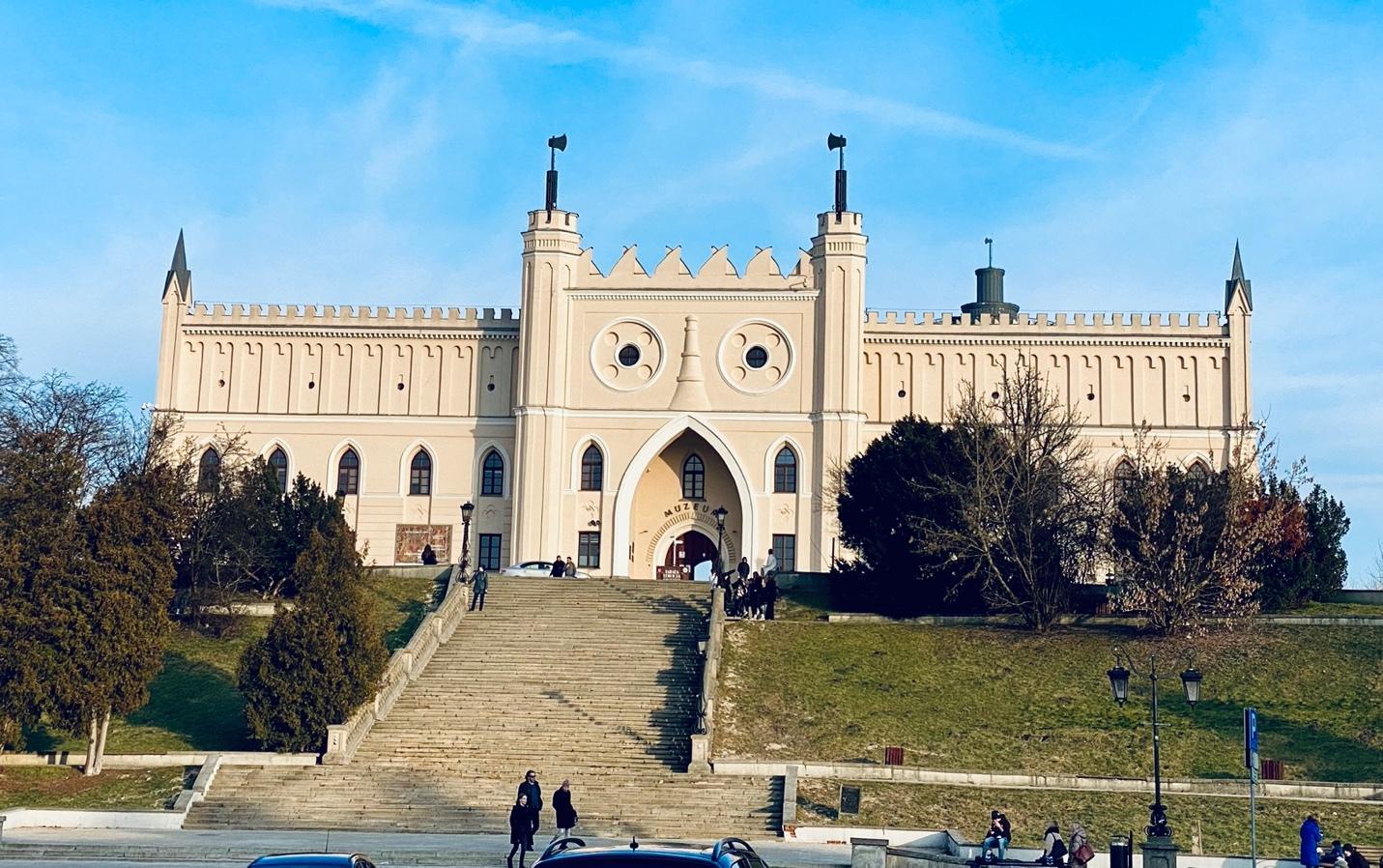
Castles older, bigger, on higher hills, climbing stepp rocks, resting in calm valleys, towering nice cities, guarding true capitals, or in the middle of black forests, or among sheep, or swarming with drones, secured by tourist traps, the ones with king inside or film crew or with the one who read this sitting in some vast hall, or climbing towers, hiding treasures, writing, fighting, cleaning, making a point or love or sleeping on ramparts under stars, yes, those happy stones warm from sun, castles! Castles here and there, especially in Europe, castles full of better stories and hungrier souls, true labyrinths and if only those walls could speak, but how to speak without mouth? Castles lack mouth and face. And it is strange lack for me.
The face is such an eye-catcher!
Defensive building could profit from little anthropomorphizing in so many ways!
Just yesterday, I met Voltaire in the enormous white cloud above Warsaw. And this castle I’m speaking about also has a face. So, it is a castle as good as a cloud, but a cloud in the shape of a philosopher, because, by having certain features (horns!), this castle is also a treatise on human nature. And on our important failure – the one of Enlightenment – the failure of modern. Short and witty brick text.
Castle telling joke – not smiling.
Sometimes it is hard to revive dead civilization using Western ideas and armies. Even a demigod from a wild island commanding millions of French in a creative way can fall short.
Napoleon failed to conquer Russia in 1812, and after the Congress of Vienna, even more of the Polish lands fell under the tsar. Hopes of resurrecting the Polish-Lithuanian Commonwealth were gone. Local thinkers and activists of the eighteenth century realized that there would be no independent state here. So, what is to be done? Something for society! The collapse of the Commonwealth happened because, after wars and political inertia, there was no functional society; wealth was not common. Millions were living in poverty. Few were well off. But then, at the beginning of a new era, tactually those magnates, whose liberties helped Russians, Austrians, and Prussians, were willing to consider doing something for the people. For example, a prison.
Ruins of old Lublin royal residence, towering the Jewish quarter still had a tower used for keeping of criminals, so it seemed natural to build on that place.
And now let’s describe the object of this review:
Lublin Castle is of three parts: first, mentioned above thick tower, donjon, almost one thousand years old.
Nearby stands a chapel, about half the tower’s age, with orthodox angels on its thin Gothic walls and sharp arches.
And there is now this prison, established after the Napoleonic wars in the Russian-dependent Kingdom of Poland.
All three parts were used as a prison, especially the cells under the tower.
Idea of the tower came from medieval France, where every don wanted to have a jon. Donjon, a basic stronghold for defense, gathering of loot, and resting. But here, such a Western tower meets an Eastern one. Just a few miles east of Lublin, there are eastern medieval towers.
As is written on a tourist sheet – here east kisses west!
Let’s consider Gothic chapel. Similar style buildings with orthodox frescoes can also be found on Cyprus, but still, this is a rarity. It was built by a king who tried to build lasting state for various cultures. So there was this Commonwealth, where catholic wore Turkic clothes and weapons, sometimes wooden ones, because there was possible to be pacifist or atheist in best days, those lucky few Poles, Lithuanians and Ruthenians were enjoying Magna Charta types of liberties and drinking with similar minded nobles of protestant and orthodox faith on a cost of peasants, who were forced to pump vodka after labor.
And to that, those eastern angels on sharp arches.
After the Commonwealth was destroyed from within and from without, next to the donjon and the chapel, there is now the prison, which used to consume criminals, revolutionaries, and patriots.
That is not strange, that Lublin has this building from precisely that time. Prisons were important in the thought of the Enlightenment. Panopticons on the one hand, ideas of resocialization on the other, compassion going against unusual and cruel punishment. People believed that there is a case to be made for progress and betterment of both collective and individual. Those ideas were still very much alive in the XIX century, despite reaction after downfall of Napoleon. It was in the air. Les Misérables were written in that spirit. And other tales of crime and punishment. Crowning of this literary tradition was The Gulag Archipelago, long text adored by famous theologians of XX century almost as new, post-enlightenment Bible.
There was case to be made that enlightenment itself blinded by reason. Rationalists were perfectly able to create prisons in old way, destructive and cruel. Maybe because they forgot original sin, maybe because they committed it by pride and lack of faith. Or maybe human nature is just that.
There are prisons everywhere for those with the eyes to see.
Although I am a theologian, I put Bukowski above Solzhenitsyn. This one dialogue about coconuts opening Tales of Ordinary Madness, where five year old girl talking with her father, a thug:
„why do you work nights?”
“it’s darker. people can’t see me.”
“why don’t you want people to see you?”
“because if they do I might get caught and put in jail.”
“what’s jail?”
“everything’s jail.”
“I’m not jail!”
Probably philosophers stating similar idea in long sentences didn’t discover entirely new world, they just express in their own way general annoyance that is felt by any human caught in any system.
As a student of Catholic University of Lublin, I was living inside walls designed by Stompf, the same architect that designed current form of Lublin castle. I was there because I was preparing for priesthood. My professors of theology and philosophy were painting the image of modernity and enlightenment very much with horns. It is easy to explain modern ideological schools as mutations of theological heresies, most famously it is done with communism described as secularized Judaism, while Nazism can be seen as analogue to some obscure protestant sect, etc. As I was young rebellious person, annoyed by modern world, I was listening. But of course, if even five-year-old girl can be seen as a prison, catholic church can be also.
DON’T JUDGE TOO HARSHLY THIS WORDY WORK OF MINE, BTW, THERE WAS a sheltie cat devoted to the destruction of this review by the power of unlimited love.
The proper form of such a review would be gaweda. Live talk. Especially now, in the merry merry month of May, it should be listened to by oak table, in a old manor or parish house or by river Bug, amid million shades of green, with tee or dereniowka in hand, and so on.
Such gaweda shouldn’t be fact-checked, but if by any chance it is and happens to be true, gawedziarz or storyteller would be parading around like a peacock until the end of days.
Let's check basic fact – does it have a face, this castle, or not? Is it there by chance or intentionally? Three dots are sometimes enough to make a face, but if there is also a nose, that cannot be a simple accident. Look at it. It is someone, for sure. The gate is the mouth. And there is a pair of windows, and even if their oculist nature is blurred somewhat by four dots inside of them, they are there as nothing but eyes. Nose, on the other hand, has no practical usage, so as a pure decorative form, it gives out the intentional nature of this mask on a castle’ entrance.
But real fun starts with horns.
My grandpa used to say that before being born, I was swimming in the middle of the Pacific.
By the same metrics, around 1820, when Jan Stompf for the first time drew this devil with horns in the form of an old Roman symbol of jurisdiction and justice – bundles of sticks with axes – there were still one and a half more century of swimming in the ocean for Benito Mussolini.
And those horns are what makes this building unusual. As there is almost no documentation, and no one in Polish nor English books is dwelling on that theme, what I am describing below is my own deduction.
In 1820s Stanisław Staszic, old enlightenment philosopher and Jan Stompf, young architect are cooperating. I heard a rumor that they even went to England to check on modern penitentiary architecture there. On the place of old Lublin castle, a prison is created, composed of new buildings and both chapel and tower. Style is neo-Gothic, a style alluding to medieval art, as it is clearly visible in sharp arch gate.
As there was a strong conviction in that age about using emotions to control the population, especially the uneducated one, giving this important building such appearance is understandable. From medieval art Stompf took the image of hell as the devil’s belly, the demon is devouring sinners. In Lublin, even more of a provincial town in the 1820s than now, that image was clear.
There is a hell above the city ready for those who sin.
AD 2025 numerous Lublin priests are painting the reality of the devil and hell with vivid colors, and there are exorcists, both regularized and amateur, and the whole catholic university guards the truth of spiritual evil.
Two centuries earlier, it had to be even more so.
Philosopher and architect are working together, and their work is approved by local Polish authorities loyal to the tsar. There is not a piece of newspaper or memoir about that fact, but face was probably easy to decipher for everyone involved. Of course, there is this old saying by some English-speaking eighteenth-century traveler in those parts, that true Slavic religions are atheism and nihilism, but no sceptic was blind to this suggestive moral put on the prison building façade. But what moral was it? Only “beware!”?
There is nothing better than dialogue between the old and the young. This one is from Maxim Gorky’ “Childhood”.
Gorky as young boy was almost killed by constant beatings from his grandfather. Still, he teased the old monster from time to time, reminding him, for example, about mistakes in words of prayers, and if grandpa was not in the mood for tortures, his response was just to question the boy:
Tell me: how many ranks of angels are there?
I answered and then I asked:
‘And what are civil servants?’
‘Want to know everything, don’t you?’ he said, smirking, lowering his eyes and chewing his lips. With reluctance he explained:
‘That’s nothing to do with God – civil servants are humans! A civil servant feeds on regulations, he eats them the whole time.’
‘What are regulations?’
‘Regulations? The same as habits,’ he answered more redily and cheerfully, his clever, piercing eyes twinkling. ‘People live together and make agreements between themselves. For example, they say: ‘This is better than anything else, so we’ll make it a custom, a regulation, a law!” it’s like when boys in the street have a game, and they decide on the rules, and how they are going to play. And what they agree on is the law!’
‘And civil servants?’
‘Troublemakers who come and break all the laws.’
‘That’s something you won’t understand,’ he said with a stern frown. Then he continued his sermon:
‘God stands above all earthly dealings! Men want one thing, and he want something else. Everything that’s human perishes. Gos has only to brethe and everything’s turned at once to ashes, dust.’
I had plenty of reasons for wanting to know all about civil servants, and persevered.
‘Uncle Yakov often sings:
“Bright angels are God’s servants,
But civil servants – serfs of the devil.”
Grandfather raised his beard with the palm of his hand, put it in his mouth and closed his eyes. His cheeks quivered, I could see he was laughting inside.
I’ll have to tie up your legs with Yashka’s and fling you both in the river. He’s no buissness singing such songs and you shouldn’t listen to them either. Those are heretical jokes, the work of dissenters and unbelievers’. After a moment’s reflection he looked at me piercingly and said softly, ‘ah, what s lot they are!’
Such a picture: Russian, or maybe Slavic, theology of liberation; serfs are of the devil. The state apparatus devours actual laws. Those who are carrying authorities have horns. I wonder if there were ones in nineteenth-century Lublin who, like this evil grandpa, put their own beard in their mouth while looking at the liktor’s fasces, an attribute of justice shown as the devil’s identification.
The case can be made, and a strong one, that the gradual collapse of the Commonwealth had its origin in this feeling that Polish nobles had – that every law is potentially leading to violence, and there is no way for the king to rule justly when he has power.
But then it may occur to some, that autocracy and anarchy are one coin.
Is it pessimistic? Sometimes it is for the better, something is reassuring in pessimism, it is a good foundation for novels. Nabokov had Gorky in low regard, and his work lacking, because he came out for him as an optimist.
Maybe, but in this fragment above, especially when one remembers relation between Gorky and Stalin, there is good dose of pessimism.
And perhaps that was also the case with Jan Stompf. Maybe Staszic and others wanted to scare the population, and maybe, maybe because there is little to no documentation, Stompf wanted to break balls.
The idea that this castle is a joke came late to me.
My first encounter with the castle was thirty years ago. I spotted its face, but there was no commentary about it from adults leading me into castle mouths. The museum, which is now there, I found interesting, yes. But in one room I was reminded about the anxiety I could read in the face of the castle: there was, in a glass cabinet, a skeleton.
Now, every time I read about people fighting for the burial of ancient human remains, I remember how shocked I was. Realization that no one asked that guy or gal if showing his or her bones is ok remains with me till now. Time is the enemy, I thought.
Not only is there general frost in the service of the Russian empire, but there is also, more importantly, general time in this cosmos that naturally breeds tsars and boys, flawed Russias and Polands alike.
But I could tell that this Face of the Real, of the prison built on the ruins, was looking silly. Even funny! One could laugh and one should, I thought. That’s the statutory obligation for youngsters, do not cry when a king stupid to the point of nakedness is walking through a dozing crowd, just laugh. If the atmospheric pressure and humidity are right, your laugh may spread like fire.
It didn’t spread. No one is, for example, advertising Lublin in such a way: visit our city to see prophecy about the lot of enlightenment in Europe! This is one of its kind architectural satire on the state of human institutions! Or, look how dumb our castle looks, for that matter. Several persons, for example, who are thinking about painting Lublin castle using the same colors that Munch used for The Scream, is non-zero.
Never failure of our civilization been more obvious, never horns of jurisdiction been scarier than under Hitler. It is crucial to give this context to the castle. It was encircled by the Jewish quarter, now totally gone. But I am unwilling to speak about that without mentioning better days.
While explaining Lublin, it is essential to mention Chełm.
More to the east, Chełm in the medieval age was Ruthenian, under Byzantine influence, while Lublin was catholic and Polish.
But a more basic difference is cosmological.
According to local Jewish tradition, God started his works with Chelm, or, in a secularized version, the Big Bang happened there. Telling such tall tales, about Chelmers capturing the Moon in a barrel or about the Big Bang happening on a certain street, there is a way of revealing something important about what happened after the real Big Bang.
I was told this theory by a certain physicist, and I think that it is good for his science to remember that, as it is good to know for every prison reformer about ax-shaped devil’s horns.
According to other Jewish traditions, the fulfilment of creation, the descent of heavenly Jerusalem, will happen in Lublin, in the reading room of rabbi Horovitz, the Seer of Lublin.
There is no secular version of the end of the days in Lublin, but I have met a thinker who made a certain prediction on this matter based on Putin's obsession with history.
But as for now, Lublin is the last piece of cosmos, where people tell old jokes about Chełm, sometimes forgetting that at the dawn of days, two or three centuries earlier, those were Jewish ones. There was a lady who was able to tell you such jokes in original splendid precious Lublin Yiddish, but COVID took her. Not one end, but many ends will happen here.
Fulfilment of the days shall happen next to the castle, as Horovitz's house used to be touching castle hill, although when he died in 1815, there were still a few more years to build the prison with the face.
Now time for the darkest of days.
During the years of the Lublin castle caricature of justice on its front was to the point, especially during the Second World War.
Epicenter of Nazi crimes was here. Odilo Globocnik is far less known than Eichmann, while done as much. There would be no Holocaust as it was without this Austrian Slovenian, who ruled Lublin as SS und Polizeiführer. Inventor of extermination camps, who gave the whole operation a distinctive mark of organized plunder.
There are such stories about him and his comrades that I prefer not to speak of.
Way of giving a hit at them is probably to mention that first Christmas night under German occupation, when Nazis make great bonfire with books of the greatest Talmud library in the world, in the front of opened just in the thirties great Yeshiwa school while Wehrmacht orchestra played stille nacht.
Globocnik killed himself shortly after being captured, who knows if not too quickly. His right hand, Ernst Lerch, was in prison for two years in total, and then opened a highly successful Tanzkaffe in Klagenfurt, immortalized as the first stage for the greatest stars of popular German and Austrian music, nicknamed “Treblinka Tanzkaffe” by one Austrian writer with good memory.
Mossad remembered Lerch too, but had not obtained the green light on him because Israeli authorities feared Europe’s reaction after Lerch's execution. And the left hand of Globocnik opened an antiquarian in Berlin after the war.
And so on, and so on. Lublin known no worse evil than those Nazis, even soviet terror after war pales in comparison.
I have written here about this castle as if it were important. It's not. There are bigger and older, with kings and so on. Lublin Castle is obscure. It is important for a little group of historians, and they hate every brick of it. They long for the original Renaissance version. Face or no face, they abhor this prison standing where a proper Polish castle used to stand. The Union of Lublin was signed in its halls. Polish princes were chasing otters beneath its walls. If the Jagiellonian dynasty managed to build in the fifteenth century an empire ruling the whole of central Europe, that castle may grow to be the most important in the world.
But it went all very differently. The Renaissance castle was destroyed during the wars. And then the whole state collapsed. There should be renovation, many are claiming. And maybe it’s not too late!
As for now, the castle divides Lublin citizens.
Those who find it important are mostly its haters. And there I am, who considers it a story, a short book, an absurd joke.
After ten years of being a priest, I left the church, I worked a little as a guide. Those were also beginning of full scale war in Ukraine, and in Lublin there were plenty of visitors: noble prize laureates, Yugoslavian admiral of US Navy, Berkeley professors, Estonian officers, polish noir writers, English pacifist preaching surrender in face of nuclear Armageddon, and this wonder boy from Charkiv, dreaming of joining his six brothers and a father fighting Russians while they prohibit him. And so many others. And in most cases, I judged this tale to strange to be told.
Or maybe there is something else going on?
Old Priests have those stories for the education of young ones. The story about the happiness of the dismissed visionary seems to be a fitting one.
Imagine you are sitting in the parish chancellery. Visionary is paying you a visit. She brought a notepad full of words of the Lord, who ordered her to write them and show you as the judiciary of the church. So you read and discover that while this is edifying to a degree, it is rather of low theological quality, maybe not as low as the letter of the Polish Conference of Bishops, but still.
So, next week, when the visionary is back, in soft words, you put in front of her the reality of this text being human rather than divine. And, to your surprise, she is happy and visibly liberated. No need for writing and prophesying, and so on, you think. This is the interpretation of the story about the dismissed visionary I was told.
But maybe there is more to her happiness? This revelation, that the Lord may have prepared for the whole of creation, is now hers only. It is her treasure. There is great charm in having one’s own story and in making it a mirror for the cosmos to see itself in it.
It appears that there are people who, though like Gwern in his famous piece against writing books, are sure it is worth it for you to work on a very long text. Sometimes it is better to design a prison gate.
Lublin Castle is a case when a guy with something to say rather than to write builds, makes a strong point in full light, his king is as naked as can be, and his garments, or rather his mask, are striking, especially if one takes history into account. There is thinking and emotion everywhere, not only in buildings. There is order, for example, across Europe when people are planting trees, lime tree for the commemoration of marriage, oak tree at the end of the pasture, to mark the end of domesticated space.
But my favorite such place, where ideas are visible, is a minute walk from Lublin Castle, in a small café.
A flock of green comfy chairs and a lot of books. On the same street, there used to live a Jew, who worked as a wandering rag collector, slowly and patiently building his rug empire, till he was able to buy a whole house next to the market square and fill it with books, which he exchanged sometimes with one canon from the local cathedral. Their libraries are no more, but books are reassembled on Rybna Street.
And the best case is when the Polish language is foreign to you.
Then you can just enjoy the smell of the paper and relax, and try to spot faces.