Mad Investors Chaos and The Woman of Asmodeus
A D&D game crossed with a Truman Show remake crossed with a math textbook crossed with a BDSM romance novel
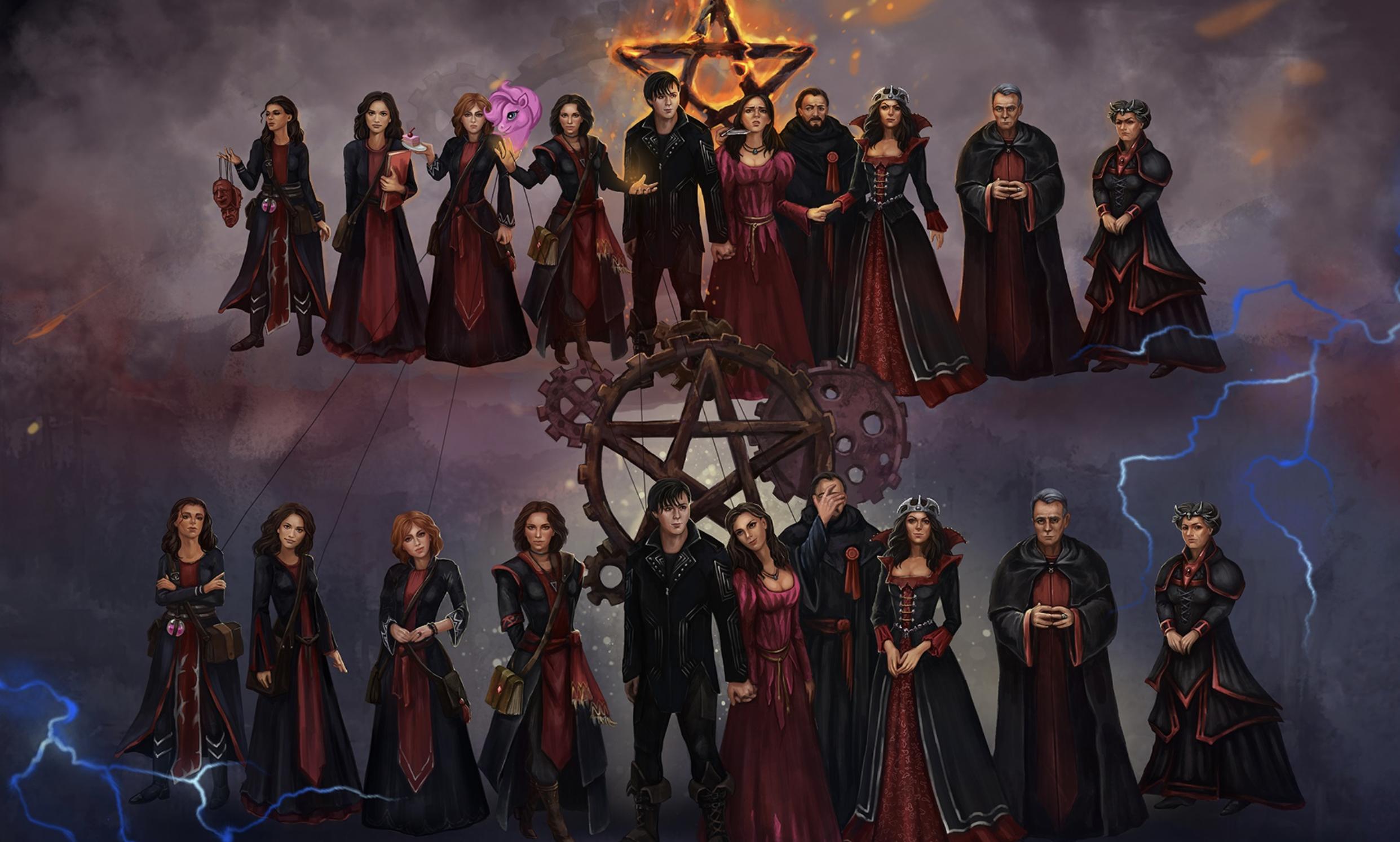
Image via projectlawful.com
Introduction:
About a decade ago, rationalist luminary Alicorn and some other people created a website called Glowfic, for the purpose of co-writing fiction. One thing led to another, and Eliezer Yudkowsky co-wrote a continuity (a series of stories) called Planecrash, of which the first story was named Mad Investor Chaos and the Woman of Asmodeus. This review covers the entire continuity[1] but I named it after the flagship story because it sounded cooler.
A bit over a decade ago, Yudkowsky first wrote about a world called Dath Ilan, a world from which he was the median citizen. This world has technology at around Earth’s level, but material conditions are far better, as dath ilan has overcome almost all coordination problems, through the use of, among other things, “decision theory,” a branch of math which allows those who understand it to mutually cooperate in prisoners’ dilemma like situations.
One day, in dath Ilan, an 18 year old guy, “Keltham” is in a plane, which crashes. He is isekaied (transported to another world), in this case a world called Golarion, the setting for the Pathfinder roleplaying game. For the past few years on Glowfic, this setting had appeared in many threads, where it had been significantly expanded and altered by the pseudonymous Lintamade, Yudkowsky’s co-author.[2]
Keltham finds himself in a snowy tundra, and runs into the only building he can see, where he meets a wizard by the name of Carissa Sevar.
Ok, but what actually is Planecrash anyway?
To put it another way, why is this not just a regular book review, barred by the rules of the competition? Planecrash, rather than being a book, is a series of “threads” or stories contained within a larger “continuity.” a thread can span anything from a few dozen to hundreds of thousands of words. Each thread is made up of individual “tags” or entries, which are written from a specific character POV by a specific author. Different characters are written by different authors (so Larwain writes all of Keltham’s tags, and Lintamande writes all of Carissa’s). Thus, the story is created collaboratively, as each character reacts to the surrounding environment and the actions of the other character. This is similar to a classic D&D game, where the dungeon master (DM) works with the players to create a story, where the characters and the world around them react to their actions. The form of the story is different enough from a book that I think it should not count for the purposes of this contest.
As for the story itself, defining it is simple. As mentioned above, It's a D&D game crossed with a Truman Show remake crossed with a math textbook crossed with a romance novel. Let’s take those in order.
Planecrash is a D&D game
So, to give some context…
Christ famously said that no man shall know the day or the hour of his return. Aroden, however, did exactly the opposite— this lawful neutral god of civilization and humanity had prophesied the exact date of his return to the world of Golarion, when he would establish his divine realm and usher in the Age of Glory.
But when the fateful day dawned, nothing happened.
Eventually, things did start to happen. It became rumored that he had, briefly, returned, and died in the attempt. His priests lost all their magic powers, a war among the gods broke out, and prophecy broke across the entire planet. The greatest empire on the continent, whose king had planned to abdicate in the god’s favor, completely fell apart, and then…
We will skip over a bunch of fantasy geopolitics, but things were pretty bleak. Imagine what would happen, in our world, if Christ had failed to return in such a way, and then Africa was largely submerged by a permanent hurricane and China completely fell apart into civil war and is now partially ruled by a giant kraken which just sort of showed up and a tear in the fabric of reality opened up in the capital city of Norway out of which limitless hordes of demons started streaming and no one knows what is happening in Australia because everyone who tries to leave the continent gets their memory wiped.[3]
All of this should give you the sense, key to the whole mood of our story, that the characters are living in a post apocalyptic world, one which was, a century ago, much more stable and richer and certainly more hopeful than the one in which they currently live. Nonetheless, Golarion has started to recover. Iomedae, the lawful good goddess of victory over evil, Aroden's former right hand, stepped up as "The Inheritor" to salvage his legacy. Her nation of Lastwall continues to hold the border against the worldwound (the aforementioned planar tear out of which limitless demons stream), while former imperial territories have become independent nations experiencing rapid technological and political advancement. Even the ancient land of Osirion saw its Pharaoh restored under the patronage of Abadar, the lawful neutral god of trade.
As for Cheliax itself, it had a different solution. After decades of civil war, it regained stability by pledging eternal allegiance to Asmodeus, lord of Hell and lawful evil god of tyranny
—————————————————————————————————————
At the time our story begins, these nations have reached an uneasy truce. The Worldwound remains a grave threat, with its demonic forces contained but not defeated. While most of its borders are defended by local governments, the remote northern frontier is maintained by Cheliax, whose infernal backing makes it the only nation wealthy enough to sustain outposts in that frozen wasteland. This is why no one is seriously challenging infernal rule over Cheliax.
Keltham is isekaied to the border of the worldwound held by Cheliax, where he meets Carissa Sevar, a Chelish military wizard. They talk for a while, and Carissa goes off to consult her superiors while Keltham meditates on his beliefs about the world, morality, and himself, after which he reaches out to the gods, to see if there is a god “like himself.” Abadar, lawful neutral god of trade, hears his prayers, and sees in Keltham something special— an understanding of the ways in which individual “selfish” agents, each working towards their own separate goals, can coordinate to build something greater than anything each could have done on their own. Abadar wants Keltham to teach his own nation of Orision about this vision, and so bargains with Asmodeus that Keltham will be allowed to leave Cheliax if he so wishes, and in the meantime not be tortured or mind controlled or otherwise ruined beyond usefulness. Asmodeus so instructs his priests, and Keltham and Carissa are teleported to Cheliax proper, to an archduke’s villa appropriated for the purpose.
The story is not set up quite like a traditional D&D game, and rarely do the authors, for instance, roll dice to determine outcomes of events, as is practically the backbone of normal D&D. Nevertheless, the story follows the standard D&D pattern, with Lintamande serving primarily as the DM, handling the world building (largely done by Keltham asking questions of Carissa, and then her answering, and then him having additional questions.) Keltham, meanwhile, is the player character.
As the story progresses, the nature of the first part of the game becomes apparent. Cheliax, because it has been commanded not to enslave Keltham, is reduced to lying to him about the nature of reality, particularly about what sort of country Cheliax is, what sort of god Asmodeus is, and, most important of all, what happens to those souls who Asmodeus claims at judgement and drags into Hell. The game is played between Keltham, as he seeks first to understand his new world, and ultimately to teach it knowledge out of civilization, and Cheliax, who seeks to extract as much scientific knowledge from him before he realizes the truth. Cheliax is playing for time here, because if Keltham teaches them enough technology out of dath ilan for them to conquer the world, who cares if he finds out the truth eventually. These efforts are led by Carissa for two reasons: first, she is the only one who understands Keltham well enough to believably lie to him, and second, a devil gives Cheliax mysterious instructions from Hell, implying Asmodeus himself has chosen Sevar in particular for some grand destiny.
But there's another player on the border. Nethys, the omniscient god of magic, has also taken notice of Keltham, and is making very strange interventions around him. Cheliax had presented Keltham with 11 teenage girls from a local wizard academy as a “welcoming present.” While they are initially intended to be nothing more than a harem for Keltham, he begins instructing them in the basis of dath ilani knowledge, starting with the principles of mathematical logic.[4] The importance of these girls, called the “project lawful girls,” increases when, within a day, two are empowered as oracles of two different gods— “Ione” is made an oracle of Nethys, while “Pilar” is made an oracle of Cayden Cailean, the chaotic good god of revelry. Normally, both would be executed, but Ione is able to, with some clever maneuvering, render herself irreplaceable to the project, while Pilar is loyal enough to Cheliax and to Asmodeus that her execution is considered unnecessary. Clearly, however, Nethys is playing at something big here[5]
A lot of really interesting stuff happens here (like the god of pain and loss getting sealed into a tiny box, and the queen of Cheliax getting convinced she is in a sex themed live action role-playing game “ero-larp,” with Keltham as the player, and two of the project girls briefly getting killed, one of whom gives us a first hand view of Hell) but we absolutely do not have time to talk about those now, because we need to talk about how…
Planecrash is a Truman Show remake
I have always had a certain frustration with The Truman Show.[6] On the one hand, the premise of a guy completely enveloped by a conspiracy which he needs to escape is clever and interesting, but on the other hand the execution of the idea is quite dismal. There are a thousand ways in which Truman would have seen through the premise, and a thousand more things which he could have tried, which would have immediately revealed to him the truth. On the other hand, the conspiracy to keep him in place is incredibly incompetent, and an actual conspiracy could have done way better. (I mean, seriously, they set him up on an artificial island with a fake sun and weather controlling machines! An actually competent conspiracy would have just found a random, perfectly real, island and stuck him there, and then not worried about faking weather at all.) On the other hand, no one to my knowledge has ever tried to make a better one.[7]
Until now, because Planecrash is the Truman show remake we never knew we needed.
As the D&D game continues to play out, it starts to turn into a new type of game. Keltham becomes oriented enough to his world that he starts to notice notes of disquiet in his surroundings. This is despite the hard work of Carissa and her lieutenant “Asmodia.” Asmodia is a project girl who, after a series of magical accidents, possesses a supernatural understanding of Bayes’s theorem, and is thus the only person with a hope of outthinking Keltham on his own ground. Meanwhile, he continues to teach his hosts knowledge out of dath ilan, some of which is merely technological in nature, but most of which consists of the ilani philosophy and mathematics. He focuses especially on the “lawful” mathematical underpinnings of thought, and even more particularly on the math behind “logical decision theory,” the study of how rational agents should make decisions in multiagent equilibria. The gods know and apply LDT, but they are forbidden by treaty from sharing it with mortals. But decision theory’s chance to drive the story will come later— for now, the story revolves around Bayes.
The game is simple in theory. In order to determine whether Cheliax is systematically misleading him about reality, Keltham needs to look for things which are more likely in worlds where Cheliax is lying to him than when it is not. For example, for most of the past three threads he has been confined to an isolated fortress, nominally for his security. There seem to be good reasons why this is the case. (Last time he went outside, the god of pain and loss appeared to try to kidnap him.) But, no matter how good the excuses are, this is still more likely in a world where there is a conspiracy, and thus weak Bayesian evidence for one. To get stronger evidence, one way or another, Keltham can run tests which a conspiracy would find it hard to fake. For instance, he demands a large number of books with weird characteristics, such that, in the ordinary world, they can just send a guy to a really big library, but any conspiracy rapidly creating fake books could not keep up.
To counter this, Carissa and Asmodia have to do a few things. First, they have to know Keltham sufficiently well that they can guess what tests he will run, and what updates he will make from them, so they can prepare against these. Second, they have to avoid any slip up, any accidental revelation of information which, if Keltham thinks about it too hard, will expose the conspiracy. Asmodia has a wall on which she tracks this, and if you forget what is on that wall and slip up, then there is a good chance Chelish security will magically remove your limbs and drag you to the wall, where Asmodia will explain in ALL CAPS just how many bits of evidence you leaked to Keltham.
I am really not doing it justice here, as full justice would involve me first explaining a bunch of math which the story has by this point extensively covered. But, if you're into conspiracies where everyone on each side is trying their hardest, there are no convenient lapses for the sake of the plot, and people actually know what they’re doing, you definitely will enjoy this subplot. Eventually, as Cheliax knew from pretty early on would inevitably happen, Keltham uncovers the truth and departs Cheliax in wrath, and the focus of the story moves onto different math.
Planecrash is a math textbook
There has been a wide variety of math in the first parts of the story, but most of it is foundational math. If you wanted an intuitive explanation of first order logic, or Shapley Values, or Bayesian versus Frequentist statistics, I do not think you will easily find explanations better than those on Keltham’s lectures. But as the story moves into its second great arc, the math becomes more concentrated. Keltham no longer delivers lectures “on-screen,” and the math we do see him discuss is increasingly concentrated around one subject: logical decision theory.
In fact, Keltham is much less on screen than ever before. In the thread, “The Woman of Irori” he only has a single tag. The focus is now on Carissa who, despite her ultimate failure to retain Keltham, is ennobled as a para-baroness and tasked with creating “keepers,” people trained in the art of rational thinking far beyond what even Keltham has yet achieved. But one night, she realizes the magnitude of her own folly in working for Hell, erases her memory of doing so after writing a mysterious letter to the grand high priestess of Asmodeus, sells her soul to an archdevil for large amounts of magic and, more importantly, the rights over certain souls in Hell’s keeping, and ultimately flees Cheliax to seek Keltham, there to aid him in whatever plan he has to counter Asmodeus.
She then runs into a bit of a problem. But, we’ll circle back to that. For now, let's discuss logical decision theory.
Let us suppose three agents, K, C, and P. And say that there are three possible states for reality to inhabit, 1, 2, and 3. Further suppose that each agent has the following preference orderings:
C: 1 > 2 > 3
K: 1 > 3 > 2
P: 2 > 1 > 3.
Which state will reality end up in.
This depends on our Collective Choice Rule (CCR)— the way we describe which preferences result in which state. At the beginning of our problem, we can say that P is a dictator[9], that is, reality ends up in whichever state P wants, in this case state 2. But now suppose we change the CCR such that, if either K or C or P would prefer the world be in state 3 to its current state, then reality ends up in that state. Otherwise, we stick with whatever P chooses. Now, P would choose to be in state 2, K (but not C) would prefer state 3 to state 2, so we end up in state 3. Now, you will notice that moving from state 3 to state 1 would be a Pareto improvement, that is, everyone is happier with state 1 than state 3, but there isn’t a clear way to get from state 3 to state 1.[10]
If this does not make sense, let's swap out the variables with names. K is Keltham, C is Carissa, and P is Pharasma, goddess of birth and death, mother of the gods, and creator and sustainer of the multiverse. It is her preferences which made creation what it is, which have allowed Hell to endure. Why does Pharasma want creation the way it is? Who knows. The point is she does.
Ultimately, if he wishes to overthrow Asmodeus (of course he wants to overthrow Asmodeus and end Hell! Even putting aside how Asmodeus has treated him personally, it is the obvious thing to do) Keltham does not have a lot of options. With Pharasma’s backing, he probably could fix things, but she would seem unwilling to give it.
On the other hand, Keltham knows enough science that, with divine powers, he could completely destroy creation, thereby freeing the souls in Hell from their torment at the cost of destroying them, and everyone else, entirely. The suffering in Hell is great enough that he would honestly prefer destroying creation to seeing it continue in this state. Carissa, to put it mildly, disagrees.
So the preference orderings come out like this:
Carissa prefers the world improved to the world as it is to the world destroyed.
Keltham preferred the world improved to the world destroyed to the world as it is
Pharasma prefers the world as it is to the world improved to the world destroyed.
There seems like an obvious solution here. All three prefer the world being improved to the world being destroyed. So Keltham can just explain that, if her creation is not improved he will just destroy it, and Pharasma will agree instead to improve it. Simple, right? The problem from Pharasma’s perspective is that, if she automatically yielded to threats like these, agents with utility functions like Carissa, who would otherwise not wish to destroy the world, could attempt to “blackmail” Pharasma, saying they intended to destroy the world unless Pharasma did what they wanted. While it would be true that Pharasma doing what they wanted would consist of a Pareto improvement over destroying the world, if she refused to accept such compromises then agents like Carissa would have no incentive to destroy the world, as would be worse by their own values. Thus, in order to do as best as she possibly can, Pharasma needs to give in when an agent with Keltham’s preference ordering threatens to destroy the world, but not Carissa’s.[11]
Thus, in order to save creation, Keltham must set out to destroy it, without holding out any hope it can be saved. Carissa, who would rather creation not be destroyed, thus cannot be allowed to ascend with Keltham unless he can sufficiently trust her not to interfere with his efforts, even if she cannot help them.
The plan comes to this: Keltham will ascend to godhood and seek to bring Pharasma to terms or, if he cannot, destroy creation. Things will go much better if Carissa ascends as well, but Keltham must be sure that Carissa will not betray him, will not, in seeking to preserve creation, turn on him after he loses her hold over her. The solution to these types of problems was theoretically demonstrated early in the story, as to how agents could come to trust each other under this type of situation, but the actual resolution comes in the thread “The meeting of their minds”, the climatic thread of the story.
But to understand the full meaning of this resolution, we must discuss the final meaning of Planecrash.
Planecrash is a love story
Specifically, it is the tragedy of Keltham and Carissa’s love affair.
Their love started on their first date, less than 24 hours after Keltham came to Golarion. All throughout the early days of the project, before the unmasking of the conspiracy, they fell deeper and deeper in love. Carissa learned from Keltham that love was not the worthless and pathetic feeling Cheliax had taught her it was, and Keltham learned from Carissa to explore his desires as a dominant, to derive sexual and romantic pleasure from his ownership of Carissa. (Yes, getting him into BDSM started as a plot to trick him into doing evil acts and thereby damning himself, but the feelings which formed between them were real nonetheless.) They get deeper and deeper into their relationship; sexually, but also romantically and emotionally. [11]
When Keltham learns of Carissa’s betrayal of him, the experience breaks him. Carissa does what she can to heal him, most importantly by ensuring that all of the project girls who had already ended up in Hell were not broken beyond repair. Despite her horror at the risk he is taking with her world, she agrees to offer him her allegiance, and will, as far as the decision theory will allow, aid him in his plan.
While they never again, as mortals, renew their former passion, they do come, in the end, to love and trust each other once more. When this is done, they use decision theory to solve the rest of their problems, become ridiculously powerful, and… well, if you want to know how that goes you’ll just have to read the epilogue.
My verdict on Planecrash.
Since I have considered Planecrash as four interlocking stories, I will start by judging each story in turn.
As a D&D game, Planecrash works. We start with a powerless and disoriented protagonist, who by the end is arguably the most powerful thing in the universe. The world is believable and interesting, and the various arcs, most notably Nethys’s background interventions, are very well executed. The world and its magic is unfolded as a coherent whole, and both authors work hard, and take great care to construct a coherent and believable setting. When the adventure path switches to Carissa’s POV, we get a lot of great moments as well.[12] Ultimately, the D&D game is a mere frame story, but it serves its job admirably in that role.
My main bone to pick here has to do with the idiosyncrasies of writing on Glowfic. The world of possibilities opened by having a setup where a work can be co-authored in such a way that individual, interlocking, pieces are attributable to individual authors is only beginning to be explored. While things start out strong in this regard, this advantage is less and less salient as the story continues, as Lintamande is increasingly sidelined near the end of the story. This is especially unfortunate because Larwain/Yudkowsky’s strengths as a writer, worldbuilding, complex and interesting plots, and characters with interesting thoughts or who are capable of perspective taking literally at all, already came through quite strongly at the beginning, but his weaknesses, writing believable dialogue such that his characters don’t all sound alike, becomes more pronounced as he writes more and more of the words on the page. [13] [14]
Lintamande, as do all writers, has her own idiosyncrasies of writing [15] but the strength of Glowfic style writing over books is that the strengths of one writer can complement the strengths of another and cover the weaknesses of another. When Planecrash devolves into a solothread (the technical term) it is still good, but I feel like something has been lost.
The Truman Show remake was, if not the best subplot, at least the most flawlessly executed one. It provides interesting depth for the story, and lets us see the math which the readers and characters have just learned applied to solving interesting problems. It is certainly possible to nitpick the execution, to argue that one trick or another should not have worked for Keltham or the conspiracy, or some random comment should have been a giveaway, or whatever, but such errors are ambiguous or obscure enough they don’t really ruin the story.
The only thing I would say here is that, after the story pivots to its second arc, the conspiracy theme is allowed to lapse. I agree the plot would make it difficult to extend this theme, and we do see conspiracy reasoning done, by design, more competently than it was by the Chelish conspiracy (like Keltham against Ri-Dul or Carissa against Cheliax) but this subplot is ultimately is allowed to fall by the wayside. I am not sure how this could be fixed, I am merely noting it for completeness.
On the math textbook aspect of the story, I think the question of whether it succeeds depends on to what extent you accept Yudkowsky’s views on logical decision theory, and to a lesser extent Bayesian versus Frequentist statistics. I am not really qualified to comment on the state of the academic debate here, but, as a layman with an interest in this field, I find his interpretation plausible enough, and am convinced by it. Certainly, LDT is not a panacea for the reasons I explain at length in the footnotes, but I do think it is useful and cogent.
There are many other philosophical ideas advanced in the continuity, with explanations and defenses of, among other things, utilitarianism, altruism, Yudkowsky’s own views of the proper ordering of government and markets, the benefits of using prediction markets, and Yudkowsky’s views on rationality and cognition more generally. I focused on the decision theory because it was the most important, but for the rest, the most I can say is, “I appreciate the new set of ideas, I will use them alongside all my existing ideas and not follow them off any cliffs.”
Finally, we shall pass judgement on Planecrash as a romance novel. I don’t actually read enough romance novels to have much to say here. I enjoyed the love story, and the interplay between Keltham and Carissa, and think it was reasonably well done. I don’t think their romance is one which will echo through the ages or anything, but so it goes.
There is also the question of the ending. Throughout this review I have treated “the meeting of their minds” as the climax of the story, and the final two threads as the epilogue. This is because the style after “the meaning of their minds” changes, going from a cohesive narrative to more of a mere summary, of the style: “and then this happened, and then this happened, and let's skip over a bunch of stuff and get to the end.” This part is not as fun to read, but I am willing to forgive the writers for it, because I don’t know that they had much choice. Sometimes, an author will bite off more than they can chew, and this leaves them with a few options: they can spend the rest of their life trying to salvage their creation and make it a cohesive story (like Tolkien tried to do, though he didn’t quite make it, and his son had to finish the job) they can just give up, like Geroge R. R, Martin did with Game of Thrones, or they can just brazen their way to an ending, keeping the core themes intact, and let everything else go. This is what the writers did here, and, given how complex Planecrash had become by this time we reached this point, and how hard it would have been to give every theme a satisfying conclusion, just dropping everything except the core story and finishing that was probably the best option.
Ultimately, I don’t know how much the average person would enjoy Planecrash. The medium of Glowfic, because of its clear visuals and delineations, makes the story more approachable than it would be if it were a book, but the length, the math, the obscure references, the sex, and the philosophy all reduce the extent to which it is approachable. However, if you have made it this far into the review, I think you should at least give it a try. As you can hopefully tell, I loved this work, and I think some of you will too. You will find yourself in love with all the characters I didn't even get to introduce: the warmth of Snack Services, the courage of Peranza, the glory of Iomedae, the absolutely adorable ambition of Meritxell (the most underutilized of all characters in the story) and, of course, the absolute train wreck of a character, Her Infernal Majestrix Aborgail II of Cheliax, who is incredibly pissed that I gave her no screen time in this review.
If this is your type of story, you will fall in love with it, and maybe you will still learn a little math along the way.
Footnotes
- ↩
Sort of, different continuities tend to bleed over into each other, and this review largely ignores the omakes, which are technically within the continuity
- ↩
It's worth noting Yudkowsky wrote this under the handle “Larwain.” I don’t think that Lintamande’s identity is publicly known.
- ↩
That last thing appears to be a pre-existing problem, actually.
- ↩
He does eventually have sex with several of them later in the story.
- ↩
Nethys refuses to explain to an increasingly frustrated conclave of gods what exactly he is doing here, but he does admit Cayden is acting on his advice.
- ↩
A classic movie which you should watch, or at least read the plot summary of, so you get the pop cultural references to it.
- ↩
Larwain, if you are reading this review, can I suggest you write a Truman show fanfic where Asmodia is isekaied to the Truman show set, and has to save the show from disaster. Also, I think Elias Abraco should come with her, so that she can order the ENTIRE CREW OF THE SHOW TO BE TORTURED UNTIL THEY STOP BEING INCOMPETENT ONE WAY OR THE OTHER [8]
- ↩
one of the most stylistically salient things about Planecrash is its frequent use of all caps, which are particularly overused when writing Asmodia’s character.
- ↩
In the sense in which that term is used in Arrow's impossibility theorem.
- ↩
There are a series of closely related impossibility results, of which Arrow’s is the most famous, which show that problems like this are, given certain assumptions, impossible to resolve in a way which satisfies certain conditions. Logical decision theory does not disprove these theorems. Note that the CCR generated by Yudkowsky’s solutions violates Independence of Irrelevant Alternatives. For that requirement to be fulfilled, Keltham’s rankings of “world destroyed” and “world preserved” should not matter in a pairwise competition between “world improved” and “world preserved.” But yet his rankings between these two outcomes, and the fact that Carissa has the reversed rankings, is why Keltham has the leverage to force Pharasma to the bargaining table, with an ultimate result of improving the world, and Carissa does not. The fact that the “effective CCR” here violates Independence of Irrelevant alternatives may not actually be so bad, but it does mean that there is a lot of kvetching about “strategic self modification of utility functions” and such, which is what happens when your CCR violates independence of Irrelevant alternatives. Still, if you are willing to put in the work, this beats the uncoordinated way of doing things, where Keltham destroys the world leading to an outcome not on the Pareto frontier. I don’t know if Yudkowsky would put it this way, but he generally seems to prefer switching from decision theoretical perspectives which violate P to those which violate I.
- ↩
All the threads are written such that the explicit scenes are in their own mini threads, with plot summaries available for those who want to read the story but have moral or aesthetic aversions to explicit sex scenes in their reading)
- ↩
IMO Carissa’s descent into Hell to sell her soul and save the souls of Keltham’s lost project girls is one of the best parts of the story.
- ↩
Lintamande arguably also has this problem, but certainly it is less pronounced in her case.
- ↩
I don’t want to be a jerk and nitpick Yudkowsky’s style but, if I had the gesture at what annoys me in his writing of dialogue, the way I would put this is that his characters, whatever their other characterization may be, will often dramatically express their frustration and annoyance in a way which would be humorous if done once or twice, but becomes annoying if it becomes an entirely character. As an example, consider the whining by this senior devil, whose entire characterization suggests she is far too proud to do anything of the sort, with the whining of Draco in the last part of that chapter of one of his other works. Those are not the clearest examples, but they are the best ones I have to hand. But again, this is just me nitpicking, and I believe his strengths as a writer far outweigh this.
- ↩
If I had to describe the most prominent of her writing idiosyncrasies, I would say— people often, when talking, will pause to collect their thoughts, or to otherwise express them, right, and this leads to a spoken pause which is not normally delineated by any sort of punctuation. But when Lintamande writes a character saying something emotional, there is like a 50% chance it will follow the pattern of “states that they’re about to say/think the thing; [dramatic pause emphasized by punctuation or a paragraph break]; a very long paragraph navel gazing about the thing.” Your taste will vary, but I find this rather charming, though I would probably cease to do so if it became more common among writers.