What is a “cult,” exactly? What does it mean for a group of people to be a cult?
Usually when we talk about a cult, we're talking about a group of people who were deliberately indoctrinated into a shared group identity. Cults are typically based on ideas, and the group identity formation happens when people have their pre-cult identities broken down, and a new identity formed based on the idea. This idea-based identity supplants other, more shallow forms of identity, like race, ethnicity, and socioeconomic status, so often a cult will include members who were originally from very different walks of life, but who bonded together over their shared commitment to the idea.
Typically, the cult has a hierarchical structure with leaders and more experienced members who convince newer members of the cult’s ideas, and intentionally make the group identity formation happen. Sometimes the cult leaders are playing a trick, but often they’re true believers who’ve bought into the idea themselves.
Another important quality of cults is that they’re always bad. You never hear about a good cult. The members have always been duped into believing something wrong_._ The idea that they’re bonding over is always something crazy and obviously false, like that they need to commit suicide so that they can be taken to heaven by aliens. It’s automatically understood that referring to a group as a cult is an insult, since the term implies all these negative aspects.
Is there a word that means something similar to “cult,” except without the implied negative aspects? I can’t think of one. I mean, what would you call a group that practices deliberate group identity formation around an idea, where the idea is not something wrong or crazy? It seems at least theoretically possible that the identity-formation practices used by cults could also be used with an idea that is morally neutral or good. At the very least, it seems like it would be interesting to study the topic of deliberate group identity formation from a morally neutral standpoint, simply to understand it as a phenomenon.
Making the Corps by Thomas E. Ricks presents an interesting case study of this. The book is about the US Marine Corps basic training program (known colloquially as “boot camp”), where civilian recruits undergo a process of transformation and deliberate group identity formation to become Marines.
This isn’t a pop-psychology book about group identity. Rather, it’s mostly an object-level account of the experiences of a group of recruits going through boot camp, including semi-biographical narratives about several of the recruits. The goal of this book review is to flesh out these ideas about indoctrination (a word the military uses unironically and without negative connotation) and deliberate group identity formation, building on the author’s descriptive account of what he witnessed at Marine boot camp.
This review isn’t a comprehensive summary of the book. Plenty of parts are left out, including interesting social commentary and analysis of the military’s role in society, as well as the author’s predictions about the future. Since the book was published in 1997, these analyses and predictions read like something out of a pre-9/11 time capsule – almost entirely wrong, but an interesting alternative history that perhaps could’ve been, if the 1990s “End of History” era had continued into the new millennium. Anyway, this review leaves those parts out, and I encourage you to read the book for yourself to get to them. But we’re going to focus specifically on the parts related to identity formation.
I’m also going to write a bit about my own experience going through military boot camp. Since this is supposed to be anonymous and I don’t want to dox myself, I’ll just say that after college I felt the patriotic calling and wanted to put in some military service, but am somewhat of a pacifist and didn’t want to be involved in fighting in wars and killing people. So I enlisted in another branch of the military (not the Marines) for a job specialty that was not related to combat or fighting, but still involved going through a boot camp training course that was very similar to Marine training, although not quite as tough[1]. So I’m going to try to include some things that the book misses – things that can only be noticed from the recruit’s perspective.
The overall goal of this review is to study how a person’s sense of individual identity can be deliberately broken down and replaced with a sense of group identity. Again, we will discuss this not as something good or bad, but simply as a phenomenon, using Marine Corps boot camp as a case study.
Who are the Marines?
The author begins the book with some stories from Somalia, where he was embedded with a Marine unit as a journalist in 1992, during chaotic famine-relief operations that often involved violent contact with various warlords and their militias. Although this is just the prologue to the book, I think it’s pretty important, since this is when the author describes how he came to write the book – how he noticed that there was something about the Marines worth writing about. He tells several anecdotes that sparked his curiosity, including the following:
“As we walked in single file, with red and green tracer fire arcing across the black sky
over the city, I realized that I had placed my life in the hands of the young corporal
leading the patrol, a twenty-two-year-old Marine. In my office back in Washington, we
wouldn’t let a twenty-two-year-old run the copying machine without adult supervision.
Here, after just two days on the ground in Africa, the corporal was leading his squad into
unknown territory, with a confidence that was contagious.
The next morning I walked to the Mogadishu airport along a hot road ankle deep in fine
dust with another returning patrol from Alpha Company, led by Cpl. Armando Cordova, a
precise-seeming man with a small mustache and wire-rimmed glasses. A native of
Puerto Rico who was raised in the Bronx, he once left the Marines and then, after ten
months back in New York City, reenlisted. ‘You don’t make friends in the world like you
do here,’ he explained, his M-16 slung horizontally across his chest. ‘We are like family.
We eat together, sleep together, patrol together.’”
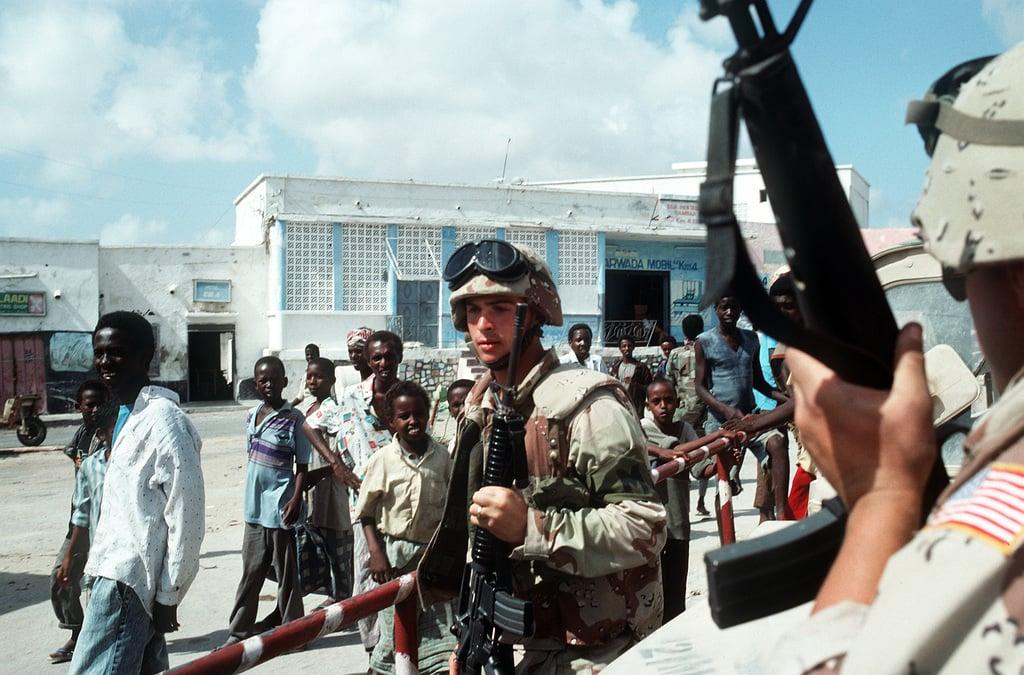
Marine in Somalia during Operation Restore Hope, 1993. Image source
So, who are the Marines? The Marine Corps was originally founded in 1775 as an amphibious naval[2] infantry force during the Revolutionary War – basically their job was to ride along on Navy ships and disembark to attack targets on land when needed. They were briefly disbanded after the Revolutionary War, and then re-established in 1798 to deal with maritime threats the US was facing at the time from French privateers. Throughout the 1800s and early 1900s, the Marines were used as an expeditionary force in several small conflicts, including the Barbary Wars, Boxer Rebellion, and the Banana Wars, while also playing a small role in larger conflicts like the Civil War and World War I.
The first time the Marines played a large role in a large conflict was World War II. This is because most of the fighting in the Pacific Theater involved amphibious assaults on Japanese-held islands, which fit the role of the Marines perfectly. Many of these battles still play a role in Marine history and lore, including Guadalcanal, Okinawa, and (especially) Iwo Jima. Post-WW2, the Marines have taken on a similar role to the Army, involving mostly-land-based fighting in Korea, Vietnam, Iraq, and Afghanistan.
So there’s a quick two-paragraph history of the Marines. But again, the book isn’t about military history. It also isn’t about US foreign policy or the ethics of military service – it’s neither a Noam-Chomsky-esque screed about the evils of the American Empire, nor a jingoistic military-worshiping endorsement. Rather, it’s an object-level, morally neutral account of the phenomenon in which civilians are transformed into Marines during boot camp – a three-month course that includes physical conditioning, some basic weapons and combat training, and (most importantly) cultural and psychological indoctrination into the Marine Corps’ core values and identity.
The Marines have two boot camp locations: one at Parris Island, South Carolina for recruits from the eastern part of the country, and another in San Diego for recruits from the western part. The book takes place at Parris Island and follows Platoon 3086, a group of recruits who went through basic training in 1995.
The author provides a demographic overview of this group: entirely men (basic training in the Marines is gender-segregated), about 75% white and 25% black and Hispanic[3], age 17-29. He describes their backgrounds as:
“Among them are an accountant fired by Ernst & Young because he flunked his CPA
exam; a self-professed gang member from Washington, DC; the son of a Merrill Lynch
bond trader; a Dutch-American who considers himself a pacifist; a former white-supremacist skinhead from Mobile, Alabama; a dozen former employees of Taco Bell and other fast food joints; and a handful of one-time workers at small, off-the-books construction firms. [...] They have come here from Shubuta, Mississippi, from Bayonne, New Jersey, from Destin, Florida, from Pittsburg, Pennsylvania, and from forty other small towns and crumbling eastern cities to pursue one of the few rites of passage left in America.”
Something I found interesting, both in the book and in my own boot camp experience, is that the military is very diverse, but in a different way than other diverse organizations. Before joining the military, I went to college at a major research university and then briefly worked at a tech company. Both were diverse in a way that reflected the global population, and I got to know people from all over the world – China, India, Europe, Africa, the Middle East, and more. But the military is diverse in a way that closely reflects American society. Boot camp was the first time that I really got to know any southerners (both white and black), Mormons, Protestants[4], Appalachian people (who are overrepresented in the military), Cajuns, Puerto Ricans, Mexican-Americans, and Native Americans. The kind of diversity you see at major universities and tech companies doesn’t always include those people.
The author notes that he’s particularly interested in this kind of diversity, as it presents the Marine Corps with quite a difficult challenge and makes the successful result at the end even more impressive. He writes:
“I wanted to see how an organization could take fifty or so American kids – a group
steeped in a culture of individualism and consumerism, many of them users of
recreational drugs, few of them with much education or hope of prospering in the
American economy – and turn them into Marines who saw themselves as a band of
brothers, overcoming deep differences of race and class.”
So, how is this accomplished? The following sections will cover several aspects of the transformation that occurs at Parris Island, in which individual identities are broken down and a new Marine identity is created.
Separateness
A key element in the process of identity formation is the removal of recruits from the outside world for the duration of boot camp training (about three months). For many of the recruits, this is their first time away from home and away from their family. A Navy Chaplain stationed at Parris Island was refreshingly blunt about the boot camp environment in an interview with the author:
“Everything is taken away – hair, clothes, food, and friends. It’s a total cutoff from
previous life.”
Part of this is the physical separateness: Parris Island is, of course, an island that is physically separated from the rest of society by water and can only be accessed via a single bridge. When recruits cross over that bridge to arrive at boot camp, they’re entering a strange, new world. The author describes this as such:
“In reality, the bright lights and yacht-set bistros of antebellum Beaufort, South Carolina,
are just a few miles from the Marine camp. But to the recruits, the 7,000 flat, wet acres of
sand that make up Parris Island might as well be a thousand miles out in the Atlantic
Ocean.”
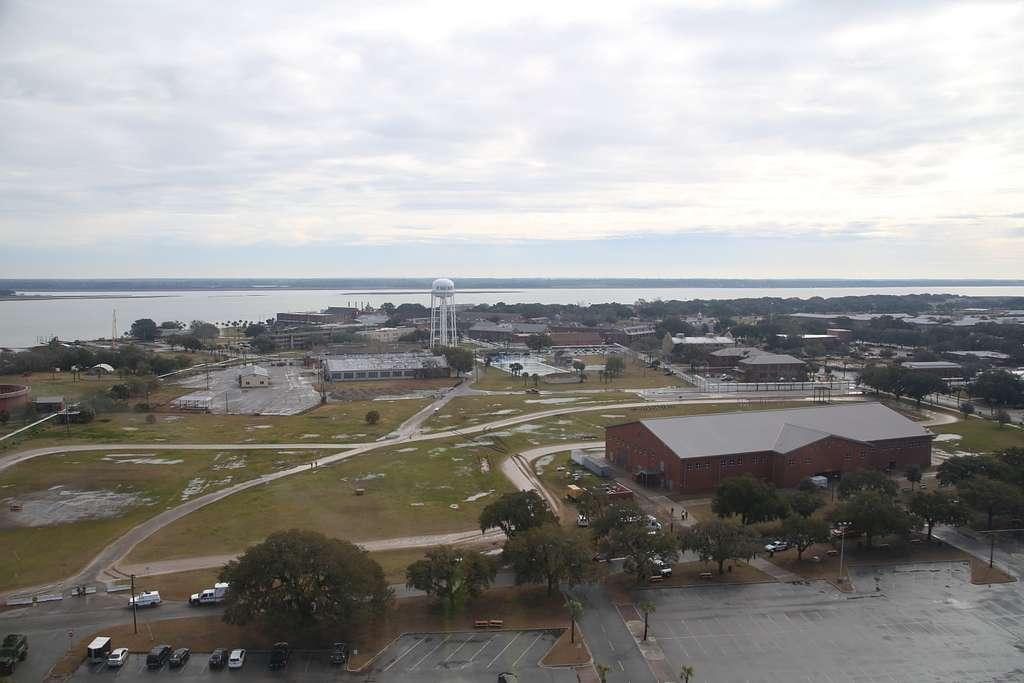
Parris Island, South Carolina. Image source
Besides the physical separateness of Parris Island, there’s also the informational separateness. Recruits have no contact with the outside world, other than periodically writing and receiving letters from friends and family. But no phone calls, no visits, no watching the news or reading the newspaper (and these days, no internet).
The book takes place in 1995, before everyone had smartphones, but having attended boot camp myself in 2017 I can report that the information cutoff feels like even more of a shock. Like everyone nowadays, I was used to having constant, instantaneous access to all of the world’s information through my phone, and instant communication with my family and friends, all the time. Once you get used to this, having it removed feels very strange.
At the beginning of this review we talked a bit about cults. Getting back to that analogy, it’s easy to see some similarity here. A key part of cult indoctrination typically involves cutting members off from their previous lives, both in terms of physical location (often some kind of remote compound) and by limiting communication with friends and family.
Disorientation
One of the most striking things I remember about boot camp is how utterly different it feels from normal life. It’s hard to explain, and it’s hard to even remember the exact feeling. But I remember thinking that it feels like a strange, dystopian nightmare – a different reality from the outside world.
Rather than being gradually eased into this new reality, recruits are thrown in headfirst, in a deliberate attempt to disorient them and induce culture shock. It begins when, immediately upon arrival, a drill instructor steps on the bus and starts yelling at the recruits to get off and line up on a set of yellow footprints. The author writes:
“The footprints, four to a row, eighteen rows, are so closely packed that the
newcomers can’t be seen as individuals. Standing nearly heel to toe in the dark night their faces are hardly visible, and their bodies become one mass. The effect is intentional: Marine Corps culture is the culture of the group, made up of members who are anonymous.”
This is the first of many aspects of boot camp that either explicitly or implicitly emphasize group identity over individual identity. The drill instructor then (very loudly) briefs them on some of many rules they’ll be expected to follow: how to stand at attention and how to respond to questions and orders (“Sir, yes, sir!”).
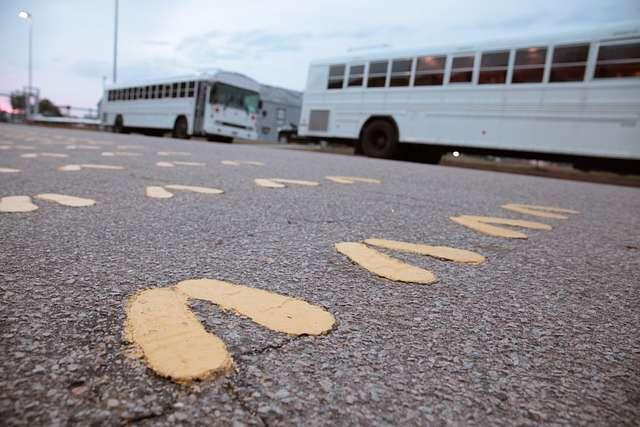
The infamous yellow footprints at Parris Island. Image source
The recruits are immediately introduced to several strange things about this new environment. One is the volume. Recruits are required to yell everything at the top of their lungs, as loud as they can. This is called “sounding off”, and it will continue for the duration of boot camp, pretty much all the time (except when the recruits are in a classroom, medical clinic, etc). And typically, their loudest isn’t loud enough to satisfy the drill instructors. This is actually pretty physically and mentally strenuous to do all the time, and many recruits end up losing their voices after a couple weeks of it.
Another strange thing about the boot camp environment is the altered sense of time. The author writes:
“Sergeant Lewis’s second move is to emphasize that no matter what they are doing, they
are not doing it fast enough. He moves them in a single file line toward the barber’s stand in the back of the receiving station. ‘Let’s go. Hurry up. Hurry. Tighter.”
This will be a constant theme for the next three months. Practically everything the recruits do will be in a hurry (even things like showering, shaving, and getting dressed), and will often be explicitly timed with a punishment if the time limit is not met. For example:
“Sergeant Lewis gives them twenty seconds to remove and hang up all their gear – hats,
canteens, canteen web belts. The more astute members realize that the only way to do it within that limit is to aid one another.”
This feeling of constantly being rushed has the effect of locking you into the present. Whatever you’re trying to do, you’re doing it as fast as you can, and it still probably isn’t fast enough.
Another strange thing about boot camp that the recruits are introduced to immediately is the language. The author writes:
“As if to underscore that they have entered a new world, Staff Sergeant Biehl begins to
teach them a new language. Its peculiarly nautical tones grows out of the Marines’
origins as a sea service. ‘We don’t call it a floor, we call it a deck,’ he lectures, striding
purposely back and forth at the front of the desks. ‘We don’t call it a door, we call it a
hatch.’ For no apparent reason relating to the sea, writing pens are now to be called
inksticks and sneakers are go-fasters.”
These are just a few examples of the new vocabulary and there are many more. But perhaps the most notable linguistic change is that the first person pronouns “I” and “me” are forbidden, and recruits are required to refer to themselves in the third person as “this recruit.” This is another not-so-subtle effort to erode the recruits’ sense of individual identity and encourage them to think of themselves as members of a group.
Learning this new language in such a high-pressure atmosphere is difficult. The author describes a conversation in which a recruit is asking permission to use the bathroom (which is called the “head”):
“‘I need to…’
‘No.’
‘Sir, I need to…’
‘No.’
‘Sir, can I go to…’
‘No.’
Finally, after four more tries, he puts it all together, dropping the first person and
including a ‘sir’: ‘Recruit Prish requests permission to make a head call, sir.’”
And although it’s not conveyed in the quote, it’s likely that this recruit was shouting at the top of his lungs during this exchange.
After being thrown into this loud, chaotic new environment, recruits are then kept awake all night and throughout the next day to undergo a series of administrative in-processing steps: haircuts, gear and uniform issue, paperwork – all done loudly and urgently. The sleep deprivation is the icing on the disorientation cake. From the time they woke up the previous day to report to their recruiting station to the time they first go to sleep on Parris Island, the recruits will be awake for about 36 hours total.
In interviews with the author, the drill instructors and officers at Parris Island are refreshingly honest about the process of disorientation. One says:
“From the recruit’s perspective, it appears to be chaos_. [...] The recruits aren’t the_
enemy–don’t get me wrong. The enemy is their values – their un-Marinelike values.
Self-indulgence, me first, ‘I’m-going-to-do-what-I-want-to-do.’”
Normally if you ask a cult leader about this kind of thing, they deny it: “What?! Use disorientation to break down the members' sense of individual identity?! Of course not, that’s ridiculous!” But the Marines own it. This is a straightforward goal that they pursue, not an accusation of something negative. The sense of personal identity, along with any selfishness and individualism, must be broken down so that the Marine group identity can be built up in its place.
Extreme Difficulty and Antagonism
Besides the disorientation and differentness of boot camp, another noteworthy thing about it is the sheer difficulty. It’s extremely difficult, both physically and mentally. Although I’m trying to base this book review mostly on the book itself, this is one of the things I think the book doesn’t fully capture and can only be seen from the recruit’s perspective. So for this section, I’m going to write primarily about my own boot camp experience.
The difficulty comes mostly from the totalitarian nature of the training. There is basically zero free time. Every second of every day is controlled. No breaks. Not even a minute to relax. You’re under pressure from the moment you wake up in the morning, throughout the day, until the moment you go to bed at night, constantly following commands that must be done as quickly as possible, and are often explicitly timed with a punishment for being too slow.
This pressure is backed up with the threat of physical punishment (called “beatings” or “getting smoked”). This doesn’t involve the drill instructors actually hitting the recruits – that was strictly forbidden, even back in 1995 when the book takes place. Rather, the drill instructors simply order the recruits to do physically exhausting and painful things. I remember having a philosophical musing during one of these beatings: Hmm so the drill instructor can’t hit me, but he can order me to do physically painful things. Is there actually a difference between the two in utilitarian terms?
Sometimes these “beatings” take the form of punitive calisthenic exercise – the stereotypical “DROP AND GIVE ME TWENTY!” These could be pushups, squats, or things like that, and they push you beyond your physical limit to make sure it really is very difficult and painful. The recruits are also issued rifles (with no ammunition, obviously), and these rifles are often used as props for punitive calisthenics. An especially tough one is “rifle squats” – doing a squat while holding the rifle (which is pretty heavy) straight out in front of you. The drill instructor calls these out with “DOWN! UP! DOWN! UP!”, and often leaves the recruits in the “down” position for a while to make it as hard as possible.
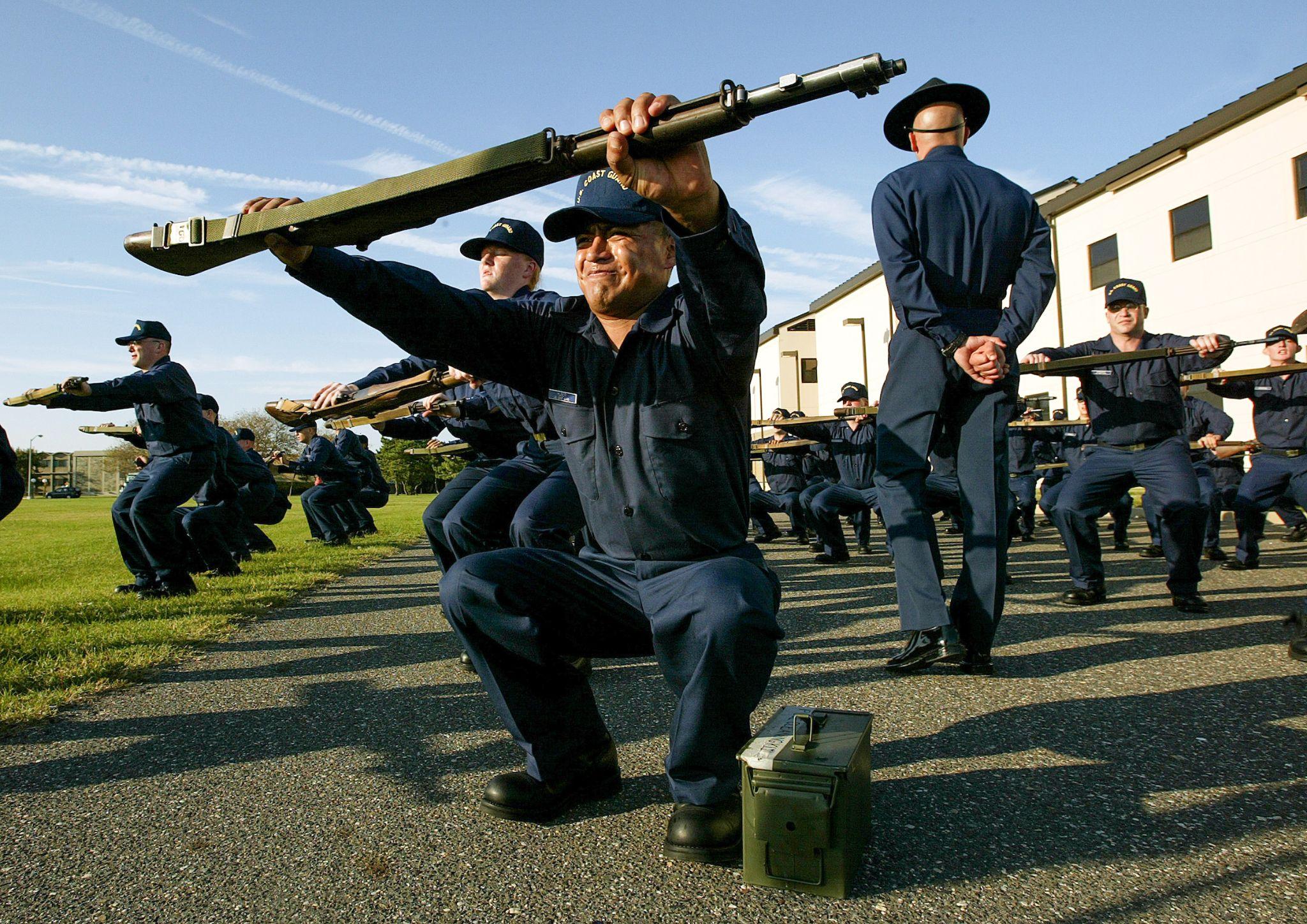
Recruits suffering in the “down” position of a rifle squat. This picture is not of Marine boot camp, but of another branch of the military with similar boot camp training. Image source (used with permission of copyright holder)
Besides punitive calisthenics, there’s also the use of stress positions. In my experience, the worst punishment (and also one of the most common ones) was being ordered to simply hold a full canteen of water over your head for about 20 minutes. This might sound easy, but after 10 minutes or so it becomes very painful. There’s also the mental agony of not knowing how much longer it would go on for – again, the altered sense of time locking you into the present moment.
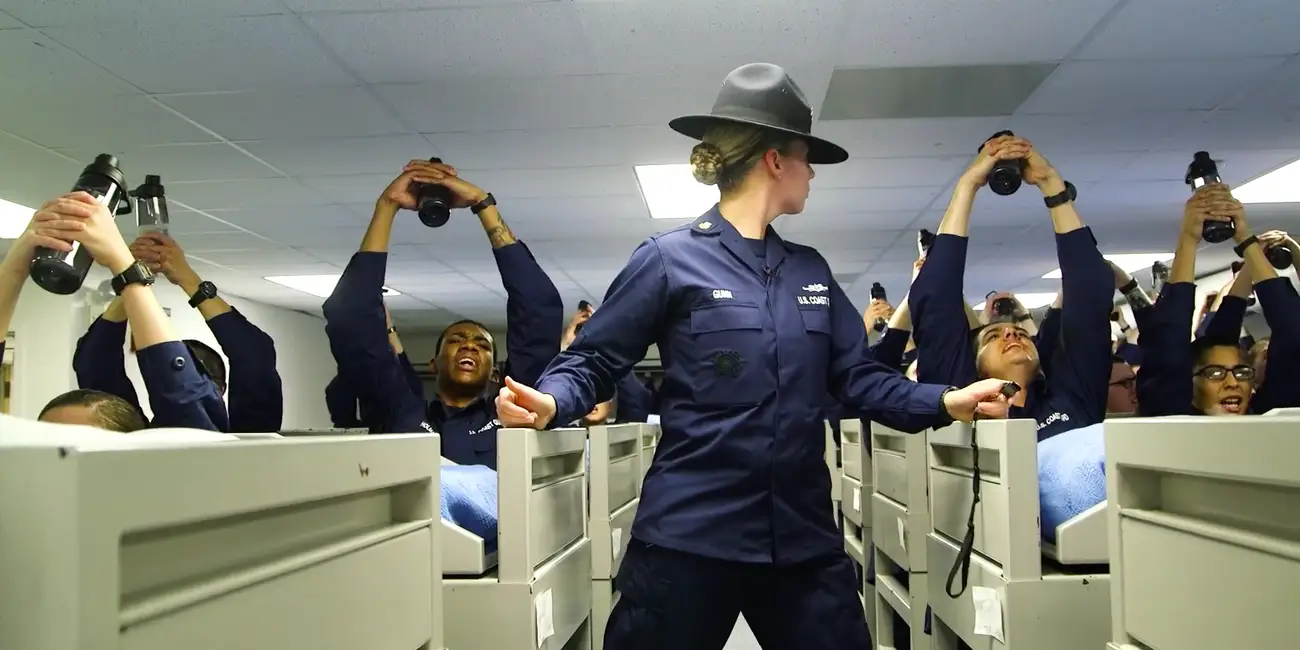
Recruits holding canteens above their head, under the watchful eye of a drill instructor. This becomes very painful after 10 minutes or so. This picture is not of Marine boot camp, but of another branch of the military with similar boot camp training. Image source
Sometimes these punishments are given out individually, but usually the recruits are punished collectively for individual mistakes. It works like this: boot camp is totalitarian in the sense that there’s a rule for practically every single thing you do: how you talk (as loudly as you can and with the new language mentioned before), how you walk, how you stand, how you hold your tray in the cafeteria, how you make your bed (called a “rack”), how you organize your things (measured down to the inch), how you wear your uniform. Plus a million other little things. You’re not allowed to touch your face[5]. When you’re done using a sink, you can’t leave any “standing water” left in the sink. Random stuff like that. Two of the most common rule violations are simply being too slow (again, lots of orders are timed) and not being loud enough.
When someone is caught breaking a rule, they incur the punishment. Sometimes they’ll be punished individually, but usually the whole recruit company will be punished collectively. The punishment will occur either on the spot, or they’ll build up a punishment “debt” to be paid all at once later, often for several hours, with only short water breaks interspersed in a long series of “beatings.” In theory, if the recruits behave perfectly all the time, they’ll never be punished. However, since there are so many rules and so many recruits, someone is caught accidentally breaking a rule constantly. So, at least for the first 4-5 weeks of boot camp, a ton of time is spent simply getting punished with calisthenics and stress positions for at least a couple hours per day.
Besides all the rules, there’s also the “required knowledge” – various facts the recruits must memorize, word-for-word, and be able to recite at any time. For the Marines, this comes in a book they’re issued literally called “KNOWLEDGE.” Some of this is pretty important and will be useful for their time in the service. For example, they must memorize all of the ranks and their insignia, so that they can properly identify a person’s rank from their uniform and know how to address them. This includes memorizing word-for-word descriptions of what the insignia look like. They also memorize the NATO phonetic alphabet (“Alpha, Bravo, Charlie, Delta…”), and their chain of command starting from their drill instructors and going all the way up to the president.
But some of the required knowledge is useless outside of boot camp and exists only to add to the stress and difficulty. For example, there’s something called the eleven general orders. These are simply eleven sentences that recruits need to memorize word for word, and be able to recite on command. The orders are loosely related to watchstanding, but their meaning is never really discussed or explained. They’re just sentences that need to be memorized, and will be forgotten almost immediately after boot camp.
Recruits can be called out and asked about required knowledge at any time. You could be silently eating a meal in the cafeteria and suddenly hear: “RECRUIT SO-AND-SO, WHAT IS YOUR FOURTH GENERAL ORDER?!?” Then you have to stand up, while everyone else continues silently eating, and yell the correct word-for-word answer as loud as you can, or else everyone will get punished later. As with the rules, there’s simply so much required knowledge that for the first month or so people are constantly getting things wrong and the group is constantly getting collectively punished for it.
This is the extreme difficulty of boot camp: the totalitarian set of rules and arbitrary knowledge to be memorized, backed by the threat of physically painful punishment, that often takes up several hours per day. It’s the most difficult thing I’ve ever done in my life, by far.
Importantly, the source of this hardship has a name, a face, and… a Smokey Bear hat. This is the drill instructor. He[6] is in control of every aspect of this totalitarian environment. Typically a recruit company will have three drill instructors (a lead instructor and two assistants) and at least one of them will be with them at all times, screaming orders and dealing out punishments.
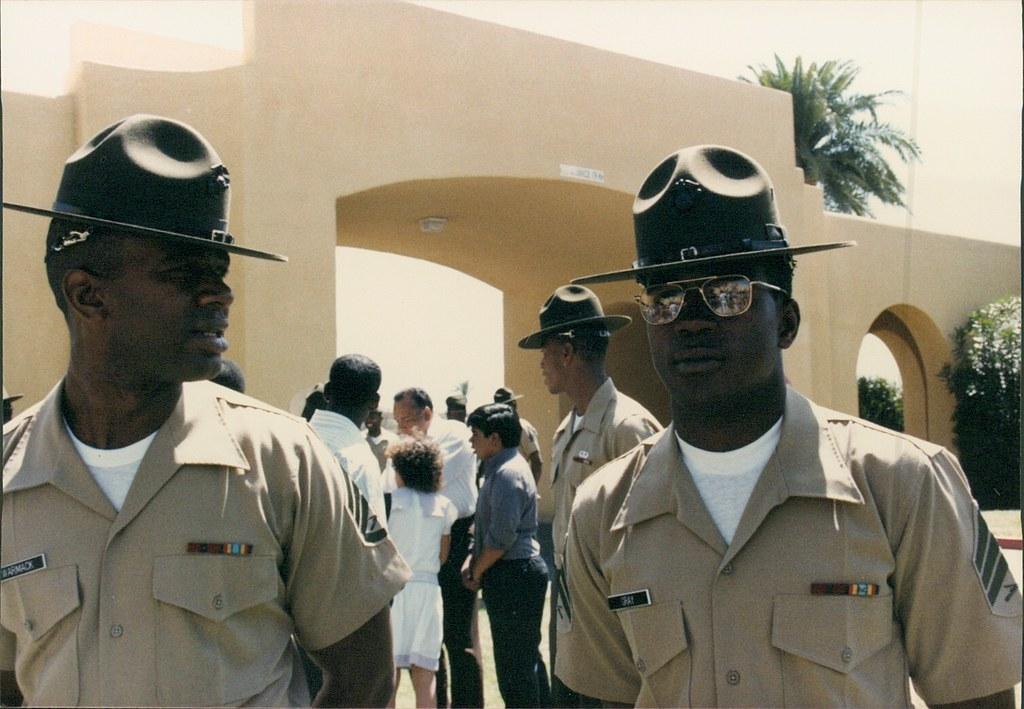
Marine Corps drill instructors. Image source
A common misconception is that the scary thing about drill instructors is just the yelling or the saying mean and insulting things. Sometimes you hear a self-styled tough guy say “I could never join the military. If some drill instructor started yelling at me, I’d just get angry and punch him in the face!” No, they wouldn’t. That’s because the scary thing about the drill instructors isn’t the yelling – it’s the power they have to make your life hell, which they frequently exercise.
The drill instructors play a key role in the process of group identity formation for the recruits. They’re the antagonist, the Other, the Out-Group that the recruits must band together in opposition to. And it works. Facing this extreme difficulty and adversity personified by the drill instructors, the recruits quickly learn to work together and have each others’ backs. The camaraderie among recruits at boot camp is unlike anything I’ve ever experienced at any other job – a combination of seriously helping each other deal with the hardships of training, helping out and cheering on the struggling members, and that kind of offensive-but-funny joking around you get when you put a bunch of 18-year-old guys together.
An unexpected takeaway from my own experience in boot camp was that (and I know this sounds bad, please don’t cancel me) I became more sympathetic to fraternity hazing rituals. Before I just thought they were a dumb and pointless form of bullying. Now, I at least kind of understand the point of them, and would guess that they probably are effective at bonding together new members through shared hardship.
Culture Formation
Alright, so far we’ve covered how the recruits’ old identities are broken down through disorientation and extreme physical/mental hardship. But it’s not enough to just break down the old identities – boot camp must also create a new identity in the recruits’ psyche. So, how is that done?
One of the surprising things about boot camp is how little time is devoted to actual job-skills training. Rather, most of the time not spent getting screamed at or doing punitive exercises is spent on something called “close order drill[7]” – basically marching and doing ceremonial rifle movements in formation. Hours and hours of grueling practice are spent learning these movements, practicing them as a group, and getting inspected on them by drill instructors. It’s actually very difficult to perfect these movements as a group. A strange side effect of going through boot camp myself is that I now have a kind of respect for the North Korean army’s ability to march in formation.
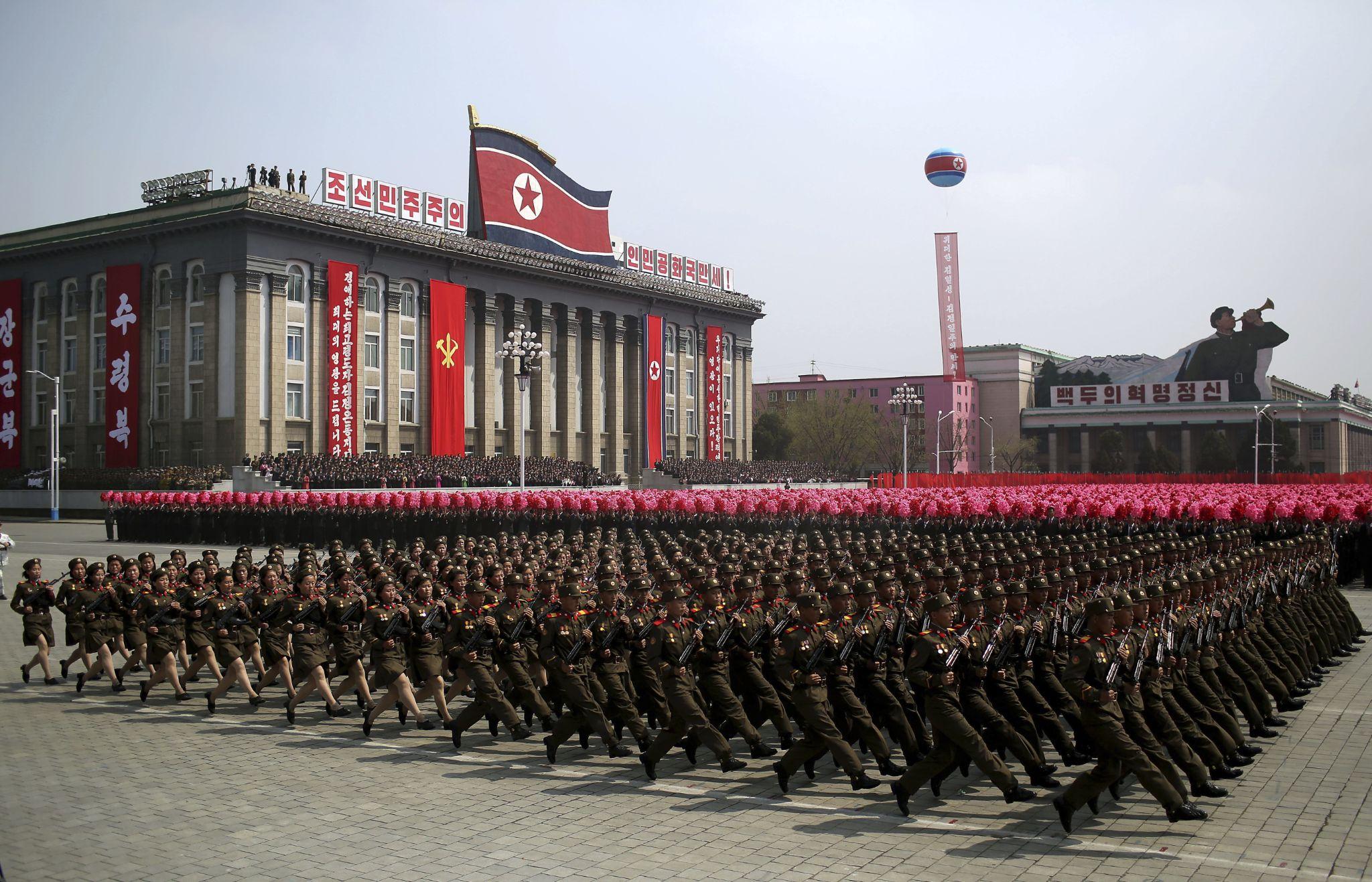
North Korean military parade. Marching with this level of coordination is actually a lot harder than it looks! Image source
After boot camp, the recruits will almost never do close order drill again, other than maybe for the occasional parade or retirement ceremony. So, what’s the point of it?
Well, one answer is that it has to do with teaching attention to detail and teamwork. It isn’t about the marching or “RIGHT SHOULDERRRRRR ARMS!” being important for its own sake. No, it’s about learning precision and group coordination. This is basically what drill instructors tell you towards the very end of boot camp when they start to drop the mask a little bit and explain some of the rationale behind things.
Another possible answer, though, has to do with culture creation through arbitrary practices. One of the most straightforward ways to create a distinct culture is to just have some unusual, arbitrary practices that distinguish you from other cultures. Orthodox Jews, for example, follow a very strict set of rules on the Sabbath. For example, many will not press elevator buttons on Saturdays because of a prohibition against “creating sparks or fires”, which is interpreted to include operating electrical switches (like elevator buttons). There’s actually a special type of elevator designed to get around this problem.
Taken literally as a matter of theology or moral philosophy, this just seems silly and is an easy thing for atheists to criticize and score points on. But as a matter of culture creation, these arbitrary rules and practices work well. Of course they seem silly to me because I’m not an Orthodox Jew. That’s the point! They allow for commonality among members of the culture, and differentness from the external culture.
I think close order drill also serves this purpose, in addition to teaching attention to detail and teamwork. It gives the recruits something in common – a shared experience. Importantly, the commonality persists even after boot camp is over and they will probably never have to do a “RIGHT SHOULDERRRRRR ARMS!” again. It’s like how I, as an ex-Catholic, can still find commonality and bond with other ex-Catholics over the strictness of Catholic school. In the military, thinking back on all the marching and close order drill has the same feeling: “Pssh, what a waste of time.” But the joking cynicism can itself be used as a bonding mechanism between two people who are both feeling it.
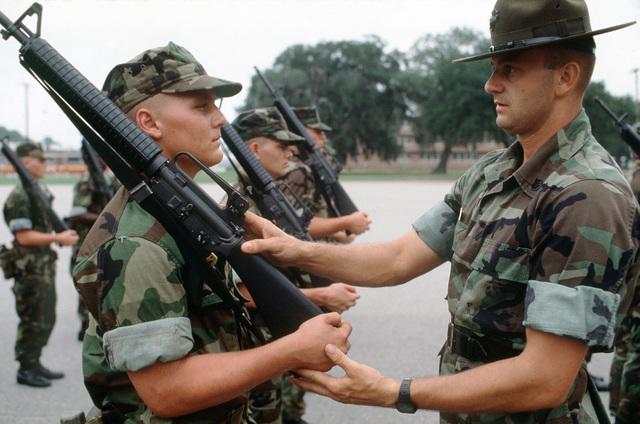
A drill instructor shows a recruit the proper rifle position for a close order drill movement. Image source
Besides the total arbitrariness of close order drill, some parts of boot camp are more recognizable as culture in a straightforward sense. One of the most obvious examples is the uniforms. Although the recruits will not earn the right to be called “Marines” until they graduate, they begin wearing the uniforms almost immediately. This, combined with the shaved heads, contributes to the loss of individuality and the feeling of collectiveness. This “loss of individuality” might sound pretty dystopian, but it can actually feel pretty great to be a part of. Personally, I’ve always enjoyed wearing uniforms, even at minimum-wage jobs I had as a teenager. It was cool to feel like part of a team. Wearing the uniforms in boot camp felt the same way. It was a source of strength, like wow, I’m really part of this thing.
Of course, the uniforms contribute to the stress of boot camp, since they come with a ton of rules, and frequent inspections. I knew one guy who got rolled back a week in training because he was caught with a wrinkly shirt (called a “blouse”) that he apparently hadn’t ironed enough. While a lot of the rules at boot camp are completely arbitrary and exist only to create a high-stress environment, the recruits will continue to follow the rules around uniforms and grooming standards (shaving, etc) throughout their time in the military. The extreme pressure of boot camp basically serves to deeply ingrain these rules so that the recruits get used to following them and it becomes a habit. For example, one of the rules is that when you’re outdoors in uniform you must be wearing your hat (called a “cover”). Being outdoors in uniform without your hat is one of the things that can bring down the wrath of the drill instructor on the entire recruit company. To this day, even though I’m no longer in the military, the thought of being outdoors in my uniform without my hat gives me a physical cringe sensation, like the thought of being out in public naked.
Besides the uniforms, boot camp introduces the recruits to many other aspects of Marine culture. They learn about Marine history, how to sing the Marine Corps hymn, and a variety of practices called “customs and courtesies” that include saluting officers when outdoors, how to address superiors, how (and when) to stand at attention, etc. Like the uniform regulations, the customs and courtesies will continue to be followed even after boot camp is over.
While many of these aspects of culture are common to all the military branches, the Marine Corps stands out in its emphasis on bringing out the recruits’ raw aggression and indoctrinating them with the warrior ethos. The book describes how this is done through pugil-stick fighting:
“Once at the pits, four recruits climb into pugil gear: large external padded jockstraps,
flak jackets, padded horse collars, and football helmets with a lineman’s web of a mask.
The pugil sticks themselves are really double-headed clubs about four feet long, with
heavy green pads at either end, like great malevolent Q-Tips. Sergeant Carey exhorts
them: ‘Kill or be killed, understand? If you come out a loser, you might as well consider
yourself dead, understand?’
Today’s preliminary round of pugil stick fighting is staged on a wooden fifty-foot-long
boardwalk elevated about two feet above a pit of sawdust. Here simple two-man
contests are staged to loosen up the recruits as the DIs stand nearby and instruct them, like handlers just outside a boxing ring. Members of 3086 are sent up the ramp to the boardwalk to confront head-on recruits from 3084, a companion platoon. Years from now, those recruits will be bosom buddies, Marine comrades who went through boot camp at the same time. But now the adversaries from 3084 are ‘the other’ – masked strangers who might as well be aliens from another planet for all the comradeship 3086 feels with them. The goal is to land two ‘killing’ blows – hits to the head, thrusts to the chest – before the opponent does the same to you.”
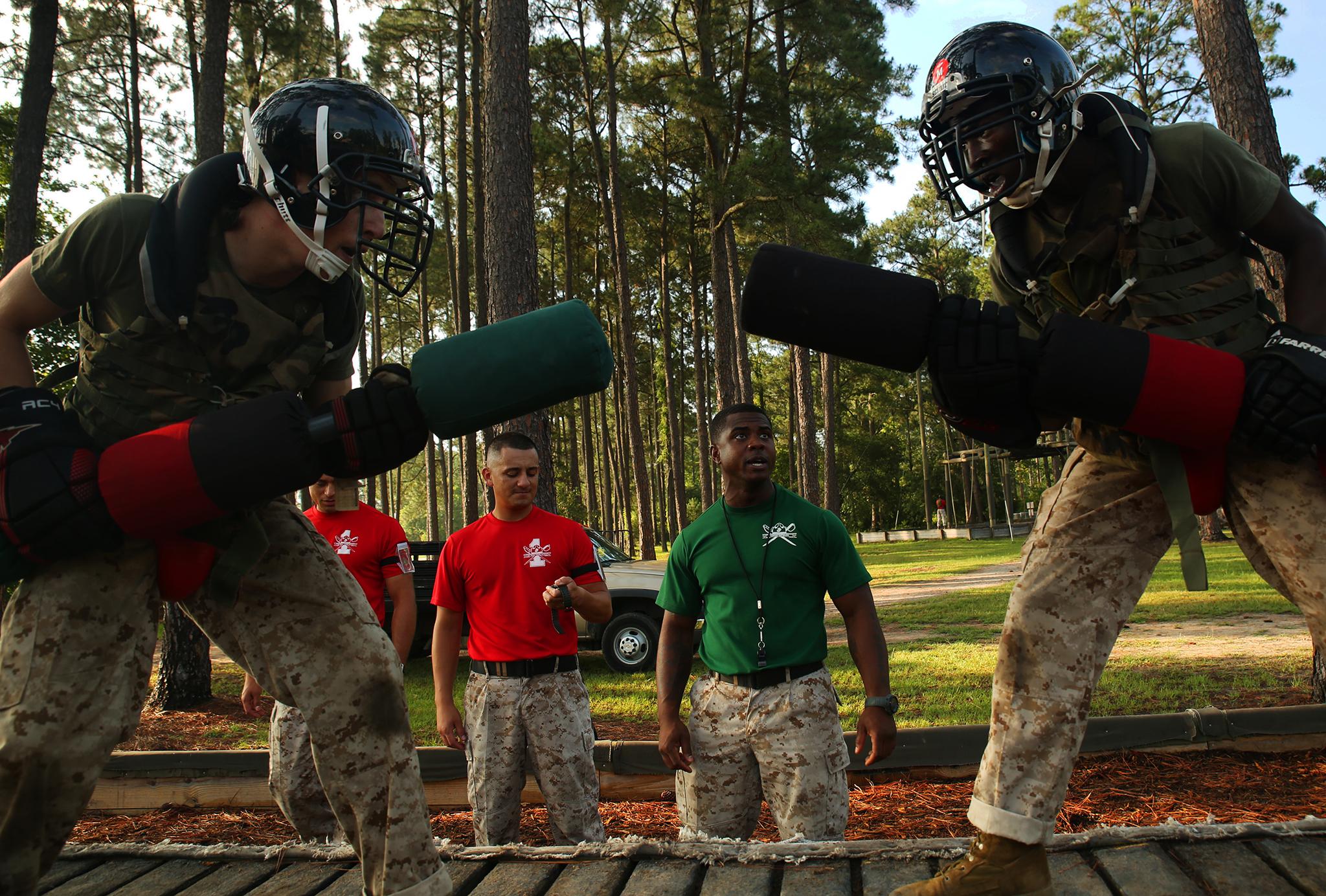
Recruits prepare for a pugil stick match. Image source
As far as I know, only the Marines go this hardcore with pugil stick training. Recruits in other branches do maybe a couple hours of pugil stick fighting on only one day. In my boot camp experience, the pugil stick day was considered a fun activity meant to be a break from the rest of training, and the drill instructors would threaten to cancel it as a punishment for screwing up too much. But for the Marines, it’s an intense experience meant to indoctrinate the recruits into the Marine warrior ethos.
Again, this psychological indoctrination is the main focus of boot camp, not job-skills training. It’s extremely unlikely that even the recruits who go on to become infantrymen will ever be engaged in close-quarters combat. The only real job-skills training the Marines will get is the weapons training – how to safely shoot, repair, and maintain a variety of different weapons. Towards the end there’s also a week of basic infantry training out in the woods called Warrior Week[8], although this serves mostly as a rite of passage, meant to be extremely difficult and physically exhausting, but not meant to actually teach infantry combat techniques.
So those are some of the important aspects of boot camp. There’s also plenty that I’ve left out – various fitness tests, inspections, classroom training on HR stuff like sexual harassment and suicide awareness, some very basic training on things like firefighting and emergency medicine, and more. Over the course of the three months, many recruits will quit, fail out, get medically discharged[9], get rolled back a week to the following recruit company, or leave under other circumstances[10]. But most of the recruits successfully pass through boot camp, and there is a graduation ceremony at the end where they officially earn the right to be called Marines.
Staying Power of New Identity
Throughout this review, we’ve been comparing Marine Corps boot camp to a cult indoctrination – total separation from the rest of society (including family and friends) both in terms of physical location and access to information, the use of disorientation and extreme physical and mental hardship to break down individual identity, and the deliberate creation of a new group identity.
However, one key difference between most cults and the Marines is that for cults, the separation from the rest of society is indefinite (they’re usually on some kind of compound or something). For the Marines, total cutoff from society only lasts for three months. After that, they go on to do their time in the service in a state of semi-separation from society. When not deployed to a warzone, they typically live and work on a base, sometimes abroad and sometimes in the US. Typically they’re allowed to go off base on nights and weekends, have a social life, hang out with friends, have romantic relationships, etc. They also have access to the internet and social media. They then serve out their enlistment for some number of years (typically 4 years at least, with 20 years required to get a pretty nice pension), and eventually retire from the Marines and re-enter the civilian world.
So, does the Marine identity formed at boot camp last after boot camp ends? The book devotes a couple chapters to this question. The author notes that the week or so immediately following boot camp graduation presents a challenge, as the newly-minted Marines (no longer “recruits”) are given a brief vacation leave. Many of the Marines will travel back home and spend time hanging out with old friends who were bad influences, and will be presented with the choice to either stay true to their new values or revert to drug use or criminality – a kind of rumspringa__.
Some non-zero number of new Marines will screw up during this post-boot-camp leave and their career will be over as quickly as it started. But most will continue on to their new posting. There, they will continue to face decisions about whether to stay true to the Marine identity, or revert to their past civilian lives. The author notes an interesting pattern, consistent with the idea that separation from family and friends helps solidify the new identity:
“The greatest single predictor of satisfaction in the Corps for the members of 3086 is simple distance from home. Generally, the farther away from their hometowns these new Marines are posted, the more they like the Corps.”
Although some Marines screw up and get kicked out, the author notes that most do not, and that the Marine identity seems to have considerable staying power in most cases.
It's also notable how the Marine identity can successfully replace other previously-held identities. I think this point is best illustrated by three specific recruits profiled in the book, all of whom were previously mentioned in the quote in the “Who are the Marines” section:
[...] a self-professed gang member from Washington, DC; [...] a Dutch-American who considers himself a pacifist; a former white-supremacist skinhead from Mobile, Alabama;
The self-professed gang member was Earnest Winston, Jr., a black guy from inner city Washington, DC who had been through an extremely rough upbringing. According to the book, he had been a member of a criminal gang, and had claimed (credibly) to have participated in armed robberies, drive-by shootings, and drug sales. Besides these gang activities, it’s also revealed in the book that he was affiliated with the Nation of Islam and espoused black-nationalist beliefs, although kept these beliefs to himself while at boot camp.
After graduation, Winston recognized the temptation he would face to return to the criminal life, and harbored doubts about whether or not he would succeed in the Marine Corps. Ultimately though, Winston didn’t revert to the criminal gang life. The last we hear about him in the book is that he was stationed in Japan as an aircraft recovery specialist, and appeared to be succeeding as a Marine. I was curious about what became of this guy since the book was published, so I did a bit of googling and found out that he died in 2021. Notably, the background on his obituary website isn’t some gang or black-nationalist symbol, but rather the Marine Corps anchor, globe, and eagle symbol.
The former white supremacist profiled in the book was Jonathan Prish, from Mobile, Alabama. And just to be clear, we’re not talking about the kind of “white supremacist” who believes in colorblind meritocracy and treating everyone equally regardless of their race. No, we’re talking about an actual, real, self-described white supremacist skinhead. And although he’s described throughout the book as a “former” white supremacist, my understanding is that the word “former” doesn’t exactly mean that he had an epiphany and realized the error of his ways before joining the Marines. More like he toned it down a bit so that he would be allowed to enlist.
But throughout boot camp, Prish does undergo a true transformation, even becoming close friends with Winston, the black-nationalist former gang member. The last we hear about Prish in the book is:
“Jonathan Prish, the Alabaman, became a guard near the American Embassy in London. Prish had his racist tattoos covered. ‘I’ve left all that behind,’ he said. ‘You go out and see the world, and you see there are cool people in all colors.’”
So those are two examples of bad identities (gang member, white supremacist) being subverted by the boot camp indoctrination and replaced with the better Marine identity. It would be nice to stop there, on a positive note, but the truth is that good identities can also be subverted and replaced. Consider the Dutch-American recruit Paul Buijs:
“Buijs contends in private conversation that he is a pacifist. It isn’t clear why he left the
Netherlands to join the Marines, but there is a hint in his personal history. He was born in
New Jersey to a free-spirited Dutch girl who came to America to find the hippie life and instead found a man who left her one month after Paul was born in 1977. She took her baby back to Holland, and Paul grew up happy there. Though essentially Dutch in outlook, he seems somehow driven to prove that he really is an American – perhaps as much an American as his vanished father.”
Buijs struggles with the violent aspects of boot camp, like the pugil stick fighting, and was described at times as the weakest recruit of the group. The author repeatedly notes the apparent contradiction between being a pacifist and joining the Marines. Now, this is an identity I’m pretty sympathetic to. Like I said, I have some pacifist leanings myself, and when I joined the military I purposely looked for a job specialty that was not focused on fighting. This is kind of impossible in the Marines though, since “every Marine is a rifleman”, as the saying goes. But by the end of boot camp, Buijs’ views have changed:
“Recruit Buijs concedes that his views have shifted a bit from his steadfast pacifism. ‘It
depends on the circumstances. If there’s a good reason, then killing is justified,’ he says.
Then he marches outside and pins on the Corps’ eagle, globe, and anchor. He isn’t the
natural-born killer of the movies, but in his own roundabout way he has become more
dedicated to the Marines than many other members of the platoon.”
Overall, the Marine identity seems to have considerable staying-power. To sum things up, the author notes that you typically see a lot more Marine bumper stickers on cars than Army bumper stickers, even though the Army is a much larger branch with many more veterans than the Marines. You also see many more Marine flags on houses than Army flags. If you talk to a middle-aged or elderly person who was in the Marine Corps even just for a couple years in their twenties, often you’ll find that having been a Marine is still a considerable part of their identity.
Epilogue: Tribalism and Group Identity
So, that’s basically it. That’s how the Marine Corps takes recruits from very diverse backgrounds and often very little in common, breaks down their individual identities, and builds up a new Marine identity in their place. Of course, this was just a broad overview, and if you want to know more I recommend reading the book. Anyway, this section will be a little epilogue with some of my own thoughts about group identity formation. Consider this part optional, so if you’re bored then you can stop here. But if you’re interested, here’s why I think this is important at the level of both communities and societies…
When I was in high school, I remember taking one of those online political compass quizzes. One of the questions was something like: “Do you agree with the following concept: From each according to his ability, to each according to his need?”
Of course, I knew to check off the “Strongly Disagree” box, since I recognized the phrase as being related to communism, knew about the horrors of communism, and didn’t want this online quiz lumping me in with its supporters!
Still, I remember thinking even at the time that I was only strongly-disagreeing because of the ideological valence of the idea, not because the idea itself actually sounded terrible. In fact, it sounds pretty nice when taken at face value. For example, this is how families operate: from the parents according to their ability, to the children according to their need. Many insular, highly religious communities also operate this way. In Amish, Mennonite, and Hasidic communities, charitable giving (“alms”) often provides a social safety net for members in need. Some egalitarian hunter-gatherer tribes also functioned like this. And to be honest, it does seem like it would be pretty nice to live in this kind of a community, where everyone looks out for each other.
So what’s going on? Is this kind of “communism” good actually? Libertarians have an easy answer for this – communes are fine if they’re voluntary_._ As long as nobody’s being violently coerced and people are allowed to leave if they want to, then it’s fine. Alright, so that’s easy but also unsatisfying. Why do people voluntarily participate in these communes, even when it means a net-loss for the most capable and productive members? Why doesn’t the Laffer curve apply to the most productive Amish farmer who has his wealth redistributed to the neediest in the community? Why didn’t the Margaret Thatcher quote about socialists “running out of other people’s money” apply to the most capable hunters in egalitarian hunter-gatherer tribes?
I think the reason why some redistributive systems work and some don’t is related to the psychology of tribalism. A redistributive economic system where everyone views themselves as part of the same tribe and a system in which they view themselves as two tribes could both be called “communism”, but are completely different in terms of the psychology of the participants and the ultimate sustainability of the system. The usual critique of wealth redistribution is that it disincentivizes economic production (Laffer curve, Margareth Thatcher quote, etc). But I think this criticism only applies to redistributive systems where the people taking a net-loss and the people taking a net-gain view themselves as two different groups. When they view themselves as part of the same group, as with the Amish or egalitarian hunter-gatherers, then the criticism seems to fall flat, as the most productive members aren’t deterred from working by the net-loss they’re taking.
Explicitly accounting for the one-tribe / two-tribe distinction also helps clear up a lot of debates in political philosophy. For example, you could imagine two people debating the merits of democracy. The pro-democracy person might talk about the right of people to self determination and self-governance – afterall, who should rule over a group of people if not themselves? The anti-democracy person might complain about the tyranny of the 51% and how a government that “robs Peter to pay Paul can always count on the support of Paul.”
But really these people aren’t debating the merits of a single political system called “democracy.” Instead, they’re using the same word for two very different systems: a one-tribe democracy and a two-tribe democracy. The one-tribe democracy is the ideal: a society where people view themselves as all part of the same group, evaluate policies based on what’s best for society as a whole, and then vote based on their individual judgment of what’s best for the group, with this hopefully leading to policies converging on the correct answer. Of course people might disagree about which policies are the best and have heated debates about them, but ultimately the goal is the betterment of the society, and the debate is just over what policies best achieve that goal. On the other hand, in the two-tribe democracy, the goal is simply to vote to take away power, resources, and status from the Out-Group and give them to the In-Group[11].
Another example: is monarchy good or bad? Well, that depends. If you’re an 18th-century American colonist or French peasant, then monarchy is bad because the monarch is representative of the Out-Group and is exploiting your In-Group. But if you’re a 14th-century Scotsman, then maybe monarchy is good because maybe you view the king as a legitimate representative of the Scottish people and a legitimate leader in the collective defense against England. In fact maybe monarchy is better than democracy on the 14th-century British isles, because in a straightforward majority-rule democracy the English could just use their greater numbers to vote to oppress the Scots, and the Scots would just have to go along with it for the sake of democracy, right?
Another example: why is Andrew Yang centrist-coded, despite proposing a UBI program that, if implemented, would be the largest wealth redistribution program in American history? Shouldn’t centrists be opposing him, and leftists / socialists supporting him? Why is he considered to be not as far left as Bernie Sanders and Elizabeth Warren, despite supporting more extreme wealth redistribution?
This doesn’t make sense when analyzed at the policy level, but it becomes much more clear when the one-tribe / two-tribe distinction is accounted for. Most socialists and leftists advocate for a two-tribe model of economic redistribution, where billionaires, CEOs, and wealthy business owners are the Out-Group who’ve gotten their wealth by exploiting the In-Group. So of course in this model, the goal is to plunder the Out-Group and redistribute their wealth to the In-Group. On the other hand, Yang supports a one-tribe model of economic redistribution, with a shared tribal identity based on American civic nationalism. In this model, billionaires are heavily taxed to have their wealth redistributed, but they’re viewed more along the lines of a successful hunter in a hunter-gatherer group or a productive Amish farmer, rather than an Out-Group of bad guys to be plundered.
I’m a fan of Yangism – the framing where all Americans, and really all humans[12] are part of the same tribe, and where the Out-Group isn’t another group of people, but rather the abstract problems we’re facing, like suffering, disease, scarcity, and being confined to Earth. I think this kind of psychological unity in a society is more important than specific policy goals. That’s why I like Andrew Yang even though I’m not sure if I agree with his UBI policy.
Obviously uniting an entire country is pretty hard though. So even though I like Yang and am rooting for him, I’m also pessimistic and don’t really expect his vision of American national unity to come to fruition any time soon. It seems tough to do this kind of thing from the top down. Probably it’s easier to organize people into communities at the small, local level, and then scale up from there. In the past, local religious communities served this purpose, and I think now that fewer and fewer people are participating in religious communities, the lack of community is leaving many people feeling lonely and unfulfilled.
Some people (surprisingly many, I think) solve this problem by simply being religious even if they don’t actually believe in the theological claims of the religion. I’ve met self-described Catholics, Jews, Hindus, and Muslims who didn’t actually believe the theological claims of their religion, but were born into it and still go along with it for the sense of community and cultural identity.
There have also been some high-profile cases of this lately, where well-known atheists have converted to religions, apparently for the appeal of the community and culture rather than the actual correctness of the theological beliefs. Here’s an example:
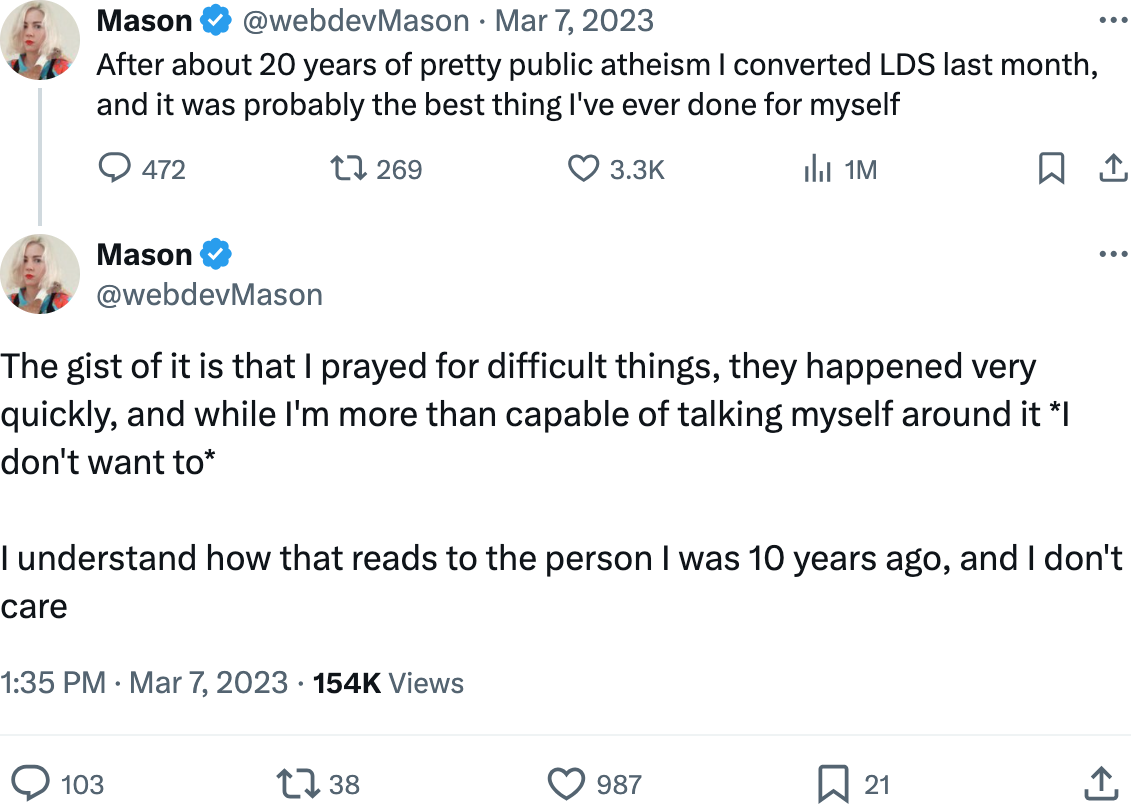
Another example is Ayaan Hirsi Ali converting to Christianity for cultural reasons, rather than actually being convinced of the theological claims.
I respect these people and think I understand why they’re doing this, but unfortunately this just won’t work for me. I don’t want to go along with a religion or community if I’m required to profess beliefs that I don’t actually think are true. So the projects I’m currently interested in are attempts to create new communities that will take the place of old-school religious communities and solve the problem of secular atomization and loneliness, but without requiring any probably-false supernatural beliefs. For example, pronatalist couple Malcolm and Simone Collins are attempting to start their own religion, which will include cultural and traditional elements of other religions while also being consistent with a scientific understanding of the universe. There’s also Praxis, an attempt to found a new nation along the network-state model proposed by Balaji Srinivasan.
Will these specific projects succeed? Who knows. But one thing I can practically guarantee is that history isn’t over, and humans will continue to organize into groups and form new social constructs, which will probably include new nations, states, and religions.
Footnotes
- ↩
Marine boot camp is typically considered to be the most difficult out of all the branches.
- ↩
I used to wonder why they were called “Marines” if they’re mostly on land. Well this is why. They were originally a naval infantry force.
- ↩
The book takes place in 1995 so these numbers are a bit dated and resemble the US population at the time. When I went through boot camp in 2017, it was probably around 60% white, 20% Hispanic, 15% black, and 5% Asian – closely resembling the current US population.
- ↩
Even though this is the largest religious group in the US, I was raised Catholic and went to Catholic school so I didn’t really know any.
- ↩
Many of the rules are completely arbitrary, but this one is actually for hygienic reasons to try to limit the spread of germs.
- ↩
In the book it’s always a “he” because Marine boot camp is gender segregated, with the women training separately. In the other branches this could be a “he” or a “she” - and actually sometimes the she’s are the toughest and fiercest.
- ↩
This is where the term “drill instructor” comes from.
- ↩
The book is a bit dated, this is now called The Crucible.
- ↩
Though medical discharges sometimes happen due to injuries, they most commonly occur for mental health reasons, when recruits say that they are suicidal.
- ↩
When I went through boot camp they gave us a drug test on the second day, but the results didn’t come back until a month later. One guy failed the drug test and got kicked out, after already going through a month of hell and pain.
- ↩
This doesn’t necessarily mean that the two-tribe democracy is terrible. For most of human history, conflicts between competing tribes were settled through wars and violence. So settling these conflicts by voting and competing in elections is at least a step above that.
- ↩
And maybe even all sentient beings, including non-humans.