Mine!: How the Hidden Rules of Ownership Control Our Lives
Prologue: Why Not Mine!?
When it first came out in 2021, I was surprised that Mine!: How the Hidden Rules of Ownership Control Our Lives didn’t make a bigger splash. Like Sapiens or Thinking Fast and Slow, the book felt perfectly positioned to popularize dense academic topics as insight porn. In their introduction, the authors of to Mine!—two law professors named Michael Heller and James Salzman—even make explicit references to Nudge and Freakonomics.
But if Mine! made a splash, the ripples didn’t go very far. As of writing, the book has only 1,700 ratings on Goodreads; by contrast some other big nonfiction books from the same year have 80,900, 18,700, and 18,100 ratings respectively. (For an apples-to-apples comparison, there’s even another “pop law” book—not, I assume, the most competitive subgenre—that has over 24,000 ratings.)
Far be it from me to declare what should or shouldn’t be the Next Big Book™—but using these numbers as a loose proxy for cultural relevance, I found it strange that Mine! was outperformed by a factor of over 10x. I’d been immediately drawn in when I first heard an interview with one of the authors, and the ideas struck me as relevant to a wide audience. Why had it not garnered more attention?
By way of answer, three hypotheses came to mind:
- Maybe Mine! lacked the Gladwellian compression it needed to generate hype: that one big meme that permeates into the wider culture.
- Perhaps the book did have a catchy thesis, but had misapplied its lens to suboptimal examples: right hammer, wrong nails.
- Alternatively, it might just be that the book sucked, and I have bad taste.
Unwilling to accept the third option, I wrote this book review to figure out which of the first two explanations was right.
The truth, as it turned out, involved a bit of each.
Get Your Tray Table Out of My Fucking Face
If the central theme of Mine! is ownership design, the leitmotif is customers acting like monsters on airplanes.
The first of these airplane examples involves a passenger named James Beach. On one flight, the six-foot-something Beach attempted to deploy a device he’d purchased called the Knee Defender—a “simple plastic bracket available for $21.95 that clamps onto the metal tray table support and locks the seat in front [to prevent reclining].” As Heller and Salzman narrate:
When the passenger sitting in front of Beach tried to “sit back, relax, and enjoy the flight,” her seat didn’t budge. She complained to the flight attendant, who asked Beach to remove the clamp, but Beach was slow to comply. Outraged, the passenger slammed her seat back, popping out the Knee Defender and jolting Beach’s laptop. He quickly jammed her seat back up and reattached the clamp. That’s when she turned around and threw her drink at Beach.
In the end, the pilot rerouted the plane to Chicago for an emergency landing, and both passengers were removed from the plane.
Who is in the wrong here—Beach or the woman in front of him? Officially, while most airlines’ official rules allow passengers to recline, the option is rarely publicized or encouraged. Polling indicates a fairly even split on opinion: 41% of respondents say it’s rude to recline—but this number jumps up to 64% if the question specifies that the person behind has asked the hypothetical recliner not to do so.
But the real monsters, according to Heller and Salzman, are the airlines: They are effectively selling the same wedge of space twice.
On modern aircrafts, the average pitch (a.k.a, legroom) has shrunk in recent years from an average of 35 inches down to 31 inches, and on some planes is as small as 28. This is valuable for airlines—per Mine!: “one inch of pitch saved per row can add up to six extra seats per flight to sell.” Moreover, the airlines get away with it because of strategic ambiguity: The companies generally don’t advertise the right to recline because confusion is part of their profit model; if everyone considers the space in front and behind to be, sort of, theirs, they’ll tolerate less space.[1]
Plane example #2 comes from Southwest Airlines, which famously employs an open seating policy: Upon boarding the plane in group A, B, or C (you can pay extra to be in group A), passengers get unrestricted seat selection throughout the aircraft.
But what happens if you are in group A and your travel companion is in group B or C? One group A flyer named Stu Weinshanker staked out a clear answer to this question when he boarded a flight in the first group, removed an iPad from his desired seat, and handed it back to another passenger before sitting down. (The woman had been trying to reserve the seat for her group C boyfriend.)
Whether Weinshanker’s behavior is heroic or unconscionable remains a matter of ongoing debate among contemporary moral philosophers. Again, though, note the strategic ambiguity employed by the ultimate owner of the seats, Southwest Airlines: There is a tension between the official open seating policy and the unofficial norm of seat-saving—a tension Southwest deliberately avoids resolving, the authors allege, because it would cut into their bottom line:
Southwest profits from open seating because passengers board more quickly than they do with assigned seats, so the planes spend more time in the air. And it profits from early-bird boarders like Weinshanker who are willing to pay for boarding in group A. In addition, and this is key, strategic ambiguity about saving open seats lets Southwest simultaneously achieve a trifecta of corporate goals: telegraphing a distinctive, easygoing brand reputation (“choose your seat”), keeping customers reasonably satisfied (“save a seat”), and maximizing revenue (“less time on the ground”).
These cases epitomize a broader pattern of ownership design we’ll return to shortly. For now, simply notice that in each example, ownership implies a victor among competing frames or “stories”: In the case of reclining, this is the story of attachment (for the reclin_er_) versus first-in-time (for the reclin_ee_); in the case of Southwest boarding, it is symbolic possession (i.e. by iPad) versus physical possession (i.e., by buttocks).
According to Mine!, there are just six such foundational stories.
Six Stories as Old as Time
The six foundational stories of ownership are:
- Self-ownership;
- Possession;
- Attachment;
- Family;
- First-in-time; and
- Labor
Mine! devotes a full chapter to each of these stories.[2] In this review, I’ll give just a few paragraphs of cherry-picked concepts and examples.
Self-ownership
“Self-ownership,” Heller and Salzman write, “is the root of all ownership.”
Unfortunately, there is no objective boundary between “self” and “not-self”—a fact which becomes obvious when we consider various bodily organs and excretions:
- Hair snipped during a haircut
- Cells taken during a biopsy
- Sperm
- Blood
- Eggs
- Kidneys
- Children
Like the airplane disputes, this isn’t just a fun thought experiment but a set of practical decisions with real implications for lives and dollars. For example, two cell lines known as “Mo” and “HeLa” have been used for extensive medical research, some of it quite lucrative; both of these lines originated with individuals (John Moore and Henrietta Lacks, respectively), who never saw a penny of the profits, and were not even aware what they’d agreed to. In America, there is a market for eggs and sperm but not kidneys, and 54,000 people die from kidney failure every year as a result; in Iran, where there is a market for kidney, no one does. You can’t sell children anywhere—but you can give them up for adoption just about everywhere.
So, really, there are two senses in which self-ownership—and, as we’ll see in a moment, all ownership stories—are invented:
- First, in the real world, we rarely have discrete categories. Instead, we draw lines at semi-arbitrary points on a continuum: What is the “body”? Who is an “adult”? How do we define “first”?
- Second, the very concept of ownership is essentially a “bundle of sticks” rather than a single unified right: The permission to use something can be decoupled from the right to sell, lend, copy, destroy, or profit from it. (This explains the general agreement that “your” child may be put up for adoption but not sold—with “your” connoting a very different bundle of rights than it does for “your” car or “your” bitcoin).
Both of these definitional challenges pervade all stories of ownership: What exactly are the criteria for claiming a right to a given resource; and what exactly is included in a right to that resource?
Possession
The story of possession states simply that if you currently have control over something, it’s yours.
From a moral standpoint, this seems obviously incorrect. If I steal your handbag and run away with it, that surely shouldn’t make me the rightful owner. Similarly, if you build a fence over my property line, then it’s not fair that you’d get to claim the extra land. It feels viscerally outrageous that the law would uphold this situation of “might makes right.”
But in reality, that’s often exactly the way things go. This is because as a story of ownership, possession has one massive advantage: It’s easy to administer. After all, even with a receipt, it will be difficult for you to prove that the stolen handbag is yours. (Who’s to say we don’t have the same handbag?) And per the logic of adverse possession, something that appears to be yours and functionally is yours for a long time should, eventually, become actually yours.
If this reasoning seems tenuous, consider that possession often changes hands; this makes remedies for theft all the more difficult. (If I sell the handbag I stole from you to some unknowing buyer, or you sell your adversely possessed land to a new owner, should those people have to suffer for the original sin?) And again, there is no objective definition of possession anyway. (Does an iPad on an airplane seat count as possession, or only a human posterior? If symbolic seat possession is allowed, can a passenger save an entire row?) In this vein, Heller and Salzman even describe how on some cruise ships, pay pool attendants to symbolically possess beach chairs on their behalf with toys and magazines.
So in practice, conflict aversion and administrative costs mean that the apparent possessor usually gets their way.
That said, if conflict over possession gets severe enough, authorities will face pressure to step in and solve the problem. In the case of scarce beach chairs, for example, some cruise lines have started employing time-tracking systems where attendants are required to remove belongings from chairs after forty-five minutes. Heller and Salzman claim that cruise ship passengers have responded positively to this new regime. (Presumably the pool attendants prefer the old system where they get a cut.)
In other situations, the authorities avoid regulating possession because it’s just not worth the costs of intervening. For example, the authors describe surfer gangs in California who claim exclusive access to a certain stretch of coastline, and lobster gangs in Maine who threaten or even shoot at boats that intrude on their territory. In both these cases, the state could step in to demand open access—but this would only create a tragedy of the commons: An overcrowded ocean means no one can catch sweet rides, and too many traps means rapidly declining lobster populations. This outcome is more “egalitarian” only in the sense that everyone is equally worse off—plus it has the added downside of being expensive to enforce. Better to accept some losers, the thinking goes, than have no winners at all.
As it turns out, there are other, more subtle ownership designs that can work here, which I’ll discuss in a bit. The key takeaway is that while possession may not be a fair ownership story, it’s often the least bad or only realistic option for the real world. More generously, in the words of Supreme Court Justice Oliver Wendell Holmes, Jr:
A thing which you have enjoyed and used as your own for a long time, whether property or an opinion, takes root in your being and cannot be torn away without your resenting the fact and trying to defend yourself, however you came by it. The law can ask no better justification than the deepest instincts of man.
Attachment
Attachment can be thought of as a kind of extended possession: Whatever you currently own has a hold on resources that are connected to it—literally or conceptually.
Many of Mine!’s illustrations of attachment revolve around property—for example, whether the deed to one’s house extends to the column of air above it, the groundwater below it, or the fluctuating shoreline a couple hundred yards away. In these contexts, landowners are described invoking attachment in order to…
- shoot down drones above their house (in Heller and Salzman’s example, the #DroneSlayer won his case);
- dig deeper and deeper wells to compete for oil or aquifer access (the coordination problem here is solved through “unitization”: profit-sharing in proportion to the owners’ acreage over the underground resources);
- and protest their lost ocean access as a result of state-subsidized beach replenishment (in this last case, a woman’s property had originally extended from her front door to wherever the water began; when Florida imported more sand to save the disappearing coastline, courts ruled that the public would now be able to access her previously private property).[3]
Conceptual attachment, on the other hand, applies to any sort of legal structure that yokes together multiple owners (e.g., shareholders or coop members). These structures come with certain advantages—economies of scale, pooling of resources, etc.—but there are, naturally, strings attached. In one Californica condo, a resident named Jeffrey DeMarco was fined for having too many rosebushes on his property, subsequently sued his homeowner’s association, and ended up losing both his home and $70,000 in legal fees. In another case, an elderly woman named Pamela McMahan was fined and eventually kicked out of her condo for failing to carry her dog across the lobby. (Her actions were in violation of a “no paws on the floor” rule.)
These seem like extreme responses to relatively minor rule-breaking. However, from the courts’ perspective, the legal and administrative costs of adjudicating every incident would be staggering; this is why the California Supreme Court ultimately upheld homeowner associations’ right to decide and enforce their own rules, so long as the rules themselves were legal. (The CA state legislature did eventually enact a ban on pet bans, enshrining animal ownership as a fundamental right for homeowners.)
Like possession, attachment is simple to understand and administer, and this is especially advantageous when we need to decide how to allocate initial ownership for new resources. According to Mine!, a universal feature of human societies is the “rule of increase,” which gives the owners of livestock a right to the animals’ offspring. By analogy, it makes sense that when a tool, idea, or piece of work we own yields fruit, we should have some claim to the profits.
It’s hard to argue with the logic of attachment as an initial ownership allocation (far be it from me to take a man’s foal!), but as we’ve seen, administrative ease can sometimes trade off with fairness. In a world where everything is attached to everything, ownership acts like a snowball and the rich get richer.
Family
The ownership story of family is essentially a merging of self-ownership + attachment: You have a claim on the possessions of those to whom you’re linked by blood or marriage.
Of course, historically, not all family members have been treated as equal owners. The majority societies around the world have practiced primogeniture (i.e., inheritance by the first-born son) which is a great deal if you’re the first-born son, and…not so great if you’re anyone else.
But as we saw with surfer and lobster gangs, flipping the switch toward total equality turns out to be quite impractical. In this case, the issue is fractionation: When land is divided equally among heirs through the generations, the parcels become smaller and smaller to the point of absurdity. In one case involving the division of a Native American reservation, the Supreme Court described:
Tract 1305 is 40 acres and produces $1,080 in income annually. It is valued at $8,000. It has 439 owners, one third of whom receive less than $.05 in annual rent and two-thirds of whom receive less than $1….The administrative costs of handling this tract are estimated by the Bureau of Indian Affairs at $17,560 annually.
The value of the land to its owners is literally not worth the cost of maintaining it.
And as family ownership is diffused, so too is responsibility. This means that individuals have less and less incentive to, say, make repairs for which they can’t guarantee their siblings or cousins will reimburse them. (Under American law, reimbursement is required only if the property is partitioned and sold.) Heller and Salzman even argue that land fractionation was partially responsible for the Irish potato famine: Smaller and smaller plots made it impossible to grow diverse crops, and then a blight wiped out the only nutritionally viable one left.
Fortunately, with more creative ownership designs, it is possible to get some of the benefits of a single owner without totally cutting out other heirs. In Germany, for example, family co-owners are required by law to provide immediate reimbursement to one another for essential repairs. In the southern U.S.—where many descendants of slaves remain land-rich and cash-poor—public interest law groups have helped to create family farm corporations. (In contrast to ownership defaults, these structures appoint a matriarch or patriarch as CEO with the right to manage the land, take out loans, and pay out dividends to other shareholders a.k.a. relatives.)
You may by this point be noticing a throughline in these examples: A simple ownership story gives way to a kind of arms race or tragedy of the commons, which in turn gives way to a more administration- or regulation-heavy ownership design. Be on the lookout for more of this pattern in the following examples.
First-in-time
Like attachment, first-in-time is a natural way to allocate previously unclaimed resources: Colonizers plant their flags, diners queue for trendy restaurants, and music fans race to snatch up concert tickets.
For the most part, this seems like a relatively neutral way to determine ownership. (Heller and Salzman: “Time is the great equalizer in the battle to own scarce resources.”) But in fact, like all forms of ownership, first-in-time is subject to certain forms of capture. In early America, for example, “first” was understood to mean the first Christian settlers who “cut, burned, fenced, planted, planted, and wrenched sustenance from [the earth] continuously for a period of years”—thus excluding the more transient, non-Christian native inhabitants.
And again, as we’ve seen, once a definition is established, people can manipulate the system to cut the line. Heller and Salzman describe professional “line standers,” who wait on the behalf of customers hoping to secure anything from a view of Supreme Court cases to an audition on Shark Tank. Similarly, on ticket websites like StubHub, hackers-turned-scalpers write programs to snatch up seats at popular events the instant they go live, then flip them for a profit.
Faced with this reality, some companies have realized they can capture the value/effort people will expend to cut the line. Disney famously created a tiered line-cutting system at its amusement parks: a FastPass+, which lets customers reserve time slots at up to three rides; and a Private VIP Tour, which lets them cut any line for the entire day.[4]
Absent these kinds of markets, competition for first-in-time can get fierce. In rare instances, this zeal may be desirable. (Heller and Salzman give the example of the “Cameron Crazies,” who camp out for thirty-six hours straight to enter a lottery for Duke basketball tickets; with this design, Duke ensures only the most dedicated fans, and students enjoy the rite of passage.) More often, the competition leads to violence or a wasteful expenditure of resources. For many years in Alaska, for example, fishermen who wanted to make a living had to participate in “derby fishing” in order to compete:
Because the season ended as soon as the catch limit [imposed to prevent overfishing] was reached, boats competed to catch crabs as quickly as they possibly could. The result was a dangerous race, a Mad Max style free-for-all. Trawlers motored out of port the instant the season opened, even in the face of bad weather and dangerous seas…No one could play it safe because they risked getting left behind as others caught what could have been their share of total catch…
Captains spent more and more money so their boats could catch fish faster than the next vessel. Because every captain did the same, all the expense gave little advantage. Instead, the whole fleet locked itself into an unwinnable high-seas competition for better technology that drove up everyone’s costs of operation, leading to less profit.
The least bad solution here turns out to be not only capping the total amount of fish to be caught but also allocating shares to boat captains at the start of the fishing season—an arrangement known as Individual Fishing Quotas. This solution heavily favors incumbents, and creates some “armchair fishermen” who simply sell their catch shares; but it eliminates the dangerous and costly race dynamics.
In other words, the problems created by first-in-time competition are not unsolvable, but they require careful consideration of tradeoffs and incentives. Smart ownership designers therefore don’t just ask “Who is in the right?”; they ask “What do I want to happen?”
Labor
Nowhere is the issue of incentives more relevant than in the last ownership story of labor.
Often, in Heller and Salzman’s examples, labor interacts with first-in-time to establish different rules for different contexts. In the landmark case Pierson v. Post, for example, the Supreme Court ruled on who should get to keep a dead fox when one man had chased and exhausted it but another had actually killed it_._ They settled on the rule of capture—a clear definition that favored Pierson (the fox-catcher) over Post (the fox-chaser).
As a result of this decision, Heller and Salzman argue that across a variety of domains, “the majority’s bright-line rule turbocharges innovations in capture technology.” This consequence highlights the importance of ex ante reasoning in addition to ex post reasoning: When a regulation or ruling is made, it not only rectifies that particular situation but sets a precedent for future owners; good rules should therefore reward desirable behaviors.
For example, in many places, treasure finders and plant foragers have historically been allowed to keep bounty they procure on private property, so long as they are not violating obvious signs of trespassing. The ex ante justification for this is that it creates an incentive to extract value that would otherwise have remained undiscovered. Or in the early Americas, the government’s definition of “first” (once again: Christians who built and permanently settled on the land) was motivated not only by racism but also by a desire to stimulate greater agricultural production.
These incentive structures are especially important for more abstract forms of labor—namely, who should get the credit and profit for an idea. In patent law, the standard is generally first to file, rather than invent (similar to the “rule of capture” in Pierson v. Post). However, different creative industries rely to a greater or lesser extent on copyright protections. In fashion and comedy, where barriers to entry are relatively low and innovation depends on imitation, creators have few formal protections. By contrast, drug manufacturers need stronger guarantees that the heavy investment they put into research and manufacturing pays off. In these situations, Heller and Salzman argue, the real question we should be asking is: “What is the least reward we can give creators so they provide enough benefit to consumers?”
In fact, there are situations in which it is actually in creators’ interest that their intellectual property be “stolen.” For example, HBO famously encourages password sharing in order to build its future fan base; the authors also cite research that 40% of people who buy counterfeits of luxury brands (e.g., Rolex) later end up buying the real thing. In these cases, creator and consumer incentives may be naturally aligned.
And of course there is a risk in making copyright too strong. For example, when a work is composed of many constituent parts (think of a documentary with lots of archival footage or a song with lots of samples), you can end up with a situation Heller terms “ownership gridlock”: Any individual sub-owner has a veto on the entire project.
Similar to the example of immediate reimbursement for home repairs, one way out of this gridlock is to allow for the borrowing of intellectual property but require compensation for it. Deployed reactively, this compensation is called “damages”; deployed proactively, it is known as “mandatory license.” (E.g., radio stations pay a mandatory licensing fee to an artist whenever they play that artist’s song.) These money transfers are an effective ownership design because they avoid many of the pitfalls we have seen come up:
- They fairly allocate a few different “sticks” from the ownership bundle.
- They are (relatively) easy to administer and enforce.
- They align the incentives of the original owners and the downstream beneficiaries of those owners’ work.
These features are crucial to good ownership design, and as resources become more scarce and important, they are all the more necessary.
The ABCs of Ownership
Heller and Salzman’s constant refrain is that ownership is a fight among six stories. This fact seems obviously true and important—but it’s not entirely clear what to do with it; for that purpose, we’ll need to flesh out a unified theory of what ownership is and how it works.
The model I’m about to lay out, based on Mine!’s examples, is admittedly not a perfect one (what model is?); but as a first approximation of what we should expect to happen to a given resource, it’s a significant improvement on “there sure are a lot of different ways ownership can shake out!”
Specifically, the book highlights how ownership passes through three distinct phases: Abundance, Battle, and Control.
Abundance
Abundance is the natural state of most resources when people first become aware of their existence (or, more often, don’t stop to consider ownership at all). In airplane business class seats, for example, passengers generally don’t fight over who “owns” the reclining space because there is plenty of it to go around. Similarly, there are no lawsuits over who owns the rights to chewed gum or used tissues, no international treaties on who gets to gaze at the stars.
Abundance, in other words, is a function of both the availability and perceived value of a resource: Either there is genuinely a lot to go around, no one else cares, or both. Whatever the reason, supply greatly outstrips demand, and people can usually just take what they want. In the rare instances where ownership does need to be negotiated, people do so informally through conversation or other ordinary social mechanisms. When we’re lucky, resources never leave this phase.
Battle
As access to a resource decreases, people get greedy, and a Battle begins to form. In fact, there are really two battles here (or, if you prefer, two “fronts” to the Battle): one to frame ownership, and one to claim ownership.
The framing battle is the one Heller and Salzman rightly draw attention to in Mine!: As airplane pitches shrink, we see passengers arguing between attachment and first-in-time. As fox pelts get trendy, we see huntsmen arguing whether chasers or killers should get dibs. Every ownership criterion must be defined, and every stick in the bundle inspected.
Then, once one or two ownership stories are dominant, people will also go to great lengths to get a bigger piece of the pie—the claiming battle. Unchecked, this results in intense race dynamics or outright violence: a Nash equilibrium in which everyone has to expend resources to keep up, and no one is better off as a result. Depending on the resource and ownership story in question, there are different names for this internecine conflict—arms race, price war, race to the bottom, tragedy of the commons—but they all share the qualities of a) rulelessness and b) competition driven by scarcity.
Control
Eventually, if the Battle is mutually harmful or socially impactful enough, some form of Control is born out of necessity.
Here, the options range in their administrative ease and egalitarianism in roughly inverse proportion. At the “easier to administer but less egalitarian” side of the continuum sits monopolies (think surfer or lobster gangs who claim exclusive beach access); at the “more egalitarian but harder to administer” side of the continuum sits collective ownership schemes (unitization of oil fields); and in the middle of the continuum sits brokered forms of ownership in which an authority/middleman offers “slices” of what would previously have been a “lump” (think line standers, or mandatory licensing).[5]
To drive this home, consider three possible Controls to solve the problem of limited legroom on airplanes:
- “Pre-clining” seats at a set angle (a “monopoly” on reclining; some budget airlines have in fact opted for this solution).
- Brokering a market wherein would-be knee defenders transfer money to would-be recliners, or vice versa. (Effectively, most airlines do employ this solution by offering different tiers of seating at different price points.)
- Having passengers take turns with the seat upright vs. reclined (a reclining “timeshare”).
It probably goes without saying that different political ideologies are more sympathetic to different forms of Control. (E.g., the left stereotypically tolerates more regulation and higher administrative costs to maintain more equal outcomes). However, it’s important to note that almost any form of Control is preferable to a late-stage Battle. While lobster gangs are silly at best and deeply problematic at worst, we should still prefer them to a world where lobsters are driven extinct by overfishing.
Finally, while ownership design is far from a perfect science, Mine! does give an indication of which kinds of resources tend to lend themselves to which forms of Control:
- For big natural resources, like oil, or fish populations, collective ownership is necessary to solve the inevitable tragedy of the commons.
- For various goods and services, it’s often possible to broker access to people willing to pay different prices for better or worse versions.
- And for “lumps” (i.e., undividable resources), like physical property or certain abstract ideas, it’s usually best to just award ownership to one person—perhaps offering damages or a mandatory license to others who might have had a claim.
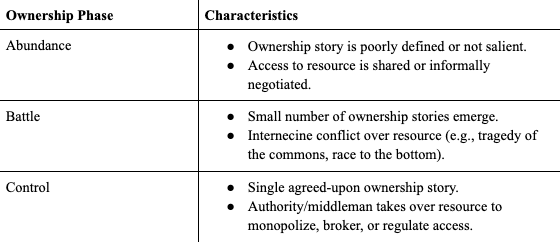
This ABC framework is admittedly reductive, and somewhat vague in its predictions; still it’s a synthesis I believe would have helped Heller and Salzman’s examples cohere.
More importantly, it serves as the foundation for the real insight that lies at the heart of Mine!
Here Comes the Hammer
Hopefully the above description strikes you as a mostly reasonable account of how ownership evolves. If so, you’ll also notice there are two “choice points” suggested by the model—moments where human actors can intentionally shape the trajectory of ownership. To be specific:
- In the Battle phase, there is always more than one frame available.
- In the Control phase, there are always multiple ownership designs available.
Crucially—and this is the synthesis I think the book was missing—the second opportunity is path-dependent on the first. Or in terms of the ABC model: The available forms of CONTROL are actually determined during the transition from ABUNDANCE to BATTLE.
It’s fairly obvious to say that ownership design is contingent on how said ownership has been previously defined; still, it’s difficult to overstate just how much the initial framing battle matters. Usually, by the time we start to think about Control over a resource, the Battle is already raging; this means there is a frame quietly operating in the background while would-be owners compete to claim oil or airplane seats or whatever it may be. By this point in the process, there are inevitably incumbents to appease or precedents that are very difficult to shift.
This isn’t to say that we have infinite choice on how to initially define ownership; not all ownership stories are equally plausible for every resource. (For example, possession and attachment are more convincing frames than labor for a plant that happens to be growing in your yard; and labor is in turn a more convincing claim than family.) But as we’ve seen, even a single ownership story can be quite squishy in its exact criteria and sub-rights. Therefore, if we have reason to believe that a resource will become important in the future, we should be hypervigilant to the framing disputes that emerge during the Battle phase.
One example of particularly prescient framing dates back to the 1990s, when NYC’s drinking water was at risk of getting polluted by fertilizers from nearby land use. In response, Al Appleton (then-Commissioner of the Department of Environmental Protection) negotiated a deal with sixty towns, ten villages, seven counties, and various environmental groups upstate in which the city committed to spending $1.5 billion in Catskills land purchases and watershed maintenance. These subsidies proved wildly popular upstate, and the EPA has since repeatedly waived a requirement that the city build a new multibillion dollar water treatment plant. “As a result,” write Heller and Salzman, “in purely financial terms, New York came out ahead by investing in natural capital rather than in built capital…The program has paid for itself many times over.”
The brilliance of this ownership design lies in its foresight in tying a desired outcome to the ownership story that will enable that outcome. In this case, “as-if attachment” (i.e., linking abstract environmental impact to the land like any other sellable physical resource) quite literally enabled positive downstream effects.
Another, more everyday scenario is the ownership stories around compensation. In a standard 9-to-5 job, we often don’t place too much weight on the question of whether an employer is paying for employees’ time, for the delivery of certain products, or some combination of the two. (Perhaps there is even some strategic ambiguity at play?) But these definitions can have huge consequences if, for example, innovation allows a previously time-consuming job to be completed much more efficiently, or external events disrupt workers’ ability to produce deliverables. You don’t have to be a hardcore capitalist or behaviorist to think that different definitions of “work” will create very different motivations under duress.
Although Heller and Salzman don’t say so outright, I think they have a pretty clear bias for how to design ownership—and, by extension, the frames that enable it: To a first approximation, the more people are affected by a resource, the more we should should favor ex ante allocations over ex post allocations.
Ex ante ownership rules mean that sometimes individuals will get screwed over in individual cases (e.g., in Pierson v. Post, the original hunter really did do more work than the man who ultimately killed and kept the fox). Certainly most of us will have had the frustrating experience of butting up against a rule of this kind, which makes sense in the abstract but not in the particulars of our situation.
But for the truly big and important stuff, is there really any alternative? Faced with the Battle of drained wells, airplane brawls, and never-ending lines, how else can we move forward? The truth is, once a resource is thoroughly framed and claimed, some not-entirely-deserving owner will have an advantage. (This might be, for example, the rich—who can buy their way to the front of the line; the knowledgeable—who can work the system to their advantage; or the incumbent owners—who, however they came by their initial possession, surely aren’t entitled to profit indefinitely.) As long as some unfairness is inevitable, we might as well try to design ownership in a way that some benefits flow back to the rest of society.
There is one major danger to trying to design ownership rules around the incentives they create: When we reason ex ante, we aren’t, as a purely technical matter, designing rewards for prosocial behavior; we’re designing what we believe are rewards for prosocial behavior. (Heller and Salzman use the catchy phrase “casual empiricism” to describe this fallacy.) Sometimes, our ex ante beliefs will be wrong and ownership designs will have unintended consequences. For example, as a result of one 1997 environmental program, some Chinese and Indian companies perversely began to produce more greenhouse gas–emitting refrigerants in order to earn credits for destroying them—this despite input from leading economists and environmentalists of the day.
This caveat notwithstanding, the overall message of Mine! is clear and persuasive: To get good ownership design, you need to get the incentives right; and to get the incentives right, you need to get the underlying stories right.
How Not to Get Owned this Century
The final chapter of Mine! (titled “The Future of Ownership—and the World”) was a bit of a letdown: Many of the examples felt like they could have just as easily fit in earlier chapters, and the authors failed to explore in any detail some of the defining ownership issues of our time—e.g., data, attention, and artificial intelligence.
To wrap up, let’s tackle these three of these issues using concepts from the book.
Data
In fairness, Heller and Salzman do address the topic of data—just not in the final chapter. (They instead include it in their exploration of labor, focusing on how databases like 23andMe have framed ownership of genetic information.)
In a pattern that should by now be familiar, the authors emphasize how data companies have consistently sold a story that maximizes their own profit. On Ancestry.com, for example, clicking accept grants the company a “sublicensable, worldwide, royalty-free license to host, store, copy, publish, distribute, provide access to, create derivative works of, and otherwise use” your genetic data. Every single adjective and verb phrase in that clause represents a different “stick” in the ownership bundle, and Ancestry.com holds them all.
Of course, data comes in all shapes and sizes, and 23andMe/Ancestry.com are not alone in grabbing sticks by the fistful. Very often, tech companies quietly claim the rights to do things most users would not even think to ask about. In fact, even clicking “buy” turns out to be a misnomer in many online contexts for what is really an indefinite long-term rental. (The authors describe instances of downloaded ebooks and movies disappearing off devices without warning when the company which “sold” them decided to pull the work.)
To be sure, there is a growing awareness of the value of data, and an effort to shift some of the ownership stories around it. At time of writing, congress is considering a piece of draft legislation, the American Privacy Rights Act, that would establish some fundamental data rights, such as…
- Restricting companies’ data privileges to what they “actually need to provide [customers] products and services.”
- Giving users the ability to block the sale or transfer of their data, and requiring “affirmative express consent before sensitive data can be transferred to a third party.”
- Ensuring users can “access, correct, delete, and export their data.”
- Allowing individuals to opt out of targeted advertising.
This seems like sensible regulation, and will help facilitate more prosocial forms of Control. But it is also reactive, and clearly there are ways we’ve been trained not to question tools and services built on top of data claimed under questionable circumstances. As with land that is adversely possessed and then sold to subsequent owners, it becomes increasingly difficult to unwind the second-order impacts of the initial claim.
Still, new stories do suggest the possibility of new ownership designs—specifically, some form of compensation for the original source/provider of the data. (Alternatively, companies could just be banned from certain uses if we don’t think the product they’re making has social value.) As we saw in the discussion of labor, this compensation could be awarded retroactively as damages, or proactively through a kind of mandatory licensing arrangement.
Furthermore, in addition to being fairer on the merits, a mandatory license for data is also better ex ante design. As journalist Eduardo Porter argues:
[I]f people were paid for their data, its quality and value would increase. Facebook could directly ask users to tag the puppy pictures to train the machines. It could ask translators to upload their translations. Facebook and Google could demand quality information if the value of the transaction were more transparent. Unwilling to enter in a direct quid pro quo with their users, the data titans must make do with whatever their users submit.
Attention
For most of human history, the supply of our attention so greatly outstripped demand that it would barely have registered as a “resource.” In hunter-gatherer societies, where subsistence activities would have consumed at most half of people’s waking hours, the dominant mental states must have been either boredom and flow. In a pre-digital modern era, people might have gotten busier (i.e., with tedious farm work or factory jobs), but they surely still experienced relatively few interruptions and mostly did one task at one time. In other words, attention existed in Abundance.
Now, of course, the situation has changed dramatically: Demands on attention exceed supply, and advertisers and online creators must compete for it. This results in familiar Battle dynamics, in which, vying desperately for scarce eyeballs, all content converges toward brevity, outrage, and porn. That claiming battle has negative externalities on both mental health and our general ability to get great stuff done.[6]
Right now, it’s difficult to envision what Controls would fix this claiming battle for attention. You could imagine some brute-force regulations (e.g., requiring opt-in for autoplay or push notifications), but these seem like tinkering on the margins. While there are more focus tools available to users now than even five years ago (e.g., Apple beefing up Do Not Disturb and Screen Time tracking), individual solutions only go so far to solve the collective action problem. Talk of a “right to disconnect” from professional communications outside of working hours also seems like a positive development in the conversation around attention.
But what Controls might be enabled if we revisited the underlying framing battle? First, we’d want to stop treating attention as a commons that anyone can make a bid for and instead insist on a stronger presumption that attention is privately owned and protected; this means imposing some cost or sanction on those who “steal” it without permission. Perhaps such a reframe would simply enable stronger regulation around what content creators and advertisers are allowed to show you when. A more radical approach might involve some financial transaction (e.g., for every dollar in advertising revenue a media company receives, a couple cents flow through to the user the company actually shows the ad to).
If these solutions sound far-fetched or extreme, consider that until very recently the idea that you would “own” data about, e.g., how old you are or whether you opened an email would have seemed equally bizarre. (People in the past might have considered this information private, but they wouldn’t have considered it economically valuable.) Yet clearly attention, like data, does have real value which can be converted into sales, votes, fame, and other forms of profit or social capital. If it didn’t, we wouldn’t see such intense competition in the market. It follows naturally then, for both moral and economic reasons, that some of that value should flow back to those who are, literally, paying attention.
Artificial Intelligence
Mine! came out in 2021, a year before ChatGPT burst onto the scene, so Heller and Salzman can’t be faulted too much for their failure to consider AI. Still, the questions they raise are so relevant to it, one almost wishes they’d release a second edition with a whole chapter devoted just to this issue…
Regarding AI training data, there’s a good case for a kind of mandatory license for the same reasons as in the general case of data ownership. We want these models to exist because they will provide a ton of social value: increasing productivity, curing disease, and better understanding the world around us. In this light, compensating those who created the training data ensures higher-quality and is also better ex ante design. Without a long-term source of input from humans, models will have to rely on synthetic data created by other AIs. (This feels intuitively more risky, though I’m not sure how much stock to put in the claim that it’s the algorithmic equivalent of inbreeding.)
The nightmare ownership design here is one in which we simply plug AI into the existing SEO-clickbait-machine—as indeed already seems to be happening to some degree. In this scenario, the AI companies retain all the “sticks” for data and attention, and we get a terrifying feedback loop: microtargeting of users to extract ever more data and attention, which is in turn used to make the models even more powerful and better at manipulating users. (More on this dynamic in the coda.) To prevent this, we need to head the problem off upstream, like the NYC commissioner who brokered a deal to preempt polluted water.
There is also another Battle to preempt a level up: The Battle to become THE dominant model—the company that is synonymous with “AI” in the way Google is synonymous with “search.” An arms race could obviously prove dangerous here if it leads to shortcuts on safety, and the consequences have massive stakes for how we work, think, and relate to one another. So once again, it is critical not only to slow down the claiming battle but to try and frame model ownership from the get-go for effective Control.
Naturally, there are a lot of policy questions to resolve on this front, but looking to analogies with other resources, these seem like reasonable predictions:
- We will need to figure out what the AI “sticks” are. Just as data ownership is currently in the process of being unbundled and negotiated (e.g., deletion rights vs. resale rights), it will be necessary to disambiguate between various aspects of AI ownership. This means trying to define now the extent to which users and companies are allowed to delete, copy, publish, modify, and do God knows what else with AI-generated materials, rather than doing so reactively.
- AI companies will not regulate themselves. This isn’t to say that they’re especially greedy or unscrupulous—in fact, by all accounts, there are lots of people working at leading AI companies who are sincerely concerned about safety. But like the Alaskan crab fishermen trapped in a dangerous derby, they cannot solve the coordination problem on their own. This means the government has a much-needed role to play in regulation, and right now there seems to be enough goodwill and genuine interest from those building models that it may not even be too difficult to enact.
- It IS possible to make progress on global coordination problems. A common response to calls for an AI slowdown is that the US can’t regulate what happens in other (rival) countries like China. Frankly, I find these arguments puzzling. While it may not be possible to halt the march of technology indefinitely, and humanity’s track record on this is far from perfect, it’s also true that we have successfully slowed or prevented the spread of various global threats and dangerous technologies. (Human cloning, global warming, and nuclear weapons all come to mind.) By even the least generous interpretation, surely our collective track record on these issues isn’t so abysmal that we wouldn’t at least try to broker an international deal on AI safety—right?
- Preserving competitive markets shouldn’t be our top priority. Let’s grant, for the usual reasons, that markets are generally good for society (i.e., more innovation, lower prices, etc.). Now ask yourself: Is AI really a situation where we want to speed up innovation or have companies running razor-thin margins? Personally, I’d much prefer a world where a small number of companies (more than one but less than five?) move slowly and deliberately in building the technology, and can afford to pay creators whose content they are using as training data. This may require an ownership design that creates moats around incumbents or collectivizes profit—disadvantaging new entrants and de-incentivizing rapid innovation; for this particular resource, I think these tradeoffs are worth it.
As always, we should be wary of “casual empiricism” in ownership design: These policy recommendations are based off how I believe the world works, and those beliefs may in fact be wrong. Unfortunately, there is no crystal ball here—no randomized controlled trial we can run on different possible futures. We can only grope our way forward by the light of history and existing science.
Coda: My Time, Your Time, We All Scream for Mai Tais
How we spend our days is, of course, how we spend our lives. –Annie Dillard
Some people’s AI dystopia is one of centralized power in which a bad actor, aided by advanced technology, makes us all slaves of its system. Others fear total misalignment with human values, or a total collapse of truth—a thousand-fold increase in lies and spam, where the only escape is to go completely off the grid (if going off the grid even remains possible). We pray the god we summon will be merciful.
But I think the most likely dystopia—the one we see most warnings of today—is actually quite a boring one: not an end state of permanent Control, but an insidious Battle none of us ever wins or loses.
The dystopia I fear is one where, like the ambiguous wedge of space on an airplane, time itself becomes both ours and not-ours; where we live in a perpetual fugue state of work-distraction-edutainment; where, nudged at every moment by omniscient digital assistants to brush our teeth, call our mothers, buy a new VR headset, we eventually cede ownership over our very fates.
This dystopia is one many of us already find ourselves drifting toward in an increasingly online world. The self is increasingly unbundled and financialized—the boundaries more porous than ever. We find ourselves on a beach vacation, sipping a Mai Tai in one hand and checking our work email in the other: the uncanny valley between leisure and labor. In a future where we’ve already ceded much ownership over our data—data which is then used to capture our attention and train ever more powerful and data-hungry models—this tale does not end well.
Or we can fight the framing battle while we still hold most of the sticks: insist on a right to moments free of suggestion, interruption, and attentional extraction; on the peace to recline fully in our magazine-reserved beach chairs, watching the surfer gangs and lobstermen duke it out. There is, for now, still time.
Footnotes
- ↩
I actually think that there’s a potentially more generous interpretation here: If some of the airlines’ savings flow back to customers in the form of cheaper tickets, then maybe the social cost—i.e., of the occasional awkward interaction with other passengers—is a price worth paying? Depending on your personal wealth and utility function, you can decide whether you want to pay more in dollars or units of unpleasantness.
- ↩
In Mine! the order is actually: first-in-time; possession; labor; attachment; self-ownership; family. I find Heller and Salzman’s sequence less natural than the progression above.
- ↩
Describing her lost beach access, the woman declared: “It had to be how the French felt when they saw the German tanks coming across their property. It was an absolute, total violation of our constitutional rights.”
- ↩
Even this is not a foolproof system. Upon learning that some disabled individuals (who also receive accommodations to skip lines) were renting themselves out as a bootleg VIP pass for $130/hour or more, Disney ended their accommodation program, calling the behavior “deplorable.”
- ↩
These terms, “slices and lumps,” were coined by legal academic Lee Anne Fennell.
- ↩
I believe as expressed this is a fairly mainstream view, one which I associated most closely with Jonathan Haidt. For some compelling counterarguments, check out Haidt’s interview with Tyler Cowen.