Moby-Dick; or, [Much More Than You Wanted to Know About the] Whale
I. The Book
If there is one piece of literature that came to prototypically represent obsession, it is Moby-Dick. This much I knew at the narration level while still knowing very little about the book itself: the obsession for revenge of a captain who leads an ill-starred chase of a creature whose thought devours him. I also knew, vaguely, that it was a challenging book to embark on, with its many registers, citations, Shakespearean prose. I was not expecting[1] a book that was so amorously technical, monomaniacally focused on knowledge as much as it is on art.
This is clear from the very beginning: expecting to be greeted by the famous Call me Ishmael incipit, I am instead ambushed by a collection of quotations on whales, pre-1851, so extensive it had to be moved from an epigraph to a dedicated chapter.[2] The list runs from Genesis (“And God created great whales”) and Job through Hamlet and Milton’s Paradise Lost, by way of Sir Thomas Browne, Hobbes’s Leviathan, Edmund Burke’s speeches in the House of Commons, and an anonymous Nantucket whaling-song — about eighty epigraphs in all. The nerdiness of this collection sets the tone for the rest of the book. Forget the allegories, the Shakespearean vibes, the Biblical references: the true subtitle of Moby-Dick is Much More Than You Wanted to Know About Sperm Whales. And the MMTYWTK is a genre that has always struck a chord with me; even more, when it revolves around something as terrible, fascinating, and almost forgotten as the whaling industry.
So here is my review of Moby-Dick; or, [Much More Than You Wanted to Know About] The Wale. For conciseness — MD.
II. Whaling
Whaling is one of those concepts I had a very loose representation of before embarking on MD. I knew that at some point it had happened, that a kind of steampunk fiction exists in which people burn whale oil instead of kerosene, and that we had banned the practice around the seventies after driving many species near-extinct.[3] And at the beginning of the book, Ishmael — MD’s narrator — doesn’t know much more than that, but is very aware of how crazy it sounds, when, young and restless, he decides to embark on the Pequod, under what from the very beginning looks like an extremely troubled man: surely lacking the lucidity of a good leader, but perfectly cast for the part.
Melville, on the contrary, knew an unreasonable amount of things about whales: he had been on a whaling ship himself. He shipped out of Fairhaven on the whaler Acushnet in January 1841, aged twenty-one, and spent eighteen months on it before jumping ship in the Marquesas. Having discovered this only after the first chapters had offered me a dire understanding of the circumstances of a whaler, the idea of this man of letters sailing around the globe killing whales and boiling their fat struck me as a curious one.
But, belief update after finishing the book: it actually makes a lot of sense. One had to have lived inside that unbelievable social bubble to grow the urge to represent it, down to the smallest detail, for the rest of the world to consider. I can easily imagine Melville, back from the trip, pestering everyone around him with sailing stories, complaining about their ignorance regarding where the substance burning in their lamps came from; and eventually deciding that he would have to put all that lore into a book — indeed, MD.
Incidentally, the book is also considered a masterpiece of modern literature. It introduces some genuinely anticipatory stylistic flashes; it enriches the nautical adventure with Dantesque-sounding analogies, with Shakespearean monologues on the deck, the sublime of the ocean, the picturesque crew, existential metaphors, juridical, biblical, encyclopedic, theatrical, pictorial, philological citations — but on those, I do not have the taste, the knowledge (and the mother tongue) to weigh in. Those are not the reason I am writing this review.
The reason is whaling.
III. The Hunt
All men live enveloped in whale-lines. All are born with halters round their necks; but it is only when caught in the swift, sudden turn of death, that mortals realize the silent, subtle, ever-present perils of life. (Ch. 60, The Line)
The craziness of whaling appears in its full splendour with the description of the procedures involved. In Melville’s time, capturing a whale meant lowering 2–3 whaleboats from the ship, each crewed by 5–6 men, and rowing them up to within a few metres of those enormous beings they could barely see — many times rowing above and through tens of other invisible giants swimming under the surface of the water. From there, by sheer arm strength, the harpooneer would throw a harpoon tied to a very strong line. The harpoon was not the kill weapon, but a fastening iron designed to lodge in the animal and hold by the line. Once it was in, the boat was tethered to the whale. The whale dived, or ran; the boat went with it. This was called the Nantucket sleigh-ride. When the animal tired, the boat hauled in close, and the kill was done by lance.
It was basically a dangerous and cruel midway between fishing and bullfighting, moved against the largest pieces of plausibly self-conscious moving matter on Earth, with the crew deliberately submitting to the unpredictable trajectory of the animal’s wounded desperation or fury on a small boat. Every movement of the wounded whale, or of one of its neighbours, could capsize, damage, or destroy the boat. Deep dives could sink it by simple traction into the abyss. Any tail flick from the creature could be harmful or fatal if it hit a member of the crew. The line and the harpoon were themselves dangerous entities: men have been pulled overboard by the loop of a running line; men have lost limbs to harpoons thrown badly. The chances of the crew ending up in the water during a hunt were, by various period accounts, on the order of one in four.[4]
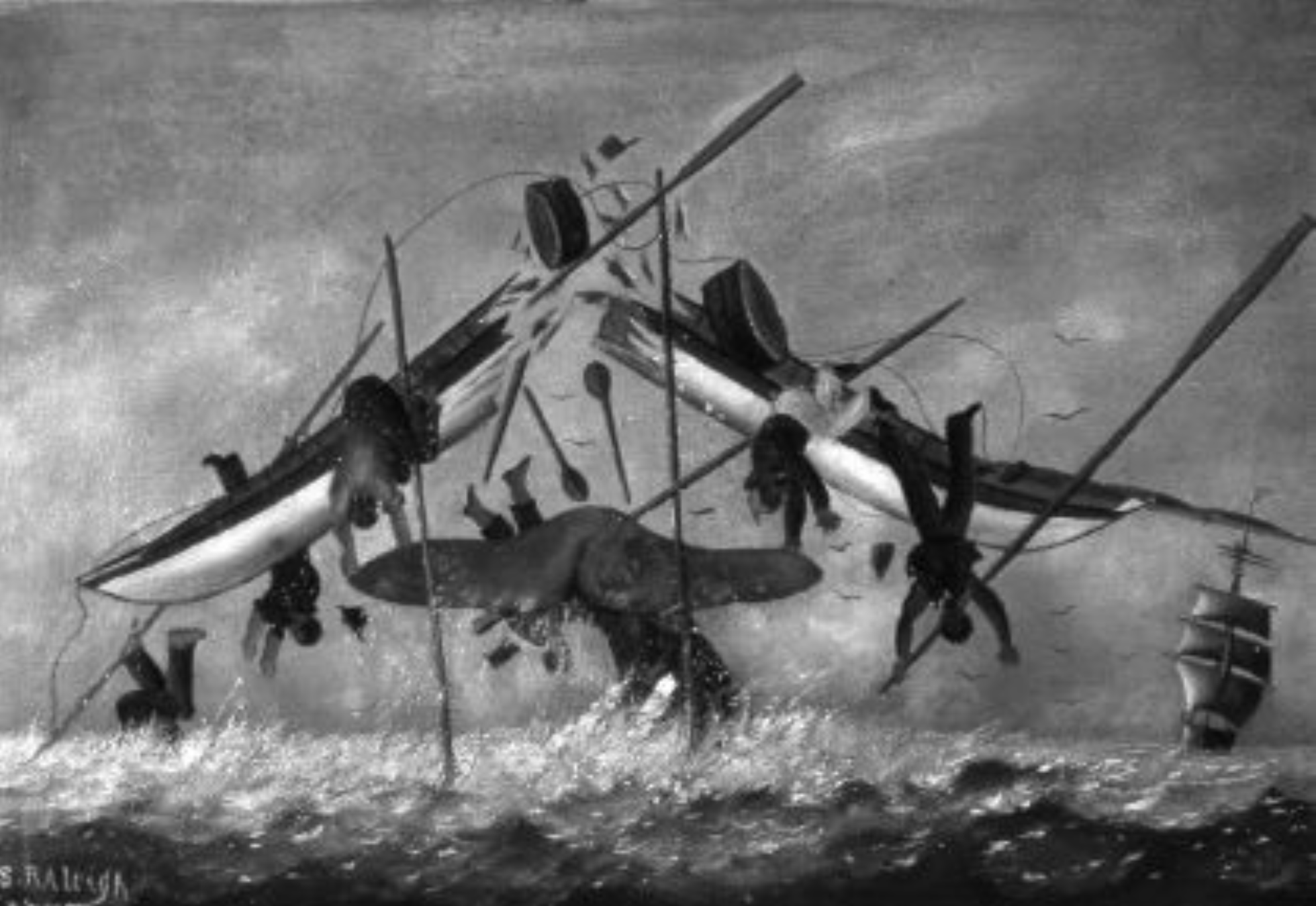
(a very plausible scenario)
And this hunt would take place from small whaleboats, far from the main ship (the whaleboat could be swept along by the whale’s pull, sometimes several miles). And the main ship could be thousands of miles from the closest strip of land. And that closest strip of land could be thousands of miles from the nearest human settlement. Which could itself be… you get the point. It goes without saying that this could happen in the cold waters of extreme latitudes, or in shark-infested tropical seas. Sea conditions compounded all the challenges listed above, as did the living conditions for the crew on a nineteenth-century small ship on a two-to-four-year trip around the globe. Truly not a big surprise that, on a typical voyage, roughly 50–70% of the men who had signed on would desert, die, or be discharged before the ship returned to port.[5]
IV. Nantucket
In thoroughfares nigh the docks, any considerable seaport will frequently offer to view the queerest looking nondescripts from foreign parts… But New Bedford beats all Water Street and Wapping. In these last-mentioned haunts you see only sailors; but in New Bedford, actual cannibals stand chatting at street corners; savages outright; many of whom yet carry on their bones unholy flesh. (Ch. 6, The Street)
Ishmael’s trip on the Pequod (Ahab’s ship) begins in Nantucket; and this is really not surprising, considering the degree to which, at the time, whaling was a North-American (East-Coast) enterprise. By 1851, the United States ran most of the world’s sperm-whale fishery: 329 whaling ships registered in New Bedford, about 735 across all American ports, ten thousand men employed, around four million gallons of sperm oil a year.[6] Most of the fleet had its home port in Nantucket, the Palo Alto of whaling, or in nearby New Bedford, which was, by some accountings of the 1850s, the richest place per capita in America. New Bedford had the deeper harbour and the capital; Nantucket had the original technical know-how, and the prestige.
Like Palo Alto, the place was multicultural and international — whaling ships had the most multicultural crews of any commercial endeavour of the time. A New Bedford whaler in 1850 might have on its deck Black American sailors (some free, some formerly enslaved), Pacific Islanders, Azoreans and Cape Verdeans, Native New Englanders, plus a dozen European nationalities (an inevitability, given the turnover rates noted above). Black officers were rare in any other branch of merchant shipping in the period; in whaling, they were not.
And the Pequod crew is no different. The very first crewman Ishmael encounters is — naturally — the most foreign one available in the times imaginary: a tattooed Polynesian harpooneer named Queequeg, with a tomahawk and a small idol he chants over. The other Pequod harpooneers are no less striking: Tashtego, a Wampanoag from Gay Head on Martha’s Vineyard; Daggoo, a gigantic free African. Harpooneers, on a Pequod-class whaler, were a privileged caste: they ate at the cabin-table with the officers, and were granted a higher share of the catch than the seamen forward.
V. Why the Whales?
Two-thirds of this terraqueous globe are the Nantucketer’s. For the sea is his; he owns it, as Emperors own empires; other seamen having but a right of way through it. The merchant ships are but extension bridges; the armed ones but floating forts; even pirates and privateers, though following the sea as highwaymen the road, they but plunder other ships, other fragments of the land like themselves, without seeking to draw their living from the bottomless deep itself. (Ch. 14, Nantucket)
The main economic drive behind whaling had, as I mentioned, quite the steampunk flavour. The thought that at some point in history the whole of London, Boston, and Philadelphia — among other cities — was lit up with fuel obtained by rendering (melting and processing) the carcasses of animals as long as a coach bus and heavier than a loaded lorry (an adult bull sperm whale is 15–18 metres and 40–60 tonnes), chased down in the most remote oceans, seems to come from the imagination of an overly creative but not particularly reality-grounded fantasy writer.
People in northern Europe have been hunting whales since the Middle Ages, rendering their blubber into lamp oil. That was a different game. The animal in question was the right whale (guess who gave it that name[7]), which was coastal, quite peaceful, and, crucially, floated after being killed. The Basques, off the Bay of Biscay, started commercial right-whaling from coastal stations as early as the eleventh century; the Dutch and English, when the Basques had fished out their local stocks, picked up the trade in the Arctic, hunting bowhead whales through the 1600s. Right- and bowhead-whale oil — “train oil” in the trade — was, however, not much better than other available greases: dirty, smoking, smelly. The premium products from these hunts were not the oil at all, but the elastic keratin plates from the whale’s mouth, baleen, which for most of the eighteenth and nineteenth centuries was worth more per pound than the oil. Baleen ran the corset, hoop-skirt, umbrella-rib, and buggy-whip industries, while the world was still waiting for the first plastics to be invented.
The economic value of whale hunting was limited until, almost by accident, sperm whaling started. The conventional date is 1712, when a Nantucket sloop captained by Christopher Hussey, hunting right whales off the coast, was blown out to sea by a storm and stumbled into a pod of sperm whales. He killed one and towed it home. Nantucketers quickly realised they had a different animal on their hands — one that lived in the deep open ocean rather than coastal waters, dove deep, fought back, and carried in its head an enormous reservoir of a much more valuable substance than train oil: spermaceti.
VI. Spermaceti
Squeeze! squeeze! squeeze! all the morning long; I squeezed that sperm till I myself almost melted into it; I squeezed that sperm till a strange sort of insanity came over me; and I found myself unwittingly squeezing my co-labourers’ hands in it, mistaking their hands for the gentle globules… Come; let us squeeze hands all round; nay, let us all squeeze ourselves into each other; let us squeeze ourselves universally into the very milk and sperm of kindness. (Ch. 94, A Squeeze of the Hand)
Funnily enough, the whole book is studded with this kind of spermaceti-rapture, with whole chapters dedicated to the wax and its container.
Spermaceti is a thick, slightly yellow oil while warm, almost pure white wax once it cools. A large sperm whale’s head contains a vast oblong organ of it — the spermaceti organ, sitting above a smaller fibrous complex of fatty acoustic lenses called the junk. The spermaceti organ alone of a large adult holds something on the order of five hundred gallons of nearly pure liquid wax. The two together are the part of the animal an industrial fishery was, in effect, organised around. In chemistry-speak: spermaceti is a wax ester — fatty alcohols esterified with fatty acids — rather than a true oil, and this made it the burning fuel for the brightest lamps and the cleanest candles of the era.[8] The clean burn was partly chemistry and partly purity: the head spermaceti was effectively a single chemical compound, with much less of the contaminants found in crude vegetable or fish oils. Candlepower, as a unit of luminous intensity, was originally defined as the light of one such candle — precisely because its brightness was the most reliably standardisable available.
This precious substance required a significant scaling-up of whaling operations: sperm whales live in the deep open ocean rather than coastal waters, so the hunt had to go offshore on the two-to-four-year voyages already described, and the animals had to be taken in significant numbers to be commercially worthwhile. Sperm whales were, at the peak of the trade, on the order of 5,000–8,000 animals killed per year by the American fleet alone; the US Lighthouse Establishment used sperm oil exclusively from 1812 until 1862, when the price finally got too high, burning the equivalent of about one whale’ worth of oil per year, per first-order lamp.
VII Ambergris
Now that the incorruption of this most fragrant ambergris should be found in the heart of such decay; is this nothing? Bethink thee of that saying of St. Paul in Corinthians, about corruption and incorruption; how that we are sown in dishonour, but raised in glory. (Ch. 92, Ambergris)
Long before the deliberate fishery, stranded whales were already cornucopias of oddities and useful products, and a whole small material culture had developed around them. Spermaceti itself was recovered opportunistically from beached carcasses and traded as a rare and expensive substance. The most bizarre product, though, was ambergris: a waxy intestinal secretion that the animal passes occasionally, with a musky and faintly sweet scent — used for centuries in high-end perfumery, and, less defensibly, as a supposed aphrodisiac. Ambergris was traded along Arabic and medieval European routes from at least the ninth century, though for centuries nobody could agree where it actually came from. (Hypotheses included sea-foam, bird droppings, undersea fungi, and fossilised resin. The sperm-whale origin was not confirmed until well into the whaling era.)
More macabre and even more curious: there is a documented late-Victorian Australian fad of climbing into the freshly-flensed carcass of a sperm whale to cure rheumatism, reported in the British Medical Journal and the Pall Mall Gazette in the 1890s. The procedure took about thirty hour, and the claimed effects lasted up to twelve months. It was propose to work through some combination of decomposition-heat (essentially a giant compost heap), ammonia fumes, and oil absorption. Sadly, none of this was tested; the fad died with shore-whaling in Australia in the early twentieth century.
VIII. White Whales and Wrackages
So ignorant are most landsmen of some of the plainest and most palpable wonders of the world, that without some hints touching the plain facts, historical and otherwise, of the fishery, they might scout at Moby-Dick as a monstrous fable, or still worse and more detestable, a hideous and intolerable allegory. (Ch. 45, The Affidavit)
We are losing the thread a bit here (in my defence, that is exactly what Melville does for six hundred pages) so let’s go back to the main point of the book’s narrative: is at least the story of a white whale hunting whaling ships Melville’s own invention?
Terrifying as the previous account might sound, it is hard for the modern reader to sympathise with the nineteenth-century sailor’s terror of an animal we now know to have been largely peaceful, and which the same century would proceed to drive to the edge of extinction with no obvious moral compunction. But the unknown is always terrifying, no matter how comprehensively we have killed its inhabitants; and any creature of the abyss has always been an unusually useful image of the unknown. The sperm whale, in 1820, was that — an enormous animal whose life was conducted somewhere light did not reach, who came up briefly to breathe and then went back to whatever it was doing.
Whales were, at the time, considered dangerous creatures, somehow with no regard to the fact that men were the ones pushing them toward extinction. Not that they always accepted their fate passively, either: Melville, when he reaches for the worst-case version of the encounter at the centre of his novel, does not have to invent the scene, because the actual record of the previous three decades has already supplied it.
In November 1820, the whaleship Essex, out of Nantucket under Captain George Pollard Jr., was sunk in the Pacific, about a thousand nautical miles west of the Galápagos, by a sperm whale who broke off from the pod the Essex was chasing, swam straight at the ship, and rammed her at the bow. He turned, came back, and rammed her again, until the ship went down. After the accident the crew spent ninety-three days at sea in the open whaleboats; eight men out of twenty made it miraculously back, after a stretch in which the survivors drew lots over which of their companions they would kill and eat. Owen Chase, the first mate, published his Narrative of the Most Extraordinary and Distressing Shipwreck of the Whale-Ship Essex in 1821, aged twenty-four. Melville read it on the Acushnet, and noted in his marginal jottings that doing so “upon the landless sea, & close to the very latitude of the shipwreck, had a surprising effect upon me.”[9] Who would have guessed?
And the white whale itself is a character out of Melville’s contemporary chronicles, more than of his imagination. Mocha Dick was a real albino sperm whale, “white as wool”, who frequented the waters around Mocha Island off the central coast of Chile, and who survived perhaps a hundred encounters with whalers before being finally killed in 1838; when he was killed, they found around twenty old harpoons in his body.[10] Melville put Reynolds’ named animal on top of Chase’s documented attack, and the result is MD.
IX. Whaling lore
I would argue that the above pretty much concludes the narrative side of the book; and yet, we have barely got started on whaling. The biggest part of the book is devoted to painting, in the smallest detail, an extremely vivid picture of what living as a whaler would actually mean. An extensive sequence of chapters is dedicated to the processing of the whale corpse — a truly non-trivial problem the moment you have to butcher a twenty-tonne piece of meat that you cannot lift and that is also partially underwater. Plus obviously many more chapters on the natural history of the whale, its evolution (in pre-Darwinian terms, of course), its representation in art, its philology, anatomy, phrenology, and theology. There is even a chapter on the whiteness of Moby-Dick. The obsession that only a scientist, or a person who has sailed for months in the high seas pursuing a prey, could develop. But there is a very noticeable absence in the book, that completely escape Melville’s representation of whales.
X. Sound
Therefore the whale has no voice; unless you insult him by saying, that when he so strangely rumbles, he talks through his nose. But then again, what has the whale to say? Seldom have I known any profound being that had anything to say to this world, unless forced to stammer out something by way of getting a living. (Ch. 85, The Fountain)
While the voices of the characters on deck — with all their dialects, inflections, Shakespearean and tragic rhetoric, and even the collective dancing-and-singing scenes — permeate the fictional soundscape, the only sound that comes from whales is their spouting and the splashing of water. The absence is doubly strange in light of our contemporary knowledge that sperm whales are the noisiest creatures on Earth.[11] The water-air interface does not only prevent hunters from ever seeing the full extent of their living prey; it makes it impossible to hear them.
They are noisy, oh they are! But the recognition came late, and as a side-effect of warfare. Underwater acoustics through the twentieth century was driven, more than anything else, by anti-submarine work: the US Navy and its counterparts built large hydrophone arrays — most famously the SOSUS network, deployed across the North Atlantic from the mid-1950s and the North Pacific from the early 1960s — to track Soviet submarines. Among the side-effects was a long archive of incidental biological sound: hours of recordings the navy classifiers had originally labelled “biologics” and ignored.
In 1967, two biologists named Roger Payne and Scott McVay started listening to the Bermuda part of that archive — recordings of humpback whales made off the SOFAR-channel station the navy had been running for years. The humpbacks were producing long, repeating, structured sequences of sound, not the random rumbles the navy classifiers had been throwing out as biological noise. Songs: identifiable themes, fixed phrase order, hours-long sessions, slow seasonal drift in the song’s content across an ocean’s worth of singers.
Humpbacks are not sperm whales; what humpbacks do is sing in long structured songs that travel through the SOFAR channel for hundreds of kilometres, and what sperm whales do is click. But the same generation of hydrophones uncovered both, and once we started listening to one species we started listening to all of them. By the 1970s a great deal more was known about what was actually happening in the ocean’s sound budget than had been known in the entire prior history of the species.
And the other thing Melville doesn’t know is that under that same head, in the spermaceti organ and the junk he has just written six chapters about, lives the loudest sound-production apparatus on earth. The spermaceti organ is not, in function, an oil reservoir, but a click generator, with the junk acting as a set of acoustic lenses that direct and focus the soundwave. A pair of phonic lips[12] at the front of the head produces an acoustic impulse; the impulse passes back through the spermaceti, reflects off an air sac at the rear, comes forward through the junk, and emerges as an extraordinarily directional, extraordinarily loud click,[13] which the whale uses to see in the dark. Sequences of “usual clicks” at half- to one-second intervals scan ahead for prey at ranges up to ~144 metres; rapid “creak” buzzes mark the closing seconds before a capture; codas — short stereotyped patterns — are exchanged between individuals as something that resembles, though is not the same as, conversation. The animal hunts squid by sound, in places where there is no light, the way a bat hunts moths in the night.
XI. Modern Whaling
Ironically enough, the sounds Melville could not have known are also the ones that contributed to ending spermaceti-oil use.[14]
Wait, what? Wasn’t spermaceti replaced by kerosene, gas, and electricity with the beginning of the twentieth century? Why were we still hunting sperm whales in the sixties?
Well, I talked about spermaceti’s properties as a lamp fuel; but the wax-ester chemistry also made it an exceptional industrial lubricant — staying thin under heat, not gumming under pressure, not gelling in cold. It was the preferred oil for fine instruments, precision mechanisms, clockworks; later for early electrical equipment, machine tools, automatic transmissions,NASA equipment. Through the middle of the twentieth century, sperm oil quietly remained an essential ingredient in the parts of the machine age where ordinary mineral oil was not good enough. By accounts, in the early 1970s, the United States was still consuming over thirty million pounds of it a year for these purposes, of which roughly half was being bought by a single company — Mobil Oil — for use, among other things, in automatic-transmission fluid.[15]
This was still the case when, 1970, Payne took recordings from his whales song archive to a producer; Songs of the Humpback Whale, released in June 1970, became the best-selling nature-sound recording in history (by most accounts). It came out about six weeks after the first Earth Day, in the same spring. At that point, cetaceans started gaining huge popularity (to the point that a short excerpt of the same recording would, in 1977, leave Earth on board Voyager 1, on its way out of the solar system as part of the Voyager Golden Record). In the same year as the album’s release — 1970 — sperm whales were listed as endangered under the US Endangered Species Conservation Act of 1969, and the Marine Mammal Protection Act of 1972 then closed the door on spermaceti imports altogether.
The advancing environmentalist legislation put strong pressure on the mechanical and automotive industries: the substance’s properties were very difficult to obtain synthetically or from other naturally harvested surrogates. By accounts, reported US transmission failures climbed from under a million a year before the ban to perhaps eight million a year in 1975, while the engineers scrambled. After a hasty R&D push, sperm oil was finally replaced by a combination of synthetic additives and jojoba oil[16]. A whole jojoba supply chain had to be built, from scratch, over the late 1970s and 80s.
XII. So, what does the whale say?
We have been listening to them for a while now, with steadily better equipment and a growing set of technologies to interpret the data.
Among many others, the Project CETI (the Cetacean Translation Initiative) gained attention as a long-term, multidisciplinary effort — biologists, linguists, roboticists, and machine-learning researchers — to record and analyse the communication of a single resident sperm-whale clan off Dominica, using a permanent array of underwater microphones, autonomous drones, and AI models trained on the resulting corpus. It is well funded and features an array of Deepmind AI researchers, cryptologists and linguists that souls straight out of the Arrival movie. In a 2024 Nature Communications paper, the team proposed that sperm-whale codas have a combinatorial internal structure — modulations in rhythm, tempo, ornamentation, and a kind of frequency variation the researchers describe as analogous to vowels — large enough that the previous count of about twenty coda types may need to be replaced by a much richer space of possible codas.[17] But we are very likely just at the beginning, and who knows what else we will to learn.
It is mind-boggling to see how just failing to observe one crucial communication channel — sound — because of an impedance mismatch we needed microphones to overcome would leave such big gaps in the most meticulous account.
Are there lessons here for the next Leviathans we will obsess over and try to tame?
Your message is stored now and emailed to the author after the contest ends. The author can reply to you, but their identity stays hidden unless they choose to respond.
Footnotes
- ↩
To my own ignorance, of course — I had read very little about the book beforehand, beyond the school-textbook line about a captain, an obsession, and a white whale.
- ↩
See Melville’s Marginalia Online, which reproduces Melville’s actual library and notes; the Extracts chapter is roughly eighty quotations long.
- ↩
Although some countries refuse to comply and keep hunting and eating whales, ostensibly for research. The 1982 IWC commercial-whaling moratorium permits indigenous subsistence catches and “scientific” takes; Japan, Norway, and Iceland have at various times exploited the latter loophole to a degree that would not pass an undergraduate ethics committee.
- ↩
The one-in-four figure is repeated by several period whaling memoirs and modern syntheses (Dolin’s Leviathan, 2007, summarises the historical literature). A clean primary-source citation for the exact fraction is not easy to pin down; the qualitative claim — that a meaningful share of every hunt’s boats ended up swamped or stove — is uncontested.
- ↩
Fleet- and production-level statistics elsewhere follow Davis, Gallman & Gleiter, In Pursuit of Leviathan (NBER / University of Chicago, 1997) and Alexander Starbuck, History of the American Whale Fishery (1878).
- ↩
Fleet- and production-level statistics elsewhere follow Davis, Gallman & Gleiter, In Pursuit of Leviathan (NBER / University of Chicago, 1997) and Alexander Starbuck, History of the American Whale Fishery (1878).
- ↩
Whalers, of course — the “right” whale was the right one to hunt: slow, coastal, fat-rich, and (the deciding factor) it floated after being killed.
- ↩
Wax esters lack the glycerol backbone of triglycerides, so they combust more completely and produce less of the acrid acrolein that ordinary seed- and animal-oil lamps emit.
- ↩
Chase’s Narrative of the Most Extraordinary and Distressing Shipwreck of the Whale-Ship Essex (W. B. Gilley, New York, 1821) was reprinted by Penguin in 1999, with Thomas Nickerson’s later account and Melville’s marginalia. Nathaniel Philbrick’s In the Heart of the Sea (Penguin, 2000) is the modern reconstruction. Melville’s annotated copy of the 1821 Narrative is in the Houghton Library at Harvard, MS Am 188.4.
- ↩
Reynolds, J. N., “Mocha Dick: Or The White Whale of the Pacific: A Leaf from a Manuscript Journal”, The Knickerbocker, vol. XIII no. 5 (New York, May 1839), pp. 377–392.
- ↩
By source level, measured in decibels referenced to one micropascal at one metre, sperm-whale clicks reach about 230 dB re 1 µPa — the loudest biological sound ever measured.
- ↩
Anglicised by the old anatomists as “monkey lips”, from the French museau de singe.
- ↩
Decibel comparisons under water are confusing because the reference pressure is different from the airborne dB scale, but the order is right: an airborne 230 dB would be physically impossible, whereas under water at high pressure it is just very, very loud. Møhl et al., J. Acoust. Soc. Am. 114, 1143 (2003).
- ↩
Contributed, it should be said — it is obviously hard to assign causal credit to a single record album or campaign over the political work, scientific advocacy, and shifting economics of the period. But it is reasonable that Songs of the Humpback Whale and its kind played a real role.
- ↩
The corporate-by-corporate transition out of sperm oil after the 1972 US import ban is documented in pieces; the headline numbers (30 million lb/yr industrial use pre-1972, 8 million transmission failures/yr in 1975) circulate via journalism more than ledgers. The qualitative claim should be robust: sperm oil was extraordinarily hard to replace, and the auto industry replaced it only with jojoba oil plus a great deal of additive chemistry.
- ↩
The seed oil of Simmondsia chinensis, a desert shrub native to the Sonoran Desert borderlands between southern Arizona and northern Mexico, whose chemistry happens to be a very close match for spermaceti (also a wax ester, by molecular accident).
- ↩
To be honest about the size of the result: structure is not the same as meaning, and combinatorial is not linguistic until somebody finds the semantics; but the structural finding alone is more than anyone working on whale sound expected to see, and the researchers themselves are careful not to overclaim.