In his 2005 commencement address at Kenyon College, David Foster Wallace states:
There is no such thing as not worshipping. Everybody worships. The only choice we get is what to worship. And the compelling reason for maybe choosing some sort of god or spiritual-type thing to worship – be it JC or Allah, be it YHWH or the Wiccan Mother Goddess, or the Four Noble truths, or some inviolable set of ethical principles – is that pretty much anything else you worship will eat you alive. If you worship money and things, if they are where you tap real meaning in life, then you will never have enough, never feel like you have enough. It’s the truth.
The crisis of Modernity is that we lost something greater than ourselves to believe in. Having lost a source of meaning outside of ourselves, we turn inside ourselves. What do we find there? Nothing good. Sifting through the dark tangle of desires, doubts, vanities, perversions, and neuroses inside of us, we erect idols. We become addicted to ourselves. We make money, we watch porn; we tend to our social status, we eat junk food; we get nose jobs, we take drugs. We are prisoners to ourselves. Our selfs.
Thirty years before Martin Amis wrote Money, Nabokov, when asked what inspired him to write Lolita, responded by describing a German newspaper article. An ape was taught how to draw: the first thing he draws is the bars of his own cage. John Self, the protagonist and narrator of Amis’ Money, is just such an ape. Looking up at a particularly weatherless day in his native London, he remarks: “it’s hard to tell the air from the impurities in our human eyes…rain, spores, tears, film, dirt. Perhaps, at such moments, the sky is no more than the sum of the dirt that lives in our human eyes.”
John Self’s, and indeed all of our eyes, are covered with a film that remakes our perception of the world into a representation of ourselves, a film that turns the world into a film – a movie – where we are the star actor. In John Self’s case, the movie is a pornographic movie. Everything that John Self’s eye, hand, and dick touches is remade according to his perverse desires. The world becomes nothing but the feeding ground of his addictions: women, booze, money, junk food. The book can be read as a spectacle of Self’s addictions, but also as a detective novel, one wherein the reader is tasked with finding what John Self’s real – unsexy and unglamorous – desires are. Money, then, is simultaneously pornographic and sentimental. This review will engage with both of these dimensions.
John Self is a man addicted to the 20th century. The novel, published in 1984, opens with John Self en route from JFK to a snazzy hotel on the Upper West Side. He is in New York to make a movie, called either Good Money or Bad Money (it’s never quite made clear to the reader), with an American named Fielding Goodney. Fielding Goodney is a grotesquely polished social climber who knows how to tell everyone – investors, actors, Self, himself – exactly what they wish to hear. (The reader of this review is advised to read Goodney’s name out loud and note its auditory resemblance to “feeling good”.)
Money is the funniest book your erudite reviewers have ever had the pleasure of studying. The whole thing runs on the incomparable voice of John Self, one of literature’s all time most enthralling narrators. He’s an astute, loquacious, buffoon. He and his world are a spectacle.
On the streets of New York, John Self is pure energy, pure chaos. He runs on the fuel of his addictions, which keep their own time, their own demands, their own voices. He succeeds marvelously at nearly everything he does, which consists primarily of drinking, eating, visiting brothels, making “experimental” visits to the bathroom, bullying, getting beaten up, making money, and treating us to unorthodox and out-of-pocket observations about absurd New York City:
New York is a jungle, they tell you. You could go further, and say that New York is a jungle. New York is a jungle. Beneath the columns of the old rain forest, made of melting macadam, the mean Limpopo of swamped Ninth Avenue bears an angry argosy of crocs and dragons, tiger fish, noise machines, sweating rain-makers. On the corners stand witchdoctors and headhunters, babbling voodoo-men – the natives, the jungle-smart natives. And at night, under the equatorial overgrowth and heat-holding cloud cover, you hear the ragged parrot-hoot and monkeysqueak of the sirens, and then fires flower to ward off monsters. Careful: the streets are sprung with pits and nets and traps. Hire a guide. Pack your snakebite gook and your blowdart serum. Take it seriously. You have to get a bit jungle-wise.
There is one thing that Self fails at, which is meeting with his friend and love interest Martina Twain. Martina is shown to be a kind and thoughtful upper-class woman, though Self describes her as a “sicko who saw nothing in me but myself”. The concept of disinterested human connection is preposterous for Self, for whom human interaction is always purely transactional. And yet human connection is what he desires most of all. In a scene midway through the novel, Self makes heroic efforts to wake up on time for breakfast with Martina, yet the internal clock of his addictions wakes him up twelve hours too late. His mistake forces him to confront, briefly, a world that runs on “objective” time rather than the solipsistic gratification-withdrawal cycles that govern him, a world that passes him by and leaves him stranded, alone, without human touch. John Self cannot bear this, and he goes on a bender. This pattern of trying and failing to meet Martina and then consumptively coping plays out multiple times throughout Money.
It’s fascinating to see how Self thinks about all this, because his mind is simultaneously astute and broken. For all his linguistic virtues as a narrator, he lacks the vocabulary and mental space to articulate his real desire, human connection. But every very once in a while, the flow of his pornographic verbiage slips, and he comes close to understanding his deep loneliness. At one particularly difficult moment, when his actors aren’t cooperating and when he can’t reach his pay-for-sex girlfriend in London, he breaks down and despairs:
After all we are only human beings down here, and we could do with a lot more praise and comfort than we actually get. Earthling reassurance – it’s in permanently short supply, don’t you think? Be honest, brother. Lady, now tell the truth. When was the last time a fellow-Earther let rest your head on their heart, caressed your cheek, and said things designed to make you feel deeply ok? It doesn’t happen often enough, does it? We’d all like it to happen more often than it does. Can’t we do a deal?
Alas: even in this moment of vulnerability and sincerity, the language of transaction, performance, and pornography slips in – “in permanently short supply,” “designed to make you feel ok,” “can’t we do a deal.” Self simply cannot perceive the world through any lens other than the transactional.
As exemplified above, a distinguishing feature of Self’s voice is its usage of second person. Self loves to address the reader (or at least some vague “you”), and his penchant for doing so is deeply tied to how his money-addled mind sees the world. These second-person constructions create an audience ex-nihilo. They are performative utterances that create for Self the spectators of the pornographic movie he stars in, but it also creates the illusion of human connection – dear reader, you are here with me, I am not alone! Of course, the reader does not actually exist in John Self’s world, and Self’s soliloquies do nothing to solve his loneliness. He speaks into an empty room and we savor his language – as glossy as the pages of a pornographic magazine – from the one-way mirror that is a novel.
Loneliness, in the world of Money, is isomorphic to pornography. “I realize, when I can bear to think about it, that all my hobbies are pornographic in tendency. The element of lone gratification is bluntly stressed.” Pornography coincides with spectacle and surface. By dedicating ourselves to ourselves, we sink below our surfaces, and those surfaces become merely that: they lack any indications or entrances into our messy human interiors. “My theory is that we don’t really go that far into other people, even when we think we do. We hardly ever go in and bring them out. We just stand at the jaws of the cave, and strike a match, and quickly ask if anybody is there.”
Here is, of course, a pun on going far into other people. The only ‘going into’ that does happen and can happen in the world of Money is pornographic in nature. Indeed, soon after John Self voices his desire for the human touch, he gets a 4D simulacrum of it. Self is called on by Fielding to comfort and assuage the fears of an aging and suddenly pious actress named Catuda Massi (in Italian: falling mass). Catuda is set to play a role in their film Good Money (or is it Bad Money?), but she refuses to have on-screen sex in the movie. Disagreement ensues, which leads to Catuda treating Self to empirical proof of the un-screenability of her breasts. His face pressed to the falling mass of her maternal breast, Self feels a semblance of the maternal love he never got and, though realizing the spectacle of this whole act, he cries and vows to protect Caduta from the pornographic demands of movie studios and audiences. We are left to wonder: does anything real happen here, or is this always, already, still pornography?
Beyond human touch, John Self expresses other, more vague, desires: “Look at the dogs in the street, how everything implicates them, how everything is their concern, how they race towards great discoveries. And imagine the grief, tethered to a fence, when there is activity – and play, and thought, and fascination – just beyond the holding rope.” The holding rope and fence are, in this analogy, the addictions that John Self worships and which keep him trapped within himself. However, when he can bear to think about it, he realizes that he is missing out on how fascinating and immersive the world can be when it is not viewed through the lens of transaction and gratification. On the rare occasion this happens, the overwhelming and beautiful grandeur of the world reveals itself.
Once, for instance, he wakes up without a hangover. It takes him a while to be sure that he is not dying, and when he becomes assured of it, he is able to ease into the surprisingly bearable lightness of being. Sitting in Martina Twain’s garden, he for once feels a tentative and suspicious harmony with a world that isn’t the 20th century one but that is (as much as is possible in always already stylized New York) natural, disinterrested, organic: “I felt like a flower: a little parched, of course, a little gone in the neck, and with no real life to come, perhaps, only sham life, bowl life, easing its petals and lifting its head to start feeding on the day.” (336)
Such an identification with a flower is somewhat baffling for a man who presents himself as a tough guy who fucks and fights and watches hard-core porn, but behind this stylized persona we can sometimes glimpse the real John Self: someone who has been corrupted by the world he lives in, who wants to get better but doesn’t know how, who has an immensely strong, unbreakable spirit which lives on despite the various addictions that dampen and muffle it. At his core – John Self would call it his “soft core” – he is a softie, a lonely guy who seeks sympathy and love, and he truly does become sympathetic to the reader who resists being distracted by the pornography.
The novel, like this review, shifts back and forth between the narrative drama of making Good/Bad Money and of Self’s (attempted) relationship with Martina Twain. Martina is the only person that Self even tries to relate to in nontransactional terms. Yet simply by virtue of her kindness in treating Self as a human being, she is a challenge for him, something out of his world. He asks her for help becoming a better person, and she gifts him a copy of Animal Farm. This simple action completely overwhelms him. It is an action alien to him, an action that comes from a world that isn’t his, an action that comes from the world of the flower. For the rest of the novel, Self struggles to read beyond the first sentence, yet he tries, because, as he expresses elsewhere when Fielding is apostrophizing Rimbeau and The Sound and the Fury, he is tired of not knowing: “Oh Christ, the exhaustion of not knowing anything. It’s so tiring and hard on the nerves. It really takes it out on you, not knowing anything.”
What Self yearns to know, the thing inside him which leads him to feel not only like a flower but also — in an effort to identify with something that isn’t a product of the 20th century — a dog, is that other world. Self, as he never fails to remind the reader with his floundering and philandering, has that dawg in him, but what he really wants to have is that dog in him, as quoted above. Dogs are able to be continually fascinated with the world because they lack ego. John Self years to break free from his egotistical desires and interact with the world in an immersive and spontaneous way. Like former ISIS leader Abu Bakr al-Baghdadi, the spirit of John Self is as dead as a dog, yet his soul is innocent.
The whole movie deal ends up being a scam. Self thought that the world was a theater of his desires, but it turned out he was an unwitting actor in Feilding’s perverse power-trip farce. The deal was never real, the investors were never real, the money was never real, and the world literally falls apart like a badly-constructed stage set. The exact plotline throughout all this is rather confusing and possibly even incoherent, but the reader is left with the understanding that this whole thing was basically one big prank on poor John Self.
In one sense, Money is about John Self making money and spending money and being implicated in the complex webs of greed and gratification that solipsism that money creates. This is the story that Self feels he lives in, and it’s one he wants to break out of: “I long to burst out of the world of money and into what? Into the world of thought and fascination.” In another sense, Money is about John Self trying to finish Animal Farm, rushing to finally be on time for a meeting with Martina Twain, and searching for human touch that is not pornographic. It is about Self trying to become a better person and failing because his only way of understanding the world is through money.
In yet another example of John Self’s moral yearning being converted into the currency of, well, currency, he talks about how he wants to make as much money as possible in order to get a full-body – full, ultimately, everything – transplant in a plastic-surgery clinic in California. This explicitly spiritual thirst for transfiguration also cannot escape the language of pornography. He often describes himself, paradoxically, as if he is a religious ascetic, undergoing the bodily suffering of his addictions. Self has an immense life force within him and nowhere to channel it but in pursuit of money and hedonistic desires. The heavenly world of thought and fascination remains out of reach.
John Self is a man of his time and place, a time and place in which everything is pornography, spectacle, performance, money. Everything is oriented towards the self. Money is a book about the crisis of Modernity, one which is easy to formulate but overwhelmingly difficult to really understand. It’s no good to worship the self.
2
“In the end, the question hanging over almost everyone in Middle Earth is which Lord will you serve?”
People need something bigger than themselves to believe in. We need something to orient ourselves towards. Before agriculture and cities, that thing was tribe and tribal religion. “In Java, for example, the people quite flatly say, ‘To be human is to be Javanese.’” Then came polity, organized religion, nation, ideology. When these things vanish, we orient ourselves towards Money. [0]
Capital-M Money is not the same thing as money. Capital-M Money is a metonym for self-obsession, self-gratification, and the variety of goals they engender: pleasure, hedonism, fame, clout, status, power, money. John Self is addicted to Money; John Self is addicted to himself; John Self is addicted to pleasure; John Self is addicted to the 20th century. These are all saying the same thing.
What does it mean to believe in something greater than yourself? It means that you believe that there is something not only worth living for – a life of material comfort and pleasure can be worth living for – but worth dying for. It means having the perspective that while you may be tiny compared to the world, you are a part of it, and you are a part of something vastly more important than any one person. It means understanding that there is a source of deep meaning external to yourself. This bigger thing provides an encompassing framework for understanding the world. It tells you who you are, what makes you you, what matters, what the right thing to do is. In other words, it tells you how you should live your life. It provides an ontology and an ethics. Through all this, the greater thing gives you something to orient yourself towards.
Beyond all this – or perhaps by virtue of all this – the greater thing acts as a source of spirituality for those who believe. The greater thing defines what is sacred. It picks out some aspects of life and elevates them. There is an inherent nonfungibility to the sacred, and note the tension here with the one of the pillars of the world of Money, in which everything is for sale, everything can be traded.
All of this is easier to grasp through example than through definition. We mentioned some classes of bigger things earlier: tribe, tribal religion, polity, organized religion, nation, ideology. The reader is invited (implored, even) to take a few moments and think about how this plays out for a particular greater thing with which they are familiar.

Money takes place in a hyperbolic 1980s America, an America which is completely devoid of belief in anything other than Money (in the metonymic sense, remember). It’s clear that America has not always been like this. Indeed, for most of the history of the United States and its precursor colonies, people were very religious. What happened? We find the events of the past one hundred years to be very relevant to the broader question that we’re interested in, so we wish to briefly tell its story through the theme of belief in the greater. Alas, we lack the time to give this topic its due diligence; the reader is advised to plug the gaps in our story if they so desire.
In the 1900s, religion declined in prominence and strictness, and the idea of the nation as a higher ideal came in to fill this gap. In the US in particular, there has always been a kind of fusion of Christian ideas with national ideas (more on this in a minute). Then World War 2 happened, and then the beginning of the Cold War, and this is perhaps where American nationalism was at its peak. Then begins the decline with Vietnam, and then stagflation and the various failures of the ‘70s. This brings us to the ‘80s, the decade in which Money takes place. At this point, American nationalism as an orientation has been eclipsed by Money, at least among a certain milieu.
“But what”, the patriotic reader cries, “about the dream of the 90s which is alive in Portland American Dream?” Excellent question, reader. The American Dream is particularly interesting because it’s a kind of Nationalist/Christian/Moneyist hybrid. Chris Arnade – walker, writer, philosopher, and former bond trader – writes:
Nations are not an outdated idea to move beyond, because without them, in our secular modern world, then there is nothing else that gives people meaning, and people need more than the economic. They need to feel a valued member of something larger than themselves, and that is ultimately what countries have been, and still can be, if they choose to be…
In the U.S., where the American Dream is our shared thick culture… you can live how you want, eat what you want, live (up to a point) how you want at a thin level, as long as you ultimately believe in making big money through hard work and playing by the rules…
The American Dream is best summarized as Careerist Christianity.
The issue with the American Dream today is that the nationalist element is missing. On first glance this seems fine, since we still have Christianity in the mix, which should function as something greater to believe in. But when you look at what the Christian/Money orientation leads to without nationalism, the picture is surprisingly grotesque. Due to the strong anti-money-worshipping beliefs of Christianity, extreme theological contortions are required in order to make this all work. The Man Himself, Christianity’s very own Jesus, the eponymous Christ, said “You cannot serve God and Money.” Some, it seems, have taken this as a challenge. Such attempts are being played out in real time in various sects across America and have brought exciting new postmodern interpretations of the Bible (such as Prosperity theology.) “The love of money”, Apostle Paul says in Timothy 6:10, “is the root of all evil.”
This is an America-centric review of an American and England -centered novel, but the loss of belief phenomenon we’re describing is by no means unique to the western anglosphere. A similar tale can be told for Russia, which like America was historically a deeply ideal-oriented society (although its ideals were rather different). There is a poem that every Russian elementary schooler learns by heart:
Russia cannot be grasped by the mind
Nor can she be measured with a common yardstick
She has her own path:
Russia can only be believed in.
This narrative of Russian exceptionalism has existed, in one form or another, since as long as any Russian can remember and is tied, primarily, to Russia’s unique position between the West and the East and its sheer enormity. These unavoidable geographical facts make the theory of exceptionalism difficult to topple completely, a theory that seeps into the discourse of even the most liberally-minded, western-orientated Russian intellectuals. This idealism, however, is completely void of any content. No one has yet figured out what exactly Russian’s path is: indeed, its inscrutability is part of its essence. And so, this ingrained idealism has made it very easy to introduce systems of belief – they initially spread like wildfire, aided by an enthusiasm for something to believe in right now, ASAP, immediately, and these top-down implementations either take centuries to become integrated (Christianity) or fail miserably (Communism).
In Adam Curtis’s documentary Can’t Get You Out of My Head, he describes Russia undergoing a rapid and total collapse of belief, first in communism and then in democracy. After an onslaught of corruption scandals in the late 1990s, “the idea that Russia could become a society of free individuals was now seen as a joke. No one believed in communism or democracy any longer.” The Russian people had been betrayed by communism and democracy – betrayed by idealism – and developed a kind of learned helplessness around trying to change the world by believing in something bigger than themselves. For Russians, “the only way to escape from that horror [the horror of communism] was to stop trying to change the world, stop trying to reshape reality.” According to Curtis, the past taught them that “the safest thing to do in the future was to believe in nothing.” Putin figured this out: he is a man who believes in nothing and wraps this nothingness in the rhetoric of Russian exceptionalism. With Putin, Russians can feel like they believe in Russia without really believing anything.
Today, the idea relating to one’s nation as something bigger than oneself, as something to worship and something to die for, is rather démodé, if not problematic or downright stupid. The problem we run into is that without nation, religion, or ideology, we are left with nothing external to ourselves to worship. We have, in the words of Curtis, “given up on utopian ideas about the future and don't believe in anything any longer, apart from the money.”
3
What sphinx of cement and aluminum bashed open their skulls and ate up their brains and imagination?
There is a phenomenon in which a bright-eyed, idealistic, anthropic young person – a person who really cares about something greater than themselves – decides that their plan will be to spend a few years making money so that they can later pursue the thing they really care about more effectively. Thus they begin their journey. As the years go by and they make more and more money, their belief in this greater thing slowly erodes. Their orientation towards the greater thing initially points them towards money as a point on the path towards the ideal. As they follow the course to money, something strange happens. Money – and here we’re talking about capital-M Money – gradually, quietly, invisibly tampers with their compass. Five years go by, and the person has now made enough money to change directions according to their initial plan. But now it seems that they need a little more money before changing direction. Time passes, they make more money, and it seems once again that they would like to make a little more money. And so on and so forth. At some point, the poles complete their shift. The north star, once the very thing that illuminated this person’s life with meaning, has transformed into the luminescent lure of Money.
(Certain readers will accuse the reviewers of mixing their metaphors here. “Is Money the shifting poles? Or is it the north star? Or is it some creature that possesses luminescent lure?” Such a reader will soon be regretting their boldness, for he or she has fallen into our trap! Money is not any one of these things in isolation. Rather, it is the eldritch entity behind them all. One imagines Money as a horrifying galaxy-sized anglerfish for whom the north star (or rather its celestial image as seen from Earth’s surface) is an appendage; this connection is obvious upon viewing a photograph of an anglerfish.)
This story of going from “I want to make money so I can do this other thing I really care about!” to “What was that silly thing I cared about when I was young?” is, sadly, a familiar one. Why do we so often lose our other beliefs when we start pursuing money? Because to make money, you gotta want it. A great way to make money is to really want to make money. If you really want to succeed in your job, you have to fully buy in. And that experience of “fully buying in” necessarily changes you. You have to let go of certain parts of yourself – parts that want other things, parts that have other goals that conflict with making money. You reinforce only the parts of yourself that are aligned with Money. The hope is that you would only be doing this for a little bit, that afterwards you could calibrate and recenter and go back to who you were before. If only.
A key element of this, the reason that money is less like a treasure and more like a siren call, is the positive feedback loop. Trying to make money changes you. It turns you into someone who wants to make money. You try to make money, which makes you want money a little more, which makes you try harder to make money, which makes you want money more, and so on. In other words, money corrupts. The broader phenomenon here is an example of what the philosopher of games C. Thi Nguyen would call value collapse. In his 2026 book The Score, he writes:
Values control what we seek out. And then the other stuff, we dismiss. Dismissing things isn't necessarily bad; it's part of basic human functioning. The world is overstuffed with things, and we need to ration our attention. We are constantly doing attentional triage; our values guide that triage. But the problem is that what's really valuable in the world is often subtle. So we if we [sic] triage too hard, we might end up throwing out all the subtle values, without giving them enough of a chance. [1]
Of particular relevance to us is the next paragraph:
Let's call this value collapse. This is a feedback loop whereby oversimplifying your values changes how you approach the world, what you notice about it, and what you spend time exploring. So you run into a narrower set of experiences-which in turn reinforces your oversimplified values. Value collapse is the worst possible end result of value capture. The image I have in my head is of a star collapsing from its own gravity and forming a black hole. Once you've gone this far, there's no escape.
So then. Our bright-eyed, idealistic, anthropic young person has yielded to the siren call, fallen into the black hole, succumbed to value collapse. The critical reader may ask: is this so bad? The reviewers will refer them to the first segment of this review, in which Money was used to illustrate that yes, it is so bad. Still. Our thesis here is about the crisis of modernity. So let us turn our attention to modernity’s Mt. Doom, the locus of 2026, that mythical peninsula where heaven and hell meet at a fault line. We’re talking, of course, of San Francisco.
4
They broke their backs lifting Moloch to Heaven! lifting the city to Heaven which exists and is everywhere about us!
An acquaintance of ours once remarked that people in San Francisco don’t know the difference between socializing and networking. Indeed, dear acquaintance, indeed. Nowhere embodies the belief in Money and illustrates its effects as intensely as Silicon Valley, “Silicon Valley” being used here in the metonymic sense. San Francisco is renowned for its homelessness and fentanyl zombies, massive salaries and inequality, burglaries and bips (as car break-ins are affectionately referred to by locals)
Filth! Ugliness! Ashcans and unobtainable dollars! Children screaming under the stairways! Boys sobbing in armies! Old men weeping in the parks!
housing policy
big beautiful bridges. What we’d like to focus on here, though, is something much less known. It’s a kind of spiritual, even mystical inclination towards something strongly resembling Money that can be found among a few of Silicon Valley’s fortuitous inhabitants. These memetic pioneers have found a way to parlay their orientation towards money into a sincere belief in something greater than themselves. The exemplars of this new belief system are Roon, Marc Andreessen, and E/Acc.
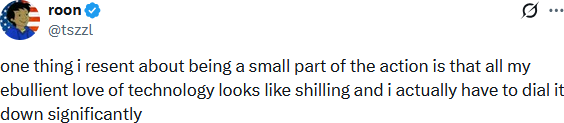
For these people, money is inherently tied to technology and progress. They take the phrase technological progress through capitalism to be both descriptive and prescriptive. The obvious text to point to here is The Techno-Optimist Manifesto, which intentionally functions as both ontology and ethics. Take a look at some different sections:
Lies
The myth of Prometheus – in various updated forms like Frankenstein, Oppenheimer, and Terminator – haunts our nightmares.
We are told to denounce our birthright – our intelligence, our control over nature, our ability to build a better world.
We are told to be miserable about the future…Truth
Our civilization was built on technology. Our civilization is built on technology. Technology is the glory of human ambition and achievement, the spearhead of progress, and the realization of our potential…Becoming Technological Supreme
We believe that advancing technology is one of the most virtuous things that we can do.
We believe in deliberately and systematically transforming ourselves into the kind of people who can advance technology…Technological Values
We believe in ambition, aggression, persistence, relentlessness – strength.
We believe in merit and achievement…
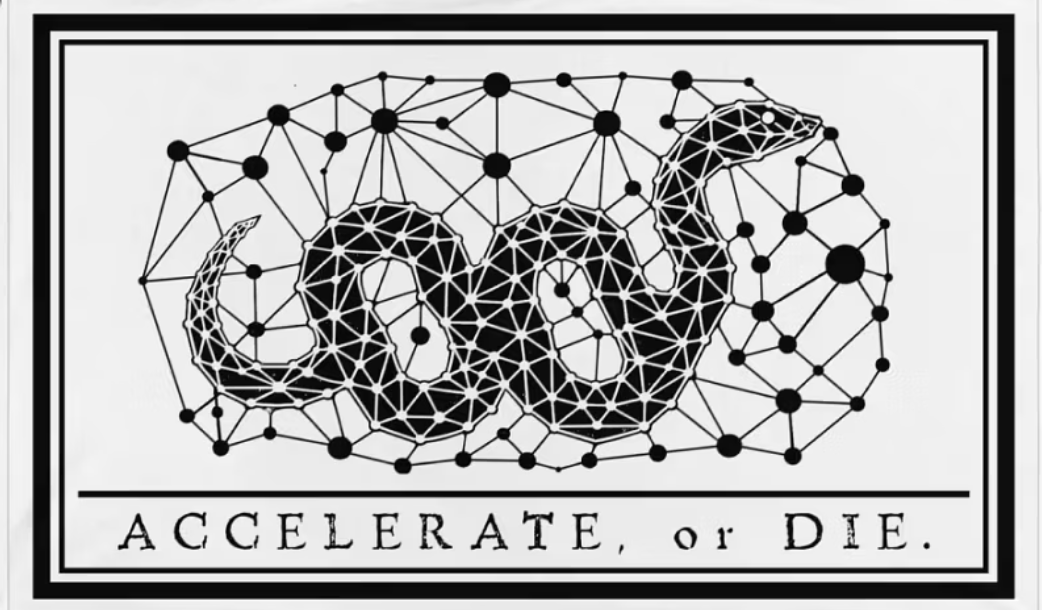
This is belief in Technocapitalism as something bigger than ourselves. Technology, progress, and capitalism become aestheticized. The technocapitalist machine becomes an object of worship. The telos of Capitalism and the telos of the individual become unified. This is all communicated quite elegantly by the E/Acc flag.
Westward, remember, the Course of Empire Takes Its Way.
Your reviewers speculate that there exists a kind of pipeline by which Silicon Valley intakes people who are oriented towards some non-capitalistic ideal and outputs people who are oriented towards money. Out west come tech visionaries who are actually visionaries; founders that actually care about their companies’ purpose; bohemians with plans to change the world. Into the maw comes the ambitious, intelligent, idealistic young person that is the bread and butter of Silicon Valley’s machinations. Out comes two types: the lucky, who end up believing in Technocapitalism; and the unlucky, who end up, disillusioned, believing in nothing but Money.
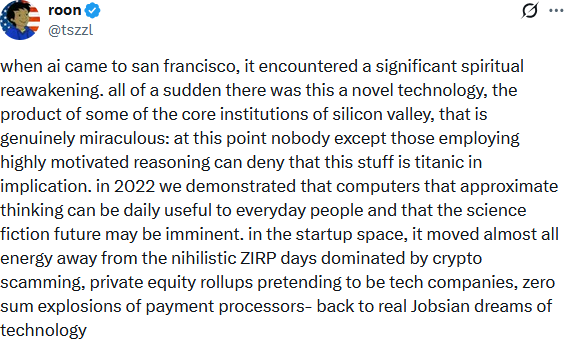
Speculations aside, it’s remarkable that Techno-Optimists have found a way to worship lowercase-m money without worshipping capital-M Money. Granted, the thing they worship sure looks a lot like Money; scholars more daring than ourselves have theorized that Money and Technocapitalism are but two heads of a higher dimensional hydra named Moloch. In any case, the existence of the Techno-Optimists shows that people are trying (and perhaps even succeeding, although the reviewers will admit they find something about the whole thing rather sus) to find an orientation towards money that does not collapse into self-worship, to find a way to worship money without draining the world of sacredness.
5
Moloch whose name is the Mind!
Let us return for a moment to the world of Money, a world which is, as the reader will recall from the first part of this review, deeply pornographic. Of course there’s the literal pornography, of which John Self is both an avid consumer and producer. But it’s not just that. The pornographic is often distinguished with the erotic. The world of Money is a world of transaction and gratification, performance and spectacle, solipsism and loneliness. The pornographic is these things; it is the consumptive, shallow, self-oriented way of relating to others and to the world around you. The erotic is the genuine, deep, other-oriented way of relating to the world. Pornography is the body, the sexual, the objective, the safe. The erotic is the soul, the sensual, the subjective, the vulnerable. erotic is the soul; pornoraphy is sexual, erotic is sensual; pornography is objective, erotic is subjective; pornography is safe, erotic is vulnerable.
Why do we care about all of this? Because the pornographic/erotic dichotomy is the exact same thing as the profane/sacred dichotomy. And (as per the first part of this review), in the world of Money, loneliness is isomorphic to pornography. Recall, dear reader, that John Self catches a few brief glimpses at a world that is not his – once from a flower, once from a dog, and once from the simple kindness of Martina Twain’s gift of Animal Farm. In these moments, he is transported from his world, the lonely, pornographic world, to the erotic world. He is transported from the profane world to the sacred world.
We lack belief in something greater than ourselves, and as a result our worlds lack sacredness. Everything’s amazing right now and nobody is happy, observes Louis C.K. (a man oddly similar to John Self). [2] We are spiritually bereft. [3]
The desacralization of life and its consequences have been a disaster for the human race.
Your message is stored now and emailed to the author after the contest ends. The author can reply to you, but their identity stays hidden unless they choose to respond.
Footnotes
- ↩
Some readers will note the connection between ‘needing something bigger than yourself to believe in’ and the concept of a “God-shaped hole”. While evocative, we find the God-shaped hole image is ultimately too distracting and baggage-laden to discuss in the body of this review.
- ↩
The idea that subtle values are easy to discard (and legible values easy to uplift) is an interesting point, one which supplements the explanation we have given. After all, money is perhaps the most legible thing that exists!
- ↩
Depression is a paradoxical ailment of modernity, one whose existence itself can cause existential despair. In Capitalist Realism: Is There No Alternative? Mark Fisher writes:
Many of the teenage students I encountered seemed to be in a state of what I would call depressive hedonia. Depression is usually characterized as a state of anhedonia, but the condition I'm referring to is constituted not by an inability to get pleasure so much as it is by an inability to do anything else except pursue pleasure. There is a sense that 'something is missing' - but no appreciation that this mysterious, missing enjoyment can only be accessed beyond the pleasure principle…
[What people today suffer from] is being trapped within themselves - in a world of individualism everyone is trapped within their own feelings, trapped within their own imaginations…[2.5]Fisher has some good thoughts here. One cannot help but be reminded of a certain John Self.
- ↩
In the words of DFW, what we have today is “the freedom to be lords of our tiny skull-sized kingdoms, alone at the centre of all creation.”
- ↩
In his 2024 essay My Spiritual Awakening, Tao Lin writes:
The lack of this belief renders life absurd for many people, leading at best to a playful sort of existential humanism, and at worst to suicidal depression, nihilistic hedonism, or the endless pursuit of money and power. I coped with the meaninglessness of existence by creating and consuming dark-humored art and, when that wasn't enough, by taking drugs.