Joshua Greene thinks we suffer from "The Tragedy of Commonsense Morality." Our moral intuition evolved to enable ingroup cooperation. But the world has changed. Modern technological societies exist at tremendous scale. Our daily institutions—work, school, commerce—now require cooperation from outgroups. We're not good at this.
Moral Tribes was written in 2013. It was hugely ambitious. Greene wanted to lay the groundwork for a rational approach to moral discourse. He was in many ways unsuccessful. The book was met with middling reviews. The Guardian was particularly harsh, calling Greene's work "crude reductionism."
[using a] fashionable mix of game theory and sociobiology… Greene tends to displace culturally accreted understandings [with] clever-sounding theoretical notions — including ideas borrowed from the prevailing versions of market economics.
Why would The Guardian use "market economics" to marginalize a scholarly work? This is, fittingly, the exact question Greene sets out to answer. And he does a splendid job in the build up.
The Assumptions
Greene borrows a pastoral metaphor popularized by Garrett Hardin in the seminal essay The Tragedy of the Commons. He conceives of contemporary society as various tribes who have been placed together on "new pastures." Although each tribe possesses an adaptive and internally consistent morality, these moral systems conflict when intermixed. Consider a shepherd on the new pasture who loses a sheep. The collectivist "Southern" herders feel that we should all search for the missing sheep. But the individualist "Northern" herders feel that only personal responsibility will yield strength for the whole. Both tribes find the action of the other to be self-serving and dishonorable.
But an alien anthropologist, witnessing everything from afar, might instead note that the conflict arises in no small part because of cross-tribe similarities. For all herders:
What they perceive as unjust makes them angry and disgusted, and they are motivated to fight, both by self-interest and by a sense of justice. Herders fight not only for themselves but for their families, friends, and fellow tribe members. They fight with honor and would be ashamed to do otherwise. They guard their reputations fiercely, judge others by their deeds, and enjoy exchanging opinions.
These traits aren't accidental. They were designed to solve the critical problem of ingroup cooperation.
Nearly all human relationships involve give-and-take, and all such relationships break down when one or both parties do too much taking and not enough giving. In fact, the tension between individual and collective interest arises not only between us but within us. … Complex cells have been cooperating for about a billion years. Nevertheless, it is not uncommon for some of the cells in an animal's body to start pulling for themselves instead of for the team, a phenomenon known as cancer.
Greene goes big here. As a whole, human emotions—including anger, gratitude, and love—are designed to facilitate cooperation. For example, we know it's not rational for strangers to cooperate in a non-iterated prisoner's dilemma. But what about friends? If two people genuinely like each other then they share emotions. They feel good when their friend feels good. Seeing the other suffer makes them suffer. For genuine friends, cooperating is the selfish choice. It's an adaptive phenomenon.
Disgust and anger have a similar effect by a different route. Why should two criminals, Art and Bud, not rat on each other once they are caught? Well, what if Art knows Bud to be angry and vindictive? Art might even believe Bud to be truly unhinged—if he is betrayed, he will ignore all future incentives in favor of revenge. Anticipating Bud's emotional vendetta, Art may (selfishly) cooperate.
Greene thinks our being, to its very core, is designed for ingroup cooperation. And paradoxically, this cooperation is reliant on outgroup conflict.
Cooperative tendencies cannot evolve (biologically) unless they confer a competitive advantage on the cooperators. Imagine, for example, two groups of herders, one cooperative and one not. The cooperative herders limit the sizes of their individual herds, and thus preserve their commons, which allows them to maintain a sustainable food supply. The members of the uncooperative group follow the logic of self-interest, adding more and more animals to their respective herds. Consequently, they erode their commons, leaving themselves with very little food. As a result, the first group, thanks to their cooperative tendencies, can take over… Cooperation evolves not because it's "nice" but because it confers a survival advantage.
No competition means no cooperation, and thus ingroup and outgroup must be natural categories. Greene largely takes this as obvious and self-evident, but he does provide examples of how it manifests.
The classic bias is laid out by research led by Geoffrey Cohen. He asked two groups of participants with known political affiliations to rate fake welfare policies. From the study itself:
The "generous policy" version offered almost $800 per month to a family with one child, an extra $200 for every additional child, full medical insurance, $2,000 in food stamps, extra subsidies for housing and day care, a job training program, and 2 years of paid tuition at a community college. [The benefits lasted] 8 years, and it guaranteed a job after benefits ended, and it reinstated aid if the family had another child. By contrast, the "stringent policy" version provided only $250 per month and $50 for each additional child. It offered only partial medical insurance, and imposed a lifetime limit of 1.5 years without the possibility of reinstating aid. In contrast to the generous policy, the stringent one provided no food stamps, housing, day care, job training, paid work, or college tuition
In test Group 1, we got exactly what we would expect: self-described liberals supported the generous policy, conservatives the stringent one. But Cohen wondered what would happen if tribal endorsements conflicted with the actual policy. In test Group 2, he sprinkled in [fake] information, eg, "the [stringent] policy was supported by 95% of House Democrats." Here is Greene's summation:
The effect of partisan support completely obliterated all effects of policy content. Liberals liked extreme conservative policies in conservative clothing. Conservatives did the same thing. [Further], most subjects denied that their judgements were affected by the partisan packaging. It's all unconscious.
More surprising might be the relationship this machinery has with race. Robert Kurzban conducted a study where he asked participants to watch a (simulated) conflict between two mixed-race basketball teams.
The participants saw pictures of various players paired with partisan statements such as "You were the ones that started the fight." The researchers then gave their participants a surprise memory test, asking them to pair pictures of people with the things those people said. By looking at the kinds of mistakes people made on the test, the experimenters could see how the participants were categorizing the players. If people in this experiment are highly sensitive to race, then they should rarely misattribute a white person's statement to a black person, or vice versa.
In the absence of salient markers of team membership, people paid a lot of attention to race and not a lot of attention to team membership. However, when the players wore colored T-shirts indicating team membership, everything reversed. Team membership mattered much more.
There's a clean explanation for this hierarchy. Race is unlikely to be a natural evolutionary category. Humans tend to interbreed with those around them. Thus, for most of human history, peoples living in close quarters were visually similar. For race to develop, there first needed to be near-complete separation, and this typically required a near-insurmountable geographical feature, eg, a mountain range or a desert. It is only after great migrations (which must be relatively rare) that humans experience interracial living. And these mixed-race worlds are short-lived. A combination of love and violence will yield a new homogeneity.
That is, our recent world is mixed-race because we happen to live in the time period shortly after the invention of cheap, safe travel. We take race for granted, but for most of human history (the first few millions of years) the typical human likely never encountered it. Thus we can make an educated guess: the mechanisms that enable racism are exapted from, and subservient to, tribalism.
If we didn't think tribalism was worth our attention before, then perhaps we do now. And, it is here that Greene gives us our first look at how we should approach the Us / Them conflict.
He brings our attention to a mock trial conducted by Fieke Harinck. Participants were randomly assigned to the roles of prosecutor or defense lawyer. They were given asymmetric goals, such that finding differing concessions could yield a win-win scenario. But:
The twist was in how the negotiators were told to think about the negotiation. Some pairs were told to think about the negotiation in purely selfish terms, to try to get lighter/stiffer penalties because doing so would advance their careers and help them get promoted. Other pairs of negotiators were told to think about the negotiation in moral terms; here, the defense lawyers were told to pursue lighter penalties because lighter penalties are, in these cases, more just. Likewise, the district attorneys were told to pursue stiffer penalties because stiffer penalties would be more just.
So who did better? The surprising answer is that the selfish careerists did better. Bear in mind that the selfish careerists did not succeed by trampling over the seekers of justice. The selfish careerists were negotiating with each other. What Harinck and colleagues found was that two people told to negotiate selfishly were, on average, better at finding win-win solutions than two people told to seek justice.
Here again is the Tragedy of Commonsense Morality. When things start going sideways, our instincts are to turn up our moral circuitry. But, he reminds us, these were designed for ingroup cooperation, and may actively hinder outgroup cooperation. The defense lawyer gets emotional about harsh penalties. The prosecutor gets emotional about victims and vengeance. There's a deluge of disgust, sadness, dehumanization, and anger. What's a (colloquially) Autistic neoliberal to do?
Trolleyology
Greene's greatest triumph comes from his work on trolley problems. Here's a familiar dilemma.
A backpacker wearing a large backpack is standing on a footbridge above a trolley track. Pushing him (backpack and all) onto the track will stop a speeding train from hitting five workmen in a tunnel. Is it moral to do so?
A large majority say no. But consider the following:
A trolley is going to hit five workmen in a tunnel. You can flip a switch so it instead hits a single workman in a separate tunnel.
Here, most of us choose to flip the switch. But Greene, who is a utilitarian, considers these two scenarios morally identical. He calls the response disparity "the perfect scientific problem." And, to his credit, he solved it.
The first insight came from patients like Phineas Gage. If you haven't already heard, Gage took a tamping iron to the skull, leaving a large hole in his brain. It was his ventromedial prefrontal cortex (VMPFC) that took the brunt of the impact. Damage to this area results not in cognitive deficits (like IQ) but emotional ones. Individuals often fail to act on emotional cues in others (happiness, sadness, discomfort) and in extreme cases, they experience little to no emotional qualia even when exposed to gore or other extreme forms of human suffering. And, here is Greene's great observation: patients with damage in this region treat the two trolley problems above nearly identically. For them, pushing a human onto the track is the same as flipping a switch. Greene's intuition here is that, for most of us, the personal and emotional act of murder prevents utilitarian calculus.
This is only half the puzzle. Remember, Greene himself thinks we should push, and he and his fellow Harvard neuroscientists do not necessarily have malfunctions in the VMPFC. He explains his own behavior as a function of a dominant dorsolateral prefrontal cortex (DLPFC). This region is associated with cognitive control. For example, in the Stroop task a volunteer is presented with a mismatched image:

Their job is to either read the word or name the color. This is cognitively taxing, and requires a certain amount of "manual" control. The DLPFC allows for this. Greene, with the help of his collaborator Jonathan Cohen, hypothesized that fMRI data would show that VMPFC and DLPFC would be predictive of decision making in trolley problems.
And that's exactly what he found. Scans showed that when we consider the visceral and personal problem of pushing someone with a backpack off a footbridge, our VMPFC (or, loosely, our emotions) is the most differently active brain region. In contrast, when we consider the (impersonal) switch problem, our DLPFC (cognitive control) is dominant. So, for most of us, we empathize with the backpacker. Our behavior is essentially dominated by our emotions. But what about the rare individual who takes a consequentialist approach to this visceral case? It's a simple but elegant model: they suppress their instincts and act 'rationally.' Their fMRI will show an active DLPFC.
I formalized this with a graph.
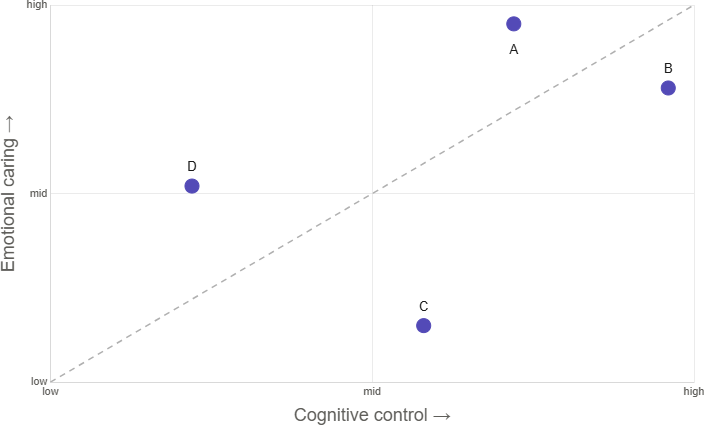
For the pushing problem, those below the dotted line are cognitive-control dominant and choose to act. Those above are emotionally dominant and do not harm the backpacker.
Greene calls this two-axis model Dual-Process Theory. It's not only a specific paradigm of conflict between the VMPFC and DLPFC, but also an overarching metaphor for moral conflicts. To expand on the latter, he likens it to Kahneman and Tversky's fast and slow, where the 'emotional' responses are fast, and cognitive control is slow. And he gives data to support this.
Put under time pressure, we are more likely to respond "instinctually" and are less likely to push the backpacker. Additionally, researcher Adam Moore, using a potential proxy for cognitive control, found those who perform better on working memory tasks also preferred more "utilitarian" actions in a variety of backpacker-push adjacent scenarios.
There's also direct evidence that a more active VMPFC is upstream of the empathetic behavior.
Molly Crockett and colleagues gave volunteers citalopram, an SSRI like Prozac, and had them respond to our standard set of dilemmas. A short-term effect of citalopram is the enhancement of emotional reactivity in the amygdala and the VMPFC, among other regions. As predicted, they found that people under the influence of citalopram (as compared with a placebo) made fewer utilitarian judgements in response to "personal" dilemmas like the [pushing] case.
The more we care about the backpacker, the harder it is to push them. Quick aside: this is not the behavior of antidepressants predicted by Huxley in Brave New World.
Solving Everything
Greene wants to fundamentally change how we approach moral problems. Remember the Tragedy of Commonsense Morality? Greene thinks we can solve this using dual-process theory. We can switch our brain to "manual mode," where cognitive control is dominant. From there, we can use utilitarianism to arbitrate our difficult moral problems.
It's difficult to do justice to Greene's prescriptions here. His observation that we should approach outgroup conflict in manual mode is genius in its simplicity. It's easy, sensible, and ought to be basic etiquette.
On the other hand, insofar as Moral Tribes is not a household name, it is likely because Greene overfits the model. He spends a huge amount of time detailing utilitarianism, which he believes will serve as the backdrop for rational discussions of moral issues. But in doing so he in many ways confuses the reader of his previous thesis.
That is, our common morality often breaks because of differing emotional intuitions. But what about our rational morality? Will we be able to synchronize this by institutionalizing utilitarianism? Here is a cynical rebuttal taken from his own book.
[Dan] Kahan's theory predicts that people who are more scientifically literate, rather than gravitating toward the truth, will simply be more adept at defending their tribe's position, whatever it happens to be.
Ie,
Egalitarian communitarians, as expected, reported perceiving great risk in climate change, but within that group there was no correlation between scientific literacy/numeracy and perceived risk. Likewise, the hierarchical individualists were, as expected, skeptical about the risks of climate change, and within this group, those who were more scientifically literate/numerate were somewhat more skeptical about the risks of climate change… Overall, beliefs were well predicted [not by numeracy but] by their general cultural outlooks—by their tribal memberships.
That is, broadly speaking, the data shows we use cognitive control to better justify our moral intuitions, not to shape them. Insofar as the latter is possible, it must be a more specific phenomenon.
More damning still are Greene's own comments on slavery. He starts out by admitting that he, as a utilitarian, doesn't believe in fundamental rights. It is the consequences of slavery that make it wrong. But then he begins to hedge.
I'm opposed to slavery because the costs overwhelmingly outweigh the benefits. But doesn't it make you a little uncomfortable to hear me put it that way? Me, too. Thus stated, it sounds like maybe, just maybe, if someone were to come along with the right kind of argument, I would consider changing my mind about slavery. Well, rest assured that on this particular matter, my mind is closed.
He doubles down:
I'm happy to join the chorus: Slavery violates fundamental human rights! "But," you object, "you don't really mean it!" Yes, I do. To a deep pragmatist, declarations about human rights are, when properly deployed, like wedding vows… we can appeal to rights when moral matters have been settled.
Greene sets out to give us a tool, a manual mode that can solve even the most difficult moral problems across warring tribes. It's a tool so powerful we can justify murdering a man whose only crime is wearing a backpack. But when presented with slavery, the easiest of moral problems, he tosses it aside to appease sacred tribal rights. He wants to eat his cake and have it too.
Dual-Process Theory: Part Two
I love Dual-Process Theory. I think it has even more explanatory power than Greene gives it credit for. Let's return to the graph.
There are competing perspectives here:
Biased Political Compass
A mother is 24 weeks pregnant. Doctors think continuing to carry the baby girl poses serious health risks to the mother, including the risk of mortality. Attempting preterm birth will result in serious health risk to the baby girl, including the risk of mortality.
Half of us react emotionally to the health of the mother, the other half to the life of the baby. We are all Point A on the graph (or less generously, Point D), but our conversations would be more productive if we could shift to Point B.
Universal Political Compass
The points on the graph were generated randomly, but if you had to label one of them as Donald Trump, which would it be? And Bernie Sanders? And Scott Alexander?
If we share intuitions here, then we can extrapolate a large pattern. Let's assume a world where current healthcare spending on America's very poor is ideal, and represented by the dotted line on the graph.
Those who are DLPFC dominant, and below the line, will think we should spend less. They will explain it is a waste of time and money for top doctors to treat drug addicts. This policy prescription has a high upfront cost, similar to pushing a backpacker in front of a trolley; it only makes sense in a consequentialist framework. And, if we push this line of thinking to the extreme, we can imagine what Phineas Gage might think of medical welfare. If we switch off our VMPFC entirely, we may see that taxation is theft and that the poor are a drain on society.
On the other hand, those above the line will want to spend more on public healthcare. Those close to the line will still offer utilitarian explanations, but, when pressed, the group as a whole will also agree that their ultimate motivation is sympathetic. At the extreme, they will say things like "you can't put a numerical value on human life." A beautiful sentiment that a functioning DLPFC tells us cannot be true.
If it is not obvious, this correlates with political affiliation. Loosely, liberals are likely to be above the line, and conservatives below it. There are plenty of individual exceptions to this (eg, bleeding-heart Republicans, like RFK Jr vis-à-vis vaccines, and coldly calculating liberals, like the famously wrong Paul Ehrlich). And there are policy exceptions as well, like the aforementioned abortion.
But there is a lot of explanatory power across policy issues, including crime, economics, welfare, and education. We can predict that the common failure mode of the left will be overly empathetic, pushing for policies that feel good, but may have negative long-term effects (eg, rent control, police abolition, ineffective public subsidies, or elimination of standardized testing). On the flip side, the failure mode of the right should be a mixture of overly selfish policy and too much trust in abstraction: no safety nets in the free market, no foreign aid, or tyrannical policing.
This information is not directly helpful in determining best policy. I think Greene is correct here, that if we want to get to the bottom of, for example, minimum wage, we should do our best to enter manual mode. Rather, it is a model of our intuition. But, if we recall Kahan's theory from above, the intuition has surprising sticking power. We end up realizing we were right all along.
Greene, who is an unabashed liberal, believed what we needed to do was allow our cognitive control to be dominant. I think this is especially true for his own tribe. They need to prove they can push the backpacker if many lives depend on it. Conservatives, on the other hand, do not necessarily have this failure mode. They need to show they have empathy outside of their narrow circle.
Your message is stored now and emailed to the author after the contest ends. The author can reply to you, but their identity stays hidden unless they choose to respond.