What if all of this has happened before? What if we’re living on a spinning record that keeps coming around to hit the same notes, years or decades or even centuries apart? That all of history is a struggle between two forces which through the ages adopt different names and aesthetics and even mask their true intentions behind different ideologies, so that only their most dogmatic adepts even recognize what they’re fighting over.
This is a question that pervades our culture, from our literature (Robert Jordan’s excellent Wheel of Time series is explicitly based on this), to our music (“Same as it ever was”), to framing the United States as a modern Roman Empire.
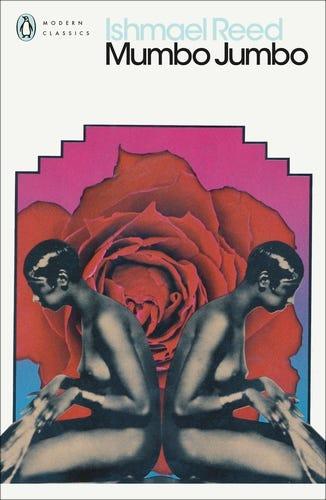
Ishmael Reed’s Mumbo Jumbo takes this question and uses it to explain the history of race relations in the United States in the 20th century. I first heard of Mumbo Jumbo through a reference in Gravity’s Rainbow, the only book I’ve read which is crazier and more impossible to review. Nevertheless, I think Reed’s framing provides a remarkably unique and useful framing not only of the 20th century, but also of current events, and so I’m writing this review in the hopes that I can encourage at least a few people to read this remarkable novel.
The Age of Jazz
Mumbo Jumbo kicks off with the birth of Jazz in New Orleans. Reed shows us this historic moment not as a depiction of creativity, or art, or achievement. Rather we are dropped squarely into the middle of a panic. Jazz or jes grew as it’s referred to in the novel, is portrayed as a mysterious disease sweeping the city of New Orleans. It begins as a disease which afflicts only the black people of New Orleans, but as the novel opens the mayor of New Orleans is hysterically summoned to the hospital to observe the city’s worst fears come to fruition, this new virus has made the jump into the white population. As the scene closes, we succumb to despair as the mayor himself begins exhibiting symptoms, demonstrating that no one is safe from this veritable pandemic.
From here we spend the majority of the novel in Harlem, watching from the cultural capital of the world as jes grew sweeps across the nation. The plot consists primarily of following two factions in conflict over jes grew with Papa LaBas representing the black community trying to embrace and promote jes grew racing against The Wallflower Order, representing the white community trying to stamp out jes grew and return to normalcy.
I say “black community” and “white community”, but these are dramatic oversimplifications which border on misrepresentations. Papa LaBass is a Voodoo houngan, and embodies a variety of diverse interests and movements, from polytheism, to afrofuturism, freedom, and deconstruction. The Wallflower Order, working with the Knights Templar, represents monotheism, control, and The Deep State. The implication here is that in general black people who are embracing jes grew are promoting the values embodied by Papa LaBass, because jes grew is implicitly an expression of these values. Likewise, in general white people who oppose jes grew and its related aesthetics are trying to protect the established order, which is fundamentally threatened by these new movements.
The novel makes these racial distinctions rather explicit. In a dramatic scene, the Mu’tafika, a group dedicated to looting American museums and cultural centers of artifacts plundered from Africa and returning them to their native homes, takes a powerful member of The Wallflower Order hostage. The Mu’tafika’s leader makes the decision to leave their hostage under the watch of their only white member, a controversial decision as the group’s other members express their distrust of their white comrade. The leader stands firm, and expresses that they cannot succeed segregated, but must trust and work together with everyone in order to ultimately flourish. This proves to be the group’s undoing, as the hostage quickly persuades his captor that their shared western culture is too important to allow naive multiculturalism to threaten. He is released, and summons his goons (the police) who slaughter the Mu’tafika. Thus we see America’s struggle over acceptance of Jazz as representative of a greater battle over cultural dominance.
The Wheel of Time
Reed wrote Mumbo Jumbo in 1972, by which time the history of Jazz was mostly settled. While it found artistic success and inspired a generation of artists, it was largely coopted into the existing culture, and failed to materialize into a revolution some dreamed of. The novel leaves off on a note of defeat, but with a hopeful eye to the future. In the closing scene, a now elderly Papa LaBass lectures a new generation on the struggle over jes grew, and notes that history is repeating itself with the rise of Funk, thus closing the gap between the historical and the contemporary. This was a provocative analogy for me, as throughout the novel I was reminded over and over again of the struggle in the early 1990’s over hip hop.
The late 1980’s witnessed an evolution in the new cultural phenomenon of Hip Hop, with the genre spreading out from its birthplace in the Bronx, to new corners of the country. With this expansion brought new influences, styles, and subgeneres. Hip Hop began to embrace sexuality, a more angry and confrontational tone, and an embrace of urban gang and street culture. At the same time, Hip Hop’s cultural prominence soared.
As Hip Hop’s content grew more radical, and its popularity began to reach more audiences, white America responded with censorship. Not only did parents attempt to prevent their children from listening to the music, but several legal attempts were made to limit Hip Hop in this era. The American Family Association, a Christian fundamentalist group, prompted officials in Florida to take legal action against Florida group 2 Live Crew, and especially their single “Me So Horny” on obscenity grounds. A district court ruled that the album was obscene and illegal to sell, and subsequently a record store clerk was arrested and charged for selling the album, and members of the group were arrested after a public performance of the banned material. Two years later the District Court of Appeals overturned the ruling on Free Speech grounds.
Just years before the groundbreaking Gangsta Rap group N.W.A. had faced censorship of their record “Fuck tha Police”. The group received a letter from the FBI which stopped short of threatening action, but made its position clear, “I wanted you to be aware of the FBI’s position relative to this song and its message.” The next year the group was arrested and fined for performing this song at a concert in Detroit, with allegations that police officers in the audience set off fireworks to imitate gunshots and create chaos, cutting the performance short. This was ultimately revealed to have been justified as a breach of contract, N.W.A.’s manager had signed a contract with the group’s insurance guaranteeing that they wouldn’t play the song, and the band was aware of the agreement. Still, the impact of this event was to send a clear message across America that certain forms of expression risked legal and police suppression.
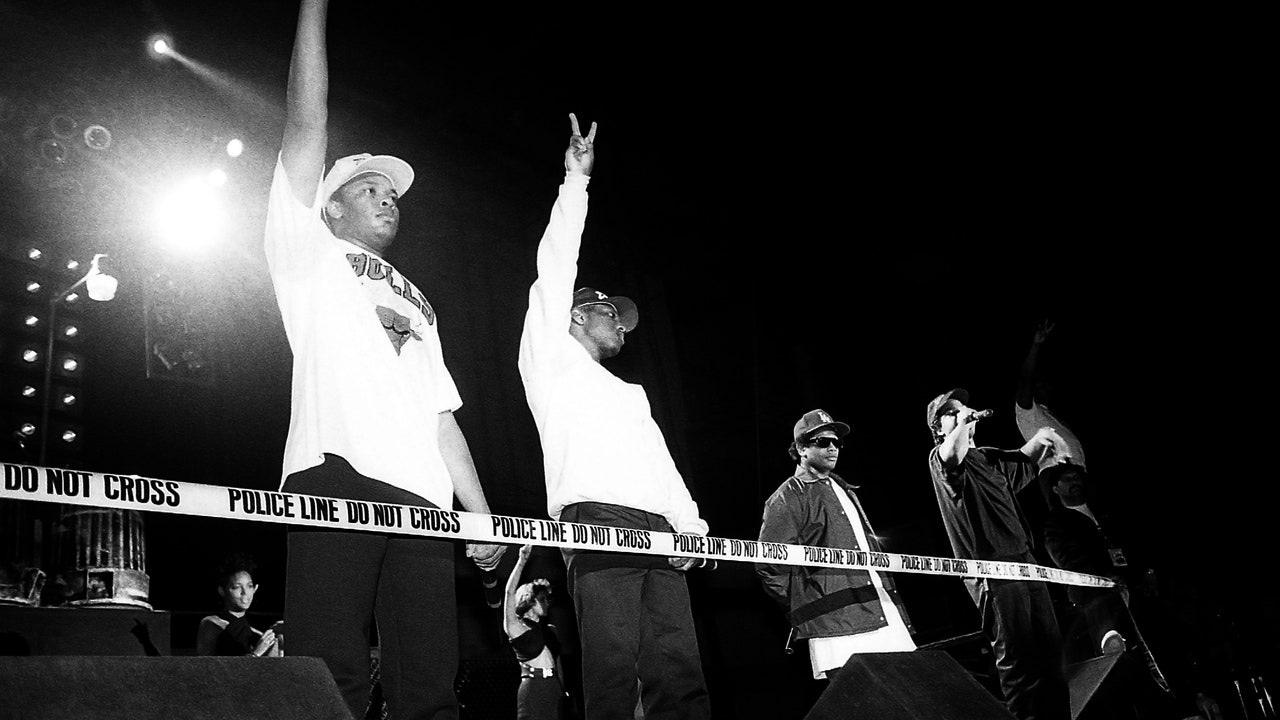
N.W.A. performing in Detroit
These episodes could have come straight from the pages of Mumbo Jumbo, despite the novel being written 15 years earlier. Rather than explicitly taking the future viewpoint, Reed takes the opposite tactic, and roots this struggle in the foundation of western culture, establishing a through line from the beginning to the current day. This conflict will keep occurring, jes grew will rise up in one form after another until one side is eventually victorious.
Limited Expression
Jazz is inherently a practice of pushing the boundaries. As unqualified as I am to review Mumbo Jumbo, I am infinitely less qualified to speak definitively on Jazz. But an understanding of Jazz is crucial to reading Reed. Jazz begins with a simple structure, some piece of music classic, recognizable, and boring. This structure becomes the boundaries within which a Jazz musician must operate. The act of Jazz is to depart from the structure, to leave the boundaries behind and explore what happens with the freedom and improvisation that brings; to attempt to go as far as one can beyond the recognizable before finally bringing the audience back full circle to safety of the familiar structure.
Mumbo Jumbo is Jazz. It plants itself in the structure of a novel, but along the way it drags the reader on excursions to unfamiliar territory. At times the text is interrupted by photographs which can be difficult to relate to the narrative. In places Reed breaks the fourth wall and includes footnotes directly to the reader, signed I.R. Even within the text, the reader will find the comforting structure of plot dropping out from under their feet, to be taken on a journey through some seemingly disconnected cultural commentary, varying from the US’s invasion of Haiti to rumors that Warren Harding had black ancestry, to suddenly find themselves back on firm ground as the narrative resumes. Each diversion strays further and further, seeking the limits achievable within the novel structure.
In the penultimate excursion, Papa LaBass recounts the origins of this conflict as a tale of ancient Egyptian mythology. In this telling, the root of this cultural conflict is a betrayal of the Egyptian god Osiris by his brother, Set. In the original mythology, people worshiped many gods and Osiris ruled as a king among gods. But his brother Set was jealous, and killed Osiris, seeking to take his place. Set’s jealousy and greed knew no bounds, and drove him to establish himself as the god of the sun, the one and only true god. To cement this position, he corrupted a follower, Moses, and used him to steal a holy text from Osiris’ widow Isis. With this text Moses was able to drive the people of Egypt away from their worship of Osiris and the other gods into a new monotheistic religion based around Set. But due to Set’s corruption, it couldn’t establish a complete dominion, and those who remembered Osiris and the old ways persisted. This is revealed to be the root of Christianity, with the corrupted Set as the true identity of the Christian God.
Here Reed ties together the basis of Jazz with the culture of oppressed peoples. Mumbo Jumbo is less concerned with the literal accuracy of its stories than it is with how they must be told. Reed is less trying to present a literal account of history, but rather to illustrate the way in which black culture, and the cultures of oppressed peoples more generally, has been limited and suppressed in Western civilization. Just as in Jazz, where the musician must find space between the beats of the structure in which to express himself, these communities have to fit their expression into the structure established by Western culture. The beauty of Jazz’s innovative introduction of chaos into order, is also the tragedy of Jazz being constrained to working within the prevailing order.
Reed brings his alternate history of Christianity back to the structure of his narrative by revealing that the holy text that Moses and Set stole from Isis is the key that this historical struggle rests on. With it, jes grew will be able to transcend cultural constraints and its proponents will be free to express themselves , unhindered by oppressive structures. If the Wallflower Order instead gains possession of the text, all could be lost and true dominion achieved.
Corruption
A key theme throughout Mumbo Jumbo is corruption. Both in the traditional political sense with various instances of the Wallflower Order using police to suppress its opponents, or cover up its own crimes, or even using political connections and wealth to try and influence what media can be presented to the public.
But also corruption in the linguistic sense of a degradation, or an impurification. We see this directly in Papa LaBass’ account of Set’s over Moses and ultimately, Western culture. It’s through the act of corruption that the Wallflower Order hostage frees himself and brings about the end of the Mu’tafika. We also see it deployed consistently throughout the novel as a strategy by the Wallflower Order to combat jes grew and stop its influence. The primary tactic of the Wallflower Order is to establish a new magazine, and use the Order’s power to amplify the magazine’s prominence. The magazine is presented as a progressive institution, placing itself alongside other institutions promoting progress.
However the magazine is full of lewd and pornographic content, creating a publication which is portrayed as grotesque. Indeed, each time the editor attempts to ally it with progressive thought leaders, they reject it, seeing it as hollow, cheap, and degenerate. This is in fact what it is, with the ploy being to portray this as the inevitable conclusion of cultural freedom. Without structure, the magazine implies, we descend into vice.
Within the magazine resides a more nefarious plot. The ultimate plan of the Wallflower Order is to create a Talking Android, a black man who will refute African American culture and endorse European American culture. This agent of corruption is to be their secret weapon, sabotaging the African American community’s attempt to regain its own cultural expression.
This plot is foiled when the naive man they have been grooming for this role is rescued by his father, a southern pastor who after seeing the magazine his son has been writing for travels to New York to take his son away from the city, and its corrupting influence. The Order scrambles for a replacement, but everyone they approach sees through their ploy. In the end they attempt to fake it, using one of their own members as the Talking Android, but he is unconvincing in the role. Thus without their Talking Android, and with the African American community unable to locate the sacred text, the battle ends in a stalemate, jes grew while not totally defeated, fails to deliver the revolution, and we await the next iteration of the conflict.
We’ve seen the other tactics portrayed in the novel used in contemporary times, with censorship, political corruption, and portrayals of cultural movements as degenerate all deployed against contemporary cultural movements, prominently in the case of Hip Hop. But the idea of a Talking Android is especially pernicious. The thought of a cultural leader, corrupted into becoming a mouthpiece for an establishment they fought against, is especially chilling.