Höcke and the AfD
Björn Höcke is the fascist, nazi de facto leader of the anti-democratic, far-right extremist party “AfD” (Alternative für Deutschland/Alternative for Germany) in Germany. At least if you believe media representatives, politicians of other parties, the domestic intelligence service, and courts around the country. This should be rather concerning given that the AfD has steadily become stronger since its inception and is currently standing at slightly below 20% in national polls, which makes it the second strongest party.
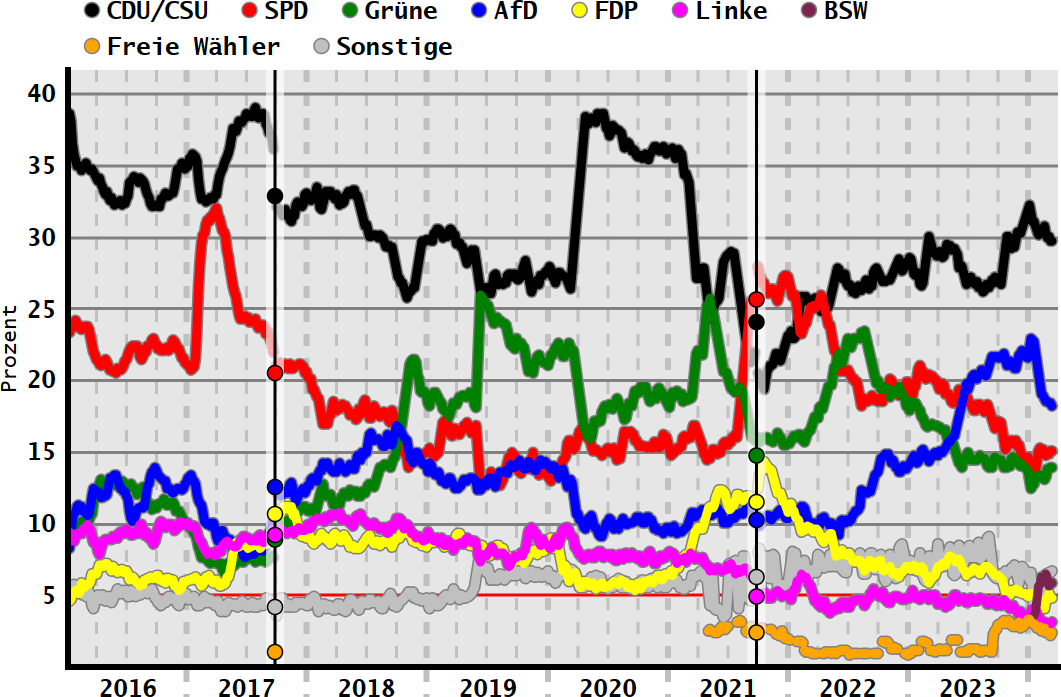
Source: INSA
In some east German states, notably Thuringia, the state for which Höcke aims to be prime minister, the AfD polls as the strongest party with over 30% of prospective votes. This is especially relevant this year because votes for three eastern states and the European Parliament will be held. For the first time since the war, a “secured right-wing extremist party” has a non-zero probability to govern a state.
However, media reporting on Höcke and the AfD may not be entirely even-handed and objective. A recent study analyzed the content of both private and public news formats concerning the treatment of different parties. As you can see, reporting is almost universally negative.[1] But maybe the AfD is simply horrible and deserves all the bad press it gets?
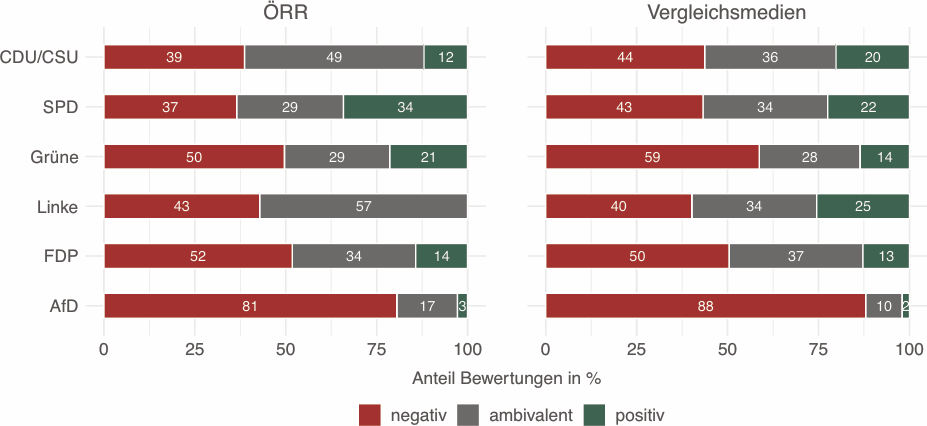
Content analysis of public media (left) and private media (right)
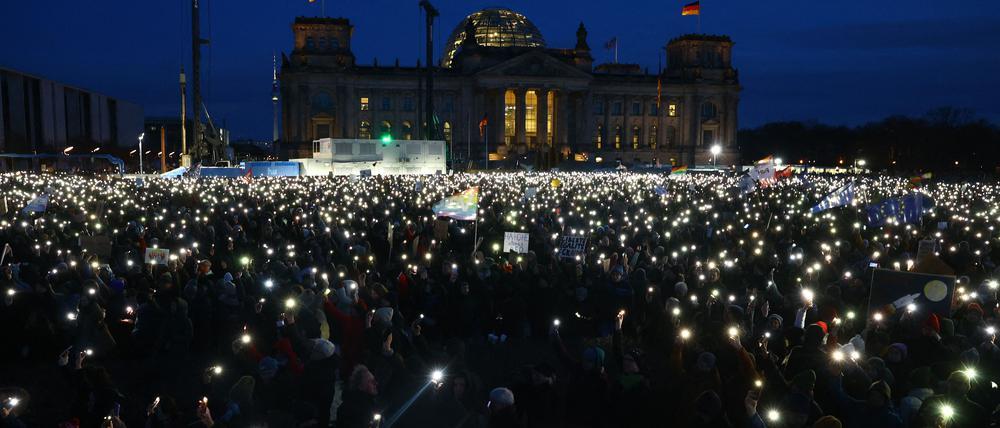
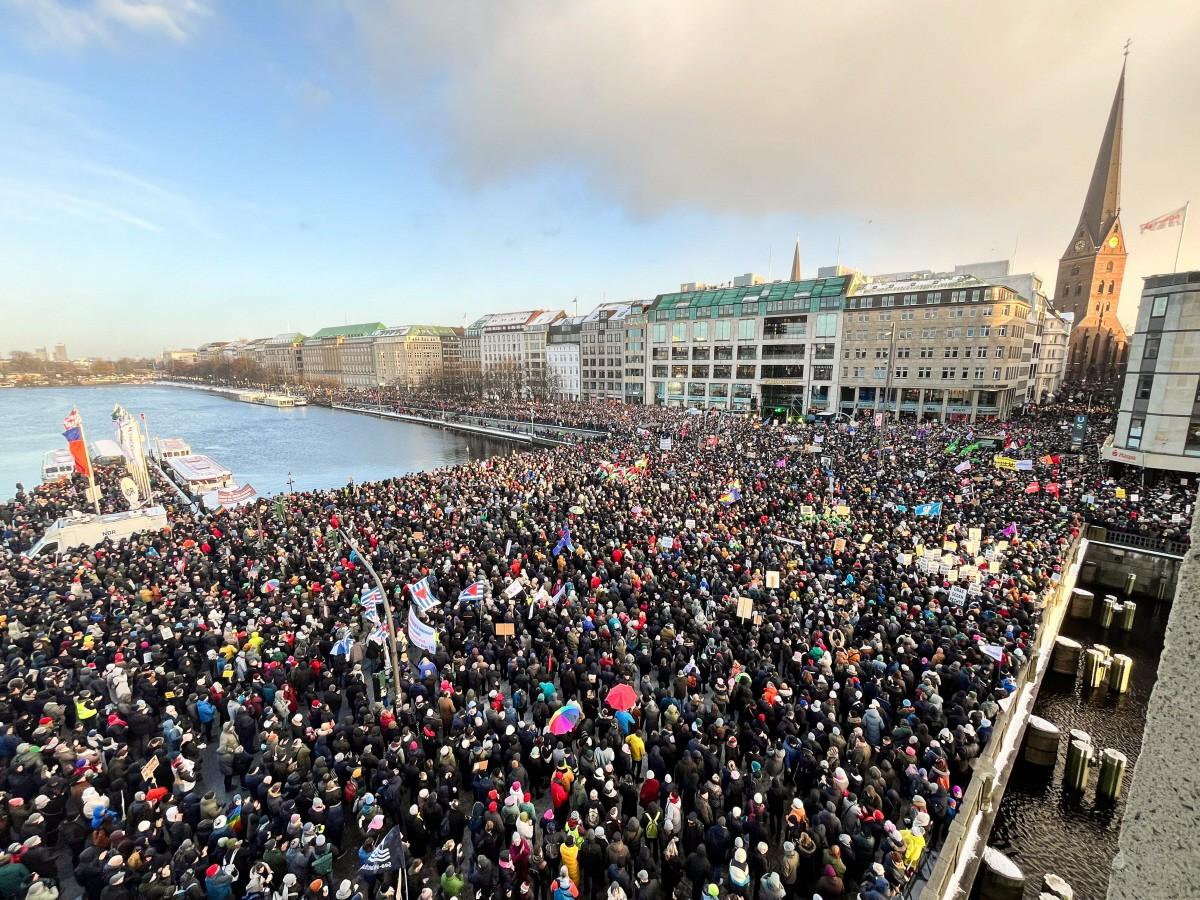
A recent example of such negative reporting was a CORRECTIV report about a secret meeting of far-right individuals, including AfD members, in Potsdam, who planned “forced deportations of people from Germany based on a set of racist criteria, regardless of whether or not they have German citizenship”.[2] These accusations were widely circulated within German media. At the same time as the report came out, even a theater production was performed to spread the message! All of this led to protests of millions of citizens across multiple German cities.
It is not in question that this meeting took place and that the “remigration” of non-assimilated individuals with German citizenship, as well as the expulsion of refugees to safe countries, have been discussed. However, there are good reasons to believe that this remigration does NOT include deportation, i.e. the extra-legal expulsion of citizens through violent means. Instead, Martin Sellner, the main speaker at the meeting, demands the formation of a “Leitkultur” (main culture) in addition to a set of incentives with the aim of getting non-assimilated migrants with German citizenship to leave the country voluntarily. You can watch a reenactment of Sellner’s presentation here. Sellner very clearly denies that he called for deportations of German citizens. Meanwhile, CORRECTIV has rowed back by stating that they never used the word “Deportation” to describe what was promoted by Sellner. The difference between deportation and remigration as defined by Sellner is crucial. Whereas the former is clearly unconstitutional and morally repugnant, the latter is not.
Media dishonesty and bias surrounding the AfD irks me a lot personally because I see the massive challenges that mass migration brings to the country but I do not want to support a fascist party that aims to abolish democracy and the rule of law. Unfortunately, just because the media uses misleading language, doesn’t mean they are wrong! It seems like we will have to do some work ourselves. Let’s see what we can figure out about the beliefs of big man Höcke himself. Is he a fascist? Does he want to abolish democracy? How far is he willing to go to deal with immigration?
Höcke seems to communicate almost exclusively in provocative and ambiguous statements.[3] Take for example the following passages from a Höcke speech, for which he was almost kicked out of his party:
“We will only have ourselves if we rebuild a positive relationship with our history. And Franz Josef Strauß already remarked that Vergangenheitsbewältigung (coming to terms with the past) as a permanent task for society as a whole paralyzes a nation. Dear friends, he was right, Franz Josef Strauß! And this stupid Bewältigungspolitik (policy of coming to terms with the past) paralyzes us even more today than it did in Franz Josef Strauß' day. We need nothing less than a 180-degree turnaround in the politics of remembrance!”
“…we Germans, our people, are the only people in the world who have planted a monument of shame in the heart of their capital. And instead of bringing the next generation into contact with the great benefactors, the famous world-shaking philosophers, the musicians, the brilliant discoverers and inventors, of whom we have so many - … - perhaps more than any other people in the world, dear friends! And instead of bringing our pupils into contact with this history in schools, German history is made to look bad and ridiculous. This cannot and must not go on!”
You could interpret this as “Germany should no longer remember its past misdeeds and maybe even glorify them.” You could also interpret this as “Germany should not focus entirely on the worst parts of its history to the detriment of the good parts.” Basically every single Höcke quote can be interpreted in one way or the other, so this doesn’t help us in our quest. Instead, let’s read his book “Never twice in the same river”, which, according to the backside text blurb, corrects the public misconceptions surrounding Höcke. My main goal is to figure out whether voting for Höcke and the AfD is something I can do in good conscience and whether his plans to solve Germany’s migration crisis are sensible.
A brief history of recent German migration
Before I start the review proper, I want to present a short overview of the current migrant situation in Germany. This has two reasons. Firstly, I want to convince you that the migrant crisis is one of the most significant problems Germany will face this century. Dealing with this crisis is the AfD’s raison d'être. Secondly, I want to be transparent and give you a context for my own views, so you can properly interpret my assessment of Höcke’s book. Since around 15 years, net migration has exploded in Germany.
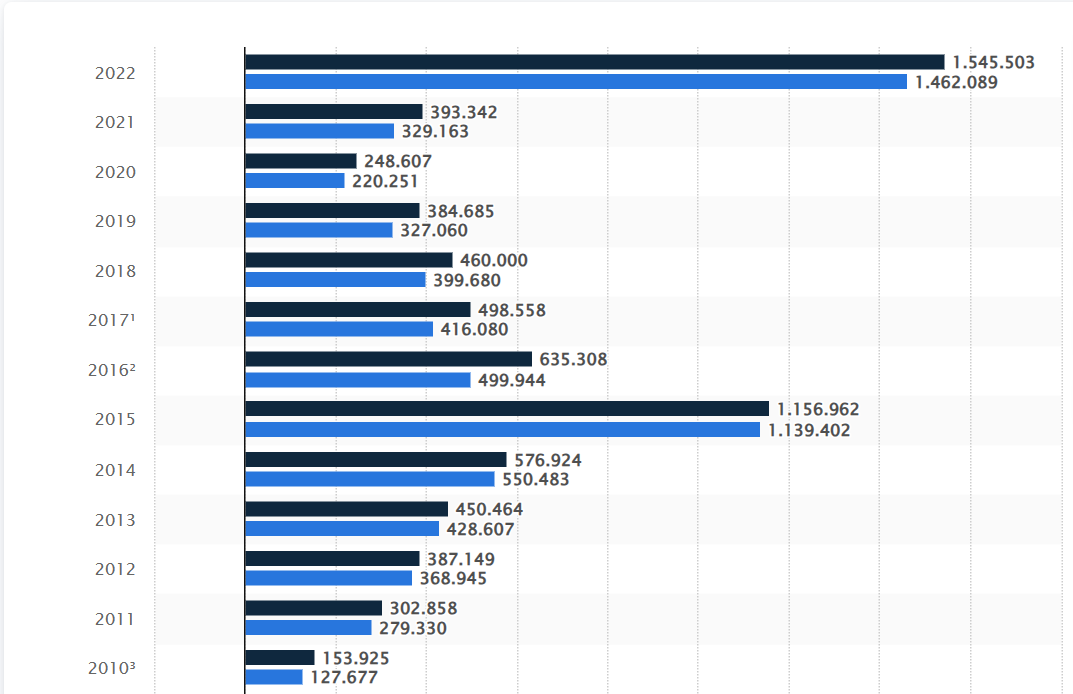
Net migration in Germany
Most notable are the Syrian refugee crisis of 2015 and the current Ukraine crisis of 2022. As you can see from the following figure, Germany took in the most refugees from the 2015 crisis. Of course, Germany is a populous country with a strong economy, but comparing our intake with the UK, France, and Italy shows that we took in a lot of people even after accounting for these variables.
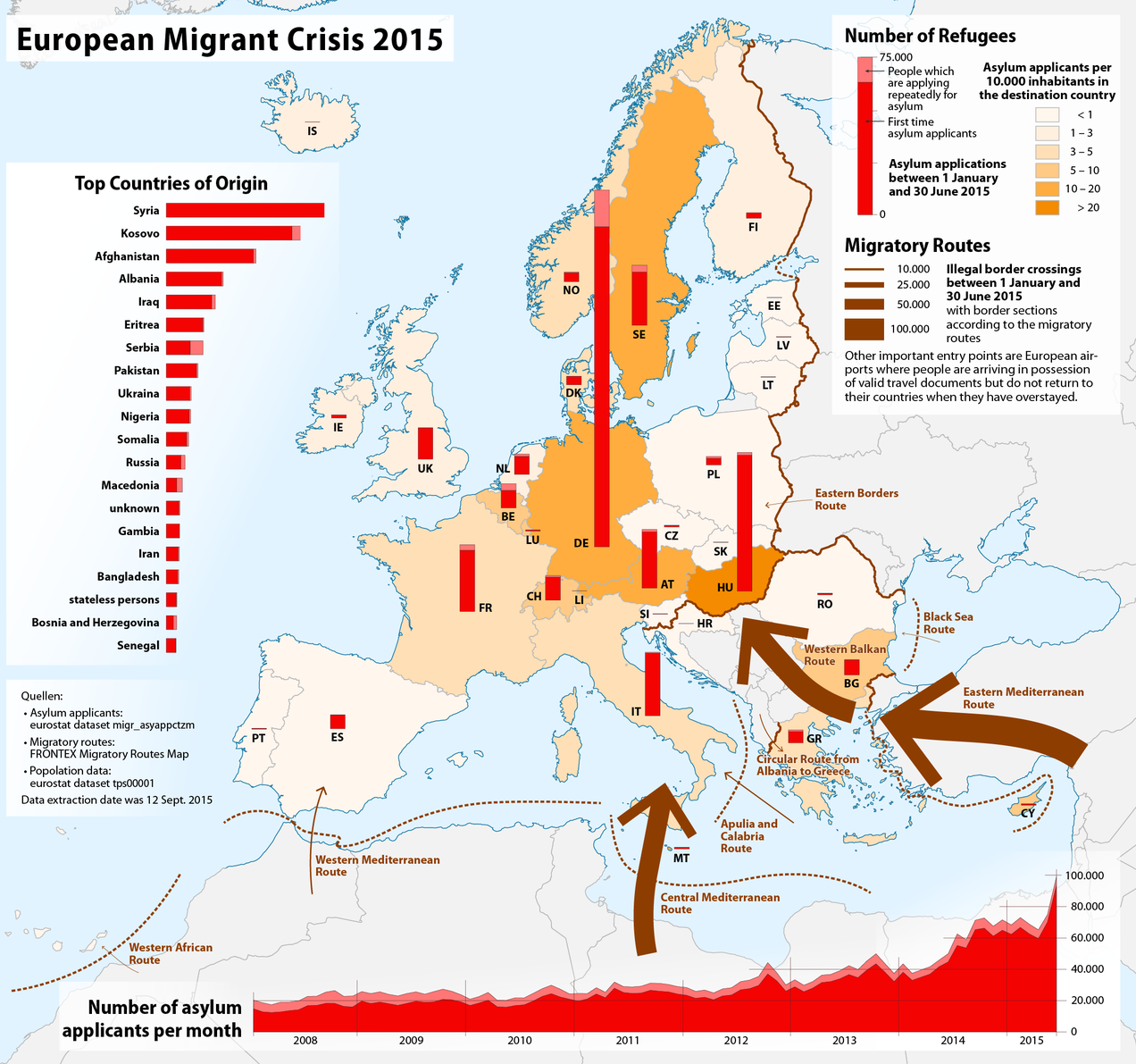
There are, in my view, two main reasons for why refugees came to Germany. Firstly, because Germany has a rather comfortable welfare system and secondly, because Angela Merkel, the former German Chancellor, literally asked for it. As a consequence of this migration policy mixed with past migration and relatively low native birth rates (1.36 (native) vs. 1.88 (non-native) per woman), the native population in Germany is gradually getting replaced. Consider the figure below, which shows the amount of individuals living in Germany by migrant background and age.[4] Whereas only about 10% of retired people have a migration background, about 40% of children do.
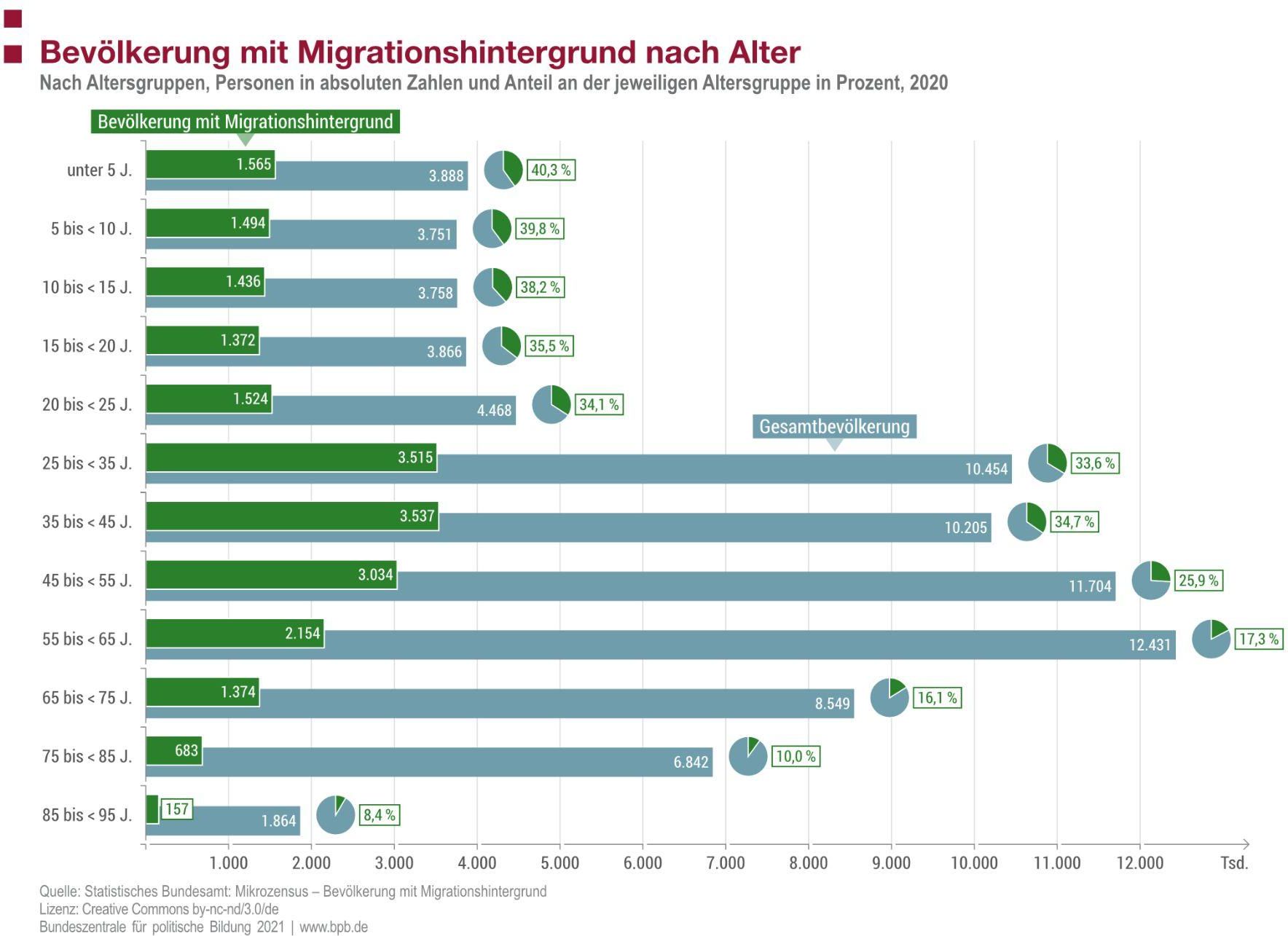
Individuals with migration background (green) compared to the overall population by age (2020)
It does not take a genius to figure out how this situation will develop if nothing is changed. By the way, it is not a conspiracy theory to say that native Germans are being replaced. You simply have to say “... and that’s a good thing!” afterward. For example, Katrin Göring-Eckardt, a leading politician of the green party, made the following statement in 2015.
“We are talking about what our country will look like in 20 to 30 years. (...) It will be more colorful. How wonderful is that? That's what we've always wanted! (...) Our country will change, and it will change drastically. And I'm looking forward to it!”
Ok fine, Germany is getting more colorful, so what? What’s the problem?
I’ll keep it short. The problem is that the average migrant, especially among the latest set of migrants, has lower cognitive abilities, greater rates of criminality, and greater rates of unemployment. Furthermore, the subset of Muslim migrants often holds values that are incompatible with secular German values, is often anti-semitic, and engages in “ethnic voting”. Each of these claims could fill an entire post, so I will simply leave you with the most well-known German wrongthink on the matter. Our establishment parties react to these problems by pouring oil on the fire. For example, they want to reduce the burdens for refugees to receive German citizenship. Now, with all this in mind, will Höcke and his AfD bring the solution to this problem? And if so, at what cost?
A brief history of Höcke
Never twice in the same river is written in dialogue form between Höcke and his interviewer, Sebastian Hennig, a lesser known right-wing author. The book begins by illuminating Höcke’s youth. Young Höcke grew up in a tranquil city along the Rhine. The way he describes it makes you think of a medieval fantasy setting with old castles deep in a dark forest. Höcke would often participate in “gang wars” between different groups of children, in which he was, obviously, the leader. He describes his parent’s parenting style as liberal in the sense that they would leave him room for his self-development. This, according to him, led to an aversion to authoritarianism, unless it has a good purpose. As a young man, Höcke began studying law, which he did not finish. He then studied sports and history for a teaching position. As a teacher, he was confronted with students of all origins. Interactions with these students weren’t all positive. He tells a story that, if I didn’t know better, I would file under “and then everybody clapped”.
“It was a summer morning. Shortly before, T-shirts had become fashionable with the names of countries printed on them, often in English, rarely in German. The special thing was that they were also worn outside of the big football events, probably to make their connection to a country - usually their own homeland - visible to everyone. As if it were a matter of course, the nationalities all found themselves reflected in the English translation. In our school at that time, many students walked around in these shirts with Turkey, Russia or Italy printed on them. You didn't see Germany shirts - until that morning: I had physical education in a 7th grade and began the lesson as usual sitting in a circle to explain the lesson schedule to the students. There sat this rather slender, always reserved strawberry blonde girls with a new top - it was a black and white shirt with Germany printed on it. The Turkish and African boys were beside themselves. “Take that off!”, “Germany is shit!” – they burst out with this tenor. In their aggressive rejection of the "German" these otherwise rather quarreling Turks and Africans were spontaneously united.
As a teacher, how did you react to this situation?
I began a very intensive pedagogical conversation in which we clarified in the group that a country that the Krakeeler's parents had voluntarily visited in order to live here with their families could be anything but "shit". As I walked out, I complimented the girl on her courage. And I immediately asked where she had bought the garment. The next morning, as a young physical education teacher, I stood in the staff room with one just like that. Of course, I didn't choose the Germany imprint, but opted for the "hardcore version" with the original Germany lettering. It was a surprise! To my delight, in the years that followed one saw one or the other student who imitated his teacher. This shirt is still in my closet today.”
Maybe as a reaction to the experiences he made as a teacher, Höcke went into politics. And he did so with great success. He quickly ascended to be the leading figure in the Thuringia AfD. So far, Höcke seems like an average German conservative, who feels a strong connection to his home, country, and to nature. He feels that his home as he knew it is under threat from the combination of a lack of patriotism on the side of Germans and a hostile attitude from the side of migrants.
Höcke’s worldview
For a book that’s supposed to lay out Höcke’s political and philosophical viewpoints, it is surprisingly thin on explaining what exactly Höcke wants and why. What are his basic normative assumptions? What does his model of the world look like? What evidence can he present to support it? Which policy conclusions follow? None of these questions are answered in a satisfying manner. In the entire book, the word “statistic” is used twice, but only to discredit their importance compared to inner feelings and evocative pictures. I suppose that this fact alone is rather telling. Furthermore, not only does he not precisely define his terms, he seems to be ideologically opposed to doing this. For instance, on the topic of his definition of the “common good” he answers “A good politician and statesman can grasp this intuitively and does not need any laboriously derived definitions from political scientists.”.
The book mostly follows a basic scheme. The interviewer broaches a topic and Höcke answers vaguely and superficially, while usually citing some (often German) poet, statesman, or philosopher. The interviewer then returns a token criticism, which Höcke answers by citing some other poet, statesman, or philosopher. Take for example the passage, in which Höcke explains the title of the book.
_“_Did your father lay the foundation for a romantic world view?
My father not only stimulated my imagination, but also my critical thinking. Because we are on the Rhine, looking at the majestic river gave me two very important insights: Firstly, the Heraclitian saying that you cannot step into the same river twice and that it is therefore an impossible undertaking to repeat past conditions, secondly the steadiness of flowing water, which cannot be stopped by human power, which is why a propagated »end of history« can only represent evidence of human hubris. In politics, these insights saved me from a naive belief in feasibility, but without slipping into paralyzing fatalism. We humans are not omnipotent in this world, but we are not powerless either.
These philosophical insights alone are not suitable for escaping a romanticized flight from the world.
I don't think it's a question of flight from the world, but rather a special form of turning to the world that is not unusual for children and young people. Many years later, during my studies, I came across the term "historical imagination". In this history-didactic approach, "embellishing cognition" forms a pillar of human historical consciousness. At some point in my childhood imagination, the realization arose that the past is also present today and is therefore real.
You mean as a collective memory of common roots?
Not only as a memory, a concrete, tangible legacy from the past always looms into the present: buildings, forms of settlement, social structures. They are "historical constants," whereby constancy is always to be understood only relatively in relation to the eternal flow of time. For people, they have a stabilizing, identity-forming function. However, duration and recurrence are only one side of the story: change and progress are also part of it and give it a rhythm. Ludwig Klages once described the phenomenon of rhythm as the "fundamental phenomenon of life". In the story he is sometimes faster, sometimes slower, sometimes lively, sometimes sedentary - sometimes he makes leaps and the whole time signature changes. In my opinion, we are currently experiencing a historic acceleration.”
Umm… okay? I don’t really have a problem with most of what he’s saying because he isn’t really saying all that much. Some things change over time and others, like some buildings, don’t. We can do some things to change the future, but not everything we want. In particular, we can’t perfectly recreate the past. Currently, a lot of things change. Ok, sure, that’s all true. I am however not sure why the fact that a river flows implies that the “end of history” hypothesis is wrong. I suppose he applies the principle of poetic induction.
I regret to inform you that basically the entire book is written in the style as quoted above. To me it seems like Höcke wishes to be seen as intellectual, even though he isn’t. He cites a large number of thinkers (the personal register at the end of the ~180 page book is itself 6 pages long) but his analysis always stays at a surface level.
In one of the book’s few insightful passages, Höcke defends Individualism. In contrast to some conservatives, he sees Individualism not as opposed to the public good, but as a necessary component of acting in a socially conscious manner. An example for this is the Prussian general Johann Friedrich Adolf von der Marwitz who “refused the Prussian king's order to plunder the Saxon castle of Hubertusburg and self-determinedly chose »disgrace where obedience brought no honor«, as it is written on his tombstone.”. Thus, the general acted in the public interest exactly because of his individual sense of duty. Höcke contrasts this with modern “selfish” or “atomized” collectivism. He implies that modern individuals are free to seek their own hedonic pleasures but at the same time are constrained by a pressure to conform in terms of their worldview. I can only partly agree with this characterization. While it is true that social pressure regarding certain “pro-social” activities such as child birth, religiosity, or communal care have decreased, it has been replaced by other goals such as social justice or the fight against climate change. You may argue that these aren’t worthwhile goals or that the means to achieve them are too costly, but it is hard to argue that they are purely selfish. Furthermore, while it is also true that opinions are strongly curtailed at the moment, is the whole of modernity really worse than the times that came before? Instead of not being allowed to criticize trans people, Blacks, and Muslims, you weren’t allowed to criticize religious institutions or the king. Besides, Höcke himself does not seem to reject the exclusion of those who have the wrong views, as long as he is not the target. If anyone wants to “actively harm the country or its people”, Höcke is not willing to talk to them because they “tamper with the supporting walls or the foundation of our common house with malicious intent or even want to tear down the entire building”. Ironically, this is pretty much the same reason why nobody talks to Höcke. So, who is he talking about? Pretty much everyone in the other parties. He calls them “Volksverächter” (despiser of the people) and states the following.
“Anyone who expects the salvation of the people from those who despise the people is hopelessly naïve. We may on the question of future cooperation never forget with other parties: A collaboration with those forces that are tearing our country into the abyss is absurd. Any consideration of joining forces or forming a coalition with parts of the political establishment presupposes their purification and fundamental readjustmentඞ That can only be expected when the old party cartel has collapsed under the increasing burden of the crisis.”
This statement is a little suspicious. You are probably not very democratically inclined if you can’t interact with the political establishment unless they go through a purifying collapse.
It may not surprise you to find out that Höcke isn’t particularly fond of modernity. In fact, he wants to clear away “the rubble heaps of modernity” because” today's biggest problems are to be blamed on it”. Under modernity Höcke understands “the dismantling of classic statehood”, which caused “the freedom and emancipation forces” to have an increasingly destructive effect. Furthermore, he blames “the advent of capitalism in the 18th century” for fueling this development. I’m not sure how his rejection of freedom and emancipation forces can coexist with his praise for Individualism. Do we not need some freedom from cultural restraints to be able to express our individuality?
Here are some things Höcke blames modernity for
- ugly architecture
- the deconstruction of gender, ethnicity, families, religions, borders, and humanity itself
- mutating creative people into “flat mass persons”
- being “directed against creation itself”, due to their “aim of permanent liquefaction”, which is “a relapse to the formless and desolate mass of preworldly chaos, as Ovid saw it in his metamorphoses”
Well, at least concerning the architecture I can agree. Though I do wonder if he really thinks that everything about modernity is to be rejected. The Enlightenment? The Rise of Democracy? The rise of global markets? Women’s Rights? Increases in individual freedom? The relatively long period of peace in Europe after WW2? The abolition of slavery and Imperialism? Should all of this be reversed too?
What can we do about it? As usual, Höcke is being vague because “the details of a new building [of the community] should not and cannot be decreed from above, but determined in a large, joint discussion.” After some prodding, he decides to provide some guidance:
- a new down-to-earthness should be promoted
- the idealistic value of meaningful work must be revitalized
- a productive economic order should be created that generates a balanced social fabric and does not widen the gap between rich and poor
- one's homeland should be rediscovered as a space of security and life development
- a people's monopoly on settlement and organization in their country should be ensured
- we should make beauty and a sense of form and measure the new benchmark
- we must strive for a metaphysical re-anchoring
Everything clear? This WILL be on the final exam. Höcke expands further on the topic of migration. He demands that migrants should get “acculturated”, meaning that they should not only accept the German rule of law but also integrate an unspecified German value system into their identity. The main reason why this doesn’t happen is because we Germans have stopped honoring our own traditions and religions because of our negative disposition towards our own culture. Due to this, migration turns invasive and threatens to replace the native culture. As mentioned before, I agree that we Germans have a rather negative view of ourselves and our history and that this adversely impacts us. However, I am not sure what Höcke means with a German value system, as the set of values that all Germans hold is pretty slim. If anything, it would be the rules as laid out in our constitution but Höcke explicitly demands more.
In the following, Höcke wades more into the territory of conspiracies. He believes that the real reason for our political elites to accept refugees is not to help them for humanitarian reasons but to replace Europeans with a multi-ethnic populace. I mean sure, you’ll probably find some random extremist politicians whose plan it is to build a multi-ethnic utopia but it seems pretty far-fetched to assume that this viewpoint is common. As evidence for his thesis Höcke only cites the statement of a single author. Not very convincing. He then cites a UN report on “replacement migration” from 2001. In this report, different migration scenarios are discussed to counteract age-related demographic change in several industrial nations. Höcke states:
“What operates here under the trivializing term "replacement migration" is the brutal displacement of Germans from their traditional settlement areas.”
Now we have moved from the mixing of different populations to the brutal displacement of Germans. Even to someone who is deeply concerned about migration, this just sounds ridiculous and casts doubts on Höcke’s ability to stay level headed. Demographic change in Germany is a serious issue that can’t just be hand waved away. Instead, alternative policies should be proposed that would deal with it without relying on mass migration. Similarly, the suffering of the refugees is real. I too object to Germany taking on millions of refugees for no reason, but we shouldn’t just deny their suffering outright. What is a practical solution to this problem that works within the German constitution and EU law? Höcke has no answer to this question and it seems that despite his professed “deeply anchored humanism”, he seemingly never even contemplated the question.
I also found some exculpatory evidence regarding the Fascism allegations that I don’t want to withhold. Remember the quote regarding German Third Reich remembrance politics in the introduction? Höcke states the following.
“My opponents interpreted this as if instead of officially condemning the Third Reich I was now demanding its glorification. This is of course wrong. Of course we must not close our eyes to the mistakes and crimes of the Nazi era. But no man and no people can build their selfconfidence only on negative references. The light sides of the story form the core of the identity without denying the dark sides that are also present.
So it wasn't about reversing the standard of evaluation for you?
No, even if I was maliciously accused of it again and again. I was merely pleading for a review of our approach to self-encountering as a people and a nation. Instead of allowing ourselves to be ruled solely by the stressful features that make us ill in the long term, we should feel at least as committed to the healing aspects of our history - but above all not constantly discrediting them with the others. This has mainly to do with self-respect, without which one cannot expect respect from third parties. How can one blame a person when he loses his respect for someone who continually degrades himself below his commonly felt worth?”
This actually sounds pretty reasonable and matches my charitable interpretation from before. There is also another quote from this book that has been used to discredit Höcke, in my view very uncharitably.
“But the longing of the Germans for a historical figure who will one day heal the wounds of the people, overcome their inner turmoil and put things in order is deep in their hearts anchored in our souls, I am convinced of that.”
Reading this without context probably makes you think of Hitler. However, he stated this in the context of the “Kyffhäuser” myth. It’s the folk belief that emperor Friedrich II. is asleep in the Kyffhäuser mountain and will come back to save the country.
What if Höcke gets into power?
Towards the end of his book Höcke’s statements get significantly more ominous. Höcke hopes for a “Wendezeit” (turning point), in which a large part of the migrant population gets remigrated into their home countries. He hopes that this transition will be peaceful but we may have the need for a new Karl Martell (a Frankish military and political leader known for defeating Muslim invaders) to save Europe. Even if the transition is peaceful, it will be difficult because “the longer a patient refuses the urgent operation, the harder the necessary cuts will inevitably be” [emphasis mine, also in the following]. Furthermore,
“… a new political leadership will then have to endure serious moral tensions: it is committed to the interests of the autochthonous population and in all likelihood will have to take measures that run counter to its actual moral feelings.”
Unfortunately, we will not get around a policy of “well-tempered cruelty”, which means
“... that human hardship and ugly scenes cannot always be avoided_ඞ_ The state executive bodies should therefore proceed as humanely as possible, but also as consistently as necessary__.”
But don’t fret because
“… existential crises require extraordinary action. Those who brought about the necessity of these measures with their unspeakable policies then bear the responsibility for this.”
However, unfortunately for those responsible
“... we will … lose a few parts of the people who are too weak or unwilling to resist the ongoing Africanization, Orientalization and Islamization_ඞ_ But apart from this possible bloodletting, we Germans have historically shown an extraordinary ability to renovate after dramatic declines.”
We can’t do it without this “bloodletting” because
“a few corrections and reforms will not suffice. But German absoluteness will be the guarantee that we will tackle the matter thoroughly and fundamentally. Once the turning point has come, we Germans won't do things by halves. Then the rubble heaps of modernity will be cleared away, because today's biggest problems are to be blamed on it.”
Note Höcke’s insistence on the necessity of his “well-tempered cruelty” and the a priori shift in responsibility for his actions. For Höcke, the solution of the migration crisis does not require a trade-off between different harms. It requires as much cruelty as is necessary. What he doesn’t say is just as important as what he does say. In no way does he ever erect any boundary for the cruelty he is willing to inflict. The only conclusion I can draw from this is that he does not have any boundaries and wants to keep his options open. Whatever he chooses to do, at the end of the day he can sleep soundly since he already transferred responsibility to the “political elites” who made his actions necessary.
Conclusion
As you can probably tell, I can’t exactly recommend the book. Maybe it can be useful to those who wish to increase the breadth of their knowledge of German poets and thinkers. For anyone who seeks a serious political or empirical analysis of the German migrant crisis, this book will be a disappointment. It reminds me of the adage “wide as an ocean, deep as a puddle”. I would recommend the books of Thilo Sarrazin instead. Though I haven’t read them myself yet, the books from Martin Sellner may also be worth a look.
At least for me personally I can come to the clear conclusion that I will not vote for Höcke if I ever get the chance to do so. Höcke seems like a dangerous man with no clear plan forward and no failsafes. Let’s assume he comes into power. If the measures to reach his nebulous goals don't work, he will in all likelihood simply up their intensity without regard for side-effects. Afterall, he is forced to do whatever he does by the previous political elite. This is a very dangerous mix of beliefs to hold. What do you think will happen if he finds it necessary that German citizens with a migration background will have to be deported (or worse) in order to reach his remigration goals?
It gives me no joy to say this, it rather fills me with concern for the future of my country. As I see it, unless the establishment parties radically change their course, as they have done in e.g. Denmark, there are currently only two possible ways forward.
- Vote for the establishment parties and observe the slow but inevitable decline of this nation.
- Vote for the AfD and risk an even quicker downfall in the hopes of preventing it.
Quo vadis, Germania?
Footnotes
- ↩
Some outlets have framed the results of this study as proving that public media are not unfair to the AfD because public media is not MORE unfair than private media. Of course, that’s not the point. Only public media has a mandate to be politically neutral. Thus, deriving a reasonable standard from the reporting behavior of private media is absurd.
- ↩
Interestingly, in the German version CORRECTIV writes about “Vertreibung” (expulsion/eviction/displacement) of German citizens and they deny having used the word “Deportation” (deportation), despite using it in the English version. Anyways, German media and politicans widely used the word “Deportation” to describe the plan.
- ↩
Migrant background means that either you or at least one of your parents were born in a different country. Migrants of generation 3+ are counted as “German”. Some of the “migrants” are ethnic Germans who came back to Germany (“Aussiedler”).